
[1868]
The presidential election of 1868 was decided at Appomattox. General
Grant was borne to the White House on a floodtide of popularity,
carrying twenty-six out of the thirty-four voting States. Schuyler
Colfax, of Indiana, became Vice-President. The Democrats had nominated
Horatio Seymour, of New York, and F. P. Blair, of Missouri.
Reconstruction was the great issue. The democratic platform demanded
universal amnesty and the immediate restoration of all the commonwealths
lately in secession, and insisted that the regulation of the franchise
should be left with States.
[1870]
The management of the South was the most serious problem before the new
administration. The whites were striving by fair means and foul to get
political power back into their own hands. The reconstructed state
governments, dependent upon black majorities, were too weak for
successful resistance. The Ku-Klux and similar organizations were
practically a masked army. The President was appealed to for military
aid, and he responded. Small detachments of United States troops hurried
hither and thither. Wherever they appeared resistance ceased; but when
fresh outbreaks elsewhere called the soldiers away, the fight against
the hated state government was immediately renewed. The negroes soon
learned to stay at home on election day, and the whites, once in the
saddle, were too skilful riders to be thrown.
[1872]
Congress, meanwhile, still strongly republican, was taking active
measures to protect the blacks. In 1870 it passed an act imposing fines
and damages for a conspiracy to deprive negroes of the suffrage. The
Force Act of 1871 was a much harsher measure. It empowered the President
to employ the army, navy, and militia to suppress combinations which
deprived the negro of the rights guaranteed him by the Fourteenth
Amendment. For such combinations to appear in arms was made rebellion
against the United States, and the President might suspend habeas corpus
in the rebellious district. By President Grant, in the fall of 1871,
this was actually done in parts of the Carolinas. State registrations
and elections were to be supervised by United States marshals, who could
command the help of the United States military or naval forces.
The Force Act outran popular feeling. It came dangerously near the
practical suspension of state government in the South, and many at the
North, including some Republicans, thought the latter result a greater
evil than even the temporary abeyance of negro suffrage. The "Liberal
Republicans" bolted. In 1872 they nominated Horace Greeley for the
Presidency, and adopted a platform declaring local self-government a
better safeguard for the rights of all citizens than centralized power.
The platform also protested against the supremacy of the military over
the civil power and the suspension of habeas corpus, and favored
universal amnesty to men at the South. Charles Sumner, Stanley Matthews,
Carl Schurz, David A. Wells, and many other prominent Republicans
engaged in the opposition.
Thinking their opportunity had come, the Democrats indorsed the
Liberals' platform and nominees. The Republicans re-nominated Grant by
acclamation, and joined with him on the ticket Henry Wilson, of
Massachusetts.
As the campaign went on, the Greeley movement developed remarkable
strength and remarkable weakness. Speaking for years through the New
York Tribune, Mr. Greeley had won, in a remarkable degree, the respect
and even the affection of the country. His offer to give bail for
Jefferson Davis in his imprisonment, and his stanch advocacy of mercy to
all who had engaged in secession, so soon as they had grounded arms,
made him hosts of friends even in the South, He took the stump himself,
making the tour of Pennsylvania, Ohio, and Indiana, and crowds of
Republicans came to see and hear their former champion.
But the Democrats could not heartily unite in the support of such a
lifelong and bitter opponent of their party. Some supported a third
ticket, while many others did not vote at all. Mr. Greeley, too, an
ardent protectionist, was not popular with the influential free-trade
element among the Liberals themselves. The election resulted in a
sweeping victory for the republican ticket. The Democrats carried but
six States, and those were all in the South. Within a month after the
election, Mr. Greeley died, broken down by over-exertion, family
bereavement, and disappointed ambition.
[1874]
Troubles in the South continued during Grant's second term. The turmoil
reached its height in Louisiana in 1874. Ever since 1872 the whites in
that State had been chafing under republican rule. The election of
Governor Kellogg was disputed, and he was accused of having plunged the
State into ruinous debt. In August, 1874, a disturbance occurred which
ended in the deliberate shooting of six republican officials. President
Grant prepared to send military aid to the Kellogg government. Thereupon
Penn, the defeated candidate for Lieutenant-governor in 1872, issued an
address to the people, claiming to be the lawful executive of Louisiana,
and calling upon the state militia to arm and drive "the usurpers from
power." Barricades were thrown up in the streets of New Orleans, and on
September 14th a severe fight took place between the insurgents and the
state forces, in which a dozen were killed on each side. On the next day
the state-house was surrendered to the militia, ten thousand of whom
had responded to Penn's call. Governor Kellogg took refuge in the
custom-house. Penn was formally inducted into office. United States
troops were hurried to the scene. Agreeably to their professions of
loyalty toward the Federal Government, the insurgents surrendered the
state property to the United States authorities without resistance, but
under protest. The Kellogg government was re-instated.
[1875]
Troops at the polls secured quiet in the November elections. The
returning board decided that the Republicans had elected their governor
and fifty-four members of the legislature. Fifty-two members were
democratic, while the election of five members remained in doubt, and
was left to the decision of the legislature. The Democrats vehemently
protested against the decision of the returning board, claiming an
all-round victory. Fearing trouble at the assembling of the legislature
in January, 1875, President Grant placed General Sheridan in command at
New Orleans. The legislature met on January 4th. Our reports of what
followed are conflicting. The admitted facts are that the democratic
members, lawfully or unlawfully, placed a speaker in the chair. Some
disorder ensuing, United States soldiers were called in and, at the
request of the democratic speaker, restored quiet. The Republicans
meanwhile had left the house. The Democrats then elected members to fill
the five seats left vacant by the returning board. Later in the day,
United States troops, under orders from Governor Kellogg, to whom the
republican legislators had appealed, ejected the five new members. The
Republicans re-entered the house, and the Democrats thereupon withdrew.
Subsequently a congressional committee made unsuccessful attempts to
settle the dispute. The democratic members finally returned, and a
sullen acquiescence in the Kellogg government gradually prevailed.
[1876]
By 1876 every southern State was solidly democratic except Louisiana,
South Carolina, and Florida, and in these republican governments were
upheld only by the bayonet.
The presidential election of 1876 was a contest of general tendencies
rather than of definite principles. The opposing parties were more
nearly matched than they had been since 1860. The Democrats nominated
Samuel J. Tilden, of New York, and Thomas A. Hendricks, of Indiana.
Rutherford B. Hayes, of Ohio, and William A. Wheeler, of New York,
became the republican standard-bearers. The election passed off quietly,
troops being stationed at the polls in turbulent quarters. Mr. Tilden
carried New York, New Jersey, Indiana, and Connecticut. With a solid
South, he had won the day. But the returning boards of Louisiana,
Florida, and South Carolina, throwing out the votes of several
democratic districts on the ground of fraud or intimidation, decided
that those States had gone republican, giving Hayes a majority of one in
the electoral college. The Democrats raised the cry of fraud. Suppressed
excitement pervaded the country. Threats were even muttered that Hayes
would never be inaugurated. President Grant quietly strengthened the
military force in and about Washington. The country looked to Congress
for a peaceful solution of the problem, and not in vain.
The Constitution provides that "the President of the Senate shall, in
presence of the Senate and House of Representatives, open all the
[electoral] certificates, and the votes shall then be counted." Certain
Republicans held that the power to count the votes lay with the
President of the Senate, the House and Senate being mere spectators. The
Democrats naturally objected to this construction, since Mr. Ferry, the
republican president of the Senate, could then count the votes of the
disputed States for Hayes.
The Democrats insisted that Congress should continue the practice
followed since 1865, which was that no vote objected to should be
counted except by the concurrence of both houses. The House was strongly
democratic; by throwing out the vote of one State it could elect Tilden.
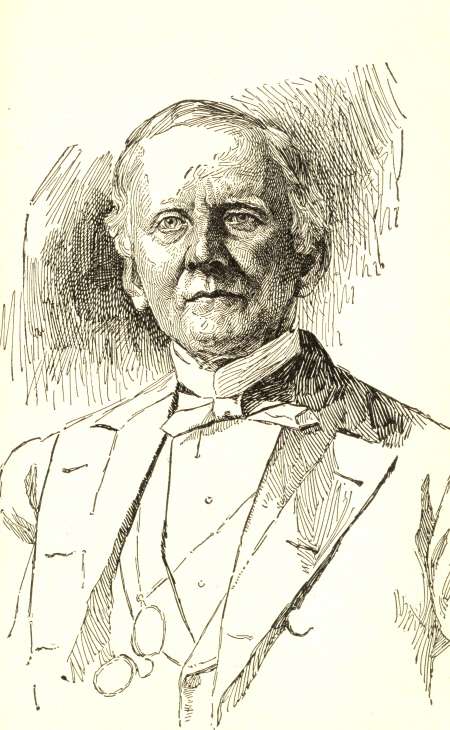
Samuel J. Tilden.
After a pastel by Sarony in the house at Gramercy Park.
[1877]
The deadlock could be broken only by a compromise. A joint committee
reported the famous Electoral Commission Bill, which passed House and
Senate by large majorities; 186 Democrats voting for the bill and 18
against it, while the republican vote stood 52 for and 75 against. The
bill created a commission of five senators, five representatives, and
five justices of the United States Supreme Court, the fifth justice
being chosen by the four appointed in the bill. Previous to this choice
the commission contained seven Democrats and seven Republicans. It was
expected that the fifth justice would be Hon. David Davis, of Illinois,
a neutral with democratic leanings; but his unexpected election as
democratic senator from his State caused Justice Bradley to be selected
to the post of decisive umpire. The votes of all disputed States were to
be submitted to the commission for decision.
It was drawing perilously near to inauguration day. The commission met
on the last day of January. The cases of Florida, Louisiana, Oregon, and
South Carolina were in succession submitted to it by Congress. Eminent
counsel appeared for each side. There were double sets of returns from
everyone of the States named. In the three southern States the governor
recognized by the United States had signed the republican certificates.
The democratic certificates from Florida were signed by the state
attorney-general and the new democratic governor; those from Louisiana
by the democratic gubernatorial candidate, who claimed to be the lawful
governor; those from South Carolina by no state official, the Tilden
electors simply claiming to have been chosen by the popular vote and
rejected by the returning board. In Oregon the democratic governor
declared one of the Hayes electors ineligible because an office-holder,
and gave a certificate to Cronin, the highest Tilden elector, instead.
The other two Hayes electors refused to recognize Cronin, and,
associating with them the rejected republican elector, presented a
certificate signed by the secretary of state. Cronin, appointing two new
electors to act with him, cast his vote for Tilden, his associates
voting for Hayes. This certificate was signed by the governor and
attested by the secretary of state.
After deciding not to go behind any returns which were prima facie
lawful, the commission, by a strict party vote of eight to seven, gave a
decision for the Hayes electors in every case. March 2d it adjourned,
and three days later Hayes was inaugurated without disturbance.
The whole country heaved a sigh of relief. All agreed that provision
must be made against such peril in the future; but it was not till late
in 1886 that Congress could agree upon the necessary measure. The
Electoral Count Bill was then passed, and signed by the President on
February 3, 1887. It aims to throw upon each State, so far as possible,
the responsibility of determining how its own presidential vote has been
cast. It provides that the President of the Senate shall open the
electoral certificates in the presence of both houses, and hand them to
the tellers, two from each house, who are to read them aloud and record
the votes.
If there has been no dispute as to the list of electors from a State,
such list, where certified in due form, is to be accepted as a matter of
course. In case of dispute, the procedure is as follows: If but one set
of returns appears and this is authenticated by a state electoral
tribunal constituted to settle the dispute, such returns shall be
conclusive. If there are two or more sets of returns, the set approved
by the state tribunal shall be accepted. If there are two rival
tribunals, the vote of the State shall be thrown out, unless both
houses, acting separately, agree upon the lawfulness of one tribunal or
the other. If there has been no decision by a tribunal, those votes
shall be counted which both houses, acting separately, decide to be
lawful. If the houses disagree, the votes certified to by the governor
shall be accepted.
[1880]
President Hayes's first important action was the withdrawal of troops
from South Carolina and Louisiana, where the rival governments existed
side by side. The republican governments at once fell to the ground. As
the Democrats had already got control in Florida, the "solid South" was
now an accomplished fact. Financial questions were those which chiefly
occupied the public mind during Hayes's administration. They are
referred to in Chapter VII., below.
Returning from a remarkable tour around the world, General Grant became
in 1880 a candidate for a third-term nomination. The deadlock in the
republican convention between him and Mr. Blaine was broken by the
nomination of James A. Garfield, of Ohio. Chester A. Arthur, of New
York, was the vice-presidential candidate. The Democrats nominated the
hero of Gettysburg, the brave and renowned General W. S. Hancock, of
Pennsylvania, and William H. English, of Indiana. Garfield was elected,
receiving 214 electoral votes against 155 for Hancock. Hancock carried
every southern State; Garfield every northern State except New Jersey,
Nevada, and California.
[1881]
President Garfield had hardly entered upon his high duties when he was
cut down by the hand of an assassin. On the morning of July 2, 1881, the
President entered the railway station at Washington, intending to take
an eastern trip. Charles J. Guiteau, a disappointed office-seeker, crept
up behind him and fired two bullets at him, one of which lodged in his
back. The President died on September 19th, after weeks of suffering.
Vice-President Arthur succeeded to the presidency, and had an uneventful
but respectable administration.
[1882]
Guiteau's trial began in November and lasted more than two months. The
defence was insanity. The assassin maintained that he was inspired to
commit the deed, and that it was a political necessity. The "stalwart"
Republicans, headed by Senator Conkling, had quarrelled with the
President over certain appointments unacceptable to the New York
senator; Guiteau pretended to think the removal of Mr. Garfield
necessary to the unity of the party and the salvation of the country.
The prosecution showed that Guiteau had long been an unprincipled
adventurer, greedy for notoriety; that he first conceived of killing the
President after his hopes of office were finally destroyed; and that he
had planned the murder several weeks in advance. Guiteau was found
guilty, and executed at Washington on June 30, 1882. The autopsy showed
no disease of the brain.
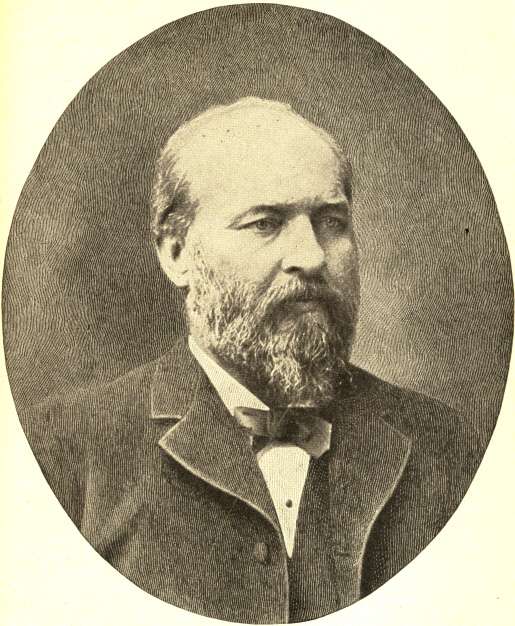
James A. Garfield.
From a photograph by C. M. Bell, Washington, D. C.
[1881]
Although it had no logical connection with the "spoils" system, the
assassination of President Garfield called the attention of the whole
country to the crying need of reform in the civil service. Ever since
the days of President Jackson, in 1829, appointments to the minor
federal offices had been used for the payment of party debts and to keep
up partisan interest. This practice incurred the deep condemnation of
Webster, Clay, Calhoun, and others, but no practical steps toward reform
were taken till 1871. The abuses of the spoils system had then become so
flagrant that Congress created a civil service commission, which
instituted competitive examinations to test the merits of candidates for
office in the departments at Washington. President Grant reported that
the new methods "had given persons of superior capacity to the service'"
But Congress, always niggardly in its appropriations for the work of the
commission, after 1875 cut them off altogether, and the rules were
suspended.
Under President Hayes civil service reform made considerable progress in
an irregular way. Secretary Schurz enforced competitive examinations in
the Interior department. They were also applied by Mr. James to the New
York Post-office, and, as the result, one-third more work was done with
less cost. Similar good results followed the enforcement of the "merit
system" in the New York custom-house after 1879. President Hayes also
strongly condemned political assessments upon office-holders, but with
small practical effect.
[1874]
The alarming increase of corruption in political circles generally,
after the war, helped to create popular sentiment for reform. Corrupt
"rings" sprang up in every city. The "whiskey ring," composed of
distillers and government employees, assumed national proportions in
1874, cheating the Government out of a large part of its revenue from
spirits. Liberal appropriations for building a navy were squandered.
During the campaign of 1872, the Democrats charged several prominent
Congressmen with having taken bribes, in 1867-68, to vote for
legislation desired by the Union Pacific Railroad. At the request of the
accused, an examination was had by a House committee. The committee's
report in 1873 recommended the expulsion of Representatives Oakes Ames
and James Brooks. Mr. Ames was accused of selling to Congressmen at
reduced rates, with intent to influence their votes, shares of stock in
the "Credit Mobilier," a corporation for the construction of the Union
Pacific Railroad. Mr. Brooks, who was a government director in the
railroad, was charged with receiving such shares. The House did not
expel the two members, but severely condemned them. Shadows of varying
density fell upon many prominent politicians and darkened their
subsequent careers.
[1883]
The tragic fate of President Garfield, following these and other
revelations of political corruption, brought public sentiment on civil
service reform to a head. A bill prepared by the Civil Service Reform
League, and introduced by Senator Pendleton, of Ohio, passed Congress in
January, 1883, and on the 16th received the signature of the President.
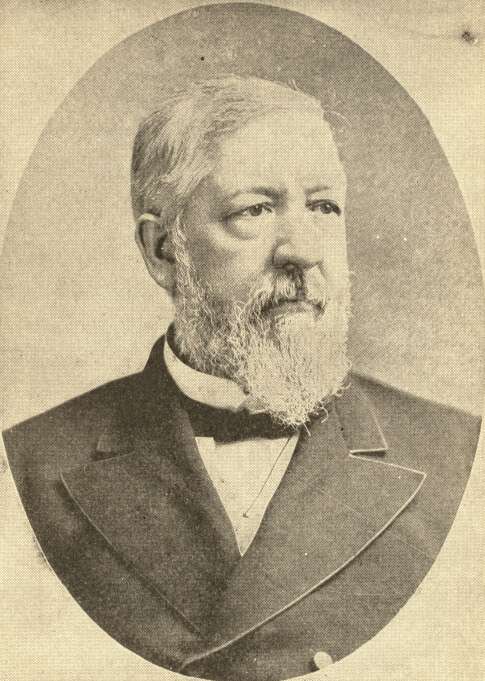
James G. Blaine.
It authorized the President, with the consent of the Senate, to appoint
three civil service commissioners, who were to institute competitive
examinations open to all persons desiring to enter the government
employ. It provided that the clerks in the departments at Washington,
and in every customs district or post-office where fifty or more were
employed, should be arranged in classes, and that in the future only
persons who had passed the examinations should be appointed to service
in these offices or promoted from a lower class to a higher, preference
being given according to rank in the examinations. Candidates were to
serve six months' probation at practical work before receiving a final
appointment. The bill struck a heavy blow at political assessments, by
declaring that no official should be removed for refusing to contribute
to political funds. Congressmen or government officials convicted of
soliciting or receiving political assessments from government employees
became liable to a five thousand dollar fine, or three years'
imprisonment, or both. Persons in the government service were forbidden
to use their official authority or influence to coerce the political
action of anyone, or to interfere with elections.
[1873-1884]
Dorman B. Eaton, Leroy B. Thoman, and John M. Gregory were appointed
commissioners by President Arthur. By the end of the year the new system
was fairly in operation. Besides the departments at Washington, it
applied to eleven customs districts and twenty-three post-offices where
fifty or more officials were employed. The law could be thoroughly
tested only when a new party came into power; that time was near at
hand.
The deepest and most significant political movement of the last twenty
years has been the gradual recovery of power by the Democracy. For some
years after the Rebellion, this party's war record was a millstone
around its neck. The financial distress in 1873 and the corruption
prevalent in political circles weakened the party in power, while the
Democracy, putting slavery and reconstruction behind its back, turned to
new issues, and raised the cry of "economy" and "reform."
The state elections of 1874 witnessed a "tidal wave" of democratic
victories. Out of 292 members of the House in 1875, 198 were democratic.
Two-thirds of the Senators were still republican. Even by republican
reckoning, the democratic presidential ticket in 1876 received a popular
majority of 157,000 and lacked but one electoral vote. In 1879 both
houses of Congress were democratic, by small majorities, for the first
time since 1856. The tide ebbed in 1880, the Democrats losing control of
the House, and suffering a decisive defeat in the presidential election;
but with 1884 the fortune of the Democracy reached high-water mark.
In this year James G. Blaine, of Maine, and John A. Logan, of Illinois,
received the republican nomination for President and Vice-President. A
number of Independent Republicans, including the most earnest advocates
of civil service reform, were strongly opposed to Mr. Blaine, alleging
him to be personally corrupt and the representative of corrupt political
methods. They met in conference, denounced the nominations, and later
indorsed the democratic nominees–Grover Cleveland, governor of New
York, and Thomas A. Hendricks, of Indiana. George W. Curtis, Carl
Schurz, and other prominent Republicans took part in the movement.
Several influential Independent Republican papers, including the New
York Times, Boston Herald, and Springfield Republican, joined the bolt.
The campaign was bitterly personal, attacks upon the characters of the
candidates taking the place of a discussion of principles. Mr. Cleveland
was elected, receiving 219 electoral votes against 182 for Mr. Blaine.
He carried every southern State, besides New York, Connecticut, Indiana,
Delaware, Maryland, and New Jersey. The total popular vote was over
10,000,000–the largest ever cast. Cleveland had 4,911,000, a plurality
of 62,000 over Blaine. The Democrats regained control of the House in
1883, and held it by a considerable majority to the end of Mr.
Cleveland's first term. In the Senate, until the election of 1892, the
Republicans continued to have a small majority.
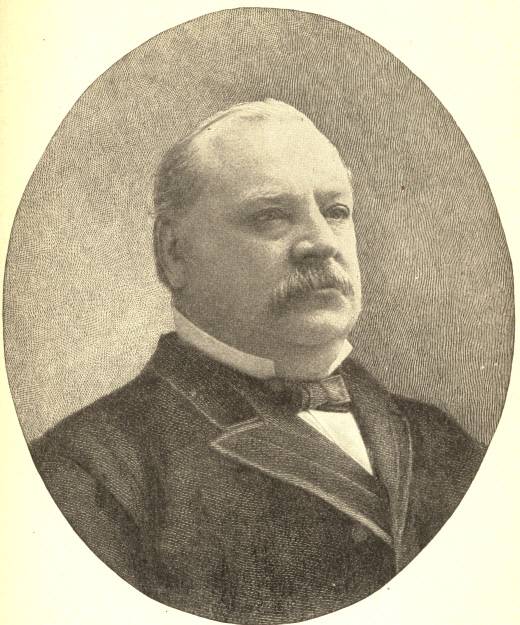
Grover Cleveland.
From a photograph copyrighted by C. M. Bell, Washington, D. C.
Upon the accession of the new administration to power, the country
waited with deep interest to see its effect upon the civil service. Mr.
Cleveland had pledged himself to a rigid enforcement of the new law, and
encouraged all to believe that with him impartial civil service would
not be confined to the few offices thus protected. After the first few
months of Cleveland's administration, one fact was apparent: for the
first time since the days of Jackson a change of the party in power had
not been followed by a clean sweep among the holders of offices. But, as
the subsequent record painfully shows, office-holders' pressure proved
too strong for Mr. Cleveland's resolution.
There were then about 120,000 government employees. Of these, not far
from 14,000 were covered by the Pendleton law. All the other minor
places were held at the pleasure of superior officers. These latter
officers numbered about 58,000. In August, 1887, from 45,000 to 48,000
of them had been changed, implying change in the offices dependent upon
them. There were some 55,000 postmasters, 2,400 of whom were appointed
by the President for a term of four years, the rest by the
postmaster-general at pleasure. At the date named, from 37,000 to 47,000
changes had been made in this department. These changes, of course, were
not all removals, as many vacancies occur by expiration of terms, death
of incumbents, and other causes.
[1886]
An important statute regarding the presidential succession, introduced
by Senator Hoar, passed Congress in January, 1886. By previous statutes,
in case of the removal, death, resignation, or disability of the
President and Vice-President, the presidency passed in order to the
temporary President of the Senate and the Speaker of the House. The
latter two might be of the opposite party from the President's, so that
by the succession of either the will of the people as expressed in the
presidential election would manifestly be defeated. Moreover, in case of
a President's death and the accession of the Vice-President, the latter,
too, might die, and thus both the presidency and the vice-presidency
become vacant in the interim between two Congresses, when there is
neither President of the Senate nor Speaker of the House. Thus President
Garfield died September 19, 1881, and the XLVlllth Congress did not
convene to choose a Speaker until the next December. The Senate had
adjourned without electing a presiding officer. Had President Arthur
died at any moment during the intervening period–and it is said that he
was for a time in imminent danger of death–the distracting contingency
just spoken of would have been upon the country.
According to the new law, in case of a vacancy in both presidency and
vice-presidency, the presidency devolves upon the members of the
cabinet in the historical order of the establishment of their
departments, beginning with the Secretary of State. Should he die, be
impeached, or disabled, the Secretary of the Treasury would become
President, to be followed in like crisis by the Secretary of War, he by
the Attorney-General, he by the Postmaster-General, he by the Secretary
of the Navy, he by the Secretary of the Interior, and he by the
Secretary of Agriculture.
We have still no legal or official criterion of a President's
disability. We do not know whether, during Garfield's illness, for
instance–apparently a clear case of disability–it was proper for his
cabinet to perform his presidential duties, or whether Arthur should not
have assumed these. Barring this chance for conflict, it is not easy to
think of an emergency in which the chief magistracy can now fall vacant,
or the appropriate incumbent thereof be in doubt.