
Though arms were grounded, there remained the new task, longer and more
perplexing, if not more difficult, than the first, of restoring the
South to its normal position in the Union. It was, from the nature of
the case, a delicate one. The proud and sensitive South smarted under
defeat and was not yet cured of the illusions which had led her to
secede. Salve and not salt needed to be rubbed in to her wounds. The
North stood ready to forgive the past, but insisted, in the name of its
desolate homes and slaughtered President, that the South must be
restored on such conditions that the past could never be repeated. The
difficulty was heightened by the lack of either constitutional provision
or historical precedent. Not strange, therefore, that the actors in this
new drama of reconstruction played their parts awkwardly and with many
mistakes.
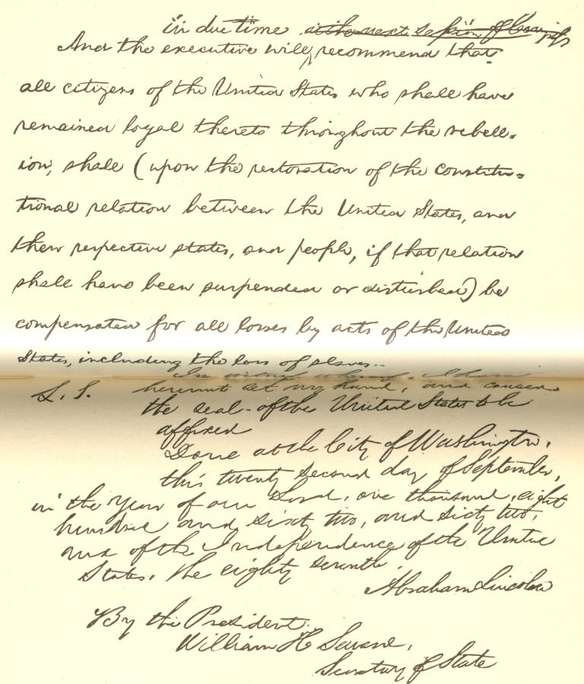
Facsimile of a portion of President Lincoln's draft of the
Preliminary Proclamation of Emancipation, September. 1862
From the original in the Library of the State of New York, Albany.
[1865]
A most interesting constitutional problem had to be faced at the outset:
What effect had secession had upon the States guilty of it; was it or
was it not an act of state suicide? This question was warmly debated in
Congress and out. Although ridiculed in some quarters as a mere
metaphysical quibble, it lay at the bottom of men's political thinking
on reconstruction, and their views of the proper answer to it powerfully
influenced their action.
All loyal Democrats and most Republicans answered it in the negative.
Secession, they said, being an invalid act, had no effect whatever; the
rebellious tracts were still States of the Union in spite of themselves.
But the two parties reasoned their way to this conclusion by different
roads. The Democrats deduced the view from the State's intrinsic
sovereignty, the Republicans from the national Constitution as ordaining
"an indestructible Union of indestructible States." This class of
thinkers, in whichever party they were found, naturally preferred the
term "restoration" to "reconstruction."
The theory of state suicide was held by many, but with a difference.
Sumner and a few others deemed that secession had destroyed statehood
alone; that over individuals the Constitution still extended its
authority and its protection, as in Territories. Thaddeus Stevens and
his followers viewed secession as having left the State not only defunct
but a washed slate governmentally, like soil won by conquest. Both these
parties conceived the work before Congress to be out-and-out
"reconstruction," involving the right to change old state lines and
institutions at will. Not even this position was more ultra than the
course which reconstruction actually took.
Closely related to this main problem were several other questions nearly
or quite as vexing. Were any conditions to be imposed upon the peoples
seeking re-admission to the Union as States? If so, what, aside from the
loyalty of voters and officeholders, were these conditions? Was the
President to initiate and oversee the process of redintegration,
prescribing the conditions of re-admission, and determining when they
were fulfilled, or was all this the business of Congress? And, lastly,
did the right thus to oversee and impose conditions depend upon a
certain war power of Congress or of President, or upon the clause of the
Constitution which guarantees to every State a republican form of
government? Nearly the same question as this, in another form, would be,
Was this right explicitly constitutional or only impliedly so?
The answer practically returned to these difficult inquiries was that
Congress, as a quasi war right, must exact of the States lately in
secession all the conditions necessary, in its view, to their permanent
loyalty and the peace of the Union.
The history of reconstruction divides into three periods: Reconstruction
during the war, President Johnson's work, and Congressional
reconstruction.
Restoration was the universal thought at first. Congressional
resolutions in 1861 declared that the war was not waged "for the purpose
of overthrowing or interfering with the rights or established
institutions" of the seceding States. Their action was looked upon as an
insurrection against the state government as well as against the United
States. Accordingly, when a handful of Virginia loyalists, in the summer
of 1861, formed a state government and elected national senators and
representatives, President and Congress recognized them as the true
State of Virginia.
Following out the same idea, President Lincoln proclaimed in 1863 that
as soon as one-tenth of the voters of any seceded State would swear to
abide by the Constitution and the emancipation laws they might form a
state government. In this way Louisiana, Arkansas, and Tennessee were
reconstructed during 1863 and 1865.
The hand of the assassin removed Lincoln from the scene of action at a
time when North and South alike stood most in need of his kind heart,
tact, and firmness. Andrew Johnson succeeded to a task for which he was
ill-fitted. Conceited, obstinate, and pugnacious, he began by alarming
the South with threats of wholesale punishment for the "crime of
treason," and ended by alienating his own party through his slack
methods of re-establishing the States. Johnson declared, and no doubt
honestly, that he was carrying out Lincoln's ideas. In May, 1865, he
offered amnesty to all but certain excepted classes, mainly civil and
military leaders, upon condition of an oath to support the Constitution,
including its Thirteenth Amendment, forbidding slavery. Though the
proclamation declaring this to be in force did not issue till December
18, 1865, it had been approved by Congress the preceding February.
President Johnson then proceeded to reorganize the state governments.
For each seceded State, except the four already reconstructed, he
appointed a provincial governor. The governor called a State convention.
Only whites who had taken the amnesty oath could elect delegates, or
themselves be elected, to this convention. At the instance of the
President the convention adopted a constitution or legislation which
forbade slavery, declared the ordinance of secession null and void, and
repudiated the Confederate debt. The convention then appointed times and
places for the election of a legislature and a permanent governor. In a
few months the governmental machinery had been set in motion in all the
late Confederate States, and in December senators and representatives
from all except Texas were knocking at the doors of Congress.
Thus far the President had had full sway. But upon the re-assembling of
Congress in December, it became apparent that he and his party were not
in harmony. Congress, still overwhelmingly republican, refused to admit
the southern delegates, and appointed a committee to investigate the
condition of affairs in the southern States. Its report was anything but
re-assuring, and Congress, mainly under the lead of Thaddeus Stevens,
boldly proceeded to rip up the entire presidential work.
Several considerations led Congress to this course. They denied the
President's right, on his own sole authority, to re-establish permanent
governments in the States in question. Furthermore, the new state
governments were declared unlawful because their constitutions had not
been submitted to the people for ratification. Congress also maintained
that only the law-making power could of right determine the conditions
of re-admission to the Union, and judge whether or not those conditions
had been fulfilled.
But the consideration which outweighed all others in favor of the
congressional procedure was the alarming temper and acts of the South
itself. The Carolinas and Georgia had simply repealed the ordinance of
secession instead of declaring it null and void. The reconstructed
legislatures pensioned Confederate soldiers and their families.
"Notorious and unpardoned rebels" were elected as state officers and to
Congress.
Worse than this, nearly all the southern States passed laws which went
far toward reducing the blacks again to slavery. In Virginia, if a negro
broke his labor-contract, the employer could pursue him and compel him
to work an extra month, with chain and ball if necessary. In Mississippi
negro children who were orphans, or whose parents did not support them,
were to be apprenticed till they became of age. Their masters could
inflict upon them "moderate corporal punishment," and re-capture such as
ran away. In South Carolina any negro engaging in business had to pay
one hundred dollars yearly as a license. Mechanics were fined ten
dollars each a year for prosecuting their trades. No negro could settle
in the State without giving bonds for his good behavior and support. In
Louisiana a farm laborer was required to make a year's contract; if he
failed to work out the time, he could be punished by forced labor upon
public works. Not all the new southern legislation was of this savage
character, and this itself must be viewed in the light of the fact that
the negroes, trained in irresponsibility, were inclined to idleness and
theft. But it was nevertheless unjust. In some sections only the
interposition of the military and of the Freedman's Bureau made life
tolerable to the blacks.
[1866]
As an offset to the above dangerous acts and tendencies, Congress, in
the spring of 1866, passed the Fourteenth Amendment [footnote: Declared
in force July 28, 1868, having been ratified by three-fourths of the
States] and submitted it to the States for ratification. It was meant to
insure to negroes in every State all the rights of citizens and the
equal protection of the laws. If and so long as negroes were in any
State forbidden to vote, it reduced that State's representation in
Congress proportionally; it excluded from national and state offices
certain specified Confederate leaders; and it guarded the national debt,
repudiating all indebtedness on behalf of the Rebellion. Every secession
State but Tennessee rejected the amendment.
[1868]
Congress replied by the "iron law" of March 2, 1867. "Secessia" was
divided into five districts and placed under military rule, there to
remain until certain conditions were fulfilled. These conditions were,
in brief, the calling of a state convention by the loyal citizens,
blacks included; the framing by the convention of a constitution
enfranchising negroes; the ratification of this constitution by the
people and its approval by Congress; the ratification of the Fourteenth
Amendment by the new legislature. Having conformed to these
prescriptions the State might be represented in Congress and consider
itself fully restored to the Union. A supplementary law of March 19th
hastened the process by giving the district commanders surveillance of
registration and the initiative in calling conventions.
By June, 1868, a sufficient number of the southern States had complied
with the conditions to make the Fourteenth Amendment law. Virginia,
Mississippi, and Texas held out till 1870, and hence were forced to
ratify the Fifteenth Amendment also. Not till January 30, 1871, were all
the States again represented in both Houses of Congress as in 1860.
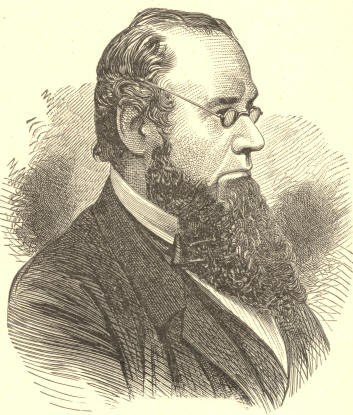
Edwin M. Stanton.
All through the days of congressional reconstruction the antagonism
between President and Congress steadily increased. Every step in the
progress encountered the President's uttermost opposition and spite. He
vetoed all important reconstruction measures, which were promptly
carried over his veto. There was much violent language and bitter
feeling on both sides. The irritation finally culminated when the House
entered articles of impeachment against Johnson–the only case of the
kind in our history involving a President. The charges were tried before
the Senate in March, 1868, the Chief Justice presiding, and occupied
three weeks. William M. Evarts was Johnson's counsel, and a glittering
array of legal talent appeared on both sides. The main charge was that
the President had wilfully violated the Tenure of Office Act in removing
Secretary Stanton from the Cabinet after the Senate had once refused to
concur in his removal. The House was hasty in bringing the prosecution.
The President was acquitted by a vote of 19 against and 35 for
impeachment–one vote less than the two-thirds necessary to impeach. The
Johnson-Congressional conflict proved one of the most mortifying
episodes in our country's history.
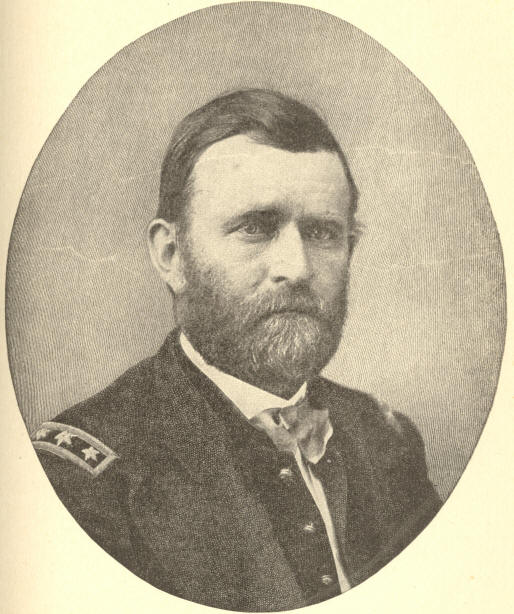
Ulysses S. Grant.