
[1861]
A civil war of vast proportions in the world's greatest republic
naturally aroused deep interest among the monarchies of Europe. Russia
evinced warm friendliness to the United States. The rest of the world,
save England and France, showed us no ill-will.
England, with unfriendly haste, admitted the belligerent rights of the
Confederacy before Mr. Adams, our minister, could reach the British
court. The North was surprised and shocked that liberty-loving,
conservative England should so far side with "rebellious slave-holders."
It would seem that, besides sympathy with the aristocratic structure of
southern society, national envy helped to put England into this false
position. Commercial interests had greater weight. Four millions of
people in England depended upon cotton manufactures for support.
Three-fourths of the cotton they had used came from our southern ports,
which the blockade closed. Moreover, the Confederacy declared for free
trade, while the North adopted a high war tariff which drove many
English goods out of American markets. The London Times complained that
nearly $4,000,000 worth of English cutlery alone had been made worthless
by our tariff.
An incident early in the war heightened the ill-will between the two
countries. On a dark night in October, 1861, Messrs. Mason and Slidell,
Confederate commissioners to England and France, ran the blockade at
Charleston, and soon after took passage at Havana on the English mail
steamer Trent. November 8th, 250 miles out from Havana, the United
States sloop of war San Jacinto, Captain Wilkes, compelled the Trent, by
a shot across her bows, to heave to, and took off the commissioners.
All England was hot with resentment. Troops were shipped to Canada, and
other war preparations begun. A special messenger was hurried to
Washington, demanding an apology and the release of the prisoners.
Wilkes's action, though without authority in international law, was
warmly approved by the people. The House of Representatives tendered him
a vote of thanks. But the Government disavowed the seizure and gave up
the commissioners. Mr. Seward, Secretary of State, in a dignified reply
to England, insisted that the seizure was fully justified by England's
own practice of searching neutral vessels on the high seas; but that, as
the United States had always condemned this practice, the prisoners
would be released, especially as Captain Wilkes should have brought the
Trent before a prize court instead of deciding the validity of the prize
himself. The action of the Government, though unpopular at the time, was
undoubtedly as prudent as it was just. We could not afford to provoke
war with England.
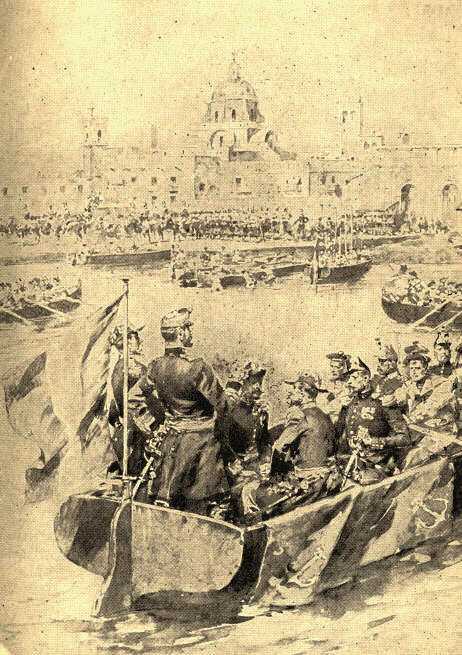
The Landing of the Allied Troops at Vera Cruz.
Our real grievance against Great Britain was that the Queen's
proclamation of neutrality was not obeyed. Confederate cruisers were
built in English yards, whence they publicly and boastfully sailed to
prey upon our then vast merchant marine. Crews as well as ships were
English. The British ministry were perfectly aware of their destination,
but used all manner of artifices to avoid interfering.
Our most vicious enemy abroad was Napoleon III., so profuse yet so
hypocritical in his professions of good-will. He, too, hastened to
accord belligerent rights to the Confederacy. Had England not been too
wary to join him, the two nations would certainly have recognized the
South's independence. Napoleon was on the point of doing this alone.
Seven war-vessels were, with his sanction, built for the Confederates at
Bordeaux and Nantes, though he was too wily to allow them to sail when
he became aware that their destination was fully known to our minister.
Far-reaching political schemes were at the bottom of Napoleon's wish for
a dismembered Union. He was plotting to restore European influence in
America by setting up an empire on the ruins of the Mexican republic,
and he knew that the United States would never allow this while her
power was unbroken. In the latter part of 1861 a French army invaded
Mexico. The feeble government was overthrown after a year or two of
fighting. In 1863 an empire was established, and Napoleon offered the
throne to the Austrian archduke Maximilian. Meanwhile, the protests of
the United States were disregarded. But when our hands were freed by the
collapse of the Confederacy, Napoleon changed his tone. The French
troops were withdrawn early in 1867, and Maximilian was left to his
fate. The unhappy prince, betrayed by his own general, fell into the
hands of the old Mexican Government, now in the ascendant, and was tried
by court-martial and shot. It should be remembered, however, that
France's unfriendly attitude all through the Rebellion was maintained by
her unscrupulous emperor and did not reflect the wish of the French
people.
The expenses of the war were colossal. From beginning to close they
averaged $2,000,000 a day, sometimes running up to $3,500,000. The
expenditure for the fiscal year ending July 1, 1865, was nearly
$2,000,000,000. Of this the War Department required, in round numbers,
$1,000, 000,000; the navy department, $123,000,000. These figures reveal
the vast scale upon which the war was waged by land and sea. The
national debt rose with frightful rapidity. It was $64,000,000 in 1860,
$1,100,000,000 in 1863, $2,800,000,000 (the highest point reached) in
1865. State and local war debts would swell the amount to more than
$4,000,000,000.
The position of Secretary of the Treasury during the war was anything
but a bed of roses. The ordinary national income was hardly a drop in
the bucket compared with the enormous and constantly increasing
expenses. The total receipts for the year ending July 1, 1860, were only
$81,000,000. How should the vast sums needed to carryon the war be
raised? Resort was had to two sources of revenue–taxation and loans.
A considerable revenue was already derived from customs imposed upon
imported goods. In 1861, and again in 1863, tariffs were raised
enormously, professedly to increase the revenue. These high rates in a
measure defeated their own purpose, altogether stopping the importation
of not a few articles.
The war compelled the Government to resort to internal taxation–always
unpopular and now unknown in the United States for nearly half a
century. Taxes were laid upon almost everything–upon trades, incomes,
legacies, manufactures. The words of Sydney Smith will apply to our
internal taxes during the war:
"Taxes on the ermine which decorates the judge, and the rope which hangs
the criminal; on the poor man's salt and the rich man's spice; on the
brass nails of the coffin and the ribands of the bride." The tax on many
finished products ranged from eight to fifteen per cent.; on some it
rose to twenty per cent.
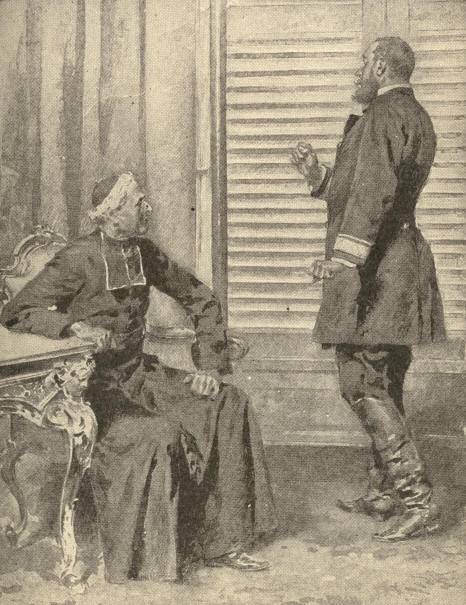
Maximilian Watching the Departure of the
Last French Troops from the City of Mexico.
[1864]
But these taxes, severe as they were, could furnish only a small part of
the necessary income. The Government must borrow. In the first year of
the war the banks loaned the United States $150,000,000 at 7.3 per cent.
interest. Many other loans were secured as the war went on–one for
$500,000,000, another for $900,000,000. As security the Government
issued bonds, bearing various rates of interest and payable after a
certain number of years. Treasury notes were also issued and made legal
tender for all debts public and private. As the Government paid its own
debts with them, they were in the nature of a forced loan. Of those
which bore no interest (commonly known as greenbacks) $433,000,000 were
issued from first to last. Also, when property was seized for the use of
the army, the owners were given certificates of indebtedness which
entitled the holders to payment at the United States Treasury.
The proportion of revenue derived from each of the above sources is
illustrated by the report of the treasurer of the United States for the
year ending July 1, 1865. Customs yielded $85,000,000, internal revenue
$209,000,000, loans $1,470,000,000.
Finance legislation during the war was more patriotic than wise, due
partly to necessary haste, largely to ignorance. The internal taxes bore
very unequally upon different classes. The tariff was ill-adjusted to
the internal taxes, letting in at low rates some classes of goods whose
home production was heavily taxed, thus discriminating in favor of the
foreigner. Millions of debt and half the other economic evil of the war
might have been saved by doing more to keep the paper dollar on a par
with gold. Thus the banks should not have been compelled to pay in gold
the loan of 1861. It forced them to suspend specie payment altogether,
December 31st of that year–those of New York City first, followed by
others everywhere, and by the United States itself. Gold had been at a
nominal premium all through 1861, but the first recorded sale at an
advance was on January 13, 1862. It would have been better, also, to
resort earlier to heavy loans, even at high rates, instead of flooding
the country with greenbacks. The national banks, which were created on
purpose to help the sale of government bonds, should have been forced to
purchase new bonds instead of supplying themselves with bonds already
issued, their purchase of which did the Government no good whatever.
Neglect in these regards caused the paper dollar to fall in value. In
July, 1864, it was worth only thirty-five cents in gold.
The finances of the Confederacy went steadily from bad to worse. The
blockade cut off its revenue from import duties. Its poor credit forbade
large loans. The government had to rely mainly upon paper money. This
soon became almost worthless. In December, 1861, it took $120 in paper
money to buy $100 in gold; in 1863 it took $1,900; in 1864, $5,000.
Nearly $1,000,000,000 in paper money was issued in all. The Confederate
debt at the close of the war was $2,000,000,000. Under the combined
influence of depreciated currency and scarcity of goods, prices became
ludicrously high. As early as 1862 flour was $40 a barrel and salt $1 a
pound. Before the war was over, a pound of sugar brought $75, a spool of
thread $20. Toward the end of the war a Confederate soldier, just paid
off, went into a store to buy a pair of boots. The price was $200. He
handed the store-keeper a $500 bill. "I can't change this," "Oh, never
mind," replied the paper millionaire. "I never let a little matter like
$300 interfere with a trade." Of course when the Confederacy collapsed
all this paper money became absolutely worthless.
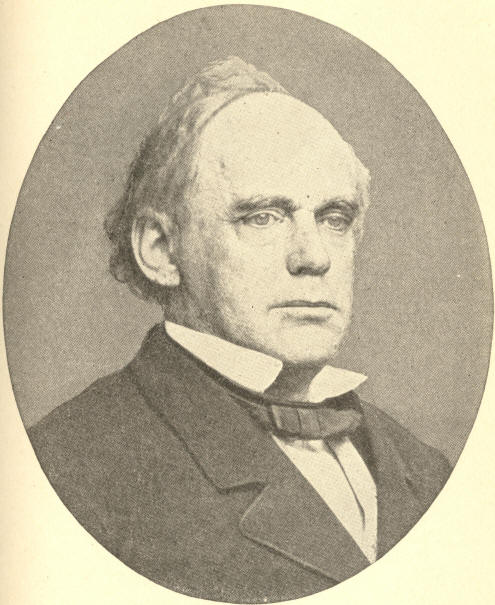
Salmon Portland Chase,
Secretary of the Treasury during the Civil War.
Mr. Lincoln and the Republican Party resorted to arms not intending the
slightest alteration in the constitutional status of slavery. But the
presence of Union armies on slave soil led to new and puzzling
questions. What should be done with slaves escaping to the Union lines?
Generals Buell and Hooker authorized slave-holders to search their camps
for runaway slaves. Halleck gave orders to drive them out of his lines.
Butler, alleging that since slaves helped "the rebels" by constructing
fortifications they were contraband of war, refused to return those
fleeing into his camp. Congress moved up to this position in August,
1861, declaring that slaves used for hostile purposes should be
confiscated. But when Fremont and Hunter issued orders freeing slaves in
their military districts, President Lincoln felt obliged to countermand
them, fearing the effect upon slave States that were still loyal.
As the war went on the conviction grew that peace would never be safe or
permanent if slavery remained, and that the suppression of the Rebellion
was postponed, jeopardized, and made costlier by every hour of slavery's
life. Slaves raised crops, did camp work, and built fortifications,
releasing so many more whites for service in hostile ranks, instead of
doing all this, and fighting, even, for the Union.
It is interesting to trace the growth of emancipation sentiment during
1862 as it is reflected in congressional legislation. In March army
officers were forbidden to return fugitive slaves. In April slavery was
abolished in the District of Columbia, with compensation to owners. At
the same time Congress adopted a pet scheme of Mr. Lincoln's, offering
compensation to any State that would free its slaves. None accepted.
There were about 3,000 slaves in the District. Upon the day of their
emancipation they assembled in churches and gave thanks to God. In June
slavery in the Territories–that bone of contention through so many
years–was forever prohibited. In July an act was passed freeing rebels'
slaves coming under the Government's protection, and authorizing the use
of negro soldiers.
[1863]
Already President Lincoln was meditating universal emancipation.
September 22d the friends of liberty were made glad by a preliminary
proclamation, announcing the President's intention to free the slaves on
January 1, 1863, should rebellion then continue to exist. It is said
that Mr. Lincoln would have given this notice earlier but for the gloomy
state of military affairs. The day comes. The proclamation goes forth
that all persons held as slaves in the rebellious sections "are and
henceforth shall be free." The blot which had so long stained our
national banner was wiped away. The Constitution of course does not
expressly authorize such an act by the President, but Mr. Lincoln
defended it as a "necessary war measure," "warranted by the Constitution
upon military necessity."
This bold, epoch-making deed, the death-warrant of slavery here and
throughout the world, evoked serious hostility even at the North. The
elections in the fall of 1862 and the spring of 1863 showed serious
losses for the administration party. Emancipation, too, doubtless added
rancor and verve for a time to southern belligerency. But the fresh
union, spirit, and strength it soon brought to the northern cause were
tenfold compensation. Besides, it vastly exalted our struggle in the
moral estimate of Christendom, and lessened danger of foreign
intervention.
The War President trod at no time a path of flowers. Strong and general
as was Union sentiment at the North, extremely diverse feelings and
views prevailed touching the methods and spirit which should govern the
conduct of the war. Certain timid, discouraged, or disappointed
Republicans, seeing the appalling loss of blood and treasure as the war
went on, and the Confederacy's unexpected tenacity of life, demanded
peace on the easiest terms inclusive of intact Union. Secretaries Seward
and Chase were for a time in this temper. The doctrinaire abolitionists
bitterly assailed President and Congress for not making, from the
outset, the extirpation of slavery the main aim of hostilities. Even the
great emancipation pacified them but little.
The Democrats proper entered a far more sensible, in fact a not wholly
groundless, complaint exactly the contrary. They charged that the
Administration, in hopes to exhibit the Democracy as a peace party
(which from 1862 it more and more became), was making the overthrow of
slavery its main aim, waging war for the negro instead of for the Union.
They complained also that not only in anti-slavery measures but in other
things as well, notably in suspending habeas corpus, the Administration
was grievously infringing the Constitution.
Yet a fourth class, a democratic rump of southern sympathizers,
popularly called "copperheads," wishing peace at any price, did their
best to encourage the Rebellion .. They denounced the war as cruel,
needless, and a failure. They opposed the draft for troops, and were
partly responsible for the draft riots in 1863. Many of them were in
league with southern leaders, and held membership in treasonable
associations. Some were privy to, if not participants in, devilish plots
to spread fire and pestilence in northern camps and cities, Partly
through influence of the more moderate, several efforts to negotiate
peace were made, fortunately every one in vain.
[1864]
But despite the attacks of enemies and the importunities of weak or
short-sighted friends, President Lincoln steadily held on his course.
The masses of the people rallied to his support, and in the presidential
election of 1864 he was re-elected by an overwhelming majority,
receiving 212 electoral votes against 21 for General McClellan, the
democratic candidate.