
[1864]
Gettysburg was the last general engagement in the East during 1863. The
next spring, as we have noticed, Grant was appointed Lieutenant-General,
with command of all the northern armies, now numbering over 600,000
effectives. This vast body of men he proposed to use against the
fast-weakening Confederacy in concerted movements. Sherman's part in the
great plan has already been traced. The hardest task, that of facing
Lee, the hero of Vicksburg and Chattanooga [he] reserved for himself.
Greek thus met Greek, and the death-grapple began.
May 4th the Army of the Potomac crossed the Rapidan and entered the
Wilderness, Meade in immediate command, with 120,000 men present for
duty. Lee, heading an army of 62,000 veterans, engaged his new
antagonist without delay. For two days the battle raged in the gloomy
woods. There was no opportunity for brilliant manoeuvres. The men of the
two armies lay doggedly behind the trees, each blazing away through the
underbrush at an unseen foe, often but a few yards off, while a stream
of mangled forms borne on stretchers came steadily pouring to the rear.
The tide of battle surged this way and that, with no decisive advantage
for either side.
But Grant, as Lee said of him, "was not a retreating man." If he had not
beaten, neither had he been beaten. Advance was the word. On the night
of the 7th he began that series of "movements by the left flank" which
was to force Lee forever from the Rappahannock front. The army stretched
nearly north and south, facing west. Warren's corps, at the extreme
right, quietly withdrew from the enemy's front, and marching south took
a position beyond Hancock's, hitherto the left. Sedgwick's corps
followed. By this sidling movement the army worked its way south, all
the while presenting an unbroken front to the enemy. Yet, on reaching
Spottsylvania, Grant found Lee's army there before him. Sharp fighting
began again on the 9th and continued three days, but was indecisive,
mainly from the wild nature of the country, heavily timbered, with only
occasional clearings.
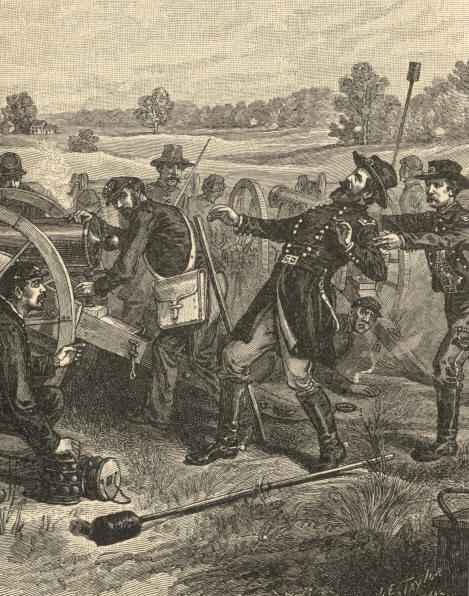
Death of General Sedgwick at Spottsylvania. May 9, 1864.
An early morning attack on the 12th carried a salient angle in the
centre of the Confederate line, securing 4,000 prisoners and twenty
guns. All that day and far into the night Lee desperately strove to
dislodge the assailants from this "bloody angle." Five furious charges
were stubbornly repulsed, the belligerents between these grimly facing
each other from lines of rifle-pits often but a few feet apart. Bullets
flew thick as hail, a tree eighteen inches through being cut clean off
by them. Great heaps of dead and wounded lay between the lines, and "at
times a lifted arm or a quivering limb told of an agony not quenched by
the Lethe of death around." Lee did not give up this death-grapple till
three o'clock in the morning, when he fell back to a new position. His
losses here in killed and wounded were about 5,000; Grant's about 6,000.
Rains now compelled both armies to remain quiet for several days.
Meantime news reached Grant that Butler, who was to have moved up the
James with his army of 20,000 and co-operate with the main army against
Richmond, had suffered himself to be "bottled up" at Bermuda Hundred, a
narrow spit of land between the James and Appomattox Rivers, the
Confederates having "driven in the cork." Re-enforcements reached Grant,
however, which made good all his losses.
On the 19th, after an unsuccessful assault the day before, he resumed
the flanking movement, and reached and passed the North Anna. But Lee
pushed in like a wedge between the two parts of the Union army,
separated by crossing the river at different points, and after some
fighting, Grant re-crossed and resumed his march to the south. Lee,
again moving on shorter lines, reached Cold Harbor before Grant.
The outer line of Confederate intrenchments at Cold Harbor was carried
on June 1st, and at early dawn on the 3d a charge made along the whole
front. Under cover of a heavy artillery fire the men advanced to the
enemy's rifle-pits and carried them. They then swept on toward the main
line. The ground was open, and the advancing columns were exposed to a
terrible storm of iron and lead. Artillery cross-fire swept through
their ranks from right to left. The troops pressed close up to the
works, but could not carry them. They intrenched, however, and held the
position gained, at some points within thirty yards of the hostile
ramparts. The Union loss was very heavy, not less than 6,000; the
Confederates, fighting under shelter, lost comparatively few.
During the next ten days the men lay quietly in their trenches. Both
forces had now moved so far south that Grant's hope of getting between
Lee's army and Richmond had to be abandoned. He therefore decided to
cross the James and take a position south of Richmond, whence he could
threaten its lines of communication, while that river would furnish him
a secure base of supplies.
The two hosts now began a race for Petersburg, an important railway
centre, twenty-two miles south of Richmond. Grant's advance reached the
town first, but delayed earnest attack, and on the morning of the 15th
Lee's veterans, after an all-night's march, flung themselves into the
intrenchments. Grant spent the next four days in vain efforts to
dislodge them. On the 19th he gave up this method of assault, and began
a regular siege. His losses in killed and wounded hereabouts had been
almost 9,000.
Things now remained comparatively quiet till late in July. Both sides
were busy strengthening their intrenchments. Lee held both Richmond and
Petersburg in force, besides a continuous line between the two. Attempts
to break this line and to cut the railroads around Petersburg led to
several engagements which would have been considered great battles
earlier in the war.
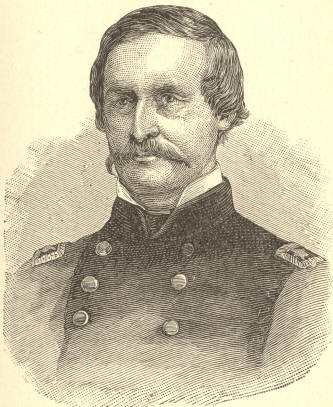
General David Hunter.
Grant's total losses from the crossing of the Rapidan to the end of June
were 61,000, but re-enforcements promptly filled his ranks. The
Confederate loss cannot be accurately determined, but was probably about
two-thirds as great.
Through July one of Burnside's regiments, composed of Pennsylvanians
used to such business, had been working at a mine under one of the main
redoubts in front of Petersburg. A shaft 500 feet long was dug, with a
cross gallery 80 feet in length at the end square under the redoubt.
This chamber was charged with 8,000 pounds of powder, which was fired
July 30th. The battery and brigade immediately overhead were blown into
the air, and the Confederate soldiers far to left and right stunned and
stupefied with terror. For half an hour the way in to Petersburg was
open. Why did none enter? The answer is sad.
Grant had splendidly fulfilled his part by a feint to Deep Bottom across
the James, which had drawn thither all but about one division of Lee's
Petersburg force. But Meade, at a late hour on the 29th, changed the
entire plan of assault, which Burnside had carefully arranged, and to
lead which a fresh division had been specially drilled. Then there was
lamentable inefficiency or cowardice on the part of several subordinate
officers. The troops charged into the great, cellar-like crater,
twenty-five feet deep, where, for lack of orders, they remained huddled
together instead of pushing on. The Confederates rallied, and after
shelling the crater till more of its occupants were dead than alive,
charged and either routed the living or took them prisoners.
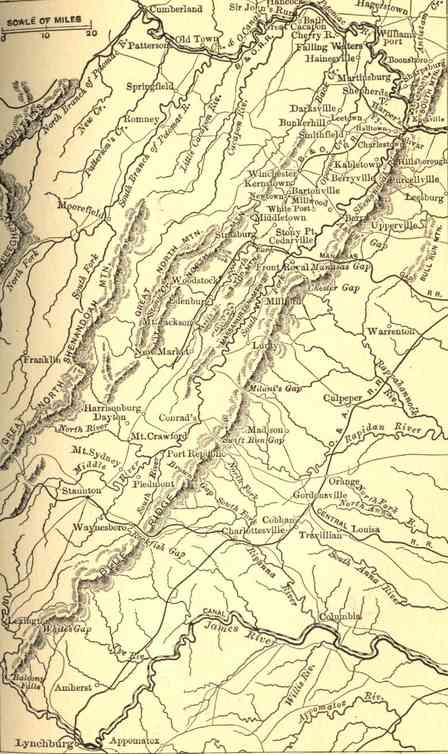
The Shenandoah Valley.
During the summer and fall of 1864 the scene of active operations was
shifted to the Shenandoah Valley. The latter part of June Lee sent
Early, 20,000 strong, to make a demonstration against Washington, hoping
to scare Grant away from Petersburg. Early moved rapidly down the
valley, hustling Hunter before him, who escaped only by making a detour
to the west, thus leaving Washington open. Thither Early pushed with all
speed.
General Lew Wallace hastily gathered up the few troops at his disposal
and hurried out from Baltimore to meet him. Wallace was defeated at the
Monocacy River July 9th, but precious time was gained for the
strengthening of Washington. When Early arrived before the city on the
11th, Grant's re-enforcements had not yet come, and the fate of the
capital trembled in the balance. Early happily delayed his attack till
the morrow, and that night two of Grant's veteran corps landed in
Washington, President Lincoln, in his anxiety, being on the wharf to
meet them. Once more Washington was safe, and Early fell back, pressed
by the newcomers.
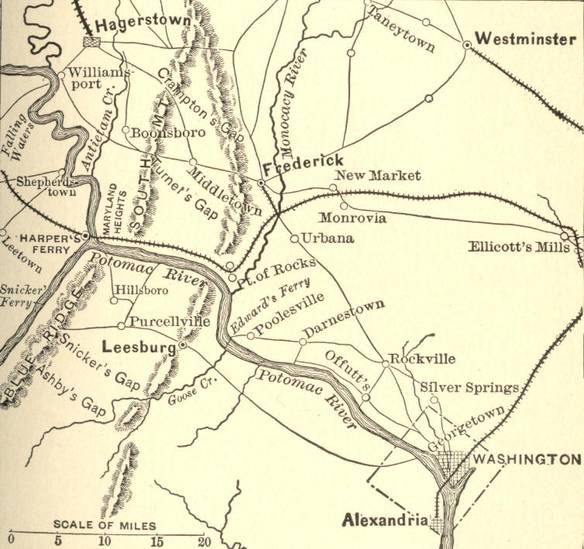
General Early's Maryland Campaign.
The pursuit was feeble, however, and the last of July Early swooped down
the valley again. A detachment pushed into Pennsylvania and burned
Chambersburg. All through the war the Confederate operations in the
Shenandoah Valley had been an annoyance and a menace. Grant now
determined to put a definite stop to this, and sent the dashing General
Sheridan for the work with 30,000 troops, including 8,000 cavalry.
Sheridan pushed Early up the Shenandoah, defeating him at Opequon Creek,
September 19th, and at Fisher's Hill two days later.
One-half of Early's army had been destroyed or captured, and the rest
driven southward. Sheridan then, in accordance with Grant's orders, that
the enemy might no longer make it a base of operations against the
capital, laid waste the valley so thoroughly that, as the saying went,
not a crow could fly up or down it without carrying rations. Spite of
this, Early, having been re-enforced, entered the valley once more. The
Union army lay at Cedar Creek. Sheridan had gone to Washington on
business, leaving General Wright in command. On the night of October
18th, the wily Confederate crept around to the rear of the Union left,
and attacked at daybreak. Wright was completely surprised, and his left
wing fled precipitately, losing 1,000 prisoners and 18 guns. He ordered
a retreat to Winchester. The right fell slowly back in good order,
interposing a steady front between Early and the demoralized left.
Meanwhile Sheridan, who had reached Winchester on his return, snuffed
battle, and hurried to the scene. Now came "Sheridan's Ride." Astride
the coal-black charger immortalized by Buchanan Read's verse, he shot
ahead and dashed upon the battle-field shortly before noon, his horse
dripping with foam. His presence restored confidence, and the army
steadily awaited the expected assault. It came, was repulsed, was
reciprocated. Early was halted, then pushed, then totally routed, and
his army nearly destroyed. It was one of the most signal and telling
victories of the war. In a month's campaign Sheridan had killed and
wounded 10,000 of the enemy and taken 13,000 prisoners.
[1865]
All this time the siege of Petersburg was sturdily pressed. In August,
Grant got possession of the Weldon Railroad, an important line running
south from Petersburg. During the next month fortifications on the
Richmond side of the James were carried and held. Through the winter
Grant contented himself with gradually extending his lines around
Petersburg, trying to cut Lee's communications, and preventing his
sending troops against Sherman. He had a death-grip upon the
Confederacy's throat, and waited with confidence for the contortions
which should announce its death.
The spring of 1865 found the South reduced to the last extremity. The
blockade had shut out imports, and it is doubtful if ever before so
large and populous a region was so far from being self-sustaining. Even
of food-products, save corn and bacon, the dearth became desperate.
Wheat bread and salt were luxuries almost from the first. Home-made
shoes, with wooden soles and uppers cut from buggy tops or old
pocketbooks, became the fashion. Pins were eagerly picked up in the
streets. Thorns, with wax heads, served as hairpins. Scraps of old metal
became precious as gold.
The plight of the army was equally distressing. Drastic drafting had
long since taken into the army all the able-bodied men between the ages
of eighteen and forty-five. Boys from fourteen to eighteen, and old men
from forty-five to sixty, were also pressed into service as junior and
senior reserves, the Confederacy thus, as General Butler wittily said,
"robbing both the cradle and the grave." Lee's army had been crumbling
away beneath the terrible blows dealt it by Grant. He received some
re-enforcements during 1864, but in no wise enough to make good his
losses. When he took the field in the spring of 1865, his total
effective force was 57,000. Grant's army, including Butler's and
Sheridan's troops, numbered 125,000.
Lee now perceived that his only hope lay in escaping from the clutches
of Grant and making a junction with Johnston's army in North Carolina.
Grant was on the watch for precisely this. On March 29th Sheridan
worked around into the rear of the Confederate right. Lee descried the
movement, and extended his lines that way to obviate it. A force was
sent, which drove Sheridan back in some confusion. Re-enforced, he
again advanced and beat the forces opposed to him rearward to Five
Forks. Here, April 1st, he made a successful charge, before which the
foe broke and ran, leaving 4,500 prisoners.
Fearing an attack on Sheridan in force which might let Lee out, Grant
sent re-enforcements, at the same time keeping up a roaring cannonade
along the whole line all night. At five on the morning of the 2d, a
grand assault was made against the Confederate left, which had been
weakened to extend the right. The outer, intrenchments, with two forts
farther in, were taken. Lee at once telegraphed to President Davis that
Petersburg and Richmond must be immediately abandoned.
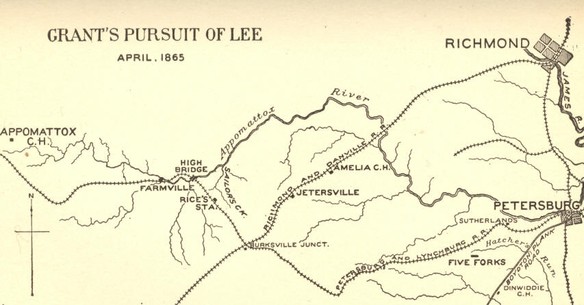
Grant's Pursuit of Lee; April, 1865.
It was Sunday, and the message reached Mr. Davis in church. He hastened
out with pallid lips and unsteady tread. A panic-stricken throng was
soon streaming from the doomed city. Vehicles let for one hundred
dollars an hour in gold. The state-prison guards fled and the criminals
escaped. A drunken mob surged through the streets, smashing windows and
plundering shops. General Ewell blew up the iron-clads in the river and
burned bridges and storehouses. The fire spread till one-third of
Richmond was in flames. The air was filled with a "hideous mingling of
the discordant sounds of human voices–the crying of children, the
lamentations of women, the yells of drunken men–with the roar of the
tempest of flame, the explosion of magazines, the bursting of shells."
Early on the morning of the 3d was heard the cry, "The Yankees are
coming!" Soon a column of blue-coated troops poured into the city,
headed by a regiment of colored cavalry, and the Stars and Stripes
presently floated over the Confederate capital.
The Confederacy was tottering to its fall. Lee had begun his retreat on
the night of the 2d, and was straining every nerve to reach a point on
the railroad fifty miles to the west, whence he could move south and
join Johnston. Grant was too quick for him. Sending Sheridan in advance
to head him off, he himself hurried after with the main army. Gray and
blue kept up the race for several days, moving on nearly parallel lines.
Sheridan struck the Confederate column at Sailor's Creek on the 6th, and
a heavy engagement ensued, in which the southern army lost many wagons
and several thousand prisoners.
Lee's band was in a pitiable plight. Its supplies had been cut off, and
many of the soldiers had nothing to eat except the young shoots of
trees. They fell out of the ranks by hundreds, and deserted to their
homes near by. With all hope of escape cut off, and his army dropping to
pieces around him, Lee was at last forced to surrender. To this end he
met Grant, on April 9th, at a residence near Appomattox Court House.
The personal appearance of the two generals at this interview presented
a striking, not to say ludicrous, contrast. Lee, who was a tall,
handsome man, was attired in a new uniform, showing all the insignia of
his rank, with a splendid dress-sword at his side. Grant, wholly
unprepared for the interview, wore a private's uniform, covered with mud
and dust from hard riding that day. His shoulder-straps were the only
mark of his high rank, and he had no sword. Having served together in
the Mexican War, they spent some time in a friendly conversation about
those old scenes. Grant then wrote out the terms of surrender, which Lee
accepted. The troops were to give their paroles not to take up arms
again until properly exchanged, and officers might retain their
side-arms, private horses, and baggage. Anxious to heal the wounds of
the South, Grant, with rare thoughtfulness, allowed privates also to
take home their own horses. "They will need them for the spring
ploughing," he said. The 19,000 prisoners captured during the last ten
days, together with deserters, left, in Lee's once magnificent army, but
28,356 soldiers to be paroled. The surrendering general was compelled to
ask 25,000 rations for these famished troops, a request which was
cheerfully granted.
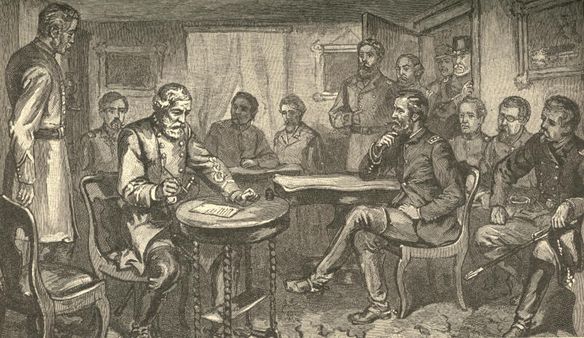
General Lee Signing the Terms of Surrender at Appomattox Court-House.
While all loyal hearts were rejoicing over the news of Lee's surrender,
recognized as virtually ending the war, a pall suddenly fell upon the
land. On the evening of April 14th, while President Lincoln was sitting
in a box at Ford's Theatre in Washington, an actor, John Wilkes Booth,
crept up behind him, placed a pistol to his head, and fired. Brandishing
his weapon, and crying, "Sic semper tyrannis," the assassin leaped to
the stage, sustaining a severe injury. Regaining his feet, he shouted,
"The South is avenged!" and made his escape.
The bullet had pierced the President's brain and rendered him
insensible. He was removed to a house near by, where he died next
morning. His body was taken to Springfield, Ill., for burial, and a
nation mourned above his grave, as no American since Washington had ever
been mourned for before. The South repudiated and deplored the foul
deed. Well it might, for, had Lincoln lived, much of its sorrow during
the next years would have been avoided.
Booth was only one of a band of conspirators who had intended also to
take off General Grant and the whole Cabinet. By a strange good fortune
Secretary Seward, sick in bed, was the only victim besides the
President. He was stabbed three times with a bowie-knife, but not
fatally. After a cunning flight and brave defence Booth was captured
near Port Royal, and killed. Of the other conspirators some were hanged,
some imprisoned.
The Confederacy collapsed. Johnston's army surrendered to Sherman on
April 26th. President Davis fled south. On May 10th he was captured in
Georgia, muffled in a lady's cloak and shawl, and became a prisoner at
Fortress Monroe. The war had called into military (land) service in the
two armies together hardly fewer than 4,000,000 men; 2,750,000, in round
numbers, on the Union side, and 1,250,000 on the other. The largest
number of northern soldiers in actual service at anyone time was
1,000,516, on May 1, 1865, 650,000 of them being able for duty. The
largest number of Confederate land forces in service at any time was
690,000, on January 1, 1863. The Union armies lost by death
304,369–44,238 of these being killed in battle, 49,205 dying of wounds.
Over 26,000 are known to have died in Confederate prisons.