
[1863]
We have seen that the fall of Donelson had driven the Confederates out
of Kentucky. In the following September, 1862, Bragg invaded the State
from Tennessee with 40,000 men. Buell hurried north from Nashville, and
after an exciting race headed him off from Louisville. Bragg slowly fell
back, first east, then south. Kentucky was rich in food and clothing,
and his army plundered freely, coming out, it was boasted, with a
wagon-train forty miles long. At Perryville Bragg turned upon Buell
fiercely. An indecisive battle was fought, October 8, 1862, which gave
the richly loaded wagon-train time to escape into Tennessee, whither
Bragg followed.
The Christmas holidays of 1862 found the Confederate host at
Murfreesboro, Tenn., thirty miles southeast of Nashville, where the
Union army lay. Rosecrans, who had succeeded Buell, moved suddenly to
the banks of Stone River, within four miles of the gay town, and
prepared to attack. Bragg, like Wellington from Brussels on the morning
of Waterloo, hurried forth to meet him. At dawn, December 31st, the
gray-colored columns emerged from the fog that overhung the river, and
spiritedly beat up the Union right. Two divisions were swept back.
Sheridan's men, inspired by their dashing leader, held their ground for
awhile, but fell rearward at last, and, forming a new line, stood at bay
with fixed bayonets. Rosecrans recalled the troops who had crossed the
river to make a similar attack upon the Confederate right, and massed
all his forces at the point of assault. Six times the southrons charged,
six times they were tumbled back by the Union batteries double-shotted
with canister. Night fell on a drawn battle.
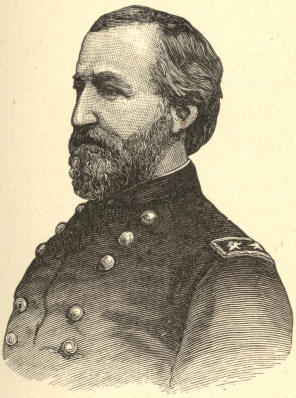
General William S. Rosecrans.
The next day, January 1, 1863, was peaceful save for cavalry
skirmishing. January 2nd the awful combat was renewed. Rosecrans having
planted artillery upon commanding ground, Bragg must either carry this
or fall back. He attempted the first alternative, and was repulsed with
terrible slaughter, losing 1,000 men in forty minutes. He escaped south
under cover of a storm. In proportion to the numbers engaged, the battle
of Stone River was one of the bloodiest in the war. About 45,000 fought
on each side. The Union loss was 12,000, the Confederate nearly 15,000.
Rosecrans did not advance again till June, although Bragg lay quite
near. The latter fell back as the Unionists approached, first into
Chattanooga and then over the Georgia line. Rosecrans followed. Bragg
was now re-enforced, and determined to retake Chattanooga, which lay on
the Tennessee River and was an important strategical point. The two
armies met on Chickamauga Creek, twelve miles south of Chattanooga. All
through the first day's battle, September 19th, there was hot
fighting–charges and countercharges–but no decisive advantage fell to
either side. During the night Bragg was reenforced by Longstreet's corps
from Virginia, and he opened the next day's fight with an assault upon
the Union left. Brigades were moved from the centre to support the left.
Through the gap thus made Longstreet poured his men in heavy columns,
cutting the Union army in two. Its right wing became demoralized, and
fled toward Chattanooga in wild confusion, Rosecrans after it at a
gallop, believing that all was lost.
But all was not lost. General Thomas commanded the Union left. Like a
flinty rock he stood while Polk's and Longstreet's troops surged in
heavy masses against his front and flank. About three o'clock heavy
columns were seen pouring through a gorge almost in Thomas's rear. They
were Longstreet's men. It was a critical moment Granger's reserves came
rushing upon the field. Raw recruits though they were, they dashed
against Longstreet like veterans. In twenty minutes, at cost of
frightful slaughter, the gorge and ridge were theirs. Longstreet made
another assault, but was again repulsed. At nightfall Thomas fell back
to Chattanooga, henceforth named, and justly, the "Rock of Chickamauga."
For six hours he had held his own with 25,000 braves against twice that
number. Out of 70,000 troops Bragg lost probably 20,000. Rosecrans's
force was about 55,000, his loss 16,000.
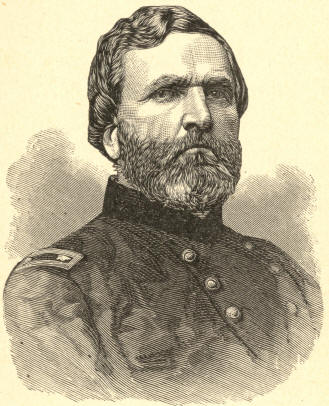
General George H. Thomas.
Bragg proceeded to shut up the Union army in Chattanooga. Grant, now
commanding the Department of the Mississippi, was ordered to recover
Chattanooga, and his deeds along this front, though less often
mentioned, will glitter upon the page of history with little if any less
lustre than those about Vicksburg. Upon his arrival, late in October, he
found the city practically in a state of siege. Its railroad
communication with Nashville was cut off, and supplies had to be hauled
in wagons sixty miles over a rough mountain road. The men had been for
some time on half rations. Thousands of horses and mules had starved,
and the artillery could not be moved for lack of teams. There was not
ammunition enough for one day's fighting. In five days Grant wrested the
railroad from Bragg's men and bridged the Tennessee, so that an abundant
supply of food and ammunition came pouring in.
Elated at his Chickamauga triumph, and unaware that he now had a greater
than Rosecrans in his front, Bragg deemed it a safe and promising
stratagem to despatch Longstreet's corps to Knoxville to capture
Burnside. It was a fatal step, and Grant was not slow to take advantage
of it. He telegraphed Sherman to put his entire force instantly en route
from Vicksburg to Chattanooga.
Chattanooga lies on the south side of the Tennessee River, at the
northern end of a valley running north and south. Along the eastern edge
of the valley rises Missionary Ridge. On the western side and farther
south, stands Lookout Mountain. After passing Chattanooga, the river
turns and runs south till it laves the base of Lookout Mountain. The
Confederate fortifications, twelve miles in length, ran along Missionary
Ridge, across the southern end of the valley, and up over Lookout
Mountain.
On November 23d, Thomas, who had succeeded Rosecrans, stormed the
breastworks half a mile from the base of Missionary Ridge. The next day
Grant sent "Fighting Joe Hooker" to sweep Bragg's detachment from
Lookout Mountain. Mist lay along the lofty slopes as the gallant Hooker
and his men moved up them, soon veiling the entire column from sight;
and it was only by the rattle of the musketry that Grant knew how the
fight progressed. This was the famous "Battle Above the Clouds." Hooker
pounded the enemy so lustily that they were glad to evacuate the
mountain in the night, and the next morning the Stars and Stripes
saluted the breezes of its topmost peak.
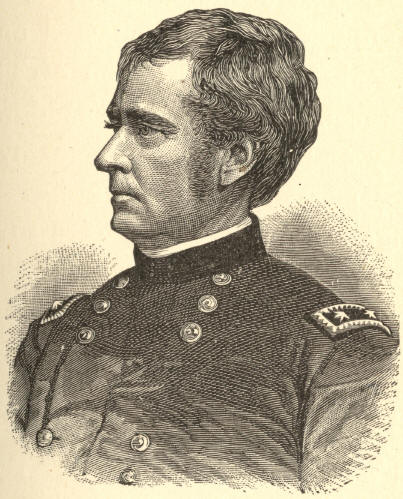
General Joseph Hooker.
While Hooker had been thus engaged, and for some days before, Sherman
had been at a movement that was even more momentous. He had slyly thrust
his army up the Tennessee River above the city, placing it between the
river and Missionary Ridge, and had worked its flank to the left as far
as the mouth of Chickamauga Creek. He had thus gotten possession of the
entire northeastern spur of that ridge with hardly the loss of a
corporal's guard.
The morrow after this was accomplished, November 25, 1863, was a day of
blood. Bragg's forces were now massed on Missionary Ridge, mainly in
front of Thomas and Sherman. Hooker had come down into the valley and
was to turn the enemy's left. If Bragg massed troops on either of the
two wings, Thomas's braves were to be let slip against the weakened
centre. Sherman got into action early in the morning, and fought his
painfully difficult way slowly up the rugged acclivities in his front.
Hooker had to bridge Chattanooga Creek, and did not attack till
afternoon. By three o'clock Sherman was so hard pressed that Grant found
it necessary to relieve him by sending Thomas forward at the centre.
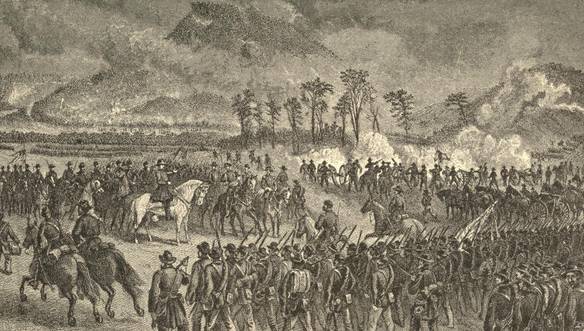
The Battle of Lookout Mountain. (The "Battle Above the Clouds.")
The signal guns boom–one, two, three, four, five, six. Up spring
Thomas's heroes from their breastworks, and rush like a whirlwind for
the first line of Confederate rifle-pits. Bragg sees the advance and
hurries help to oppose. His batteries open with shot and shell, then
with canister. The infantry rake Thomas with a withering fire. Yet on,
double quick, dash the lines of blue over the open plain, over rocks,
stumps, and breastworks, bayonetting back or capturing their
antagonists, till the first line of rifle-pits is theirs.
The orders had been to halt at this point and re-form. But here, with
Bragg's artillery raining a veritable hell-fire upon them–here is no
place of resting, and as the men's blood is up, they sweep forward
unbidden, with a cheer. It is five hundred yards to the top–a steep
ascent, covered with bowlders and fallen timber. Over the rocks, under
and through the timber, each one scrambles on as he can. Half-way up is
a line of small works. It is carried with a rush, and on the men go,
right up to the crest of the ridge. Now they confront the heaviest
breastworks. The air is thick with whizzing musket-balls, and fifty
cannon belch flame and death. But nothing can stop that furious charge.
Sheridan's men reach the top first, the rest of the line close behind.
The "Johnnies" are routed after a short fight, and the guns turned
against them as they fly. By night Bragg's army is in full retreat,
Chattanooga is safe and free, Grant's lines of communication are
assured, and the keys of the State of Georgia in his hands.
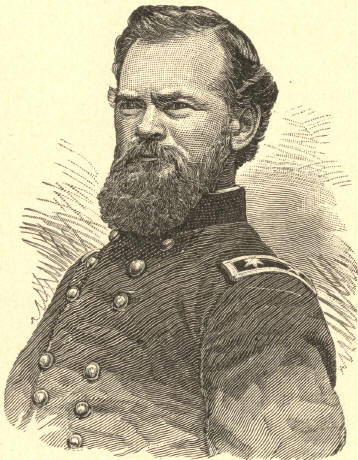
General James B. McPherson.
The Union forces in this battle numbered about 60,000, the Confederate
half as many; but the latter fought with all the advantage which the
mountain and breastworks could give them. They lost nearly 10,000
including 6,500 prisoners. The Union loss was between 5,000 and
6,000–2,200 in the one hour's charge against the centre.
[1864]
There was no halting, no resting. Scarcely had the sounds of yesterday's
cannonade died away, when Sherman's already jaded forces were put in
motion to the north, to make sure that Burnside was set free at
Knoxville; but Longstreet had already raised the siege and started east.
By December 6th, Bragg's redoubtable army, which, so recently as
September, swore to reconquer Tennessee and to invade Kentucky, was rent
in twain, one part of it fleeing to Virginia, the other to the heart of
Georgia.
No important military movement occurred in the Centre during this winter
of 1863-64. In March Grant was made Lieutenant-General, with command of
all the Union armies, Sherman succeeding to the headship of the
Mississippi Department. The latter accompanied his superior toward
Washington as far as Cincinnati, and there, in a parlor of the Burnet
House, the two victorious generals, bending over their maps together,
planned in outline that gigantic campaign of 1864-65, which was to end
the war; then, grasping one another warmly by the hand, they parted, one
starting east, the other south, each to strike at the appointed time his
half of the ponderous death-blow.
Sherman pushed out from Chattanooga May 6, 1864, with 100,000 men and
254 cannon. His force comprised the Army of the Cumberland, 60,000,
under Thomas; the Army of the Tennessee, 25,000, under Schofield; and
the Army of the Ohio, 15,000, under McPherson. Johnston, who had
superseded Bragg, lay behind strong works at Dalton, a few miles
southeast, with 64,000 men, his base being Atlanta, 80 miles away.
Sherman's supplies all came over a single line of railroad from
Nashville, nearly 150 miles from Chattanooga as the road ran. Every
advantage but numbers was on Johnston's side.
Sherman calculated that the Army of the Cumberland could hold his
opponent at bay, while the two smaller armies crept around his flanks.
This plan was adhered to throughout, and with wonderful success. All
through May and the first of June a series of skilful flanking movements
compelled Johnston to fall back from one position to another, each
commander, like a tried boxer, constantly on the watch to catch his
opponent off guard. Heavy skirmishing day after day made the march
practically one long battle.
June 10th Johnston planted his army upon three elevations–Kenesaw,
Pine, and Lost Mountains–and stubbornly stood at bay. A pouring rain,
which turned the whole country into a quagmire and the streams into
formidable rivers, made the usual flank manoeuvre impracticable. Sherman
resolved to assault in front. June 27th a determined onset was made
along the whole line for two hours but failed, though the troops gained
positions close to the hostile works and intrenched. They lost 2,500;
the Confederates not more than a third of this number. The roads having
now improved, Sherman resorted to his old tactics, the Confederates
having to fall back across the Chattahoochee, and come to bay under the
very guns of Atlanta.
Just at the critical moment, when Sherman's army was slowly closing in
around Atlanta, General Johnston, so wary and cool, was superseded by
the young and fiery Hood, pledged to assume the offensive. On the 20th
Hood made a furious attack on Hooker's front, but was repulsed with
heavy losses. On the 22d he struck again, and harder. By a night march,
Hardee's corps at dawn fell upon the Union left flank and rear like a
thunderbolt out of a clear sky, rolling up the Army of the Tennessee in
great confusion. The brave and talented McPherson was killed early in
the action, Logan succeeding. "McPherson and revenge," he cried, as upon
his coal-black steed he careered from post to post of danger, inspiring
his men and restoring order. The veterans soon recovered from their
surprise. The Union lines were completely re-established, and by night
Hood's army was driven back into the city, having sacrificed probably
10,000 much-needed men, 2,500 of them killed.
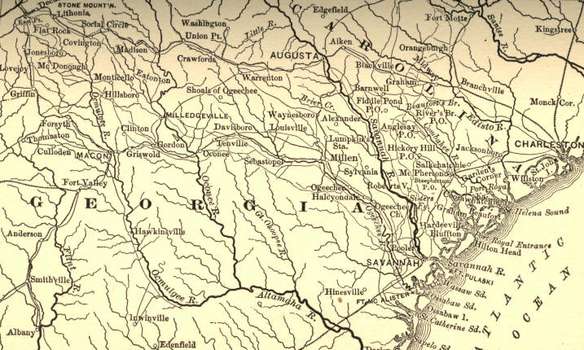
Atlanta to Savannah.
Sherman now began to swing round to the south and southeast of Atlanta,
till at last he cut its communications with the Confederacy. Hood
evacuated the city and his opponent entered it, September 5th. The
northern troops, after their four months' incessant marching and
fighting, now got a little well-earned rest. Their total losses from
Chattanooga were 32,000. The Confederates had sacrificed about
35,000–the larger part under Hood.
The last of September Hood struck out boldly for Tennessee, menacing,
and, in fact, temporarily rupturing Sherman's long supply-line from
Nashville. Leaving one corps to hold Atlanta, Sherman raced back for 100
miles in pursuit. The railroad being well guarded, Hood could do no
serious damage, and finally turned west into Alabama. Sherman now
resolved on a march to the sea. Thomas, with three corps, was sent to
Tennessee to look out for Hood. The 62,000 troops remaining at Atlanta
were put into light marching trim, and the wagons filled with 20 days'
rations and 200 rounds of ammunition per man. All storehouses and other
property useful to the enemy were then destroyed, communications with
the North cut, and November 15th a splendid army of hardy veterans swung
off for the Atlantic or the Gulf, over 200 miles away. Their orders were
to live on the country, the rations being kept for emergencies; but no
dwellings were to be entered, and no houses or mills destroyed if the
army was unmolested. The dwelling-house prescription was, alas, too
often broken over. There was little resistance, Georgia having been
drained of its able-bodied whites. Negroes flocked, singly and by
families, to join "Massa Linkum's boys." The railroads were destroyed,
and the Carolinas thus cut off from the Gulf States.
Each regiment detailed a certain number of foragers. These, starting off
in the morning empty-handed and on foot, would return at night riding or
driving beasts laden with spoils. "Here would be a silver-mounted family
carriage drawn by a jackass and a cow, loaded inside and out with
everything the country produced, vegetable and animal, dead and alive.
There would be an ox-cart, similarly loaded, and drawn by a nondescript
tandem team equally incongruous. Perched upon the top would be a ragged
forager, rigged out in a fur hat of a fashion worn by dandies of a
century ago, or a dress-coat which had done service at stylish balls of
a former generation. The jibes and jeers, the fun and the practical
jokes, ran down the whole line as the cortege came in, and no masquerade
in carnival could compare with it for original humor and rollicking
enjoyment. ... The camps in the open pine-woods, the bonfires along the
railways, the occasional sham battles at night with blazing pine-knots
for weapons whirling in the darkness, all combined to leave upon the
minds of officers and men the impression of a vast holiday frolic."
[footnote: The March to the Sea, by Major-General J. D. Cox. Campaigns
of the Civil War. Scribners.]
At the start Sherman was uncertain just where he should strike the
coast. The blockade vessels were asked to be on the lookout for him from
Mobile to Charleston. By the middle of December the army lay before
Savannah. Hardee held the city with 16,000 men, but evacuated it
December 20, 1864, Sherman entering next day. He wrote to Lincoln, "I
beg to present you as a Christmas gift the city of Savannah." The
capture of Fort McAllister a week before had opened the Ogeechee River,
and Sherman now established a new base of supplies on the sea-coast.
The North rang with praises of the Great March, which had pierced like a
knife the vitals of the Confederacy. Georgia, with her arsenals and
factories, had been the Confederacy's workshop. Twenty thousand bales of
cotton had been burned upon the march, besides a great amount of
military stores. The 320 miles of railroad destroyed had practically
isolated Virginia from the South and the West. And all this had been
done with the loss of less than 1,000 men.
[1865]
Meanwhile Thomas had dealt the Confederacy another staggering blow. The
adventurous Hood had advanced with his army of 44,000 to the very gates
of Nashville. The deliberate Thomas, spite of prickings from Grant,
waited till he felt prepared. Then he struck with a Titan's hand. The
first day's fight, December 15th, drove the Confederate line back two
miles. Hood formed again on hills running east and west, and hastily
fortified. All next day the battle raged. Late in the afternoon the
works on the Confederate left were carried by a gallant charge. Total
rout of Hood's brave army followed. It fled south, demoralized and
scattered, never to appear again as an organized force. In the two days'
battle, 4,500 prisoners and 53 guns were taken.
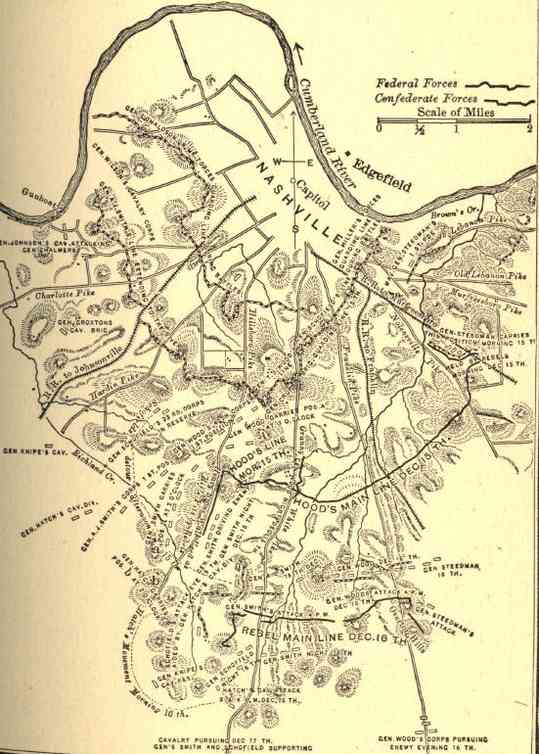
The Battle-Field of Nashville.
February 1, 1865, his troops all rested and equipped afresh, Sherman set
his face to the north. The days of frolic were over. Continuous rains
had made the Carolinas almost impassable. The march now begun was an
incessant struggle with mud, swamps, and swollen rivers. A pontoon and
trestle bridge three miles long was thrown across the Savannah, and
miles of corduroy road were built through continuous swamps. Charleston,
incessantly besieged since the war opened, where the United States had
wasted more powder and iron than at all other points together, fell
without a blow. Columbia was reached the middle of the month. It caught
fire–just how has never been settled–and the greater part of the city
was destroyed. Sherman's men helped to put out the flames, and left
behind provisions and a herd of five hundred cattle for the suffering
inhabitants.
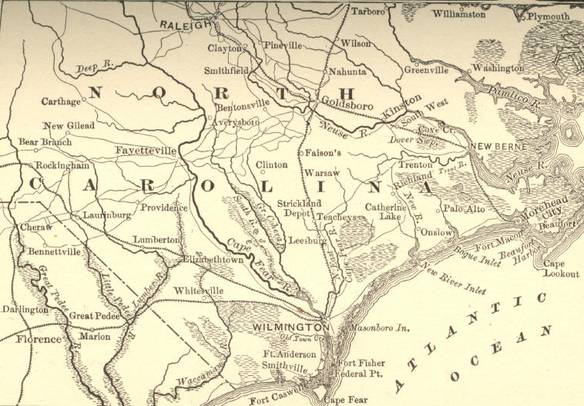
Map of North Carolina.
The army pushed on toward North Carolina, destroying railroads as it
went. Johnston was athwart their path with 30,000 men. March 16th he
struck Sherman's army at Averysboro', N. C., and three days later at
Bentonville. In the latter battle he was completely routed, and re
treated during the night. Sherman swept on to Goldsboro', where
re-enforcements from the coast, under Schofield, increased his army to
90,000. He was undisputed master of the Carolinas. By this time the
Confederacy was hastening to its fall. April 11th the news of Lee's
surrender was hailed in Sherman's army with shouts of joy. A few days
later Johnston surrendered to the hero of Atlanta and of the March to
the Sea.