
The North conducted the war upon three great lines of campaign: 1. The
Western campaigns, to clear the Mississippi River and thus divide the
Confederacy. 2. The campaigns in the centre, to reach the sea at Mobile,
Savannah, or Charleston, cutting the Confederacy a second time. 3. The
Eastern campaigns, to take Richmond, and capture or destroy the main
Confederate army, ending the Confederacy. This chapter deals with the
Western campaigns alone.
[1862]
The opening of 1862 found the Confederates in possession of a strong
line across the southern portion of Western Kentucky, stretching from
Bowling Green, near the centre of the State, to Columbus on the
Mississippi. The two gates of this line were Forts Henry and Donelson,
on the Tennessee and Cumberland Rivers, respectively, just over the
Tennessee border. If these forts could be taken the Confederates must
give up Kentucky.
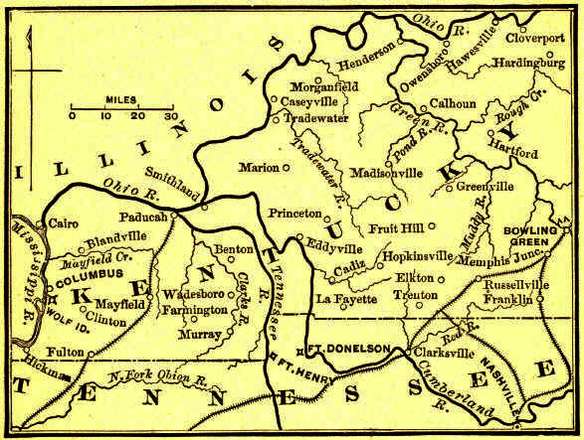
The Confederate Line from Columbus to Bowling Green.
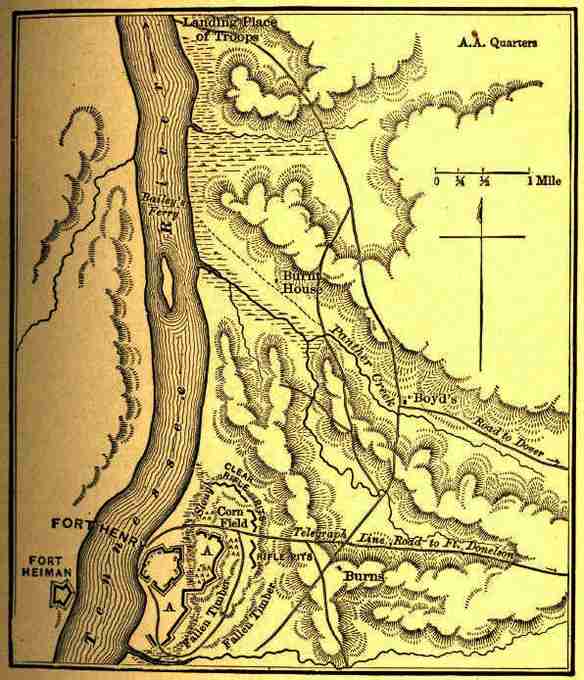
Fort Henry.
On February 6th, after a two hours' bombardment, Fort Henry surrendered
to General Grant, who had come up the river from Cairo with 17,000
troops, and with seven gunboats commanded by Commodore Foote. Most of
the garrison, about 3,000, had been sent off before the fleet opened
fire, General Tilghman foreseeing that he could not hold the fort. The
land forces arrived too late to cut off their retreat, and they escaped
safely to Fort Donelson, some dozen miles to the east.
Grant marched at once to invest Donelson, and sat down before it on the
12th with 15,000 men. The stronghold stood upon a bluff 100 feet high.
On the east it was protected by the Cumberland River; on the north and
south by two flooded creeks. Along a crest back of the fort a mile or
two ran a semicircular line of rifle-pits, with abatis in front. Nine
batteries were posted at various points along the line. Donelson was
garrisoned by 20,000 men under Generals Floyd, Pillow, and Buckner, who
quietly looked on while Grant's smaller army hemmed them in. On the 14th
the gunboats opened fire upon the water batteries between fort and
river. Commodore Foote steamed up boldly within 400 yards and pounded
the opposing works with his heavy guns. He did little damage, however,
while the Confederate fire proved very effective against him. His
flag-ship, the Hartford, was struck fifty-nine times. A shot crashed
into the pilothouse, destroying the wheel and wounding Foote himself.
The boat became unmanageable and drifted down-stream. A shot cut the
tiller-ropes of the Louisville. The other boats were also considerably
damaged, and after an action of an hour and a half, the entire fleet
withdrew.
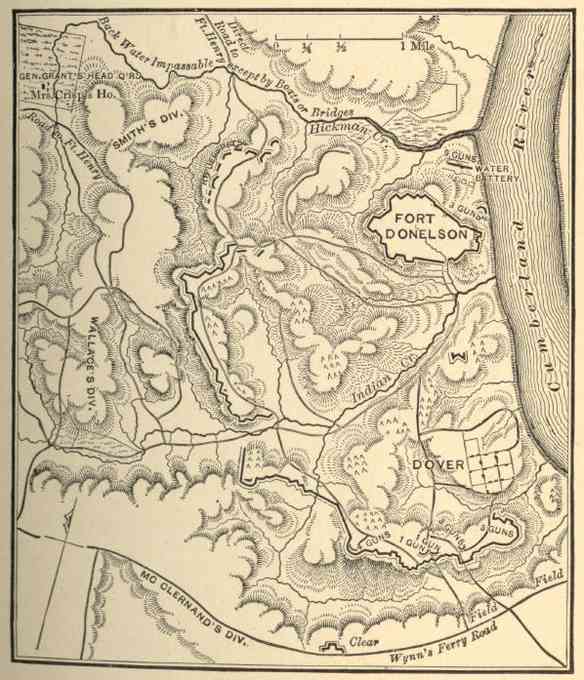
Fort Donelson.
But Grant's army had been re-enforced to 27,000. Three divisions, under
Smith, Wallace, and McClernand, stretched in a semicircle about Donelson
from north to south. On the night of the 14th the Confederate generals
held a consultation, and decided to try cutting their way out. Most of
the troops were withdrawn from the rifle-pits during the night, and
massed on the Union right. The weather had suddenly turned frosty, and
the Union men, without tents or camp-fires, many even without blankets,
shivered all night in the intense cold. Before dawn the attacking column
from inside, 10,000 strong, rushed through the woods and fell upon
McClernand's division, which formed the Union right. For hours the woods
rang with musketry and the southern yell. Slowly the Confederates drove
the Unionists before them and gained the road running south to
Charlotte, opening to themselves the way of escape.
This, however, they had not yet utilized, when, about one o'clock,
General Grant, who had been aboard the fleet consulting with Commodore
Foote, came upon the field. Learning that the foe had begun to fight
with full haversacks, he instantly divined that they were trying to make
their escape, and inferred that their forces had been mostly withdrawn
from opposite the Union left to make this attack against the right.
General Smith was therefore instantly ordered to fall upon the
Confederate right. As Grant had surmised, the intrenchments there were
easily carried. Meanwhile the demoralized soldiers of the Union right
and centre rallied, and drove the Confederates back to their
intrenchments. At daybreak Buckner sent to Grant for terms of
capitulation. "No terms except unconditional and immediate surrender can
be accepted: I propose to move immediately upon your works," was the
answer. The resolute words rang through the North, carrying big hope in
their remotest echo. Donelson surrendered. Floyd and Pillow had sneaked
away during the night, the former monopolizing the few boats to
transport his own brigade. Fifteen thousand troops remained and were
taken prisoners.
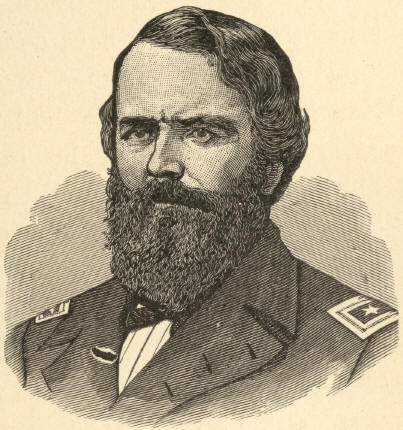
General John Pope.
The capture of Henry and Donelson necessitated the evacuation of Bowling
Green and Columbus. Kentucky was now clear of Confederates, and the
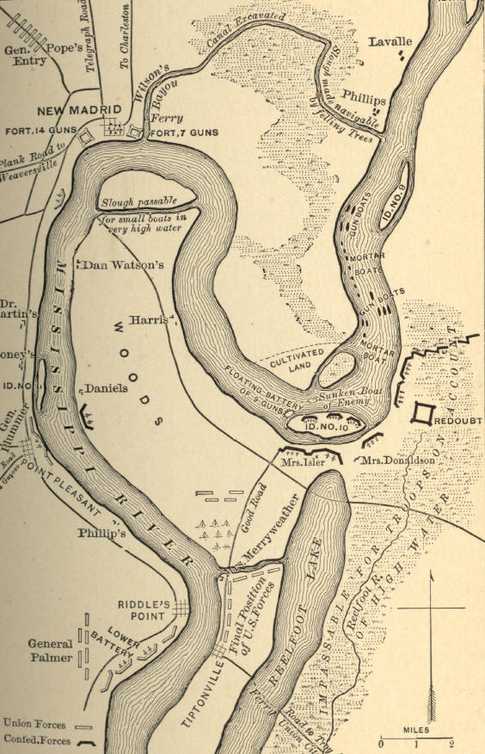
Mississippi open down to Island Number Ten. This island lay in a bend of
the river at the extreme northwestern corner of Tennessee. The great
stream here runs northwest for a dozen miles, then sharply turns to the
south again. New Madrid stands at this northern bend. It was protected
by Confederate fortifications and gunboats. Early in March, General
Halleck, now at the head of the Western Department, sent General Pope
against New Madrid with 20,000 men. The enemy fled to Island Number Ten,
leaving thirty-three guns, besides ammunition and many tents.
Island Number Ten was strongly fortified. Commodore Foote came down the
river with seventeen gunboats, and on March 16th began a bombardment
which was kept up for three weeks with little effect; but early in April
Pope got upon the Tennessee shore, in the undefended rear of the island,
and by intercepting its communication to the south, forced it to
surrender, April 8th. Seven thousand prisoners, one hundred heavy siege
guns, several thousand small arms, besides large stores of ammunition
and supplies, were thus secured, without the loss of a single Union
soldier. This exploit brought to Pope great fame.
Pope now descended the river to Fort Pillow, 100 miles below, which he
prepared to take. He was just then transferred by Halleck to another
field, and the reduction of Pillow left to the gunboats. Pillow was
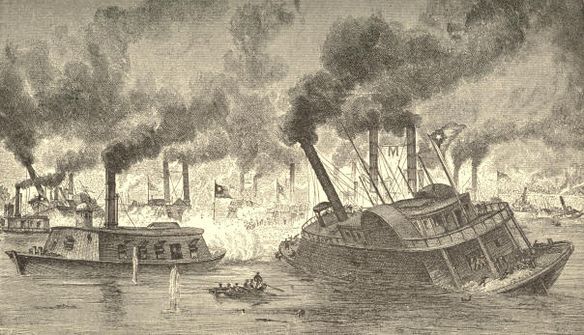
abandoned June 4th. The Union flotilla, increased by four rams, now ran
down the river to Memphis, where, on June 6th, in the presence of
thousands of spectators upon the bluffs, it fought a battle with a
southern fleet. Seven of the Confederate boats were destroyed, and the
next day Memphis surrendered.
After the fall of Donelson the Confederates began concentrating their
forces at Corinth, in the northeast corner of Mississippi. Meanwhile the
Army of the Tennessee, under orders from Halleck, had moved up the
Tennessee River, and encamped, some 40,000 strong, at Pittsburg Landing
on the Tennessee River, 25 miles north of Corinth. Here Grant, who had
been temporarily removed, took command again on March 17th. Buell, with
40,000 men, was on the march thither from Central Tennessee. The
Confederate generals at Corinth, Albert Sidney Johnston and Beauregard,
wisely determined to strike Grant before Buell arrived. There ensued the
greatest battle which had up to that time shaken the solid ground of
this continent.
[footnote: Indifferently called the battle of Shiloh or the battle of
Pittsburg Landing.]
New Madrid and Island Number Ten.
About six o'clock on the morning of April 6th the Confederates burst
through the thick woods upon the Union pickets and drove them in. It was
at least partially a surprise. Grant in person was nine miles down the
river. The Union officers hastily got their men into line, as the
attacking columns came sweeping in after the pickets. Three of the five
Union divisions were raw recruits, many of whom fled at the first fire.
Some colonels led their entire regiments off the field. Later in the day
Grant saw 4,000 or 5,000 of these runaways cowering under the shelter of
the bluffs.
General William T. Sherman.
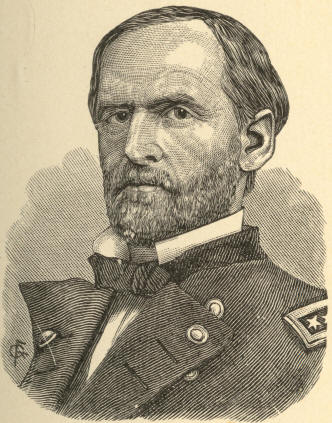
But the bulk of the army made a stubborn resistance. General W. T.
Sherman, then comparatively unknown, inspired his division of raw troops
with his own intelligent courage. Their gallant and protracted fight
around the Shiloh log church made them the heroes of the day. But the
Confederates' onset was impetuous. Step by step they forced their
opponents back through the heavy woods, and by noon stood in possession
of the Union camps; Grant's army, badly shattered, being cooped up in a
narrow space along the edge of the river.
The tide now turned. About two o'clock, General Johnston was killed, and
the Confederate advance flagged. Between the two armies lay a deep
ravine. Grant planted some fifty guns upon the edge, and two of the
gunboats took positions where they could rake the ravine. By these
dispositions Beauregard's advance was stayed. Night fell, and
hostilities ceased.
Fortunately, 22,000 of Buell's men arrived during the night, and next
morning Grant ordered an advance. Beauregard made as desperate a
resistance as he could, seeing that his heavy losses the day before had
left him but 30,000 troops fit for duty. Buell's men showed the effects
of long training under that matchless disciplinarian, and fought
splendidly. The enemy were steadily pushed back, until more than all the
ground lost on the preceding day had been triumphantly regained, and the
battle of Pittsburg Landing, from being for the Union side a defeat
accomplished and a surrender threatened, was turned into a bright and
inspiring victory. Beauregard ordered a retreat, and, not being pursued,
regained his old position at Corinth. He had lost about 10,000 men. Our
loss was 12,000, including four regiments taken prisoners. The battle
was a severe check to both sides.
A.R. Ward H.R. Hall, JR.
The Battle of the Rams at Memphis, June 6, 1862.
On February 2d the largest fleet that had ever sailed under the American
flag left Fortress Monroe for the mouth of the Mississippi, commanded by
Commodore Farragut. It consisted of 16 gunboats, 21 mortar-schooners,
six sloops of war, and five other vessels. Fifteen thousand land troops,
under General Butler, soon followed. Thirty miles below New Orleans
Forts Jackson and St. Philip, mounting 100 guns, frowned at each other
across the Mississippi. Farragut's fleet sailed up the river and the
mortar-schooners were moored to the banks within range of the forts.
Boughs were tied to the top-masts so that the enemy could not
distinguish them from the trees along the shore. April 18th the mortars
began shelling the forts. An incessant fire was kept up night and day,
for six days, till nearly 6,000 shells had been thrown.
Memphis to Iuka. 1862.
As the forts sustained little damage, Farragut decided to run the
batteries. A gunboat stole up by night and cut the boom of hulks chained
together, which crossed the river just below the forts. Some of the
boats were rubbed over with mud to make them invisible, and chain cables
hung over the sides to protect the engines. About half past two in the
night of April 23d the fleet moved up the river through the gap in the
boom. The enemy, on the alert, launched fire-rafts and lit bonfires to
lift the cover of night. Old Jackson and St. Philip poured a hot fire
into the fleet as vessel after vessel slowly steamed past, answering
with its most spiteful broadsides.
But the Union craft had more than the forts against them. Once past the
boom they were in the midst of a hostile fleet of fifteen vessels,
including a dangerous ironclad ram. A fierce water-fight followed. The
Union Varuna was sunk; the flag-ship Hartford set on fire by one of the
fire-rafts. The flames, however, were soon put out. Other vessels were
disabled. But every one of the Confederate ships was captured or
destroyed, and Jackson and St. Philip had to surrender. Farragut then
sailed up the river and took possession of New Orleans without
resistance. Butler at once occupied the city with his troops, and the
Stars and Stripes again waved over the Crescent City. Since that
eventful day New Orleans has never been in disunionist hands.
After the battle of Pittsburg Landing, Halleck himself came down from
St. Louis, and took the reins. Grant was nominally in command under him,
but had next to nothing to do. Re-enforced by 25,000 men under Pope,
Halleck slowly advanced toward Corinth, entering the place May 30th,
Beauregard having evacuated it May 29th. A few Quaker guns–logs mounted
on wagon-wheels–were the only trophies. Halleck now had 110,000
effectives, Beauregard less than 60,000. Halleck lay inactive at Corinth
for six weeks, when he was summoned to Washington as General-in-Chief.
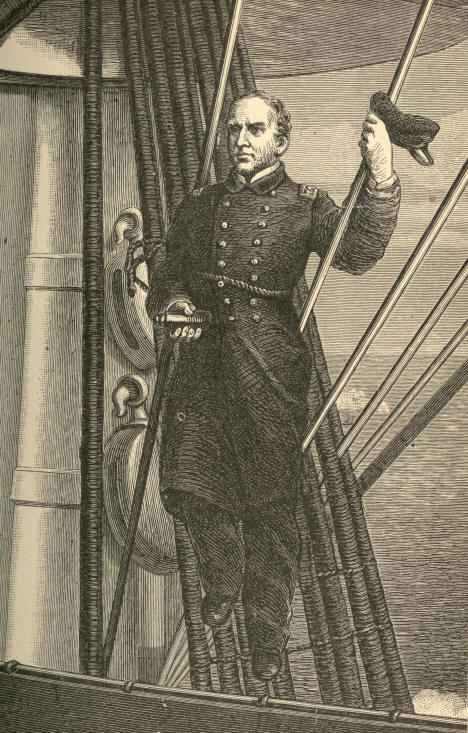
Farragut in the Main-Rigging.
From the original by William Page.
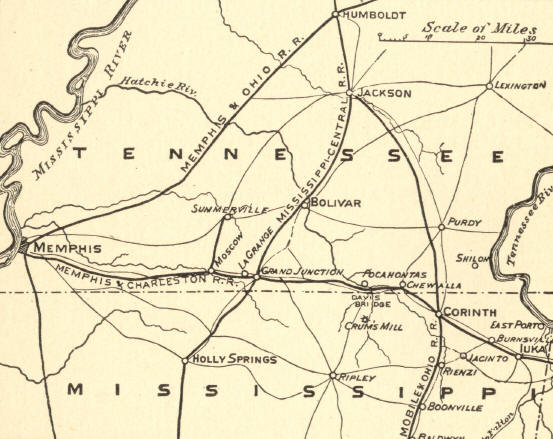
Grant once more took command of the forces about Corinth, which
re-enforcements to Eastern Tennessee soon reduced to 42,000. With these
he was expected to guard 200 miles of railroad, from Memphis to Decatur
in Northern Alabama. The Confederates under Van Dorn and Price attempted
to regain Corinth, but in the battles of Iuka, September 19th, and
Corinth, October 3d and 4th, were repulsed with heavy losses. Grant then
took the offensive. Vicksburg, about half-way from north to south on
Mississippi's western boundary, was the only stronghold left to the
Confederates on the great river. Its capture would ideally complete the
western campaign. Grant's plan was for Sherman to descend the river from
Memphis, while he himself simultaneously attacked Vicksburg by land.
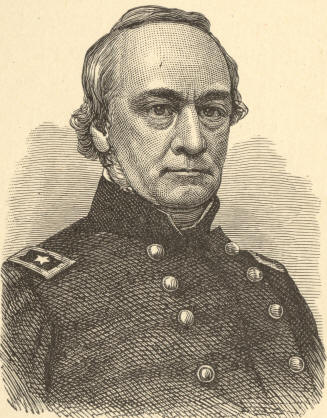
General Henry W. Halleck.
[1863]
So long as the stout-hearted general continued his march south all his
supplies had to be brought over the Mississippi Central Railroad from
Holly Springs, near the Tennessee border. A troop of 3,500 Confederate
cavalry, making a long detour around his army, swooped down upon Holly
Springs, December 20th, captured the garrison of 1,300 men, and
destroyed all the stores, valued at $2,000,000. For two weeks the Union
army had to live from the enemy's country, and then after all to fall
back to Holly Springs. Meanwhile Sherman, ignorant of his superior's ill
fortune, descended the Mississippi, and with a force of 30,000 made
during the last days of the year an unsuccessful attack upon Vicksburg.
Very early in January, 1863, McClernand arrived near Vicksburg with
re-enforcements. The last of the month, Grant, who had given up the land
expedition, took command in person. Sherman's repulse had shown that
Vicksburg could not be taken from the water side. A position must be
gained in the rear. This seemed, and indeed proved, an almost impossible
task. The Mississippi was unusually high, and the surrounding country a
vast network of bayous and swamps. The winter passed away in fruitless
labors to make some sort of a water passage to the rear of Vicksburg,
either above, via the Yazoo, or around through Louisiana to some point
below the city, whence the army could cross again to the Vicksburg side
of the Mississippi and strike Pemberton's stronghold from the southeast.
In most of these attempts Grant himself had little faith, but the army
was better at work than idle. At last he resolved, without attempting a
regular canal, partly by land but utilizing bayous and creeks as he
could, to swing his army across west of the river to New Carthage, south
of Vicksburg, run the Vicksburg batteries with the fleet, and, uniting
his land and water forces in the capture of Grand Gulf, to gain the rear
of Vicksburg by way of the Big Black River. It was a bold plan, but it
succeeded.
In April, by building corduroy roads through miles of swamp and bridging
numberless bayous, the general succeeded in reaching New Carthage, some
twenty miles south of Vicksburg, with a good part of his land forces. On
the night of April 16th, the gunboats and provision transports ran the
gauntlet of Vicksburg's guns with little damage. The last of the month a
landing was effected just below Grand Gulf, on the east bank, fifteen or
twenty miles still farther south of Vicksburg. The enemy made some
resistance, but were driven back.
Grant's position was now full of peril. He was in the heart of the
enemy's country. Pemberton was occupying Jackson and Vicksburg with
50,000 men. General Joseph E. Johnston was hurrying to his aid with
re-enforcements. Grant's forces available for an advance about equalled
Pemberton's. A bold policy was the only safe one. Taking five days'
rations, he cut loose from his base at Grand Gulf and marched north to
attack Pemberton before Johnston could join him. Jackson, forty-four
miles to the east of Vicksburg, was easily captured, May 14th. Grant had
thus thrust himself in between Johnston and Pemberton. Turning to the
left he smote Pemberton a heavy blow at Champion's Hill on the 16th, and
drove him into Vicksburg. Johnston fell back baffled. In eighteen days
Grant had marched 200 miles, defeated the enemy in four engagements,
inflicting a loss of 8,000 and taking 88 guns, and shut up a large army
in Vicksburg–all this upon five days' rations. It is a brilliant
record, equalled, if at all, only by some of Napoleon's campaigns.
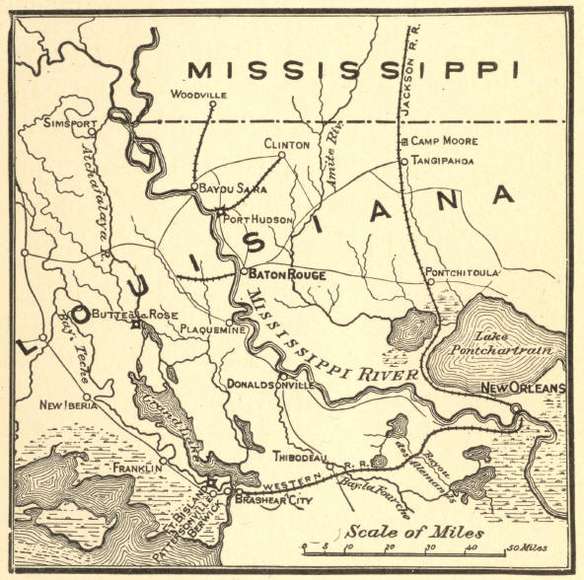
Operations in Louisiana. February to July, 1863.
The bold commander now transferred his base of supplies to the Yazoo
River, which runs into the Mississippi a few miles above Vicksburg.
After an unsuccessful assault upon the city's strong intrenchments, he
sat down to a deliberate siege. Twelve miles of trenches were
constructed. Eighty-nine batteries, with more than 200 guns, day after
day rained shot and shell against the Vicksburg fortifications. The
lines of investment crept nearer and nearer the fated city. The pickets
chaffed with each other, and exchanged tobacco and newspapers. June
25th, a mine was exploded under one of the Vicksburg parapets, but it
made no effectual breach. A second explosion, July 1st, was equally
unavailing. Johnston kept menacing the rear, but feared to attack, as
Grant had been re-enforced to 60,000.
Famine began to threaten the city, Porter's fleet blockading the water
front. Flour sold for $1,000 a barrel in Confederate money. Mule flesh
became the chief meat. Rats were hung up for sale in the market. The
inhabitants sought protection from the shells in cellars and caves.
Cave-digging became a regular business. The Vicksburg daily news sheet
was now printed on wall paper. July 3d. white flags appeared upon the
city's works. An armistice followed, and the next day Pemberton
surrendered. The prisoners, some 30,000 in number, were mostly released
on parole. With the fall of Vicksburg the western campaigns virtually
closed. The capture of Port Hudson, below, was assured from that moment,
and followed on July 8th. The "Father of Waters" once more rolled
"unvexed to the sea," and the Confederacy was cut in twain.