
[1910-1911]
After many years of urging on the part of statisticians and public men,
Congress, in 1902, passed a bill which was signed by the President
providing for a permanent census bureau connected with the Department of
Commerce and Labor. This bureau, as shown in the taking of the
thirteenth census, serves to promote both efficiency and economy in the
collection of statistics associated with the census work. Heretofore the
Director of the Census had enormous patronage at his disposal which he
farmed out among congressmen and other political leaders.
E. Dana Durand, a trained statistician of wide experience, was appointed
Director of the Census. He announced that so far as possible the 65,000
enumerators would be selected under civil service rules and for
supervisors of the census he selected men on the basis of their special
fitness for the work. President Taft was in complete agreement with this
programme and insisted that local enumerators were to be appointed for
the purpose of getting the work properly done and not to assist any
would-be dispensers of local patronage.
On April 15 the enumerators began their work of gathering statistics.
The usual inquiries were made on population, mortality, agriculture,
manufactures, etc. Prior to April 15, an advance schedule was sent to
practically every farmer in the country, and he was asked to fill it out
before the coming of the enumerator. Similarly, in the cities, the
enumerators distributed advance population schedules which the head of
the family was requested to fill out before the official visit of the
enumerator. In taking the thirteenth census, greater attention was given
than ever before to perfecting the schedules and weighing each question
with regard to its precise significance and scientific value. To that
end a group of trained investigators, familiar with the various topics
which the census would cover, spent several months on a preliminary
study of the character of these questions. In addition to the
nationality of each person as determined by the mother tongue of the
foreign-born inhabitants, additional inquiries were made relative to the
industry in which each person was employed and whether the person was
out of work on April 15.
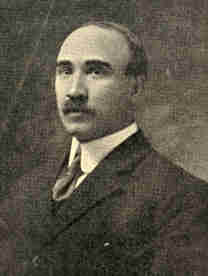
Copyright by Clinedinst. Washington.
E. Dana Durand, Director of the Census.
Population schedules in the cities and large towns were required to be
completed within two weeks and in the rural districts within thirty
days. The enormous labor of tabulating and classifying these answers was
then begun by the 3,500 clerks in the Census Office at Washington. Much
of this labor was performed by machines each capable of making 25,000
tabulations a day. Results of the first tabulation of the population in
the cities were made known about June 1 and the count of the principal
cities was completed by April 15. During September the population of the
entire country was made known. Within two years the leading facts in the
census were compiled and published as special bulletins. The entire cost
of the census was about $13,000,000.
The total population of the United States, including our territorial
possessions and dependencies, was found to be about 101,000,000, thus
for the first time passing the hundred million mark. The population of
the United States proper was 91,972,266; of Alaska, 64,356; Porto Rico,
1,118,012; Hawaii. 191,909; Guam and Samoa, 15,100; the Philippine
Islands about 7,700,000. These numbers indicate an increase in the
population of continental United States of 21 per cent in the decade, or
a slightly larger growth than the 20.7 per cent made during the
preceding ten years.
One of the striking facts brought out in the census is the absolute
decline in the percentage of population compared with the previous
decade in a number of the States of the East, South, and Middle West,
and an increase of this percentage in the other States, especially among
those of the Rocky Mountains and the Pacific Coast. The percentage of
total increase of population in Alabama was 16.9 and the increase,
according to the twelfth census, was 20.8; in Illinois, 16.9 as against
26 for the preceding census; Indiana, 7.3 against 14.8; Kentucky, 6.6
against 15.5; Massachusetts, 20 against 25.3; Minnesota, 18.5 against
33.7; Texas, 27.8 against 36.4; Montana, 54.5 against 70. Iowa showed an
actual loss of three-tenths per cent of her inhabitants, while according
to the preceding census there was a gain of 16.7 per cent in that State.
In the following States the gains in percentages were as follows: North
Dakota, 80.8 against 67.1 for 1900; South Dakota, 45.4 and 15.2; Kansas,
15 and 3; Nebraska, 11.8 and 0.3; Colorado, 48 and 30.6; Oklahoma,
109.7; Utah, 34.9 and 31.3; Nevada, 93.4 and 10.6; Idaho, 101.3 and
82.7; Washington, 120.4 and 45; Oregon, 62.7 and 30.2, and California,
60.1 and 22.4.
In numerical advance, New York, Pennsylvania, California, Texas, and
Illinois led. The increase in New York was nearly 2,000,000, in
Pennsylvania over 1,000,000, and in the other three States nearly
900,000 each.
Another notable fact brought out by the thirteenth census was that the
growth of the cities was greater than during the preceding ten years.
The rate of growth of the medium-sized cities was more rapid than that
of the large cities. This was not the case during the preceding decade.
Of the total population of continental United States, 46.3 per cent were
urban. That is, 42,623,383 of the inhabitants resided in cities and
towns having a population of 2,500 or more. The same territory in 1900
and 1890, similarly classified as urban, contained 40.5 and 36.1 per
cent, respectively, of the total population of the country. In all but
two States, Montana and Wyoming, the urban population has increased
faster than the rural population. The increase, since 1900, in the
population living in urban territory was 11,035,841 or 34.9 per cent,
while the increase in population living in rural territory during the
same period was 4,941,850 or 11.1 per cent. For the United States as a
whole, therefore, the rate of increase for the population of urban areas
was three times that for the population living in rural territory. In
the States of the east north-central division, including Ohio, Indiana,
Illinois, Michigan, Wisconsin, the urban gain was 31.2 per cent, but
there was a decrease in rural population of 0.2 per cent. The urban
increase of Illinois was 31.2 per cent, but the rural territory of the
State showed a loss of 7.5 per cent. The rural loss in Indiana was 5.5
per cent, and in Ohio 1.3 per cent. Michigan's rural gain was 2 per cent
and Wisconsin's 5.7. per cent. There were fourteen States in which more
than one-half of the population in 1910 were living in urban territory.
Among these States were Massachusetts, Rhode Island, and Connecticut
with nine-tenths of their population urban; Illinois with 62 per cent,
and Ohio with 56 per cent.
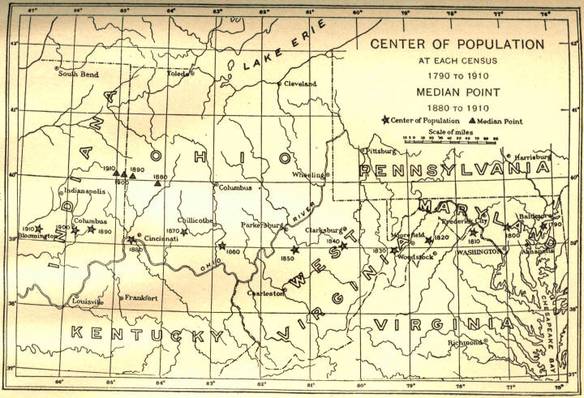
CENTER OF POPULATION AT EACH CENSUS 1790 TO 1910.
MEDIAN POINT 1880 TO 1910.
[Transcriber's Note: Location is within a few miles of latitude 39
degrees. The longitude is approximately: 1790, 76.2; 1800, 77.0; 1810,
77.6; 1820, 78.6; 1830, 79.3; 1840, 80.4; 1850, 81.3; 1860, 82.8; 1870
83.7; 1880, 84.7; 1890, 85.5; 1900, 85.8; 1910, 86.5 ]
The rapid growth of our industrial and manufacturing interests during
the past quarter of a century is shown by the fact that 22 per cent of
the people of the country are massed in cities of 100,000 inhabitants
and over. In the three largest cities alone–New York, Chicago, and
Philadelphia–there are almost one-tenth the population of the whole
country. There were five cities with populations between 500,000 and
1,000,000; eleven between 250,000 and 500,000; 31 between 100,000 and
250,000; 59 between 50,000 and 100,000; 120 between 25,000 and 50,000;
374 between 10,000 and 20,000; 629 between 5,000 and 10,000, and 1,173
between 2,500 and 5,000.
The thirteenth census revealed but slight change in the location of the
centre of population. In computing its position, no account of the
population of Alaska and of our insular possessions was taken into
consideration. It had moved west about 39 miles and northward
seven-tenths of a mile and was located at Bloomington in southern
Indiana. The westward movement from 1900 to 1910 was nearly three times
as great as from 1890 to 1900, but was less than that for any decade
between 1840 and 1890. This advance of the centre of population toward
the West was due to the increase in the population of the Pacific Coast
States. The large increase in the population of New York, Pennsylvania,
Illinois, and other States north of the thirty-ninth parallel served as
a balance to the increase in Texas, Oklahoma, and southern California.
During the past fifteen years there has been a steady migration from the
rural portions of the United States to the western provinces of Canada,
not less than 650,000 immigrants having crossed the border within that
period. Most of them have become naturalized Canadians. It has been
estimated that these immigrants took with them, on an average, $1,000.
According to the congressional reapportionment act following the twelfth
census, there were to be 386 members in the House of Representatives or
one representative to 194,182 of the population. The House of
Representatives actually contained. 391 members after the admission of
Oklahoma. By the census of 1910, several States were entitled to
additional members, but in order that no State should be reduced in the
number of its representatives, the House of Representatives passed a
bill providing for an increase of 42 members. The new ratio of
representation would then be one representative to 211,877
inhabitants. Effort was made to prevent this increase, for it was argued
that the House had already become unwieldy, requiring great effort on
the part of members to make themselves heard. The bill failed to pass
the Senate at the regular session, but subsequently, at the special
session, it became a law. Party lines were closely drawn in the Senate,
for, on account of this increase, the Republicans would probably gain 32
new congressmen and the Democrats only 10. By this reapportionment the
northeastern part of the country and the extreme western and
southwestern portions gained in their representation. New York gained
six representatives; Pennsylvania, four; California and Oklahoma, three
each; Illinois, Massachusetts, Washington, and Texas each gained two,
and sixteen other States each gained one.
The number of farms, according to the thirteenth census, were 6,340,357
or an increase of about 10 per cent over the number reported in 1900.
There was an increase of 63,000,000 acres devoted to farming during the
decade. About 60 per cent of the farms of the country were operated by
their owners and two-thirds of these farms were free from mortgages. Two
million three hundred and forty-nine thousand two hundred and fifty-four
farms were worked by tenants and 57,398 were in charge of managers. The
tenant system was shown to be far more common in the South than at the
North or West. In the south central group of States, which includes a
large part of the cotton area, the tenants numbered 1,024,265 and the
owners 949,036. In the south Atlantic States there were 591,478 owners
and 118,678 tenants; in north Central States, 1,563,386 owners and
644,493 tenants, and in the Western States, 309,057 owners and 52,164
tenants.
Our foreign commerce for the year 1910 amounted in the aggregate to
about $3,500,000,000, or over $1,250,000,000 more than in 1900. Our
exports were valued at $2,000,000,000.