
[1909]
On March 4, 1909, the date of the inaugural ceremonies, Washington was
visited by a heavy snow-storm, and Mr. Taft, departing from the custom
of delivering his inaugural address at the east end of the Capitol,
spoke in the Senate chamber. Many trains bearing visitors to Washington,
from various parts of' the country, were blockaded, This condition
served to emphasize the call, many times made, for the transfer of the
date of these services to April 30, the day on which President
Washington took the oath of office.
President Taft's inaugural address was wise and temperate and
satisfactory to the country at large. He asserted that the most
important feature of his administration would be the maintenance and
enforcement of the reforms inaugurated by President Roosevelt. He
justified appropriations, as his predecessor had done, for maintaining a
suitable army and navy; advocated the conservation of our natural
resources, the establishment of postal savings banks, and direct lines
of steamers between North and South America.
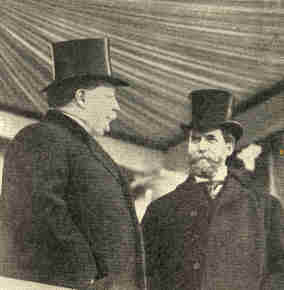
Copyright by Clinedinst, Washington.
President William H. Taft and Governor Hughes
on the reviewing stand at the inauguration, March 4,1909.
The cabinet was made up of men largely gathered from private life, a
majority of them being comparatively unknown to the public. Philander C.
Knox was United States senator from Pennsylvania when he was appointed
Secretary of State. He had served as Attorney-General in President
McKinley's cabinet. Franklin MacVeagh, of Illinois, who was made
Secretary of the Treasury, had been prominent as a merchant in Chicago
and active in public affairs. Mr. MacVeagh and Jacob M. Dickinson, who
became Secretary of War, were both members of the Democratic party. By
inviting Democrats to become members of his political family, President
Taft desired to give recognition to the fact that he had been elected by
Democratic votes and had received substantial support in parts of the
South. Mr. Dickinson was also from Chicago. The Secretary of the Navy,
George von L. Meyer, of Massachusetts, had served as ambassador to
Russia, and later as Postmaster-General during Mr. Roosevelt's
administration. Frank H. Hitchcock, of Ohio, who was made
Postmaster-General, had served as First Assistant Postmaster-General.
George W. Wickersham, an attorney of good standing in New York City, was
appointed Attorney-General. Richard A. Ballinger, of Seattle, who had
been Commissioner of the General Land Office, 1907-1909, was appointed
Secretary of the Interior. James Wilson, of Iowa, who had served as
Secretary of Agriculture since 1897, was continued in that office.
Charles Nagel, a noted lawyer of St. Louis, was made Secretary of
Commerce and Labor.
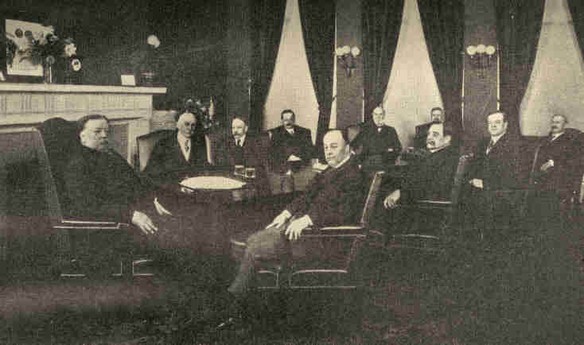
Copyright, 1909, by Brown Bros., N. Y. Reading from left to right:
President Taft, Franklin MacVeagh, Sec'y of the Treasury. George W.
Wickersham, Attorney-General. George von L. Meyer, Sec'y of the Navy,
Philander C. Knox, Sec'y of State, James Wilson, Sec'y of Agriculture.
Charles Nagel, Sec'y of Commerce and Labor( above). Jacob M. Dickinson,
Sec'y of War (below). Frank H. Hitchcock, postmaster-General. Richard A.
Ballinger, Sec'y of the Interior. President Taft and Cabinet, 1909.
With the beginning of the new administration the President's salary was
increased to $75,000 a year; that of the Vice-President to $12,000; and
members of the cabinet to $12,000.
From June 1 to October 15 there was held at Seattle the
Alaska-Yukon-Pacific Exposition. The rapid growth of Seattle has been
due in no small degree to the fostering of trade with Alaska. The
exhibits served to demonstrate the wisdom of the purchase of the
territory, which at that time was characterized as Seward's "folly."
Alaska has for some years been recognized as a country of wealth and
opportunity. The gold output each year is more than three times the sum
paid Russia for the territory. About one-fifth of the gold produced in
the United States comes from Alaskan mines. Products amounting to
$33,500,000 were shipped to the States from Alaska during the year 1907,
and the return trade for that year amounted to $19,500,000. The value of
the fishery products is five-sevenths as great as the output of the gold
mines. Alaskan coal-fields are estimated to be even richer than her gold
deposits. Other productions of the territory are silver, tin, lead,
quicksilver, graphite, marble, lumber, grains, vegetables, and fruits.
The purpose of the exposition was declared to be "to exploit the
resources and potentialities of the Alaskan and Yukon territories; to
make known and foster the vast importance of the trade of the Pacific
Ocean and of the countries bordering thereon, and to demonstrate the
marvellous progress of Western America." The energy and determination of
the men of the new Northwest was well shown in the preparation made for
the exposition. No financial assistance was asked from the federal
government. The necessary $10,000,000 were contributed almost entirely
in Seattle and the State of Washington. One million dollars were
expended by Seattle, as a preparatory step, on her municipal
improvements.
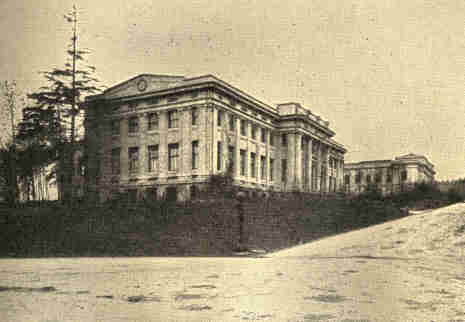
The Alaska-Yukon-Pacific Exposition, Seattle.
The Palace of Fine Arts.
The site of the exposition was the campus of the State University,
between Lakes Washington and Union. From the grounds, notable for their
natural beauty, were visible in the distance Mount Rainier, the loftiest
peak in the United States, the snow-covered Olympics to the west, and
the Cascade range to the east.
Three permanent buildings were erected by the State of Washington with
the understanding that they were afterward to be used by the university.
Most of the structures followed the French Renaissance design. In the
forestry building, which was 320 feet long and 140 feet broad, and built
of logs in the rough, there were displayed the timber resources of
Alaska and the Northwest. An out-door farm illustrated the agricultural
resources of the region. The Japanese exhibit was second only in
interest to that of Alaska. The exposition served to demonstrate, as it
was intended to do, the possibilities for the investment of capital in
the Northwest and the opportunities for those seeking new homes.
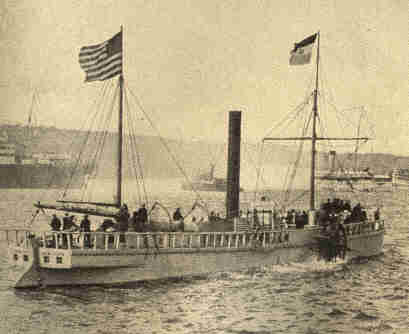
The Hudson-Fulton Celebration.
The Clermont proceeding up the Hudson River under her own steam.
Beginning with September 25 and continuing throughout the first week of
October, there was a notable celebration in New York City, and in other
cities on the Hudson, commemorative of the discovery of that river by
Henry Hudson three centuries before and the trip up the river by Robert
Fulton's steamboat in 1807. The leading feature of the pageant was the
assembling in the harbor of the largest fleet of international character
ever brought together at one time, and the cruise up the Hudson as far
as Newburg of eighty war vessels selected from the navies of the United
States, Great Britain, Germany, France, and other powers. These huge
vessels were in striking contrast to the two small ones which were given
the place of honor in the pageant, the replicas of the Half Moon and
the Clermont. The land parades were likewise spectacular in their
effects.
In October, 1909, Commander Robert E. Peary and Dr. Frederick A. Cook,
two American travellers, returned to the United States, both making
claims to having discovered the north pole. The accomplishment of this
task, which had baffled so many arctic explorers, was hailed as a
triumph throughout the civilized world. Ardent supporters of each of
these men began to champion the right of their favorite to the great
honor. It was shown that Commander Peary had for twenty-three years been
engaged in arctic exploration. His first voyage was made to Greenland in
1886, and in his numerous expeditions to the frozen north since that
time he had secured much scientific data relating to the glaciology,
geology, and ethnology of those regions.
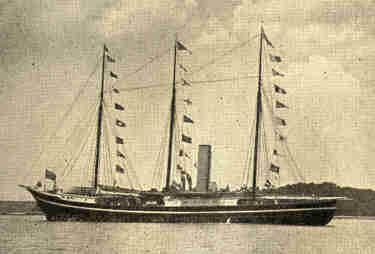
Commander Peary's ship, The Roosevelt.
When Commander Peary left the Roosevelt, the ship which bore him as far
north as navigation permitted, on February 22, 1909, his expedition
consisted of 8 white men, 59 Eskimos, 140 dogs, and 23 sledges, with the
necessary equipment for arctic travel. Upon returning to the United
States after overcoming the many dangers incident to such exploration,
he submitted his records to the National Geographical Society. A
committee of that body, after passing upon these documents, declared
unanimously that it was their opinion that Peary had reached the north
pole, April 6, 1909. This report further commended him for his
organization and management of this expedition and for his contributions
to scientific knowledge.
Before his return to America, Dr. Cook had been hailed as the discoverer
of the north pole by European scientists, especially those of Denmark,
who accepted his story of the accomplishment of this task in April,
1908, one year earlier than the date of Peary's discovery. Many honors
were conferred upon him when he reached Copenhagen, September 4, 1909.
He was met by the Crown Prince of Denmark and the American minister, and
by explorers, professors, and scientists from various European
countries. He was greatly honored also upon his return to New York City.
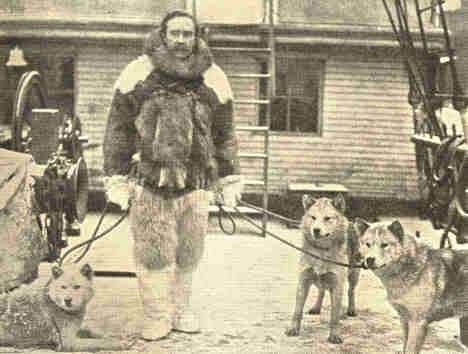
Commander Robert E. Peary, and three
of his Eskimo dogs, on The Roosevelt.
Commander Peary declared that the claims made by Dr. Cook were without
foundation. His decision was based on the evidence given by two Eskimos
who had accompanied Dr. Cook, and who asserted that the party went only
a two days' journey north from Cape Hubbard and were never beyond the
land ice. Further evidence of deception by Dr. Cook was set forth by
Edward M. Barrill, who had accompanied him on his ascent of Mount
McKinley in 1906. This guide declared that Dr. Cook had not reached the
summit of that mountain as claimed, but that the records had been
falsified. Later, a commission was appointed by the University of
Copenhagen to examine the notes and memoranda submitted to them by Dr.
Cook. After a careful examination of these documents, the commission
reported that they found no evidence sufficient to warrant the belief
that Dr. Cook actually reached the north pole.
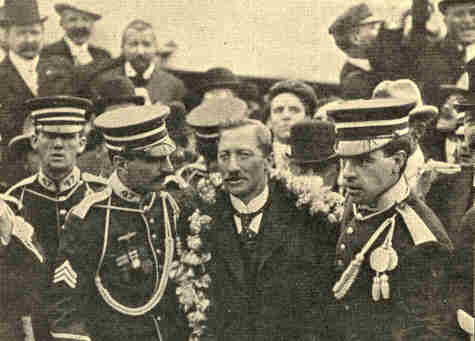
Photograph by Brown Bros., N.Y.
Dr. F. A. Cook on his arrival in
New York, September 21, 1909.
By vote of Congress, June 20, 1910, the territories of Arizona and New
Mexico were granted permission to form State constitutions. The
constitutions which were framed in their conventions and passed by
majorities of the people contained some unusual provisions. The Arizona
constitution included the initiative, referendum, and recall of all
elective officers, including judges. The New Mexico constitution
contains a referendum clause, but the clause providing for initiative
was rejected.
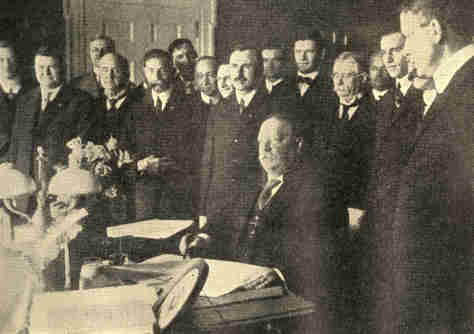
Copyright by Clinedinst, Washington.
President Taft signing the proclamation making
Arizona the forty-eighth State of the Union,
at the White House, February 14, 1912.
The constitution of Arizona was attacked in Congress and opposed by
President Taft on account of the provision for the recall of judges. The
chief objection to the constitution of New Mexico was the unsatisfactory
method provided for its amendment. This constitution, however, was
approved by President Taft and by the House of Representatives, but the
Senate failed to take any action. In August, 1911, the President vetoed
a joint resolution to admit the territories of New Mexico and Arizona as
States into the Union. He stated his attitude as follows: "The
resolution admits both territories to statehood with their constitutions
on condition that at the time of the election of State officers New
Mexico shall submit to its electors an amendment to its new constitution
altering and modifying its provisions for future amendments, and on the
further condition that Arizona shall submit to its electors at the time
of the election of its State officers a proposed amendment to its
constitution by which judicial officers shall be excepted from the
section permitting a recall of all elective officers. If I sign this
joint resolution, I do not see how I can escape responsibility for the
judicial recall of the Arizona constitution. The joint resolution admits
Arizona with the judicial recall, but requires the submission of the
question of its wisdom to the voters. In other words, the resolution
approves the admission of Arizona with the judicial recall, unless the
voters themselves repudiate it. . . . This provision of the Arizona
constitution in its application to county and State judges seems to me
pernicious in its effect, so destructive of independence in the
judiciary, so likely to subject the rights of the individual to the
possible tyranny of a popular majority, and therefore to be so injurious
to the cause of free government that I must disapprove a constitution
containing it."
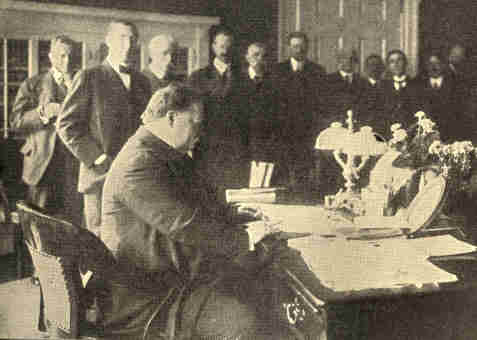
Photograph, Copyright, by Clinedinst. Washington.
President Taft signing the proclamation making New Mexico a State,
January 6, 1912.
January 6, 1912, New Mexico, having complied with all conditions, was
formally admitted into the Union as the forty-seventh State.
Arizona, having an area of 113,000 square miles, was organized as a
territory in 1863 and appeared in the federal census reports for the
first time in 1870 with a population of 9,658. From 1870 to 1890 its
growth in population was rapid, increasing a little more than four times
during the decade 1870-1880 and doubling during the succeeding ten
years. The population in 1900 was 122,931 and in 1910 it was 204,354.
During the last decade, therefore, the increase in population has been
66.2 per cent, while the percentage of increase in the United States as
a whole has been only 21 per cent. According to the thirteenth census,
Arizona contained eight cities with an aggregate population of 58,414.
The largest cities were Tucson, with a population of 13,193, and Phoenix
with 11,134.
Arizona produces more copper than any other State in the Union. Of the
total copper ore mined in the United States (1909) 27.7 per cent was
from Arizona. There are also good mines of gold and silver. Coal-mining,
marble-quarrying, lumbering, raising cattle, sheep, and ostriches are
also important industries in Arizona. Through the efforts of the
Reclamation service in completing the Roosevelt Dam and a dam at Parker,
and by the use of pumps, it is estimated that 1,000,000 acres of fertile
land will become available for cultivation. Other large areas are also
susceptible of irrigation.
In 1850 the territory of New Mexico was organized and in 1863 it was
reduced to its present limits with an area of 122,000 square miles. The
population of New Mexico in 1900 was 195,310 and in 1910 was 327,301 an
increase of 67.6 per cent. Albuquerque, with a population of 11,020, and
Rosewell with 6,172 were the two largest cities. Like Arizona, New
Mexico possesses great wealth in mines and forests, but the foundation
for her future industrial progress lies in her farms. In 1910 New Mexico
possessed 500,000 acres of irrigated land. It was estimated that
3,000,000 acres more were amenable to artificial watering and the
government is expending millions of dollars on projects which will
fertilize vast areas of this land.
During the year 1911 the world was astounded at the unparalleled
exhibitions of the possibilities of the aeroplane. The dream of
centuries had been realized, and American genius was responsible for the
achievement. In 1896, a model machine which had been constructed under
the direction of Professor Langley, secretary of the Smithsonian
Institution, driven by a one horse-power steam-engine, made three
flights of a mile each near Washington. Congress appropriated $50,000
for the construction of a complete machine, but after two unsuccessful
attempts to fly, with an operator, the project was abandoned.
Wilbur Wright and his brother Orville, bicycle manufacturers of Dayton,
Ohio, did not share in the general ridicule which followed this failure,
and after three years of experimentation demonstrated that the
principles upon which Professor Langley had constructed his machine
were, in the main, sound. The first successful flight of a few seconds
by one of their machines weighing 750 pounds was made in 1903. Two years
afterward a flight of 24 miles was made at the rate of 38 miles an hour.
Other successful experiments followed, and the claim of the Wrights to
be considered the inventors of the first successful man-carrying flying
machine was established. French inventors at about the same time were
carrying on successful experiments with machines similarly constructed.
September 16, 1908, Wilbur Wright, at Le Mans, France, demonstrated that
his machine could remain in the air for over an hour and at the same
time fly across country at a high speed. In that year, also, Orville
Wright, in a government test at Fort Myer, Virginia, not only made
flights lasting over an hour, but carried a companion with him. During
July, 1909, a French aviator, Bleriot, flew across the English Channel,
a distance of 32 miles. That year, also, Orville Wright ascended to the
height of 1,600 feet; with a passenger, made a record flight of 1 hour,
12 minutes and 36 seconds; and flew across country with a companion for
10 miles at the rate of 42 miles an hour. Thus it was shown that a
machine had at last been constructed which would not only fly, but would
remain in the air at the will of its pilot and subject to his guidance.
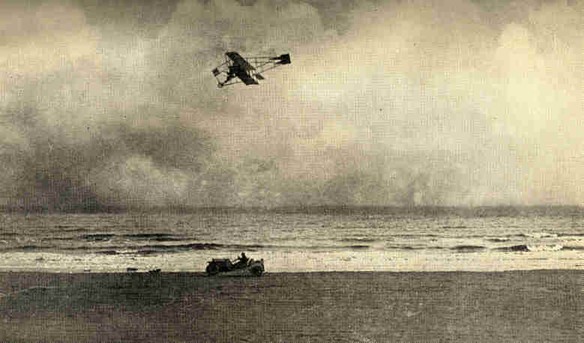
From a photograph by H. H. Morris.
Charles K. Hamilton racing an automobile on the beach at Galveston, Texas.
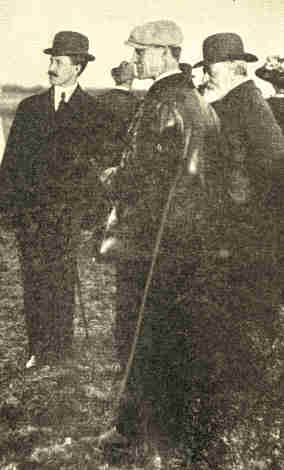
Photograph by Brown Bros., N.Y.
Wilbur and Orville Wright, and the late King Edward of England.
[1911]
In the aviation meet at Los Angeles, January 10, 1910, Louis Paulhan, a
Frenchman, established the record of 4,000 feet for height and Glenn H.
Curtiss with a passenger set a new world's record of 55 miles.
Shortly afterward Curtiss demonstrated for the first time that it was
possible for an aeroplane, especially constructed, to rise from the
surface of water, make a flight in the air, return to the
starting-point, and again alight on the water.
The great possibilities as well as the dangers connected with aviation
were brought out in the meet at Chicago during August, 1911, where two
aviators lost their lives. C. P. Rodgers, in a Wright machine, remained
in the air twenty-six and one-half hours out of the possible thirty-one
and one-half hours. Lincoln Beachey set a new world's record by
ascending 11,642 feet. This record was again surpassed within a month by
Ronald G. Garros, a French aviator, who ascended 13,943 feet.
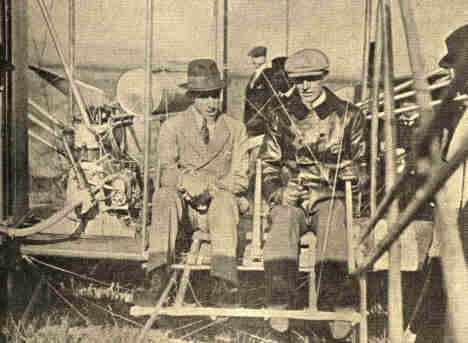
Wilbur Wright in his aeroplane at Pau, France, with King Alfonso of Spain.
Harry K. Atwood flew from St. Louis to Chicago in one day, a distance of
315 miles. He continued his flight to New York, and in eleven days
reached that city. He had travelled 1,265 miles in the actual flying
time of 28 hours. C. P. Rodgers eclipsed all records for long-distance
aeroplane flying by crossing the continent from Sheepshead Bay, New
York, to Pasadena, Cal., a distance of 4,231 miles. He accomplished this
feat in the total time of 49 days, September 17 to November 5, 1911. His
actual flying time was 82 hours.
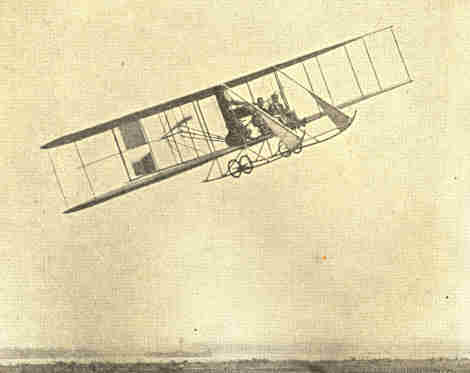
Harry K. Atwood with Lieut. Fickle flying over Governor's Island, N. Y.,
after completing his flight from St. Louis to New York.
These flights served to demonstrate that the permanent triumphs of
aeronautics are to be won by steadiness and efficiency and not by
recklessness.
Among the significant legislation of the Sixty-second Congress, the
passing of the "publicity law," August, 1911, is deserving of especial
commendation. The Democratic platform, 1908, demanded publicity of
campaign contributions, and Mr. Bryan announced that no funds would be
received from corporations. According to a New York statute, all
campaign receipts and expenditures must be filed. The Republican
campaign committee agreed to apply this law in the presidential contest.
According to the federal Publicity law no candidate for member of the
House of Representatives may spend more than $5,000 in his campaign for
nomination or election, and no candidate for United States senator may
spend, legally, more than $10,000 in his campaign, Candidates are
prohibited from making promises of office or other promises in order to
obtain votes, and no candidate for senator may aid in the election of
members of the legislature that is to fill a senatorial vacancy. At the
time, two United States senators were under indictment for the purchase
of their seats, and one of them acknowledged that he had expended nearly
$100,000 in his primary campaign.
In partial fulfilment of the declaration that his policy was to bring
about legislation for the benefit of the whole country, President Taft
in his message to Congress, December, 1911, asked that the appointment
of local federal officers throughout the country should be placed under
the classified service. "I wish," he wrote, "to renew again my
recommendation that all the local officers throughout the country,
including collectors of internal revenue, collectors of customs,
postmasters of all four classes, immigration commissioners, and marshals
should be by law carried into the classified service, the necessity for
confirmation by the Senate be removed, and the President and the others,
whose time is now taken up in distributing this patronage, under the
custom that has prevailed since the beginning of the Government in
accordance with the recommendation of the senators and congressmen of
the majority party, should be relieved from this burden. I am confident
that such a change would greatly reduce the cost of administering the
government and that it would add greatly to its efficiency. It would
take away the power to use the patronage of the government for political
purposes."
President Taft took an advance position also in his advocacy of the
substitution of the appeal to reason for the appeal to force in the
settlement of all international difficulties. The treaties of
arbitration which were agreed upon during the summer of 1911 between
Secretary Knox and the representatives of Great Britain and France
illustrate the general type of treaty which the President hoped would be
negotiated with other nations. Heretofore, the treaties to which the
United States has been a party have accepted as suitable for arbitration
all questions save those which concerned "vital interests and national
honor." It was a great step forward, therefore, when the agreement was
reached between the powers that all disputes that are justiciable and
cannot be settled by diplomacy are to be submitted to arbitration.
In case of a difference on whether the dispute were justiciable or not,
it was to be submitted to a commission of inquiry for decision. If the
commission found it was justiciable the question in dispute must be
submitted to arbitration. Should the commission find it was not
justiciable there would still exist the possibility of war. But either
nation has the power to delay the findings a year during which time
diplomatic action may be resumed. The arguments against the ratification
of these facts in the Senate were based on the plea that they provided
for compulsory arbitration and thus tended to deprive the Senate of its
constitutional prerogative. The wording was so greatly modified in the
Senate that the form of treaty which was finally ratified differed but
little from the arbitration treaties of 1908.