
[1908]
In spite of the oft-repeated statement made by President Roosevelt that
he would not be a candidate for nomination on the Republican national
ticket in 1908, the party leaders seemed to fear a stampede in the
Chicago convention. Plans had been laid carefully by the party leaders
to prevent this possibility, and when William H. Taft, of Ohio, received
the nomination on the first ballot, delegates and spectators gave vent
to their feelings by prolonged applause. Out of a total of 980 ballots
cast Mr. Taft received 702. As Secretary of War in President Roosevelt's
cabinet he had been chosen by the President to succeed him, for it was
believed that through training and sympathy he was best fitted to carry
out the policies of the administration.
Other candidates for nomination had appeared during the summer and each
had a following of more or less strength. Senator La Follette, of
Wisconsin; Governor Hughes, of New York, and Speaker Cannon, of
Illinois, each received some support in the convention. Throughout the
land no surprise was occasioned, however, by the nomination of Mr. Taft.
Apparently the nomination of James S. Sherman, of New York, for the
office of Vice-President was the result of political expediency; he was
a good organization man; he had enjoyed considerable experience in
public affairs and had been a member of Congress for twenty years.
Moreover, the fact that he came from New York made it a wise move,
politically, to give him a place on the ticket.
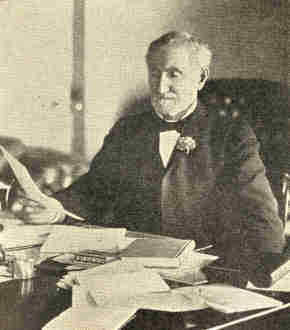
Copyright by Clinedinst, Washington.
Joseph G. Cannon.
To outside observers the convention was a harmonious one, ready and
anxious to adopt and indorse the Roosevelt policies and to accord a most
hearty support to the candidate who best represented these policies. The
platform which was drawn up was a strong political document which not
only stated the Republican policies clearly but was also a piece of
campaign literature of some note from the stand-point of literary worth.
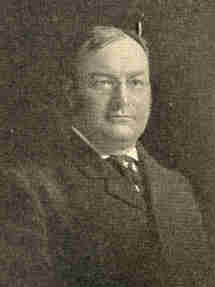
Photograph by C. M. Ball, Washington.
James S. Sherman, nominated for Vice-President.
Throughout the months preceding the assembling of the Democratic
convention, in Denver, there was some uncertainty as to who would
control it. Governor Folk, of Missouri, had been much in the public eye
through his war on graft and on account of his successful administration
of the gubernatorial office. Judge Gray, of Delaware, who had served his
State in the United States Senate and had acquired an enviable
reputation as a justice of the United States Circuit Court, was also a
strong candidate. Judson Harmon, of Ohio, Attorney-General under
President Cleveland, and Governor Johnson, of Minnesota, had numerous
supporters.
When the voting began in the convention the result was not long in
doubt. William Jennings Bryan was for the third time accorded the honor
of leading the Democratic party. On the first ballot Mr. Bryan received
892-1/2 votes; Judge Gray, his chief opponent, received 59-1/2. The
cheers which followed the announcement of the vote showed that two
defeats had not dampened the loyalty of the Western Democrats. Mr. Kern,
of Indiana, was nominated by acclamation for the Vice-Presidency. The
committee on the formation of the platform seemed to have some
difficulty in determining the final form of some of the planks.
Both parties in their platforms favored tariff revision. The Republican
party declared for the protective system and reciprocity and promised a
special session of Congress to treat the whole tariff question. The
Democratic party adhered to the old principle of "tariff for revenue"
and pledged itself to return to that basis as soon as practicable.
Furthermore, it pledged itself to bring about immediately such
reductions as would put trust-controlled products upon the free list and
to lower the duties on the necessaries of life, particularly upon those
which were sold more cheaply abroad than at home. Lumber was to go on
the free list. Any deficiency in the revenues which might arise from
this policy was to be made up through the medium of an income tax.
Both platforms declared for reform in the currency laws, but neither one
advanced any plan for revision. The Democratic platform condemned as
criminal the large expenditures of the recent administration, but showed
some inconsistency by favoring such policies as a large navy, generous
pensions, large expenditures for the improvement of rivers and harbors
which would necessitate the expenditure of great sums.
The regulation of railways and corporations was demanded by both
parties. The difference between the demands lay in the means to be
employed. The Democratic platform declared for State control of this
question as well as that relating to the conservation of our natural
resources. The Republicans took the stand that both questions should be
solved by the Federal Government.
In treating the problem of the alien races the Republican document
referred to the negro race by name, demanded equal justice for all men,
and condemned the devices used by some States for disfranchising the
negro. Nothing was said concerning Chinese and Japanese immigration. The
Democratic platform was silent on the negro question and declared
against the admission of Orientals into our country.
Arbitration was favored by the Republicans, but was not mentioned in the
opposition platform. On the Philippine question there was a division.
The Republicans favored a gradual development of home-rule; the
Democrats for early independence under an American protectorate.
Three things in the Democratic platform are worthy of note: (I) The
demand for a federal law compelling publicity of campaign contributions;
(2) the election of senators by direct vote, and (3) the adoption of
such parliamentary rules as would make the House of Representatives a
deliberative body.
The Socialist convention, which assembled in Chicago, nominated Eugene
V. Debs for President and Ben Hanford for Vice-President.
Two tendencies of political thought were displayed in the Socialist
platform as framed by the committee. First, a tendency away from
individual ownership of productive property and the individual
administration of industry, and toward the collective ownership of
productive property and the collective administration of industry. This
was illustrated by the demands made for the collective ownership of all
railways, steamship lines, and other means of transportation, as well as
telephones, telegraphs, etc. It was further evidenced by the demand that
the public domain be made to include mines, quarries, oil wells,
water-power, reclaimed and reforested lands. The second tendency was
away from a form of government of checks and balances toward one by the
unrestrained majority. This was shown by the demands for the abolition
of (I) the Senate, (2) the veto power of the President, (3) the power of
the Supreme Court to pass on the constitutionality of legislation.
Industrial demands were made. There should be a more effective
inspection of workshops and factories; there should be no employment of
children under sixteen years of age; interstate transportation of the
products of child labor or convict labor should be forbidden; compulsory
insurance against unemployment, illness, accidents, old age, and death
should be adopted.
Among the political reforms demanded were inheritance and income taxes,
equal suffrage for men and women, the initiative and referendum,
proportional representation, and the right of recall. The Federal
Constitution was to be amended by majority vote. Judges were to be
elected for short terms.
The nominees of the Prohibition party were Eugene W. Chapin, of
Illinois, for President, and Aaron S. Watkins, of Ohio, for
Vice-President. In the platform framed there were the usual declarations
against the liquor traffic, but there were also planks demanding
reforms. The election of senators by direct vote; the passage of
inheritance and income taxes; the establishment of postal savings banks;
the guaranty of bank deposits; the creation of a permanent tariff
commission; the conservation of natural resources; an equitable and
constitutional employers' liability act, and legislation basing suffrage
only upon intelligence and ability to read and write the English
language, were the chief planks. Beyond any doubt this platform–the
shortest of all–shows that the men who constructed it were not
dreamers. It is possible that the delegates may have been looked upon as
visionaries, for there were few among them who could be called
"practical politicians," but, as one writer of note has said, the
delegates were "typical of that class of society on which the nation
ever depends in a great crisis, the sort from which all moral movements
spring. . . ."
It has often been said that the excitement of presidential campaigns is
detrimental to the nation. This could hardly be said of the campaign of
1908. To produce political excitement there must be debatable questions
termed, by the politicians as "issues." Just what the issues were in the
campaign few people could determine. There were no issues which involved
foreign affairs. The Democratic party did not criticise the sending of
the fleet around the world, the administration's policy in Cuba, the
policy concerning the Panama Canal, nor even the policy pursued in the
Philippines. As regards military and naval matters, pensions to
veterans, the development of internal waterways, the conservation of
resources, etc., there were no issues simply because the people had
practically the same views about them. Consequently issues had to be
made, and, generally speaking, the Republican leaders appealed to the
people along the lines of the personal fitness of the candidates.
It was pointed out that President Roosevelt had indicated his Secretary
of War as the best man to carry out the policy inaugurated by the
administration of subduing and controlling influential law-breakers. The
chief officer of the government has vested in himself powers of wide
range–the appointment of the judiciary, the superintendence of the
administration of the business affairs of the nation, the guidance of
our international affairs. Therefore the President must be a keen judge
of men capable of distinguishing the honest, efficient servant of the
nation from the self-seeking politician; he must resist political
pressure; he must be national in his patriotism and breadth of vision;
he must know our foreign relations intimately, that the continuity of
policies may not be broken and the efficiency of our foreign service
weakened thereby. He must have the capacity to work long hours, with
skill, care, and rapidity. In short, the chief executive must be a man
who is fit mentally and physically.
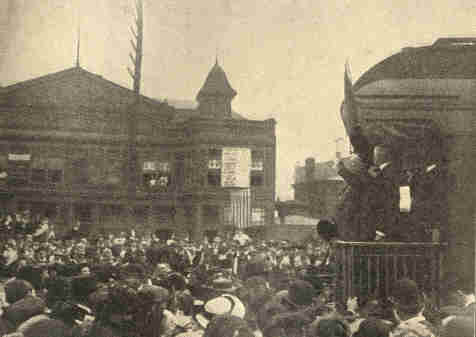
William H. Taft on his trip, stumping for the nomination.
Some of these essential qualities the candidates of the two great
parties possessed in a high degree. They were honest and sincere; they
were familiar with the desires and needs of the various sections of the
nation; they were national in the breadth of their policies. But they
were different in temperament, equipment, and experience, and upon this
difference the Republican leaders made their appeal to the voters.
The Democratic nominee was essentially an orator–he swayed the masses
by his denunciation of the perils which threatened the nation through
the concentration of wealth which had gone on under the Republican rule.
His opponents admitted that a man of his stamp was invaluable to the
American people, but they contended that his place was in the editor's
chair, in the pulpit, or upon the lecture platform, not as the chief
executive of the nation. Furthermore, it was said that this great orator
had views on political, social, and economic questions which bordered on
the visionary, and that any man who had openly supported free silver,
anti-imperialism, or even the guaranty of bank deposits, could not be
safely trusted with the guidance of the nation's destinies.
The Republican candidate had none of the qualifications of an orator; he
was rather a teacher. He did not cater to the desires of his audience;
he struck at the abuses most prevalent in the section where he spoke. It
was his business to point out weaknesses; to find remedies for them; to
educate, not sway, his audiences. His mind was constructive; his
training had been along the lines of constructive political thought; he
had proven his ability by his organization of a civil government for the
Philippines and by his solution of the vexed question of Cuba. So it was
argued that the best test of his ability and guaranty of efficiency was
the work he had already done.
The campaign was lacking in life and enthusiasm simply because there
were no clearly defined issues. The candidates went through the usual
performances of "swinging around the political circuit." Mr. Taft was
accorded a warm welcome on his trip, for the people wished to get
acquainted with President Roosevelt's choice as much as to hear him
discuss the Republican policies. Mr. Bryan, who conducted a great
speaking campaign, confined his attention to advocating the bank
guaranty plan and to attacking the evils of private monopoly. Political
enthusiasm was at a low ebb. Few people took matters seriously and the
campaign was aptly characterized as the "Era of No Feeling."
The vote cast for presidential electors was primarily an expression of
popular confidence in the Roosevelt administration. For nearly half a
century the situation in the nation had been becoming more and more a
source of anxiety to the thinking men of the land. Our economic
development had taken place so rapidly that the great aggregations of
capital and the great corporations had gotten beyond control and had
shown dangerous tendencies toward lawlessness and political corruption.
The feeling that the great corporations were not only beyond the control
of law but even controlled the government in the interests of a few, led
to a belief that the government was passing out of the hands of the
people, and that the function of our republican government was being
arrested. The radical and the agitator were getting the ear of the
nation, for the faith of the nation was shaken. Then came President
Roosevelt to take up a task of greatest difficulty, and for nearly eight
years, amidst the applause of the plain people, he administered the
affairs of the nation firmly, honestly, and with efficiency. The
Republican convention in Chicago by its nomination of Mr. Taft had put
the stamp of its approval upon the Roosevelt administration, and turned
to appeal to the voters.
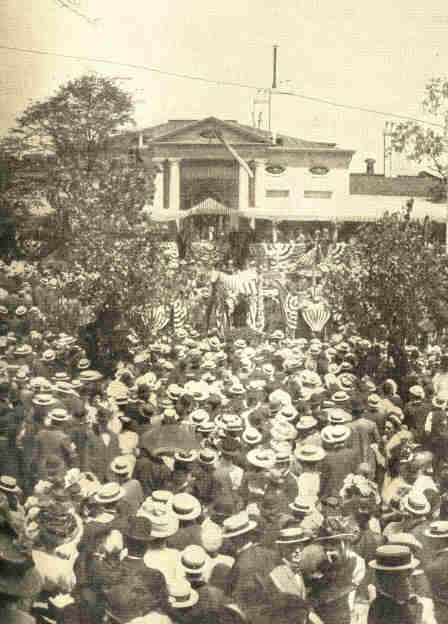
Copyright, 1908, by Young & Carl, Cincinnati, Ohio.
Mr. Taft formally accepting the Republican nomination for the
Presidency, on the veranda of the residence of his brother, Mr. Charles
P. Taft, of Cincinnati, Ohio.
In round numbers Taft received 7,680,000 votes and Bryan 6,410,000. The
electoral vote stood 321 for the Republican candidate and 162 for the
Democratic candidate. Thirty States elected Republican presidential
electors; eighteen elected Democratic electors. With the exception of
Nebraska, Nevada, and Colorado, which together contributed sixteen
electoral votes, all the States carried by the Democratic nominee were
Southern States. The nation had approved the Roosevelt policy, but the
great popular vote for Mr. Bryan showed clearly the loyalty of millions
of voters. These men believed that their leader stood for the plain
people–for the unprivileged. There were many who had feared Mr. Bryan's
policies in 1896, who voted for him in 1908 because they believed that
twelve years of public life and the study of national problems had
changed and bettered his ideals.
Some Republican writers professed to believe that the popular vote
indicated that a majority of people adhered to the policy of protection.
To others it appeared that the voters were willing to accept the
protective policy with a promise for honest tariff revision in order to
obtain a continuation of the Roosevelt policies.
The popular vote is interesting mainly for what it showed concerning the
changed strength of the small parties, During the period 1904 to 1908
the drift had evidently been away from them. The Socialist vote was
nearly as large in 1908 as in 1904, which was a consolation to
Socialists, for they had held the ground gained by the heavy vote in
1904. The Prohibition vote fell off about ten per cent from that polled
in 1904 and the Independence party polled only 82,000 votes.
In the House of Representatives the Sixty-first Congress had 219
Republicans and 172 Democrats; the Senate 60 Republicans and 32
Democrats.