
[1907]
While President Roosevelt advocated peace, he believed that the best
means to preserve peace was suitable preparation for war. In his message
to Congress, 1904, he said; "There is no more patriotic duty before us
as a people than to keep the navy adequate to the needs of this
country's position. Our voice is now potent for peace, and is so potent
because we are not afraid of war. But our protestations would neither
receive nor deserve the slightest attention if we were impotent to make
them good." At all times he urged a larger and more efficient navy. For
years, before he became Assistant Secretary of the Navy, he had been a
student of naval affairs. He found that there was no programme for
building ships as in the European countries, and that there was general
unpreparedness for war.
Before the war with Spain, the American navy was so inferior that it was
excluded from any table of the principal navies of the world. Had the
United States possessed a few more battleships at that time, it is
probable that war would not have occurred. Spanish authorities had been
told by naval experts that their navy was superior to ours.
Profiting by that experience, plans for a larger navy were projected. By
the close of the year 1907 there were about 300 vessels in the navy
manned by 35,377 men. In comparative strength it ranked second only to
that of Great Britain. Not only was there an increase in the number of
vessels but there was great improvement in marksmanship and in the
handling of ships. In the battle of Santiago it has been estimated that
about five per cent of the shells struck the enemy. During the year 1902
Rear-Admiral Robley D. Evans introduced regular and frequent target
practice. So effective was this work that in 1908, at ranges twice as
great as at Santiago, gunners throughout the fleet averaged sixty per
cent and one vessel scored eighty per cent. Rapidity of fire also was
increased nearly fourfold.
It was the custom to send the fleet each winter to the Caribbean Sea for
manoeuvres, which lasted about four months. In December, 1907, the
Atlantic fleet, comprising sixteen battle-ships and a flotilla of
torpedo-boats, began a cruise around the world. President Roosevelt
steadily adhered to the plan in the face of the most extravagant
denunciation on the part of those who declared that it could be
considered only as a menace toward Japan. Naval experts claimed,
however, that the experience to be gained by this cruise, such as
practice in handling ships in all kinds of weather, the renewal of
stores and coal, and the meeting of other problems incident to actual
warfare, justified the experiment.
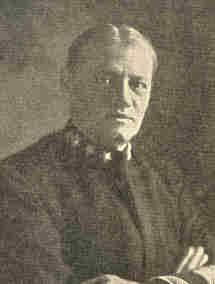
Copyright. 1908. by Harris & Ewing.
Rear-Admiral Robley D. Evans.
Under command of Rear-Admiral Evans the fleet reached Rio Janeiro on
January 12. Unusual honors were tendered the men by the Brazilian
government and people. The day of their arrival was made a national
festival. In reply to the friendly greeting from the Brazilian
government President Roosevelt wrote: "The war-ships on this cruise
exist for no other purpose than to protect peace against possible
aggression. As between the United States and Brazil these ships are not
men-of-war, but messengers of friendship and good-will." There were
similar manifestations on the part of Argentina, Chile, and Peru. The
visit of the fleet to these countries was regarded as a compliment. They
were permitted to see something of the strength of the republic at the
north and learned that the Monroe Doctrine might be enforced, if need
be, by a navy of the first rank. Notable ceremonies attended the arrival
of the fleet at Honolulu, Auckland, Sydney, Melbourne, and Manila. A
despatch to a London paper said: "It is beyond question that the United
States is no longer a Western but a cosmic power. America is now a force
in the world, speaking with authoritative accent, and wielding a
dominant influence such as ought to belong to her vast wealth,
prosperity, and importance."
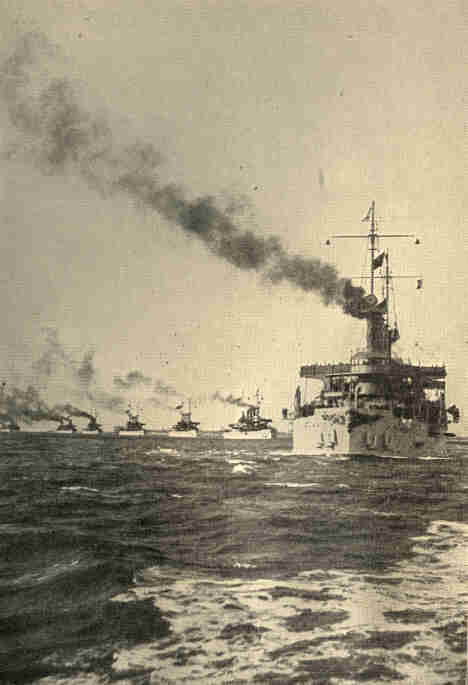
Copyright, 1907. by Underwood & Underwood.
The Atlantic fleet starting on its journey round the world, December, 1907.
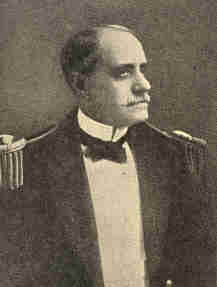
Rear-Admiral Charles S. Sperry.
At Auckland Rear-Admiral Evans, who had spent forty-eight years in the
navy, having reached the age limit of sixty-two years, was succeeded in
command by Rear-Admiral Sperry. Unusual honors were accorded the fleet
by Japan. Each American warship was escorted into the harbor of Yokohama
by a Japanese vessel of the same class and many other evidences of
friendship were manifest during their visit. The fleet then proceeded to
China, through the Suez Canal and the Strait of Gibraltar, and at the
end of one year and sixty-eight days, after covering 45,000 miles,
dropped anchor in Hampton Roads. The accomplishment of this feat,
without precedent in naval annals, still farther contributed to the
establishment of the prestige of the United States as a great world
power.
In 1889 the government of the United States purchased from the Indians a
large irregular tract of land not then occupied by them and erected it
into a separate territory under the name of Oklahoma. When it was opened
for settlement, April 22, 1889, a horde of settlers who had been waiting
on the borders rushed in to take possession of the lands. Cities and
towns sprang up as if by magic. The loose system of government exercised
by the five civilized tribes became steadily more ineffective when the
Indian Territory was thus brought into contact with white settlers. By
1893 affairs had become so confused that Congress decided to take steps
toward the ultimate admission of the territory into the Union as a
State. A committee of the Senate reported that the system of government
exercised by the Indians cannot be continued, that it is not only
non-American but it is radically wrong, and a change is imperatively
demanded in the interest of the Indians and the whites alike, and such
change cannot be much longer delayed, and that there can be no
modification of the system. It cannot be reformed; it must be abandoned
and a better one substituted.
Gradually the five tribes–Cherokee, Choctaw, Creek, Chickasaw, and
Seminole–were shorn of their governmental powers. Lands were allotted
in severalty, certain coal, oil, and asphalt lands being reserved. A
public school system was established and maintained by general taxation.
In his message to Congress, 1905, President Roosevelt recommended the
immediate admission of Oklahoma and Indian Territory as one State and
Arizona and New Mexico as another. A statehood bill embodying this
recommendation was passed by the House, but was amended in the Senate so
as to strike out the provision relative to the admission of New Mexico
and Arizona. Opposition to the admission of the last two territories as
one State came principally from the great mining companies of Arizona
supported by the railroad corporations. They were in practical control
of the territory with hundreds of millions of dollars in property. They
were fearful of the loss of control and an increase of taxation under
such a combination. Finally an act was passed by Congress, in 1906,
enabling the people of Oklahoma and Indian Territory to form a
constitution and State government and be admitted into the Union. The
enabling act provided that all male persons over the age of twenty-one
years who were citizens of the United States or who were members of any
Indian nation or tribe in said Oklahoma and Indian Territory, and who
had resided within the limits of said proposed State for at least six
months next preceding the election, should be entitled to vote for
delegate or serve as delegates in a constitutional convention. A number
of Indians were delegates in this convention. The constitution, which
was adopted by the voters, September 17, 1907, was greatly criticised on
account of its radicalism. The new State, the forty-seventh, was
formally proclaimed by the President in 1908. It has an area of 70,000
square miles. In 1900 the population was 800,000 which was increased to
1,500,000 by the date of admission. The wonderful climate and fertile
soil together with the energy of its population have continued to
attract thousands of immigrants each year.
The exclusion of Japanese students from the public schools of San
Francisco, 1906, seemed for a time to augur grave results. One-half of
the ninety Japanese who were in attendance upon these schools were above
sixteen years of age and were taught in the classes with little
children. The order of the San Francisco school board excluding the
Japanese was in harmony with the California law which permitted local
school boards to segregate Mongolians in schools apart from those for
white children. But this order nullified our treaty with Japan which
provided that the subjects of that nation should be granted the same
personal rights when in this country that our own citizens enjoy.
President Roosevelt acted with promptness and decision. His attitude was
shown in his message to Congress, December, 1907, in which he said: "To
shut them out from the public schools is a wicked absurdity . . . .
Throughout Japan Americans are well treated and any failure on the part
of Americans at home to treat the Japanese with a like courtesy and
consideration is by just so much a confession of inferiority in our
civilization . . . . I ask fair treatment for the Japanese as I would
ask fair treatment for Germans or Englishmen, Frenchmen, Russians, or
Italians .... In the matter now before me, affecting the Japanese,
everything that is in my power to do will be done, and all of the
forces, military and civil, of the United States which I may lawfully
employ will be so employed."
But the problem was not settled, for early in the year 1909
anti-Japanese resolutions were brought before the legislatures of
California, Nevada, Oregon, and two or three other Pacific States. The
bills before the legislature of California provided:
1. For the segregation of Japanese and other Orientals in residential
quarters at the option of municipalities.
2. That aliens should not own land in California.
3. That aliens should not become directors in California corporations.
4. For separate schools for Japanese students.
On February 8, President Roosevelt sent a telegram to the Speaker of the
California assembly giving the Government's views on the pending bills.
"The policy agreed to by both governments," he said, "aims at mutuality
of obligation and behavior. In accordance with it the purpose is that
the Japanese shall come here exactly as Americans go to Japan, which is
in effect that travellers, students, persons engaged in international
business, men who sojourn for pleasure or study, and the like, shall
have the freest access from one country to the other, and shall be sure
of the best treatment, but that there shall be no settlement in mass by
the people of either country in the other." While there is nothing in
the Constitution or laws to prevent the President from urging a State
legislature to vote for or against certain pending bills, such a course
is unusual. It had become a national question, however, and the
President's energy in handling the problem is worthy of praise.
According to the census of 1900, there were over 700,000 children under
sixteen years of age at work in the mills, mines, factories, and
sweat-shops of the United States. Nearly all of the States had
child-labor laws, but they were ordinarily poorly enforced and no State
was wholly free from the blight of this child slavery. While fourteen
years was the minimum in most of the States, a few permitted the
employment of children of ten years of age. In the majority of cases
there was no legal closing hour after which children might not be
employed.
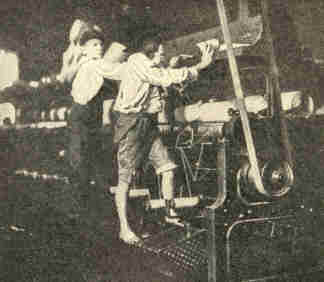
Cotton-mill operatives so small that in order to reach
their work they have to stand upon the machinery.
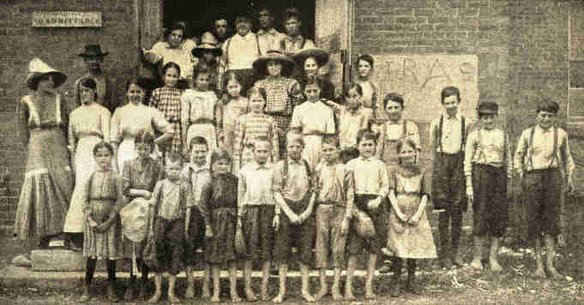
The spinning-room overseer and his flock in a Mississippi cotton-mill.
The subject was given national prominence through the Beveridge-Parsons
Bill introduced into the Senate, December, 1907, marking an epoch in the
history of federal legislation. This bill proposed to exclude from
interstate commerce all products of mines and factories which employ
children under the age of fourteen. The bill was not, however, brought
up for discussion. The leading arguments of its opponents were as
follows: (1) That the question was local only; (2) there was no reason
to believe that federal would be better than State administration; (3)
that it was limited in effect since it could not prevent children being
employed in the manufacture of goods to be sold within a State. A bill
passed both houses and was signed by the President, authorizing the
Secretary of Commerce and Labor "to investigate and report on the
industrial, social, moral, educational, and physical conditions of woman
and child workers of the United States, wherever employed, with special
reference to their age, hours of labor, term of employment, health,
illiteracy, sanitary and other conditions surrounding their occupation,
and the means employed for the protection of their health, persons, and
morals." An appropriation of $150,000 was made with which to carry on
this investigation. Among the demands of the National Child Labor
Committee have been a shorter day's work for children between the ages
of fourteen and sixteen, health certificates for factory employment in
dangerous trades, and the regulation of children in street trades.
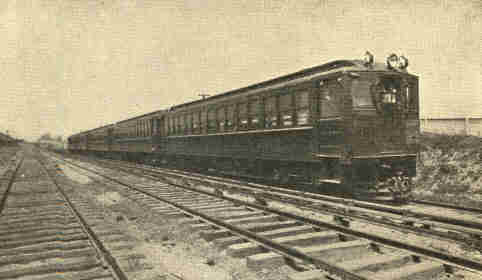
Electric train, Long Island R. R.
The period of Mr. Roosevelt's administrations was notable on account of
advances made in various other directions. Electricity was applied to
new and larger uses. Power was transmitted to greater distances. Niagara
Falls was made to produce an electric current employed leagues away.
Electric railways, radiating from cities, converted farms and sand-lots
into suburban real estate quickly and easily accessible from the great
centres. Telephone service was extended far into country parts, and,
with the rural free delivery of mail, brought farmers into quick and
inexpensive communication with the outside world, robbing the farm of
what was once both its chief attraction and its greatest
inconvenience–isolation.
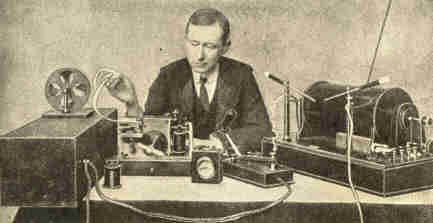
Guglielmo Marconi and his wireless telegraph.
German experiments developed an electric surface car with a speed of two
miles a minute. Wireless telegraphy came into use. By means of high
masts rigged, with wires diverging to the earth somewhat like the frame
of a partly opened umbrella, it was found possible under favorable
atmospheric conditions to telegraph hundreds of miles through the air.
The most notable use of this invention was to communicate between ships
and the shore or between ships at sea, a particularly desirable facility
in fog, storm, or darkness, when other signals were useless.
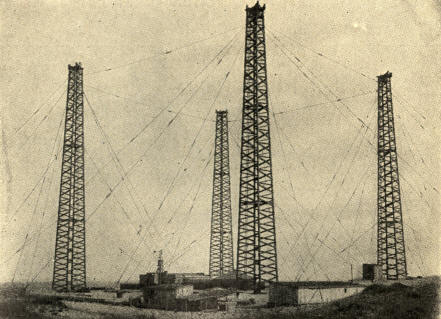
Marconi Transatlantic Station at South Wellfleet, Cape Cod, Mass.
Electricity and the gasolene engine were applied to bicycles, vehicles,
and boats, often generating sufficient power to run a small factory.
Bicycles somewhat passed from vogue, but automobiles became fashionable,
partly for rapid transit, partly for work formerly consigned to heavy
teams. Auto-carriages capable of railway speed, varying indefinitely in
style and in cost, might be seen upon the smoother roads about cities
all the way from Maine to California. They exerted great influence in
inducing communities to macadamize roads, for which the passing of the
stage-coach and the spread of railroads had diminished the demand.
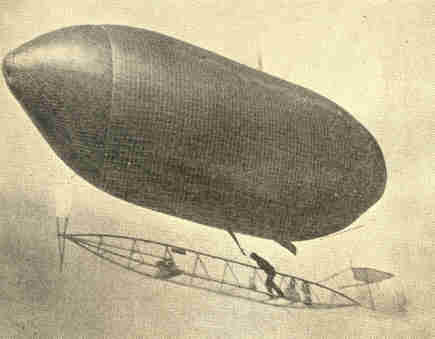
Courtesy of Scientific American.
The "Arrow" getting under way.
Effort with flying machines was incessant but only partially successful.
No air-ship had thus far been devised which could undertake a definite
voyage of length with any certainty of reaching its destination. The
best feat yet was that of the air-ship Arrow, which, October 25, 1904,
at St. Louis, made a ten-mile trip. On the other hand, the development
of boats able to carry life for hours beneath the surface of the sea
added a new form of attack and defence against the well-nigh
impenetrable sides and enormously powerful guns of modern naval ships.
About 1890 the use of the Australian ballot system became general, and
thus the purchase of votes became more difficult. But this reform did
not eliminate the evils of machine politics. State laws were extended to
the control of party affairs, with severer punishments for corrupt
practices, the control of lobbying, and the requirement of publicity for
campaign expenses. In a few States the primary election system was put
into operation. Public officers won popular approval in numerous States
and cities by their activity in revealing "graft" and by their fearless
enforcement of the law.
These reforms were made possible by the increase of independent voting
in State and city politics. Politicians must reckon, as never before,
with the demand of the average citizen for honesty in public service.
The influence of corporations in governmental affairs received a check,
and there came to be a growing demand for the more complete control of
public utilities, and for the public ownership of them in cities.
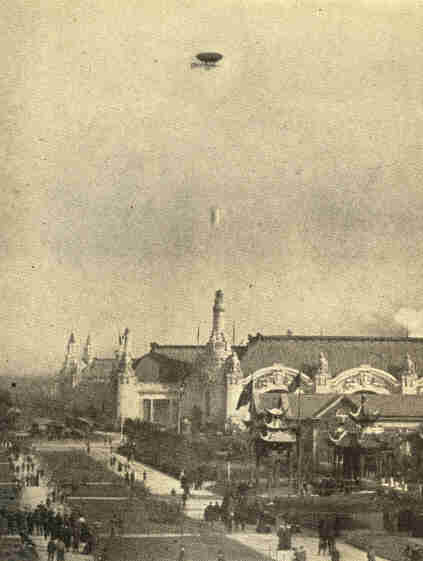
Courtesy of Scientific American
Baldwin's airship "Arrow" at a height of 600 feet over
the Exposition Palaces, St. Louis, October 25, 1904.
The prominence of the moral element in the business and political
reforms mentioned above characterizes this as an era of "awakened civic
conscience." Both moral and economic considerations may be seen in the
protest against the excessive use of alcoholic liquors that has resulted
in the prohibition of liquor selling in a number of States and parts of
States, especially in the South. Educationally, the period showed
increased attention to the industrial and practical aspects of school
work. Courses in manual training came to be regarded as necessary for
the complete development of mind and body. Physical education received
greater attention. The establishment of public libraries, aided by the
munificent gifts of Andrew Carnegie, was rapid.
Millions of dollars, also, were contributed to the cause of education
and research. Among the most notable of these gifts were those by Mr.
Carnegie for the establishment of the Carnegie Institution and the
Carnegie Foundation, and the contribution to the General Education Board
by John D. Rockefeller. In 1902 the Carnegie Institution at Washington
was established by a gift of $10,000,000 by Andrew Carnegie. This sum he
afterward increased to $25,000,000. The work of the institution is to
carry on scientific study and research. Material is being collected for
the economic history of the United States, and students of American
history have been aided by the catalogues showing the location of
documentary and other source material. While the head-quarters of the
Institution is in Washington, important departments are located
elsewhere throughout the country. There is a laboratory at Tucson,
Arizona, for the study of desert plant life; a biological laboratory at
Cold Spring Harbor, Long Island; a marine biological laboratory at
Tortugas, off the Florida coast, and an astronomical observatory at
Mount Wilson, California.
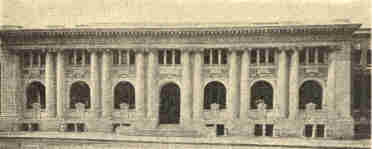
Atlanta, Ga.
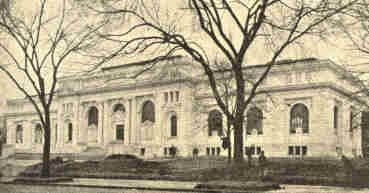
Washington, D. C.
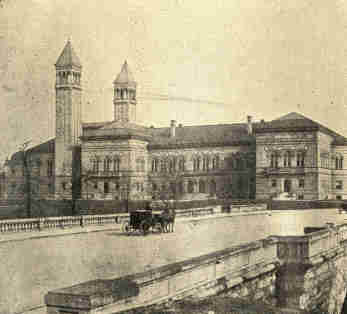
Pittsburgh, Pa.
CARNEGIE FREE PUBLIC LIBRARIES.
May 6, 1905, the announcement was made of a gift of $10,000,000 for the
purpose of providing retiring pensions for the teachers of colleges,
universities, and technical schools in the United States, Canada, and
Newfoundland. In making the gift Mr. Carnegie wrote: "I hope this fund
may do much for the cause of higher education and to remove a source of
deep and constant anxiety to the poorest paid and yet one of the highest
of all professions." The fund was to be applied without regard to age,
sex, creed, or color. Sectarian institutions, so-called, or those which
require a majority of their trustees, officers, faculty, or students to
belong to a specified sect, or which impose any theological test
whatever, were excluded by the terms of the gift. Universities supported
by State taxation were at first excluded, but a supplementary gift by
Mr. Carnegie of $5,000,000, in 1908, extended the privileges of the
foundation to these universities.
In February, 1907, John D. Rockefeller increased the money at the
disposal of the General Education Board by a gift of $32,000,000. This
fund, which had been originally established by him, amounting to
$11,000,000, had been used chiefly for the improvement of education in
the South. Common schools were aided, high-schools established, and
instruction in agriculture fostered. The additional sum was to be
devoted to lending assistance to certain selected colleges, with the
stipulation that the college was to raise three times the amount of
money granted it by the Board.