
[1907]
The Northern Securities Company is a corporation, formed under the laws
of New Jersey, for the purpose of obtaining control of a majority of the
stock of the Northern Pacific Railroad and part of the stock of the
Great Northern Railroad. These roads, which parallel each other from
Lake Superior to the Pacific, have been held by the courts, in the case
of Pearsall vs. the Great Northern Railway, to be competing lines.
The organizers of the Northern Securities Company contended that their
ultimate purpose in organizing the company was to control the two
railway systems not for the purpose of suppressing competition, but to
create and develop a volume of trade among the States of the Northwest
and between the Orient and the United States by establishing and
maintaining a permanent schedule of cheap transportation rates.
When the company had completed its organization and the full
significance of the organization was known, the State of Minnesota
instituted proceedings against the company in the State courts. Later
the case was transferred to the federal Circuit Court and eventually
carried to the Supreme Court of the United States, where the contentions
of the State were overruled.
In March, 1902, a suit was instituted by the United States in the
Circuit Court of the eighth federal district. The judges who sat upon
the case decided unanimously that the acquisition of the stock of the
Northern Pacific and the Great Northern Railways by the Securities
Company was a combination for the restraint of trade among the States,
and therefore a violation of the Sherman act. A decree was issued by the
court prohibiting the company from acquiring any more of the stock of
these roads and from exercising any control over either of the roads in
question.
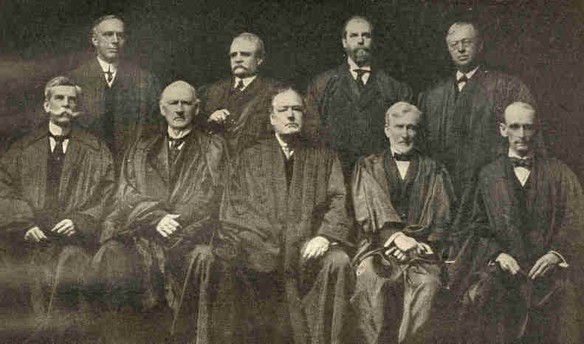
Copyright by Clinedinst. Washington.
W. Van Devanter. H. H. Lurton. C. E. Hughes. J. R. Lamar.
O. W. Holmes. J. M. Harlan. E. D. White. J. E. McKenna W. R. Day.
Justices of the United States Supreme Court who acted upon the cases of
the Standard Oil and American Tobacco Companies.
The case was carried to the Supreme Court which by a vote of five to
four, affirmed the decree of the lower court. In the majority opinion
the court took the position that the mere acquisition by the Securities
Company of the stock of the two roads was in itself a combination for
the restraint of trade. The power to do things made unlawful by the
Sherman act had been acquired and this in effect violated that act.
Another point was made clear by the court. The defendants had vigorously
denied that the power of Congress over interstate commerce was extended
to the regulation of railway corporations organized under State laws, by
reason of these corporations engaging in interstate commerce. The court
declared that while this was not the intention of the Government, the
Government was acting within its rights when it took steps, not
prohibited under the Constitution, for protecting the freedom of
interstate commerce. Furthermore, it was held that no State corporation
could stand in the way of the enforcement of the national will by
extending its authority into other States. In substance the court denied
the right of any State to endow a corporation of its creation with power
to restrain interstate commerce.
The contention of the defendants, that the Sherman law was intended to
prohibit only those restraints which are unreasonable at common law, was
dismissed on the ground that this question had been passed upon by the
lower court in other cases.
The dissenting opinions were two in number and were written by Justice
White and Justice Holmes.
Several conclusions of importance may be drawn from the court's
decision.
1. That Congress may forbid transactions of purchase and sale when such
transactions confer on an individual or group of individuals the power
to destroy competition.
2. No State can create corporations and confer upon them power to
interfere with interstate commerce.
3. The Sherman law is not to be interpreted as forbidding the reasonable
restraints of trade which are not objectionable at common law.
The Bailey case is one of importance by reason of the fact that the
decision handed down by the Supreme Court was an effective blow against
the "peonage system," which is an evasion of the constitutional
prohibition of slavery. The Alabama law provides, in effect, that the
mere act of quitting work on the part of a contract laborer is
conclusive evidence that he is guilty of the crime of defrauding his
employer.
Alonzo Bailey was engaged by a corporation to do farm work and signed a
contract for a year, the wages being $12 a month. The company, to bind
the contract, paid Bailey $15 down and it was agreed that thereafter he
should be paid at the rate of $10.75 a month. After working a month and
a few days he left. Instead of suing him for a breach of contract and
recovery of damages, the company caused the arrest of Bailey on the
charge of an attempt to defraud. No direct evidence could be produced
that this was his intention, but the law expressly authorized the jury
to find him guilty of fraud, on the ground that he quitted work. The
accused was not allowed to testify as to his unexpressed intention. His
opportunity to escape prison was to pay back the $15 or to work out the
sum. In case neither was done, he was to be fined double the amount paid
at the time of making the contract or go to work at hard labor.
The attorneys for Bailey, wishing to test the constitutionality of the
Alabama law, carried the case to the Supreme Court of the United States.
The constitutionality of the law was called into question on the
following grounds: (1) That it violated the prohibition against
involuntary service; (2) it denied the plaintiff in error the right of
due process of law; (3) that by laying a burden on the employee and no
equivalent burden on the employer, the law denied to the plaintiff the
constitutional right of equal protection of the laws.
The decision of the court was not unanimous. Justices Holmes and Lurton
upheld the Alabama law, but the majority, in an opinion written by
Justice Hughes, declared the law in conflict with the Thirteenth
Amendment, which prohibits slavery or involuntary servitude, except as a
punishment for crime.
The significance of the decision is this–slavery has been outlawed by
our highest court, and one more legal barrier to the progress of the
black man has been removed.
The case of Loewe vs. Lawler, probably better known to the public as the
Danbury Hatters case, was decided by the Supreme Court in February,
1908, Chief Justice Fuller rendering the decision. The action was
brought originally in the United States Circuit Court for the District
of Connecticut and, after passing through the Circuit Court of Appeals,
reached the Supreme Court late in 1907.
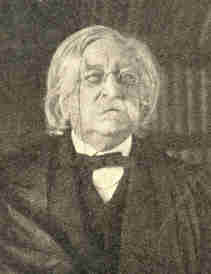
Photograph copyright by Clinedinst, Washington.
Chief Justice Melville W. Fuller.
The plaintiffs, who were manufacturers of hats, complained that the
defendants–members of the United Hatters of North America, an
organization which was a part of the American Federation of Labor–were
"engaged in a combined scheme and effort to force all manufacturers of
fur hats in the United States, including the plaintiffs, against their
will and their previous policy of carrying on their business, to
organize their workmen . . . into an organization of the said
combination known as The United Hatters of North America, or, as the
defendants and their confederates term it, to unionize their shops, with
the intent thereby to control the employment of labor in, and the
operation of, said factories . . . and to carry out such scheme, effort
and purpose by restraining and destroying the interstate trade and
commerce of such manufacturers by means of intimidation of, and threats
made to such manufacturers and their customers in the several States, of
boycotting them, their product and their customers . . . until . . . the
said manufacturers should yield to the demand to unionize their
factories."
These methods had been successfully employed before, as is evidenced by
the fact that seventy of the eighty-two manufacturers of fur hats had
been compelled to accept the conditions set forth by the American
Federation of Labor. The boycott against the Danbury, manufacturers
began in July, 1902, and was widened to include the wholesalers who
handled the goods of the Danbury concern, the dealers who bought from
the wholesalers, and customers who bought from these dealers. Notices to
this effect were printed in the official organs of the American
Federation of Labor and the United Hatters of North America. To make the
feeling against the manufacturers more intense, statements were
published to the effect that they were practising an unfair, un-American
policy in discriminating against competent union men in favor of the
cheap unskilled foreign labor.
The counsel for the defence argued that no case could be set up under
the Sherman act, since the defendants were not engaged in interstate
commerce, implying that a combination of laborers was not a violation of
the act. The court held that an action could be maintained in this case
and that the combination as it existed was "in restraint of trade" in
the sense designated by the act of 1890. The significance of the
decision lies in the fact that the Supreme Court made no distinctions
between classes. Records of Congress show that efforts were made to
exempt, by legislation, organizations of farmers and laborers from the
operation of the act and that their efforts failed. Therefore the court
held that every contract, combination, or conspiracy in restraint of
trade was illegal and cited a former decision (The United States vs.
Workingmen's Amalgamated Council) to show that the law interdicted
combinations of workingmen as well as capital.
The Sherman act was passed by Congress in 1890. It was entitled "An Act
to Protect Trade and Commerce against Unlawful Restraints and
Monopolies." Since its passage various cases falling under it have been
decided, but until the decisions in the Standard Oil Company and the
American Tobacco Company cases the extent and intent of this act have
not been understood.
In the Standard Oil case the question involved was this: Was the Sherman
act violated by the existence and conduct of this corporation, which
owned or controlled some eighty corporations originally in competition?
The control had been acquired for the purpose of monopolizing the sale
and distribution of petroleum products in the United States, and had
been acquired by various means of combination with the intent either by
fair or unfair methods "to drive others from the field and to exclude
them from their right to trade." The proof was that, to destroy
competitors, prices had been temporarily reduced in various localities,
spies had been used on competitors' business, bogus independent
companies operated, and rebates given and taken.
In the case of the American Tobacco Company, there were more than one
hundred formerly competing companies united under the control of a
single organization and the market in nearly all tobacco products was
monopolized. This domination was secured "by methods devised in order to
monopolize the trade by driving competitors out of business."
In each case the court found the defendants guilty on the grounds that
the agreements and the conduct of the defendants indicated a purpose to
destroy competitors and monopolize trade in certain articles. The
desired result was accomplished by wrongful means which injured the
public as well as the competitors.
The facts in neither case required the consideration of the question as
to whether the Sherman act prohibited every unification of formerly
competing properties and every restraint of trade, reasonable or
unreasonable but, owing to the uncertainty of the public concerning the
meaning of the law, the court stated definitely the meaning and scope of
the act. From appearances the Supreme Court has practically amended the
Sherman act by limiting its application to "unreasonable" restraints of
trade. The significance of the decisions lies here rather than in the
fact that both companies were compelled to dissolve. The best legal
authorities believe that the new interpretation of "reasonableness" and
"unreasonableness" of restraint of trade has increased rather than
decreased the effectiveness of the law, inasmuch as the meaning has
always been obscure. The new policy is a notification to combinations of
capital that to exist without prosecution they must not resort to any
unfair, oppressive, or illegal methods to control competition or crush
competitors.