
[1907]
Since the organization of our government nearly 29,000,000 foreigners
have come to the United States. The flow of immigration first assumed
large proportions during the decade 1831-1840 and since that time one
wave after another has reached our shores. The last one, and the one
which has caused the greatest alarm, gathered force about 1897 and
reached its full tide in the first decade of the twentieth century, when
over 8,000,000 aliens landed at our ports.
During this period (1820-1910) the character of immigration has changed.
Prior to 1880 the greater part of it came from northern Europe, but
since that time the number has constantly fallen off, and the flow from
southern Europe has greatly increased. During the decade 1871-1880
Austria-Hungary, Italy, and Russia sent only 181,000 of 2,262,000 aliens
who landed in the United States–about eight per cent. During the decade
1901-1910, 8,130,000 immigrants came to our shores, and of these
5,800,000, or over 70 per cent, were from these three countries. In 1901
Austria-Hungary sent, 113,400; in 1907 about 338,500, but owing to the
passage of the immigration law in 1907 the number fell abruptly, but by
1910 had again increased to 260,000. The same is true of Italy. In 1901
about 136,000 came; in 1907 nearly 286,000, and in 1910 about 215,500.
Russia sent 85,000 in 1901, some 260,000 in 1907, and 187,000 in 1910.
The numbers from northern Europe do not approach these. The immigration
from the British Isles does not reach the 100,000 mark; from Germany
only 30,000 come yearly.
Causes for this influx are varied. Many come desirous of owning homes, a
pleasure out of reach in their home country on account of high prices.
Free institutions attract others. A land which offers free schools to
all regardless of race or creed, religious freedom, and the opportunity
to play some part in the political life of the state is naturally
attractive. Some come to escape military service, others with the idea
of making money and returning to their native land. Density of
population and the accompanying excessive competition in the struggle
for existence also play a part.
Hundreds of letters telling of the general prosperity in America and
contrasting this with the condition at home, do their work with the
disheartened peasants. It is said that half of our immigrants come on
tickets paid for by friends in America. The large employers of labor,
and even the States themselves, are constantly calling for laborers.
Ours is a huge, half-developed country, and the development of our
resources, particularly the coal and iron industries, the cotton; rice,
cane, and tobacco industries, and the railways demands thousands of
helpers.
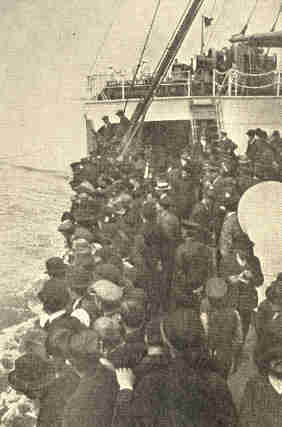
Emigrants bound for America.
The steamship companies which have found an extremely profitable
business in the transportation of immigrants have used various means to
increase the numbers. Agents are said to be in all European countries
soliciting trade. Associations for the assistance of poor emigrants have
been formed in various European cities–this is especially true among
the Jews who, by means of societies such as the "Hebrew Shelter" of
London, have aided thousands of Roumanian and Russian Jews on their way
to America.
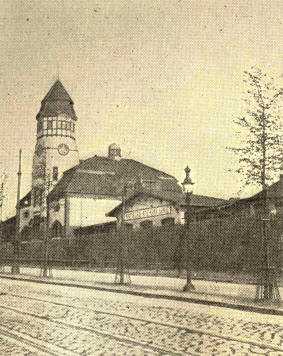
Entrance to Emigrant Station or "model town" in Hamburg.
Built for emigrants waiting to sail.
Although most of the European countries have placed restrictions upon
emigration, these restrictions unfortunately do not retard the
emigration of the undesirable classes. As a result America was called
upon early to legislate on this problem. The first act was in 1819 and
was aimed to regulate the transportation of immigrants. The laws of
1875, 1882, 1891, 1893, and 1903 dealt with the class of immigrants to
be admitted. The acts did not accomplish the end for which they were
framed, and the question was taken up again by Congress which, after a
lengthy discussion, passed the act of 1907. No great change in policy
was effected by this law which, for the most part, only revised the
wording of the old laws and modified the methods of regulation. The head
tax of two dollars, hitherto levied on each alien, was doubled but was
made inapplicable to immigrants from our insular possessions or to
aliens who had resided for a year either in the British possessions in
North America, or in Cuba or Mexico. All aliens suffering from
tuberculosis or loathsome diseases or those who were "mentally or
physically defective, such mental or physical defect being of a nature
which may affect the ability . . . to earn a living," were excluded.
Children under sixteen unaccompanied by a parent were excluded.
Steamship companies were placed under additional restrictions to insure
against their violation of the act. Should an immigrant within a period
of three years be found to have entered the country contrary to the
terms of the act, he was to be deported and the transportation company
responsible for his coming would be held liable for the expense of his
deportation.
The effect of the new law can be seen in the immigration statistics–the
number of immigrants for the year 1908 is but little more than half as
great as the number for 1907. The chief decrease was in the stream from
southern Europe. This decrease cannot be attributed entirely to the act
of 1907, but must be accounted for in part by the panic of 1907.
Observations extending over a long period of years have disclosed the
fact that the ebb and flow of the tide of immigration is closely
attached to the periods of economic prosperity and depression.
When the races of northern Europe contributed the greater part of our
immigrants there was a general feeling that this was a decided advantage
to us. The people were readily assimilated into our population and were
in general intelligent, industrious citizens who soon acquired a
patriotic love for America and its institutions. The serious problems
came with the increased number of southern Europeans.
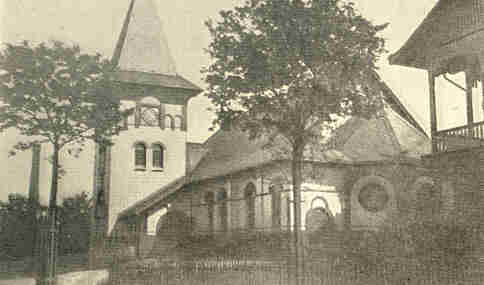
One of several churches built for emigrants of various
faiths in the station or "model town" of the
Hamburg-American Company, for use while waiting to sail.
For years Italians emigrated to South America, particularly to Brazil
and the Argentine Republic, where the climate, race customs, and
language were more to their liking than in the north. A diminution of
prosperity there has turned part of the tide northward. About eighty per
cent of our Italians come from southern Italy, a fact explained by the
difference between the industrial conditions in the northern and
southern parts of the peninsula. In the south agriculture is the only
industry, and it frequently suffers from climatic conditions, the
resulting losses bearing heavily upon the population. Conditions are
aggravated by an unequal division of taxes between the north and the
south. Often the only alternative to starvation is emigration. During
the past decade 2,000,000 Italians have come to us and, according to
estimates, about two-thirds of them have settled in the cities of the
Northern States, a condition detrimental to the foreign and our social
organization alike. These Italians, peasants and experts in fruit
culture by training, become day laborers, thus losing their greatest
productive power. The Italian who keeps away from the city finds his lot
more agreeable. Wherever they have settled as farmers they have been
uniformly successful. The person who knows only the Italian of the
tenements has little sympathy for him, in spite of the fact that many of
this race have proved themselves to be quiet, sober, and useful
citizens.
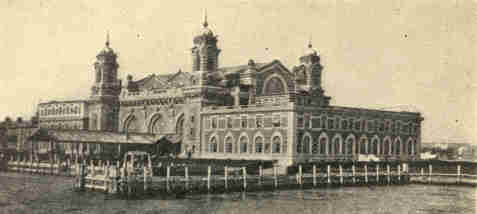
Exterior view of main building.
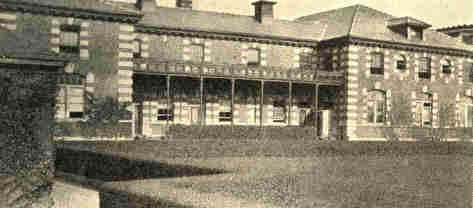
Restaurant. Immigrants dining-room and detention quarters.
Detained immigrants are fed here at the expense of the steamship companies.
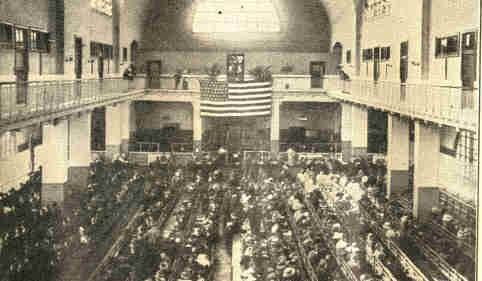
Here all immigrants must present themselves upon arrival for their
first inspection under the law–sometimes as many as 5,000 a day.
U. S. IMMIGRANT STATION, ELLIS ISLAND, N. Y.
The Slavic immigration since 1880 has been mainly from the more
primitive districts out of touch with the civilization of western
Europe. These people have come, not as settlers, but as laborers in the
mines, factories, and foundries, planning to remain here for a time,
earn as much as possible, and return to their native land.
In 1899 statistics began to be compiled by means of which the race and
nationality of aliens might be determined. From 1899 to 1907 about
seventy-two per cent of the Slavic immigration came from
Austria-Hungary. Since 1900 at least 100,000 aliens from this country
have come to the United States each year; in 1905, 1906, and 1910 the
number exceeded 250,000 each year, and in 1907 it was 340,000. In this
crowd came Bohemians Poles, Slovaks, Ruthenians, Slovenians, Croatians,
Bulgarians, Servians, Montenegrins, and other allied peoples. They are
distributed over various parts of the land. Pennsylvania, on account of
its mines, gathers by far the greatest number–in 1906 there were about
500,000 Slavs in the State; New York had nearly 200,000, and Illinois
about 134,000. The Bohemians and Poles seem inclined to farm, but in the
main the Slav laborers have busied themselves in the coal, coke, iron,
and steel industries. Very seldom do the Slavs take to petty street
traffic, as do the Jews and Italians, but prefer the harder and better
paid work in the mines and foundries.
The Russians make the smallest Slavic group in America. Although many
Russians are reported among the immigrants, only about five per cent are
native born Russians, the rest being Jews, Poles, Finns, and
Lithuanians.
About one-eighth of our European immigrants are Jews. By the law of 1769
the Jews in Russia are compelled to live within certain territorial
limits known as the Jewish Pale, and about ninety-four per cent comply
with the regulation. The law of 1882 has further restricted the places
of residence, for Jews are now prohibited from buying or renting lands
outside the limits of the cities or incorporated towns. Their
educational advantages are limited by law; few are admitted to the bar
and few to the other learned professions. To these disabilities the
Russian government has added the terror of persecution, which will
explain why 150,000 Jews come to America each year. In all there are
1,250,000 here.
"ALIEN PASSENGERS" AND IMMIGRANTS ENTERING THE UNITED STATES FROM
EUROPEAN COUNTRIES, 1820-1910
| Last Permanent Residence |
1820-30 |
1831-30 |
1841-50 |
1851-60 |
1861-70 |
1871-80 |
1881-90 |
1891-1900 |
1901-1910 |
Total |
| Austria-Hungary | 7,800 | 72,969 | 353,717 | 597,047 | 2,145,266 | 3,176,801 | ||||
| Belgium | 27 | 22 | 5,074 | 4,738 | 6,734 | 7,221 | 20,177 | 20,062 | 41,635 | 105,690 |
| Denmark | 169 | 1,063 | 539 | 3,749 | 17,094 | 31,771 | 88,132 | 52,670 | 65,285 | 260,472 |
| France | 8,497 | 45,575 | 77,262 | 76,358 | 35,984 | 72,206 | 50,464 | 36,006 | 73,379 | 475,731 |
| Germany | 6,761 | 152,454 | 434,626 | 951,667 | 787,468 | 718,182 | 1,452,970 | 543,922 | 341,498 | 5,389,548 |
| Greece | 15,996 | 167,519 | 183,515 | |||||||
| Italy | 408 | 2,253 | 1,870 | 9,231 | 11,728 | 55,759 | 307,309 | 655,694 | 2,045,877 | 3,090,129 |
| Netherlands | 1,078 | 1,412 | 8,251 | 10,789 | 9,102 | 16,541 | 53,701 | 31,816 | 48,262 | 180,952 |
| Norway, Sweden | 91 | 1,201 | 13,903 | 20,931 | 109,298 | 211,245 | 568,362 | 95,264 | 190,505 | 1,691,013 |
| Sweden |
230,679 | 249,534 | ||||||||
| Russia | 91 | 646 | 656 | 1,621 | 4,536 | 52,254 | 265,088 | 593,703 | 1,597,306 | 2,515,901 |
| Spain, Portugal | 2,622 | 2,954 | 2,759 | 10,353 | 8,493 | 9,893 | 6,535 | 6,723 | 27,935 | 170,426 |
| Portugal |
23,010 | 69,149 | ||||||||
| Switzerland | 3,226 | 4,821 | 4,644 | 25,011 | 23,286 | 28,293 | 81,988 | 33,149 | 34,922 | 239,340 |
| England | 22,167 | 73,143 | 263,332 | 385,643 | 568,128 | 460,479 | 657,488 | 271,094 | 388,017 | 3,089,491 |
| Scotland | 2,912 | 2,667 | 3,712 | 38,331 | 38,768 | 87,564 | 149,869 | 60,053 | 120,469 | 504,345 |
| Ireland | 50,724 | 207,381 | 780,719 | 914,119 | 435,778 | 436,871 | 655,482 | 403,496 | 339,065 | 4,223,635 |
| Wales |
11,186 | 17,464 | 28,650 | |||||||
| Europe; unspecified | 43 | 96 | 155 | 116 | 210 | 656 | 10,318 | 4,370 | 1,719 | |
| Total | 98,816 | 495,688 | 1,597,502 | 2,452,657 | 2,064,407 | 2,261,904 | 4,721,602 | 3,703,061 | 8,136,016 | 25,531,653 |
Immigrants from British North America and other countries 2,535,810
Estimated number of immigrants prior to October 1, 1819 250,000
[Transcriber's note: Norway/Sweden and Spain/Portugal are combined totals in
columns where only one value is given.]
TOTAL NUMBER OF IMMIGRANTS, 1891 TO 1910
| Sex | Age | |||||
| Year Ending June 30 |
Total Number |
Male |
Female |
Under 14 |
14 to 45 |
45 and Over |
| 1891 | 560,319 | 354,059 | 296,200 | 95,879 | 405,843 | 58,597 |
| 1892 | 623,084 | 385,781 | 237,303 | 89,167 | 491,839 | 42,078 |
| 1893 | 502,917 | 315,845 | 187,072 | 57,392 | 419,701 | 25,824 |
| 1894 | 314,467 | 186,247 | 128,220 | 41,755 | 258,162 | 14,550 |
| 1895 | 279,948 | 159,924 | 120,024 | 33,289 | 233,543 | 13,116 |
| 1896 | 343,267 | 212,466 | 130,801 | 52,741 | 254,519 | 36,007 |
| 1897 | 230,832 | 135,107 | 95,725 | 38,627 | 165,181 | 27,024 |
| 1898 | 229,299 | 135,775 | 93,524 | 38,267 | 164,905 | 26,127 |
| 1899 | 311,715 | 195,277 | 116,438 | 43,983 | 248,187 | 19,545 |
| 1900 | 448,572 | 304,148 | 144,424 | 54,624 | 370,382 | 23,566 |
| 1901 | 487,918 | 331,055 | 156,863 | 62,562 | 396,516 | 28,840 |
| 1902 | 648,743 | 466,369 | 182,374 | 74,063 | 539,254 | 35,426 |
| 1903 | 857,046 | 613,146 | 243,900 | 102,431 | 714,053 | 40,562 |
| 1904 | 812,870 | 549,100 | 263,770 | 109,150 | 657,155 | 46,565 |
| 1905 | 1,026,499 | 724,914 | 301,585 | 114,668 | 855,419 | 56,412 |
| 1906 | 1,100,735 | 764,463 | 336,272 | 136,273 | 913,955 | 50,507 |
| 1907 | 1,285,349 | 927,976 | 355,373 | 138,344 | 1,100,771 | 46,234 |
| 1908 | 782,870 | 506,912 | 275,958 | 112,148 | 630,671 | 40,051 |
| 1909 | 751,786 | 519,969 | 231,817 | 88,393 | 624,876 | 38,517 |
| 1910 | 1,041.570 | 736,038 | 305,532 | 120,509 | 868,310 | 52,751 |
| Year |
Debarred from Landing |
Returned Within One Year |
Returned Within Three Years |
Able to Read but not Wruite [See note 1] |
Unable to read or Write [See note 1] |
| 1892 | 2,164 | 637 | |||
| 1893 | 1,053 | 577 | 59,582 | 61,038 | |
| 1894 | 2,389 | 417 | 16,784 | 41,614 | |
| 1895 | 2,394 | 189 | 2,612 | 42,302 | |
| 1896 | 2,799 | 238 | 5,066 | 78,130 | |
| 1897 | 1,617 | 263 | 1,572 | 43,008 | |
| 1898 | 3,030 | 199 | 1,416 | 43,057 | |
| 1899 | 3,798 | 263 | 1,022 | 60,446 | |
| 1900 | 4,246 | 356 | 2,097 | 93,576 | |
| 1901 | 3,516 | 363 | 3,058 | 117,587 | |
| 1902 | 4,974 | 465 | 2,917 | 162,188 | |
| 1903 | 8,769 | 547 | 3,341 | 185,667 | |
| 1904 | 7,994 | 300 | 473 | 3,953 | 168,903 |
| 1905 | 11,879 | 98 | 747 | 8,209 | 230,882 |
| 1906 | 12,371 | 61 | 615 | 4,755 | 265,068 |
| 1907 | 13,064 | 70 | 925 | 5,829 | 337,573 |
| 1908 | 10,902 | 114 | 1,955 | 2,310 | 172,293 |
| 1909 | 10,411 | 58 | 2,066 | 2,431 | 191,049 |
| 1910 | 24,270 | 23 | 2,672 | 4,571 | 253,569 |
Note 1: Prior to 1895 the figures are for persons over 16 years; from
1895 to 1910 for persons 14 years of age and over.
The question of Oriental immigration has caused much comment in our
Pacific Coast States for several years. Before 1900 the total number of
Japanese coming to America seldom reached 1,500 a year. Since that time
about 12,000 have come each year, except in 1903 when 20,000 came and
1907 when the number reached 30,000. Seventy per cent of this number,
however, went to Hawaii. Over-population and economic depression in
their native land have caused this exodus. Most of these immigrants are
laborers–skilful, energetic and efficient–who apparently desire to
become citizens. Among the better classes are many who have attained
eminence in various lines of work in our country. In scientific
investigation the names of Takamine, Noguchi, Yatsu, Takami, Asakawa,
and Iyenaga are well known. The names of those who have been more than
ordinarily successful in business would make a long list. The most
serious objections to the Japanese arise in the coast States where these
immigrants have raised a serious labor problem. The people of these
commonwealths also fear a race problem which in gravity will rival the
one in the Southern States. It is claimed that even now, when the number
of Orientals is small, the enforcement of law is exceedingly difficult
in the Chinese quarters, while the control of the Japanese is next to
impossible since they do not congregate in certain sections of the
cities as do the Chinese. It is claimed that the 2,000,000 whites who
live on the Pacific Coast will be swamped and lose control of the
government if this Oriental immigration is not entirely prohibited. The
Chinese do not cause so much anxiety. Since the passage of the exclusion
act thirty years ago, few have come to the United States–scarcely more
than 2,000 a year. As laborers they are efficient, patient, and honest
in keeping labor contracts.
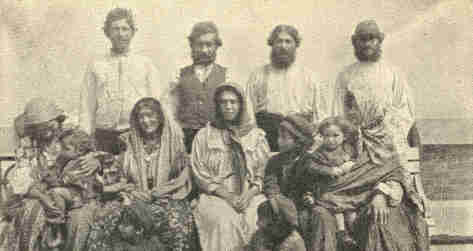
Gypsies excluded and deported as undesirable.

Ruthenian shepherds from Austria, bound out West for farmers.
Considered desirable and qualified to enter.
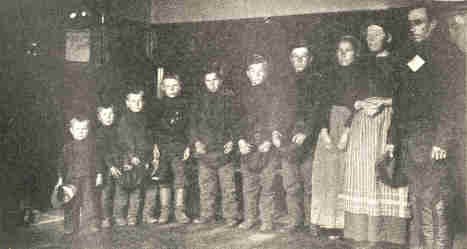
A German family of ten considered desirable and qualified to enter.
GROUPS OF IMMIGRANTS UPON THEIR ARRIVAL AT ELLIS ISLAND
These swarms of foreigners who come to us each year are causing
uneasiness in the minds of the thinking people. Can our foreign
population be growing more rapidly than our power to assimilate it? Is
this element as dangerous to our civilization as we think? Has
criminality increased as a result of increased immigration? Has this
element increased labor agitations during the past decade? Some contend
that we are rapidly approaching the limit of our power of assimilation
and that we are in constant danger of losing the traits which we call
American. The immigrants from southern Europe are in too many cases
deficient in education. This lack of education may or may not prove a
danger. So far it seems to have been the rule that in the second
generation these foreigners have shown themselves extremely anxious to
take advantage of the opportunities offered by our free schools.
One of the most serious charges made against the Americanized foreigner
has been that through him there has developed in our political system a
strain of corruption which endangers our institutions. Political
corruption did not come with the immigrants: it was known in all its
forms years ago. This much can be said, however: the worst class of
foreign-born citizens has ever proved to be a support of corrupt
political bosses. Our city governments have been notoriously corrupt and
the cities harbor the great masses of foreigners. The high cost of
living in the cities and the relatively low wages force the aliens into
poor and crowded quarters which tend to weaken them physically and
degrade them morally and socially. Among the Italians of the cities
there appears to be a vicious element composed of social parasites who
found gambling dens, organize schemes of black-mail, and are the agents
of the dreaded Black Hand. It is the class which furnishes aids for the
lowest political bosses and furnishes the bad reputation for the
Italians.

Group of Cossack immigrants considered desirable and qualified to enter.
An investigation of the nationalities in the city of Chicago has been
made by Professor Ripley, of Harvard. The results illustrate the
wonderful dimensions of the problem which the cities confront in the
assimilation of the foreign element. In the case of Chicago, were the
foreigners (those not American beyond the third generation) to be
eliminated, the population would dwindle from 2,000,000 to about 100,00.
In this city fourteen languages are spoken by groups of not less than
10,000 persons each. Newspapers are regularly published in ten different
languages and church services conducted in twenty different tongues.
Measured by the size of its foreign colonies, Chicago is the second
Bohemian city in the world, the third Swedish, the fourth Polish, and
the fifth German. There is one large factory employing over 4,000 people
representing twenty-four nationalities. Here the rules of the
establishment are printed in eight languages. So it is with the other
cities. New York, for example, has a larger Italian population than
Rome, and is the greatest Jewish city, for there are in the city some
800,000 Jews. In all eighty per cent of the population of New York are
foreigners or the children of foreigners. In Boston the per cent reaches
seventy and in Milwaukee about eighty-six.
The charge that criminality has increased rapidly with the increased
immigration from southern Europe seems to be substantiated by
statistics. From 1904 to 1908 the number of aliens charged with
committing grave crimes nearly doubled. While this fact will not prove
the point, it suggests thought on the question.
It has been truthfully said that the fundamental problem in this
question of immigration is most frequently overlooked. Back of the
statistics of illiteracy, pauperism, criminality, and the economic value
of immigrants lies another one of great proportions. What has been the
effect upon our native stock? What has been the expense, to our native
stock, of this increase of population and wealth through immigration?
The decreasing birth rate of our native population some contend is due
to the industrial competition caused by the foreign element. If this be
true, the foreigners have supplanted not supplemented the American, and
the question arises, how long can the assimilation go on before we lose
our American characteristics?
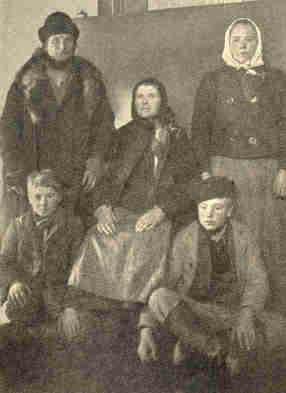
Swedish immigrant family considered desirable and qualified to enter.
The number of Europeans who return to their native lands after living a
time in the United States is comparatively small and the loss is not
great. The emigration of our farmers to Canada is a more serious thing.
Since 1897 the Dominion Government has fostered high-class immigration.
Canadian agencies have been established in many of our Western cities
with the avowed object of attracting farmers to the Provinces. The
Canadian Pacific Railway Company has taken up the pioneering business.
It sells the land, builds the home and the necessary buildings, breaks
the fields, plants the first crop, and hands over to the prospective
settler a farm under cultivation. In return the railway demands
high-class immigrants and, to insure this, no settler can take
possession of a railway farm unless he can show $2,000 in his own right.
Between 1897 and the close of 1910 Canada gained by immigration nearly
2,000,000 inhabitants. Of these, 630,000 were from the United States,
and it is estimated that those who went from the United States during
the past five years took with them $267,000,000 in cash and settlers'
effects. The end of the movement has not come, for the railway companies
have now gone into the reclamation of arid lands. Since 1908 over
1,000,000 acres of arid land in Alberta have been placed under
irrigation, and the work of reclaiming another equally large section has
begun. The American farmers who are taking advantage of this opportunity
form a class which we cannot afford to lose.