
[1907]
Popular opinion ascribed three reasons for the panic of 1907. The first
of these was the attitude of the President toward certain great
corporations. It is true that his attacks bared some of the most deeply
rooted evils which have always been at the bottom of our
panics–dishonesty in the administration of great aggregations of
capital. Great were the lamentations and doleful the predictions of what
would happen should the President not change his policy of enforcing the
laws. The railway opponents of the President were sure the panic came
from the Hepburn Bill, which was passed early in 1906. If this had been
dangerous to the welfare of the railroads it is reasonable to assume
that foreign capital would have been withdrawn from American railways
and that American capitalists interested in railroads would have
attempted to avert financial ruin by disposing of their holdings.
Neither situation developed, for the European investors increased their
holdings and American capitalists continued to plan still greater
investments in railways.
The second general explanation was found in the unsound and reckless
banking in New York City. The dangers arising from trust companies had
been known for several years. It came to be believed that the deposits
in these trust companies were being misused by the bank officers for the
promotion of various speculating schemes. The disclosures which came
with the investigation of the insurance companies fixed these beliefs
more firmly in the minds of the people, and the first break in
confidence precipitated runs on the New York banks.
The third explanation was that the panic was due to the defects in our
American currency system.
These were the popular explanations, but there were deep-seated causes
which had worked to bring about the existing conditions. The crisis was
world-wide and was felt most in the countries where there was a gold
standard. In 1890 the world's supply of gold available for monetary use
was hardly $4,000,000,000; in 1907 it was more than $7,000,000,000.
Along with this went a rapid rise in the average price of commodities in
gold-standard countries. Bank deposits in the United States in 1907 were
three times as great as they were in 1897. Amidst all this prosperity
there were forces which were bound to bring a reaction and among the
most important of these was the demand for capital for conversion into
fixed forms. Ready capital was also lessened relatively by the great
losses experienced as a result of the Spanish-American War, the Boer
War, the Japanese-Russian War, the San Francisco earthquake, and the
Baltimore fire. These losses, which amounted to $3,000,000,000, came at
a time when the world was just entering upon a period of great
industrial activity and needed all its capital. Much capital was
absorbed in the construction of railroads, industrial plants,
development of foreign industries, etc. These conditions brought about a
tightening of money rates in Europe and American financial centres;
consequently rates of interest went up. Commercial paper which brought
three to three and one-half per cent in New York in 1897 brought seven
per cent in 1907.
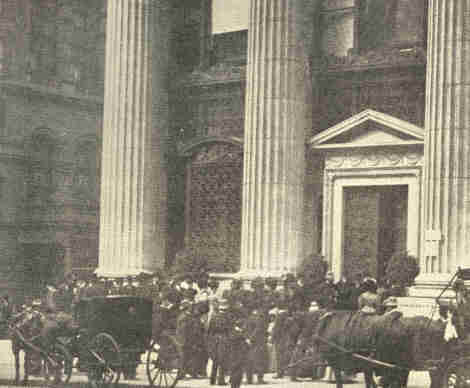
The panic of 1907. Run on the Knickerbocker Trust Company,
34th Street and Fifth Avenue.
Closely allied to this movement was the increase in the number of
securities issued by industrial concerns. A few resourceful men, in
order to do away with the evils of unrestricted competition, devised a
remedy in the form of mergers. Others of less capacity but greater
daring saw opportunities for money-making, and a craze for mergers and
for the incorporation of private enterprises swept over the country. By
1907 there were at least $38,500,000,000 worth of securities in
existence. The natural result was speculation. When investors began to
fear the soundness of the securities a collapse of credit was due.
The rapid development of trust companies had its effect. The cash
reserves held by these companies were small; their investments were not
always conservative and the depositors were often suspicious. This free
expansion of business with little or no reference to cash reserve or
capital gave rise to another cause for the panic, which was not a matter
of money. It was a matter of what was in men's minds. There was a period
of "muckraking" in which leaders financial and political were severely
critcised. Whether or not this criticism was justified by the exposition
of the frauds of the insurance companies and the questionable dealings
of some other corporations need not be discussed. The criticism created
an attitude of mind throughout the nation, and the first weakening of a
bank brought on the deluge.
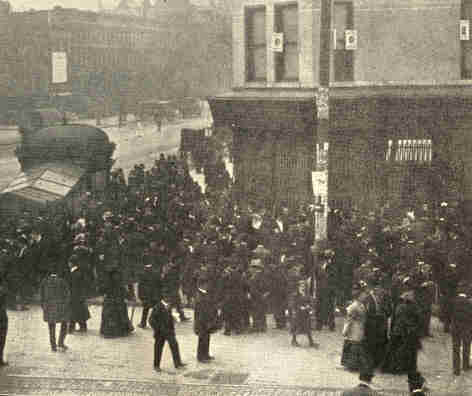
The panic of 1907. Uptown branch of the
Knickerbocker Trust Company, 125th Street.
To the ordinary observer the panic of 1907 will date from October 22,
when the Knickerbocker Trust Company of New York closed its doors.
Earlier in the month the Mercantile National Bank had gotten into
difficulties and had appealed to the clearing-house committee for aid,
which was given. Soon it was noted that the Knickerbocker Trust Company
was in a precarious condition, and the directors, following the example
of the other bank, appealed to the same committee. The investigation of
the committee showed the company insolvent and aid was refused. When the
facts became known, a run on the bank began and it was compelled to
close its doors. The lack of confidence in other financial institutions
was soon shown by similar runs.
No bank could stand the strain unaided. Now the Federal Government
stepped in and Secretary of the Treasury Cortelyou came in person to New
York and deposited $40,000,000 of the surplus from the United States
Treasury to be used for the aid of beleaguered institutions. For more
than a week the crowds of depositors sought their money. The lines were
not broken at night until the police hit upon the plan of giving to each
individual a ticket denoting his place in the line. The Trust Company of
America alone paid $34,000,000 across its counters and still crowds
thronged the streets. At length the enormous reserve of the Treasury was
exhausted and it became necessary to delay and deliberately to make slow
payments. Through loans made by other banks the Trust Company of America
and the Lincoln Trust Company, which had endured the hardest sieges,
were saved and now the panic entered its second stage.
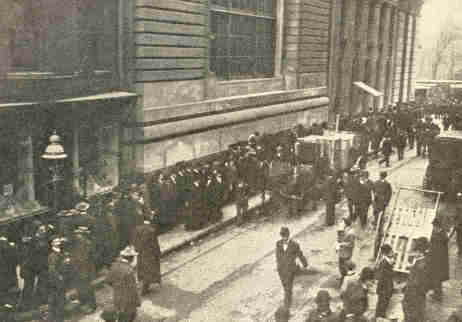
The panic of 1907. Run on the Colonial Trust Company.
Line of depositors in Ann Street waiting their turn.
The country was thoroughly aroused, and to avoid a nation-wide raid upon
banking houses the bankers took radical steps. The first measure
resorted to was the enforcement of the rule requiring savings-bank
depositors, at the option of the institution, to give sixty days' notice
before withdrawing deposits. The second expedient was one which had been
resorted to during former years of financial unsteadiness. "Emergency
currency" was issued. This currency took various forms. (1) The
clearing-house loan certificates issued in denominations ranging from
$500 to $20,000, used for settling inter-bank balances; (2)
clearing-house certificates in currency dimensions to be used by banks
in paying their customers; (3) clearing-house checks which took the form
of checks drawn upon particular banks and signed by the manager of the
clearing-house; (4) cashier's checks (in opposition to the National Bank
act) secured by approved collateral; (5) New York drafts which were
cashier's checks drawn against actual balances in New York banks; (6)
negotiable certificates of deposit, and (7) pay checks payable to bearer
drawn by bank customers upon their banks in currency denominations.
These were guaranteed by the firm which issued them.
Other devices were used to aid the banks and to block the spread of the
panic by limiting cash payments by the banks. The governors of Nevada,
Oregon, and California declared legal holidays continuously for several
weeks, thereby allowing the banks to remain closed. In some places the
size of withdrawals was limited to $10 or $25 daily.
The panic was felt to a great degree on the New York Stock Exchange
because the banks refused to make loans, but this stringency was
relieved by a bankers' pool, headed by J. P. Morgan, which loaned
$25,000,000 at the prevailing rate of interest. With the strengthening
of the Stock Exchange another stage of the panic passed.
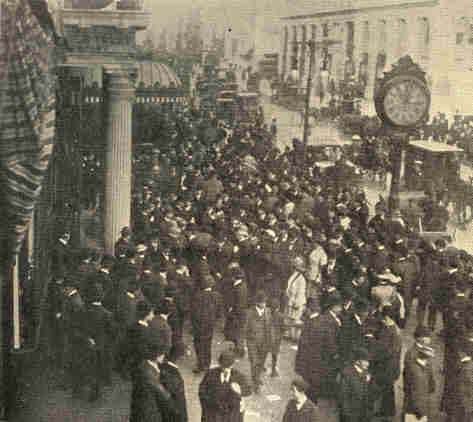
The panic of 1907. Run on the Lincoln
Trust Company, Fifth Avenue entrance.
In spite of the use of the surplus of the Treasury the banks showed a
loss of $50,000,000 in actual cash during the five weeks of the panic.
Now demands were made on foreign countries for gold. The Bank of England
made no move to block the great withdrawals of gold except to raise the
official discount to seven per cent. The flow of gold did much to stay
the ebb of confidence.
Some contended for an issue of paper money and after a long discussion
by the officials of the Treasury, it was decided to sell $50,000,000
worth of Panama two per cent bonds and $100,000,000 worth of three per
cent notes in the hope of calling from its hiding-place the money which
was being hoarded. The result of the venture was not satisfactory and
the loan operations soon ceased.
Gradually financial affairs righted themselves. The emergency currency
was redeemed, the runs on banks ceased, confidence slowly returned, and
business picked up, although by the middle of 1908 the volume was
scarcely half of what it had been a year before. The number of bank
failures had been comparatively small. Only twenty-one banks were
obliged to suspend payment, while in 1893 the number was 160.
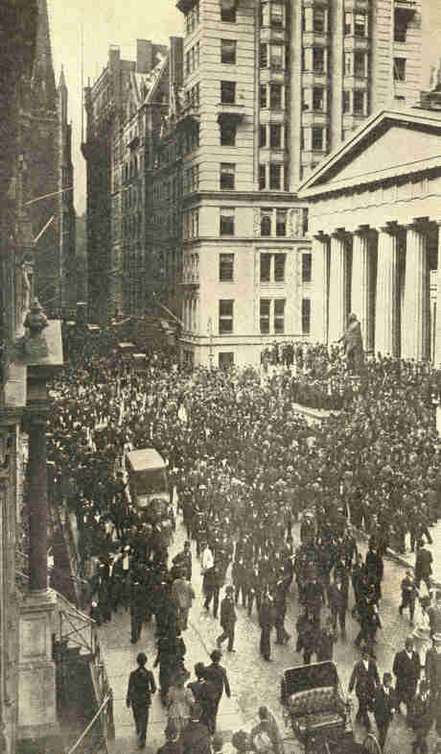
The panic of 1907. Wall Street, in front of the Sub-Treasury Building,
when the run on the Trust Company of America was at its height.
Naturally there was much discussion concerning the defects of our
financial system, of the needs of elastic currency, of a central bank,
etc., when the Sixtieth Congress met in December, 1907. Several bills
were offered for the establishment of a central bank; some for the issue
of a special currency by the government; others for the legalization of
certificates and currency created by clearing-house associations. The
aversion of the people to the centralization of the banking business in
the hands of a few of the great money powers made the establishment of a
central bank out of the question.
The bills which were discussed at any length were the Fowler Bill, the
Vreeland Bill, and the Aldrich Bill. The first was discarded, although
it had merits, and the two branches of Congress were unable to agree
upon either of the others. The result was a compromise measure which
became the Aldrich-Vreeland Act.
The important provisions of this act are as follows: (1) Ten or more
national banking associations, each with an unimpaired capital and
surplus of not less than twenty per cent and an aggregate capital and
surplus of not less than $5,000,000, may form national currency
associations. These associations are to have power to render available,
for the basis of additional circulation, "any securities, including
commercial paper, held by a national banking association."
(2) To obtain this additional circulation, any bank belonging to a
national currency association having circulating notes outstanding
secured by United States bonds to an amount not less than forty per cent
of its capital stock, and having the required unimpaired capital and
surplus, may deposit approved securities with the currency association
and be empowered by the Secretary of the Treasury to issue additional
circulating notes to an amount not to exceed seventy-five per cent of
the cash value of the securities. If the securities are State or
municipal bonds the issue must not exceed ninety per cent of the market
value of the bonds.
(3) The banks and assets of all banks belonging to the currency
association are liable to the United States for the redemption of this
additional currency, and the association may at any time require that
additional securities be deposited. All banks are held liable to make
good the securities of any bank in the association.
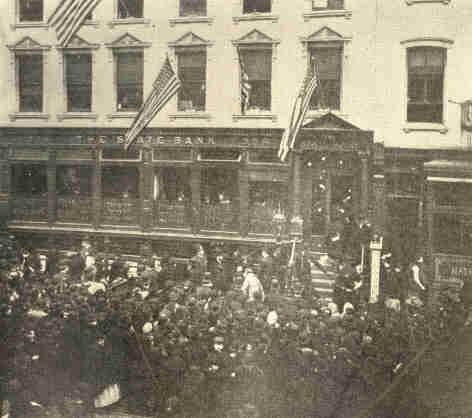
The panic of 1907, Run on the State Bank,
Grand Street, New York.
(4) The total amount of circulating notes outstanding for any bank shall
not at any time exceed the amount of its unimpaired capital and surplus,
neither shall the amount of such notes in the United States exceed
$500,000,000 at any time. The amount issued in each State shall bear the
same relation to the total amount issued in the United States as the
unimpaired capital and surplus of the banks of that State bear to the
unimpaired capital and surplus of the banks of the United States.
(5) The tax on circulating notes secured by United States bonds bearing
two per cent or less shall be one-half of one per cent; if secured by
United States bonds bearing more than two per cent, the tax shall be one
per cent. If the securities are other than United States bonds, the tax
shall be at a rate of five per cent per annum for the first month and
afterward an additional tax of one per cent per annum for each month
until a tax of ten per cent per annum is reached.
(6) The redemption of the notes may take place by the banks depositing
with the Treasurer of the United States lawful money to replace the
securities deposited.
(7) The formation of a national monetary commission to inquire into and
report to Congress necessary or desirable changes in the banking and
currency laws was provided for.