
[1905-1907]
On June 1, 1905, an exposition was opened at Portland, Oregon, in
commemoration of the Lewis and Clark expedition (1804-1805). Four
hundred acres of ground adjoining the principal residence district,
overlooking the Willamette River, were set aside for this purpose. There
were extensive exhibits by the United States, Great Britain, Canada,
Holland, Italy, China, and other European and Asiatic countries. The
fair was, in general, the expression of the life and history of the
Pacific Northwest and the direct relationship between that region and
the Orient. Many national congresses were held in conjunction with it,
such as the American Medical Association, National Good Roads
Association, and the National Conference of Charities and Correction.
The different interstate commerce acts, beginning with that of 1887 and
including the railroad rate bill of 1906, constitute a system of control
established by the Federal Government over persons and corporations
engaged in interstate or foreign commerce; this includes the carrying of
persons and property by either rail or water. Pipe lines, telephone,
telegraph, express, and sleeping-car companies are also brought under
the same provisions. The administration of these laws was vested in the
Interstate Commerce Commission consisting of seven members.
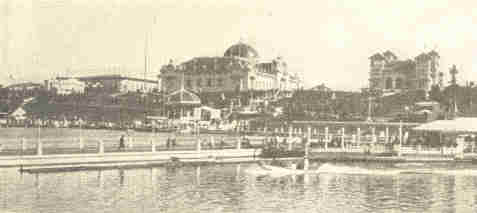
The Lewis and Clark Exposition, Portland, Ore.
General view across the Lagoon.
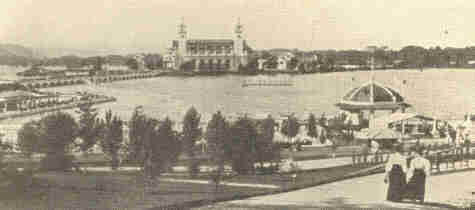
The Lewis and Clark Exposition, Portland, Ore.
The Government Buildings across the Lagoon.
The important provisions of these laws may be summarized as follows:
1. All charges must be just and reasonable. The commission was given
power to fix maximum rates after investigation of a complaint by either
party to a dispute over rates.
2. Pooling agreements were prohibited.
3. It was made unlawful to make discriminations by giving to any
particular person, corporation, or locality an unreasonable advantage
over others. Granting of passes was prohibited to other than railroad
employees, and granting of rebates was forbidden.
4. By the "long or short haul" clause it was made unlawful for a common
carrier to charge more for the transportation of passengers, or the same
kind of freight, over a shorter than a longer distance; provided the
transportation was under substantially similar circumstances and
conditions over the same line and in the same direction.
5. All rates were required to be published and posted where they might
be consulted by any person.
6. Railroad companies were forbidden to engage in other lines of business.
7. Companies engaged in interstate commerce must have a uniform system of
accounting.
8. They are required to make reports to the Interstate Commerce
Commission regularly.
This commission was also empowered to receive complaints, hear
testimony, make orders correcting abuses, or investigate conditions
without previous complaint. It was given the power to suspend the
proposed increase of rates until their justice had been determined. Any
person objecting to an order of the commission was empowered to appeal
to the "Commerce Court," which was created, being made up of five
circuit court Justices.
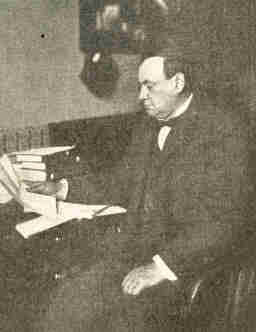
Copyright by Clinedinst, Washington.
Dr. Harvey W. Wiley, many years
Chief of the U. S. Bureau of Chemistry.
Nearly all of the States have passed laws relating to the purity of
goods sold to the public. Investigation showed, however, that twenty per
cent of the articles of food in common use were adulterated. This led to
the passing of a far-reaching measure by Congress, 1906, known as the
Pure Food and Drugs law. It provides against the manufacture and sale of
adulterated or misbranded foods, drugs, medicines, or liquors in the
District of Columbia, the Territories, and the insular possessions of
the United States, and prohibits the shipment of such goods from one
State to another or to a foreign country. To the Department of
Agriculture was given the power to enforce the law. Thus the public is
protected against adulterated foods and medicines and dishonest and
misleading labels, and honest manufacturers are protected against
fraudulent competition.
For a number of years some of the European countries condemned American
packing-house products. Abuses in the processes of preparing preserved
meats were brought vividly before Americans by Upton Sinclair in his
novel "The Jungle." The Department of Agriculture took up the problem
and a special investigation was ordered by President Roosevelt. The
report showed the need for more rigid inspection, and the agitation
throughout the country forced the House of Representatives, 1906,
somewhat reluctantly, to adopt the President's recommendation for a
thorough inspection, by government agents, of all processes and methods
used in the meat packing-houses.
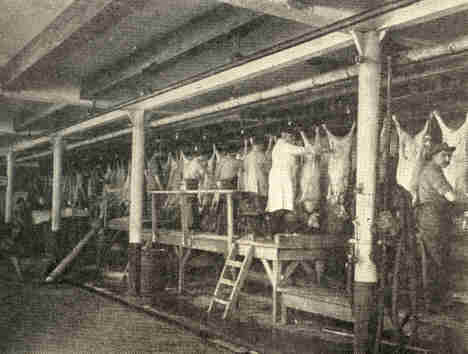
U. S. Government inspection of a packing-house.
Inspector's assistant attaching a "Retained" tag to carcass marked by
inspector on the heading bench. Carcasses so marked are left intact
until they reach the retaining-room.
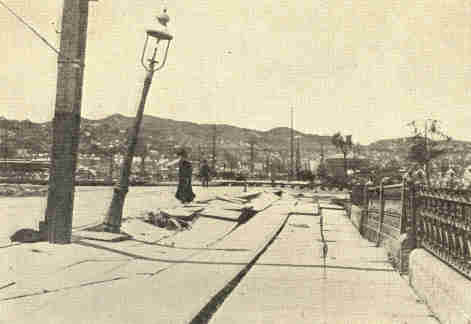
Earthquake at San Francisco, April 18, 1906.
Upheaval of sidewalk at Eighteenth and Capp Streets.
Early in the morning of April 18, 1906, San Francisco was visited by one
of the most dreadful disasters of modern times. An earthquake shock
destroyed many of the important buildings in the business part of the
city. Other cities and towns along the coast and in the Santa Clara
Valley suffered greatly and a number of the buildings of Leland Stanford
University, thirty miles south of San Francisco, were demolished. Ninety
per cent of the loss in San Francisco was due to the conflagration which
raged for two days. Fires broke out owing to the crossing of electric
wires. The water-mains were old and poorly laid and the force of the
earthquake had burst them. Firemen and soldiers fought the advance of
the flames by destroying buildings with dynamite. Not until an area
three miles in length and two miles in breadth, including all the
business and the thickly settled residential sections, had been burned
over was the advance of the flames stopped. The estimated loss of life
was 1,000, and property valued at $300,000,000 was destroyed. Among the
irreparable losses were several libraries, the collections of the
California Academy of Sciences, and many works of art. The noted
Bancroft Library with its collection of manuscripts was saved.
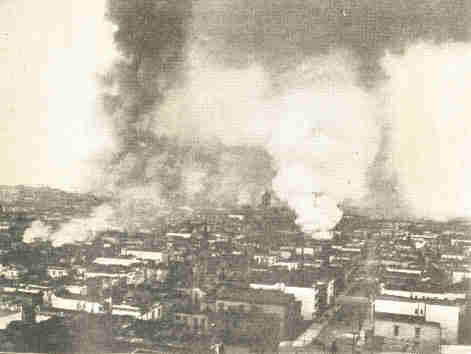
Burning of San Francisco following the earthquake.
Showing destruction of buildings after the
earthquake and fire in San Francisco.
A quarter of a million people were rendered homeless and were without
food and the means of earning a livelihood. The sympathy of the world
was aroused and offers of relief came from all quarters. Two million
five hundred thousand dollars was voted by Congress, and the total
relief fund amounted to $20,000,000. There was little suffering for lack
of food and water, owing to the co-operation of representatives of the
Red Cross Association, a citizens' committee, and the United States army
in distributing supplies.
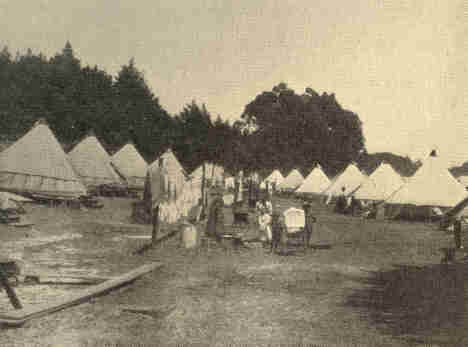
Refugees in Golden Gate Park, San Francisco.
One hundred thousand persons were sheltered in tents in Golden Gate
Park. The courage and hopefulness of the people did not desert them, and
the rebuilding of the city was immediately begun. At the end of a year
one-half of the burned area had been rebuilt. The old frame and low
brick structures were replaced by modern buildings of steel and
re-enforced concrete, for this type had survived the earthquake shock.
After two years, a new San Francisco, more beautiful and more
substantial, had risen on the site of the old.
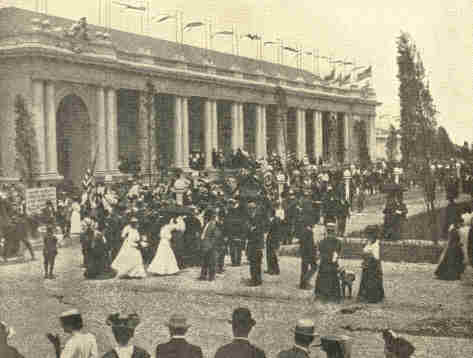
Copyright by Underwood & Underwood, N.Y.
The Jamestown Exposition–Manufactures and
Liberal Arts Building from the Auditorium.
On April 26, 1907, the Jamestown Exposition was opened. It was in
commemoration of the first English settlement in America. The southern
shore of Hampton Roads, forty miles southeast of old Jamestown, was
selected as the site for the buildings. The historic idea was uppermost
in the exposition. The colonial type of construction was dominant and
good taste and moderation were notable in the arrangement of the grounds
and exhibits. Industrial and commercial progress were emphasized. The
United States had a special exhibit to illustrate the work of the
different departments. In the harbor, one of the finest in the world,
was the greatest international naval display ever witnessed. Every
variety of war-vessel in existence was on exhibition besides commercial
and passenger boats from the great ports of the world.