
[1906]
Toward the close of the nineteenth century, attention was called to the
fact by scientific men that the methods employed in the use of our soil,
mines, forests, and water supply were extremely wasteful. During the
previous decades the resources of the country were regarded as
inexhaustible. As stated by President Roosevelt in 1907: "Hitherto as a
nation we have tended to live with an eye single to the present, and
have permitted the reckless waste and destruction of much of our
national wealth." At the same time the call came for the conservation of
our natural resources.
The destruction of the forests first attracted attention. The first
national reservation of forests was made in 1891, and in 1898 a marked
advance was made by the establishment of a division of Forestry in the
Department of Agriculture. Gifford Pinchot, as chief of the division,
called attention of the people to the interdependence of the forests and
the waterways.
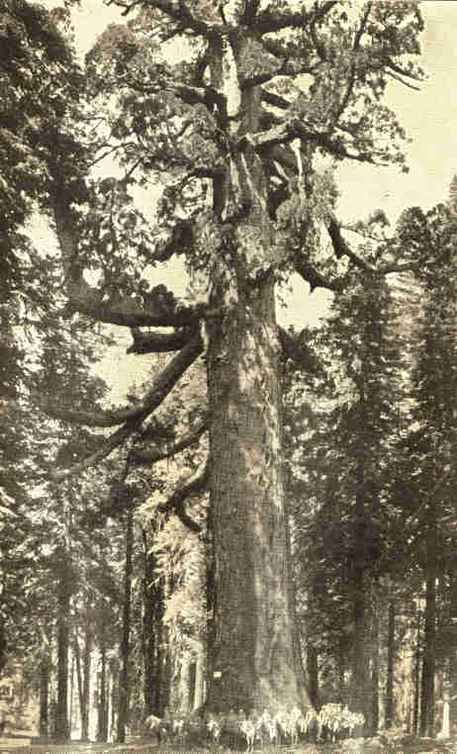
Grizzly Giant, Mariposa Grove, California, with a squad of cavalry at
its base.
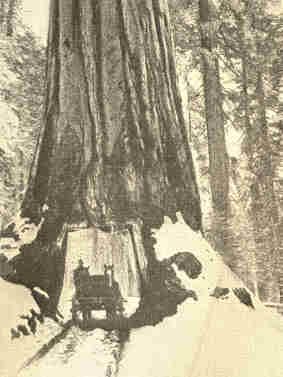
Big tree "Wanona," showing the relative size of other conifers compared
with big trees. Mariposa Grove.
In 1906, after long effort, the famous Mariposa Grove of large trees in
California was made a national reservation. During the same year a bill
was passed by Congress providing for the preservation of Niagara Falls.
Public opinion had been aroused by the campaign of the American Civic
Association. Power companies had multiplied so rapidly that it seemed
the whole volume of water was about to be used for commercial purposes
and that the most famous object of natural scenery in the United States
would be destroyed.
In response to appeals from the people of the interior, President
Roosevelt, March 14, 1907, appointed the Inland Waterways Commission. In
his letter which created the commission he said: "The time has come for
merging local projects and uses of the inland waters in a comprehensive
plan designed for the benefit of the entire country. . . . I ask that
the Inland Waterways Commission shall consider the relations of the
streams to the use of all the great permanent natural resources and
their conservation for the making and maintenance of prosperous homes."
This commission while carrying on its investigations discussed the
general policy of conservation and suggested to the President the
calling of a convention for the purpose of discussing the conservation
of the nation's resources. Thus originated the celebrated White House
conference of May 13-15, 1908. The opening session presented an
impressive scene, for there were assembled in the east room of the White
House, upon the invitation of the President, the Vice-President, seven
members of the cabinet, all of the justices of the Supreme Court, most
of the representatives and senators, thirty-four governors of States
together with their advisers, and representatives of the governors of
the remaining States, governors of the Territories, representatives of
sixty-eight national societies, and numerous special guests.
The opening address of President Roosevelt was a notable effort. "This
conference," he said, "on the conservation of natural resources is in
effect a meeting of the representatives of all the people of the United
States called to consider the weightiest problem now before the nation.
. . . We have become great in a material sense because of the lavish use
of our resources, and we have just reason to be proud of our growth. But
the time has come to inquire seriously what will happen when our forests
are gone; when the coal, the iron, the oil, and the gas are exhausted;
when the soils shall have been still further impoverished and washed
into the streams, polluting the rivers, denuding the fields, and
obstructing navigation. These questions do not relate only to the next
century or the next generation. One distinguishing characteristic of
really civilized men is foresight; we have to, as a nation, exercise
foresight for this nation in the future, and if we do not exercise that
foresight, dark will be the future!"
During the meeting numerous addresses were made on the conservation of
the minerals, of the soils, of the forests, and of the waters of the
country. In his address on the conservation of ores and related
minerals, Andrew Carnegie declared that during the three-fourths of a
century from 1820 to 1895 nearly 4,000,000,000 tons of coal were mined
by methods so wasteful that 6,000,000,000 tons were either destroyed or
allowed to remain in the ground forever inaccessible. From 1896 to 1906
as much coal was produced as during the preceding seventy-five years.
During this decade 3,000,000,000 tons were destroyed or left in the
ground beyond reach for future use. Basing his statements on the
investigations of scientists, he showed that at the present rate of
increase in production the available coal of the country would be
exhausted in two hundred years and the workable iron ore within a
century.
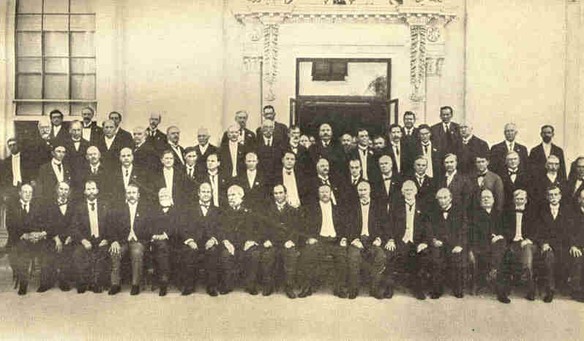
Copyright by Underwood and Underwood.
The President, Governors, and other leading
men at the National Resources Conference,
at the White House, May 13 to 15, 1908.
Similarly, James J. Hill demonstrated that the forests of this country
are fast disappearing and that from three to four times as much timber
was consumed each year as forest growth restored. His statements
regarding the tremendous soil waste in our farming methods were likewise
astounding. Resolutions were adopted covering the entire subject of
conservation as shown in one of them as follows: "We agree that the land
should be so used that erosion and soil-wash shall cease; that there
should be reclamation of arid and semi-arid regions by means of
irrigation, and of swamps and overflowed regions by means of drainage;
that the waters should be so conserved and used as to promote
navigation, to enable the arid regions to be reclaimed by irrigation,
and to develop power in the interests of the people; that the forests
which regulate our rivers, support our industries, and promote the
fertility and productiveness of the soil should be preserved and
perpetuated; that the minerals found so abundantly beneath the surface
should be so used as to prolong their utility; that the beauty,
healthfulness, and habitability of our country should be preserved and
increased; that the sources of national wealth exist for the benefit of
the people, and that monopoly thereof should not be tolerated." It was
recommended that the States should establish conservation commissions to
co-operate with one another and with a similar national commission.
On June 8, 1908, the first national conservation commission was created
by President Roosevelt. Its forty-nine members were men well known in
politics, in the industries, and scientific work. Gifford Pinchot was
chairman of this commission which submitted its first report at a
conference in Washington, December 8-10, 1908. The delegates consisted
of governors and other representatives from the States and from national
organizations. This report was received with favor and it was
recommended that the work of the commission should be continued.
Congress declined to make the necessary appropriation of $25,000 for
this purpose, although it was strongly endorsed by the President.
In 1901 the National Conservation Association was formed, a voluntary
organization of public and scientific men. The purpose of this
association is to carry on the movement for conservation in every State.
Within seven months after the White House conference, forty-one State
conservation commissions were created and fifty-one conservation
commissions representing national organizations were formed.
President Roosevelt carried the movement still farther in calling the
first North American conservation congress. Representatives to this
conference met in Washington, February 18, 1909. They came from Canada,
Newfoundland, and Mexico as well as the United States. Broad general
principles of conservation applicable to the North American continent
were adopted.
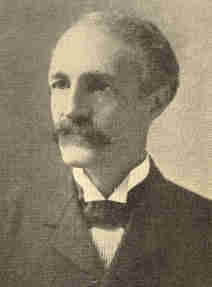
Gifford Pinchot, President
of the Conservation Commission.
The movement was materially strengthened also through the withdrawal of
large areas of the public domain from private entry. Thus 148,000,000
acres of forests and 80,000,000 acres of coal land were withdrawn during
President Roosevelt's administrations.
Directly connected with the problems of conservation are those of
irrigation. The so-called arid regions constitute two-fifths of the
area of the United States, or some 1,200,000 square miles. Of this vast
region, it has been estimated that about one-tenth can be irrigated to
advantage. By the end of the year 1908, some 13,000,000 acres had been
reclaimed, or nearly one-third of the total amount suitable for
irrigation purposes. This has brought about the rapid growth of cities
and a substantial industrial advance in the former arid regions of the
far West. The most notable impulse to this movement was made in 1902
when Congress passed a law, the Reclamation act, providing that the
proceeds from the sales of public lands in thirteen States and three
Territories should be expended by the National Government in the
construction of irrigation works.
The total receipts from the sales of these lands amounted to $28,000,000
by the end of the year 1905, and twenty-three projects, dams,
reservoirs, or canals were in different stages of construction. The most
important of these undertakings were the Roosevelt Dam, the Shoshone
Dam, and the Truckee-Carson Canal.
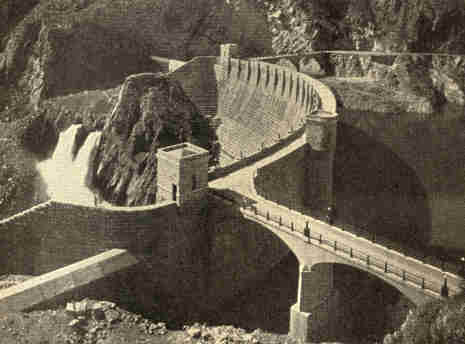
Built by the U. S. Reclamation Service.
Roosevelt Dam from the road.
The Roosevelt Dam is the chief work of construction in what is called
the Salt River project. By the completion of this work at least 200,000
acres in the vicinity of Phoenix, Arizona, were reclaimed. This dam is
284 feet high, 1,080 feet long on the crest, and 165 feet thick at the
base. The resulting reservoir with a storage area of 16,320 acres will
be the largest artificially formed lake in the world. It forms a body
of water 25 miles long, almost 2 miles broad, and with a maximum depth
of 220 feet. The main canals are 119 miles in length and the lateral
canals 208 miles. Not only will this structure insure a supply of water
in the Salt River valley where, in recent years, orchards and other
products have perished, but it will prevent the floods which have
devastated that region from time to time. Water-power amounting to
25,000 horse-power has been developed by the construction. This power
is used in part for pumping, and another area, estimated at 40,000
acres, outside the territory covered by the canals has been reclaimed.
The power is also used for lighting, for manufacturing, and for mining.
It was seen that the Shoshone River, in northwestern Wyoming, during the
season of melting snows, carried away more waste water than would be
adequate to reclaim many thousands of acres in the arid regions of the
lower altitudes. Two million two hundred and fifty thousand dollars were
allotted for the construction of the Shoshone Dam which will form a
reservoir of water sufficient to irrigate 75,000 acres of land 50 miles
farther down the river.
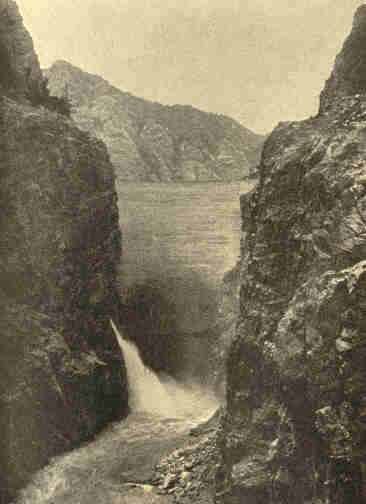
Shoshone Dam, Wyoming.
Highest dam in the world. Height 328.4 feet.
The Truckee-Carson project provides for the irrigation of 150,000 acres
in western Nevada. The water of the Truckee River, which flows out of
Lake Tahoe, is distributed by canals having an aggregate length of 670
miles. The main canal was opened in 1905.
By the close of the year 1906, over $39,000,000 had been allotted for
works under actual construction, and this amount had increased to
$119,500,000 within four years. It has been estimated that the land thus
reclaimed will alone be worth $240,000,000. The additional cost of a
project is assessed against the land. When the land is sold, the money
received is used for the development of new irrigation areas.
Another significant plan outlined by the irrigation congress in its
meeting, 1911, provided for bringing about the complete reclamation of
all swamp and overflowed land. The swampland area of the United States
exceeds 74,500,000 acres, or an amount greater than the area of the
Philippine Islands by 1,000,000 acres.
The Mississippi basin has been called the heart and soul of the
prosperity of the United States. Two-fifths of the area of the country,
comprising one-half the population, is tributary to the Mississippi
system, which has over 20,000 miles of navigable waters. This valley
produces three-fourths of our foreign exports. The network of railroads
covering this territory has for a number of years furnished altogether
inadequate transportation facilities, and conditions have grown steadily
worse. Traffic experts throughout the United States have been advising
river improvement as a means of relieving the congestion of freight.
This situation has led to a revival of interest in the deep waterway
from the Lakes to the Gulf which has been talked and written about for
nearly three-quarters of a century.
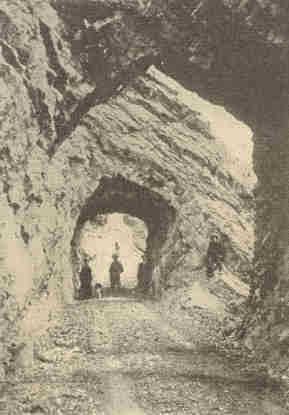
Photograph by Clinedinst.
Shoshone Project. Wyoming Park wagon road,
showing wonderful tunnelling work on the new
wagon road from Cody, Wyo., to the
National Park via the Shoshone Dam.
[1907]
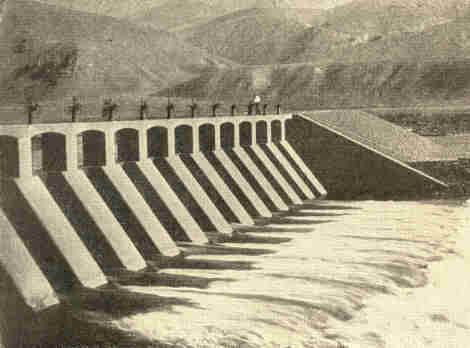
Truckee-Carson reclamation project.
Diversion dam and gates at heading of main canal.
Concerted action was not taken until 1907, when the Lakes to the Gulf
Deep Waterways Association was formed at St. Louis, having for its
object the deepening of the water-way between Lake Michigan and the
Gulf. The proposal to construct a canal by the way of the Illinois River
to the Mississippi, large enough to carry ships, was declared feasible
by government engineers and a route was surveyed. President Roosevelt
endorsed the scheme. In his message to Congress, December 3, 1907, he
said: "From the Great Lakes to the mouth of the Mississippi there should
be a deep water-way, with deep water-ways leading from it to the East
and the West. Such a water-way would practically mean the extension of
our coast line into the very heart of our country. It would be of
incalculable benefit to our people. If begun at once it can be carried
through in time appreciably to relieve the congestion of our great
freight-carrying lines of railroad. The work should be systematically
and continuously carried forward in accordance with some well-conceived
plan . . . . Moreover, the development of our water-ways involves many
other important water problems, all of which should be considered as
part of the same general scheme."
He appointed an Inland Waterways Commission which was to outline a
comprehensive scheme of development along the various lines indicated.
Their leading recommendation had to do with the proposal for a deep
water-way from Chicago to New Orleans. The completion of the drainage
canal by the city of Chicago, at a cost of $55,000,000, really created a
deep waterway for forty miles along the intended route. It was reported
to Congress by a special board of surveyors that the continuation of
such a water-way to St. Louis would cost $31,000,000.
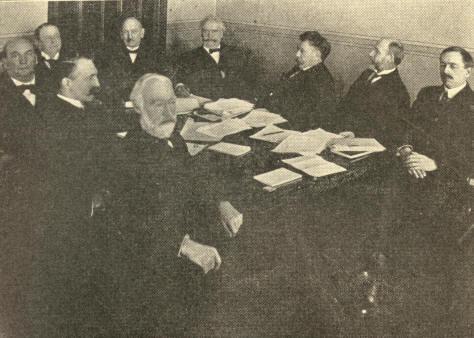
Inland Waterways Commission.
The legislature of Illinois, following the recommendation of Governor
Charles S. Deneen, submitted to the people an amendment of the
constitution which would enable the State to assume a bonded
indebtedness of $20,000,000 for the purpose of constructing a deep
waterway from Chicago to St. Louis. The measure was approved by popular
vote November 3, 1907. Thereupon, the State Senate passed a bill
providing for the construction of the canal. This failed in the House.
It was again introduced into the legislature, 1910, but failed to pass.
Among the other important projects submitted by the Inland Waterways
Commission are the following: To connect the Great Lakes with the ocean
by a twenty-foot channel by the way of the Erie Canal and the Hudson
River, an inner channel extending from New England to Florida; to
connect the Columbia River with Puget Sound and deepen the Sacramento
and the San Joaquin Rivers, so as to bring commerce by water to
Sacramento and other interior California cities.
With the hope that New York City might again come into a mastery of the
trade with the West, as at the time when the Erie Canal was first
completed and because of the inability of the railroads to meet the
demands of traffic, the legislature of New York, in 1903, appropriated
$100,000,000 for the enlargement of that waterway and the two branch
canals, the Oswego and Champlain. The proposed uniform depth is twelve
feet and it is otherwise to be large enough for boats of a thousand ton
cargo or four times the capacity of boats now on the canal.