
[1905-1906]
Looking toward the completion of the Panama Canal, there has been a
revival of interest on the part of the United States in the republics of
South America. From the time of the promulgation of the Monroe Doctrine,
there has been a distant friendship on our part for these nations. The
plan inaugurated by James G. Blaine when Secretary of State is much
better understood to-day than in his time. In 1881, with the desire of
emphasizing the leadership of the United States in the western
hemisphere, he proposed a congress of all the American nations. Nothing
came of the proposal at the time, but in 1888 Congress passed a
resolution providing for such an international conference. The meeting
was in Washington the following year, and Secretary Blaine, as chairman,
exercised great influence. While the direct results of the meeting were
not great–principally a declaration in favor of the arbitration of all
disputes among these nations–the indirect benefits were considerable.
In 1901 a second Pan-American congress was held in the city of Mexico.
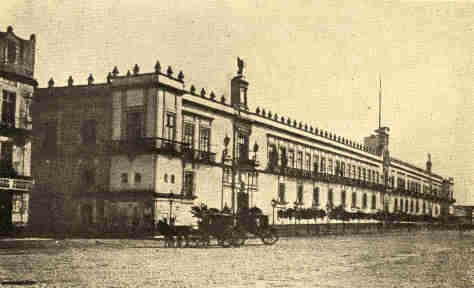
Courtesy of the Pan-American Union.
Federal Palace, where the second Pan-American
Congress was held in the City of Mexico.
In the meantime the trade with these countries has been largely
monopolized by England, France, and Germany. During the year 1905, the
total exports and imports of the Latin-American countries amounted to
$2,000,000,000. Of this foreign trade the United States bought 35 per
cent of the exports and sold to these countries only 27 per cent of
their imports, producing an unfavorable balance of trade amounting to
$200,000,000. Of the goods imported from this country, over one-fourth
went to Mexico and Cuba. In that year Brazil bought from the United
States only 11 per cent of its imports. Argentina, with a larger foreign
trade than either Japan or China, bought only 14 per cent of its imports
from the United States. With the exception of Mexico, the foreign
commerce of the Latin-American states with European countries has
increased more rapidly than with the United States. Various reasons have
been given for this situation. The sensitive South American resents the
air of superiority assumed toward them by the people of the United
States. In our newspapers there is a seeming disregard for the real
evidences of their national development. Revolutions and boundary
disputes have been exaggerated. In general, citizens of the United
States have no comprehension of the advancement of these countries
within recent times and appreciate but slightly that their economic
future is as fully assured as our own. Argentina constitutes an
excellent example of this progress. This country has an area of
1,135,840 square miles. Splendid rivers water the immense plains. The
chief of these, the Parana, which flows 2,000 miles through the country,
carries a volume of water to the sea one and one-half times that of the
Mississippi, and is capable of floating ships having a draught of 18
feet for 600 miles into the interior. Buenos Ayres, with a population of
1,000,000, in 1906 had a volume of foreign trade amounting to
$562,000,000, constituting it the twelfth port in the world. In 1905
over 10,000,000 acres of land were cultivated in Argentina, an increase
of fourfold within fifteen years. The cereals, cotton, fruits, and meats
produced amounted to $350,000,000.
That the volume of trade between this country and the South American
states has been so small has been due also to the fact that so few
vessels flying the stars and stripes are engaged in this trade.
According to the report of Secretary Root, in 1906, there were in the
harbor of Rio Janeiro the previous year, 1,785 ships flying the flag of
Great Britain; 657 the flag of Germany; 349 the French; 142 the
Norwegian, and 7 sailing vessels (two of them in distress) the flag of
the United States. The bulk of goods from this country to South America
goes by the way of European ports and on foreign ships.
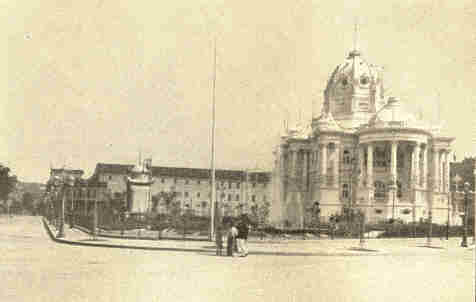
Courtesy of the Pan-American Union.
Monroe Palace, where the third Pan-American
Conference was held in Rio de Janeiro.
July 4, 1906, the third Pan-American conference was opened at Rio
Janeiro. Among the leading questions discussed were: (1) the right of
creditor nations to enforce by war on the debtor nations contractual
obligations, or the right to use gun-boats as collection agents; and (2)
those relating to commercial intercourse. Besides the regular delegates
from the United States, Elihu Root, Secretary of State, was present at
the opening session. His address at this meeting, together with his
visit to the leading cities, served to inaugurate a new understanding
between these countries and the United States. The true American policy
was set forth by Secretary Root in the following toast: "May the
independence, the freedom, and the rights of the least and weakest be
ever respected equally with the rights of the strongest, and may we all
do our share toward the building up of a sound and enlightened public
opinion of the Americas which shall everywhere, upon both continents,
mightily promote the reign of peace, of order, and of justice in every
American republic." He went as Ambassador Extraordinary representing the
President of the United States. In order to emphasize his official
position, he travelled on an American war-ship. His addresses made in
the various cities were intended to be an official declaration from the
government of the United States, and that position was outlined in his
formal address before the congress. "We wish for no victories," he said,
"but those of peace; for no territory except our own; for no sovereignty
except the sovereignty over ourselves. We deem the independence and
equal rights of the smallest and weakest member of the family of nations
entitled to as much respect as those of the greatest empire, and we deem
the observance of that respect the chief guaranty of the weak against
the oppression of the strong. We neither claim nor desire any rights or
privileges or powers that we do not freely concede to every American
republic. We wish to increase our prosperity, to expand our trade, to
grow in wealth, in wisdom, and in spirit, but our conception of the true
way to accomplish this is not to pull down others and profit by their
ruin, but to help all friends to a common prosperity and a common
growth, that we may all become greater and stronger together."
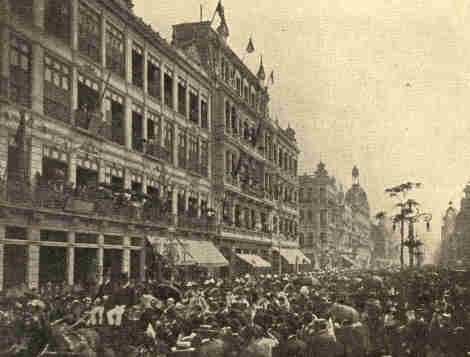
Courtesy of the Pan-American Union.
Arrival of Secretary Root at Rio de Janeiro.
The International Bureau of American Republics was founded as a result
of the first Pan-American conference. The original plans of the
founders were not carried out owing to a lack of interest on the part of
the Department of State as well as in the foreign offices of the South
American countries. Secretary Root determined to make this bureau an
efficient agency for bringing about better relations between the two
continents. He defined the main purpose to be not only to build up trade
and commerce among all American nations, but to promote more friendly
relations, a better understanding of each other, and the general
prosperity and well-being of all the countries of the American
continents. Through gifts from Andrew Carnegie and contributions from
the different South American states a splendid modern building, costing
$1,000,000, was erected in Washington, 1908, as the home of the Bureau
of the Pan-American Republics. Besides other enterprises, the Bureau
publishes a monthly periodical which contains information on the
commerce, new enterprises, and general development of each republic.
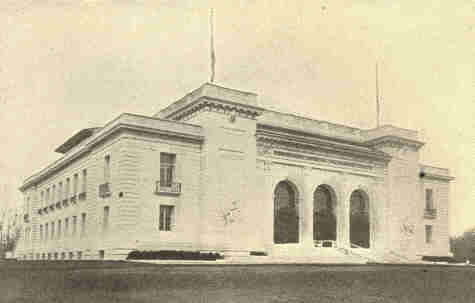
Photograph by Clinedinst.
The Bureau of the Pan-American Republics.
With these new relationships came a new interpretation of the Monroe
Doctrine. At various times European nations have engaged in
controversies with South American states over the payment of debts due
the citizens of the former. The question has then arisen, to what extent
shall the United States permit the use of force against the debtor
nations? The wider application of the Monroe Doctrine under President
Cleveland looking toward the maintenance of the rights of the weaker
American nations, has been followed by recognition of our obligation to
secure the performance of duties by those nations. Said President
Roosevelt (1905): "We cannot permanently adhere to the Monroe Doctrine
unless we succeed in making it evident, in the first place, that we do
not intend to treat it in any shape or way as an excuse for
aggrandizement on our part at the expense of the republics to the south
of us; second, that we do not intend to permit it to be used by any of
these republics as a shield to protect that republic from the
consequences of its own misdeeds against foreign nations; third, that
inasmuch as by this doctrine we prevent other nations from interfering
on this side of the water, we shall ourselves in good faith try to help
those of our sister republics, which need such help, upward toward peace
and order."
The immediate cause for this statement by President Roosevelt was the
problem confronting our government on account of the bankrupt condition
of the Republic of Santo Domingo. Debts had accumulated for over thirty
years until by the beginning of 1905 they amounted to more than
$32,000,000. Each successive ruler became a more reckless borrower and
new loans were secured upon harsher terms.
Finally affairs were brought to a crisis on account of the pressure on
the part of the French and Italian governments for the payment of the
claims of their citizens. The republic was on the verge of dissolution
when President Roosevelt intervened. European governments were
satisfied, for it signified the payment of their claims. An agreement
was signed by representatives of the government of Santo Domingo and of
the United States whereby the United States was to undertake the task of
collecting and apportioning the revenues of Santo Domingo. The
stipulation was made that no plan of annexation, purchase, or permanent
control on the part of the United States should ensue. Agents were to be
appointed by the United States who should take charge of the
customhouses. Forty-five per cent of the total receipts were to be used
in carrying on the affairs of the republic and the balance was to go to
pay the indebtedness. In his message, February, 1905, President
Roosevelt, pressing upon the Senate the urgent need for the ratification
of this agreement, said: "The state of things in Santo Domingo has
become hopeless unless the United States or some other strong government
shall interpose to bring order out of chaos. . . . If the United States
declines to take action and other foreign governments resort to action
to secure payment of their claims, the latter would be entitled,
according to the decision of the Hague Tribunal in the Venezuela cases,
to the preferential payment of their claims; and this would absorb all
the Dominican revenues and would be a virtual sacrifice of American
claims and interests in the island. If, moreover, any such action should
be taken by them, the only method to enable the payment of their claims
would be to take possession of the custom-houses, and, considering the
state of the Dominican finances, this would mean a definite and very
possibly permanent occupation of Dominican territory, for no period
could be set to the time which would be necessarily required for the
payment of their obligations and unliquidated claims." The Senate, in
special session, shirked responsibility and refused either to ratify or
reject the treaty.
With the revolutionists on the island growing stronger and the European
Powers becoming more insistent, President Roosevelt, disregarding the
attitude of the Senate, appointed an American as receiver of customs.
The move proved immediately successful. The insurrection died out, trade
revived, smuggling ceased, and the people were infused with a new
spirit. There was also a remarkable increase in the customs receipts,
those of 1906 showing an increase of 44 per cent over the receipts of
1905 and 72 per cent over those of 1904. Although only 45 per cent of
the revenues collected were turned over to the Dominican government,
this sum was almost double the amount which they had received when they
had control of the collection themselves.
After two years of discussion, the treaty was ratified by the Senate,
February 25, 1907, and by the Dominican Congress, May 3. The terms were
practically those which had been carried out by order of President
Roosevelt. The United States, in a sense, became the trustee of Santo
Domingo, and thus established a new relation between this country and
the smaller republics of the western hemisphere.