
[1903-1905]
Great progress was made during the nineteenth century toward the
settlement of differences between nations through arbitration. The
United States was a party to 50 out of the total number of 120
arbitration treaties. Questions settled in this manner, such as
boundary, damages inflicted by war or civil disturbances and injuries to
commerce, would formerly have led to war. Twenty of these cases have
been between the United States and Great Britain, and a settlement was
effected when, at times, it seemed as if war could not be averted.
The work of the Hague Peace Conference, which met May 18, 1899,
constituted a fitting close to the efforts which were put forth during
the century to bring about conciliation through arbitration. The
conference assembled in response to an invitation issued by the Czar of
Russia "on behalf of disarmament and the permanent peace of the world."
One hundred and ten delegates were present, representing twenty-six
different powers of which the United States was one. The delegates were
divided into three commissions, each having separate subjects for
consideration.
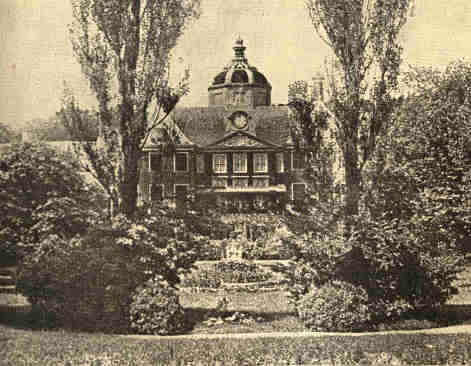
The House in the Woods, The Hague, Holland,
where the first Peace Conference was held.
The first commission adopted unanimously the resolution that "the
limitation of the military charges which so oppress the world is
greatly to be desired," but agreed that this could not now be
accomplished through an international compact.
In the second commission a revision of the Declaration of Brussels
concerning the rules of war was made. It was agreed by the entire
conference that a new convention for this purpose should be called, and
that the protection offered by the Red Cross, as agreed upon in the
Geneva convention, should also be extended to naval warfare.
The proposition expressing the desire that international conflicts might
in the future be settled through arbitration was considered by the third
commission. Said ex-President Harrison: "The greatest achievement of the
Hague conference was the establishment of an absolutely impartial
judicial tribunal." Some of the chief features of this permanent court
of arbitration were as follows:
(1) Each nation which agreed to the plan was to appoint, within three
months, four persons of recognized competency in international law, who
were to serve for six years as members of the International Court;
(2) an International Bureau was established at The Hague for the purpose
of carrying on all intercourse between the signatory powers relative to
the meetings of the court and to serve also as the recording office, for
the court;
(3) nations in dispute may select from the list of names appointed as
above, and submitted to them by the bureau, those persons whom they
desire to act as arbitrators;
(4) the meetings of the court are to be held at The Hague unless some
other place is stipulated by the nations in the controversy.
The permanent International Court of Arbitration was declared to be
organized and ready for operation by April, 1901. At that time there
were seventy-two judges appointed by twenty-two of the signatory powers,
It is readily seen that the advantages of such a court are that
unprejudiced arbitrators are selected, rules of procedure are defined,
and decisions rendered are more liable to be accepted in future cases
and thus a code of law will be formed, So many cases have been submitted
to this tribunal that it has been said that a government which will not
now try arbitration before resorting to arms is no longer considered
respectable. This court was convened for the first time May 18, 1901.
The first case coming before the tribunal–the Pious Fund Case–was
presented by the United States and Mexico, September 15, 1902. Up to
1846 the Mexican government had paid annual interest on some property
administered by it but belonging to the Catholic church. Part of it was
situated in what is now California. After 1848, when this California
estate came under United States jurisdiction, Mexico refused to pay that
part of the church outside of Mexico its share. This difference between
our Government and Mexico the Hague Tribunal took up.
Agreeably to chapter 3, title 4, of the agreement, each party named two
arbitrators, and the latter, acting together, an umpire. In case of an
equality of votes a third power, designated by agreement of the parties,
was to select the umpire. The arbitrators chosen were M. de Martens, of
the Orthodox Greek church; Sir Edward Fry, an English Protestant; M.
Asser, a Jew, and M. Savornin-Loman, a Dutch Protestant. Decision was
reached within the prescribed thirty days and announced October 14,
1902. It favored the United States contention, giving its proportion of
the Mexican payments to the Catholic church in California.
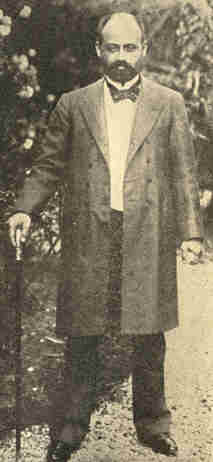
President Castro of Venezuela.
A second case, involving issues of war and peace, arose from the action
of Great Britain and Germany against Venezuela in the winter of
1902-1903. Subjects of these as well as of other powers had claims
against Venezuela. That country was in financial straits and its
creditors pressed. December 9, 1902, British and German war-ships sunk
or seized some Venezuelan vessels; next day they landed marines at La
Guayra, who took possession of the custom house; the 14th they bombarded
and demolished a fort at Puerto Cabello. Through the good offices of the
United States the matter of debts was referred to the Hague Tribunal.
The German claims were decided by two representatives of Germany and two
of Venezuela, or, if they disagreed, by an umpire whom the United States
selected. So with the other claims. The tribunal fixed the order in
which Venezuela should pay the different countries, and the United
States was charged with overseeing the payments, a percentage of
Venezuelan customs receipts being reserved for that purpose.
In 1903 Andrew Carnegie donated $1,500,000 for the purpose of erecting a
"palace of peace," the permanent head-quarters of this court. The deed
of trust states: "The establishment of a permanent Court of Arbitration
by the treaty of the 29th of July, 1899, is the most important step
forward, of a world-wide humanitarian character, that has ever been
taken by the joint powers, as it must ultimately banish war, and
further, being of opinion that the cause of peace will greatly benefit
by the erection of a court house and library for the permanent Court of
Arbitration," etc.
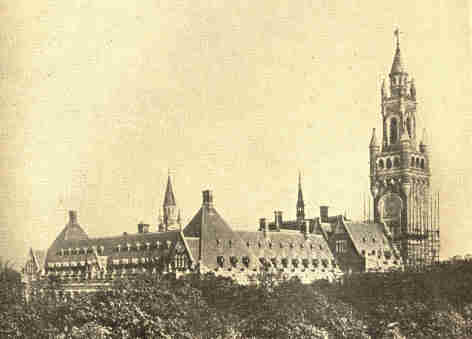
The new Peace Palace, The Hague, Holland.
The site of this building, which will be ready for occupancy in 1912, is
near The Hague. Its exterior will resemble some of the old city walls to
be seen in Holland. The various governments which were parties to the
treaty have contributed materials for the completion of the interior and
objects of art for decoration. The United States presented a large
marble group of statuary called "Peace Through Justice."
Two notable congresses were held in the United States during the year
1904, for the purpose of promoting the peace of the world. The
Inter-Parliamentary Union held a meeting, the twelfth in its history, in
connection with the World's Fair at St. Louis. This organization was
founded at Paris in 1888 by thirty members of the French Chamber of
Deputies and ten members of the British Parliament, for the purpose of
promoting the cause of peace and arbitration. Scoffed at from the
beginning, the Union continued to grow until it included parliamentary
delegates from every European country having a constitutional form of
government.
The meeting of the Union at St. Louis was the first to be held in the
United States, for this country took no part in the organization until
1903. Russia and Turkey, having no parliaments, are not represented in
the meetings of the Union. It is a noteworthy fact however that the Czar
sent an official representative to the meeting in 1896 and that it was
due to his report of that meeting, more than to any other cause, that
the Czar invited the nations to send representatives to The Hague in
1898.
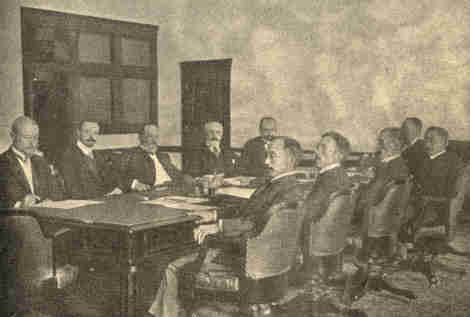
Russian and Japanese Peace Envoys in session at Portsmouth, N. H.
In the congress at St. Louis, representatives from the deliberative
bodies of fifteen nations were present. Among these delegates were some
of the well-known public men from Great Britain, France, Germany,
Austria, Italy, Belgium, The Netherlands, the United States, and various
other countries. They were practical men and not dreamers.
Two important resolutions resulted from the gathering. One of these
called upon the powers to intervene and put an end to the war between
Russia and Japan. The other invited the President of the United States
to call a second peace congress, similar to the Hague conference. The
resolution, addressed to President Roosevelt, stated that there were a
number of questions left unsettled from the first Hague conference and
that new problems had arisen since that time which demanded
readjustment, such as the use of wireless telegraphy in the time of war.
On October 3 of the same year an international peace congress was held
in Boston. Numerous congresses of this nature have been held from time
to time since the meeting of the first one in London in 1843. Since the
year 1888, when a congress was held in Paris, an international peace
congress has met each year with the exception of 1895, the year of the
Boer war, and in 1898 and 1899, on account of the Spanish-American war.
The first of these congresses in America was held in conjunction with
the Columbian Exposition at Chicago, 1893. There were in attendance at
Boston distinguished statesmen, clergymen, scholars, and professional
men, and a number of noted women, representing the many peace and
arbitration societies in Great Britain, Germany, Austria, and numerous
other countries.
On the Sunday before the opening of the congress, special services were
held in many of the Boston churches and the peace movement was discussed
by distinguished preachers from Europe and America. In the deliberative
sessions, which were held in Faneuil Hall, the Old South Meeting House,
and other places, the first session being opened by an address by
Secretary of State John Hay, the following topics, among others, were
discussed: the work and influence of the Hague Tribunal; the reduction
of the armaments of the nations; education and the peace sentiment. But
here, as in every previous congress, the two topics to receive primary
consideration have been arbitration and disarmament. At all times there
has been the urgent appeal to the nations to abandon the brutality and
injustice of war and to adopt the humane and just methods of peace.
In response to the resolution adopted at St. Louis, President Roosevelt,
on October 20, 1904, invited the nations which had taken part in the
first Hague conference to another conference at the same place. But in
his message to Congress of that year he defined very clearly his own
position, condemning in no uncertain terms the thought of peace at any
price. "There are kinds of peace," he said, "which are highly
undesirable, which are in the long run as destructive as any war. The
peace of tyrannous terror, the peace of craven weakness, the peace of
injustice–all these should be shunned as we shun unrighteous war."
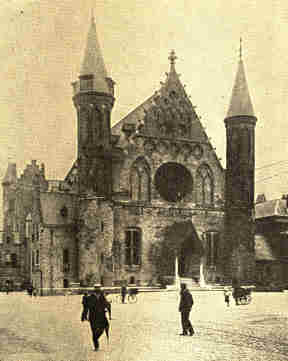
Building where the second Peace Conference
was held, The Hague, Holland.
Favorable replies to the invitation sent by President Roosevelt were
received from all the nations. Russia, then in the midst of war with
Japan, while approving, stipulated that the conference should not be
called until the end of that war. When peace was restored, in the summer
of 1905, Emperor Nicholas II issued an invitation to fifty-three nations
to send representatives to such a conference. For the first time, nearly
every independent nation on the globe was represented among the
delegates in an international gathering of this nature. It met at The
Hague during the summer of 1907.
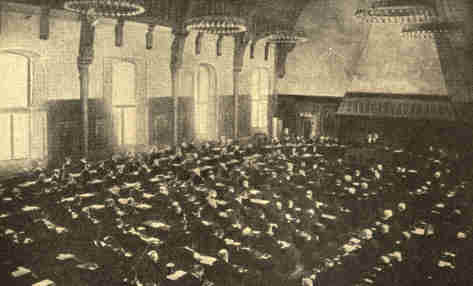
First session of the second Peace Conference, The Hague, Holland.
Delegates from the United States were instructed to favor obligatory
arbitration; the establishment of a permanent court of arbitration; the
prohibition of force in the collection of contract debts; immunity from
seizure of private property at sea; a clearer definition of the rights
of neutrals, and the limitation of armaments.
While belief was reasserted by the conference that there should be the
obligatory arbitration of all questions relating to treaties and
international problems of a legal nature, the principle was not adopted,
although thirty-two nations of the forty-five represented favored it.
The resolution adopted, which provided for the collection of contract
debts, is as follows: "In order to avoid between nations armed conflicts
of a purely pecuniary origin arising from contractual debts claimed of
the government of one country by the government of another country to be
due to its nationals, the signatory powers agree not to have recourse to
armed force for the collection of such contractual debts. However, this
stipulation shall not be applicable when the debtor State refuses or
leaves unanswered an offer to arbitrate; or, in case of acceptance,
makes it impossible to formulate the terms of submission; or, after
arbitration, fails to comply with the award rendered."
Provision was made for an international prize court, to which appeal
might be made from the prize courts of the belligerent powers. The
declaration was adopted prohibiting the throwing of projectiles and
explosives from balloons.
Before the end of the year 1908, one hundred and thirty-five arbitration
treaties had been concluded. The United States was a party to twelve of
these. Most of the treaties bind the signatory powers to submit to the
Hague Tribunal all differences in so far as they do not affect "the
independence, the honor, the vital interests, or the exercise of
sovereignty of the contracting countries, and provided it has been
impossible to obtain an amicable solution by means of direct diplomatic
negotiations or by any other method of conciliation."