
[1905]
The aggressive policy of President Roosevelt continued throughout the
four years succeeding March 4, 1905, when he again took the oath of
office as President. In his suggested reforms he continued to be a real
leader of the people. John Hay, who for seven years had so efficiently
performed his duties as Secretary of State, was continued in that
office. William H. Taft, after his return from the Philippine Islands,
where he had held the office of first civil governor, succeeded Elihu
Root as Secretary of War.
The United States, having become a world power after the war with Spain,
assumed leadership in the adjustment of Chinese problems. At the close
of the century American manufacturers had built up in China a market for
their cotton goods which they desired to extend. At the same time strife
arose among some of the European nations for trade advantages in that
empire. Great Britain, France, Germany, Russia, and Italy were demanding
for their citizens concessions, leases, franchises, and special trade
privileges in various parts of that country. Gradually, spheres of
influence covering certain regions were acquired and it seemed probable
that China would be partitioned among the European Powers as Africa had
been in the previous decade. This would be a blow to American export
trade. Now the acquisition of the Philippine Islands gave us a vantage
point from which we could consistently exert influence in Oriental
affairs. In September, 1899, John Hay addressed a note to the European
Powers interested, asking recognition of the policy of the "open door,"
which means that no power should exclude the citizens of other nations
from equal trade rights, within its sphere of influence, in China.
Without winning complete acceptance from all the nations, the justice of
this policy was, in the main, approved.
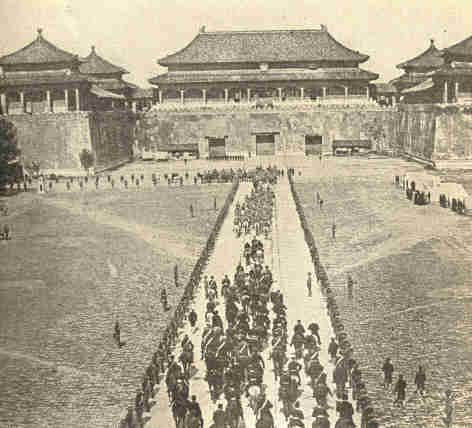
Copyright by Underwood & Underwood, N.Y.
Count Von Waldersee escorted by officers of the allied armies
between lines of U. S. troops toward the Sacred Gate, Peking.
During the following year came the Boxer Rebellion in which there were
massacres of Europeans and Americans. When the foreign legations were
besieged in Peking, United States troops took part in the expedition
which marched to their relief. Seizure of Chinese territory, as
indemnity, might have followed, but Secretary Hay brought the influence
of this country to bear in securing guarantees of the territorial
integrity of China and equal trade rights in its ports.
Friendly relations between the Chinese Empire and the United States were
still further strengthened by the liberal attitude of our government
relative to the indemnity growing out of the Boxer uprising. The total
amount which China had obligated itself to pay the governments,
societies, and private individuals was $333,000,000. Of this sum,
$24,400,778 was allotted to the United States. As a mark of friendship
for China, Congress upon the recommendation of President Roosevelt,
1907, cancelled the obligation of China to pay that part of the
stipulated indemnity in excess of $11,655,492, or an amount adequate to
cover the actual amount of the claims. This generous conduct prompted
the Chinese government to devote the funds thus remitted to the sending
of Chinese students to this country for their education. About one
hundred of these students have entered our schools and colleges each
year since 1907. American institutions will, as a consequence, have a
great influence on the progressive development of China.
For some time Russia had been extending her influence over the Chinese
tributary province of Manchuria. In 1903 negotiations for a new
commercial treaty were begun between China and the United States. There
were numerous delays on account of an agreement relative to opening the
Manchurian ports. For a time it seemed probable that the American demand
that her trading rights should be restored in Manchuria would bring on
serious complications with Russia. Upon the completion of the treaty,
however, the request was renewed and China acquiesced by opening the
ports of Mukden and Ta Tung Kao to the ships of all nations. At the same
time Russia agreed that she would in no way oppose this action.
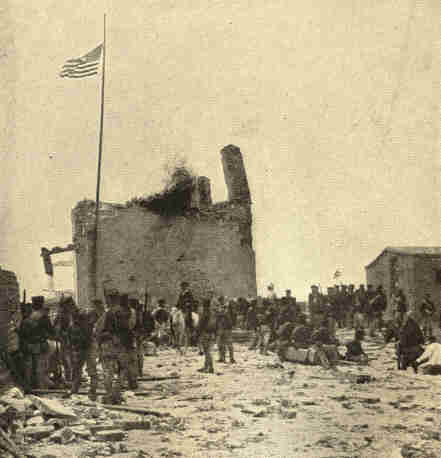
Copyright 1901, by Underwood & Underwood.
American flag raised over battered remnants of South Gate
immediately after city's capture. Battle of Tien-Tsin, China.
At the outbreak of the war between Japan and Russia, in 1904, Secretary
Hay took another step toward maintaining the administrative entity of
the Chinese Empire. At the suggestion of Germany he addressed a note to
the powers which had taken part in the treaty of Peking, asking them to
pledge themselves to limit the area of the war; keep China from becoming
involved, and use their best endeavors to prevent the violation of
Chinese interests by either belligerent, provided China should maintain
absolute neutrality. These proposals were agreed to by the signatory
nations, and both Russia and Japan promised to respect Chinese
neutrality.
Meantime a new national spirit had been developing rapidly in China and
a greater sensitiveness was manifest toward the treatment of Chinese
outside the empire. The strict interpretation of the Chinese Exclusion
act had caused many Chinese entering the ports of the United States
unwarranted hardships. A crisis was reached in 1905.
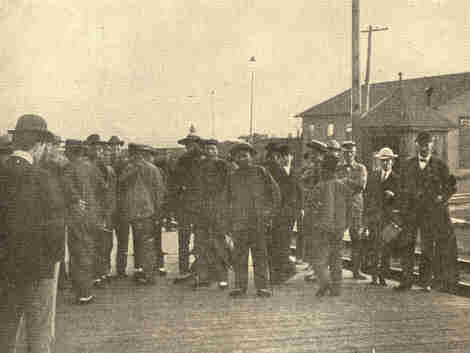
Arrival of Chinamen at Malone, N. Y.,
from Canada, accompanied by officials.
According to the rules adopted by the Secretary of Commerce and Labor,
neither the immigration acts nor the Chinese exclusion acts apply to a
Chinese person born in the United States. Under the laws, all Chinese
laborers, both skilled and unskilled, are prohibited from entering the
United States, but this prohibition does not extend to merchants,
teachers, students, and travellers who are to be granted all the rights,
privileges, and exemptions accorded the citizens of any other nation. In
spite of these rulings, Ju Toy, who claimed to have been born in the
United States, was deported. Three Chinamen, with their sister, who had
been studying in the English schools came to Boston. Notwithstanding
they had a letter from Mr. Choate, former United States ambassador to
Great Britain, they were not allowed to land with other passengers, and
were otherwise humiliated by the formalities to which they were
subjected. Men of influence throughout the Chinese Empire were aroused
and a circular was issued, in May, 1905, which was widely disseminated
in the chief cities, calling for agreement not to buy any more American
goods. Newspapers urged students to leave schools where American
teachers were employed or American text-books or supplies were used. At
this juncture President Roosevelt was appealed to by the American
members of the Chinese Educational Association. Acting with his
accustomed vigor, he issued instructions to the Secretary of Commerce
and Labor to send a letter to all immigration officials, instructing
them that "any discourtesy shown to Chinese persons by any officials of
the Government will be the cause for immediate dismissal from the
service." In his message to Congress he declared that it was Chinese
laborers alone who are undesirable, and that other Chinamen–students,
professional men, merchants–should be encouraged to come to the United
States. "We have no right," he wrote, "to claim the open door in China
unless we do equity to the Chinese."