
[1904]
The Republican convention met at Chicago, June 21, and on June 23
nominated Theodore Roosevelt for President. President Roosevelt's
nomination was a certainty from the beginning. This action was demanded
by the rank and file of Republicans, for his achievements were popular.
Among the problems which he had helped to solve were those growing out
of the war with Spain; settlement of the anthracite coal strike;
creation of the Department of Commerce and Labor; and the investigation
and prosecution of dishonesty in the post-office department.
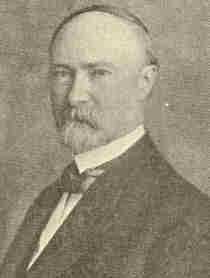
Charles W. Fairbanks,
Vice-President of the United States.
Plans for the convention had all been matured in advance with the
exception of the selection of a candidate for Vice-President. By the
time the convention assembled the opinion was general that for
geographical reasons some one from Indiana should be named for this
office. Charles Warren Fairbanks, a leading lawyer in Indianapolis, who
was serving his second term in the United States Senate, was nominated
without any real opposition. He had served as a member of the Joint High
Commission to adjust international questions of moment between the
United States and Great Britain. Grover Cleveland and William Jennings
Bryan had declared they would not be candidates for the presidency and
the Democratic party was in a dilemma. Both the conservative and the
radical elements of the party declared they would write the platform and
name the candidates. Alton Brooks Parker, Chief Judge of the Court of
Appeals of New York, who was supported by Grover Cleveland, came
gradually into prominence as the candidate of the conservatives and
William Randolph Hearst of the radicals.
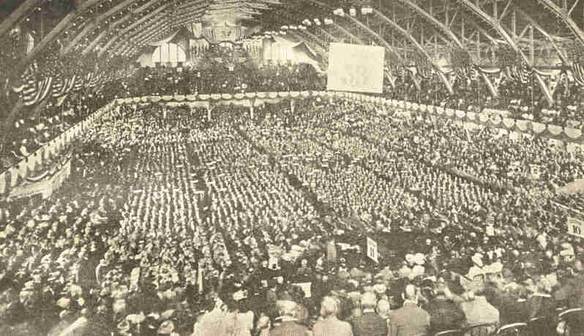
The Republican convention at Chicago, 1904.
The chief contest came in the Democratic convention of New York. There
Judge Parker was supported by David B. Hill, ex-United States senator,
and August Belmont, a New York banker. In consequence it was declared by
the opposition that Judge Parker was the candidate of the trusts, Wall
Street magnates, and a class of politicians of which Hill was the type.
This view was taken by Bryan. In spite of the opposition of Tammany
leaders and the Hearst faction, twice as many Parker as Hearst delegates
were chosen.
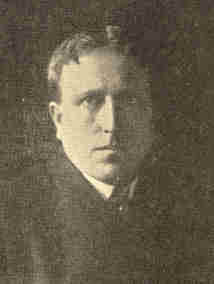
William R. Hearst.
In the convention, which met at St. Louis, July 9, Judge Parker received
658 votes for President on the first ballot, Hearst received 200, and
there were a few scattering votes. The requisite two-thirds came to
Parker before the result of the ballot was announced. Henry G. Davis, of
West Virginia, was named for the office of Vice-President.
He had served two terms in the United States Senate, had declined the
office of Post-Master General under President Cleveland, was very
wealthy, and noted for his philanthropy.
Bryan demanded that the platform should be silent on the question of the
money standard, but Parker declined the nomination unless it should be
understood that he would maintain the gold standard, and his declaration
was endorsed by the convention.
There were no distinguishing issues between the two leading parties. The
money question had disappeared and both parties were outspoken in their
declarations against trusts and combinations of capital.
The Populist party, in a convention made up of delegates from one-half
the States, nominated Thomas E. Watson, of Georgia, and Thomas H.
Tubbles, of Nebraska, for President and Vice-President, respectively.
There were two Socialist conventions: one, that of the Social Democratic
party, nominated Eugene V. Debs, of Indiana, for President, and the
Socialist Labor party named Charles H. Corregan, of New York, for the
same office. The nominees of the Prohibitionist party were Silas C.
Swallow, of Pennsylvania, for President, and George W. Carroll, of
Texas, for Vice-President.
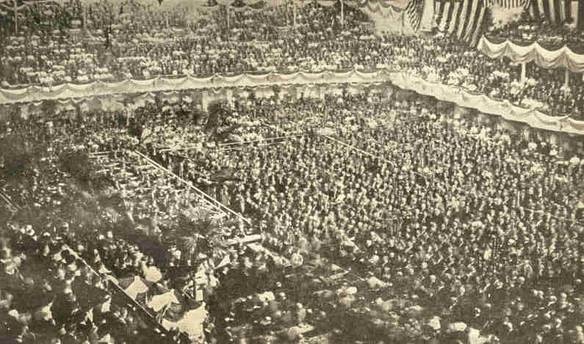
The Democratic convention at St. Louis, 1904.
The campaign was noteworthy on account of the apathy which was very
general. Heated discussions so characteristic of previous political
contests were seldom heard, and arguments were addressed to the
intelligence of voters rather than to passion and prejudice.
It has been called a reading rather than a speaking campaign. The
leading Republican document was a pamphlet containing two notable
addresses. One of these was delivered by John Hay at Jackson, Mich., on
the occasion of the celebration of the semi-centennial of the founding
of the Republican party. He attributed to that party the success in the
conduct of public affairs since 1860, and praised President Roosevelt as
a man and great administrator. The other speech was similar in content,
and was delivered by Elihu Root as temporary chairman of the Republican
convention.
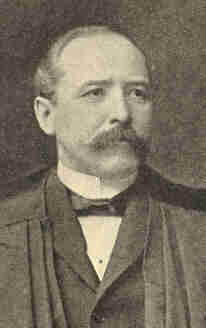
Alton B. Parker.
Toward the close of the campaign, the charge was made that the
Republicans were endeavoring to win through a wholesale purchase of
votes. It was asserted that George B. Cortelyou, manager of the
campaign, having obtained secrets of the conduct of some of the great
corporations, was using that knowledge to force them to contribute to
the Republican fund. A second charge proclaimed that the administration
had changed its attitude toward certain corporations and that the
magnates of Wall Street, having decided to elect Roosevelt, were
contributing generously to the Republican campaign fund. Shortly before
the day for the election, Judge Parker in a series of speeches announced
his belief in these reports. President Roosevelt declared that no proof
for the statements could be produced, and ended as follows: "The
statements made by Mr. Parker are unqualifiedly and atrociously false.
As Mr. Cortelyou has said to me more than once during this campaign, if
elected I shall go into the presidency unhampered by any pledge,
promise, or understanding of any kind, sort or description, save my
promise, made openly to the American people, that so far as in my power
lies I shall see to it that every man has a square deal, no less and no
more." In his reply, Judge Parker reiterated the charge, but gave no
concrete instances of money having been obtained from corporations.
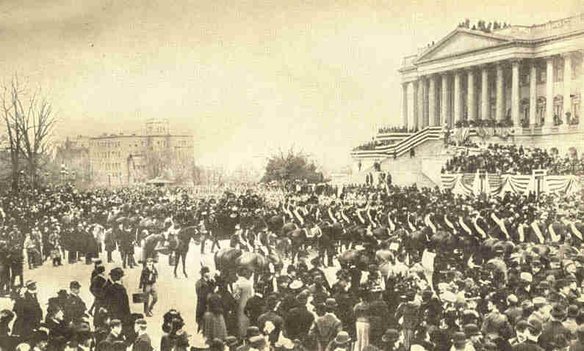
Photograph by Clinedinst, Washington, D. C.
Inauguration of President Roosevelt, March 4. 1905.
Out of a total vote of 13,544,705, Roosevelt received 7,630,893 votes,
or 2,524,244 more than his leading competitor. His majority was
1,717,081. Debs received 397,308 votes; Swallow, 258,039; Watson,
114,306; Corregan, 32,516. Thirty-three States gave Roosevelt majorities
and twelve Southern States returned majorities for Parker. In the
electoral college Roosevelt received 336 votes and Parker 140. A
surprising feature of the election was the large number of independent
votes cast, as shown by the fact that Minnesota, Massachusetts,
Missouri, and Montana, while giving majorities for the Republican
candidates, elected Democratic governors, and in several other States a
similar tendency was manifest in the divergence between the vote for the
national candidates and local candidates.