
[1902]
The sentiment noted at the end of the last chapter seemed to be the
motive of Mr. Roosevelt's public life. Not only was he better informed
on the whole than almost any President who had sat in the chair before,
but he was a good lawyer, familiar with national and general history and
awake to all contemporary doings, questions, and interests south, west,
east, and abroad. He was also more a man of action and affairs than any
of his predecessors. He had, in a very high degree, alertness, energy,
courage, initiative, dispatch. Physically as well as mentally vigorous,
he read much, heard all who could usefully inform him, apprehended
easily, decided quickly, and toiled like Hercules. He was just and
catholic in spirit, appreciating whatever was good in any section of the
country or class of people. He respected precedent but was not its
slave. Rather than walk always in ruts with never a jolt, he preferred
some risks of tumbling over hummocks. Few public men of any age or
country have more fully met Aristotle's test of a statesman: "ability to
see facts as they exist and to do the things needing to be done."
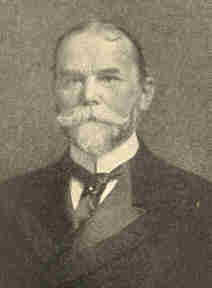
Copyright. l904. by Pach Bros., N. Y.
John Hay, Secretary of State. [Died July 1, 1905.]
He had able aids; pre-eminent among these were John Hay, Secretary of
State, and Elihu Root, Secretary of War. Each was, to say the least,
the peer of his greatest predecessors in his office. It was mainly to
Mr. Root that we were indebted for starting the Cubans prosperously as
an independent nation. His service for the Philippines so far as it went
was not less distinguished; and he effected vitally important
reorganization and reform in the war office.
A well co-ordinated plan was developed whereby army officers were given
advanced training in the various branches of military science as in the
European countries. Neither the President nor Secretary Root advocated a
large standing army, but they both strove to bring the army "to the very
highest point of efficiency of any army in the civilized world." The
ability of Secretary Root to inaugurate reforms in a department which
when he became its head was overridden by tradition, was well expressed
by President Roosevelt as follows: "Elihu Root is the ablest man I have
known in our governmental service. I will go further. He is the greatest
man that has appeared in the public life of any country, in any
position, on either side of the ocean in my time."
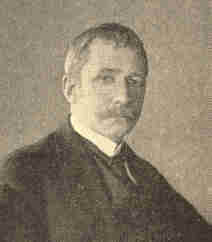
Copyright. 1903. by Clinedinst, Washington.
Elihu Root, Secretary of War.
[Secretary of State, July 1905.]
Under Secretary Hay our State Department attained unprecedented
prestige, due in part to the higher position among the nations now
accorded us. This result itself Mr. Hay had done much to achieve; and he
passed hardly a month in his office without making some further addition
to the renown and influence of his country. If the United States
has–which may be doubted–raised up diplomatists with Mr. Hay's mastery
of international law and practice and his art and skill in conducting
delicate negotiations, we have probably never had his equal in
diplomatic initiative, or in the thorough preparation and presentation
of cases. He did not meet occasions merely but made them, not
arbitrarily but for the world's good. Settling the Alaskan boundary
favorably to the United States at every point save one, crumbling with
the single stroke of his Pauncefote treaty that Clayton-Bulwer rock on
which Evarts, Blaine, and Frelinghuysen in turn had tried dynamite in
vain, were deeds seldom matched in statecraft.
By an act of Congress, in 1903, a new member was added to the
President's cabinet in the person of the Secretary of the Department of
Commerce and Labor. George B. Cortelyou was the first man appointed to
that office. Two bureaus, those of corporations and of manufactures,
were created for the department. The other bureaus, such as the Bureau
of Statistics, Bureau of Standards of Weights and Measures and Coast and
Geodetic Survey, were transferred from the other departments. The place
of this new department was defined by the President in the following:
"to aid in strengthening our domestic and foreign markets, in perfecting
our transportation facilities, in building up our merchant marine, in
preventing the entrance of undesirable immigrants, in improving
commercial and industrial conditions, and in bringing together on common
ground those necessary partners in industrial progress–capital and
labor."
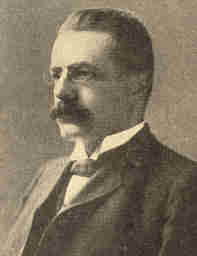
Photograph by Rice.
George B. Cortelyou,
Secretary of the Department of Commerce and Labor.
Among the problems engaging President Roosevelt none was of wider
interest than the construction of an Atlantic-Pacific canal. A
commission of nine, Rear-Admiral Walker its head, had been set by
President McKinley to find the best route. It began investigation in
the summer of 1899, visiting Paris to examine the claims of the French
Panama Company, and also Nicaragua and Panama. It surveyed, platted,
took borings, and made a minute and valuable report upon the work which
each of the proposed canals would require.
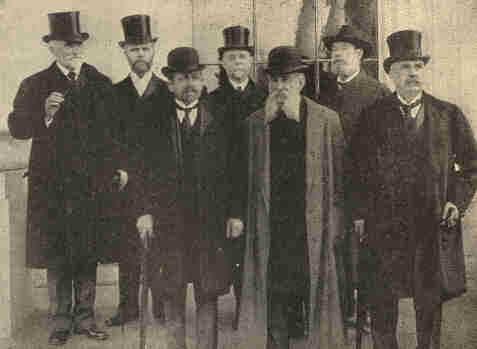
The Isthmian Canal Commission, taken March 22, 1904.
1. Col. Frank J. Hecker. 2. William Barclay Parsons. 3. Wm. H. Burr.
4. C. E. Grunsky. 5. Ad. J. G. Walker. 6. B. M. Harrod. 7. Gen. Geo. W. Davis.
The most practicable routes were Nicaragua and Panama. The Nicaragua way
was between three and four times the longer–183 miles to 49; 38 hours
from ocean to ocean as against 12. The Panama way was straighter, had
less elevation at its summit, and required fewer locks. Congress finally
decided to construct a high level lock-canal. The cost of keeping up and
operating a Panama canal was estimated at six-tenths that of one across
Nicaragua. Harbor expenses and facilities would be nearly the same for
both lines. The time required for construction, probably nine or ten
years, would be a trifle the less at Nicaragua. Control works, to keep
always the proper depth of water in the canal, could be more easily
maintained at Panama.
Panama political and commercial complications were serious. The isthmus
was Colombia territory, and, since October, 1899, a civil war had been
raging in that republic. Its financial condition was desperate. Two
hundred million inconvertible paper pesos had depreciated to the value
of two cents each in gold, yet were legal tender for all obligations. In
such a country, especially as war was in progress, the only government
able to maintain itself was despotic. Civil troubles were intensified by
dissension between Catholics and Protestants. Revolution accompanied any
change in administration.
Under Ferdinand de Lesseps, creator of the Suez Canal, the French
company had performed extensive excavations at Panama. The New Panama
Canal Company of France held certain concessions from the Colombian
government. The value of its assets was $109,000,000 at most. If we dug
at Nicaragua these would be worth little. Besides, a Nicaragua canal
completed, some $6,000,000 of stock owned by the French company in the
Panama railroad would dwindle in value.
The validity of the French company's rights was questioned. Its
agreement to work some each year had not been kept. Its charter was to
expire in October, 1904, but, for 5,000,000 francs, the Colombia
President granted a six-year extension. Even with this the French
franchise would revert to Colombia in 1910. Colombia wished delay. The
United States transcontinental railroads did not want a canal, as it
would divert from them heavy, bulky, and imperishable freight. They
therefore joined Colombia in seeking delay, playing off the Nicaragua
plan against the Panama, hoping to defeat both.
Late in 1901, newspapers in the United States began urging the purchase
from Colombia of a land belt across the isthmus to be United States
territory. Our Senate, December 16, 1901, by a vote of 72 to 6, ratified
the Hay-Pauncefote treaty with Great Britain, in which it was agreed
that we should build a canal, allowing all other nations to use it.
Meantime, spite of the fact that the Walker commission had recommended
Nicaragua route, public sentiment began to favor Panama. Even the Walker
commission changed to this view.
The Spooner act of Congress, approved June 28, 1902, authorized the
President to build an isthmian canal. The Panama properties and
franchises were to be bought if he could get good title and also obtain
the fee of a right of way from Colombia; otherwise he must pierce
Nicaragua. The act provided for all necessary funds. The French
company's claims were investigated, pronounced valid, and in due time
acquired by the United States.
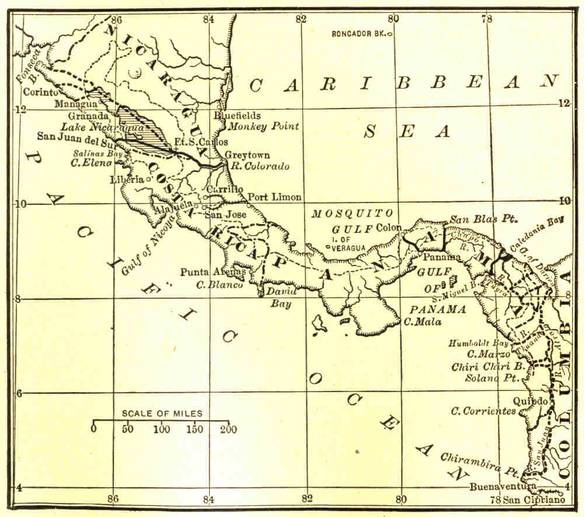
The American Isthmus, showing routes investigated for a ship-canal.
Solid Lines–Routes investigated by the Isthmian Canal Commission.
Dashed Lines–Routes investigated by others.
Effort to secure from Colombia the required territorial rights was made
in the proposed Hay-Herran treaty, ratified by our Senate, 73 against 5,
March 17, 1903, under which we were to pay Colombia, besides an annual
rental $10,000,000 for the lease of a belt six miles wide from sea to
sea. August 17, 1903, the Colombian Senate rejected this treaty, and,
October 18, the government of that country proposed another, involving
the payment by us of $25,000,000 instead of $10,000,000. If we offered
this, would not the price rise to $30,000,000 or more?
Papers in the United States argued for a revolution in Panama. The
isthmus, it was urged, was in time nearer to Washington than to Bogota.
All Panama interests centred in the canal. Should Nicaragua get the
canal, Colon and Panama would be deserted. Both places owed their peace
to the presence of our navy. On the principle that treaties concerning
territory run with the territory, ignoring changes of sovereignty, our
time-honored obligation to keep peace on the isthmus, bound us, if
Panama set up for herself, to protect her even against Colombia. England
would concur. English ships would use the canal more than ours. Great
Britain, risking and spending nothing, would gain incalculably. France,
too, would acquiesce. The Frenchmen got some $40,000,000 if the canal
crossed Panama but lost everything if it passed to Nicaragua. Other
European nations wished the canal built and felt that now was the
accepted time. Latin-American States alone showed sympathy with
Colombia.
Photograph by Clinedinst.
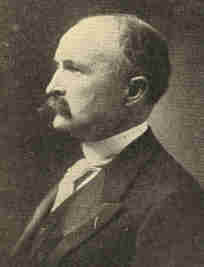
M. Bunau-Varilla, Minister from Panama.
Revolution took place. On the afternoon of November 3, 1903, the Panama
city council declared that city independent of Colombia. Colon followed.
A provisional Panama government was organized. November 6 we recognized
Panama as an independent State. November 7 she appointed M.
Bunau-Varilla her diplomatic agent at Washington. November 13 he was, as
such, formally received by President Roosevelt. November 18 Secretary
Hay and M. Bunau-Varilla signed a treaty whose first article read: "The
United States guarantees and will maintain the independence of the
Republic of Panama." Articles II and III gave us, in effect, sovereignty
over a ten-mile wide canal zone between the oceans. This treaty was
ratified by Panama December 2, and by our Senate February 23, 1904.
November 16, 1903, Colombia protested to Great Britain against our
action, and, November 28, offered us a canal concession free if we would
permit her to subjugate Panama.
Both at home and abroad the administration was charged with sharp
practice for its Panama coup, and the case made out by critics was prima
facie strong–less, indeed, on its legal than on its ethical and
prudential side. We had allowed ourselves to profit by Colombia's
distress, encouraged secession in federal republics like our own, and
rendered ourselves and our Monroe doctrine objects of dread throughout
Central and South America. Still, Colombia had been so stiff and greedy
and the settlement was in the main so happy, that censure soon subsided.
All the powerful nations speedily followed our example and recognized
Panama's independence.
Copyright, 1900. by Underwood & Underwood, N. Y:
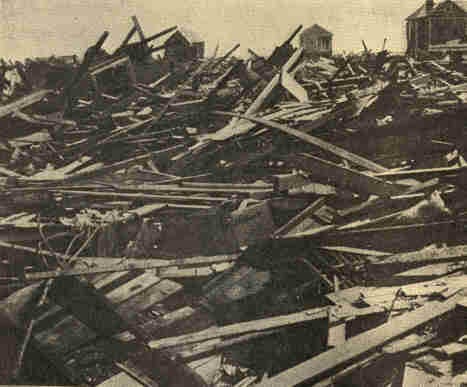
Great heaps of wreckage piled high by the Galveston disaster.
In September, 1900, the city of Galveston was visited by one of the
greatest disasters known in American history. A fierce storm swept the
waters of the gulf over the island on which Galveston is situated,
destroying property aggregating many millions of dollars and causing the
loss of 6,000 lives out of the total population of 37,000. For a time it
seemed that the site of the city would have to be abandoned, for the
highest land on which buildings stood was but a few feet above the
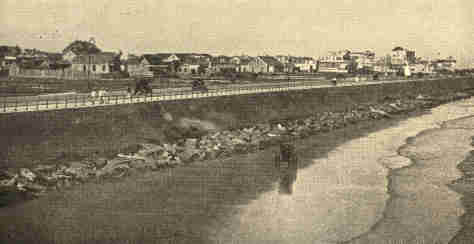
highest waves. It was determined, however, to build a stone wall three
miles in length which should be massive enough to protect the city from
any similar attack. Its top, which is five feet thick, is three feet
above the highest point reached by the water. The bottom of the wall is
sixteen feet thick. This wall, which is built concave toward the gulf,
is protected by earth and stone filled in for two hundred feet, thus
providing a driveway thirty feet wide with walks on either side,
beautified with trees and shrubs.
Photograph by H. H. Morris.
The boulevard and sea-wall, Galveston. Built after the flood.
The management of public affairs during the rebuilding of the city was
entrusted to a committee of experts. So efficiently and economically was
the administration of the government, that the Galveston Plan, commonly
spoken of as the Commission Plan, soon became a model for municipal
organization. A modification of this plan was soon put into operation at
Des Moines, Iowa. This plan consists of government by five salaried
persons, one of them acting as mayor. This body performs both
legislative and executive duties, each member being in charge of a
department of the city government. The arguments in favor of this type
of government are: (1) Responsibility is easily located; (2) a few men
receive such salaries that they may be expected to give their whole time
to the duties of their offices; (3) more civic interest will be aroused.
All officers are subject to removal at any time by vote of a certain
proportion of the people.
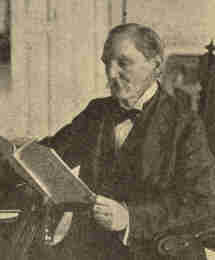
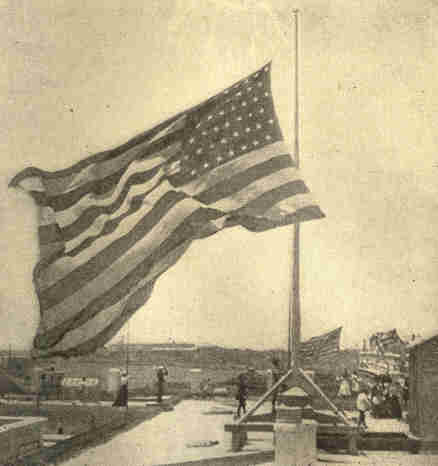
The Cuban government was organized in the spring of 1902. On May 20 of
that year, Governor-General Wood for the United States turned over the
government house at Havana to President Tomaso Estrada y Palma.
The ceremonies attending the transfer were impressive. A letter from
President Roosevelt addressed to the President and the Congress of the
Republic of Cuba was handed to President Palma. This declared the
occupation of Cuba by the United States to be at an end and tendered the
sincere friendship and good wishes of this country. At noon General Wood
hauled down the American flag, which had floated above the Governor's
palace at Havana, and assisted General Gomez in raising to the breeze
the red triangle with central silver star and three blue and two white
stripes constituting the flag of the new republic. All of the foreign
ships in the harbor likewise ran up the Cuban flag in honor of the
occasion. Forty-five shots, one for each State in the Union, were fired
as the stars and stripes were lowered from Morro Castle and the other
fortresses. The American troops saluted the new emblem, fired twenty-one
guns in honor of the new nation, and then embarked for the United
States. Thus was kept to the letter–a noble example of public
faith–the promise we made when invading Cuba, that we would not acquire
territory.
Copyright, 1902, by Underwood &Underwood, N.Y.
Tomaso Estrada y Palma,
First President of Cuba, in the palace, Havana.
Copyright. 1902, by Underwood & Underwood.
Lowering the Stars and Stripes on the palace,
May 20, 1902, for the flag of the Cuban Republic.
Those who prophesied a short life for the new republic and a reign of
fraud and corruption were mistaken. During the first year economy became
the rule in the administration of all branches of the public service,
the government was self supporting, and a balance accumulated in the
treasury. Moreover, the reforms inaugurated by Americans continued. Some
3,400 teachers were employed in the island and 120,000 pupils were in
constant attendance upon the schools. In all parts of the island the
effects of American rule were visible. Ten million dollars had been
expended in sanitation reforms and the cleansing of Havana and the other
cities. Industrial schools for orphan boys and girls were begun and
hospitals and asylums for the sick, helpless, and insane were
reestablished. By 1901 a railroad, with branch lines, was constructed
between Santiago and Havana, thus giving the whole island excellent
transportation facilities.
Cuba could not gain prosperity at a bound. Whereas the island should,
under natural conditions, have had $30,000,000 to $40,000,000 due her
from foreign countries in 1902, she was $50,000,000 in debt. Her
manufactures were insignificant. It was estimated that, in the year
named, $80,000,000 of American money was invested in Cuba. The main
enterprises were railroads, sugar and tobacco plantations, mines, and
fruit farms.
Free commercial intercourse with Spain no longer existing, Cuban sugar
and tobacco producers sought markets in the United States, leading to
the "reciprocity" conflict touched upon in Chapter XIII, Vol. V. During
1902 a reciprocity treaty was negotiated and promptly ratified in Cuba.
Our Senate amended it and returned it to Cuba for reconsideration.
Brought hither again, it was passed by our Senate in December, 1903.
President Roosevelt signed it December 17, declaring its provisions
effective in ten days.
The Philippine Commission (Chapter XV, Vol. V), four Americans and three
islanders, at first enacted laws by the authority of the President as
Commander-in-Chief. After the Congressional Act of July 1, 1902, the
formula ran: "By authority of the United States be it enacted by the
Philippine Commission." The government was pronouncedly civil both in
nature and in spirit, the natives being gradually placated, and only an
occasional outbreak demanding the presence of troops. Schools were
established, the English language and American ideas of government and
business introduced. No promise of Philippine independence was given,
yet the tenor of our whole policy toward the Filipinos, of official
utterances and of public sentiment relating to them, was to the effect
that we should never look upon any of the islands as a crown colony.
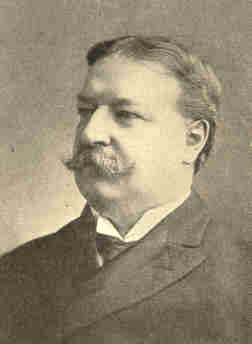
Gov. William H. Taft
[Secretary of War, 1905.]
The same interests that forbade Cuban reciprocity opposed tariff
concessions to the Philippines. A 25 per cent reduction from the Dingley
rates was the best that Congress would grant, though the commission
besought one of at least 75 per cent. For a time our behavior in this
too much resembled English and Spanish dealings with colonies centuries
ago. The United States acquired from the Philippine religious orders
422,337 acres of land, three-fifths of it highly cultivated and thickly
inhabited, for $7,239,000. In all, the government owned about 61,000,000
out of the perhaps 70,000,000 acres of land in the islands. Of the
government lands, 40,000,000 acres were forest.
The law of July 1, 1902, to supplement the commission, provided for a
native assembly of not more than 100 members or less than 50, with
annual sessions of 90 days. Municipal autonomy was allowed and became
common. An efficient constabulary was established, also a Philippine
mint and coinage system on a gold basis. Careful exploitation of the
agricultural, mineral, and other resources of the islands was provided
for, as well as an increasing number of public improvements in the
interest of order, health, and cleanliness. To promote investment in the
Philippine public works, 4 per cent bonds were issued, guaranteed by the
United States.
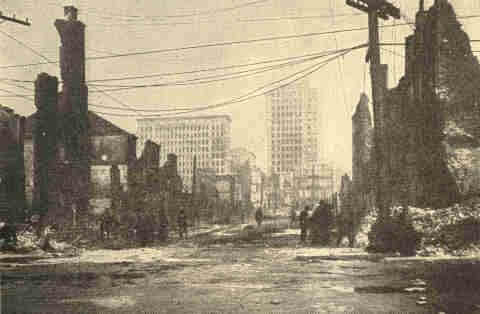
The Baltimore fire.
Lombard and Calvert Streets, Showing Continental and Equitable Buildings.
[1904]
Preparatory to forming the Philippine Assembly the commission took a
census of the islands. In 1905 the population returned from 342 islands
was 7,635,426. Of this number only about 9 per cent were wild tribes,
though more than half the entire population could neither read nor write
in any language. Of the 370,000 pupils in the newly established schools,
or double the number in attendance two years previously, one in nine on
the average had some understanding of English. Twelve thousand adults
were in the night schools, chiefly engaged in acquiring the English
language.
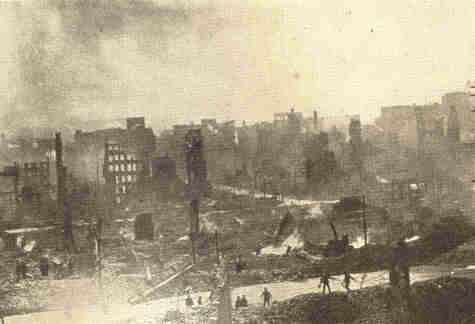
The Baltimore fire.
Hopkins Place and German Street, looking east.
In February, 1904, a fire broke out in the heart of the city of
Baltimore. Some 1,337 structures were either entirely destroyed or
rendered unfit for occupancy. The loss in buildings and other property
destroyed was about $75,000,000. With a few exceptions, the financial
district of the city was burned. For a time it was feared that the
losses would be so great that restoration could not be made, but new
plans were projected which included broader streets and better
buildings. Instead of a decrease in the number of business concerns,
there was an increase through the entrance of firms from the outside.
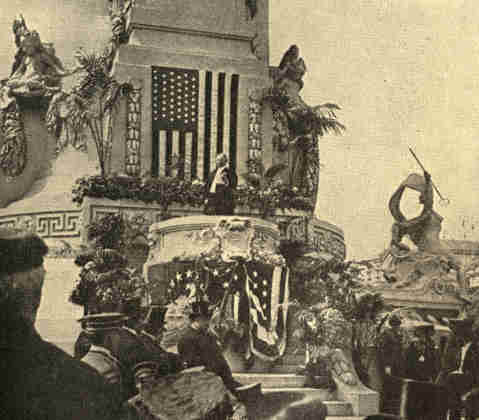
Copyright, 1904. William H. Rau, Philadelphia.
Opening Day at the Louisiana Purchase Exposition.
President D. K. Francis delivering the opening address.
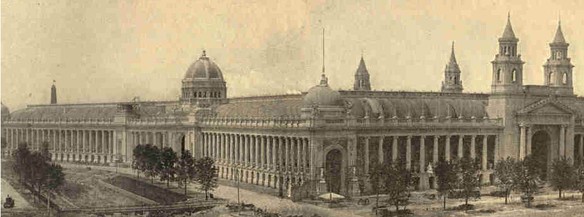
The Varied Industries Building.
THE LOUISIANA PURCHASE EXPOSITION.
The Louisiana Purchase Exposition at St. Louis was opened April 30,
1904, and continued for seven months. It commemorated the acquisition of
the Louisiana territory which was consummated April 30, 1803, marking
one of the greatest events in American history. Out of this area had
been carved thirteen States and two territories wherein over 17,000,000
people were making their homes.
The design for the exposition represented the work of ten of the most
distinguished architects of the country. The buildings, grouped in
perfect taste, mostly of noble style, had 128 acres of floor space, far
beyond that at the disposal of any preceding fair. The grounds also were
unprecedentedly ample and beautifully diversified, containing about
1,200 acres. The total attendance, 18,741,073, fell short of that at
Chicago in 1893 by over 8,000,000.
The general plan of the exposition was intended to symbolize the history
of the Louisiana territory representing the successive occupants of the
soil–the wild animals; the Indians; the discoverers; the explorers;
the hunters; the trappers, and the pioneers. The aim was to make it one
vast educational object lesson. To that end there were extensive
exhibits from thirty States and from the chief cities of work done in
the primary and secondary schools and in the universities and colleges
of the country. This feature culminated in the International Congress of
Arts and Sciences. Over 100 of the leading scholars from England,
France, Germany, Holland, Italy, Japan, the United States, and a number
of other countries made addresses and took part in the various
discussions. All the fields of human knowledge were represented by these
specialists.
One feature of this exposition was unique: it represented to an
unprecedented extent processes in lieu of products or in addition to
them. Every day at almost every point something was literally doing,
going on. Machinery whizzed, mines were operated, artists were at work,
experts showed their craft; Indians, Filipinos, the blind, deaf, and
dumb were taught.