
[1900]
Theodore Roosevelt was born in New York City, October 27, 1858. He was
graduated from Harvard in 1880. At the age of twenty-three he entered
the New York State Assembly, where he served six years with great
credit. Two years he was a "cowboy" in Dakota. He was United States
Civil Service Commissioner and President of the New York City Police
Board. In 1897 he became Assistant Secretary of the Navy, holding this
position long enough to indite the despatch which took Dewey to Manila.
He then raised the first United States Volunteer Cavalry, commonly
spoken of as "Rough Riders," and went to Cuba as their
lieutenant-colonel. Gallantry at Las Guasimas made him their colonel,
the first colonel, Leonard Wood, having received a brigadier-general's
commission. Returning from the war, Colonel Roosevelt found himself, as
by a magic metamorphosis, Governor of his State, fighting civic battles
against growing corporate abuses. He urged compulsory publicity for the
affairs of monopolistic combinations, and was prominently instrumental
in the enactment of the New York Franchise Tax Law.
The party managers in the 1900 convention hoped by making him
Vice-President to remove him from competition for the presidency in
1904. But the most unexpected of the many swift transitions in his
career foiled their calculations and brought him in a moment to the
summit of a citizen's ambition.
The new chief magistrate was no less honest, fearless, or
public-spirited than the recent one; it only remained to be seen whether
he were not less astute and cautious. Coming to the office as he did, he
was absolutely unfettered, which, in one of so frank a temperament,
might prove a danger. He was more popular with the people than with
politicians. Though highly educated and used to the best associations,
he was more approachable than any of his predecessors. At a public
dinner which he attended, one round of cheers was given him as "the
President of the United States" another as "Roosevelt," and a third as
"Teddy." Had McKinley been in his place a corresponding variation would
have been unthinkable.
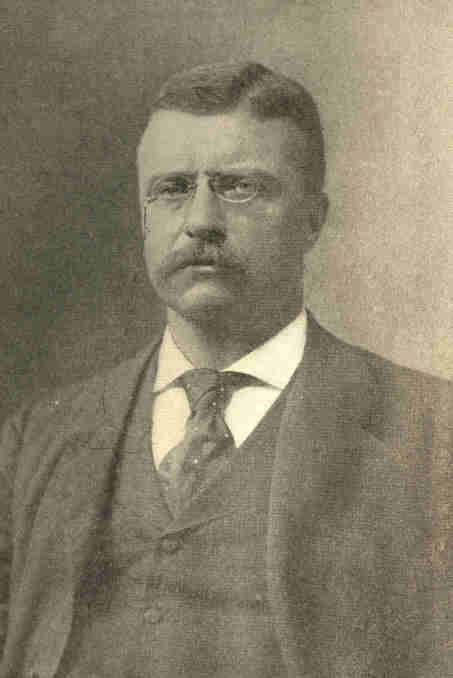 From a copyrighted photograph by Pach Bros., N. Y.
Theodore Roosevelt.
From a copyrighted photograph by Pach Bros., N. Y.
Theodore Roosevelt.
President Roosevelt's temper and method were in pointed contrast to
McKinley's. Whereas McKinley seemed simply to hold the tiller, availing
himself of currents that to the eye deviously, yet easily and
inevitably, bore him to his objective, Roosevelt strenuously plied the
oar, recking little of cross currents or head winds, if, indeed, he did
not delight in them. Chauncey Depew aptly styled McKinley "a Western man
with Eastern ideas." Roosevelt, "an Eastern man with Western ideas."
This aspect of the new President's character gave him hold on both West
and East. Roosevelt was the first President since William Henry Harrison
to bring to his office the vigor and freshness of the frontier, as he
was, anomalously, the first city-born or wealthy-born incumbent.
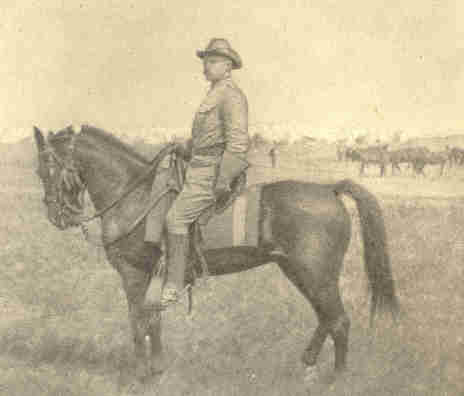
Theodore Roosevelt, as Lieut.-Colonel of the "Rough Riders."
[1901]
The members of President McKinley's cabinet were invited to retain their
portfolios, which they agreed to do. At the time, Roosevelt was reputed
to be the foremost civil service reformer in the country. Politicians
were soon made aware that the President regarded fitness for office as
the first test. Unfortunately during the presidency of McKinley, some
8000 offices had been taken out of the competitive lists. During
Roosevelt's first term, however, the list of offices placed under the
merit system was greatly extended. Within the twenty-one years from the
enactment of the first national civil service reform law wonders had
been accomplished in that more than one-half of the 300,000 offices in
the executive civil service were placed in the classified competitive
service.
President Roosevelt stood for liberal reciprocity with Cuba, urging
this, at first, with results disastrous to party harmony. He was
vindicated by public opinion, but learned wisdom. Though believed to be
favorable to a decided easing of custom-house levies, his administration
soon frankly avowed itself unable to proceed further than high-
protectionists would follow. The evidence of his tariff convictions won
him strong support in the West, which was prepared to go greater lengths
than he. In the congressional campaign of 1902, ex-Speaker Henderson, of
Iowa, a stanch protectionist, withdrew from public life, as was
supposed, rather than misrepresent himself by acceding to tariff reform
or his constituents by opposing it.
Mr. Roosevelt signalized his accession by an effort to make the federal
anti-trust law something more than a cumberer of the statute-book. His
inaugural message and innumerable addresses of his boldly handled the
whole trust evil and called for the regulation of capitalistic
combinations in the interest of the public.
Appreciation of the President's attitude on these matters may be
assisted by some notice of the then threatening vigor and universality
of the movement toward industrial combination. Mr. Beck, Assistant
Attorney-General of the United States, declared in 1892:
"Excessive capitalization of corporations, dishonest management by their
executive officers, the destruction of the rights of the minority, the
theft of public utilities, the subordination of public interests to
private gain, the debauchery of our local legislatures and executive
officers, and the corruption of the elective franchise, have resulted
from the facility afforded by the law to corporations to concentrate the
control of colossal wealth in the hands of a few men . . . . The
question presses ever more importunately for decision whether these
marvellous aggregations of capital can be subordinated to the very laws
which created them."
Legislation in many States, the enactment of the Sherman anti-trust law
by Congress, and the decision of the Supreme Court in the Trans-Missouri
case rendered insecure trust agreements of the old type, in which
constituent corporations surrendered the control of their affairs to
trustees. But the current merely shifted to a different channel, the
trust proper giving way to the giant corporation having the same aims,
methods, and efficiency, while, as more legal, it was less vulnerable.
In the railway world, "community of interest" assumed the place of
pooling agreements. The Union Pacific acquired large holdings from
Collis P. Huntington's estate and controlled the Southern Pacific. The
power behind the Southern Railway got control of nearly all the other
Southern railways, including the Atlantic Coast Line, the Plant System,
and at last even the Louisville and Nashville. The New York Central
dominated the other Vanderbilt roads. The Pennsylvania secured decisive
amounts of Baltimore and Ohio stock, as well as weighty interests in the
Chesapeake and Ohio and the Norfolk and Western, and so on.
[1902]
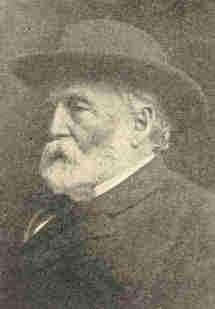
Collis P. Huntington.
Great banking establishments, foremost among them the house of J. P.
Morgan & Co., took to financing these schemes. Morgan re-organized the
Northern Pacific, and it would forthwith have pooled issues with the
Great Northern but for opposition by the State of Minnesota. James J.
Hill was master of the Great Northern, and confidence existed between
him and Morgan.
They wished a secure outlet for the products of the Northwest, also
access to Chicago over a line of their own. After a survey of the field
the promoters selected as the most available for the latter office the
Chicago, Burlington and Quincy. Purchase of shares in this corporation
was quietly begun. Soon the Burlington road was apparently in hand.
Prices rose.
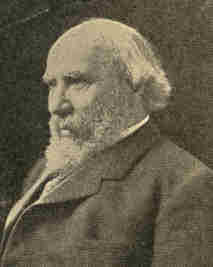
Copyright. 1902. by Pach Bros., N. Y.
James J. Hill.
The Union Pacific control perceived in the aggression of the two
northern lines a menace to its northwestern and Pacific coast
connections. The Union Pacific leader, E. H. Harriman, resorted to an
unexpected coup. He attempted to purchase the Northern Pacific,
Burlington and all. A mysterious demand, set Northern Pacific shares
soaring. The stock reached $1,000 a share and none was obtainable. Panic
arose; bankers and brokers faced ruin.
The two sides now declared a truce. The Northern Securities Company was
created, with a capital approaching a billion dollars, to take over the
Burlington, Northern Pacific, and Great Northern stocks.
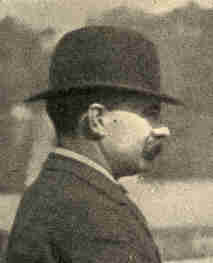
E. H. Harriman.
The States of Minnesota and Washington, unable in their own courts to
thwart this plan, sought the intervention of the United States Supreme
Court. Their suit was vain till the Administration came to the rescue.
At the instance of the Attorney-General, an injunction issued from the
high court named forbidding the Securities Company to receive the
control of the roads, and the holders of the railroad stocks involved to
give it over. It was observed, however, that at the very time of the
above proceedings the Southern Railways' power obtained control of the
Louisville and Nashville without jar or judicial obstruction.
While general, the process of confederation was specially conspicuous in
the iron and steel trade. In rapid succession the National Steel
Company, the American Sheet Steel Company, and the American Tin Plate
Company were each made up of numerous smaller plants. Each of these
corporations, with a capital from $12,000,000 to $40,000,000, owned the
mines, the ships, and the railways for hauling its products, the mills
for manufacturing, and the agencies for sale. Through the efforts of
John W. Gates numerous wire and nail works were combined into the
American Steel and Wire Company. The Federal Steel Company, the American
Bridge Company, the Republic Iron and Steel Company, huge and complete,
were dictators each in its field.
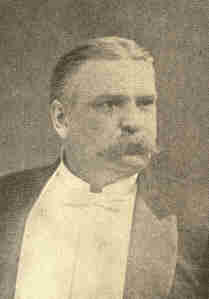
John W. Gates.
The Carnegie Steel Company long remained independent. Determined not to
enter a "combine," Andrew Carnegie sought to fortify his position. He
obtained a fleet of ships upon the lakes, purchased mines, undertook to
construct tube works at Conneaut, Ohio, and planned for railroads. A
battle of the giants, with loss and possible ruin for one side or the
other, impended. Carnegie was finally willing to sell. Hence, the United
States Steel Corporation capitalized for a billion dollars. Carnegie and
his partners were said to receive about $300,000,000 in bonds of the new
corporation, while the other trusts and the promoters absorbed the stock
for their properties and services. The underwriting syndicate probably
realized $25,000,000.
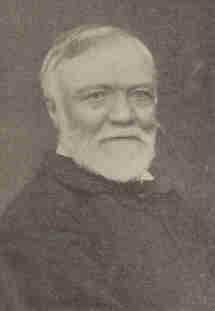
Copyright. 1902, by Rockwood. N. Y.
Andrew Carnegie.
The trust creators extended their operations abroad. In 1901 J. Pierpont
Morgan and associates acquired the Leyland line of Atlantic
steamships. British nerves had not recovered tone when a steamship
combination, embracing not only American and British but also German
lines and ship-building firms at Belfast and on the Clyde was announced.
Of the great Atlantic companies, only the Cunard line remained
independent. Parliamentary and ministerial assurances of governmental
attention only emphasized the strength of the association.
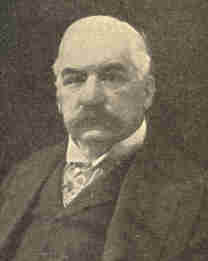
Copyright, 1901. by Pach Bros., N. Y:
J. Pierpont Morgan.
One effect of this organization at home was to place the Ship Subsidy
Bill, which passed the Senate in 1901, for the time, at least, on the
table. The sentiment of the country, especially of the Middle West,
would not permit the payment of public money to a concern commercially
able to defy Britannia on the sea.
The Yankee Peril confronted Londoners when they saw American capital
securing control of their proposed underground transit system. At their
tables they beheld the output of food trusts. One of these, the
so-called Beef Trust, called down upon itself in 1902 domestic as well
as foreign anathema.
The failure of the corn crop in 1900, together with a scarcity of
cattle, tended to raise the price of beef. In 1902 outcry became
emphatic. Advance in meat values drew forcibly to view the control held
by six slaughtering concerns acting in unison.
The President ordered an investigation, and, as a result, proceedings
under the Sherman Act to restrain the great packers from continuing
their alleged combination. A temporary injunction was granted. The slow
machinery of chancery bade fair to work out a decree, but long before it
was on record, alert spirits among the packing firms evolved a new plan
not obnoxious to decrees, but effective for union.
If the public suffered from these phalanxed industries while they ran
smoothly, it endured peculiar evils from the periodical conflicts
between the capital and the labor engaged in them.
The Steel Strike of 1901 was a conflict over the unionizing of certain
hitherto non-union plants of the United States Steel Corporation. It
resulted in defeat for the strikers and in the disunionizing of plants.
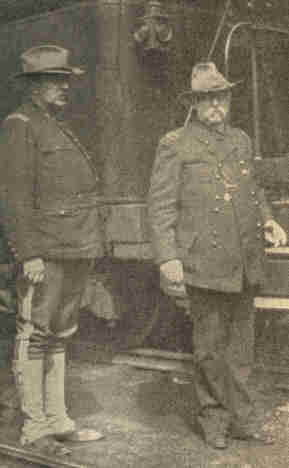
Col. Clements. Gen. Gobin, commanding troops
sent to Shenandoah in the coal strike of 1902.
This strike had no such consequences for the consuming public as
attended the anthracite coal strike of 1902, which was more bitterly
fought in that it was a conflict over wages. The standard of living had
been lowered in one of the coal-fields by the introduction of cheap
foreign labor. Now the same process threatened the other coal-field.
A strike ordered by the United Mine Workers began May 12, 1902, when one
hundred and forty-seven thousand miners went out. Though the record was
marred at places, they behaved well and retained to a large degree
public sympathy. When the price of anthracite rose from about $5 a ton
to $28 and $30, the parts of the country using hard coal were threatened
with a fuel famine and had begun to realize it. For the five months
ending October 12th, the strike was estimated to have cost over
$126,000,000. The operators stubbornly refused to arbitrate or to
recognize the union, and the miners, with equal constancy, held their
ranks intact.
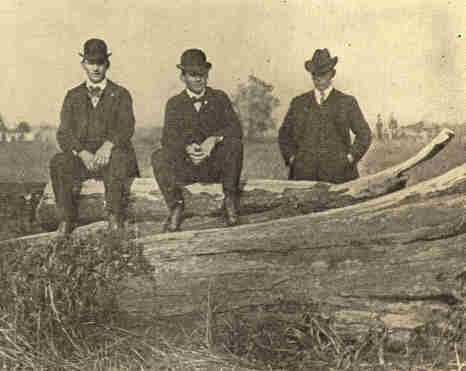
Coal strike at Shenandoah, Pa., 1902. A strikers' picket.
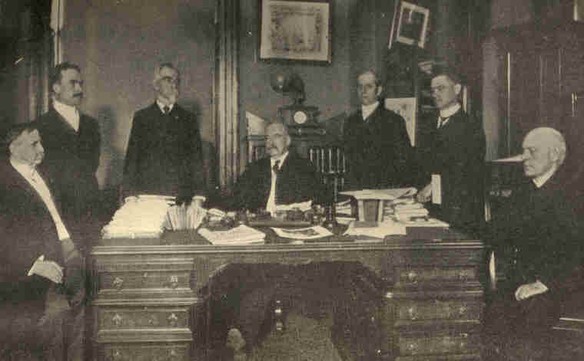
Copyright, 1902, by George Grantham Bain.
The coal strike arbitrators chosen by the President. Carroll D. Wright,
Recorder; T. H. Watkins, General J. M. Wilson, Judge Gray, Presiding
Officer; E, W. Parker, E. E. Clark. and Bishop Spalding.
The problem of protecting the public pressed for solution as never
before. The only suggestion at first discussed was arbitration. Enforced
arbitration could not be effected in the absence of contract without
infringing the workingman's right to labor or to decline to do so; in
other words, without reducing him, in case of adverse decision by
arbitration, to a condition of involuntary servitude. It looked as
though no solution would be reached unless State or nation should
condemn and acquire ample portions of the mining lands to be worked
under its own auspices and in a just manner. This course was suggested,
but nearly all deemed it dangerously radical; nor was it as yet likely
to be adopted by Congress or by the Pennsylvania legislature, should
these powers be called to deal with the problem.
On October 3 President Roosevelt called the coal operators and President
Mitchell of the United Mine Workers to a conference at the White House,
urging them to agree. His effort, at first seeming unsuccessful, was
much criticised, but very few failed to praise it when, a few days
later, it was found to have succeeded completely. An able and impartial
commission, satisfactory to both sides, was appointed by the President
to act as arbitrator, both miners and operators agreeing to abide its
decrees. The miners, the four hundred thousand women and children
dependent on them, the poor beginning to suffer from cold, indeed the
whole nation, including, no doubt, the operators, felt relief.
"How much better," said the young President, once, addressing a
fashionable assembly, "boldly to attempt remedying a bad situation than
to sit quietly in one's retreat, sigh, and think how good it would be if
the situation could be remedied!"