 Exile
Deported
Exile
Deported
In 1917, a revolution toppled Russia’s Czar, and replaced him with a communist government. Also, immediately after World War One, the country experienced high inflation, high unemployment, and a number of labor strikes. Against this backdrop, the United States began arresting and deporting anyone suspected of “radical” thinking (e.g., Communism, socialism, anarchism, pro-labor). These arrests became known as the “Palmer Raids” after the Attorney General of the United States, A. Mitchell Palmer.
Source: Excerpt from an essay written by A. Mitchell Palmer called “The Case Against the ‘Reds,'” 1920.
Like a prairie-fire, the blaze of revolution was sweeping over every American institution a year ago. It was eating its way into the homes of the American workmen, its sharp tongues of revolutionary heat were licking the altars of the churches, leaping into schools, crawling into the sacred corners of American homes, burning up the foundations of society.
My information showed that thousands of aliens supported communism in this country. Aliens who were making the same glittering promises of lawlessness and criminal rule to Americans, that they had made to the Russian peasants.
The whole purpose of communism appears to be a mass organization of the criminals of the world to overthrow the decencies of private life, to usurp property that they have not earned, to disrupt the present order of life. Communism distorts our social law.
It has been impossible in so short a space to review the entire menace of the internal revolution in this country, but this may serve to arouse the American citizen to its reality, its danger, and the great need of united effort to stamp it out, under our feet, if needs be. It is being done. The Department of Justice will pursue the attack of these “Reds” upon the Government of the United States with vigilance, and no alien, advocating the overthrow of existing law and order in this country, shall escape arrest and prompt deportation.
Source: Excerpt from the statement Emma Goldman gave at her deportation hearings. Goldman was an anarchist and socialist who sympathized with the working poor. She was deported during the Palmer Raids.
I wish to register my protest against these proceedings, whose very spirit is nothing less than a revival of the ancient days of the Spanish Inquisition or Czarist Russia [when anyone who disagreed with the government was deported or killed]. Today so-called aliens are deported. Tomorrow American citizens will be banished . Already some “patriots” are suggesting that some native-born American citizens should be exiled .
The free expression of the hopes of a people is the greatest and only safety in a sane society. The object of the deportations and of the anti-anarchist law is to stifle the voice of the people, to muzzle every aspiration of labor. That is the real and terrible menace of these proceedings. Their goal is to exile and banish every one who does not agree with the lies that our leaders of industry continue to spread.
Emma Goldman
New York, October 27, 1919
Exile
Deported
During World War One, the U.S. Congress passed several laws, the Espionage and Sedition Acts, that criminalized certain acts deemed threatening to the war effort. Some people thought these laws unconstitutionally restricted free speech, while others thought they were necessary. The documents below include Wikipedia articles on the Espionage and Sedition Acts and an excerpt from a famous court case in which the Acts were challenged. The document set concludes with a speech by the socialist leader Eugene V. Debs. After giving the speech, Debs was prosecuted under the Espionage and Sedition Acts. After reading all of the documents, decide whether you think Debs was guilty.
Source: Excerpt from the Wikipedia articles on the Espionage Act.
The Espionage Act of 1917 was a United States federal law passed shortly after entering World War I, on June 15, 1917, which made it a crime for a person:
- To convey information with intent to interfere with the operation or success of the armed forces of the United States or to promote the success of its enemies. This was punishable by death or by imprisonment for not more than
.
- To convey false reports or false statements with intent to interfere with the operation or success of the military or naval forces of the United States or to promote the success of its enemies and whoever when the United States is at war, to cause or attempt to cause insubordination, disloyalty, mutiny, refusal of duty, in the military or naval forces of the United States, or to willfully obstruct the recruiting or enlistment service of the United States. This was punishable by a maximum
fine (almost
in today's dollars) and
in prison.
Thus, while “espionage” is usually defined as a clandestine activity of getting secret information and passing it on to the enemy, the law vastly extended the meaning of the term to include also the openly carried expressing of political opinions, without revealing any secret, and by persons who had no connection with the enemy - as long as the expressing of such opinions was construed as helping the enemy.
The legislation was passed at the urging of President Woodrow Wilson, who feared any widespread dissent in time of war, thinking that it constituted a real threat to an American victory.
Source: Excerpt from the Wikipedia article on the Sedition Act http://en.wikipedia.org/wiki/Sedition_Act_of_1918
The Sedition Act of 1918 (May 16, 1918) was an amendment to the Espionage Act of 1917 passed at the urging of President Woodrow Wilson, who was concerned that dissent, in time of war, was a significant threat to morale. The passing of this act forbade Americans to use “disloyal, profane, scurrilous, or abusive language” about the United States government, flag, or armed forces during war. The act also allowed the Postmaster General to deny mail delivery to dissenters of government policy during wartime.
Source: Excerpt from a Supreme Court decision in the case of Schenck v. United States, written by Justice Oliver Wendell Holmes Jr. Schenck was a socialist who opposed the draft in World War I and passed out pamphlets comparing it to slavery. He was prosecuted under the Sedition Act and appealed his case to the Supreme Court, arguing that his pamphlet activity was protected by the
 Amendment, under freedom of speech. In the decision below, the Supreme Court decided that Schenck was guilty, and that during wartime, the government may limit freedom of speech.
The character of every act depends upon the circumstances in which it is done. The most stringent protection of free speech would not protect a man in falsely shouting “Fire!” in a theatre and causing a panic...
The question in every case is whether the words used are used in such circumstances and are of such a nature as to create a clear and present danger that they will bring about the substantive evils that Congress has a right to prevent...
When a nation is at war many things that might be said in time of peace are such a hindrance to its effort that their utterance will not be endured so long as men fight and that no Court could regard them as protected by any constitutional right.
Source: Eugene Debs delivered the following speech in June 1918. He visited three Socialists who were in prison for opposing the draft, and then spoke, across the street from the jail, for two hours. The excerpt below is only a small segment of a much longer speech.
Comrades, friends and fellow-workers, thank you for this very cordial greeting, this very hearty reception.
Three of our most loyal comrades are paying the penalty for their devotion to the cause of the working class. They have come to realize, as many of us have, that it is extremely dangerous to exercise the constitutional right of free speech in a country fighting to make democracy safe in the world.
Every one of these Wall Street conspirators and would-be murderers claims to be an arch-patriot; every one of them insists that the war is being waged to make the world safe for democracy. What humbug! What rot! What false pretense! These autocrats, these tyrants, these red-handed robbers and murderers, the “patriots,” while the men who have the courage to stand face to face with them, speak the truth, and fight for their exploited victims—they are the disloyalists and traitors. If this be true, I want to take my place side by side with the traitors in this fight.
Wars throughout history have been waged for conquest and plunder. In the Middle Ages when the feudal lords who inhabited the castles, the poor, ignorant serfs had been taught that it was their patriotic duty to fall upon one another and to cut one another’s throats for the profit and glory of the lords and barons who held them in contempt. And that is war in a nutshell. The master class has always declared the wars; the subject class has always fought the battles. The master class has had all to gain and nothing to lose, while the subject class has had nothing to gain and all to lose—especially their lives.
In all the history of the world you, the people, have never had a voice in declaring war, and strange as it certainly appears, no war by any nation in any age has ever been declared by the people.
Yours not to reason why; Yours but to do and die.
That is their motto and we object on the part of the awakening workers of this nation.
If war is right let it be declared by the people. You who have your lives to lose, you certainly above all others have the right to decide the momentous issue of war or peace.
It is the minorities who have made the history of this world. It is the few who have had the courage to take their places at the front; who have been true enough to themselves to speak the truth that was in them; who have dared oppose the established order of things; who have espoused the cause of the suffering, struggling poor; who have upheld without regard to personal consequences the cause of freedom and righteousness.
They are continually talking about your patriotic duty. It is not their but your patriotic duty that they are concerned about. There is a decided difference. Their patriotic duty never takes them to the firing line or chucks them into the trenches.
In passing I suggest that we stop a moment to think about the term “landlord.” “LANDLORD!” Lord of the Land! The lord of the land is indeed a superpatriot. This lord who practically owns the earth tells you that we are fighting this war to make the world safe for democracy—he who profiteers at the expense of the people who have been slain and mutilated by multiplied thousands, under pretense of being the great American patriot. It is he, this patriot who is in fact the archenemy of the people; it is he that you need to wipe from power. It is he who is a far greater menace to your liberty and your well-being than the Prussian Junkers (Germans) on the other side of the Atlantic ocean.
Yes, in good time we are going to destroy all enslaving and degrading capitalist institutions and re-create them as free and humanizing institutions. The world is daily changing before our eyes. The sun of capitalism is setting; the sun of socialism is rising.
In due time the hour will strike and this great cause triumphant—the greatest in history—will proclaim the emancipation of the working class and the brotherhood of all mankind.
Section Questions
After the end of World War I, in January 1919, the Allied Powers met at the Paris Peace Conference to decide on the terms of the treaty that would be presented to the defeated Central Powers. The Allies also created the League of Nations, an inter-governmental organization charged with peacefully resolving disputes between nations, promoting disarmament, and protecting human rights.
After the Paris Peace Conference, President Woodrow Wilson returned to the U.S. and tried to persuade Congress to ratify the treaty and join the League of Nations. The first document below is a speech given by Wilson in support of the League. The second is a speech by Republican senator Henry Cabot Lodge, who opposed the league.
Source: Speech given by President Woodrow Wilson in Pueblo Colorado, September 25, 1919. Wilson toured the country to rally popular support for the treaty of Paris and the League of Nations.
My fellow citizens, as I have crossed the continent, I have perceived more and more that men have been busy creating an absolutely false impression of the treaty of peace and the Covenant of the League of Nations.
At the front of this great treaty is the Covenant of the League of Nations. Reflect, my fellow citizens that the membership of this great League is going to include all the great fighting nations of the world, as well as the weak ones.
And what do they unite for? They enter into a solemn promise to one another that they will never use their power against one another for aggression; that they never will violate the territorial integrity of a neighbor; that they never will interfere with the political independence of a neighbor; that they will abide by the principle that great populations are entitled to determine their own destiny; and that no matter what differences arise between them they will never resort to war without first submitting their differences to the consideration of the council of the League of Nations, and agreeing that at the end of the six months, even if they do not accept the advice of the council, they will still not go to war for another three months.
I wish that those who oppose this settlement could feel the moral obligation that rests upon us not to turn our backs on the boys who died, but to see the thing through, to see it through to the end and make good their redemption of the world.
For nothing less depends upon this decision, nothing less than liberation and salvation of the world.
You will say, “Is the League an absolute guaranty against war?” No; I do not know any absolute guaranty against the errors of human judgment or the violence of human passions but I tell you this: With a cooling space of nine months for human passion, not much of it will keep hot.
We have accepted the truth of justice and liberty and peace, and this truth is going to lead us, and through us the world, out into pastures of quietness and peace such as the world never dreamed of before.
Source: A speech given by Henry Cabot Lodge in Washington, D.C. on August 12, 1919. Cabot Lodge was a ferocious Republican opponent of the Democrat President Woodrow Wilson. Deeply suspicious of any attempt to unnecessarily involve the U.S. in international political matters Cabot Lodge campaigned against U.S. participation in the League of Nations. Cabot Lodge's viewpoint eventually won and the U.S. never joined the League.
Mr. President:
The first step to world service is the maintenance of the United States. You may call me selfish if you will, conservative or reactionary , or use any other harsh adjective you see fit to apply, but an American I was born, an American I have remained all my life. I can never be anything else but an American, and I must think of the United States first.
I have never had but one allegiance - I cannot divide it now. I have loved but one flag and I cannot share that devotion and give affection to the mongrel banner invented for a league. Internationalism is to me repulsive .
The United States is the world's best hope, but if you fetter her in the interests and quarrels of other nations, if you tangle her in the intrigues of Europe, you will destroy her power for good and endanger her very existence. Leave her to march freely through the centuries to come as in the years that have gone.
We hear much of visions, but when words describe a present that doesn’t exist and future that no man can predict, they are as unreal and short-lived as steam.
No doubt many excellent and patriotic people see a coming fulfillment of noble ideals in the words ‘league for peace'. We all respect and share these aspirations and desires, but some of us see no hope, but rather defeat, for them in this murky plan. For we, too, have our ideals, even if we differ from those who have tried to establish a monopoly of idealism.
Our first ideal is our country. Our ideal is to make her ever stronger and better and finer, because in that way alone can she be of the greatest service to the world's peace and to the welfare of mankind.
Since the founding of the republic, some Americans advocated temperance—limits on the consumption of alcohol. Temperance organizations formed and then unified into the American Temperance Union in 1833. In the early
 century, the cause morphed into the Prohibition movement, which had the support of diverse constituencies including Progressives, many southerners and women, pietist Protestant denominations (for example, Methodists), and the Ku Klux Klan. The
 Amendment to the Constitution passed in 1919, prohibiting the manufacture, sale, and transport of alcohol. It was repealed in 1933. The documents below include the
Amendment, several prohibitionist posters, and an article from the New York Times. Read these documents to find out what problems some people saw in society and why they favored Prohibition.
Amendment to the Constitution passed in 1919, prohibiting the manufacture, sale, and transport of alcohol. It was repealed in 1933. The documents below include the
Amendment, several prohibitionist posters, and an article from the New York Times. Read these documents to find out what problems some people saw in society and why they favored Prohibition.
Source: The United States Constitution.
The US Senate passed the
Amendment on December 18, 1917. It was ratified on January 16, 1919, after
states approved it. The
Amendment on December 5, 1933. It is the only amendment that has ever been completely repealed.
Section 1. After one year from the ratification of this article the manufacture, sale, transportation, importation or exportation of intoxicating liquors in the United States and all its territory is hereby prohibited.
Section 2. The Congress and the several States shall both have power to enforce this article by appropriate legislation.
Section 3. This article shall have no power unless it shall have been ratified as an amendment to the Constitution by the legislatures of the several States, as provided in the Constitution, within seven years from the date of the submission to the States by the Congress.
amendment?
Source: Read at the Eighth Annual Meeting of the National Temperance Council, Washington D.C., September 20, 1920. The National Temperance Council was created in 1913 to work for Prohibition. (Figure below ).
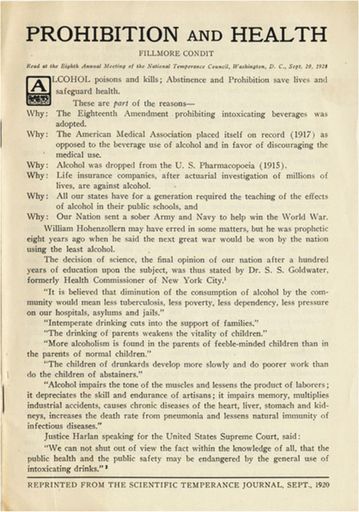
Figure 8.1
PROHIBITION AND HEALTH
Alcohol poisons and kills; Abstinence and Prohibition save lives and safeguard health.
Dr. S.S. Goldwater, formerly Health Commissioner of New York City, stated the decision of science, the final opinion of our nation after a hundred years of education upon the subject of alcohol.
“It is believed that less consumption of alcohol by the community would mean less tuberculosis, less poverty, less dependency, less pressure on our hospitals, asylums and jails.”
“Alcohol hurts the tone of the muscles and lessens the product of laborers; it worsens the skill and endurance of artists; it hurts memory, increases industrial accidents, causes diseases of the heart, liver, stomach and kidney, increases the death rate from pneumonia and lessens the body’s natural immunity to disease.”
Justice Harlan speaking for the United States Supreme Court, said:
“We cannot shut out of view the fact that public health and public safety may be harmed by the general use of alcohol.”
Questions:
Amendment?
Source: The New York Times, November 14, 1922.
‘ HOOCH MURDER’ BILL DRAFTED BY ANDERSON
Anti-Saloon Head Aims to Reach Those Whose Drinks Cause Death.
William H. Anderson, State Superintendent of the Anti-Saloon League, announced in a statement yesterday that the organization would sponsor a measure at the upcoming State Legislature. The measure would be known as the “Hooch Murder” bill. It says a person can be tried for murder, and punished accordingly, if they are suspected of selling alcohol that resulted in the death of the person drinking it. Commenting on the measure, Mr. Anderson said:
“This bill is intended for whoever it may hit, but it is especially directed at the immoral foreigner, usually an alien , who had largely stopped killing with a knife from hate or with a gun for hire, and has gone into the preparation and thoughtless selling of poison for profit.”
....
Amendment?
Source: Poster published in 1913 by the Scientific Temperance and American Issue Publishing Company. (Figure below ).
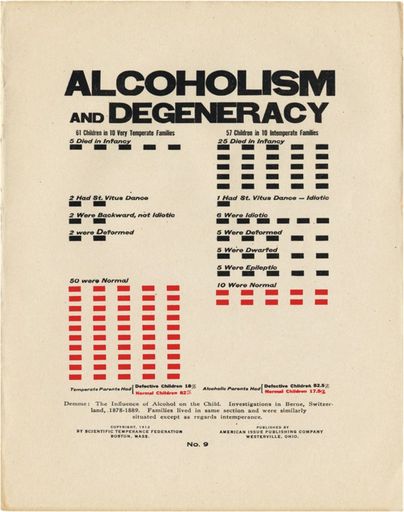
Figure 8.2
Source: Poster published in 1913 by the Scientific Temperance Federation and American Issue Publishing Company. (Figure below ).
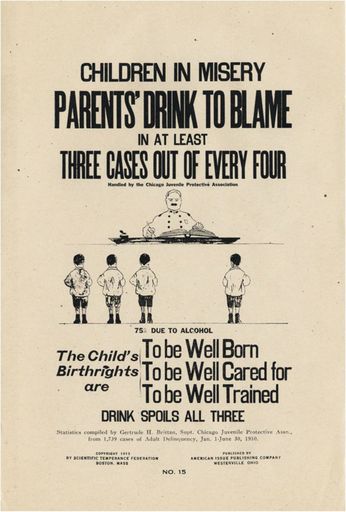
Figure 8.3
century. Do you think these beliefs are silly or reasonable? Explain.
The textbook excerpt below provides introductory information about the Chicago Race Riots of 1919. Read that and then the documents that follow, thinking about what the textbook leaves out. According to each document, what caused the riots?
Source: The 2006 edition of The American Vision , a high school textbook.
In the summer of 1919, over
race riots broke out across the nation. The worst violence occurred in Chicago. On a hot July day, African Americans went to a whites-only beach. Both sides began throwing stones at each other. Whites also threw stones at an African American teenager swimming near the beach to prevent him from coming ashore, and he drowned. A full-scale riot then erupted in the city. Angry African Americans attacked white neighborhoods while whites attacked African American neighborhoods. The riots lasted for several days. In the end,
people died
white and
black—and over
were injured.
Source: A work of history by John Hope Franklin called From Slavery to Freedom: A History of Negro Americans . This is from the Eighth Edition, published in 1987, but the book was first published in 1947.. Franklin is a United States historian and past president of the Organization of American Historians and the American Historical Association. More than three million copies of From Freedom to Slavery have been sold. In 1995, Franklin was awarded the Presidential Medal of Freedom, the nation's highest civilian honor.
The most serious racial outbreak occurred in Chicago late in July of the so-called Red Summer.... The riot that began on July
had its immediate origin in a fight at Lake Michigan beach. A young African American swimming offshore had drifted into water that was customarily used by whites. White swimmers commanded him to return to his part of the beach, and some threw stones at him. When the young man went down and drowned, blacks declared that he had been murdered.... Distorted rumors circulated among blacks and whites concerning the incident and the subsequent events at the beach. Mobs sprang up in various parts of the city, and during the night there was sporadic fighting. In the next afternoon, white bystanders meddled with blacks as they went home from work. Some were pulled off streetcars and whipped.... On the South Side a group of young blacks stabbed an old Italian peddler to death, and a white laundry operator was also stabbed to death.... Thirty-eight people had been killed, including
whites and
people injured,
were white and
were black. There is no record of the racial identity of the remaining
. More than
families, mostly black, were homeless as a result of to the burnings and general destruction of property.
Source: From “The Causes of the Chicago Race Riot,” by Walter White, October 1919. This article was published in The Crisis, an African-American newspaper. The author was a leader of the NAACP, an organization devoted to protecting African-American rights.
Since 1915 the colored population of Chicago has more than doubled, increasing in four years from a little over
to what is now estimated to be between
and
. Most blacks lived in the area called the “Black Belt.” Already overcrowded, this so-called “Black Belt” could not possibly hold the doubled colored population. One cannot put ten gallons of water in a five-gallon pail.
Whites who are afraid that blacks will move out of the “Black Belt” and into “white” neighborhoods have formed the “Property Owners' Association” to keep blacks out of white neighborhoods. They discuss ways to keep Negroes in “their part of town.”
In a number of cases during the period from January 1918 to August 1919, there were bombings of colored homes and houses occupied by Negroes outside of the “Black Belt.” During this period no less than twenty bombings took place, yet only two persons have been arrested and neither of the two has been convicted.
Source: “Race Riots and Their Remedy” by W.S. Scarborough, from The Independent, an African-American newspaper. It is talking about black soldiers who served in World War One in Europe. More than 350,000 African Americans served in World War One, which ended in 1919. (Figure below ).
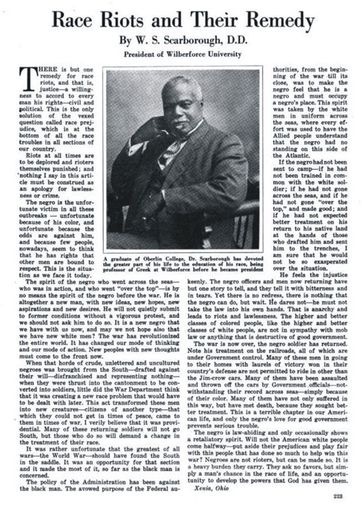
Figure 8.4
“Race Riots and Their Remedy”
The spirit of the Negro who went across the seas -- who was in battle -- is different from the spirit of the Negro before the war. He is altogether a new man, with new ideas, new hopes, new dreams, and new desires. He will not quietly accept discrimination, and we should not ask him to do so. It is a new Negro that we have with us now....
The war transformed these men into new creatures -- citizens of another type.
Source: Article from the Chicago Tribune, the main newspaper in Chicago, April 12, 1919. Many people in Chicago worked at meat-packing factories, where they prepared meat to be shipped around the country. These factories were also called “stockyards.”
Packers’ Force Cut by

Outsiders who are thinking of coming to Chicago to take a “job at the yards” will not find the “welcome” sign out awaiting them.
It became known yesterday that since the end of the Great War the force of workers has dropped by nearly
Another problem is that the factories promised to return every employee who enlisted in the armed forces to “as good or better” a job than he held when he put on a uniform. [White] men are now returning in increasingly large numbers and none are being turned away.
“No discrimination is being shown in the reducing of our forces,” said an official of one of the packing companies, in discussing reports that southern colored men, who were hired during the war job shortage, were being fired. “It is a case of survival of the fittest, the best man staying on the job. It is a fact that the southern Negro cannot compete with the northerner.”
The section below includes documents from the women’s suffrage movement, both for and against. The Declaration of Sentiments, from 1848, is the first classic statement from the American Women’s Rights movement. The following two documents are texts from anti-suffragists. The set concludes with a photograph of a participant in a pro-suffrage rally. As you examine these documents, attempt to determine why some people supported the Women’s Suffrage movement while others opposed it.
Source: The Declaration of Sentiments, Seneca Falls Conference, 1848. Elizabeth Cady Stanton and Lucretia Mott, two American activists in the movement to abolish slavery organized the first conference to address Women's rights and issues in Seneca Falls, New York, in 1848. The Declaration of the Seneca Falls Convention was signed by sixty-eight women and thirty-two men.
We hold these truths to be self-evident: that all men and women are created equal; that they are endowed by their Creator with certain inalienable rights; that among these are life, liberty, and the pursuit of happiness.... Whenever any form of government becomes destructive of these ends, it is the right of those who suffer from it to refuse allegiance (loyalty) to it, and to insist upon the institution of a new government....
The history of mankind is a history of repeated injuries and usurpations (taking away power) on the part of man toward woman, having in direct object the establishment of an absolute tyranny over her.
He has never permitted her to exercise her inalienable right to the elective franchise (right to vote).
He has compelled her to submit to laws, in the formation of which she had no voice.
He becomes, in marriage, for all intents and purposes, her master--the law giving him power to deprive her of her liberty, and to administer punishment.
He closes against her all the avenues to wealth and distinction which he considers most honorable to himself. As a teacher of religion, medicine, or law, she is not known.
He has given to the world a different code of morals for men and women, by which moral delinquencies (crimes) which exclude women from society, are not only tolerated, but deemed of insignificant in man.
He has endeavored, in every way that he could, to destroy her confidence in her own powers, to lessen her self-respect, and to make her willing to lead a dependent and abject life.
Now, in view of this entire disfranchisement of one-half the people of this country, --in view of the unjust laws above mentioned, and because women do feel themselves aggrieved, oppressed, and fraudulently deprived of their most sacred rights, we insist that they have immediate admission to all the rights and privileges which belong to them as citizens of the United States.
Source: Excerpt from Molly Elliot Seawell’s The Ladies’ Battle, published in 1911. Seawell was an anti-suffragist from Virginia.
It has often been pointed out that women should not pass laws on matters of war and peace, since no woman can do military duty. But this point applies to other issues, too. No woman can have any practical knowledge of shipping and navigation, of the work of train-men on railways, of mining, or of many other subjects of the highest importance. Their legislation, therefore, would not be intelligent, and the laws they devised to help sailors, trainmen, miners, etc., might be highly offensive to the very people they tried to help. If sailors and miners refused to obey the laws, who would have to enforce them? The men!
The entire execution of the law would be in the hands of men, backed up by irresponsible voters (women) who could not lift a finger to catch or punish a criminal. And if all the dangers and difficulties of executing the law lay upon men, what right have women to make the law?
Also, there seems to be a close relationship between suffrage and divorce. Political differences in families, between brothers, for example, who vote on differing sides, do not promote harmony. How much more inharmonious must be political differences between a husband and wife, each of whom has a vote which may be used as a weapon against the other? What is likely to be the state of that family, when the husband votes one ticket, and the wife votes another?
Source: Article from an anti-suffrage newspaper, The Woman’s Protest Against Woman’s Suffrage, published in New York by the National Association Opposed to Woman Suffrage, in October 1912.
The Suffragists’ ideal is a kitchen-less house. The Suffragist keeps writing and speaking about pots and pans, and denounces housekeeping as degrading . The Suffragists teach women to revolt against the daily task of tending child and house, and we sadly see the results in the nation’s poor health and lowered physique. It is the Suffragist theory that women’s sphere in life should be the same as the man’s. Is it not clear how this hideous feminism is sapping our vitality as a nation? Is it too much to say that it lies at the root of half the sickness and disease in our country?
There are many wealthy women who support Suffragism, and who do a very dangerous thing in preaching to working women that housework is degrading. As long as a working woman keeps her home clean and well tended, she enjoys the high regard of her neighbors. Yet, now the more weak-minded have been influenced by the Suffragists’ snobbish preaching. Such feminism is destroying our national character and warping the natural impulses and beliefs that make a woman’s life such a beautiful work of art.
Source: Representative John A. Moon of Tennessee, speech in House of Representatives, January 10, 1918, on the issue of the woman suffrage amendment.
It has been insisted that the real purpose of this amendment is to deprive the Southern States of representation in part in Congress....
In those Southern States where the colored population outnumbers the white, to double the number of ignorant voters by giving the colored woman the right to vote would produce a condition that would be absolutely intolerable. We owe something to the wishes and the sentiments of the people of our sister States struggling to maintain law and order and white supremacy....
We are engaged now in a great foreign war. It is not the proper time to change the whole electoral system... Patriotism, in my judgment, forbids the injection of this issue into national politics at this time.
Source: Photograph of Suffragist Virginia Arnold posing with banner at a 1917 protest organized by the National Woman’s Party. (Figure below ).
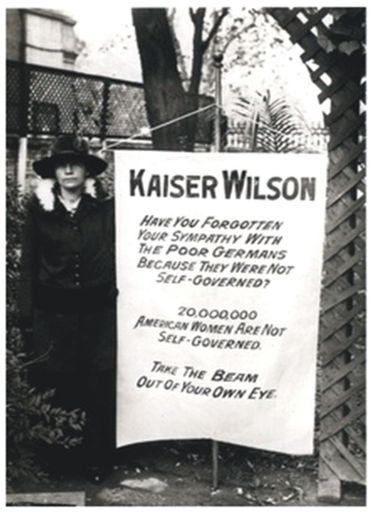
Figure 8.5
Kaiser Wilson
Have you forgotten Your Sympathy With The Poor Germans Because They Were Not Self-Governed?

American Woman Are Not Self-Governed.
Take the Beam
Out Of Your Own Eye.