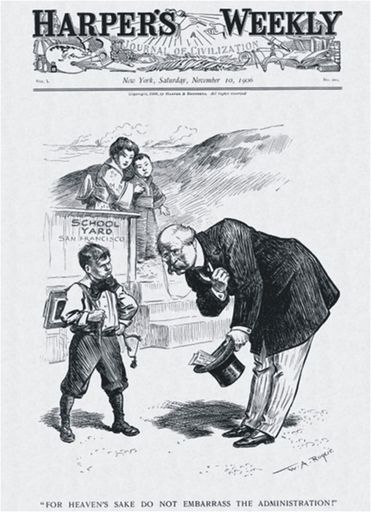
Figure 7.1
By 1906, Chinese people had been immigrating to San Francisco for decades, but Japanese immigrants were few and had arrived only recently. In 1906 the San Francisco Board of Education ordered Japanese students to attend Chinese schools. President Theodore Roosevelt opposed this decision and attempted to have the decision reversed. It was unusual for the president to intervene in such a local issue.
Source: Public speech by Roosevelt, December 1905.
It is unwise to depart from the old American tradition and to discriminate for or against any man who desired to come here as a citizen. We cannot afford to consider whether he is Catholic or Protestant, Jew or Gentile; whether he is Englishman or Irishman, Frenchman or German, Japanese, Italian, Scandinavian, Slav, or Magyar.
The class of Chinese laborers are undesirable immigrants to this country, because of their numbers, the low wages for which they work, and their low standard of living.
Source: Letter from Roosevelt to a friend on May 6, 1905, in which he criticizes the California Legislature’s recent move to restrict immigration from Japan.
The California Legislature has the right to protest against the immigration of Japanese laborers. Their cheapness and clannishness make them a challenge to our laboring class, and you may not know that they have begun to present a serious problem in Hawaii—all the more serious because they keep entirely to themselves. Furthermore, I understand that the Japanese themselves do not permit any foreigners to own land in Japan.
I would not have objected at all to the California Legislature passing a resolution, courteous and proper in its terms, which would really have achieved their goal. But I do object to, and feel humiliated by, the foolish offensiveness of the resolution they passed.
Source: Roosevelt’s annual message to Congress, December 4, 1906.
Here and there a most unworthy feeling has manifested itself toward the Japanese [such as] shutting them out of the common schools of San Francisco [and] mutterings against them in one or two other places, because of their efficiency as workers. To shut them out from the public schools is a wicked absurdity.
It’s absurd that the mob of a single city may at any time perform acts of lawless violence that would plunge us into war. A city should not be allowed to commit a crime against a friendly nation.
Source: Letter from Roosevelt to the Secretary of Commerce and Labor, Victor Metcalf, who went to San Francisco to investigate the Japanese segregation crisis, November 27, 1906.
The White House
Washington, Nov 27, 1906
My Dear Secretary Metcalf:
....I had a talk with the Japanese Ambassador and told him that in my judgment the only way to prevent constant friction between the United States and Japan was to keep the movement of the citizens of each country into the other as restricted as possible to students, travelers, business men and the like. It was necessary that no Japanese laboring men—that is, of the coolie class—come into the United States.... The Ambassador agreed with this view and said that he had always been against Japanese coolies going to America or Hawaii. Of course, San Francisco’s action will make it difficult for most Japanese to agree with this view. But I hope my message will smooth over their feelings....
Sincerely yours,
THEODORE ROOSEVELT
Source: This cartoon was published in Harper’s Weekly, a New York-based magazine, in November 1906. It shows Secretary of Commerce and Labor Metcalf speaking to a young schoolboy, who represents San Francisco. (Figure below ).
Figure 7.1
Beginning around 1870, a Christian movement called the Social Gospel sought to apply the teachings of Jesus in the urban condition, helping immigrants and the poor and fighting vices such as alcoholism. Organizations such as the Salvation Army and the YMCA were formed as a part of this movement. One offshoot of the Social Gospel was the settlement house movement, in which well-educated white Christian women established houses in poor urban areas, from which they worked to educate the poor and help them out of poverty. The most famous such effort, Hull House, was established on the south side of Chicago by Jane Addams. As you read the documents about Hull House below, think about the attitude that advocates of the Social Gospel held toward the people they tried to help.
Source: Excerpt from Jane Addams, The Spirit of Youth and the City Streets, 1909. As more and more young immigrants moved from farms in the country to urban areas, dance halls became a popular form of recreation. Many progressive reformers found these dance halls to be inappropriate and pushed to create alternative forms of entertainment for youth, like amusement parks.
One Sunday night at twelve o’clock I walked past a large public dance hall. As I was standing by the rail, a young man approached me and quite simply asked me to introduce him to some ‘nice girl,’ saying that he did not know anyone there. I replied that a public dance hall was not the best place in which to look for a nice girl, and he said: ‘But I’m awfully lonesome since I came to Chicago.’ And then he added rather defiantly: ‘Some nice girls do come here. It’s one of the best halls in town.’. . .
The public dance halls are filled with frivolous and irresponsible young people in a feverish search for pleasure. They are not a substitute for the old dances on the village green in which all of the older people in the village participated. Chaperonage then was not a social duty but natural and inevitable....
Let us fix modern city so that it shall be free from the wickedness and weakness which tempt the young people who are living in its tenement houses and working in its factories.
Source: Excerpts from an article by a Progressive social reformer, Louise de Koven Bowen, called “Dance Halls,” published in June 1911.
The dances are short—four to five minutes; the intermissions are long—fifteen to twenty minutes; thus ample opportunity is given for drinking.
In these same halls obscene language is permitted, and even the girls carry on indecent conversation, cursing a lot, while the less sophisticated girls stand around listening, scandalized but fascinated....
Many of the halls are poorly lighted. There is very little protection in case of fire...
A city law should be passed covering the following points:....
2. All dance halls should be made to comply with the regulations of the Building and Fire Departments so as to insure proper sanitation and adequate fire protection....
3. The sale of liquor in dance halls or in buildings connected with them should be prohibited....
7. No immoral dancing or familiarity should be tolerated.
8. People under the influence of liquor or known prostitutes should not be permitted in dance halls....
11. There should be an inspector of dance halls who should have in his department a corps of assistants who would regularly inspect the halls and make reports concerning them to him weekly.
Source: Excerpt from Jane Addams’ book, Twenty Years at Hull-House, (1910). This passage comes from a chapter called “Immigrants and Their Children.”
An Italian girl who has had lessons in cooking will help her mother to connect the entire family with American food and household habits. That the mother has never baked bread in Italy–only mixed it in her own house and then taken it out to the village oven–makes all the more valuable her daughter's understanding of the complicated cooking stove. The same thing is true of the girl who learns to sew, and more than anything else, perhaps, of the girl who receives the first simple instruction in the care of little children–that skillful care which every tenement-house baby requires if he is to live through his second summer.
Through civic instruction in the public schools, the Italian woman slowly becomes urbanized, and the habits of her entire family change. The public schools in the immigrant neighborhoods deserve all the praise as Americanizing forces.
Source: The document below was written by Hilda Satt Polacheck in the 1950s, in her book I Came a Stranger: The Story of a Hull-House Girl. She tells about her memories of Hull House from 1896.
Several days before Christmas 1896 one of my Irish playmates suggested that I go with her to a Christmas party at Hull-House....
I asked her if there would be any Jewish children at the party. She said that there were Jewish children at the parties every year....
I then began to understand that things might be different in America. In Poland it had not been safe for Jewish children to be on the streets on Christmas.
At the party, the children of the Hull-House Music School sang some songs, that I later found out were called “Christmas carols.” I shall never forget the sweetness of those voices. I could not connect this beautiful party with any hatred or superstition that existed among the people of Poland.
As I look back, I know that I became an American at this party. I was with children who had been brought here from all over the world, with their fathers and mothers, in search of a free and happy life. And we were all having a good time at a party, as the guests of an American, Jane Addams.
In addition to poverty and social vices, the progressives worked against corruption. In the late 19th century and beyond, many cities were run by political ‘machines,’ which traded political favors and government contracts for votes and money. The heads of these machines were called ‘bosses.’ The machine in New York City was called Tammany Hall, and the most famous boss was Boss Tweed.
Source: Excerpt from a book by muckraker Lincoln Steffens, The Shame of Cities, published in 1904.
New advances in printing technology during the 1890’s made magazines and other publications inexpensive to print. Magazines became available to a broader middle-class audience. Lincoln Steffens was well known for writing magazine articles about child labor, prisons, religion and political machines.
Lincoln Steffens, The Shame of the Cities (New York: McClure, Philips & Co., 1904), 1–18.
The typical American citizen is a business man…. The spirit of business is profit, not patriotism; individual gain, not national prosperity. “My business is sacred,” says the business man in his heart. “Whatever helps my business, is good; it must be. Whatever hurts it, is wrong; it must be. A bribe is bad, that is, it is a bad thing to take; but it is not so bad to give one, not if it is necessary to my business.”
And it’s all a moral weakness. Oh, we are good—on Sunday, and we are “fearfully patriotic” on the Fourth of July. But the bribe we pay to the janitor is the little brother of the bribe passed to the councilman to sell a city street, and the father of the deal made by the president of the railroad, who agrees to use air-brakes only if he is given stock in the air-brake company.
We are responsible, not our leaders, since we follow them. We let them divert our loyalty from the United States to some “party”; we let them boss the party and turn our democracies into autocracies . We cheat our government and we let our leaders loot it, and we let them bribe our sovereignty from us. We are content to let them pass bad laws, giving away public property in exchange for money.
independence
Source: Excerpt from a talk by George Plunkitt, a political boss in New York City. The talk was called “On the Shame of Cities,” recorded in 1905. ( Graft is another word for corruption and bribes). In this talk, Plunkitt responds to Lincoln Steffens’s book, The Shame of the Cities.
I’ve been readin’ a book by Lincoln Steffens on The Shame of the Cities . Steffens means well, but like all reformers, he don’t know how to make distinctions. He can’t see no difference between honest graft and dishonest graft and, consequently, he gets things all mixed up.... For instance, I ain’t no looter. The looter hogs it. I never hogged. I made my money in politics, but at the same time, I served the organization and got more big improvements for New York City than any other livin’ man.
Steffens made one good point in his book. He said he found that Philadelphia, ruled almost entirely by Americans, was more corrupt than New York, where the Irish do almost all the governin’. I could have told him that before he did any investigatin’ if he had come to me. The Irish was born to rule, and they’re the honestest people in the world. Show me the Irishman who would steal a roof off an orphanage! He don’t exist. Of course, if an Irishman had the political pull and the roof was in bad shape, he might get the city authorities to put on a new one and get the contract for himself, and buy the old roof at a bargain-but that’s honest graft…
One reason why the Irishman is more honest in politics than many Americans is that he is grateful to the country and the city that gave him protection and prosperity when he was driven by oppression from Ireland. His one thought is to serve the city which gave him a home. His friends here often have a good place in one of the city departments picked out for him while he is still in Ireland. Is it any wonder that he has a tender spot in his heart for old New York when he is on its salary list the mornin’ after he lands?
After Reconstruction and during the Jim Crow era, two African-American leaders emerged with very different ideas of how African-Americans could improve their place in society. Read the documents below and try to discern the differences. How would followers of each man live their lives?
Source: Excerpt from Booker T. Washington’s ‘Atlanta Compromise’ speech, 1895
Booker T. Washington was born a slave in 1856 and was nine years old when slavery ended. He became the principal of the Tuskegee Institute in Alabama, a school designed to teach blacks industrial skills. Washington was a skillful politician and speaker, and he won the support of whites in the North and South who donated money to the school. On September 18, 1895, Booker T. Washington spoke before a mostly white audience in Atlanta.
Ignorant and inexperienced, it is not strange that in the first years of our freedom we began at the top instead of at the bottom; that a seat in Congress or the state legislature was more attractive than starting a dairy farm or garden.
A ship lost at sea for many days passed a friendly ship and sent out a signal, “Water, water; we die of thirst!” The answer from the friendly ship at once came back, “Cast down your bucket where you are.” A second time the signal, “Water, water; send us water!” ran up from the distressed ship, and was answered, “Cast down your bucket where you are”.... The captain of the distressed vessel, at last heeding the injunction, cast down his bucket, and it came up full of fresh, sparkling water. To those of my race I would say: “Cast down your bucket where you are”—cast it down in making friends with the Southern white man, who is your next-door neighbor. Cast it down in agriculture, mechanics, in commerce, in domestic service.... No race can prosper till it learns that there is as much dignity in tilling a field as in writing a poem. It is at the bottom of life we must begin, and not at the top…. To those of the white race who look to foreign immigrants for the prosperity of the South, I would repeat what I say to my own race, “Cast down your bucket where you are.” Cast it down among the eight millions of Negroes, whose fidelity and love you have tested.... As we have proved our loyalty to you in the past... so in the future, in our humble way, we shall stand by you with a devotion that no foreigner can approach.... In all things that are purely social we can be as separate as the fingers, yet one as the hand in all things essential to mutual progress.
Source:A book by W.E.B. DuBois called The Souls of Black Folk.
The most influential public critique of Booker T. Washington came in 1903 when black leader and intellectual W.E.B. DuBois published an essay in his book, The Souls of Black Folk. DuBois rejected Washington’s message and instead called for political power, insistence on civil rights, and the higher education of Negro youth. DuBois was born and raised a free man in Massachusetts and was the first African American to earn a PhD from Harvard.
Easily the most striking thing in the history of the American Negro since 1876 is the rise of Mr. Booker T. Washington. His leadership began at the time when Civil War memories and ideals were rapidly passing; a day of astonishing commercial development was dawning; a sense of doubt and hesitation overtook the freedmen’s sons. Mr. Washington came at the psychological moment when whites were a little ashamed of having paid so much attention to Negroes [during Reconstruction], and were concentrating their energy on dollars.
Mr. Washington practically accepts the alleged inferiority of the Negro races. Mr. Washington withdraws many of the high demands of Negroes as men and American citizens. He asks that black people give up, at least for the present, three things—
First, political power;
Second, insistence on civil rights;
Third, higher education of Negro youth,
— and concentrate all their energies on industrial education, the accumulation of wealth, and the pacifying of the South. As a result of this tender of the palm-branch, what has been the return? In these years there have occurred:
1. The disfranchisement of the Negro; 2. The legal creation of a distinct status of civil inferiority for the Negro; 3. The steady withdrawal of aid from institutions for the higher training of the Negro.
Mr. Washington’s doctrine has tended to make the whites, North and South, shift the burden of the Negro problem to the Negro’s shoulders and stand aside as critical spectators; when in fact the burden belongs to the nation, and the hands of none of us are clean if we do not all work on righting these great wrongs.
 century?