 with each candidate speaking non-stop for at least an hour. Do you completely trust what either candidate will say in this setting? Why or why not?
Abraham Lincoln is remembered as the President who emancipated the slaves, but he also made statements about Blacks that are offensive to modern readers. Read the documents below and decide—was Lincoln racist? Consider the context in which each statement was made.
Source: An excerpt from Stephen A. Douglas’s argument in the first Lincoln-Douglas debate at Ottawa, Illinois, August 21, 1858.
In 1858, Abraham Lincoln ran against Stephen A. Douglas for a seat in the U.S. Senate. The two engaged in a series of seven public debates, which attracted national attention. Although Lincoln lost the election, he became widely known for his views on slavery.
If you desire Negro citizenship, if you desire to allow them to come into the State and settle with the White man, if you desire them to vote on an equality with yourselves, and to make them eligible to office, to serve on juries, and to judge your rights, then support Mr. Lincoln and the Black Republican party, who are in favor of the citizenship of the Negro. For one, I am opposed to Negro citizenship in any and every form. I believe this government was made... by White men, for the benefit of White men and their posterity forever...
Mr. Lincoln believes that the Negro was born his equal and yours, and that he was endowed with equality by the Almighty, and that no human law can deprive him of these rights.
Source: From Abraham Lincoln’s reply to Stephen A. Douglas at Ottawa, Illinois, August 21, 1858.
I have no purpose directly or indirectly to interfere with the institution of slavery in the States where it exists. I have no purpose to introduce political and social equality between the white and black races. There is a physical difference between the two, which in my judgment will probably forever forbid their living together in perfect equality, and... I, as well as Judge Douglas, am in favor of the race to which I belong, having the superior position. I have never said anything to the contrary, but there is no reason in the world why the Negro is not entitled to all the natural rights in the Declaration of Independence, the right to life, liberty and the pursuit of happiness. I hold that he is as much entitled to these as the White man. I agree that the Negro is not my equal in many respects--certainly not in color, perhaps not in moral or intellectual endowment . But in the right to eat the bread... which his own hand earns, he is my equal and the equal of every living man.
with each candidate speaking non-stop for at least an hour. Do you completely trust what either candidate will say in this setting? Why or why not?
Source: Abraham Lincoln, writing in a letter to Mary Speed, a personal friend, September 27, 1841.
BLOOMINGTON, ILL., September 27, 1841.
MISS MARY SPEED, Louisville, Ky.
….Today, on board a boat, I saw a gentleman who had purchased twelve Negroes in different parts of Kentucky and was taking them to a farm in the South. They were chained six and six together. A small iron chain was around the left wrist of each so that the Negroes were strung together precisely like so many fish upon a trot-line. In this condition they were being separated forever from the scenes of their childhood, their friends, their fathers and mothers, and brothers and sisters, and many of them, from their wives and children, and going into perpetual slavery... yet amid all these distressing circumstances ... they were the most cheerful and apparently happy creatures on board. One, whose offense for which he had been sold was over-fondness for his wife, played the fiddle almost continually; and the others danced, sung, cracked jokes, and played various games with cards from day to day. How true it is that “God renders the worst of human conditions tolerable...”
Your sincere friend,
A. LINCOLN.
Source: From Pictures of Slavery and Anti-Slavery: Advantages of Negro Slavery and the Benefits of Negro Freedom Morally, Socially, and Politically Considered by John Bell Robinson, a White pro-slavery spokesperson, Pennsylvania, 1863.
God himself has made them for usefulness as slaves, and requires us to employ them as such, and if we betray our trust, and throw them off on their own resources, we reconvert them into barbarians.
Our Heavenly Father has made us to rule , and the Negroes to serve, and if we... set aside his holy arrangements... and tamper with his laws, we shall be overthrown and eternally degraded , and perhaps made subjects of some other civilized nation.... Colonization in their native land of all the Negroes would be so nearly impracticable, that it will never be done... If they could all be colonized on the coast of Africa, they would fall back into heathenism and barbarism in less than fifty years.
The Union imposed a military draft, in which men between the ages of
 and
and
 were required to join the army. The penalty for disobeying the law was a
 fine. Many wealthy people were willing to pay that fine rather than risk their lives in the army, so they essentially bought their way out of the draft. Poorer people had no such option, and considered the policy unfair. In 1863, Irishmen in New York City rioted in protest. As you read the following documents, think about how each one portrays the protesters. What parties do they describe most sympathetically? What parties do
you
find most sympathetic?
fine. Many wealthy people were willing to pay that fine rather than risk their lives in the army, so they essentially bought their way out of the draft. Poorer people had no such option, and considered the policy unfair. In 1863, Irishmen in New York City rioted in protest. As you read the following documents, think about how each one portrays the protesters. What parties do they describe most sympathetically? What parties do
you
find most sympathetic?
Source: Excerpts from “The Reign of the Rabble ," New York Times, Wednesday, July 15, 1863.
The colored boarding house on Vandewater Street, was attacked by the rioters about 6 1/2 o'clock P.M., the doors broken open and the windows entirely demolished; nine of the inmates were injured.
About the same time THOMAS JOHNSON, a colored man, had one of his arms broken by jumping from the third story window of a house No. 62 Roosevelt-street, while the house was on fire. He was rescued from the rioters by the police and was taken to the station-house .
MARY WILLIAMS , a colored woman,
old, while being pursued by the infuriated mob, jumped from a window of No. 74 Roosevelt-street to the pavement, and was terribly injured -- the building was then on fire. She was taken to Bellevue Hospital.
Source: Excerpt from “Facts and Incidents of the Riot," New York Times, July 16, 1863.
At a late hour on Tuesday night the mob, number
or
, made an attack upon the clothing-store of BROOKS BROTHERS. Sergeant FINNEY was knocked down, beaten on the head and body with clubs, and afterward shot in the hand by a pistol by one of the rioters. He is very severely injured, and no hopes are entertained of his recovery….
Looting seems to have been the sole object with the rioters in their attack upon the store. The fine ready-made clothing was tempting. Fortunately, the Police and the employees of the establishment successfully stopped the invaders before much property had been stolen. Three or four persons, whose names could not be confirmed, lost their lives at this place, and many others were badly injured.
Source: Excerpt from “The Popular Tumult.” New York Herald, Wednesday, July 16, 1863.
THE POPULAR TUMULT
The crowd in one neighborhood turned their attention to the Chinese who live there. The Celestials [Chinese] had been found guilty of being united to white wives, and their headquarters were destroyed. The Chinamen escaped, but in some instances their wives have not followed them.
Source: “The Riots at New York," Harper's Weekly, Aug. 1, 1863
SACKING OF A DRUG-STORE
Sated with blood, the rioters now turned their attention to looting. A drug-store close by was destroyed, the doors and windows being smashed in with clubs and stones. One fellow rushed out with a closely-packed suitcase, which he opened in the street. The clothes and other things contained in it were eagerly seized and contended for by boys and women standing around. There were a number of letters in it, and some documents, which were probably of value to the owner; but these were savagely torn and trampled under foot by the disappointed plunderers. A woman sat upon the steps nearby, and read out parts of one of the letters to the cheers of her lowly companions.
Source: “The Riots at New York," Harper's Weekly, Aug. 1, 1863
[ BURNING OF THE COLORED ORPHAN ASYLUM ]
The Orphan Asylum for Colored Children was visited by the mob about four o'clock. Hundreds, and perhaps thousands of the rioters, the majority of whom were women and children, entered the premises, and in the most excited and violent manner they ransacked and plundered the building from cellar to attic. The building was located in the most pleasant and healthy portion of the city. It was purely a charitable institution. In it there are on an average
or
homeless colored orphans.
 quotes to support your claim that the newspaper were or were not sympathetic to the rioters.
quotes to support your claim that the newspaper were or were not sympathetic to the rioters.
quotes to support your claim that the newspaper were or were not sympathetic to the rioters.
From the beginning of the Civil War, Lincoln insisted that the goal was to preserve the union, not to free the slaves. In part, he took this position to retain the loyalty of the four Border States, Delaware, Maryland, Kentucky, and Missouri. As the war progressed, the Confederacy used slave labor to supply their cause—for example, to build fortifications or work in factories—and Lincoln changed his policy. On September 22, 1862, Lincoln issued the first part of the Emancipation Proclamation, which stated that in any state that had not returned to the union by the following January
 , the slaves would be declared free. Then, on January 1, 1963, he issued the document below, following through on his promise. As you read, try to determine why Lincoln freed the slaves. Out of a sincere opposition to slavery? As a strategic move to help win the war and preserve the Union?
Source: The Emancipation Proclamation, January 1, 1863 (Figure below ).
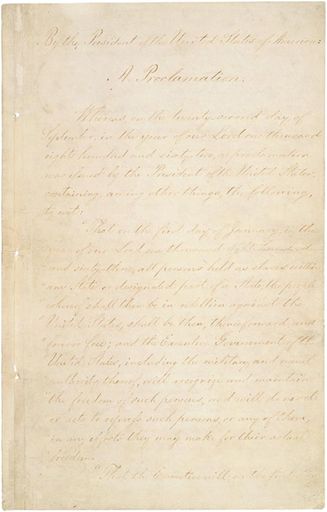
Figure 5.1
On the first day of January, in the year of our Lord one thousand eight hundred and sixty-three, all persons held as slaves within any State in rebellion against the United States, shall be forever free...
Now, therefore I, Abraham Lincoln, President of the United States, by virtue of the power in me vested as Commander-in-Chief, of the Army and Navy of the United States... do order and designate [appoint] the following States as being in rebellion:
Arkansas, Texas, Louisiana, Mississippi, Alabama, Florida, Georgia, South Carolina, North Carolina, and Virginia.
And I hereby call upon the people so declared to be free to abstain from all violence, unless in necessary self-defense; and I recommend to them that, in all cases when allowed, they labor faithfully for reasonable wages.
And I further declare and make known, that such persons will be received into the armed service of the United States.
And upon this act, sincerely believed to be an act of justice, warranted by the Constitution, upon military necessity, I invoke the considerate judgment of mankind, and the gracious favor of Almighty God.
By the President: ABRAHAM LINCOLN
Source: Excerpt from The Life and Times of Frederick Douglass , 1881.
In mid-1863, after the Emancipation Proclamation had been announced, President Lincoln called Frederick Douglass to the White House to speak with him. Douglass recounts the event here in his autobiography.
President Lincoln did me the honor to invite me to discuss the best way to induce (persuade) the slaves in the rebel states to escape. Lincoln was alarmed about the increasing opposition to the war in the North, and the mad cry against it being an abolition war. Lincoln worried that an early peace might be forced upon him which would leave all those who had not escaped in slavery.
I was impressed by this kind consideration because before he had said that his goal was to save the Union, with or without slavery. What he said on this day showed a deeper moral conviction against slavery than I had ever seen before in anything spoken or written by him. I listened with the deepest interest and profoundest satisfaction, and, at his suggestion, agreed to organize men who would go into the rebel states, and carry the news of emancipation, and urge the slaves to come within our boundaries....
I refer to this conversation because I think that, on Mr. Lincoln's part, it is evidence that the proclamation, so far at least as he was concerned, was not passed merely as a `necessity.'
Thomas Nast is perhaps the most famous political cartoonist in American history. He worked for the New York-based weekly magazine Harper’s Weekly . Nast and Harper’s supported the North in the Civil War, taking a liberal and somewhat elitist Republican position. Both of the cartoons below feature a white female character called ‘Liberty’—a common symbol of the period. What does the symbol remind you of? Note the dates of the cartoons and the similarities and differences between them.
Source: A political cartoon drawn by Nast in 1865. (Figure below ).
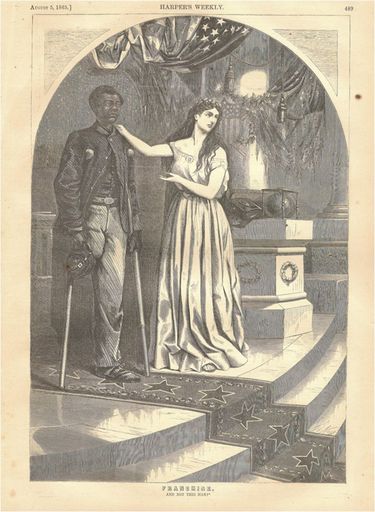
Figure 5.2
FRANCHISE. AND NOT THIS MAN?
Source: A political cartoon drawn by Nast in 1874. (Figure below ).
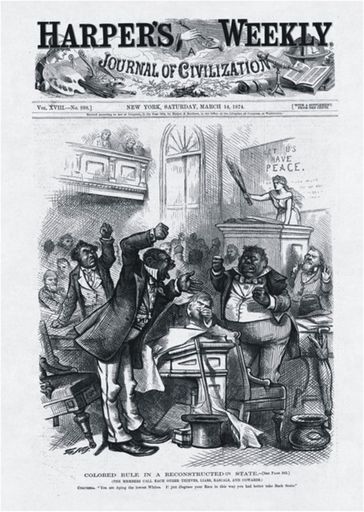
Figure 5.3
Columbia. (The members call each other thieves, liars, rascals, and cowards.) “You are Aping the lowest Whites. If you disgrace your Race in this way you had better take Back Seats.”
After Abraham Lincoln was assassinated, he was succeeded as president by Andrew Johnson, a Tennesseean who sympathized with the South. During debates over Reconstruction—how to treat the freed slaves and rebuild the South—a group of Radical Republicans in Congress thought Johnson was too kind to the South. Read the following speeches from Andrew Johnson and Senator Thaddeus Stevens and consider which plan was more likely to be successful.
Source: This campaign speech was delivered on September 3, 1866 in Cleveland, Ohio. Johnson was trying to get people to support his ideas, but he was booed by the crowd of Radical Republicans.
Before the Civil War there were
black people held as slaves by about
people living in the South. That is,
Now we come to the [Radical Republicans]. And what do they want? To spend
a year to build schools and find jobs for these freed slaves. We have already spent
to set them free and give them a fair chance to take care of themselves -then these [Radical Republicans] ask for
Source: This speech was delivered to the United States Congress on March 2, 1867 by Andrew Johnson after he vetoed the First Reconstruction Act, a plan by the Radical Republicans that would have given freedmen the right to vote.
The Radical Republicans also want to force the South to give blacks the right to vote. The blacks have not asked for the right to vote; most of them have no idea what it means. The Southern states should not be forced to do anything they don’t want to do. To force the right to vote out of the hands of the white people and into the hands of the blacks is against the law.
Source: This speech was delivered to the United States Congress on March 19, 1867.
Freed slaves should have the right to vote. The Southern states should be ruled by the Army until they learn how to accept blacks as their equals.
The cause of the war was slavery. We have freed the slaves. It is our responsibility to protect them, and help them until they are able to provide for themselves.
I propose that each freed slave who is a male adult, or the head of a family, will receive forty acres of land, (with
to build a house).
Four million people have just been freed from slavery. They have no education, have never worked for money, and don’t know about their rights. Unless they become independent, they will have to once again become the servants of their old masters.
We must make the freed slaves independent so that their old masters can’t force them to work unfairly. This can only be done by giving them a small plot of land to farm.
After the Civil War, America debated how to handle the millions of freed slaves. The eventual outcome was a system of sharecropping, in which plantation owners retained possession of their land and allowed freedmen to farm small parts of it. In return, the landowner received a percentage of the crop. The documents below include a photograph of sharecroppers and a sharecropping contract. As you examine them, compare the sharecropping system to the Radical Republican’s plan to give each freedman “
 and a mule.” Which would be better for the freed slaves? Which would be better for the landowners? Which would be fairer?
Source: Black sharecroppers picking cotton in Georgia, photograph by T.W. Ingersoll, 1898. Library of Congress, Washington, D.C. (Figure below ).
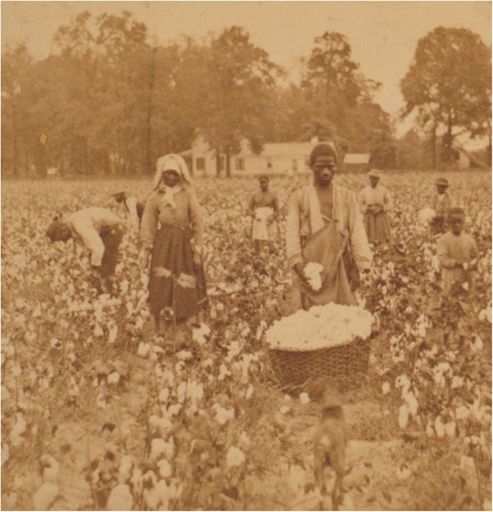
Figure 5.4
Source: A sharecropping contract from 1882, from the collection of Grimes Family Papers held in the Southern Historical Collection, University of North Carolina, Chapel Hill.
To everyone renting land, the following conditions must be agreed to:
For every
of land (rented by sharecroppers), I will provide a mule team, plow, and farming tools. The sharecroppers can have half of the cotton, corn, peas, pumpkins, and potatoes they grow if the following conditions are followed, but--if not--they are to have only two-fifths.
For every mule or horse furnished by me there must be
good sized rails (logs) hauled, and the fence repaired if I so direct. All sharecroppers must haul rails (logs) and work on the fence whenever I may order. The wood must be split and the fence repaired before corn is planted. No cotton must be planted by sharecroppers on their home patches of land. No sharecropper is to work off the plantation when there is any work for them to do for me.
Every sharecropper must be responsible for all farming gear placed in his hands, and if not returned must be paid for unless it is worn out by use.
Nothing can be sold from their (sharecroppers’) crops until my rent is all paid, and all amounts they owe me are paid in full.
I am to gin & pack all of the cotton and charge every sharecropper an eighteenth of his part, the cropper to furnish his part of the bagging, ties, & twine.
The sale of every sharecropper's part of the cotton to be made by me when and where I choose to sell, and after taking all they owe me.
You have examined cartoons by Thomas Nast about Reconstruction, and you have read about both the post-war debate about the freedmen and the sharecropping system that replaced slavery. This section adds the text of the three Constitutional amendments passed after the war, an example of a discriminatory local ‘Black Code’ from Louisiana, and two more eyewitness accounts about the condition of Reconstruction-era African Americans. Use these documents and others you have read to decide whether Blacks were really free during this period in American history.
Source: The
 and
and
 amendments to the United States Constitution are sometimes called the “Reconstruction Amendments.” They were passed in order to abolish slavery and to establish the rights of former slaves.
(Figure
below
).
amendments to the United States Constitution are sometimes called the “Reconstruction Amendments.” They were passed in order to abolish slavery and to establish the rights of former slaves.
(Figure
below
).
Image:
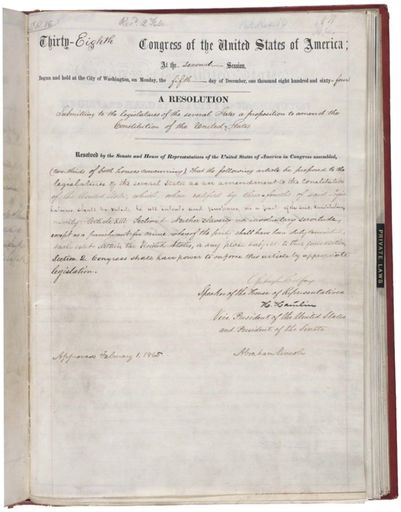
Figure 5.5
The
Amendment
Section 1. Neither slavery nor involuntary servitude , except as a punishment for crime where of the party shall have been duly convicted, shall exist within the United States , or any place subject to their jurisdiction.
____________________________________________________________________________________
Amendment: 1868
Section 1. All persons born or naturalized in the United States , and subject to the jurisdiction (laws) thereof, are citizens of the United States and of the State wherein they reside. No State shall make or enforce any law which shall abridge (limit) the privileges or immunities (rights) of citizens of the United States; nor shall any State deprive any person of life, liberty, or property , without due process of law; nor deny to any person within its jurisdiction the equal protection of the laws .
____________________________________________________________________________________
Section 1. The right of citizens of the United States to vote shall not be denied or abridged by the United States or by any State on account of race, color, or previous condition of servitude.
and
amendments passed?
Source: An example of “Black Codes,” from laws passed in Opelousas, Louisiana immediately after the Civil War.
In the years following the Civil War--throughout the South--state, city, and town governments passed laws to restrict the rights of free African-American men and women. These laws were often called “Black Codes.”
No negro or freedmen shall be allowed to come within the limits of the town of Opelousas without special permission from his employers…. Whoever breaks this law will go to jail and work for two days on the public streets, or pay a fine of five dollars. No negro or freedman shall be permitted to rent or keep a house in town under any circumstances. No negro or freedman shall live within the town who does not work for some white person or former owner. No public meetings of negroes or freedmen shall be allowed within the town. No freedman shall be allowed to carry firearms, or any kind of weapons. No freedman shall sell or exchange any article of merchandise within the limits of Opelousas without permission in writing from his employer.
Source: Excerpt from Senate Report
 ,
,
 Congress,
 Session (1880). Former slave Henry Adams made this statement before the U.S. government in 1880 about the early days of his freedom after the Civil War.
In September I asked the boss to let me go to the city of Shreveport. He said, “All right, when will you come back?" I told him “next week.” He said, "You had better carry a pass." I said, "I will see whether I am free by going without a pass."
I met four white men about six miles south of town. One of them asked me who I belonged to. I told him no one. So him and two others struck me with a stick and told me they were going to kill me and every other Negro who told them that they did not belong to anyone. They left me and I then went on to Shreveport. I saw over twelve colored men and women, beat, shot and hung between there and Shreveport.
Sunday I went back home. The boss was not at home. I asked the madame (the boss’s wife), “where was the boss?” She said, “You should say 'master'. You all are not free… and you shall call every white lady 'missus' and every white man 'master.'”
During the same week the madame took a stick and beat one of the young colored girls, who was about fifteen years of age. The boss came the next day and whipped the same girl nearly to death…After the whipping a large number of young colored people decided to leave that place for Shreveport. (On our way), out came about forty armed white men and shot at us and took my horse. They said they were going to kill everyone they found leaving their masters.
Source: Sydney Andrews, a Northern white man, quoted in the Joint Report on Reconstruction, 1866
In 1865 the United States government created the Freedmen’s Bureau to help former slaves in Southern states. The Freedmen’s Bureau helped people by providing medical supplies, health care and establishing schools. The creation of schools for former slaves was an important part of Reconstruction. Before the Civil War, Southern states outlawed the teaching of reading and writing to slaves.
Many of the negroes…common plantation negroes, and workers in the towns and villages, were supporting little schools themselves. Everywhere I found them hoping to get their children into schools. I often noticed that workers in stores and men working in warehouses, and cart drivers on the streets, had spelling books with them, and were studying them during the time they were not working. Go outside any large town in the south, and you will see children and in many cases grown negroes, sitting in the sun alongside their cabins studying.
