Manifest Destiny and the Slavery Question
Trail of Tears
As Americans settled new land in the southeast, politicians discussed what to do with the Indian tribes they encountered. Some advocated
civilizing
them—converting them to Christianity and a European-American way of life. Others, including President Andrew Jackson, favored forcible
removal
of the Indians to lands in the west. Removal won out.
Some tribes signed treaties to leave, others fought and were defeated. The Cherokee tribe, however, was removed by an illegitimate treaty. In 1833 several Cherokee, who did not represent the tribe as a whole, signed the Treaty of New Echota, agreeing to vacate the land. Other members of the tribe signed a petition protesting that that they had not authorized the men to negotiate—but Congress ignored their requests. By 1838 only
 Cherokee had left and
 remained. The U.S. government sent in
 troops to force the Cherokee to walk to their new territory in Oklahoma. During this march, which became known as the Trail of Tears,
 Cherokee died of cold, starvation, and disease.
Letter - Elias Boudinot
Source: The following letter was written in 1837 by Elias Boudinot, a Cherokee who supported the Treaty of New Echota. The letter is to John Ross, the leader of the opposition. For many years, Boudinot opposed Georgia’s attempt to take Cherokee land. But by 1833, he decided that it would be best to sign a treaty supporting removal.
Look at our people! They are wretched! Look, my dear sir, around you, and see the progress that vice and immorality have already made! See the misery!
If the darker picture which I have described here is a true one, can we see a brighter possibility ahead? In another country, and under other circumstances, there is a
better
prospect. Removal, then, is the only remedy, the only
practical
remedy. Our people may finally rise from their very ashes, to become prosperous and happy, and a credit to our race. I would say to my countrymen, fly from your life here that is destroying our nation.
What is
your
(John Ross) plan of relief? It is dark and gloomy beyond description. You want the Cherokee to live according the laws of Georgia, no matter how unfair they are? Instead of fix the evil, you would tie our people down in the chains of slavery. The final destiny of our race, under such circumstances is too revolting to think of. Take my word, it is the sure end of our race if you succeed in preventing the removal of your people. There will come a time when there will be few of us left as reminders of this brave and noble race. May God protect us from such a destiny.
Questions:
-
Close Reading:
What was life like for the Cherokee in Georgia, according to Boudinot?
-
Close Reading:
What does Boudinot hope will happen if the Cherokees move west?
-
Close Reading:
Why does Boudinot think John Ross is wrong about opposing the Treaty of New Echota?
State of the Union speech – Andrew Jackson
Source: Andrew Jackson, State of the Union speech. December 6, 1830.
It gives me great pleasure to announce to Congress that the Government’s benevolent policy of Indian removal has almost been achieved.
We have wept over the fate of the natives of this country, as one by one many tribes have disappeared from the earth. However, we must accept this the way we accept when an older generation dies and makes room for the younger.... We would not want to see this continent restored to the condition in which our forefathers found it. What good man would prefer a country covered with forests and occupied by a few thousand savages to our great Republic, studded with cities, towns, and prosperous farms, decorated with art and industry, occupied by more than
 happy people, and filled with all the blessings of liberty, civilization, and religion?
The United States will pay to send the natives to a land where they may live longer and possibly survive as a people. No doubt it will be painful to leave the graves of their fathers; but how is this different from what our ancestors did and what our children are doing now?
Can it be cruel when this Government offers to purchase the Indian’s land, give him new and extensive territory, pay the expense of his removal, and support him for the first year in his new home? How many thousands of our own people would gladly embrace the opportunity of moving West under such conditions!
The policy of the Government towards the red man is not only liberal, but generous. The Indian is unwilling to follow the laws of the States and mingle with the population. To save him from utter annihilation, the Government kindly offers him a new home, and proposes to pay the whole expense of his removal and settlement.
Questions:
-
Close Reading:
Why would he say, “We have wept over the fate of the natives of this country,” if he supports Indian Removal?
-
Close Reading:
Why does Jackson think the United States was better in 1830 than in 1609?
-
Close Reading:
Why does Jackson think his policy is kind and generous? Do you agree?
Nat Turner’s Rebellion
In 1831, a Virginia slave named Nat Turner assembled an “army” of slaves and led a rebellion that killed
 white men, women, and children. Turner was tried, convicted, and hanged. Read the documents below and try to determine what kind of person Nat Turner was—a hero or a lunatic?
Confessions of Nat Turner – Thomas R. Gray
Source: These confessions were narrated to lawyer Thomas R. Gray in prison where Nat Turner was held after his capture on October 30, 1831. His confessions were published on November 5, 1831 for his trial.
(Figure
below
).
The Confessions of Nat Turner: The Leader of the Late Insurrections in Southampton, Va. As Fully and Voluntarily Made to Thomas R. Gray, in the Prison Where He Was Confined, Nov. 5, 1831, For His Trial.
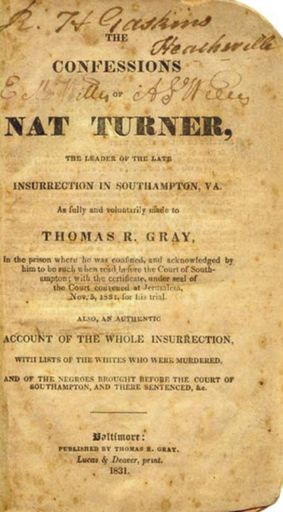
Figure 4.1
Cover Page of the Confessions of Nat Turner
[To the Public]
Thomas R. Gray:
Public curiosity has tried to understand Nat Turner’s motives behind his
diabolical
actions.... Everything connected with the rebellion was wrapped in mystery, until Nat Turner the leader of the violent and savage band, was captured.... I was determined to end public curiosity and write down Nat Turner’s statements, and publish them, with little or no change, from his own words.
Nathaniel Turner:
As I child, I knew I surely would be a
prophet
, as the Lord had showed me visions of things that had happened before my birth. My father and mother said I was intended for some great purpose. I was a child of uncommon intelligence and I knew I was never meant to be a slave. To a mind like mine, restless, curious and observant of every thing that was happening, religion became the subject that occupied all of my thoughts.
Thomas R. Gray:
Nat Turner is a complete
fanatic
. The calm way he spoke of his late actions, the expression of his
fiend
-like face when excited by enthusiasm, still bearing the stains of the blood of helpless innocence about him. I looked on him and my blood curdled in my veins.
Vocabulary
-
diabolical
-
evil, like the devil
-
prophet
-
a person God chose to protect and lead people
-
fanatic
-
intense dedication to an idea
-
fiend
-
monster, demon, devil
Questions:
-
Sourcing:
Who wrote this document? When and where was it published? What kind of publication is it?
-
Close Reading:
Describe Nat Turner according to himself.
-
Close Reading:
Describe Nat Turner according to Gray’s introduction and conclusion notes.
-
Corroboration:
Is there a contradiction between Turner and Gray’s description? How and why?
-
Sourcing:
Is this a trustworthy source? Does this account of Turner’s character seem believable? Explain.
“The Southampton Tragedy” – The Richmond Enquirer
Source: Editor. “The Southampton Tragedy.” The Richmond Enquirer. Virginia, 27 September 1831.
I am led to believe, from all that I can learn, that Nat Turner has been planning his mischief and disruption for quite some time. After pretending to be inspired to rebel by God, he made his announcement of rebellion to the Blacks. He has used every means in his power, to gain control over the minds of the slaves. A dreamer of dreams and a would-be Prophet, he used all the arts familiar to such pretenders, to trick, confuse and overwhelm the slave’s minds.
Questions:
-
Sourcing:
Who wrote this document? When and where was it published? What kind of publication is it?
-
Sourcing:
Who is the author of his article speaking to? How do you know this? How does his audience affect what he says and how he says it?
-
Contextualization/Close Reading:
According to the author of this article, what kind of person is Nat Turner? Think about when this article was written: How might its publication date affect how the author represents Turner? Refer to your timeline if necessary.
-
Sourcing:
Is this a trustworthy source? Explain.
An Address to the Slaves of the United States – Garnet
Source: Speech delivered by Henry Highland Garnet at the National Negro Convention of 1843 held in Buffalo, New York. The convention drew
 delegates including leaders like Frederick Douglass.
You had far better all die—
die immediately
, than live slaves, and throw your misery upon your children. However much you and all of us may desire it, there is not much hope of freedom without the shedding of blood. If you must bleed, let it all come at once--rather
die freemen, than live to be slaves
.
The patriotic Nathaniel Turner was driven to desperation by the wrong and injustice of slavery. By force, his name has been recorded on the list of dishonor, but future generations will remember him among the noble and brave.
Questions:
-
Sourcing:
Who wrote this document? When? How long after the Turner rebellion was this document written?
-
Sourcing:
Who is the author of this document speaking to? How does his audience affect what he says and how he says it?
-
Close Reading:
According to the author of this speech, what kind of person is Nat Turner? What proof does he provide to illustrate that Turner is this type of person?
-
Contextualization:
Why does this author think of Nat Turner in this way? Think about when this article was written: How does the author’s historical context shape how he thinks of and represents Turner?
-
Sourcing:
Is this interpretation of Turner trustworthy? Why or why not?
Texas Independence
Mexico declared its independence from Spain in 1821 and adopted a Constitution in 1824. Through the 1820s and 1830s, Americans moved into the Mexican territory promising to uphold the Mexican Constitution. In 1833 General Santa Anna took control of the Mexican government and imposed a new constitution. A war followed, with General Santa Anna’s supporters fighting against the supporters of the old constitution and the Texan immigrants from the United States. In 1836, the American Texans went a step farther and declared independence from Mexico. The Texans won the war and became an independent nation, which was soon admitted into the U.S.A. as the
 state. Read the documents below and try to determine why Texans declared their independence from Mexico.
Letter – E.W. Ripley
Source: The letter below is written by an American to the Mexican government in 1823, asking for permission to settle in Mexico.
Dear Sir,
A number of men of good character wish to move onto Mexican territory, south of the Colorado. Their object is to form a farming colony. This piece of land is now inhabited by Indians and such a colony would check their attacks. These men promise to learn your language and follow your laws. They will defend your territory. These Americans would move immediately with their families if they can obtain a grant to settle the land. I think they would be of great service to yourself individually and to the nation of Mexico. I have the honor to be
Your most obedient servant,
E.W.Ripley
New Orleans, August 1823
Questions:
-
Sourcing:
Who wrote this document? Were they Mexican or American? When did they write it?
-
Close Reading:
Does this document present a positive or negative view of the American settlers in Texas? Provide a quote to support your claim.
-
Sourcing:
Do you trust the perspective of this document? Why or not?
Letter – Rafael Manchola
Source: The letter below was written by Rafael Antonio Manchola, a Tejano (Mexican living in Texas). He wrote this letter about the Anglo-Americans in 1826 to a military commander.
We cannot trust the Anglo-American colonists because they are continually demonstrating that they refuse to follow our laws, unless it is convenient for them. We will have many problems if we do not stop their disrespectful behavior by stationing soldiers and a Mexican judge in each settlement. They have been using their own colonists as judges and practicing their own laws, forgetting that they swore to obey the laws of Mexico.
Questions:
-
Sourcing:
Who wrote this document? Were they Mexican or American? When did they write it?
-
Close Reading:
Does this document present a positive or negative view of the American settlers in Texas? Provide a quote to support your claim.
-
Sourcing:
Do you trust the perspective of this document? Why or not?
Texas Declaration of Independence
Source: The Texas Declaration of Independence, issued March 2,1836. The image shown below is a printed version published shortly after the handwritten version was signed.
(Figure
below
).
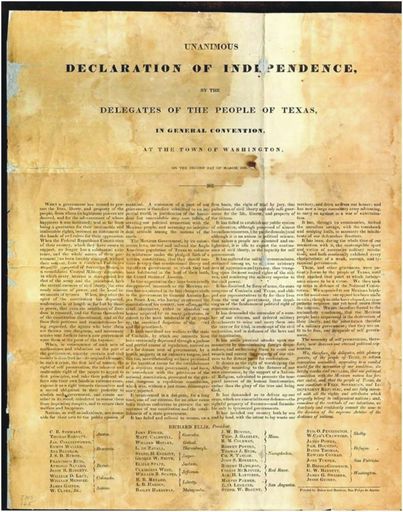
Figure 4.2
Printed broadside version of the Texas Declaration of Independence
When a government has ceased to protect the lives, liberty and property of the people... it is the right of the people to abolish such government, and create another one that will secure their future welfare and happiness.
General Santa Anna, has overturned the constitution of his country, and now offers us the cruel option either to abandon our homes, or submit to the most intolerable of all tyranny.
The Mexican government has failed to establish any public system of education…
It denies us the right of worshipping the Almighty as we want to…
It has demanded that we give up our arms, which are essential to our defense…
It has invaded our country both by sea and by land, with intent to lay waste our territory, and drive us from our homes…
It has encouraged the merciless Indians to massacre the inhabitants of our defenseless frontiers….
We, therefore, do hereby resolve and declare, that our political connection with the Mexican nation has forever ended, and that the people of Texas do now constitute a free, Sovereign, and independent republic…
Questions:
-
Sourcing:
Who wrote this document? Were they Mexican or American? When did they write it?
-
Close Reading:
Does this document present a positive or negative view of the American settlers in Texas? Provide a quote to support your claim.
-
Sourcing:
Do you trust the perspective of this document? Why or not?
Alamo Defenders' Burial Speech - Juan Seguin
Source: Colonel Juan Seguin's Alamo Defenders' Burial Speech, April 4, 1837. Seguin was a Mexican who supported the Texas Revolution and fought with the American settlers against General Santa Anna. The speech below was given at the burial of the men who died at the Alamo.
Original Spanish:
Compañeros de armas: Estos restos que hemos tenido el honor de conducir en nuestros hombros son los de los valientes héroes que murieron en el Alamo. Sí mis amigos, ellos prefirieron morir mil veces a servir el yugo del tirano. Que ejemplo tan briIlante, digno de anotarse en las páginas de la historia. El genio de la libertad parece estar viendo en su elevado trono de donde con semblante halagueño nos señala diciendo: “Ahí tenéis a vuestros hermanos, Travis, Bowie, Crockett y otros varios a quienes su valor coloca en el número de mis héroes.---Yo os pido a que poniendo por testigo a los venerables restos de nuestros dignos compañeros digamos al mundo entero. Texas será libre, independiente o pereceremos con gloria en los combates.
English Translation:
“Companions in Arms!! These remains which we have the honor of carrying on our shoulders are those of the brave heroes who died in the Alamo. Yes, my friends, they preferred to die a thousand times rather than submit themselves to the tyrant's yoke. Yes, soldiers and fellow citizens, these are the worthy beings who, by the twists of fate, delivered their bodies to the ferocity of their enemies. I invite you to declare to the entire world, “Texas shall be free and independent or we shall perish in glorious combat.”
Questions:
-
Sourcing:
Who wrote this document? Were they Mexican or American? When did they write it?
-
Close Reading:
Does this document present a positive or negative view of the American settlers in Texas? Provide a quote to support your claim.
-
Sourcing:
Do you trust the perspective of this document? Why or not?
The War In Texas - Benjamin Lundy
Source: Benjamin Lundy became active in the antislavery movement in the 1820s. He organized abolitionist societies, lectured extensively, and contributed to many abolitionist publications. He wrote this pamphlet called
The War in Texas
in 1836. Lundy argued that the Texas revolution was a slaveholders' plot to take Texas from Mexico and to add slave territory to the United States.
(Figure
below
).
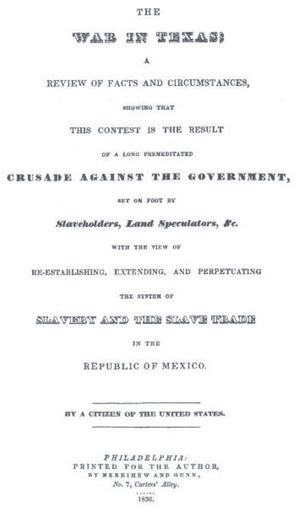
Figure 4.3
We have been asked to believe that the inhabitants of Texas have been fighting to maintain the sacred principles of Liberty, and the natural, inalienable Rights of Man:---whereas, their motives have been exactly the opposite. The immediate cause and main goal of this war—led by the slaveholders of this country, (with land speculators and slave traders)---has been to grab the large and valuable territory of Texas from the Mexican Republic, in order to re-establish the SYSTEM OF SLAVERY; to open a vast and profitable SLAVEMARKET; and, ultimately, to annex it to the United States.
Questions:
-
Sourcing:
Who wrote this document? Were they Mexican or American? When did they write it?
-
Close Reading:
Does this document present a positive or negative view of the American settlers in Texas? Provide a quote to support your claim.
-
Sourcing:
Do you trust the perspective of this document? Why or not?
Section Question:
-
Corroboration:
Based on all five documents, do you think that the Texans were justified in declaring independence?
Manifest Destiny
Even while the United States were crowded along the Atlantic coast, Americans developed the idea that the nation was destined to stretch across the continent. This idea was called ‘Manifest Destiny.’ Examine the images below, read the two texts by Joseph O’Sullivan, and try to determine why many Americans supported Westward expansion.
Map of the United States with the contiguous British & Spanish Possessions by John Melish (1816)
Source: A map of the United States made by John Melish in 1816. According to the David Rumsey Collection, this is “the first large scale detailed map made in the U.S. that showed the entire country from the Atlantic to the Pacific.”
(Figure
below
).
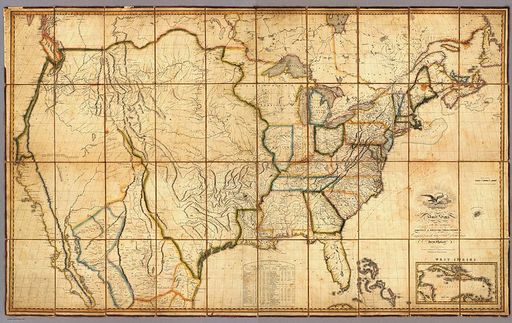
Figure 4.4
A map of the United States made by John Melish in 1816
Map of the United States – Ormando Gray (1872)
Source: Map of the United States made by Ormando Willis Gray, published in Philadelphia in 1872.
(Figure
below
).
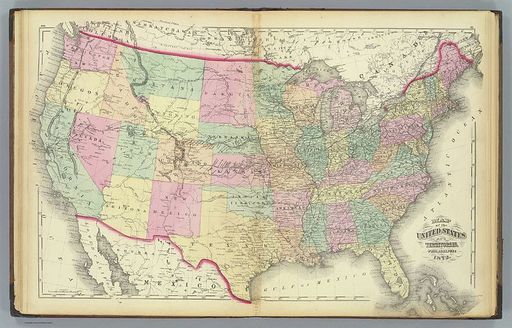
Figure 4.5
Map of the United States made by Ormando Willis Gray
Section Questions:
-
Sourcing:
When was Melish’s map made?
-
Contextualization:
What territory was part of the United States at that point?
-
Close Reading:
Compare Melish’s map to Gray’s 1872 map. What land did Melish include, even though it was not part of the United States?
-
Why would Melish draw a map that included land that was not yet a part of the United States in 1816?
American Progress – John Gast
Source: John Gast painted American Progress 1872 to represent the spirit of Manifest Destiny. This image is of a chromolithograph made around 1873 by George A. Croffut, based on Gast’s painting.
(Figure
below
).
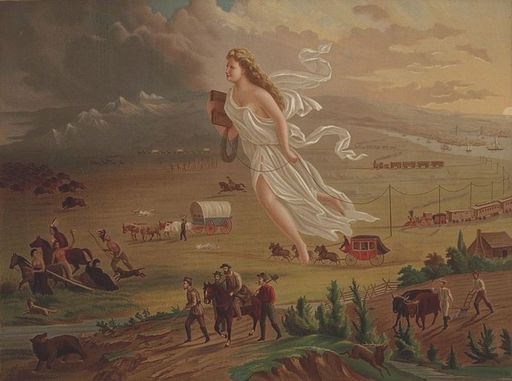
Figure 4.6
This image is of a chromolithograph made around 1873 by George A. Croffut
Questions:
-
What do you think the woman in this painting represents? How is this symbolized in the painting?
The Great Nation of Futurity – John O’Sullivan
Source: An article by John O’Sullivan called “The Great Nation of Futurity,” from
The United States Democratic Review
in 1839. John O’Sullivan was a writer and editor of a well-known newspaper around the time of the Mexican-American war. Most people give him the credit for coining the term “Manifest Destiny.” As you read the quotes below, try to figure out what he thinks of America.
Our national birth (and the Declaration of Independence) was the beginning of a new history, which separates us from the past and connects us only with the future….
We are the nation of progress, of individual freedom, of universal
enfranchisement
. Our future history will be to establish on earth the moral dignity and salvation of man -- the undeniable truth and goodness of God. America has been chosen for this mission among all the nations of the world, which are shut out from the life-giving light of truth. Her high example shall put an end to the
tyranny
of kings, and carry the happy news of peace and good will to millions who now
endure
an existence hardly better than that of beasts of the field. Who, then, can doubt that our country is destined to be the great nation of the future?
Vocabulary
-
Enfranchisement
-
the right to vote
-
Tyranny
-
cruel and oppressive government
-
Endure
-
suffer through
Questions:
-
What does John O’Sullivan think America stands for?
-
What, according to John O’Sullivan, is America’s mission?
Annexation – John O’Sullivan
Source: An article by John O’Sullivan, “Annexation,” from the
United States Magazine and Democratic Review
, 1845.
It is time now for all opposition to annexation of Texas to stop...
Texas is now ours. She is no longer to us a mere geographical space. She is no longer to us a mere country on the map....
The time has come for everyone to stop treating Texas as an alien, and to stop
thwarting
our policy and
hampering
our power, limiting our greatness and checking the fulfillment of our manifest destiny to overspread the continent
allotted
by
Providence
for the free development of our yearly multiplying millions.
Vocabulary
-
Thwarting
-
opposing
-
Hampering
-
slowing down
-
Allotted
-
given
-
Providence
-
God
Questions:
-
Close Reading:
What do you think John O’Sullivan means by the following phrase:
“our manifest destiny to overspread the continent allotted by Providence for the free development of our yearly multiplying millions”?
Section Question:
-
Based on all of these documents, how did Americans feel about expanding westward?
Irish Immigration
In the
 , a disease killed most of the potato plants in Ireland, leaving the Irish without enough food to eat. To escape the so-called Irish Potato Famine, many Irish immigrated to the United States. Once there, however, they faced strong anti-Irish discrimination. The Irish had long been oppressed and looked down on by neighboring Britain, and many Americans were of British ancestry. Most Irish were Catholic, and most Americans were Protestants with a strong anti-Catholic prejudice. Most Irish were poor and entered American life at the bottom of the social ladder. Today, it seems obvious that people of Irish descent are racially ‘white,’ but this was not so clear to the people of the 1840s. Examine the following documents and try to determine whether the Irish were considered ‘white’ in the
 century.
Black vs. Irish - Thomas Nast
Source: A cartoon drawn by Thomas Nast for the cover of Harper’s Weekly, December 7, 1876.
(Figure
below
).
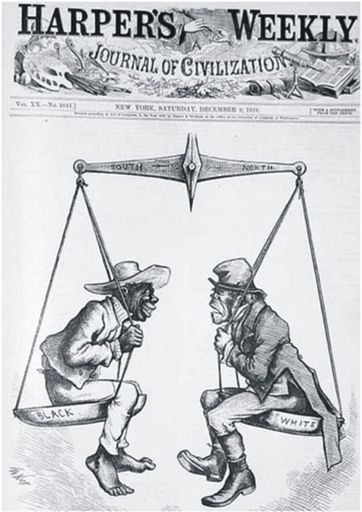
Figure 4.7
Questions:
-
The man in the “white” scale is supposed to be Irish. What is the message of this cartoon?
-
Thomas Nast, the cartoonist, drew for
Harper’s Weekly
. Based on this cartoon, what sort of people do you think read
Harper’s Weekly
?
Cartoon in a Newspaper, 1883
Source: Political cartoon published in Puck humor magazine on May 9, 1883.
(Figure
below
).
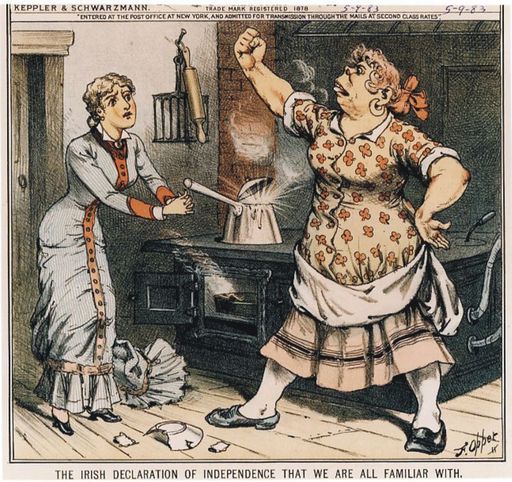
Figure 4.8
THE IRISH DECLARATION OF INDEPENDENCE THAT WE ARE ALL FAMILIAR WITH.
Questions:
-
The angry woman in the cartoon is supposed to be Irish. Describe what she looks like and how she’s acting.
-
Based on this cartoon, what job do you think many Irish women had in the 1880s? What were some stereotypes about Irish women?
Excerpt from The Know-Nothing and American Crusader – July 29, 1854
Source: An item that ran in The Know-Nothing and American Crusader, a nativist, anti-Catholic newspaper published in Boston.
THINGS WHICH ROMAN CATHOLIC PRIESTS AND ALL TRUE ROMAN CATHOLICS HATE
Providence, July 22, 1854
-
They HATE our Republic, and are trying to overthrow it.
-
They HATE our
Flag
, and they grossly insulting it.
-
They HATE the liberty of the Press.
-
They HATE the liberty of speech.
-
They HATE our Public School system.
-
They HATE the Bible, and would blot it out of existence
if
they could!
-
They HATE Protestants, and are sworn to
exterminate
them from our country and the earth.
-
They HATE all
rulers
that do not swear allegiance to the Pope of Rome.
-
They HATE to be
ruled
by
Americans
, and say ‘WE WILL NOT BE RULED BY THEM!'
-
They HATE to support their own paupers and they are left to be supported by the tax paying Americans.
-
They HATE, above all, the
‘Know-Nothings’
, who are determined to rid this country from their cursed power.
—UNCLE SAM
Questions:
-
Why did the ‘Know-Nothings’ hate the Catholics so much?
-
According to the ‘Know-Nothings’ could the Irish ever be true Americans? Why or why not?
New York Times Advertisement, 1854
Source: An advertisement that ran in the New York Times on March 25, 1854.
(Figure
below
).
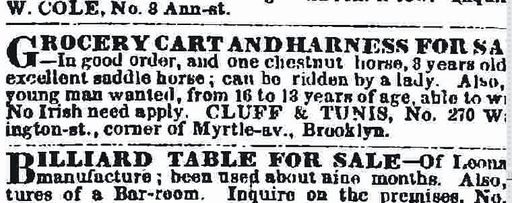
Figure 4.9
Jensen, Richard. “No Irish Need Apply: A Myth of Victimization.” Journal of Social History 36.2 (2002) 405-429
Modified Transcript:
GROCERY CART AND HARNESS FOR SALE
They are in good condition.
One chestnut horse,
 old, is also for sale. Excellent saddle horse; can be ridden by a lady.
Also, young man wanted, from
 to
to
 of age, able to work. No Irish need apply.
CLUFF & TUNIS, No. 270 Washington St., corner of Myrtle Ave., Brooklyn.
Questions:
-
What does the advertisement mean when it says: “No Irish need apply?”
-
Based on this advertisement, how do you think the Irish were treated when they looked for jobs? Why might this be the case?
Wages of Whiteness – David Roediger
Source: Excerpt from the book Wages of Whiteness, written by historian David R. Roediger and published in 1991.
Irish-Americans were sometimes used as substitutes for slaves in the South. Gangs of Irish immigrants worked ditching and draining plantations, building levees and sometimes clearing land because of the danger of death to valuable slave property (and, as one account put it, to mules) in such work. One Southerner explained the use of Irish labor as follows: ‘n-----s are worth too much to be risked here; if the Paddies (Irish) are knocked overboard... nobody loses anything.’
Irish youths were likely to be indentured servants from the early 1800s through the Civil War. In that position they were sometimes called ‘Irish slaves’ and more frequently ‘bound boys.’ In New York City, Irish women made up the largest group of prostitutes, or as they were sometimes called in the 1850s, ‘white slaves.’
Questions:
-
Why were Irish used to do difficult labor in the South?
-
Based on this document, do you think the Irish were treated like slaves?
John Brown
As the movement to abolish slavery grew, Southern states became concerned that the addition of new free states would put slaveholding states in a minority and might ultimately lead to the abolition of slavery. In the Compromise of 1850, the people of the Nebraska Territory were given the right to vote on whether or not slavery would be legal. Advocates of both sides moved to Nebraska in order to vote, and violence erupted between them. In response to an episode of pro-slavery violence, abolitionist John Brown killed
 pro-slavery settlers in the Pottowatomie Creek Massacre.
He then went to Virginia, where he plotted the seizure of an arsenal of weapons, which he planned to distribute to slave to help them rebel. Before they could carry out his plan, John Brown and his men were arrested, tried, and hanged. This event energized abolitionists and horrified Southerners, and helped lead the United States down the path to war.
President Lincoln called John Brown a “misguided fanatic.” Read the documents below and decide whether you agree with Lincoln. Was Brown a fanatic or a hero?
Speech to the Court – John Brown
Source: John Brown's last speech, given to the court at his trial. November 2, 1859.
I have, may it please the court, a few words to say. In the first place, I deny everything but what I have all along admitted -- the design on my part to free the slaves. That was all I intended. I never did intend murder, or treason, or the destruction of property, or to excite or incite slaves to rebellion, or to make insurrection (revolt).
I have another objection: had I so interfered in behalf of the rich, the powerful, the intelligent, the so-called great, or in behalf of any of their friends--either father, mother, brother, sister, wife, or children, or any of that class-- it would have been all right; and every man in this court would have deemed it an act worthy of reward rather than punishment.
I believe that to have done what I have done--on behalf of God’s despised poor was not wrong, but right. Now, if it is deemed necessary that I should
forfeit
my life to further the end of justice, and mingle my blood further with the blood of my children and with the blood of millions in this slave country whose rights are disregarded by wicked, cruel, and unjust acts-- I say: so let it be done!
Vocabulary
-
Forfeit
-
give up
Questions:
-
Contextualization:
John Brown delivered this speech on the last day of his trial, after hearing the jury pronounce him ‘guilty.’ He knew he would be sentenced to die. Given that context, what does this speech say about him as a person?
-
Based on this document, do you think John Brown was a “misguided fanatic?” Why or why not?
Last Meeting Between Frederick Douglass and John Brown
Source: In this passage, Frederick Douglass describes his last meeting with John Brown, about three weeks before the raid on Harper’s Ferry. This account was published by Douglass in 1881 in The Life and Times of Frederick Douglass.
About three weeks before the raid on Harper's Ferry, John Brown wrote to me, informing me that before going forward he wanted to see me...
We sat down and talked over his plan to take over Harper’s Ferry. I at once opposed the measure with all the arguments at my command. To me such a measure would be fatal to the work of the helping slaves escape [Underground Railroad]. It would be an attack upon the Federal government, and would turn the whole country against us.
Captain John Brown did not at all object to upsetting the nation; it seemed to him that something shocking was just what the nation needed. He thought that the capture of Harper's Ferry would serve as notice to the slaves that their friends had come, and as a trumpet to rally them.
Of course I was no match for him, but I told him, and these were my words, that all his arguments, and all his descriptions of the place, convinced me that he was going into a perfect steel-trap, and that once in he would never get out alive.
Questions:
-
Close Reading:
What are two reasons why Douglass opposed John Brown’s plan to raid Harper’s Ferry?
-
Sourcing:
Douglass’ account is written in 1881, twenty-two years after the raid. Do you trust his account? Why or why not?
-
Based on this document, do you think John Brown was a “misguided fanatic?” Why or why not?
Letter to John Brown in Prison
Source: The letter below was written to John Brown while he was in prison, awaiting trial.
Wayland [Mass.], October 26, 1859.
Massachusetts, Oct 26th, 1859
Dear Capt Brown,
You do not know me, but I have supported your struggles in Kansas, when that Territory became the battle-ground between slavery and freedom.
Believing in peace, I cannot sympathize with the method you chose to advance the cause of freedom. But I honor your generous intentions, I admire your courage, moral and physical, I respect you for your humanity, I sympathize with your cruel loss, your sufferings and your wrongs. In brief, I love you and bless you.
Thousands of hearts are throbbing with sympathy as warm as mine. I think of you night and day, bleeding in prison, surrounded by hostile faces, sustained only by trust in God, and your own strong heart. I long to nurse you, to speak to you sisterly words of sympathy and consolation. May God sustain you, and carry you through whatsoever may be in store for you!
Yours with heartfelt respect, sympathy, and affection.
L. Maria Child.
Questions:
-
Do you find this document surprising? Why or why not?
-
Based on this document, do you think John Brown was a “misguided fanatic?” Why or why not?
Political Cartoon – Forcing Slavery Down the Throat of a Freesoiler
Source: A political cartoon drawn and published by John L. Magee in 1856 in Philadelphia. The large, bearded figure represents a “freesoiler” who opposed the extension of slavery into the western territories such as Kansas. The four smaller figures represent Democratic politicians. Democratic presidential nominee James Buchanan and senator Lewis Cass are restraining the freesoiler by the hair while Senator Stephen Douglas and President Franklin Pierce force a slave into his mouth.
(Figure
below
).
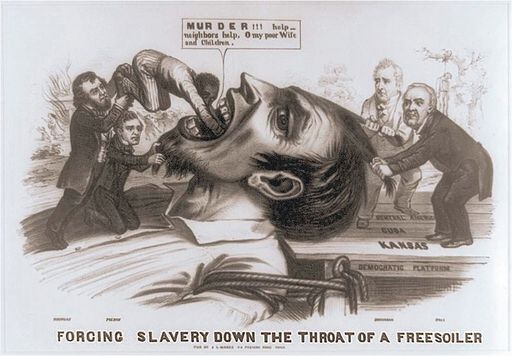
Figure 4.10
References
-
.
Cover Page of the Confessions of Nat Turner
. Public Domain
-
.
http://www.tsl.state.tx.us/treasures/republic/declare-01.html
. Public Domain
-
Merrihew and Gunn.
http://www.tamu.edu/ccbn/dewitt/lundy.htm
. Public Domain
-
.
http://www.davidrumsey.com/luna/servlet/detail/RUMSEY~8~1~236~20060:Map-of-the-United-States-with-the-c
. Public Domain
-
.
http://www.davidrumsey.com/luna/servlet/detail/RUMSEY~8~1~26393~1100064:Map-of-the-United-States-and-territ?sort=Pub_List_No_InitialSort%2CPub_Date%2CPub_List_No%2CSeries_No&qvq=q:ormando+gray;sort:Pub_List_No_InitialSort,Pub_Date,Pub_List_No,Series_No;lc:RUMSEY~8~1&mi=36&trs=129
. Public Domain
-
.
http://memory.loc.gov/service/pnp/ppmsca/09800/09855v.jpg
. Public Domain
-
.
http://www.hsp.org/default.aspx?id=394
. Public Domain
-
.
http://www.hsp.org/default.aspx?id=394
. Public Domain
-
New York Times.
http://tigger.uic.edu/~rjensen/no-irish.htm
. Public Domain
-
.
http://lcweb2.loc.gov/cgi-bin/query/h?pp/PPALL:@field(NUMBER+@1(cph+3b38367))
.
