The Early Republic
Stamp Act
In March 1765, the British Parliament passed the Stamp Act, a tax on newspapers and all other printed materials in the American colonies. The British argued that the tax was needed to pay off debts that they had incurred while protecting the American colonists during the French and Indian War. The British thought that it was fair for the Americans to pay higher taxes. The Americans disagreed. Read the documents below and try to determine why the Americans were upset about the Stamp Act.
Boston Editorial
Source: This letter appeared as an editorial in a Boston newspaper on October 7, 1765. The author is unknown.
Boston-Gazette, and Country Journal,
7 October 1765
My Dear Countrymen,
AWAKE! Awake, my Countrymen and defeat those who want to enslave us. Do not be cowards. You were born in Britain, the Land of Light, and you were raised in America, the Land of Liberty. It is your duty to fight this tax. Future generations will bless your efforts and honor the memory of the saviors of their country.
I urge you to tell your representatives that you do not support this terrible and burdensome law. Let them know what you think. They should act as guardians of the liberty of their country.
I look forward to congratulating you on delivering us from the enemies of truth and liberty.
Questions:
-
Sourcing:
Who wrote this document? When? For what purpose? What was the audience?
-
Contextualization:
What was going on at the time the document was written? What were people doing? What did people believe?
John Hughes Letter
Source: The following letter was written by John Hughes, Stamp Distributor in Philadelphia, to his bosses in London. The Stamp Act was passed in March 1765 and went into effect November 1765.
Philadelphia January 13th 1766.
My Lords,
The colonists have been insulting His Majesty, saying that the Stamp Act was unconstitutional, and oppressive.
Many believe that the Stamp Act is only being used to enrage the people, & at the same time, to conceal other plans.
It is apparent to many people here, that the Presbyterians, who are very numerous in America, are at the head of these riots. They are opposed to Kings and some begin to cry out,--No King but King Jesus. The leaders, and the Clergy, fill every newspaper with inflammatory pieces, so that the minds of the common people are kept in a continual ferment.... No one dares write anything that would calm the people down. Doing so would put the writer’s life and fortune in danger.
I am convinced the Presbyterians intend nothing less than the throwing off their allegiance and obedience to his Majesty, & forming a Republican Empire, in America, & being Lords and Masters themselves.
I am daily Threatened, by Verbal Messages, and Anonymous Letters, with a Mob of several Thousand People, from the Jerseys, New York, and New England.
I conclude with praying, that the Almighty may secure the allegiance of America to the Crown of Britain, by destroying the seeds of rebellion, and by punishing the ringleaders of these riots.
I am, My Lords, Your most Obedient & Most Humble Servant,
John Hughes
Vocabulary
-
Compels
-
forces
-
Inflammatory
-
Arousing angry or violent feelings
-
Ferment
-
agitation or excitement, typically leading to violence
-
Presbyterians
-
a major religion formed during the Great Awakening
-
Allegiance
-
loyalty
Questions:
-
Sourcing:
Who wrote this and what is his job? Does he side with England or with the colonists? How do you know?
-
Contextualization:
Based on his account, what is happening in America in 1766? How has the Stamp Act affected the author personally? Provide evidence from the document to support your answer.
-
Do you believe this account? Give one reason why you would trust his account, and one reason why you might not.
London Newspaper Letter
Source: The following letter was written in a London newspaper. It shows that the British could not understand why the people of Boston were so upset about the Stamp Act.
From a London paper, January 27, 1766
The riotous behavior of the people in Boston is remarkable. I would have been less surprised by their behavior if we had taxed their beer, because everyone drinks beer. But the Stamp Act is a tax on none of the necessities of life. It does not affect the poor. And even a poor person can afford this little amount of money. The tax on newspapers only affects the rich—common people do not purchase newspapers. Isn’t it surprising, then, that the mob in Boston has begun to riot against this tax even before it has officially gone into effect?
Questions:
-
Sourcing:
What newspaper does this come from? What would you predict the author’s perspective will be on the Stamp Act? Was this written before or after the Stamp Act went into effect?
-
Contextualization:
What happened in Boston? Why is the author surprised? Who reads the newspapers, according to the author?
Section Questions:
-
Corroboration:
Where do the documents agree and where do they conflict?
-
Corroboration:
Was the Stamp Act fair? How were the colonists treated by the British?
-
Corroboration:
How did the colonists feel about their treatment?
The Battle of Lexington
After the passage of the Stamp Act, tensions between the colonists and the British government continued to rise, and the colonists began to organize militias. On April 19, 1775, British troops marched from Boston to the nearby towns Lexington and Concord to arrest the militia’s leaders, John Hancock and Sam Adams, and to confiscate their weapons. The militias learned in advanced that the British were coming, and about
 militiamen, also called minutemen, assembled before dawn on the central green of the town of Lexington. As dawn was breaking, a shot rang out which set off the first battle of the American Revolution. But who fired the shot? The historical sources disagree. Read the documents below and attempt to determine which side fired first. Then analyze the two paintings of the battle and decide which is a more accurate representation of the battle.
A sample exploration of these documents can be viewed in the video at
http://historicalthinkingmatters.org/why/
Diary of John Barker
Source: Entry for April 19th, 1775, from the diary of Lieutenant John Barker, an officer in the British army.
19th. At 2 o’clock we began our march by wading through a very long stream up to our middles. About
 away from a town called Lexington, we heard there were some hundreds of people collected together intending to oppose us. At 5 o’clock we arrived there and saw a number of people, I believe between
 and
and
 , formed in a common in the middle of the town. We still continued advancing, prepared for an attack though without intending to attack them. As we came near them, they fired one or two shots, upon which our men without any orders, fired and put them to flight. We then formed on the Common, but with some difficulty, the men were so wild they could hear no orders; we waited a considerable time there, and at length proceeded on our way to Concord.
Questions:
-
Sourcing:
What kind of document is this? When was it written?
-
Contextualization:
Imagine the scene. What might the soldiers have been thinking?
-
Close Reading:
According to this document, which side fired first?
Account of the Battle of Lexington – Nathaniel Mullikan
Source: Sworn by
 minutemen on April 25 before three Justices of the Peace.
We Nathaniel Mulliken, Philip Russell, (Followed by the names of
 other men present on Lexington Green on April 19, 1775)... All of lawful age, and inhabitants of Lexington... do testify and declare, that on the nineteenth of April, about five o’clock in the morning, we proceeded towards the Green, and saw a large body of troops marching towards us. Some of our men were coming to the Green, and others had reached it, at which time, they began to disperse. While our backs were turned on the British troops, they fired on us, and a number of our men were instantly killed and wounded, not a gun was fired by any person in our company on the British soldiers to our knowledge before they fired on us, and continued firing until we had all made our escape.
Lexington, April 25, 1775.
Questions:
-
Sourcing:
What kind of document is this? Do you trust it more or less than a diary entry? When was this written? Whose side does this document represent?
-
Close reading:
What is the significance of the phrase “to our knowledge?”
-
Corroboration:
Where do Barker’s and Mullikan’s accounts disagree? Are there any facts that both accounts agree on?
Battle of Lexington Engraving - Amos Doolittle
Source: One of four engravings made by Amos Doolittle in 1775. Doolittle was an engraver and silversmith from Connecticut who visited the site of the battle and interviewed participants and witnesses.
(Figure
below
.
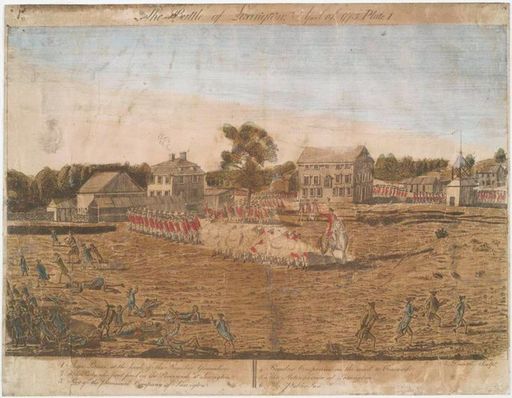
Figure 3.1
One of four engravings made by Amos Doolittle in 1775
Questions:
-
Sourcing:
When was this document created? By whom? For what purpose?
-
Which figures in this image are British? Which figures are American? How can you tell?
-
Look closely at the image. Which side appears to be firing first?
Terrence Blachaux Painting
Source: A painting made by Terrence Blachaux in 1859, which was used in a
 Century American postage stamp.
(Figure
below.
Century American postage stamp.
(Figure
below.
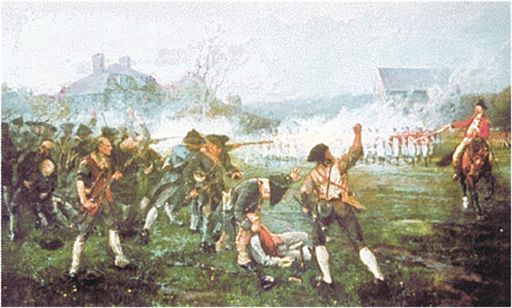
Figure 3.2
Century American postage stamp.
Questions:
-
Sourcing:
When was this image created? By whom? For what purpose?
-
According to this image, who fired first?
Section Questions:
-
Corroboration:
Which of the first two texts seems more reliable—Mullikan or Barker? Why might they differ?
-
Corroboration:
Which of the images probably presents a more accurate representation of the Battle of Lexington?
-
Why might the creator of the other image have wanted to portray the battle differently?
The Declaration of Independence
Declaration of Independence
Source: The Declaration of Independence is a statement approved by representatives of the
 colonies. The representatives, called the Continental Congress, met in Philadelphia. The Declaration was adopted on July 4, 1776.
(Figure
below.
colonies. The representatives, called the Continental Congress, met in Philadelphia. The Declaration was adopted on July 4, 1776.
(Figure
below.
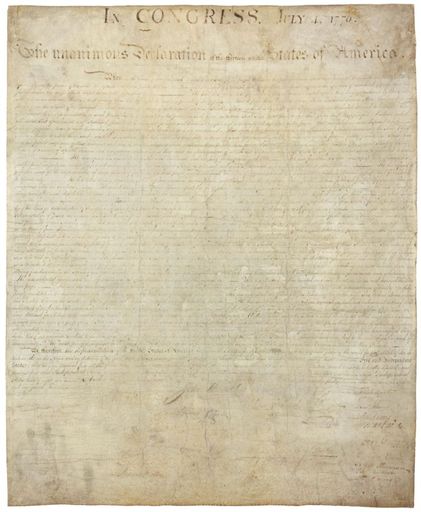
Figure 3.3
Declaration of Independence
We hold these truths to be
self-evident
, that all men are created equal, that they are
endowed
by their Creator with certain
inalienable
rights, that among these are life, liberty and the pursuit of happiness. That
to secure
these rights, governments are
instituted
among men,
deriving
their just powers from the
consent
of the governed. That whenever any form of government becomes destructive to these ends, it is the right of the people to alter or to abolish it, and to institute new government.
The history of the present King of Great Britain is a history of repeated abuses intended to establish tyranny over the colonies. To prove this, let facts be submitted:
(1 & 2) He has refused to pass, and forbidden his governors to pass, important and necessary laws.
(3 & 4) He has insisted that certain large districts give up their right to representation; in other districts, he has insisted that the legislature meet in uncomfortable, and distant places, so that they won’t oppose him.
(5 & 6) He has broken up certain legislatures that opposed him, and refused to let others be elected.
(8 & 9) He has refused to establish courts of justice, and has made judges dependent on him for their jobs and salaries.
(10) He has sent swarms of British officers to harass our people and eat our food.
(11 & 12) He has kept among us, in times of peace, standing armies, without the consent of our legislatures; he has tried to make the military independent of, and superior to, the local, civil power.
(14 & 15) For keeping large bodies of armed troops among us; For protecting them, by a mock trial, from punishment for any murders which they should commit on the colonists;
(16) For cutting off our trade with all parts of the world;
(17) For imposing taxes on us without our consent;
(18) For depriving us, in many cases, of the benefits of trial by jury;
(21) For abolishing our most valuable laws, and fundamentally changing the forms of our governments;
(23 & 24) He is waging war against us; He has plundered our seas, ravaged our coasts, burned our towns, and destroyed the lives of our people.
(27) He has started fights among us and has also forced us to live near merciless Indian savages, who only destroy all ages, sexes, and conditions.
(28) He has ignored all of our humble efforts to address these problems.
Vocabulary
-
self-evident
-
obvious
-
endowed
-
given
-
inalienable
-
cannot be taken away
-
to secure
-
to get
-
instituted
-
established
-
deriving
-
getting
-
consent
-
agreement
Questions
For questions 1 and 2, restate the indicated paragraph in your own words.
-
We believe in these obvious truths: that all men are created equal, that they....
-
In order to protect these rights, governments are set up. These governments get their powers from....
-
Close Reading:
Do these grievances seem to be things that upset rich people, or both rich and poor?
-
Do you think these complaints would give people reason to go to war and possibly die? Why or why not?
The Ideological Origins of the American Revolution – Bernard Bailyn
Source: Excerpt from a book by historian Bernard Bailyn. The book, published in 1967, is called
The Ideological Origins of the American Revolution
.
The Declaration of Independence represents the colonists’ deepest fears and beliefs. The colonists believed they saw a clear pattern in the events that followed 1763. They believed they saw an evil and deliberate conspiracy to crush liberty in America. They saw evidence of this conspiracy in the Stamp Act and in the Coercive Acts.
They also believed that America was destined to play a special role in history. They believed that America would become “the foundation of a great and mighty empire, the largest the world ever saw to be founded on such principles of liberty and freedom, both civil and religious.” The colonists believed that England was trying to enslave them, and that they should use “all the power which God has given them” to protect themselves.
Questions:
-
Close Reading:
What does Bailyn think the Declaration of Independence represents? What evidence does he use to support his claims?
A People’s History of the United States - Howard Zinn
Source: Excerpt from
A People’s History of the United States
, which was published in 1980 by historian Howard Zinn.
It seemed clear to the educated, upper-class colonists that something needed to be done to persuade the lower class to join the revolutionary cause, to direct their anger against England. The solution was to find language inspiring to all classes, specific enough in its listing of grievances to fill people with anger against the British, vague enough to avoid class conflict, and stirring enough to build patriotic feelings.
Everything the Declaration of Independence was about – popular control over governments, the right of rebellion and revolution, fury at political tyranny, economic burdens, and military attacks – was well suited to unite large numbers of colonists and persuade even those who had grievances against one another to turn against England.
Some Americans were clearly omitted from those united by the Declaration of Independence: Indians, black slaves, and women.
Questions:
-
Close Reading:
What does Zinn think the Declaration of Independence represents? What evidence does he use to support his claims?
Section Questions:
-
Which historian, Bailyn or Zinn, do you find more convincing? Why?
Loyalists during the Revolution
Loyalist Letter – Anonymous
Source: The following letter was written by an anonymous Loyalist under the pseudonym ‘Rusticus’. Printed in a Pennsylvania newspaper, it lists all the advantages of being British.
Pennsylvania Packet
January 2, 1775
My Friends and Countrymen,
This howling wilderness has been converted into a
flourishing
and populous country. But, is this not due to the way in which the colonies have been treated from the beginning? Isn’t our growth a result of Great Britain’s willingness to encourage our industry and protect us from foreign countries? If so, surely some degree of gratitude, such as becomes a free and liberal people, would be appropriate.
The peace and security we have already enjoyed under Great Britain’s protection, before the mistaken system of taxation took place, must make us look back with regret to those happy days whose loss we mourn, and which every
rational
man must consider as the golden age of America.
Let us then, my friends and countrymen, be patient and avoid all
inflammatory
publications that are disrespectful to our most gracious Sovereign. Let us look forward to a happy termination of our present disputes, and a
cordial
reconciliation
with our mother country.
Rusticus
Vocabulary
-
Flourishing
-
rapidly growing
-
Rational
-
reasonable
-
Inflammatory
-
arousing violent feelings
-
Cordial
-
warm and friendly
-
Reconciliation
-
existing in harmony
Loyalist Letter – Charles Inglis
Source: The following letter was written by Reverend Charles Inglis, an Anglican minister. He was trying to sway colonists not to follow the Patriot leaders who were leading Americans into war.
New York Gazette
September 19, 1774
To the Inhabitants of North America:
Brethren, Friends and Fellow Subjects,
In case these people in Massachusetts succeed in convincing other colonies to break from Great Britain, let us calmly consider how prepared we are for such a war. I will not exaggerate, but represent things as they really are.
The naval power of Great Britain is the greatest in the world. Do we have a fleet to look this power in the face and defend our coasts? No—not one ship. The inevitable consequence then must be, that all our seaport towns will be taken and all our trade and commerce destroyed. Have we disciplined troops to encounter those British soldiers that are now in America, or that may be sent here?—Not a single regiment. We will need to leave our farms, our shops, our trades and
begin
to learn the art of war at the very same time we are called to practice it. And EVERYTHING will be at stake.
If we turn our eyes west to our back-country the situation is no better. Every man in Canada is a soldier, and may be commanded whenever government pleases. Then, add the Indians, whose warriors in Canada and the Six Nations amount to at least FIVE THOUSAND. In the case of our civil war with Britain, all these Canadians and Indians would be let loose on our back-settlements, to scalp, ravage and lay everything to waste.
Shall we, then, madly pursue violent measures that will plunge our country into all the horrors of a civil war? Shall we desperately risk our lives, liberties and property and recklessly drench this happy country with the blood of its inhabitants? --Forbid it humanity! Forbid it loyalty, reason and common sense!
A New York Freeholder (landowner)
Shays’s Rebellion
In 1881, the colonies adopted the Articles of Confederation—a document that bound them into the United States of America. Since the colonists were fighting to free themselves from monarchical rule, they created a very weak central government. Under the Articles of Confederation, the federal government could not tax, could not make laws that would be binding in all
states, had no executive branch, and could not raise a national army.
Shays’s Rebellion was a violent protest held by farmers in western Massachusetts. You will learn more about it by reading the first document below, an excerpt from a recent U.S. History textbook. According to the textbook, Shays’s Rebellion made Americans realize that they needed a stronger government. As you read that documents that follow, try to understand the connection between Shays’s Rebellion and the Articles of Confederation and then determine whether all Americans drew the same lessons from the Rebellion.
Shays’s Rebellion – The American Vision
Source: An account of Shays’s Rebellion excerpted from The American Vision, a high school U.S. History textbook published in 2003.
Shay’s Rebellion
The property owners’ fears seemed justified when a full-scale rebellion, known as
Shays’s Rebellion
, erupted in Massachusetts in 1786. The rebellion started when the government of Massachusetts decided to raise taxes instead of issuing paper money to pay off its debts. The taxes fell most heavily on farmers, particularly poor farmers in the western part of the state. As the recession grew worse, many found it impossible to pay their taxes as well as their mortgages and other debts. Those who could not pay often faced the loss of their farms.
Angry at the legislature’s indifference to their plight, in late August 1786, farmers in western Massachusetts rebelled. They closed down several county courthouses to prevent farm foreclosures, and then marched on the state supreme court. At this point, Daniel Shays, a former captain in the Continental Army who was now a bankrupt farmer, emerged as one of the rebellion’s leaders.
In January 1787, Shays and about
 farmers headed to a state arsenal intending to seize weapons before marching on Boston. In response, the governor sent more than
 volunteers under the command of General Benjamin Lincoln to defend the arsenal. Before they arrived, Shays attacked, and the militia defending the arsenal opened fire. Four farmers died in the fighting. The rest scattered. The next day Lincoln’s troops arrived and ended the rebellion. The fears the rebellion had raised, however, were harder to disperse.
A Call for Change
People with greater income and social status tended to see the rebellion, as well as inflation and an unstable currency, as signs that the republic itself was at risk. They feared that as state legislatures became more democratic and responsive to poor people, they would weaken property rights and vote to take property from the wealthy. As General Henry Knox, a close aide to George Washington, concluded: “What is to afford our security against the violence of lawless men? Our government must be braced, changed, or altered to secure our lives and property.”
These concerns were an important reason why many people, including merchants, artisans, and creditors, began to argue for a stronger central government, and several members of the Confederation Congress called on the states to correct “such defects as may be discovered to exist” in the present government. The confederation’s failure to deal with conditions that might lead to rebellion, as well as the problems with trade and diplomacy, only added fuel to their argument.
Questions:
-
Sourcing:
What kind of document is this? When was it written?
-
Close Reading:
According to this document, how was Shays’s rebellion related to the Articles of Confederation?
-
Close Reading:
According to this document, how did people respond to Shays’s Rebellion?
Thomas Jefferson on Shays’ Rebellion
Source: Thomas Jefferson was in France during Shays’ Rebellion, but he wrote a letter to a friend about it.
Paris, November 13, 1787
The British have so long hired their newspapers to repeat every form lies about our being in
anarchy
, that the world has at length believed them, and we have believed them ourselves. Yet where does this
anarchy
exist? Where did it ever exist, except in the single instance of Shays’ rebellion? God forbid we should ever be
 without such a rebellion.
What country before ever existed without a rebellion? And what country can preserve its liberties if their rulers are not warned from time to time that their people preserve the spirit of resistance? Let the people take arms. The
remedy
is to present them with the facts,
pardon
and
pacify
them.
The tree of liberty must be refreshed from time to time with the blood of patriots and tyrants. It is its natural
manure
. Our Constitutional Convention has [made too much of Shays’ rebellion]: and in the spur of the moment [I believe they are over-reacting].
Vocabulary
-
Anarchy
-
chaos;confusion and disorder
-
Remedy
-
cure
-
Pardon
-
forgive
-
Pacify
-
calm down
-
Manure
-
fertilizer
Questions:
-
Sourcing:
Who wrote this document? What else do you know about his views on a strong central government?
-
Contextualization:
According to Jefferson, have the colonies been peaceful or chaotic? Support your answer with evidence from the document.
-
Close Reading:
What does Jefferson mean when he says “The tree of liberty must be refreshed from time to time with the blood of patriots and tyrants?”
Section Questions
-
Opening Up the Textbook:
How does this document challenge or expand the information you read in the textbook?
Federalists and Anti-Federalists
In 1787, the states sent delegates to the Constitutional Convention, where they debated and wrote the new Constitution. Two camps developed—
Federalists
who favored a strong central government and
Anti-Federalists
, who favored a weak one. The Federalists, led by Alexander Hamilton, were strongest among Northerners, city dwellers, and merchants. The Anti-Federalists, including Thomas Jefferson, included more Southerners and farmers. The documents below show the Federalist and Anti-Federalist positions on Congressional representation and the impact of the new Constitution upon the states.
Federalist Position on Congressional Representation – Alexander Hamilton
Source: Speech by Alexander Hamilton, June 21, 1788
The Antifederalists seem to think that a pure democracy would be the perfect government. Experience has shown that this idea is false. The ancient democracies of Greece were characterized by tyranny and run by mobs.
The Antifederalists also argue that a large representation is necessary to understand the interests of the people. This is not true. Why can’t someone understand thirty [thousand] people as well as he understands twenty people?
The new constitution does not make a rich man more eligible for an elected office than a poor person. I also think it’s dangerous to assume that men become more wicked as they gain wealth and education. Look at all the people in a community, the rich and the poor, the educated and the ignorant. Which group has higher moral standards? Both groups engage in immoral or wicked behavior. But it would seem to me that the wealthy overall have the advantage. Their immoral behavior often benefits the general wealth of the country, and it’s less wicked and sinful.
Question:
-
What type of Congressional representation did the federalists prefer? Why?
Anti-Federalist Position on Representation in Congress – Melancton Smith
Source: Speech by Melancton Smith, delivered June 21, 1788.
Representatives should be a true picture of the people. They should understand their circumstances and their troubles. Therefore, the number of representatives should be so large that both rich and poor people will choose to be representatives.
If the number of representatives is small, the position will be too competitive. Ordinary people will not attempt to run for office. A middle-class yeoman (farmer) will never be chosen. So, the government will fall into the hands of the few and the rich. This will be a government of oppression.
The rich consider themselves above the common people, entitled to more respect. They believe they have the right to get anything they want.
Questions:
-
What kind of Congressional representation did the Anti-Federalists favor? Why?
Section Question:
-
Which argument do you find more convincing, Federalist or Anti-Federalist?
Federalist Position on State/Federal Power – Alexander Hamilton
Source: Speech given by Alexander Hamilton, June 28, 1788
The Antifederalists argue that the federal government should not be allowed to tax the people because it will take everything it can get.
It is unfair to presume that the representatives of the people will be tyrants in the federal government, but not in the state government. If we are convinced that the federal government will pass laws that go against the interests of the people, then we should have no federal government at all. But if we unite, we can accomplish great things.
I must finally say that I resent the implication that I am only interested in rank and power. What reasonable man would establish a system that would reduce his friends and children to slavery and ruin?
No reasonable man would want to establish a government that is unfriendly to the liberty of the people. Do not assume, gentlemen, that the advocates of this Constitution are motivated by their ambition. It is an unjust and uncharitable view.
Question:
-
Did the Federalists want the states or the Federal government to have more power? Why?
Antifederalist Position on State/Federal Power - Melancton Smith
Source: Speech given by Melancton Smith on June 27, 1788.
In a country where most people live more than twelve hundred miles from the center, I don’t think one [government] body can legislate for the whole. Can such a government design a system of taxation that will be beneficial for everyone?
Won’t such a centralized taxation system lead to swarms of officers, infesting our country and taking our money? People will be taxed beyond their means, and their complaints will never reach the government.
It is not possible to find a set of representatives who are familiar with all parts of the continent. Can you find men in Georgia who know what’s happening in New Hampshire, who know what taxes will best suit its inhabitants, and how much they can afford? Can the best men make laws for the people they know nothing about?
We have no reason to eliminate our state governments, or think they are incapable of acting wisely. Our state governments should be the guardians of our rights and interests.
Questions:
-
Did the Anti-Federalists want the states or the Federal government to have more power? Why?
Section Question:
-
Whose arguments do you find more convincing, the Federalists or Anti-Federalists?
Slavery in the Constitution
The Declaration of Independence included a list of grievances against King George. Thomas Jefferson’s original draft of the Declaration included a grievance condemning slavery and blaming the King for introducing it into the Americas. That grievance was deleted before the final version was adopted, but the Declaration did include the phrase “all men are created equal.”
In spite of this, the Constitution allowed slavery to continue. The documents below include Jefferson’s slavery grievance and statements from several framers of the Constitution explaining their decision not to abolish slavery. As you read, think about why slavery persisted in the Constitution, despite the fact that the Declaration declared all men equal.
Slavery Grievance – Jefferson
Source: Thomas Jefferson was born to a slave-owning family and he himself owned slaves. As chairman of the committee that drafted the Declaration of Independence, Jefferson wrote a paragraph condemning slavery in his first draft of the Declaration. He included this paragraph in his list of complaints against King George III. Before the final version of the Declaration was adopted, this paragraph was deleted.
King George III has waged cruel war against human Nature itself. He has taken away the most sacred rights of Life and Liberty from a distant people who never offended him. He did this by captivating and carrying them into slavery in another hemisphere if they did not die a miserable death in their transportation to this new world. These disgraceful practices are the Warfare of the Christian King of Great Britain.
He has stopped every attempt to prohibit or to restrain the disgusting business of slavery. He is determined to keep open a market where men are bought and sold.
Questions:
-
Sourcing:
When was this passage written? By whom?
-
Close Reading:
How does Jefferson describe slavery? Who does he blame for the continuation of the slave trade?
-
Close Reading:
Why do you think Jefferson italicizes the word ‘Christian’ at the end of the first paragraph?
-
Contextualization:
What else was going on at this time? Why do you think that Thomas Jefferson included a paragraph about slavery when he first wrote the Declaration of Independence? Why do you think it was removed?
Constitutional Convention – Statements on Slavery
Source: Statements from the Constitutional Convention, which was held in Philadelphia in 1787. Representatives from the
colonies gathered at the Constitutional Convention to write the new constitution. These are some of their comments about the issue of slavery. The comments of Rutlidge, Elseworth, and Williamson are taken from notes made by James Madison. The comment by Franklin is taken from a published speech he delivered in Philadelphia just before the Constitutional Convention.
Mr. RUTLIDGE:
Religion and humanity have nothing to do with this question. The true question at present is whether the Southern states shall or shall not be a part of the Union. If the Northern states think about their interest, they will not oppose the increase of slaves because they will profit by selling the goods that slaves produce.
Mr. ELSEWORTH:
Let every state do what it pleases. The morality or wisdom of slavery are decisions belonging to the states themselves. What enriches a part enriches the whole.
Mr. WILLIAMSON:
Southern states could not be members of the Union if the slave trade ended. It is wrong to force any thing that is not absolutely necessary, and which any state must disagree to.
BENJAMIN FRANKLIN:
I agree to this Constitution with all its faults because I think a federal [national] government necessary for us. When you assemble a large group of men, you will inevitably find that they will disagree with each other about their local interests, and their selfish views. We have to accept some of these disagreements in order to build a national government.
Questions:
-
Did each of these men consider slavery to be immoral? What other issues do they believe to be more important than slavery?
A Necessary Evil? – John P. Kaminski
Source: Excerpt from
A Necessary Evil?
, a book written by historian John Kaminski and published in 1995.
The men at the Constitutional Convention never considered getting rid of slavery. The Revolutionary talk of freedom and equality had been left behind; Americans in general and the men at the Convention in particular wanted a united, well-ordered, and prosperous society in which private property—including slave property—would be secure.
Question:
-
According to Kaminski, why didn’t the authors of the Constitution abolish slavery?
The Founding Fathers and Slavery – William Freehling
Source: Excerpt from
The Founding Fathers and Slavery
, a book written by historian William Freehling and published in 1987.
The Founding Fathers’ racism [was] a barrier to antislavery. Here again Jefferson typified the age. Jefferson suspected that blacks had greater sexual appetites and lower intellectual abilities than did whites. These suspicions, together with Jefferson’s fear that free blacks and free whites could not live harmoniously in America, made him and others think that the only way Africans could be free was if they were sent back to Africa.
Question:
-
According to Freehling, why didn’t the authors of the Constitution abolish slavery?
The Law of American Slavery – Kermit Hall
Source: Excerpt from
The Law of American Slavery
, a book written by historian Kermit Hall and published in 1987.
Slavery hung over the Philadelphia Convention, threatening to divide northern and southern delegates. Even though slavery existed by law in some of the northern states in 1787, most people there favored its end. Southerners were more unsure about whether to end slavery, both because they had significantly greater numbers of slaves to deal with and because an end to [slavery] had important economic implications. The result was compromise. The Founding Fathers were more determined to fashion a new nation than they were to bring an end to slavery.
Question:
-
According to Hall, why didn’t the authors of the Constitution abolish slavery?
Section Question:
-
Based on the information from the primary sources above, which of the historians’ explanations do you find most convincing? Why?
Hamilton versus Jefferson
Alexander Hamilton and Thomas Jefferson were two of the most important political leaders of the young United States. Hamilton had been George Washington’s aide-de-camp during the Revolutionary War and was a leading advocate for a strong central government during the Constitutional Convention. The
Federalist Papers
, which he wrote along with James Madison and John Jay, are the most extended and influential defense of the U.S. Constitution. Thomas Jefferson was the author of the Declaration of Independence and an influential leader of the other political faction, the Anti-Federalists. Hamilton was a New Yorker and an advocate for merchants and city-dwellers. Jefferson came from rural Virginia and envisioned the United States as a nation of farmers. Despite their disagreements, President Washington brought both men into his cabinet, Hamilton as Secretary of Treasury and Jefferson as Secretary of State. The letters below show one of their squabbles. As you read, note phrases that show each man’s personality.
Letter to George Washington - Alexander Hamilton
Source: This letter was written by Alexander Hamilton to President George Washington on September 9, 1792. Hamilton was Secretary of the Treasury in Washington’s administration.
Philadelphia,
September 9, 1792
Dear Sir,
I have received your letter of August
 . I sincerely regret that you have been made to feel uneasy in your administration. I will do anything to smooth the path of your administration, and heal the differences, though I consider myself the deeply injured party.
I
know
that I have been an object of total opposition from Mr. Jefferson. I
know
from the most authentic sources, that I have been the frequent subject of most unkind whispers by him. I have watched a party form in the Legislature, with the single purpose of opposing me. I believe, from all the evidence I possess, that the
National Gazette
[a newspaper] was instituted by Jefferson for political purposes, with its main purpose to oppose me and my department.
Nevertheless, I can truly say that, besides explanations to confidential friends, I never directly or indirectly responded to these attacks, until very recently.
But when I saw that they were determined to oppose the banking system, which would ruin the credit and honor of the Nation, I considered it my duty to resist their outrageous behavior.
Nevertheless, I pledge my honor to you Sir, that if you shall form a plan to reunite the members of your administration, I will faithfully cooperate. And I will not directly or indirectly say or do a thing to cause a fight.
With the most affectionate and faithful attachment, etc.
Letter to George Washington - Thomas Jefferson
Source: This letter was written by Thomas Jefferson to President George Washington on September 9, 1792. Jefferson was Secretary of State in Washington’s administration.
DEAR SIR,
I received your letter of August
 . You note that there have been internal tensions in your administration. These tensions are of great concern to me. I wish that you should know the whole truth.
I have never tried to convince members of the legislature to defeat the plans of the Secretary of Treasury. I value too highly my friendships with them to . I admit that I have, in private conversations, disapproved of the system of the Secretary of Treasury. However, this is because his system stands against liberty, and is designed to undermine and demolish the republic.
I would like for these tensions to fade away, and my respect for you is enough motivation to wait to express my thoughts until I am again a private citizen. At that point, however, I reserve the right to write about the issues that concern the republic.
I will not let my retirement be ruined by the lies of a man who history—if history stoops to notice him—will remember a person who worked to destroy liberty. –Still, I repeat that I hope I will not have to write such a thing.
I trust that you know that I am not an enemy to the republic, nor a waster of the country’s money, nor a traitor, as Hamilton has written about me.
In the meantime & ever I am with great and sincere affection & respect, dear Sir, your most obedient and most humble servant.
Section Questions:
Use both the Hamilton and Jefferson letters to answer the following questions.
Using BOTH letters by Hamilton and Jefferson, answer the questions below:
-
Sourcing:
When were these letters written? What do you predict they will say?
-
Context:
Why are both Hamilton and Jefferson writing to George Washington? Based on both of these letters, what seems to have been happening in George Washington’s administration? How can you tell?
-
Close reading:
Which letter is angrier? What specific words and phrases support your claim?
-
What do the letters indicate about each man’s personality? What specific quotations support your claim?
-
Corroboration:
Who do you believe “started” the fight? Based on what they wrote, whom do you trust more: Hamilton or Jefferson? Why?
The Louisiana Purchase
In 1803, the United States purchased an area of land from France called Louisiana. The land stretched from the Mississippi river to present-day Montana and covered some
 . France had originally explored the land, but ceded it to Spain in 1763. In 1801, with Napoleon’s France conquering much of Europe, Spain returned Louisiana to France. The United States felt threatened by the possibility of a Napoleonic colony in North America. President Jefferson sent diplomats to France to attempt to buy New Orleans and West Florida. In need of money to finance its other wars, France sold the whole of Louisiana to the U.S. for
 dollars.
The Louisiana Purchase doubled the land area of the United States, but not all Americans supported Jefferson’s decision. Read the following documents to learn why Jefferson’s Federalist rivals opposed the Louisiana Purchase.
“Purchase of Louisiana” – Alexander Hamilton
Source: “Purchase of Louisiana” an editorial written by Alexander Hamilton for the New York Evening Post, July 1803.
The purchase of New Orleans is essential to the peace and prosperity of our Western country, and opens a free and valuable market to our commercial states. This purchase will probably make it seem like Mr. Jefferson is brilliant. Any man, however, who possesses any amount of intelligence, will easily see that the purchase is the result of lucky coincidences and unexpected circumstances and not the result of any wise or thoughtful actions on the part of Jefferson’s administration. As to the vast region west of the Mississippi, it is a wilderness with numerous tribes of Indians. And when we consider the present territory of the United States, and that not one-sixteenth is yet under occupation, the possibility that this new purchase will be a place of actual settlement seems unlikely. If our own citizens do eventually settle this new land, it would weaken our country and central government. On the whole, we can honestly say that this purchase is at best extremely problematic.
Question:
-
Close Reading:
Based on this document, why did Federalists oppose the Louisiana Purchase?
Letters – Rufus King and Thomas Pickering
Source: The following two letters are written between two Federalists. Rufus King was a Senator from New York and Thomas Pickering was a Senator from Massachusetts.
Rufus King to Timothy Pickering, November 4, 1803
According to the Constitution, Congress may admit new states. But can the President sign treaties forcing Congress to do so? According to the Louisiana Treaty, the territory must be formed into states and admitted into the Union. Will Congress be allowed to set any rules for their admission? Since slavery is legal and exists in Louisiana, and the treaty states that we must protect the property of the inhabitants, won’t we be forced to admit the new states as slave states? Doing so will worsen the problem of unequal representation from slave and free states.
Timothy Pickering to Rufus King. March 4, 1804
I am disgusted with the men who now rule us. The coward at the head [Jefferson] is like a French revolutionary. While he talks about humanity, he enjoys the utter destruction of his opponents. We have too long witnessed his general wickedness—his cruel removals of faithful officers and the substitution of corruption and immorality for honesty.
Question:
-
Close Reading:
Based on these documents, why did Federalists oppose the Louisiana Purchase?
Section Questions:
-
Corroboration:
Where do the documents agree? Where do they conflict?
-
Corroboration:
Based on all of the documents, what can you say about why the Federalists opposed the Louisiana Purchase?
Lewis and Clark
After the purchase of the Louisiana from the French, President Thomas Jefferson dispatched a team of explorers, led by Meriwether Lewis and William Clark, to explore the newly acquired territory. Lewis, Clark, and the rest of their team left in 1803, returned in 1805, and kept extensive records of their journey. Read the documents below to determine how the party interacted with the Native Americans they met.
Letter to Meriwether Lewis – Thomas Jefferson
Source: The passage below is from a letter written by Thomas Jefferson to Meriwether Lewis on June 20, 1803. The letter gives detailed instructions on how Lewis and Clark should treat Native Americans.
To Captain Meriwether Lewis,
In all your interactions with the natives, treat them in the most friendly and peaceful manner. Assure them that the purpose of your journey is innocent, that the U.S. wishes to be neighborly, friendly, and useful to them. Tell them we wish to trade peacefully with them, and find out what articles would be most desirable for both of us to trade.
If a few of their chiefs wish to visit us, arrange such a visit for them. If any of them wish to have some of their young people schooled by us and taught things that might be useful to them, we will receive, instruct and take care of them….Carry with you some smallpox medicine and explain to them how to use it and encourage them to use it, especially in the winter.
Thomas Jefferson
Pr. U.S. of America
Questions:
-
How did Jefferson want Lewis and Clark to treat the Native Americans they meet?
Diary Entries of William Clark
Source: All the men on the journey kept diaries about their experiences. Below are two entries from William Clark’s diary. The first describes the ritual of the “Buffalo Dance” among the Mandan Indians. The second entry describes setting up camp near The Dalles Indians in present day Oregon.
January 5, 1805
The old men arrange themselves in a circle... the young men have their wives back of the circle... the Girl then takes the Old man (who very often can scarcely walk) and leads him to a Convenient place for the business... We sent a man to this Buffalo Dance last night, and they gave him
 girls.
November 21, 1805
An old woman & wife to a Chief came and made a Camp near ours. She brought with her
 young women I believe for the purpose of gratifying the passions of the men of our party.
Questions:
-
According to Clark, what happens at the Buffalo Dance?
-
According to these diary entries, what is one way that Lewis and Clark’s men interacted with the Native American tribes they met?
Diary Entries on Sacagawea - William Clark
Source: Many people have heard the name of Sacagawea, the Native American woman who (with her husband and newborn baby) accompanied Lewis and Clark on their journey and served as a translator. Below are Clark’s diary entries about Sacagawea.
May 11, 1806
The tribe surrounded us in the lodge. When the chief arrived, we gave him a small medal and spoke to the Indians through Sacagawea. We informed them who we were, where we were came from, and our friendly intentions towards them, which pleased them very much.
August 17, 1806
We said goodbye to our interpreters (Shabono and his wife, Sacagawea), who accompanied us on our route to the Pacific Ocean.
I offered to take his little son, a beautiful, promising child who is
 old. They agreed and said that in one year the boy would be sufficiently old to leave his mother and he would then take him to me. I agreed to raise the child as my own, in such a manner as I thought proper.
Questions:
-
Based on these two passages, how would you describe the relationship between Sacagawea’s family and Lewis and Clark?
References
-
.
http://images.nypl.org/?id=54426&t=w
. Public Domain
-
. . Public Domain
-
.
The Declaration of Independence
. Public Domain