• The Rise of the City • Immigration • Building Ethnic Communities
• African American Labor and Community • Working-class and Commercial
Culture • The New Sexuality and the Rise of Feminism • Re-Imagining
American Nationality
AMERICA’SCITIESgrewrapidlyinthelate19thandearly20thcenturies,bothto
accommodate expanded production and trade and to house the toiling masses
that worked on the wharves, streets, and factories. Growth called forth techno-
logical advance: running water, electric lighting and trolley lines, steel suspension bridges, skyscrapers, and elevators. Immigration soared to remedy severe labor
shortfalls in manufacturing and construction; foreign languages and cultures, as a result, became an ever more noticeable feature of American urban life.
The new economic elites wanted to impress their importance and aspirations
upon the cities in which they resided. They built mansions in posh residential districts either in the cities themselves or in tony suburbs that were sprouting on urban rims. They also sought to impart to their cities an architectural elegance and cultural gravitas that, in their minds, rivaled those of the greatest cities in history—
London, Paris, Rome, Athens, Berlin. The elites’ determination to uplift their cities through physical transformation and promotion of the arts was in part an effort to counteract urban distress and unruliness. It expressed the elites’ anxiety about the masses that seemed to have other, and less lofty, ideas about city living. Labor-capital conflict was one area in which the ideas of rich and poor clashed in late19th century America; struggles over culture were another. A vigorous commercial
culture took root in working-class and ethnic districts of the city, appearing in dance halls, nickelodeons, and amusement parks. Exuberance rather than refinement, adventure rather than education defined these leisure pursuits. Young,
working-class women pioneered a sexual revolution in the districts of this commercial 675
676
Chapter 20 Cities, Peoples, Cultures, 1890–1920
CHRONOLOGY
1893
Columbia Exposition opens
1900
Chicago joins New York City and Philadelphia as the only
U.S. cities with populations exceeding 1 million
1900–1914
Immigration averages more than 1 million per year
1907
Congress establishes Dillingham Commission to study
immigration problems
1907–1911
An average of 73 of every 100 Italian immigrants return
to Italy
1908
Israel Zangwill’s play, The Melting-Pot, debuts
1909
Immigrants and their children constitute more than 96 percent
of labor force building and maintaining railroads
1910
Black skilled tradesmen in northern cities reduced to 10
percent of total skilled trades workforce ◆ 20,000
nickelodeons dot northern cities
1911
Triangle Shirtwaist Company fire kills 146 workers
1914
Theda Bara, movies’ first sex symbol, debuts ◆ The Masses, a
radical journal, begins publication
1915
Horace Kallen publishes “Democracy versus the Melting Pot”
1916
Randolph Bourne publishes “Trans-National America”
1919
Japanese farmers in California sell $67 million in agricultural
goods, 10 percent of state’s total
1920
Nation’s urban population outstrips rural population
for first time
culture, and immigrants began to emphasize both hybridity and diversity as signa-
ture features of American life. A new—and modern—America was taking shape in
the country’s cities, a development that aroused both great hopes and great fears.
THE RISE OF THE CITY
By the late 19th century, cities were changing the face of America. Their popula-
tions, their physical size, and their capacity to transform the landscapes they
inhabited dwarfed those of cities a mere 50 years earlier. The rate of urban growth was staggering. Chicago, for example, grew from 30,000 residents in 1850 to
500,000 in 1880 to 1,700,000 by 1900. Chicago joined two other cities,
New York and Philadelphia, in surpassing the million-inhabitants mark. The number of cities with more than 100,000 residents soared from 18 in 1870 to 38 in 1900.
A new kind of building, the skyscraper, came to symbolize the aspirations tak-
ing shape in these expanding urban milieux. These modern towers were made pos-
sible by the use of steel rather than stone in the framework and by the invention of electric-powered elevators. Impelled upward by rising real estate values, they were The Rise of the City
677
intended to evoke the same sense of grandeur as Europe’s Gothic cathedrals. But
these monuments celebrated man, not God; material wealth, not spiritual riches;
science, not faith. Reaching into the sky, dwarfing Europe’s cathedrals, they were convincing embodiments of America’s urban might.
If advances in construction made possible America’s urban areas’ vertical reach,
technological advances encouraged horizontal expansion. Most important in this
regard was the application of electricity to urban transportation systems. Between 1890 and 1920, virtually every major city built electric-powered transit systems to replace horse-drawn trolleys and carriages. By 1912, some 40,000 miles of electrical railway and trolley track had been laid. In Boston, electricity made possible the construction of the first subways in 1897, and New York and Philadelphia soon
followed suit.
As a result of these transportation improvements, it now became possible for
urban dwellers to live miles away from where they worked. As recently as the
1870s, many of America’s urban centers had been walking cities. They were com-
pact entities, with residential areas abutting work districts, and different income and ethnic groups living in close proximity to each other. By the 1890s, these walking cities had given way to metropolitan entities, with core areas of work and commerce—“downtowns”—now surrounded by expanding rings of residential areas
offering inhabitants their own homes and gardens, and the promise of tree-lined
streets. The intensifying congestion, dirt, poor air, and poverty of urban cores
made these new residential areas into refuges of peace and quiet, and they drew
those with ample economic resources. In some cases, these areas were jurisdictionally separate from cities, becoming prototypes of the independent 20th-century suburb: Brookline, Massachusetts, a town southwest of Boston, and Evanston, Illinois, a town north of Chicago, were two early examples of this phenomenon. In other
urban centers, the new residential districts arose as part of the cities themselves.
The old cores, meanwhile, increasingly became home to the poor, to immigrants,
and to racial minorities.
These changes in the appearance of cities above ground were matched by
important changes below. None were more important than water and sewage sys-
tems. By 1900, Chicago was pumping 500 million gallons per day to its inhabitants through 1,900 miles of water pipes. Another 1,500 miles of sewage pipe carried used water and other waste products away from Chicagoan households. The 139 gallons
that Chicago and other American cities were pumping a day for each of its inhabi-
tants dwarfed the 20–40 gallons per capita that British and German cities were
distributing to their residents. The scale and power of these water systems made flush toilets and bathtubs standard equipment in every American middle-class urban home in America by 1900. Such improvements came more slowly to the urban poor. In
cities such as Pittsburgh, for example, water supplies and water pressure were much steadier in the prosperous neighborhoods than they were in those of the poor. As late as the First World War, a significant percentage of working-class families still lacked running water in their homes. Still, America’s urban poor had better access to
running water than did their counterparts in Europe.
These water systems were impressive engineering feats. In New York City, a
network of aqueducts that one historian has described as “the greatest project in water engineering since the Roman Empire,” carried water in tunnels that were
678
Chapter 20 Cities, Peoples, Cultures, 1890–1920
more than thirteen feet in diameter a distance of thirty miles from upstate reservoirs. If measured by their ability to procure, pump, and carry away huge volumes of water, these American systems were unrivalled in the world.
If measured by efforts to control costs, to ensure the safety of workers building tunnels and aqueducts, and to enhance public health, these waterworks were less
impressive. The construction and administration of these projects occurred within political systems that were often notorious for their corruption. City and state officials expected to receive kickbacks for awarding contracts. Some regarded the size of the kickback as a more important consideration in choosing a contractor than
the firm’s competence or the prudent use of taxpayer monies. Expenditures on
urban construction projects were therefore high. Those in charge of designing and building this infrastructure often did not do enough to protect laborers from the hazards of working underground, to ensure that consumers used the water efficiently, or to protect local lakes, rivers, and oceans against contamination from sewage. Typhoid and other water-born epidemics periodically struck the inhabitants of America’s cities. In Chicago in 1882, the city’s polluted water gave rise to a typhoid fever outbreak that killed more than 20,000 people. In some cities, non-bacterial contaminants compromised water quality, limiting its use for drinking.
A Philadelphia newspaper reported in 1895 that the local water tasted “like a solution of gum boots and coal tar.”
By 1900, the problems caused by contaminated water had begun to yield to the
insistence of urban reformers that cities improve water treatment. Urban govern-
ments were installing water filtration systems and developing safer processes for sewage disposal and treatment. Newly paved roads reduced the amount of dirt,
mud, and stagnant pools of water on city streets and thus further curtailed the
spread of disease. As a result, urban mortality rates began to fall.
Advances in water systems, in transportation, and in housing reflected the
breadth of the commitment in America’s urban centers to improving the lives of
urban dwellers. This commitment extended well beyond questions of physical
well-being to those of education and morals. In the late 19th century, urban elites undertook one of the most intensive cultural improvement campaigns in all of
American history. Symphonies, opera companies, museums, and libraries sprouted
in countless cities, often housed in imposing buildings that transformed the urban landscape. In cities such as New York, Cleveland, and Philadelphia these institutions, interwoven with newly designed urban parks, anchored ambitiously
conceived urban districts meant to be places where city dwellers might escape the struggles of daily life and cultivate their higher sensibilities. Thus in New York City, the Metropolitan Museum of Art and the American Museum of Natural
History each took shape in the 1870s alongside Central Park, the first landscaped public park in the United States. The park’s principal designer, Frederick Law
Olmsted, imagined his 50-block-long masterpiece, with its 5 million plantings, as a refuge from the city, a place where people “may stroll for an hour, seeing, hearing, and feeling nothing of the bustle and jar of the streets.” If these same people took another hour to contemplate the artistic masterpieces of the Metropolitan
Museum or marvel at the holdings of the American Museum of Natural History,
so much the better. Museums and parks were part of the same civic, civilizing,
and regenerating enterprise. Olmsted’s success with parks in New York gave him
The Rise of the City
679
an opportunity to replicate it in numerous other cities, including Atlanta, Boston, Brooklyn, Hartford, Detroit, Chicago, Louisville, and Washington, D.C. No other
single individual exercised as large an influence on American urban landscapes.
Urban elites of the late 19th century were drawn to Beaux-Arts architecture, a
Paris-based style that merged neoclassical size and scale with Italian Renaissance and Baroque decorative influences. By 1902, the Metropolitan Museum had
acquired its signature Beaux-Arts façade, which defines the exterior look of the
museum to this day. A few years earlier, the Boston Public Library, then the finest public library in the world, moved into magnificent new quarters, whose features
included a massive reading room resembling a Roman basilica and a central court-
yard modeled on a 16th-century Italian Renaissance cloister. Free and open to the public, the library was celebrated by local newspapers as a “palace of the people”
and as “feeding the most careless or unconscious eye with the food of high artistic loveliness.”
The scale and ornateness of these buildings revealed the ambitions of the urban
elites who founded them. These elites were constructing palatial institutions for posterity, imagining that the buildings would stand as permanent monuments to their
civic vision and influence. They were, at the same time, making a deep investment in their cities, proclaiming their concern not simply with their private lives but with the public life and well-being of others who lived in the cities they loved. Founders of the Metropolitan expressed this sentiment in 1880, when they talked about dif-fusing “knowledge of art in its higher forms of beauty” so as to “educate and refine a practical and laborious people.”
The energy that they poured into these institutions, however, also revealed anx-
ieties about their own social status. For the newly wealthy in their ranks, museums, symphonies, operas, and the like offered a form of alchemy that converted their
riches into cultural prestige and authority: as one museum leader said, these institutions would “convert pork into porcelain, grain and produce into priceless pottery, the rude ores of commerce into sculptured marble, and railroad shares and mining
stocks … into the glorified canvas of the world’s masters.”
Elites worried, too, about plebeian resistance to their civilizing projects. What if the masses ignored these institutions? Or misused them? Both the New York
museums and Central Park were sites of conflict in the late 19th century between
administrators and the people: the former laying down fastidious sets of rules about dress and comportment when using these institutions, the latter repeatedly declaring their intention to be left alone or demanding a role in the shaping of park and
museum rules. In the 1880s, 100 labor organizations, representing 50,000 workers, presented petitions to the Metropolitan and Natural History museums asking that
these institutions open their doors to the public on Sunday, the only day that was free of work for most of New York City’s inhabitants. Religious groups and religious members of the Boards of Trustees brought intense pressure on these
museums to keep their doors closed on the Sabbath. By 1892, however, both
institutions decided to open on Sundays, handing a victory to the city’s labor movement. Privately, at least, the more visionary museum leaders had to be pleased that the demand among the city’s poor for access had become so strong.
The conflicts of urban life were acutely felt in Chicago. As the fastest growing
American city, it was also one of the hardest to control. Rapid growth spurred
680
Chapter 20 Cities, Peoples, Cultures, 1890–1920
innovation but also generated a great gulf between the rich and the poor, violent labor-capital conflict (see Chapter 19), and widespread corruption. The city had
also suffered from disasters such as the typhoid epidemic of 1882 and the Chicago Fire of 1871, which destroyed the homes of 100,000 residents across a stretch of
land four miles long. The massive destruction caused by the fire actually accelerated urban creativity and innovation. One of the most interesting groups of American
architects, the so-called Chicago School, arose in the city a decade after the fire. It included men such as Louis Sullivan and John Wellborn Root and a young drafts-man by the name of Frank Lloyd Wright. America’s most daring skyscraper designs
came out of this group, as did buildings (mostly Sullivan’s creations) that merged crisp modern lines, functionality, and wondrous ornamentation. At a later time,
Wright would take what he learned as Root’s and Sullivan’s assistant and develop
a distinctive American form of modernist architecture that made his buildings in
Chicago and elsewhere among the most original and admired in 20th-century
America.
Chicago’s remarkable ascent as a center for manufacturing, trade, and architec-
tural innovation made it the choice for hosting the Columbia Exposition of 1893, a world’s fair to celebrate the 400th anniversary of Columbus’s discovery of America.
slides.
lantern
Exposition
Columbian’s
World
(6.1.016):
material
Visual
Collection.
(1893)
Archival
States
Goodyear
United
Archives,
Chicago,
Museum
Honor,of
Brooklyn
Courts
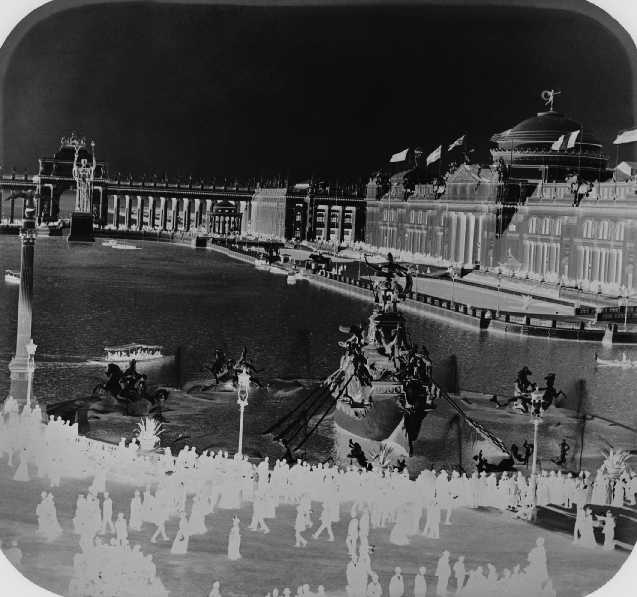
The White City. This photograph captures the scale, grandeur, and classical lines of the Columbia Exposition’s White City. The massive Agriculture Building sits to the right of the Basin.
The Rise of the City
681
The fair’s two square miles of area made it three times as large as the fair in Paris four years before, and the giant Ferris wheel unveiled by exposition planners was meant to rival the Eiffel Tower as an iron and steel architectural marvel.
At the heart of this enterprise was a monumental set of gleaming buildings
called the “White City,” meant to evoke the classical grandeur of Greece and Rome and to trumpet the maturation of American civilization. One set of buildings—
Agriculture, Transportation, Manufacturing, among them—devoted itself to inven-
torying America’s achievements in various economic sectors. Other buildings
celebrated American women, the histories, cultures, and peoples of the individual states, and the contributions of foreign nations to the story of human progress. The Transportation Building, designed by Sullivan, was the most innovative of the fair’s structures, while the Manufactures Building was the largest, covering more than
twice as much area as the Great Pyramid of Egypt and being lit by 120,000 incan-
descent lamps. Steel skeletons held the buildings up; they were sheathed in perishable stucco, unlikely to survive even one Chicago winter. The stucco was easy to work
with, however, and thus allowed architects to unleash their decorative instincts in their building designs.
The individual buildings were carefully laid out around a manmade lagoon
created by landscape master Olmsted himself, who imparted a neoclassical unity
to the entire enterprise. Broad, open courts studded with statuary and interspersed with fountains and parks connected the buildings to each other. It is remarkable
that exposition planners invested so much effort in a “city” meant to exist only
for a few months.
The planners nevertheless hoped that their work would endure as a design and
influence, if not as an actual urban space. Indeed, the White City, an exemplar of Beaux-Art principles, gave rise to a movement of urban architectural renovation
that would become known as the City Beautiful movement. Its carefully composed
vision of urban order, it was hoped, would offer city planners an inspiration for imposing a similar kind of order on the actual urban environments in which they
lived. Metaphorically, the rise of this White City out of the swamps of Jackson
Park south of Chicago symbolized the city’s and the nation’s capacity for rebirth.
A utopian dream of an ordered city and a triumphant industrial civilization, the
White City embodied America’s quest for and belief in perfection.
With paid admissions at 21,480,141 in a nation with a population of 63 mil-
lion, the Columbia Exposition was by far the most successful fair in American history. Americans from all over the country came to marvel at this reincarnation of ancient Rome and to record their impressions in special printed books that thought-fully guided them through the fair, beginning with the category “My first day in the
‘White City.’” The White City did fill many fairgoers with pride and inspiration, much as the planners of the fair hoped it would. Visitors, however, also found their attention drawn to another part of the fair, one that focused on amusement rather than education, and on the dissonances of modern life rather than its classical sym-metry. The Midway Plaisance was a long strip located at some distance from the
White City, full of concessions where one could buy food and drink, engage in
games, line up for rides, including the Ferris wheel, and gaze upon the curiosities that countless small entrepreneurs had gathered into their traveling dime museums and freak shows. This, Daniel Burnham, the fair’s head designer understood, was
682
Chapter 20 Cities, Peoples, Cultures, 1890–1920
“the lighter and more fantastic side of the Fair.” The chaotic variety of its sights and smells proved irresistible to tourists.
Part of Midway’s variety was deliberately ethnographic, as numerous pavilions
displaying life in areas of Africa and Asia were housed here. The accent was on the primitive and exotic: the pavilions did not display the modernizing elites of these faraway places, or their achievements in manufacture or transportation, but rather native peoples supposedly barely touched by civilization. It was hard to miss the implication that civilization occurred in America and Europe, as represented in
the White City, while primitivism belonged to people of color from Africa, the
Middle East, and Asia.
The very structure of the fair thus embodied and reinforced a racial hierar-
chy that posited the superiority of white, middle-class civilization. African
Americans understood how much this hierarchy organized not only America’s
relationship with much of the world but also life within the United States itself.
The anti-lynching crusader Ida B. Wells (see Chapter 18) published a pamphlet,
with contributions from several black leaders, titled “The Reason Why the
Colored American Is Not in the World’s Columbian Exposition.” Exploring the
intertwined histories of American slavery and racism, this pamphlet offered
a detailed accounting of the refusal of fair organizers to include African Ameri-
cans. “Theoretically open to all Americans, the Exposition practically is, literally and figuratively, a ‘White City,’” the pamphlet asserted. Wells boycotted the fair on “Colored American Day,” but former abolitionist Frederick Douglass
attended in order to give a stirring speech. “Men talk of the Negro problem,”
he said. “There is no Negro problem. The problem is whether the American peo-
ple have honesty enough, loyalty enough, honor enough, patriotism enough to
live up to their own Constitution.” Try as it might, the Columbia Exposition
could not erase the question of race; nor could all the striving for unity and placidity in the White City erase the presence in Chicago and every other major
American city of polyglot populations of diverse ethnic origins. These interna-
tional populations constituted the peoples of the American city, and they would
stake a claim to define it as much as the elites who built the palatial museums,
opera houses, and White Cities.
IMMIGRATION
The United States had always been a nation of immigrants, but never had so many
come in so short a time. Between 1880 and 1920, some 23 million immigrants came
to a country that numbered only 76 million in 1900. From 1900 to 1914, an aver-
age of 1 million immigrants arrived each year. In many cities of the Northeast and Midwest, immigrants and their children constituted a majority of the population. In 1920s Boston, New York City, Chicago, and Milwaukee, immigrants accounted for
more than 70 percent of the total population; in Buffalo, Detroit, and Minneapolis, more than 60 percent; and in Philadelphia, Pittsburgh, and Seattle, more than
50 percent. Everywhere in the country, except in the South, the working class was overwhelmingly ethnic.
European immigration accounted for approximately three-fourths of the total.
Some states received significant numbers of non-European immigrants—Chinese,
Immigration
683
Japanese, and Filipinos in California; Mexicans in California and the Southwest;
and French Canadians in New England. Although their presence profoundly
affected regional economies, politics, and culture, their numbers, relative to the number of European immigrants, were small. Immigrants from Latin America were free
to enter the United States throughout this period, but few did until 1910, when the social disorder caused by the Mexican Revolution propelled a stream of refugees to southwestern parts of the United States. Half a million French Canadians had
migrated to New England and the upper Midwest between 1867 and 1901. After
that, the rate slowed as the pace of industrialization in Quebec quickened.
European
Most of the European immigrants who arrived between 1880
Immigration
and 1914 came from Eastern and Southern Europe. Among
them were 3 to 4 million Italians, 2 million Russian and Polish
Jews, 2 million Hungarians, and an estimated 5 million Slavs and other peoples from eastern and southeastern Europe (Poles, Bohemians, Slovaks, Russians, Ukrainians, Lithuanians, Serbians, Croatians, Slovenians, Montenegrins, Bulgarians, Macedonians, and Greeks). Hundreds of thousands came as well from Turkey, Armenia, Lebanon,
Syria, and other Near Eastern lands abutting the European continent.
These post-1880 arrivals were called “new immigrants” to underscore the cul-
tural gap separating them from the “old immigrants,” who had come from north-
western Europe—Great Britain, Scandinavia, and Germany. Old immigrants were
regarded by many native-born Americans as racially fit, culturally sophisticated, and politically mature. The new immigrants, by contrast, were often regarded as
racially inferior, culturally impoverished, and incapable of assimilating American values and traditions. This negative view of the new immigrants reflected in part a fear of their alien languages, religions, and economic backgrounds. Few spoke
English, and most adhered to Catholicism, Orthodoxy, or Judaism rather than Prot-
estantism. Most, with the exception of Jewish immigrants, were peasants, unaccus-
tomed to urban industrial life, but they were not as different from the old
immigrants as the label implied. For example, many of the earlier-arriving Catholic peasants from Ireland and Germany had had no more familiarity with American
values and traditions than did the Italians and Slavs who arrived later.
In fact, the old and new European immigrants were more similar than different.
Both came to America for the same reasons: either to flee religious or political persecution or to escape economic hardship. The United States attracted a small but
steady stream of political refugees throughout the 19th century: labor militants
from England; nationalists from Ireland; socialists and anarchists from Germany,
Russia, Finland, and Italy. Many of these people possessed talents as skilled workers, labor organizers, political agitators, and newspaper editors and thus exercised influence in their ethnic communities. However, only the anti-Semitic policies of Russia in the late 19th and early 20th centuries triggered a mass emigration (in
this case Jewish) of political refugees.
Most mass immigration was propelled instead by economic hardship. Europe’s
rural population was growing faster than the land could support. European facto-
ries absorbed some, but not all, of the rural surplus. Industrialization and urbanization were affecting the European countryside in ways that disrupted rural ways of life. As railroads penetrated rural areas, village artisans found themselves unable to 684
Chapter 20 Cities, Peoples, Cultures, 1890–1920
Other Northwestern
All Others 6%
European 4%
German 4%
Eastern European
German
Asian 4%
Italian 22%
6%
28%
Italian
Canadian 6%
8%
Other Central
European
10%
Other
Scandinavian
Northwestern
11%
European
18%
British
Irish
18%
15%
Russian and Baltic states
Austro-Hungarian
18%
22%
1860–1900
1900–1920
Sources of Immigration
Source: Data from Historical Statistics of the United States, Colonial Times to 1970
(White Plains, NY: Kraus International, 1989), pp. 105–9.
compete with the cheap manufactured goods that arrived from city factories. These handicraftsmen were among the first to emigrate. Meanwhile, rising demand for
food in the cities accelerated the growth of commercial agriculture in the hinterland.
Some peasant families lost their land. Others turned to producing crops for the
market, only to discover that they could not compete with larger, more efficient
producers. In addition, by the last third of the 19th century, peasants faced competition from North American farmers. Prices for agricultural commodities plum-
meted everywhere. The economic squeeze that spread distress among American
farmers in the 1880s and 1890s caused even more hardship among Europe’s peas-
antry, and many of them decided to try their luck in the New World.
An individual’s or family’s decision to emigrate often depended on having a
contact—a family member, relative, or fellow villager—already established in an
American city. These people provided immigrants with a destination, inspiration
(they were examples of success in America), advice about jobs, and financial aid.
Sometimes whole villages in southern Italy or western Russia—or at least all of the young men there—seemed to disappear, only to reappear in a certain section of
Chicago, Pittsburgh, or New York. Villages without contacts in the United States
were relatively unaffected by the emigration mania.
Most immigrants viewed their trip to the United States as a temporary sojourn.
They came not in search of permanent settlement but in search of high wages that
would enable them to improve their economic standing in their homeland. For
them, America was a land of economic opportunity, not a land to call home. This
attitude explains why men vastly outnumbered women and children in the migra-
tion stream. From 1899 to 1910, three-fourths of the immigrants from Southern
and Eastern Europe were adult men. Some had left wives and children behind;
more were single. Most wanted merely to make enough money to buy a farm in
their native land. True to their dream, many did return home. For every 100 Italian immigrants who arrived in the United States between 1907 and 1911, for example,
73 returned to Italy. Before the First World War, an estimated 60 to 80 percent of all Slavic immigrants eventually returned to the land of their birth.
Immigration
685
Bettmann/CORBIS©
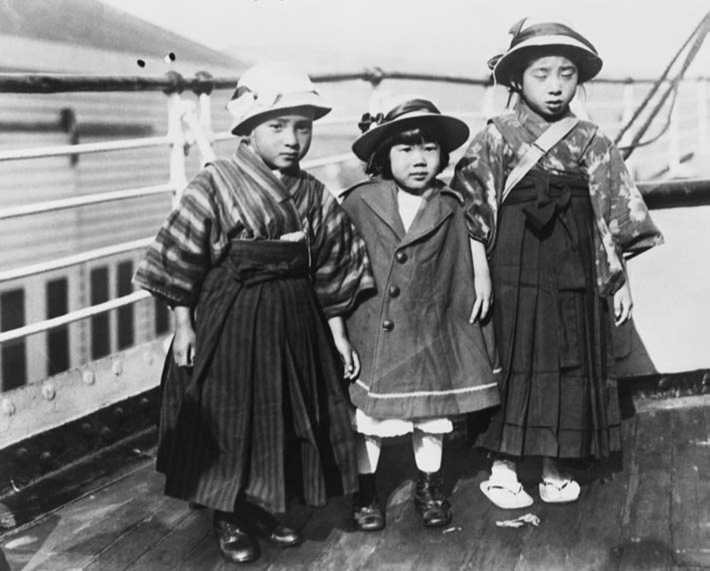
Immigrant Japanese Children Arrive at Angel Island, San Francisco
Harbor, 1905. Beginning in 1907, as a result of the “gentlemen’s agreement” between the United States and Japanese governments, it would no longer be possible for Japanese immigrants such as these children to come to the United States.
The rate of return was negligible among certain groups, however. Jews had lit-
tle desire to return to the religious persecution they had fled, and only 5 percent returned to Europe. The rate of return was also low among the Irish, who saw
few opportunities in their long-suffering (although much-loved) Emerald Isle. In
the early 20th century, however, such groups were exceptional. Most immigrants
looked forward to returning to Europe. Not until the First World War shut down
transatlantic travel did most immigrants begin to regard their presence in the United States as permanent.
Immigration tended to move in rhythm with the U.S. business cycle. It rose
in boom years and fell off during depressions. It remained high during the first
14 years of the new century when the U.S. economy experienced sustained growth,
broken only briefly by the Panic of 1907–08.
Chinese and
The relatively small numbers of Chinese and Japanese
Japanese
immigrants who came to the United States in the late 19th
Immigration
and early 20th centuries reflected the efforts of native-born
Americans and their allies to keep them out. As many as
300,000 Chinese immigrants arrived in the United States between 1851 and 1882,
and more than 200,000 Japanese immigrants journeyed to Hawaii and the western
686
Chapter 20 Cities, Peoples, Cultures, 1890–1920
continental United States between 1891 and 1907. They contributed in major ways
to the development of two of the West’s major industries: railroad building and
commercial agriculture. These two immigrant groups might have formed two of
America’s largest, each numbering in the millions, but the U.S. government began
to exclude Chinese immigrant laborers in 1882 (The Chinese Exclusion Act) and
Japanese immigrant laborers in 1907 (see Chapter 22). The government also inter-
preted a 1790 law to mean that Chinese, Japanese, and other East Asian im-
migrants were ineligible for citizenship. These exclusions remained in force until the 1940s and 1950s. They expressed the racial prejudice felt by most native-born
white Americans toward nonwhite Asian immigrants, and they also revealed how
determined America was to remain a nation of European immigrants and their
descendants.
The factors propelling Chinese and Japanese immigrants were similar to those
motivating their European counterparts. The rural population in those countries
was increasing at a rate faster than the rural economies could support. Chinese
and Japanese rural peasants were being integrated into an international market for agriculture, contributing to the global oversupply of agricultural goods and depress-ing prices. Many Chinese and Japanese immigrants, like their European counter-
parts, intended to move abroad just long enough to make enough money to
establish themselves economically in their homelands. Thus the early streams of
Chinese and Japanese migration to the United States were overwhelmingly com-
posed of men looking for work. Similar to the European immigrants, the Chinese
and Japanese sojourners tended to follow precise migratory paths—from one region
or village in China or Japan to one city or region in the United States.
Conditions in China were more desperate than those in Japan, where industri-
alization had begun to generate new wealth and absorb some of the rural popula-
tion. Chinese immigrants, as a result, often suffered greater hardship than did their Japanese counterparts. In the 19th century, many were forced to sign contracts with suppliers of overseas laborers that subjected them to slave-like conditions: They were herded onto boats for the transpacific voyage, bound to particular employers for years on end, thrust into dangerous working conditions, and paid paltry wages.
The conditions of their labor in the western states where they tended to settle
inflamed the sentiments of white working men, who saw the Asian migration as a
threat to their own wages and livelihoods. These white workers might have made
common cause with Asian immigrant workers, but the racial prejudice they har-
bored toward the “yellow hordes” was simply too great. White workers became
leaders of the movements in the western states to keep these immigrants out.
Significant numbers of Chinese and Japanese immigrants continued to try to
enter the United States during the period of Asian immigrant exclusion—after
1882 in the case of the Chinese and after 1907 in the case of the Japanese. Some
were desperate to reunite with family members already living in the United States, while others were driven to escape deteriorating economic circumstances in their
homeland. Many attempted to enter the United States with forged papers declaring
them to be merchants (a permitted class of Chinese and Japanese immigrants) when
they were not, or that they had been resident in the United States before the exclusion laws had gone into effect (and thus entitled to return). San Francisco was their principal port of entry, and Angel Island, in San Francisco harbor, became the
Immigration
687
counterpart of Ellis Island in New York harbor: the place where inspectors for the U.S. Bureau of Immigration interrogated them and scrutinized their documents and, more often than not, sent them back to Asia.
Other East Asian immigrants attempted to enter the United States through
Canada or Mexico, hoping to find a non-patrolled part of the land border and to
cross into the United States undetected. They became, in effect, America’s first illegal aliens. That a certain percentage of East Asian immigrants had entered the
country illegally, and were subject to deportation, generated considerable fear
among the Asian immigrant populations resident in the United States, deepening
tendencies within these communities to secrecy and to separation from mainstream
American culture and society. Despite these considerable hardships, Asian immi-
grants would prove to be resourceful and would find ways to build homes and
livelihoods in America.
Immigrant Labor
In the first decade of the 20th century, immigrant men and
their male children constituted 70 percent of the workforce
in 15 of the 19 leading U.S. industries. They concentrated in industries where
work was the most backbreaking. Immigrants built the nation’s railroads and
tunnels; mined its coal, iron ore, and other minerals; stoked its hot and sometimes deadly steel furnaces; and slaughtered and packed its meat in Chicago’s putrid
packinghouses. In 1909, first- and second-generation immigrants—especially
Greeks, Italians, Japanese, and Mexicans—constituted more than 96 percent of
the labor force that built and maintained the nation’s railroads. Of the 750,000
Slovaks who arrived in America before 1913, at least 600,000 headed for the coal
mines and steel mills of western Pennsylvania. The steel mills of Pittsburgh,
Buffalo, Cleveland, and Chicago also attracted disproportionately large numbers
of Poles and other Slavs.
Immigrants also performed “lighter” but no less arduous work. Jews and
Italians predominated in the garment manufacturing shops of New York City,
Chicago, Philadelphia, Baltimore, and Boston. In 1900, French-Canadian immi-
grants and their children held one of every two jobs in New England’s cotton tex-
tile industry. By 1920, the prosperity of California’s rapidly growing agricultural industry depended primarily on Mexican and Filipino labor. In these industries,
immigrant women and children, who worked for lower wages than men, formed
a large part of the labor force. Few states restricted child labor. More than
25 percent of boys and 10 percent of girls aged 10 to 15 were “gainfully employed.”
Immigrants were as essential as fossil fuels to the smooth operation of the
American economic machine. Sometimes, however, the machine consumed workers
as well as coal and oil. Those who worked in heavy industry, mining, or railroading were especially vulnerable to accident and injury. In 1901, for instance, 1 in every 400 railroad workers died on the job and 1 in every 26 suffered injury. Between the years 1906 and 1911, almost one-quarter of the recent immigrants employed at the
U.S. Steel Corporation’s South Works (Pittsburgh) were injured or killed on the job.
Lax attention to safety rendered even light industry hazardous and sometimes fatal.
In 1911, a fire broke out on an upper floor of the Triangle Shirtwaist Company, a New York City garment factory. The building had no fire escapes. The owners of the factory, moreover, had locked the entrances to each floor as a way of keeping their 688
Chapter 20 Cities, Peoples, Cultures, 1890–1920
employees at work. A total of 146 workers, mostly young Jewish and Italian women, perished in the fire or from desperate nine-story leaps to the pavement below.
Chronic fatigue and inadequate nourishment increased the risk of accident and
injury. Workweeks averaged 60 hours—10 hours every day except Sunday. Work-
ers who were granted Saturday afternoons off, thus reducing their workweek to 55
hours, considered themselves fortunate. Steelworkers were not so lucky. They la-
bored from 72 to 89 hours per week and were required to work one 24-hour shift
every two weeks.
Most workers had to labor long hours simply to eke out a meager living. In
1900, the annual earnings of American manufacturing workers averaged only
$400 to $500 per year. Skilled jobs offered immigrants far more (as much as
$1,500 to $2,000 per year), but most of these jobs were held by Yankees and by
Germans, Irish, Welsh, and other “old immigrant” Europeans. Through their
unions, workers of Northern European extraction also controlled access to new
jobs that opened up and usually managed to fill them with a son, relative, or fellow countryman. Consequently, relatively few of the new immigrants rose into the prosperous ranks of skilled labor. In any case, employers were replacing many skilled workers with machines operated by cheaply paid operatives.
From the 1870s to 1910, real wages paid to factory workers and common
laborers did rise, but not steadily. Wages fell sharply during depressions, and the hope for increases during periods of recovery often collapsed under the weight of renewed mass immigration, which brought hundreds of thousands of new job seekers into the labor market. One of every five industrial workers was unemployed,
even during the boom years of the early 20th century.
Most working families required two or three wage earners to survive. If a
mother could not go out to work because she had small children at home, she
might rent rooms to some of the many single men who had recently immigrated.
But economic security was difficult to attain. In his 1904 book, Poverty, social
investigator Robert Hunter conservatively estimated that 20 percent of the industrial population of the North lived in poverty.
Living
Strained economic circumstances confined many working-
Conditions
class families to cramped and dilapidated living quarters.
Many of them lived in two- or three-room apartments, with
several people sleeping in each room. To make ends meet, one immigrant
New York City family of eight living in a two-room apartment took in six boarders.
Some boarders considered themselves lucky to have their own bed. That luxury
was denied the 14 Slovaks who shared eight beds in a small Pittsburgh apartment
and the New York City printer who slept on a door he unhinged every night and
balanced across two chairs. The lack of windows in city tenements allowed little
light or air into these apartments. Crowding was endemic. The population density
of New York City’s Lower East Side—where most of the city’s Jewish immigrants
settled—reached 700 per acre in 1900, a density matching or exceeding that of the world’s poorest cities. Overcrowding and poor sanitation resulted in high rates of infectious diseases, especially diphtheria, typhoid fever, and pneumonia. In the
early years of the twentieth century, improvements in the quality of housing and
public health finally began to ease the dangers of urban life.
Building Ethnic Communities
689
BUILDING ETHNIC COMMUNITIES
The immigrants may have been poor, but they were not helpless. Migration had
required a good deal of resourcefulness, self-help, and mutual aid—assets that survived in the new surroundings of American cities.
A Network of
Each ethnic group quickly established a network of institu-
Institutions
tions that supplied a sense of community and multiplied
sources of communal assistance. Some immigrants simply
reproduced those institutions that had been important to them in the Old Country.
The devout established churches and synagogues. Lithuanian, Jewish, and Italian
radicals reestablished Old World socialist and anarchist organizations. Irish na-
tionalists set up clandestine chapters of the Clan Na Gael to keep alive the struggle to free Ireland from the English. Germans felt at home in their traditional Turnevereins (athletic clubs) and musical societies.
Immigrants developed new institutions as well. In the larger cities, foreign-
language newspapers disseminated news, advice, and culture. Each ethnic group
created fraternal societies to bring together immigrants who had known each other in the Old Country, or who shared the same craft, or who had come from the same
town or region. Most of these societies provided members with a death benefit
(ranging from a few hundred to a thousand dollars) that guaranteed the deceased
a decent burial and the family a bit of cash. Some fraternal societies made small loans as well. Among those ethnic groups that prized home ownership, especially
the Slavic groups, the fraternal societies also provided mortgage money. And all of them served as centers of sociability—places to have a drink, play cards, or simply relax with fellow countrymen. The joy, solace, and solidarity these groups generated helped countless immigrants adjust to American life.
The Emergence
Within each ethnic group, a sizable minority directed their
of an Ethnic
talents and ambitions toward economic gain. Some of these
Middle Class
entrepreneurs addressed their communities’ needs for basic
goods and services. Immigrants preferred to buy from fellow
countrymen with whom they shared a language, a history, and presumably a bond of
trust. Enterprising individuals responded by opening dry-goods stores, food shops, butcher shops, and saloons in their ethnic neighborhoods. Those who could not afford to rent a store hawked their fruit, clothing, or dry goods from portable stands,
wagons, or sacks carried on their backs. The work was endless and the competition tough. Men often enlisted the entire family—wife, older children, younger children—in their undertakings. Few family members were ever paid for their labor, no matter how long or hard they worked. Although many of these small businesses failed, enough
survived to give some immigrants and their children a toehold in the middle class.
Other immigrants turned to small industry, particularly garment manufacture,
truck farming, and construction. A clothing manufacturer needed only a few sewing machines to become competitive. Many Jewish immigrants, having been tailors in
Russia and Poland, opened such facilities. If a rented space proved beyond their
means, they set up shop in their own apartments. Competition among these small
690
Chapter 20 Cities, Peoples, Cultures, 1890–1920
manufacturers was fierce, and critics condemned the work environments as
“sweatshops.” Workers suffered from inadequate lighting, heat, and ventilation;
12-hour workdays and 70-hour workweeks during peak seasons, with every hour
spent bent over a sewing machine; and poor pay and no employment security, espe-
cially for the women and children who made up a large part of this labor force.
Even at this level of exploitation, many small manufacturers failed; but over time, significant numbers of them managed to firm up their position as manufacturers
and to evolve into stable, responsible employers. Their success contributed to the emergence of a Jewish middle class.
The story was much the same in urban construction, where Italians who had
established themselves as labor contractors, or padroni, went into business for
themselves to take advantage of the rapid expansion of American cities. Although
few became general contractors on major downtown projects, many of them did
well building family residences or serving as subcontractors on larger buildings.
One who did make the leap from small to big business was Amadeo P. Giannini,
the son of Italian immigrants, who used his savings from a San Francisco fruit and vegetable stand to launch a career in banking. Determined to make bank loans available and affordable to people of ordinary means, Giannini generated a huge business in small loans. Expanding on his ethnic base of small depositors, he eventually made his bank—the Bank of America—into the country’s largest financial institution.
In southern California, Japanese immigrants chose agriculture as their route to
the middle class. Working as agricultural laborers in the 1890s, they began to
acquire their own land in the early years of the 20th century. Altogether, they
owned only 1 percent of California’s total farm acreage. Their specialization in
fresh vegetables and fruits (particularly strawberries), combined with their family-labor-intensive agricultural methods, was yielding $67 million in annual revenues by 1919—one-tenth of the total California agriculture revenue that year. Japanese farmers sold their produce to Japanese fruit and vegetable wholesalers in Los
Angeles, who had chosen a mercantile route to middle-class status. The success of Japanese farmers was all the more impressive given that the state of California had passed the Alien Land Law in 1913, prohibiting Japanese and other Asian aliens
from owning property in the state. Japanese immigrant farmers thus depended on
their native-born children or friendly whites to acquire land for them, arrangements that made them more vulnerable to losing the land—or control of it—than if they
had been able to own it outright themselves.
Each ethnic group created its own history of economic success and social
mobility. From the emerging middle classes came leaders who would provide their
ethnic groups with identity, legitimacy, and power and would lead the way toward
Americanization and assimilation. Their children tended to do better in school than the children of working-class ethnics, and academic success served as a ticket to upward social mobility in a society that increasingly depended on university-trained engineers, managers, lawyers, doctors, and other professionals.
Political
The underside of this success story was the rise of govern-
Machines and
ment corruption and organized crime. Many ethnic en-
Organized Crime
trepreneurs operated on the margins of economic failure and
bankruptcy, and some accepted the help of those who
Building Ethnic Communities
691
promised financial assistance. Sometimes the help came from honest unions and
upright government officials, but other times it did not. Unions were generally
weak, and some government officials, lacking experience and economic security,
were susceptible to bribery. Economic necessity became a breeding ground for gov-
ernment corruption and greed. A contractor who was eager to win a city contract—
to build a trolley system, a sewer line, or a new city hall, for example—would find it necessary to pay off government officials who could throw the contract his
way. By 1900, such payments, referred to as “graft,” had become essential to the
day-to-day operation of government in most large cities. Graft, in turn, made
local office holding a source of economic gain. Politicians began building political organizations called machines to guarantee their success in municipal elections.
The machine “bosses” used a variety of legal and illegal means to bring victory
on Election Day. They won the loyalty of urban voters—especially immigrants—
by providing poor neighborhoods with paved roads and sewer systems. They
helped newly arrived immigrants find jobs (often on city payrolls) and
occasionally provided food, fuel, or clothing to families in need. Many of their
clients were grateful for these services in an age when government provided little public assistance.
The bosses who ran the political machines—including “King Richard” Croker
in New York, James Michael Curley in Boston, Tom Pendergast in Kansas City,
Martin Behrman in New Orleans, and Abe Ruef in San Francisco—served their
own needs first. They saw to it that construction contracts went to those who of-
fered the most graft, not to those who were likely to do the best job. They protected gamblers, pimps, and other purveyors of urban vice who contributed large amounts
to their machine coffers. They often required city employees to contribute to their campaign chests, to solicit political contributions, and to get out the vote on Election Day. And they engaged in widespread election fraud by rounding up truck-
loads of newly arrived immigrants and paying them to vote a certain way; having
their supporters vote two or three times; and stuffing ballot boxes with the votes of phantom citizens who had died, moved away, or never been born.
Big-city machines, then, were both positive and negative forces in urban life.
Reformers despised them for disregarding election laws and encouraging vice, but
many immigrants valued them for providing social welfare services and for creating opportunities for upward mobility.
The history of President John F. Kennedy’s family offers one example of
the economic and political opportunities opened up by machine politics. Both of
Kennedy’s grandfathers, John Francis Fitzgerald (“Honey Fitz”) and Patrick Joseph Kennedy, were the children of penniless Irish immigrants who arrived in Boston in the 1840s. Fitzgerald excelled at academics and won a coveted place in Harvard’s
Medical School but left Harvard that same year, choosing a career in politics
instead. Between 1891 and 1905, Fitzgerald served as a Boston city councilor,
Massachusetts state congressman and senator, U.S. congressman, and mayor of
Boston. For much of this period, he derived considerable income and power from
his position as the North End Ward boss, where he supervised the trading of
jobs for votes and favors for cash in his section of Boston’s Democratic and
Irish-dominated political machine.
Patrick Kennedy, an East Boston tavern owner and liquor merchant, became an
equally important figure in Boston city politics. In addition to running the
692
Chapter 20 Cities, Peoples, Cultures, 1890–1920
Democratic Party’s affairs in Ward Two, he served on the Strategy Board, a secret council of Boston’s machine politicians that met regularly to devise policies, settle disputes, and divide up graft. Both Fitzgerald and Kennedy derived a substantial
income from their political work and used it to lift their families into middle-class prosperity. Kennedy’s son (and the future president’s father), Joseph P. Kennedy, would go on to make a fortune as a Wall Street speculator and liquor distributor
and to groom his sons for Harvard and the highest political offices in the land.
His rapid economic and social ascent had been made possible by his father’s and
father-in-law’s earlier success in Boston machine politics.
Underworld figures, too, influenced urban life. In the early years of the 20th
century, gangsterism was a scourge of Italian neighborhoods, where Sicilian immi-
grants had established outposts of the notorious Mafia, and in Irish, Jewish,
Chinese, and other ethnic communities as well. Favorite targets of these gangsters were small-scale manufacturers and contractors, who were threatened with violence and economic ruin if they did not pay a gang for “protection.” Gangsters imposed
their demands with physical force, beating up or killing those who failed to abide by the “rules.” In Chinese communities, secret societies originating in China, or tongs, and initially set up in America to strengthen communal life among the immigrants, occasionally crossed the line into crime. Sometimes this transition resulted from good intentions—for example, tong members might smuggle into the United
States the wife and children of an immigrant Chinese man who had no legal way
of reuniting his family—but other times, tongs became enmeshed in far more dam-
aging criminal activities such as the opium trade, prostitution, and gambling.
Greedy for money, power, and fame, and willing to use any means necessary,
many immigrant and ethnic criminals considered themselves authentic entrepre-
neurs cut from the American mold. By the 1920s, petty extortion had escalated in
urban areas, and underworld crime had become big business. Al Capone, the ruth-
less Chicago mobster who made a fortune from gambling, prostitution, and bootleg
liquor during Prohibition, once quipped: “Prohibition is a business. All I do is to supply a public demand. I do it in the best and least harmful way I can.”
New York City’s Arnold Rothstein, whose financial sophistication won him a gam-
bling empire and the power to fix the 1919 World Series, nurtured his reputation as
“the J. P. Morgan of the underworld.” Mobsters like Rothstein and Capone were
charismatic figures, both in their ethnic communities and in the nation at large.
Few immigrants, however, followed their criminal path to economic success.
AFRICAN AMERICAN LABOR AND COMMUNITY
Unlike immigrants, African Americans remained a predominantly rural and south-
ern people in the early 20th century. Most blacks were sharecroppers and tenant
farmers. The markets for cotton and other southern crops had stabilized in the early 20th century, but black farmers remained vulnerable to exploitation. Landowners,
most of them white, often forced sharecroppers to accept artificially low prices for their crops. At the same time, they charged high prices for seed, tools, and groceries at the local stores they controlled. Few rural areas generated enough business to support more than one store or to create a competitive climate that might force
prices down. Those sharecroppers who traveled elsewhere to sell their crops or
African American Labor and Community
693
purchase their necessities risked retaliation—either physical assaults by white vigilantes or eviction from their land. Thus, most remained beholden to their land-
owners, mired in poverty and debt.
Some African Americans sought a better life by migrating to industrial areas of the South and the North. In the South, they worked in iron and coal mines, in furniture and cigarette manufacture, as railroad track layers and longshoremen, and as laborers in the steel mills of Birmingham, Alabama. By the early 20th century, their presence was growing in the urban North as well, where they worked on the fringes of industry as janitors, elevator operators, teamsters, and servants of various kinds. Altogether, about 200,000 blacks left the South for the North and West between 1890 and 1910.
In southern industries, blacks were subjected to hardships and indignities that
even the newest immigrants were not expected to endure. Railroad contractors in
the South, for example, treated their black track layers like prisoners. Armed guards marched them to work in the morning and back at night. Track layers were paid
only once a month and forced to purchase food at the company commissary, where
the high prices claimed most of what they earned. Their belongings were locked up to discourage them from running away. Although other southern employers of
black workers did not engage in labor practices as harsh as those of the railroad contractors, they still confined blacks to the dirtiest and most grueling jobs. The Jim Crow laws passed by every southern state legislature in the 1890s legalized
this rigid separation of the black and white races (see Chapter 18).
The nation’s worsening racial climate adversely affected the southern blacks
who moved north, even though these migrants had moved to states that generally
did not have Jim Crow laws. Northern industrialists generally refused to hire black migrants for manufacturing jobs, preferring the labor of European immigrants.
Only when those immigrants went on strike did employers turn to African Ameri-
cans. Black workers first gained a foothold in the Chicago meatpacking industry in 1904, when 28,000 immigrant packinghouse workers walked off their jobs.
Employers hoped that the use of black strike-breakers would inflame racial tensions between white and black workers and thus undermine labor unity and strength.
African Americans who had long resided in northern urban areas also experi-
enced intensifying discrimination in the late 19th and early 20th centuries. In 1870, about one-third of the black men in many northern cities had been skilled tradesmen: blacksmiths, painters, shoemakers, and carpenters. Serving both black and
white clients, these men enjoyed steady work and good pay, but by 1910 only 10
percent of black men made a living in this way. In many cities, the number of barber shops and food catering businesses owned by blacks also went into sharp
decline, as did black representation in the ranks of restaurant and hotel waiters.
These barbers, food caterers, and waiters had formed a black middle class whose
livelihood depended on the patronage of white clients. By the early 20th century, this middle class was in decline, the victim of growing racism. Whites were no longer willing to engage the services of blacks, preferring to have their hair cut, beards shaved, and food prepared and served by European immigrants. The residential segregation of northern blacks also rose in these years, as whites excluded them from growing numbers of urban neighborhoods.
African Americans did not lack for resourcefulness. In urban areas of settle-
ment, they laced their communities with the same array of institutions—churches,
694
Chapter 20 Cities, Peoples, Cultures, 1890–1920
fraternal insurance societies, political organizations—that solidified ethnic neighborhoods. A new black middle class arose consisting of ministers, professionals,
and businesspeople who serviced the needs of their racial group. Black-owned real estate agencies, funeral homes, doctors’ offices, newspapers, groceries, restaurants, and bars opened for business on the commercial thoroughfares of African American
neighborhoods. Many businessmen had been inspired by the words of black educa-
tor Booker T. Washington, and specifically by his argument that blacks should
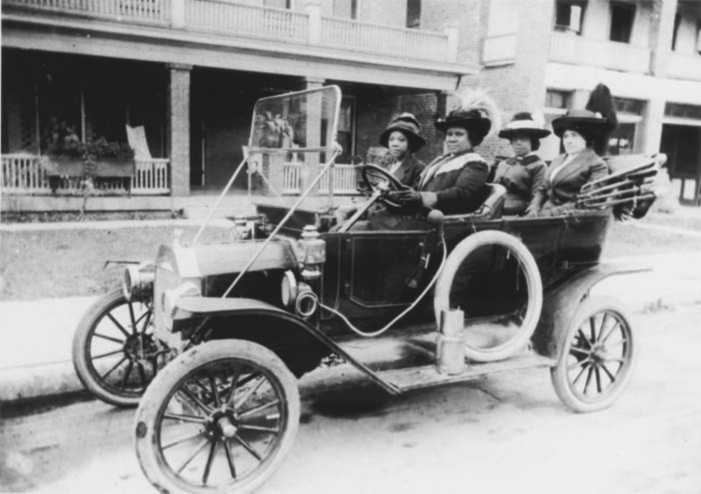
devote themselves to self-help and self-sufficiency. Madame C. J. Walker offers one example of a black woman who built a lucrative business from the hair and skin
lotions she devised and sold to black customers throughout the country. In many
cities, African American real estate agents achieved significant wealth and power.
Nevertheless, entrepreneurial success remained a tougher task among African
Americans than among immigrants. Black communities were often smaller and
poorer than their white ethnic ones; economic opportunities were fewer, and black businessmen found it more difficult than their white ethnic counterparts to cultivate customers outside of their core community. Racial prejudice stood as an obstacle to black business success. Meanwhile, blacks were so marginalized in politics that they had little opportunity to gain power or wealth through holding political office or controlling a political machine. Thus the African American middle class remained
smaller and more precarious than did its counterpart in ethnic communities, less
able to lead the way toward affluence and assimilation.
Collection/www.madamcjwalker.com
Family
Bundles/Walker
A’Lelia
Madame C. J. Walker. This prominent African American entrepreneur, pictured here
behind the wheel of her car, built a successful business selling hair and skin lotions to black customers throughout the country.
Working-class and Commercial Culture
695
WORKING-CLASS AND COMMERCIAL CULTURE
As much as the white elites and their middle-class allies attempted to impose a genteel order on city life, the city’s vitality escaped such bounds. Most workers shared in a new culture of commercial entertainment that included dance halls, music halls, vaudeville theaters, nickelodeons (early storefront movie theaters), amusement
parks, and ball parks. Storefront vaudeville theaters, for instance, began to advertise “cheap amusements” to a broad working public in the 1880s. With roots in
such antebellum entertainments as minstrelsy, circuses, and dime museums, vaude-
ville shows offered a variety of miscellaneous short acts for only a dime: a typical show might include sentimental ballads, acrobats, soft-shoe dances, magicians,
mind readers, one-act plays, blackface minstrelsy, sports stars from baseball or boxing, puppeteers, jugglers, and dancing bears. Not considered respectable middle-
class fare at first, vaudeville became increasingly popular and eventually became a cross-class, national phenomenon.
Amusement parks such as Steeplechase Park at Coney Island, built in 1895,
attracted a large working-class audience of men and women while soon also appeal-
ing to middle-class youth. Older middle-class commentators found the unchaperoned mingling of young men and women in an urban public space troubling, even shocking, but that loosening of restraint was what made Coney Island so pleasurable and exciting. A new kind of institution in American life, Coney Island was a structured world promoting gaiety and play, with dozens of rides and titillating attractions such as the “Blowhole Theater,” whose jets of air blew women’s skirts up. “Will
she throw her arms around your neck and yell?” asked a sign for the “Cannon
Coaster,” providing its own answer: “Well, I guess, yes!”
The rides at Coney Island offered young men and women a temporary escape
from their industrial working lives, yet ironically enough many of the rides themselves imitated the industrial workplace. The 1884 Switchback Railroad, for
instance, an early precursor to the roller coaster, was directly inspired by the operation of gravity-powered coal cars in the shafts of coal mines. New innovations in technology and transportation found a pleasurable mirror at Coney Island and at
the other amusement parks around the country that quickly sprang up in imitation.
While vaudeville theaters and amusement parks at first attracted a primarily
working-class crowd of pleasure-seekers, they appealed to growing middle-class
audiences as well. These cross-class populations were the ones drawn in such large numbers to the sights and sounds of the Midway at the 1893 Columbia Exposition,
their attraction to commercial entertainment on that strip subverting the work of those elites who were attempting to impose “White City” notions of order and
demeanor on America’s city dwellers.
Popular
Just as in the antebellum period, urban workers read a wide
Literature
variety of dime novels (paperbacks that sold for a dime; see
Chapter 10) and newspapers. Beginning in the 1860s and
1870s, a flourishing cheap literature reflected the presence of working women in
the new industrial order: the popular 1871 story “Bertha the Sewing Machine Girl; or, Death at the Wheel,” inspired many imitators and was staged as a popular play 696
Chapter 20 Cities, Peoples, Cultures, 1890–1920
Nickelodeons in Major American Cities, 1910
Nickelodeons
Seating
Population
Cities
Population
(estimate)
Capacity
per Seat
New York
4,338,322
450
150,000
29
Chicago
2,000,000
310
93,000
22
Philadelphia
1,491,082
160
57,000
26
St. Louis
824,000
142
50,410
16
Cleveland
600,000
75
22,500
27
Baltimore
600,000
83
24,900
24
San Francisco
400,000
68
32,400
12
Cincinnati
350,000
75
22,500
16
New Orleans
325,000
28
5,600
58
Source: Garth Jowett, Film: The Democratic Art (Boston: Little, Brown, 1976), p. 46.
in New York City. Its author, Laura Jane Libbey, published more than 60 novels in the 1880s appealing to a working-class audience. Working women read a variety of
romances as well, purchasing dime novels from newsstands and pushcarts in large
cities. Featuring wealthy heroines or working women who discovered that by birth
they were actually aristocrats, these romantic tales offered fantasies that—in imagination, at least—closed the gulf between the classes. Dime novels appealing to
working-class men often told heroic stories of working-class manhood in which
men overcame numerous obstacles to become the foremen or owners of factories.
Such stories allowed a form of imagined compensation for the loss of independence men actually experienced as permanent wage earners.
If literature gestured toward the past, another form of commercial entertain-
ment, the movies, pointed toward the future. Movies were well suited to poor city dwellers with little money, little free time, and little command of the English language. Initially, the movies cost only a nickel. The “nickelodeons” where they
were shown were usually converted storefronts in working-class neighborhoods.
Movies required little leisure time because at first they lasted only 15 minutes on average. Viewers with more time on their hands could stay for a cycle of two or
three films (or for several cycles). And even non-English-speakers could understand what was happening on the “silent screen.” By 1910, at least 20,000 nickelodeons
dotted northern cities.
These early “moving pictures” were primitive by today’s standards, but they
were thrilling just the same. The figures appearing on the screen were “larger than life.” Moviegoers could transport themselves to parts of the world they would otherwise never see, encounter people they would otherwise never meet, and watch
boxing matches they could otherwise not afford to attend. The darkened theater
provided a setting in which secret desires, especially sexual ones, could be explored.
As one newspaper breathlessly commented in 1899: “For the first time in the his-
tory of the world it is possible to see what a kiss looks like.”
The New Sexuality and the Rise of Feminism
697
No easy generalizations are possible about the content of these early films,
more than half of which came from France, Germany, and Italy. American-made
films tended toward slapstick comedies, adventure stories, and romances such as
those generated by Buster Keaton and Fatty Arbuckle, two silent screen stars (see the History Through Film feature). Producers did not yet shy away, as they soon
would, from the lustier or seedier sides of American life. The Hollywood formula
of happy endings had yet to be worked out. In fact, the industry, centered in New York City and Fort Lee, New Jersey, had yet to locate itself in sunny southern
California. In 1914, the movies’ first sex symbol, Theda Bara, debuted in a movie that showed her tempting an upstanding American ambassador into infidelity and
ruin. She would be the first of the big screen’s vamps, so-called because the characters they portrayed, like vampires, thrived on the blood (and death) of men.
THE NEW SEXUALITY AND THE RISE OF FEMINISM
The appearance of the vamp was one sign that popular culture had become an
arena in which Americans were beginning to experiment with more open expres-
sions of sexuality. Another sign was the growing number of women who began
insisting that they be accorded the same sexual freedom long enjoyed by men. This impulse was strongest among young, single, working-class women who were entering the workforce in large numbers and mixing at workplaces, in loosely supervised ways, with men their own age. The associations between young men and women
that sprang up at work carried over into their leisure. Young people of both sexes flocked to the dance halls that were opening in every major city. They rejected the stiff formality of earlier ballroom dances such as the cotillion or the waltz for the freedom and intimacy of newer forms, such as the foxtrot, tango, and bunny-hug.
They went to movies and to amusement parks together, and they engaged, far more
than their parents had, in premarital sex. It is estimated that the proportion of women having sex before marriage rose from 10 to 25 percent in the generation
that was coming of age between 1910 and 1920.
This movement toward sexual freedom was one expression of women’s dissat-
isfaction with the restrictions that had been imposed on them by earlier generations.
By the second decade of the 20th century, eloquent spokeswomen had emerged to
make the case for full female freedom and equality. The author Charlotte Perkins
Gilman called for the release of women from domestic chores through the collectiv-ization of housekeeping. Social activist Margaret Sanger insisted in her lectures on birth control that women should be free to enjoy sexual relations without having to worry about unwanted motherhood. The anarchist Emma Goldman denounced
marriage as a kind of prostitution and embraced the ideal of “free love”—love
unburdened by contractual commitment. Alice Paul, founder of the National
Women’s Party, brought a new militancy to the campaign for woman suffrage (see
Chapter 21).
These women were among the first to use the term feminism to describe their
desire for complete equality with men. Some of them came together in Greenwich
Village, a community of radical artists and writers in lower Manhattan, where
they found a supportive environment in which to express and live by their feminist ideals. Crystal Eastman, a leader of the feminist Greenwich Village group called
698
Chapter 20 Cities, Peoples, Cultures, 1890–1920
HISTORY THROUGH FILM
Coney Island (1917)
Directed by Roscoe “Fatty” Arbuckle
At the beginning of the film, Buster
(uncredited). Starring Roscoe “Fatty”
Keaton’s character watches a parade
Arbuckle (Fatty), Buster Keaton (Rival),
with his girlfriend (Alice Mann) before
Alice Mann (Love Interest), Agnes Neilson
the two decide to enter Luna Park.
(Fatty’s Wife), and Al St. John (Old Friend).
When Keaton comes up short on the
entry fee, his lady friend drops him for
Coney Island was one of the first silent
a man who has the admission cash (Al
films to feature a classic comedy duo:
St. John). Meanwhile, Fatty sits, bored,
Roscoe “Fatty” Arbuckle and Buster Kea-
on the beach with his dowdy wife, but
ton. The two met through a mutual friend
he eventually sneaks away from her after
in New York City in 1917 and quickly
burying himself in the sand to hide. For
struck up a silver-screen partnership.
the rest of the film, Keaton, Arbuckle,
Arbuckle, already a silent movie star, and
and St. John vie for Mann’s attention,
Keaton, a veteran of the vaudeville circuit,
punching and pranking each other in the
crafted a crude, slapstick tour de force of
process. Keaton eventually wins back
pratfalls, gags, and fights. It was the begin-
Mann’s affection, and Fatty and St. John
ning of a popular style of comedy on film,
swear off women altogether, until they
the fat/skinny buddy pic, which would be
spy another young lady and run after her.
recast in famous teams like Abbot and
The raucous style of physical comedy
Costello, Laurel and Hardy, and to an
that dominates this film offers us a
extent, the Three Stooges.
glimpse of the values then coursing their
Coney Island opens to images of
way through working-class commercial
Luna Park at night, brightly lit towers,
culture. The cinematic displays of infor-
luminescent avenues, mechanized roller
mal association between men and women,
coasters. Highlighting these modern
of adventure and sexuality, had been
inventions, the film showcases the tech-
inspired by behaviors that many young
nological innovations of the late 19th
urban dwellers, including sizable numbers
and early 20th century. Coney Island
of immigrants, had themselves embraced.
itself—its state-of-the-art rides (The
The film is notable, too, for the breadth of
Witching Waves, Chutes), its street ven-
its attack on social conventions and
dors hawking ice cream and candy, its
authority figures. In the movie, no rela-
carnival-like,
consumer-driven
atmo-
tionship is sacred (the primary narrative
sphere—is one of the most prominent
follows Fatty’s attempts to cheat on his
“characters” in the film. It is cast as hav-
wife), no authority figure powerful (the
ing irresistible allure. Like the Midway
inadequate and often thickly mustachioed
Plaisance and in contrast to the White
Keystone Kops all end up locked in jail,
City, Coney Island sought to fill urban
knocked out cold), and no gender line
dwellers’ leisure time with adventure and
firm (Fatty cross-dresses to disguise him-
fun rather than with moral improvement.
self from his wife). While the assault on
Heterodoxy, defined the feminist challenge as “how to arrange the world so that
women can be human beings, with a chance to exercise their infinitely varied gifts in infinitely varied ways, instead of being destined by the accident of their sex to one field of activity.”
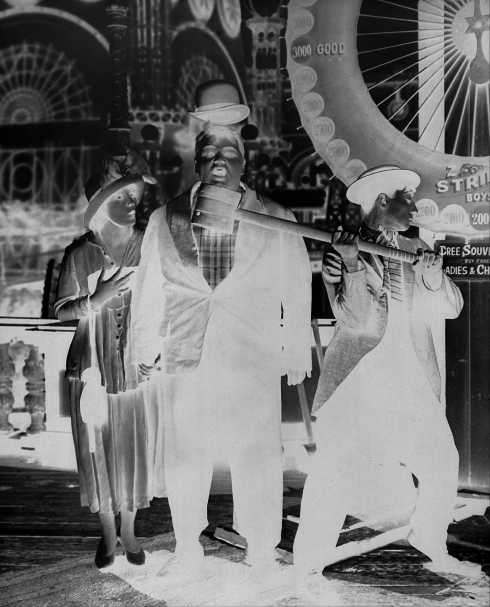
The New Sexuality and the Rise of Feminism
699
Fatty Arbuckle (center)
getting clobbered by
Buster Keaton (right) in a
scene from Coney Island.
Their love interest, played
by Alice Mann, looks on.
Collection
Everettof
Courtesy
authority in the movie is presented in a
in the movies became the rule of the day,
hilarious style, it carries a more serious
lords of cinematic anarchy, like Arbuckle,
message: namely that working-class indi-
lost their footing. In fact, Arbuckle’s career
viduals were going to make their own way
crashed in the twenties. In 1921, actress
in the world. It is precisely these declara-
Virginia Rappe died four days after attend-
tions of cultural independence that made
ing a bootleg liquor party at Fatty’s San
urban elites and their middle-class allies so
Francisco apartment. Arbuckle was accused
anxious about their ability to impose their
of rape and was tried three times for
own sense of order and morality on city life.
manslaughter. Though eventually acquit-
By the 1920s executives in the movie
ted, his career as an actor never recovered.
industry had taken steps to expunge
He died in 1933 of a heart attack at age 46.
Arbuckle-style antics from their films, and
Buster Keaton, however, went on to become
to make these art forms more suitable for
a successful actor, sharing the Hollywood
refined middle-class audiences. Once decorum
limelight with the likes of Charlie Chaplin.
The movement for sexual and gender equality aroused considerable anxiety.
Parents worried about the promiscuity of their children. Conservatives were certain that sexual assertiveness among women would transform American cities into dens
of iniquity. Vice commissions sprang up in every major city to clamp down on
700
Chapter 20 Cities, Peoples, Cultures, 1890–1920
prostitution, drunkenness, and pornography. The campaign for prohibition—a ban
on the sale of alcoholic beverages—gathered steam. Movie theater owners were
pressured into excluding “indecent” films from their screens. Many believed lurid tales of international vice lords scouring foreign lands for innocent girls who could be delivered to American brothel owners. This “white slave trade” inspired passage of the 1910 Mann Act, which made the transportation of women across state lines
for immoral purposes a federal crime (on the Mann Act, see Chapter 21).
Nor did it escape the attention of conservatives that Greenwich Village was
home not only to the exponents of “free love” but also to advocates of class war-
fare. William “Big Bill” Haywood, leader of a newly-formed radical labor organization, the Industrial Workers of the World (IWW) (see Chapter 21) frequented
Greenwich Village. So, too, did IWW organizer and Heterodoxy member, Elizabeth
Gurley Flynn. Flynn’s lover, Carlo Tresca, was an IWW theoretician. When Green-
wich Village radicals began publishing an avant-garde artistic journal in 1914, they called it The Masses; its editor was Max Eastman, the brother of Crystal. This convergence of labor and feminist militancy intensified conservative feeling that the nation had strayed too far from its roots.
RE-IMAGINING AMERICAN NATIONALITY
The large presence of immigrants in America also alarmed conservatives. Among
the native-born middle and upper classes, the prevailing view was that immigrants should shed their ethnic backgrounds and become thoroughly American in speech,
dress, and culture, and in their commitment to the principles of liberty and democracy. A refusal or inability to do so was increasingly interpreted by these conservative sectors of the population as marking the inferiority of the immigrant group in question or their unfitness for life in America. Such interpretations of immigrant behavior generated support for coercive Americanization campaigns and for legislation that would extend the ban on “undesirable” immigrant groups from East
Asians to Eastern and Southern Europeans, West Asians, and Africans. In 1907,
Congress established the Dillingham Commission to collect information on every
immigrant group in America with an eye toward making a factual case for closing
America’s immigrant gates.
As these pressures mounted, immigrants began to fight back, some insisting
that all immigrants had the capacity to become fully American, others declaring
that America would be a better place if it made room for at least some of the diversity that immigrants had brought to American culture. In 1908, Israel Zangwill, an Anglo-Jewish writer, debuted his play, The Melting-Pot, on Broadway. The play’s
theme was that all immigrants, even those originating from Eastern Europe, could
become the most successful and best of Americans. The play’s protagonist, David
Quixano, belongs to a Russian Jewish family that has been killed in Russian anti-
Jewish riots. David alone survives and flees to New York City, where he is taken in by his uncle and his uncle’s mother, both older souls who will never successfully adapt their lives to the rhythms of America. But David himself has the youth, drive, and desire to succeed. A talented musician, he seizes the opportunity that America gives him, writes a successful American symphony, marries the Gentile girl of his dreams, and becomes a proud American.
Re-Imagining American Nationality
701
It mattered greatly to Zangwill, the playwright, that David’s success grew out
of his willingness to abandon his ethnic and religious past and to embrace America.
Zangwill imagined an America in which all immigrants, or at least all immigrants
from Europe, would succeed in similar ways, leaving behind their Old World cul-
tures (and grievances) and melting together to form a new and vigorous nationality.
The climactic moment in the play comes when Zangwill puts these words in
David’s mouth: “America is God’s Crucible, the great Melting-Pot where all the
races of Europe are melting and reforming! ... Germans and Frenchmen, Irishmen
and Englishmen, Jews and Russians—into the Crucible with you all! God is making
the American.”
Zangwill was criticized at the time and by subsequent writers for believing that
the shedding of one’s Old World culture was both possible and desirable. But his
celebration of the melting pot should not be understood as a simple-minded call
for conformity of the sort that conservatives desired. Zangwill adhered to a
dynamic conception of American nationality; the core of American culture, he
believed, would change and become a different compound once varieties of immi-
grants had melted themselves and their cultures into it. Thus, even if the specific contributions of different immigrant cultures could not be precisely identified, they would nevertheless be present and influential. In such ways would the melting pot, as Zangwill imagined it, change and refresh American nationality.
Zangwill attracted prominent individuals to his point of view. President Theodore Roosevelt wrote Zangwill in 1908, after watching a performance of The Melting-Pot, that “I do not know when I have seen a play that stirred me as much.” And President Woodrow Wilson declared in 1915 that America was “the only country in the world”
that experiences a “constant and repeated rebirth.” Wilson credited this rebirth to immigrants and to the contributions they had made to the “glory and majesty of a great country.” In such ways did Zangwill’s views resonate with prominent political figures who were beginning to identify themselves with reform.
Other immigrant thinkers were discomfited by the kind of melting that Zang-
will had advocated. One of them was Horace Kallen, a German-Jewish immigrant,
philosopher, and social critic. While an undergraduate at Harvard University in the first years of the 20th century, Kallen, along with fellow student Alain Locke (see Chapter 24), developed the doctrine of cultural pluralism. This doctrine called on America to become home to many cultures, not one; it argued against coercive assimilation and the melting pot and for the celebration of ethnic difference. Kallen believed that multiple cultures, if allowed to flourish in a democratic environment, would generate harmony not discord. In a famous 1915 article, “Democracy versus
the Melting Pot,” he imagined the American nation as an orchestra in which each
ethnic group would have its own “theme and melody,” contributing a distinctive
part to the “symphony of [American] civilization.”
The following year, another critic, the native-born Randolph Bourne, wrote an
essay, “Trans-National America,” in which he picked up on Kallen’s insistence that immigrants be given a role in shaping culture in the United States. America, Bourne wrote in 1916, “shall be what the immigrant will have a hand in making it, and not what a ruling class, descendant of those British stocks which were the first permanent immigrants, decide[s] that America shall be.” Bourne located America’s
uniqueness in the encounters that occurred between immigrant cultures on the one
702
Chapter 20 Cities, Peoples, Cultures, 1890–1920
hand and the nation’s atmosphere of freedom and democracy on the other. This
atmosphere permitted individuals from all kinds of groups, both immigrant and
native-born, both to preserve their own cultures and to partake of others. Bourne believed that immigrants delighted in the process of cultural exchange that America’s environment of freedom encouraged. He celebrated such exchanges, and the
variety of identities that arose from them, as essential to the American ideal.
Through this process of exchange, Bourne argued, individuals would share more
and more of their cultures with each other and would, as a result, become more
cooperative with others. These exchanges, too, would make immigrants patriotic,
able to believe that they “may have a hand in the destiny of America.” Such inte-
gration, cooperation, and patriotism would create a nationality superior, Bourne
wrote, to any emerging from a “narrow ‘Americanism’ or forced chauvinism.”
Bourne’s ideal of American nationality, one he labeled cosmopolitanism,
allowed for more variation and choice than did Kallen’s, which viewed cultural
expressions in America as arising almost exclusively from the traditions that immigrants had brought with them to the New World. For Bourne, the New World was
much more about creating new cultural forms out of the mélange of peoples and
cultures that inhabited America than it was about preserving old forms; unlike
Zangwill, Bourne did not look forward to an America in which everyone had been
melted into one shape. Bourne celebrated variety, and he shared with Kallen a belief that America’s atmosphere of freedom and commitment to democracy would allow
such variety to flourish here as it had in few other places.
Zangwill, Kallen, and Bourne all failed to grapple sufficiently with race and
with the discrimination that America imposed on groups marked as racially differ-
ent, especially African Americans. Their writings did not address the perniciousness of Jim Crow, nor did they acknowledge the reality of Chinese and Japanese exclusion. Nevertheless, these thinkers’ reckoning with diversity in America was innovative. They were among the first to articulate in public forums arguments for
diversity that were percolating among the masses of immigrants living in America
and struggling to find ways to make this new land their home. Today, Kallen
and Bourne in particular are seen as early exponents of what late-20th-century
Americans would call “multiculturalism.”
Like feminism, pluralism and cosmopolitanism generated anxiety in large
stretches of America, especially in farming communities and small towns, and in the South, where industrialization and urbanization were proceeding at a slower rate
than elsewhere. To these Americans, it seemed as though the cultures that immigrants were creating in cities were taking the nation too far from its Anglo-Saxon roots.
The urban elites who exercised considerable cultural power in America were
also troubled by the immigrant masses and the urban cultures they were creating.
Many of their members, long frustrated by the apparent immigrant preference for
movies, amusement parks, and saloons over the “civilizing forces” of museums,
libraries, and lectures, were not predisposed to find virtue in immigrant cultures.
Nevertheless, change was beginning to occur in these elite circles, as the positive reactions of Presidents Roosevelt and Wilson to Zangwill’s ideas of the melting
pot indicate. Both Roosevelt and Wilson had begun to understand that American
nationality might be strengthened by the infusion into it of new peoples and new
cultures, and that the resulting hybridity might be superior to an imagined Anglo-Saxon purity. Jane Addams, an important urban reformer who increasingly traveled
Conclusion
703
in Roosevelt’s and Wilson’s political circles, ventured beyond where these two
presidents were willing to go by acknowledging the importance of “immigrant
gifts”—aspects of immigrant cultures that should be preserved even as immigrants
assimilated into American nationality. Addams’s concession to diversity was a small one, and she would continue to insist, across several decades of work with immigrants (see Chapter 21), on the importance of immigrant assimilation to American
middle-class values and norms. Nevertheless, Addams’s gesture was evidence that
the peoples and cultures of the cities had begun to influence the ways in which
broader circles of Americans thought about their nation.
CONCLUSION
By 1920, America’s urban population outstripped its rural population for the first time in the country’s history. Despite a political system that was chronically vulnerable to corruption, urban leaders found ways to build housing and infrastructure
that enabled cities to address the demands placed on them by rapid growth.
Through the invention of skyscrapers, elevators, electrified railroad and trolley lines, and sophisticated water systems, cities became centers of technological innovation. Urban elites wanted to make their cities centers of culture, too, and em-
barked on grand projects of architectural and landscape renovation to spread
culture, civilization, and refinement through urban populations.
The gap between the elites and their cultural projects on the one hand and the
lives of the urban masses on the other remained large, however. The numbers of
new workers, many of them foreign born, arriving in cities was enormous. Their
working and living conditions were often poor. Groups defined as racially differ-
ent—African Americans, Chinese and Japanese immigrants, and even groups of
southern and eastern European immigrants—suffered from prejudice as well. Every
group could point to examples of economic success among their ranks, and, by the
second decade of the 20th century, solid middle classes had emerged within them.
Yet, majorities remained working-class, coming up short in their quest for equality and opportunity in America.
If economic success remained elusive, the new urban masses nevertheless dem-
onstrated a spirit of creativity and independence that profoundly shaped urban culture. The culture emerging out of dance halls, amusement parks, and nickelodeons
prized adventure rather than refinement, liberty rather than order, and diversity rather than conformity. Many urban dwellers thrived in this new environment.
Working-class women discovered liberties in dress, employment, dating, and sex
that they had not known and propelled feminism into being. Social critics began
to imagine forms of American nationality that not only put immigrants on the
same footing as the native born, but also that praised diversity as a central part of the American experience. Cities, meanwhile, acquired reputations for being innovative and as being places for forward-looking and independently minded Americans
to settle.
This association of the cities with newness and difference only increased the
cultural distance between them and the countryside. Within the cities, the popular culture of the immigrant masses also troubled urban elites and their middle-class allies. These cultural tensions had already begun to spill over into politics, shaping a new and important movement called progressivism.
Appendix A
THE DECLARATION
OF INDEPENDENCE
THE UNANIMOUS DECLARATION OF THE THIRTEEN
UNITED STATES OF AMERICA
When in the Course of human events it becomes necessary for one people to dis-
solve the political bands which have connected them with another, and to assume
among the Powers of the earth, the separate and equal station to which the Laws
of Nature and of Nature’s God entitle them, a decent respect to the opinions of
mankind requires that they should declare the causes which impel them to the
separation.
We hold these truths to be self-evident, that all men are created equal, that
they are endowed by their Creator with certain unalienable Rights, that among
these are Life, Liberty and the pursuit of Happiness. That to secure these rights, Governments are instituted among Men, deriving their just Powers from the consent of the governed. That whenever any Form of Government becomes destruc-
tive of these ends, it is the Right of the People to alter or to abolish it, and to institute new Government, laying its foundation on such principles and organizing its Powers in such form, as to them shall seem most likely to effect their Safety and Happiness. Prudence, indeed, will dictate that Governments long established
should not be changed for light and transient causes; and accordingly all experi-
ence hath shewn, that mankind are more disposed to suffer, while evils are sufferable, than to right themselves by abolishing the forms to which they are
accustomed. But when a long train of abuses and usurpations, pursuing invari-
ably the same Object evinces a design to reduce them under absolute Despotism,
it is their right, it is their duty, to throw off such Government, and to provide new Guards for their future security. Such has been the patient sufferance of
these Colonies; and such is now the necessity which constrains them to alter
their former Systems of Government. The history of the present King of Great
Britain is a history of repeated injuries and usurpations, all having in direct object the establishment of an absolute Tyranny over these States. To prove this, let
Facts be submitted to a candid world.
Text is reprinted from the facsimile of the engrossed copy in the National Archives. The original spelling, capitalization, and punctuation have been retained. Paragraphing has been added.
A-1
A-2
Appendix A
He has refused his Assent to Laws, the most wholesome and necessary for the
public good.
He has forbidden his Governors to pass Laws of immediate and pressing
importance, unless suspended in their operation till his Assent should be obtained; and when so suspended, he has utterly neglected to attend to them.
He has refused to pass other Laws for the accommodation of large districts
of people, unless those people would relinquish the right of Representation in the Legislature, a right inestimable to them and formidable to tyrants only.
He has called together legislative bodies at places unusual, uncomfortable, and
distant from the depository of their Public Records, for the sole Purpose of fatiguing them into compliance with his measures.
He has dissolved Representative Houses repeatedly, for opposing with manly
firmness his invasions on the rights of the People.
He has refused for a long time, after such dissolutions, to cause others to be
elected; whereby the Legislative Powers, incapable of Annihilation, have returned to the People at large for their exercise; the State remaining in the mean time
exposed to all the dangers of invasion from without, and convulsions within.
He has endeavoured to prevent the Population of these States; for that purpose
obstructing the Laws for Naturalization of Foreigners; refusing to pass others to encourage their migrations hither, and raising the conditions of new Appropriations of Lands.
He has obstructed the Administration of Justice, by refusing his Assent to Laws
for establishing Judiciary Powers.
He has made Judges dependent on his Will alone, for the tenure of their
offices, and the amount and payment of their salaries.
He has erected a multitude of New Offices, and sent hither swarms of Officers
to harass our People, and eat out their substance.
He has kept among us, in times of peace, Standing Armies without the Consent
of our legislatures.
He has affected to render the Military independent of and superior to the Civil
Power.
He has combined with others to subject us to a jurisdiction foreign to our
constitution, and unacknowledged by our laws; giving his Assent to their Acts of
pretended Legislation:
For Quartering large bodies of armed troops among us:
For protecting them, by a mock Trial, from Punishment for any Murders
which they should commit on the Inhabitants of these States:
For cutting off our Trade with all parts of the world:
For imposing Taxes on us without our Consent:
For depriving us in many cases, of the benefits of Trial by Jury:
For transporting us beyond Seas to be tried for pretended offences:
For abolishing the free System of English Laws in a neighbouring Province,
establishing therein an Arbitrary government, and enlarging its Boundaries so as
to render it at once an example and fit instrument for introducing the same abso-
lute rule into these Colonies:
For taking away our Charters, abolishing our most valuable Laws, and altering
fundamentally the Forms of our Governments:
The Declaration of Independence
A-3
For suspending our own Legislatures, and declaring themselves invested with
Power to legislate for us in all cases whatsoever.
He has abdicated Government here, by declaring us out of his Protection, and
waging War against us.
He has plundered our seas, ravaged our Coasts, burnt our towns, and
destroyed the lives of our people.
He is at this time transporting large Armies of foreign Mercenaries to compleat
the works of death, desolation and tyranny, already begun with circumstances of
Cruelty and perfidy scarcely paralleled in the most barbarous ages, and totally
unworthy the Head of a civilized nation.
He has constrained our fellow Citizens taken Captive on the high Seas to
bear Arms against their Country, to become the executioners of their friends and
Brethren, or to fall themselves by their Hands.
He has excited domestic insurrections amongst us, and has endeavoured to
bring on the inhabitants of our frontiers, the merciless Indian Savages, whose
known rule of warfare, is an undistinguished destruction of all ages, sexes and
conditions.
In every stage of these Oppressions We have Petitioned for Redress in the most
humble terms: Our repeated Petitions have been answered only by repeated injury.
A Prince, whose character is thus marked by every act which may define a Tyrant,
is unfit to be the ruler of a free People.
Nor have We been wanting in attentions to our British brethren. We have
warned them from time to time of attempts by their legislature to extend an unwar-rantable jurisdiction over us. We have reminded them of the circumstances of our
emigration and settlement here. We have appealed to their native justice and magnanimity, and we have conjured them by the ties of our common kindred to disavow
the usurpations, which, would inevitably interrupt our connections and correspon-
dence. They too have been deaf to the voice of justice and of consanguinity. We
must, therefore, acquiesce in the necessity, which denounces our Separation, and
hold them, as we hold the rest of mankind, Enemies in War, in Peace Friends.
We, therefore, the Representatives of the United States of America, in General
Congress, Assembled, appealing to the Supreme Judge of the world for the recti-
tude of our intentions, do, in the Name, and by Authority of the good People of
these Colonies, solemnly publish and declare, That these United Colonies are, and of Right ought to be Free and Independent States; that they are Absolved from all Allegiance to the British Crown, and that all political connection between them and the State of Great Britain, is and ought to be totally dissolved; and that, as Free and Independent States, they have full Power to levy War, conclude Peace, contract Alliances, establish Commerce, and to do all other Acts and Things which Independent States may of right do. And for the support of this Declaration, with a firm reliance on the protection of divine Providence, we mutually pledge to each other our Lives, our Fortunes and our sacred Honor.
Appendix B
THE CONSTITUTION OF THE
UNITED STATES OF AMERICA
We the People of the United States, in Order to form a more perfect Union, estab-
lish Justice, insure domestic Tranquility, provide for the common defence, promote the general Welfare, and secure the Blessings of Liberty to ourselves and our Posterity, do ordain and establish this Constitution for the United States of America.
Article I
Section 1 All legislative Powers herein granted shall be vested in a Congress of
the United States, which shall consist of a Senate and House of Representatives.
Section 2 The House of Representatives shall be composed of Members chosen
every second Year by the People of the several States, and the Electors in each State shall have the Qualifications requisite for Electors of the most numerous Branch of the State Legislature.
No Person shall be a Representative who shall not have attained to the Age
of twenty five Years, and been seven Years a Citizen of the United States, and who shall not, when elected, be an Inhabitant of that State in which he shall be chosen.
Representatives and direct Taxes1 shall be apportioned among the several States
which may be included within this Union, according to their respective Numbers,
which shall be determined by adding to the whole Number of free Persons, including those bound to Service for a Term of Years, and excluding Indians not taxed, three fifths of all other Persons.2 The actual Enumeration shall be made within three Years after the first Meeting of the Congress of the United States, and within every subsequent Term of ten Years, in such Manner as they shall by Law direct. The Number
of Representatives shall not exceed one for every thirty Thousand, but each State shall have at Least one Representative; and until such enumeration shall be made, the State of New Hampshire shall be entitled to chuse three; Massachusetts eight; Rhode Island and Providence Plantations one; Connecticut five; New York six; New
Jersey four; Pennsylvania eight; Delaware one; Maryland six; Virginia ten; North
Carolina five; South Carolina five; and Georgia three.
Text is from the engrossed copy in the National Archives. Original spelling, capitalization, and punctuation have been retained.
A-4
The Constitution of the United States of America
A-5
When vacancies happen in the Representation from any State, the Executive
Authority thereof shall issue Writs of Election to fill such Vacancies.
The House of Representatives shall chuse their Speaker and other Officers; and
shall have the sole Power of Impeachment.
Section 3 The Senate of the United States shall be composed of two Senators
from each State, chosen by the Legislature thereof, for six Years; and each Senator shall have one Vote.3
Immediately after they shall be assembled in Consequence of the first Election,
they shall be divided as equally as may be into three Classes. The Seats of the
Senators of the first Class shall be vacated at the Expiration of the second Year, of the second Class at the Expiration of the fourth Year, and of the third Class at the Expiration of the sixth Year, so that one third may be chosen every second Year;
and if Vacancies happen by Resignation, or otherwise, during the Recess of the Legislature of any State, the Executive thereof may make temporary Appointments
until the next Meeting of the Legislature, which shall then fill such Vacancies.4
No Person shall be a Senator who shall not have attained to the Age of thirty
Years, and been nine Years a Citizen of the United States, and who shall not, when elected, be an Inhabitant of that State for which he shall be chosen.
The Vice President of the United States shall be President of the Senate, but
shall have no Vote, unless they be equally divided.
The Senate shall chuse their other Officers, and also a President pro tempore, in the Absence of the Vice President, or when he shall exercise the Office of President of the United States.
The Senate shall have the sole Power to try all Impeachments. When sitting for
that Purpose, they shall be on Oath or Affirmation. When the President of the
United States is tried, the Chief Justice shall preside: And no Person shall be convicted without the Concurrence of two thirds of the Members present.
Judgment in Cases of Impeachment shall not extend further than to removal
from Office, and disqualification to hold and enjoy any Office of honor, Trust or Profit under the United States: but the Party convicted shall nevertheless be liable and subject to Indictment, Trial, Judgment and Punishment, according to Law.
Section 4 The Times, Places and Manner of holding Elections for Senators and
Representatives, shall be prescribed in each State by the Legislature thereof, but the Congress may at any time by Law make or alter such Regulation, except as to the
Places of chusing Senators.
The Congress shall assemble at least once in every Year, and such Meeting
shall be on the first Monday in December, unless they shall by Law appoint a
different Day.5
Section 5 Each House shall be the Judge of the Elections, Returns and Qualifi-
cations of its own Members, and a Majority of each shall constitute a Quorum to
do Business; but a smaller Number may adjourn from day to day, and may be
authorized to compel the Attendance of absent Members, in such Manner, and
under such Penalties as each House may provide.
A-6
Appendix B
Each House may determine the Rules of its Proceedings, punish its Members for
disorderly Behaviour, and, with the Concurrence of two thirds, expel a Member.
Each House shall keep a Journal of its Proceedings, and from time to time pub-
lish the same, excepting such Parts as may in their Judgment require Secrecy; and the Yeas and Nays of the Members of either House on any question shall, at the
Desire of one fifth of those Present, be entered on the Journal.
Neither House, during the Session of Congress, shall, without the Consent of
the other, adjourn for more than three days, nor to any other Place than that in
which the two Houses shall be sitting.
Section 6 The Senators and Representatives shall receive a Compensation for
their Services, to be ascertained by Law, and paid out of the Treasury of the United States. They shall in all Cases, except Treason, Felony and Breach of the Peace, be privileged from Arrest during their Attendance at the Session of their respective Houses, and in going to and returning from the same; and for any Speech or
Debate in either House, they shall not be questioned in any other Place.
No Senator or Representative shall, during the Time for which he was elected,
be appointed to any civil Office under the Authority of the United States, which
shall have been created, or the Emoluments whereof shall have been encreased dur-
ing such time; and no Person holding any Office under the United States, shall be a Member of either House during his Continuance in Office.
Section 7 All Bills for raising Revenue shall originate in the House of Represen-
tatives; but the Senate may propose or concur with Amendments as on other Bills.
Every Bill which shall have passed the House of Representatives and the Senate
shall, before it become a Law, be presented to the President of the United States; If he approve he shall sign it, but if not he shall return it, with his Objections to that House in which it shall have originated, who shall enter the Objections at large on their Journal, and proceed to reconsider it. If after such Reconsideration two thirds of that House shall agree to pass the Bill, it shall be sent, together with the Objections, to the other House, by which it shall likewise be reconsidered, and if
approved by two thirds of that House, it shall become a Law. But in all such
Cases the Votes of both Houses shall be determined by yeas and Nays, and the
Names of the Persons voting for and against the Bill shall be entered on the Journal of each House respectively. If any Bill shall not be returned by the President within ten Days (Sundays excepted) after it shall have been presented to him, the Same
shall be a Law, in like Manner as if he had signed it, unless the Congress by their Adjournment prevent its Return, in which Case it shall not be a Law.
Every Order, Resolution, or Vote to which the Concurrence of the Senate and
House of Representatives may be necessary (except on a question of Adjournment)
shall be presented to the President of the United States; and before the Same shall take Effect, shall be approved by him, or being disapproved by him shall be
repassed by two thirds of the Senate and House of Representatives, according to
the Rules and Limitations prescribed in the Case of a Bill.
Section 8 The Congress shall have power To lay and collect Taxes, Duties,
Imposts and Excises, to pay the Debts and provide for the common Defence and
The Constitution of the United States of America
A-7
general Welfare of the United States; but all Duties, Imposts and Excises shall be uniform throughout the United States;
To borrow Money on the credit of the United States;
To regulate Commerce with foreign Nations, and among the several States, and
with the Indian Tribes;
To establish an uniform Rule of Naturalization, and uniform Laws on the sub-
ject of Bankruptcies throughout the United States;
To coin Money, regulate the Value thereof, and of foreign Coin, and fix the
Standard of Weights and Measures;
To provide for the Punishment of counterfeiting the Securities and current Coin
of the United States;
To establish Post Offices and post Roads;
To promote the Progress of Science and useful Arts, by securing for limited
Times to Authors and Inventors the exclusive Right to their respective Writings
and Discoveries;
To constitute Tribunals inferior to the supreme Court;
To define and punish Piracies and Felonies committed on the high Seas, and
Offences against the Law of Nations;
To declare War, grant Letters of Marque and Reprisal, and make Rules con-
cerning Captures on Land and Water;
To raise and support Armies, but no Appropriation of Money to that Use shall
be for a longer Term than two Years;
To provide and maintain a Navy;
To make Rules for the Government and Regulation of the land and naval
Forces;
To provide for calling forth the Militia to execute the Laws of the Union, sup-
press Insurrections and repel Invasions;
To provide for organizing, arming, and disciplining, the Militia, and for gov-
erning such Part of them as may be employed in the Service of the United States,
reserving to the States respectively, the Appointment of the Officers, and the
Authority of training the Militia according to the discipline prescribed by Congress; To exercise exclusive Legislation in all Cases whatsoever, over such District
(not exceeding ten Miles square) as may, by Cession of particular States, and the Acceptance of Congress, become the Seat of the Government of the United States,
and to exercise like Authority over all Places purchased by the Consent of the
Legislature of the State in which the Same shall be, for the Erection of Forts,
Magazines, Arsenals, dock-Yards, and other needful Buildings;—And
To make all Laws which shall be necessary and proper for carrying into Execu-
tion the foregoing Powers, and all other Powers vested by this Constitution in the Government of the United States, or in any Department or Officer thereof.
Section 9 The Migration or Importation of such Persons as any of the States
now existing shall think proper to admit, shall not be prohibited by the Congress prior to the Year one thousand eight hundred and eight, but a Tax or duty may
be imposed on such Importation, not exceeding ten dollars for each Person.
The Privilege of the Writ of Habeas Corpus shall not be suspended, unless
when in Cases of Rebellion or Invasion the public Safety may require it.
A-8
Appendix B
No Bill of Attainder or ex post facto Law shall be passed.
No Capitation, or other direct, Tax shall be laid, unless in Proportion to the
Census or Enumeration herein before directed to be taken.
No Tax or Duty shall be laid on Articles exported from any State.
No Preference shall be given by any Regulation of Commerce or Revenue to the
Ports of one State over those of another: nor shall Vessels bound to, or from, one State, be obliged to enter, clear, or pay Duties in another.
No Money shall be drawn from the Treasury, but in Consequence of Appro-
priations made by Law, and a regular Statement and Account of the Receipts and
Expenditures of all public Money shall be published from time to time.
No Title of Nobility shall be granted by the United States: And no Person hold-
ing any Office of Profit or Trust under them, shall, without the Consent of the
Congress, accept of any present, Emolument, Office, or Title, of any kind whatever, from any King, Prince, or foreign State.
Section 10 No State shall enter into any Treaty, Alliance, or Confederation;
grant Letters of Marque and Reprisal; coin Money; emit Bills of Credit; make any
Thing but gold and silver Coin a Tender in Payment of Debts; pass any Bill of
Attainder, ex post facto Law, or Law impairing the Obligation of Contracts, or
grant any Title of Nobility.
No State shall, without the Consent of the Congress, lay any Imposts or Duties
on Imports or Exports, except what may be absolutely necessary for executing
its inspection Laws: and the net Produce of all Duties and Imposts, laid by any
State on Imports or Exports, shall be for the Use of the Treasury of the United
States; and all such Laws shall be subject to the Revision and Controul of the
Congress.
No State shall, without the Consent of Congress, lay any Duty of Tonnage,
keep Troops, or Ships of War in time of Peace, enter into any Agreement or Com-
pact with another State, or with a foreign Power, or engage in War, unless actually invaded, or in such imminent Danger as will not admit of delay.
Article II
Section 1 The executive Power shall be vested in a President of the United States of America. He shall hold his Office during the Term of four Years, and, together with the Vice President, chosen for the same Term, be elected, as follows:
Each State shall appoint, in such Manner as the Legislature thereof may direct,
a Number of Electors, equal to the whole Number of Senators and Representatives
to which the State may be entitled in the Congress: but no Senator or Representa-
tive, or Person holding an Office of Trust or Profit under the United States, shall be appointed an Elector.
The Electors shall meet in their respective States, and vote by Ballot for two
Persons, of whom one at least shall not be an Inhabitant of the same State with
themselves. And they shall make a List of all the Persons voted for, and of the
Number of Votes for each; which List they shall sign and certify, and transmit
sealed to the Seat of the Government of the United States, directed to the President of the Senate. The President of the Senate shall, in the Presence of the Senate and The Constitution of the United States of America
A-9
House of Representatives, open all the Certificates, and the Votes shall then be
counted. The Person having the greatest Number of Votes shall be the President, if such Number be a Majority of the whole Number of Electors appointed; and if
there be more than one who have such Majority, and have an equal Number of
Votes, then the House of Representatives shall immediately chuse by Ballot one
of them for President; and if no Person have a Majority, then from the five highest on the List the said House shall in like Manner chuse the President. But in chusing the President, the Votes shall be taken by States, the Representation from each State having one Vote; A quorum for this Purpose shall consist of a Member or Members
from two thirds of the States, and a Majority of all the States shall be necessary to a Choice. In every Case, after the Choice of the President, the Person having the
greatest Number of Votes of the Electors shall be the Vice President. But if there should remain two or more who have equal Votes, the Senate shall chuse from
them by Ballot the Vice President.6
The Congress may determine the Time of chusing the Electors, and the Day on which they shall give their Votes; which Day shall be the same throughout the United States.
No Person except a natural born Citizen, or a Citizen of the United States, at
the time of the Adoption of this Constitution, shall be eligible to the Office of President, neither shall any Person be eligible to that Office who shall not have attained to the Age of thirty five Years, and been fourteen Years a Resident within the United States.
In Case of the Removal of the President from Office, or of his Death, Resigna-
tion, or Inability to discharge the Powers and Duties of the said Office, the Same shall devolve on the Vice President, and the Congress may by Law provide for the
Case of Removal, Death, Resignation or Inability, both of the President and Vice
President, declaring what Officer shall then act as President, and such Officer shall act accordingly, until the Disability be removed, or a President shall be elected.7
The President shall, at stated Times, receive for his Services, a Compensation,
which shall neither be encreased nor diminished during the Period for which he
shall have been elected, and he shall not receive within that Period any other Emolument from the United States, or any of them.
Before he enter on the Execution of his Office, he shall take the following Oath
or Affirmation:—“I do solemnly swear (or affirm) that I will faithfully execute the Office of President of the United States, and will to the best of my Ability, preserve, protect and defend the Constitution of the United States.”
Section 2 The President shall be Commander in Chief of the Army and Navy of
the United States, and of the Militia of the several States, when called into the actual Service of the United States; he may require the Opinion, in writing, of the principal Officer in each of the executive Departments, upon any Subject relating to the Duties of their respective Offices, and he shall have Power to grant Reprieves and Pardons for Offences against the United States, except in Cases of Impeachment.
He shall have Power, by and with the Advice and Consent of the Senate, to
make Treaties, provided two thirds of the Senators present concur; and he shall
nominate, and by and with the Advice and Consent of the Senate, shall appoint
Ambassadors, other public Ministers and Consuls, Judges of the supreme Court,
and all other Officers of the United States, whose Appointments are not herein
A-10
Appendix B
otherwise provided for, and which shall be established by Law; but the Congress
may by Law vest the Appointment of such inferior Officers, as they think proper,
in the President alone, in the Courts of Law, or in the Heads of Departments.
The President shall have Power to fill up all Vacancies that may happen during
the Recess of the Senate, by granting Commissions which shall expire at the End of their next Session.
Section 3 He shall from time to time give the Congress Information of the State
of the Union, and recommend to their Consideration such Measures as he shall
judge necessary and expedient; he may, on extraordinary Occasions, convene both
Houses, or either of them, and in Case of Disagreement between them, with
Respect to the Time of Adjournment, he may adjourn them to such Time as he
shall think proper; he shall receive Ambassadors and other public Ministers;
he shall take Care that the Laws be faithfully executed, and shall Commission all the Officers of the United States.
Section 4 The President, Vice President and all civil Officers of the United
States, shall be removed from Office on Impeachment for, and Conviction of, Trea-
son, Bribery, or other high Crimes and Misdemeanors.
Article III
Section 1 The judicial Power of the United States, shall be vested in one supreme Court, and in such inferior Courts as the Congress may from time to time ordain and establish. The Judges, both of the supreme and inferior Courts, shall hold their
Offices during good Behaviour, and shall, at stated Times, receive for their Services, a Compensation, which shall not be diminished during their Continuance in Office.
Section 2 The judicial Power shall extend to all Cases, in Law and Equity,
arising under this Constitution, the Laws of the United States, and Treaties made, or which shall be made, under their Authority;—to all Cases affecting Ambassadors, other public Ministers and Consuls;—to all Cases of admiralty and maritime
Jurisdiction;—to Controversies to which the United States shall be a Party;—to
Controversies between two or more States;—between a State and Citizens of
another State;8—between Citizens of different States,—between Citizens of the
same State claiming Lands under Grants of different States, and between a State,
or the Citizens thereof, and foreign States, Citizens or Subjects.
In all Cases affecting Ambassadors, other public Ministers and Consuls, and
those in which a State shall be Party, the supreme Court shall have original Jurisdiction. In all the other Cases before mentioned, the supreme Court shall have appellate Jurisdiction, both as to Law and Fact, with such Exceptions, and under such
Regulations as the Congress shall make.
The Trial of all Crimes, except in Cases of Impeachment, shall be by Jury;
and such Trial shall be held in the State where the said Crimes shall have been
committed; but when not committed within any State, the Trial shall be at such
Place or Places as the Congress may by Law have directed.
The Constitution of the United States of America
A-11
Section 3 Treason against the United States, shall consist only in levying War
against them, or in adhering to their Enemies, giving them Aid and Comfort. No
Person shall be convicted of Treason unless on the Testimony of two Witnesses to
the same overt Act, or on Confession in open Court.
The Congress shall have Power to declare the Punishment of Treason, but no
Attainder of Treason shall work Corruption of Blood, or Forfeiture except during
the Life of the Person attainted.
Article IV
Section 1 Full Faith and Credit shall be given in each State to the public Acts,
Records, and judicial Proceedings of every other State. And the Congress may by
general Laws prescribe the Manner in which such Acts, Records and Proceedings
shall be proved, and the Effect thereof.
Section 2 The Citizens of each State shall be entitled to all Privileges and Immunities of Citizens in the several States.
A Person charged in any State with Treason, Felony, or other Crime, who shall
flee from Justice, and be found in another State, shall on Demand of the executive Authority of the State from which he fled, be delivered up, to be removed to the
State having Jurisdiction of the Crime.
No Person held to Service or Labour in one State, under the Laws thereof,
escaping into another, shall, in Consequence of any Law or Regulation therein, be discharged from such Service or Labour, but shall be delivered up on Claim of the Party to whom such Service or Labour may be due.
Section 3 New States may be admitted by the Congress into this Union; but no
new State shall be formed or erected within the Jurisdiction of any other State, nor any State be formed by the Junction of two or more States, or Parts of States, without the Consent of the Legislatures of the States concerned as well as of the Congress.
The Congress shall have Power to dispose of and make all needful Rules and
Regulations respecting the Territory or other Property belonging to the United
States; and nothing in this Constitution shall be so construed as to Prejudice any Claims of the United States, or of any particular State.
Section 4 The United States shall guarantee to every State in this Union a
Republican Form of Government, and shall protect each of them against Invasion;
and on Application of the Legislature, or of the Executive (when the Legislature
cannot be convened) against domestic Violence.
Article V
The Congress, whenever two thirds of both Houses shall deem it necessary,
shall propose Amendments to this Constitution, or, on the Application of the Legislatures of two thirds of the several States, shall call a Convention for proposing Amendments, which, in either Case, shall be valid to all Intents and Purposes, as Part of this Constitution, when ratified by the Legislatures of three fourths of the several States, or by Conventions in three fourths thereof, as the one or the other Mode of Ratification A-12
Appendix B
may be proposed by the Congress; Provided that no Amendment which may be made
prior to the Year One thousand eight hundred and eight shall in any Manner affect the first and fourth Clauses in the Ninth Section of the first Article; and that no State, without its Consent, shall be deprived of its equal Suffrage in the Senate.
Article VI
All Debts contracted and Engagements entered into, before the Adoption of this
Constitution, shall be as valid against the United States under this Constitution, as under the Confederation.
This Constitution, and the Laws of the United States which shall be made in
Pursuance thereof; and all Treaties made, or which shall be made, under the
Authority of the United States, shall be the supreme Law of the Land; and the
Judges in every State shall be bound thereby, any Thing in the Constitution or
Laws of any State to the Contrary notwithstanding.
The Senators and Representatives before mentioned, and the Members of the
several State Legislatures, and all executive and judicial Officers, both of the United States and of the several States, shall be bound by Oath or Affirmation, to support this Constitution; but no religious Test shall ever be required as a Qualification to any Office or public Trust under the United States.
Article VII
The Ratification of the Conventions of nine States, shall be sufficient for the Establishment of this Constitution between the States so ratifying the Same.
Done in Convention by the Unanimous Consent of the States present the
Seventeenth Day of September in the Year of our Lord one thousand seven hun-
dred and Eighty seven and of the Independence of the United States of America
the Twelfth. In witness whereof We have hereunto subscribed our Names,
Articles in Addition to, and Amendment of, the Constitution of the United
States of America, Proposed by Congress, and Ratified by the Legislatures of the
Several States, Pursuant to the Fifth Article of the Original Constitution.
Amendment I9
Congress shall make no law respecting an establishment of religion, or prohibiting the free exercise there-of; or abridging the freedom of speech, or of the press; or the right of the people peaceably to assemble, and to petition the Government for a
redress of grievances.
Amendment II
A well regulated Militia, being necessary to the security of a free State, the right of the people to keep and bear Arms shall not be infringed.
Amendment III
No Soldier shall, in time of peace, be quartered in any house, without the consent of the Owner, nor in time of war, but in a manner to be prescribed by law.
The Constitution of the United States of America
A-13
Amendment IV
The right of the people to be secure in their persons, houses, papers, and effects, against unreasonable searches and seizures, shall not be violated, and no Warrants shall issue, but upon probable cause, supported by Oath or affirmation,
and particularly describing the place to be searched, and the persons or things to be seized.
Amendment V
No person shall be held to answer for a capital or otherwise infamous crime, unless on a presentment or indictment of a Grand Jury, except in cases arising in the land or naval forces, or in the Militia, when in actual service in time of War or public danger; nor shall any person be subject for the same offence to be twice put in
jeopardy of life or limb; nor shall be compelled in any criminal case to be a
witness against himself, nor be deprived of life, liberty, or property, without due process of law; nor shall private property be taken for public use, without just
compensation.
Amendment VI
In all criminal prosecutions, the accused shall enjoy the right to a speedy and public trial, by an impartial jury of the State and district wherein the crime shall have been committed, which district shall have been previously ascertained by law, and to be informed of the nature and cause of the accusation; to be confronted with the witnesses against him; to have compulsory process for obtaining witnesses in his
favor, and to have the Assistance of Counsel for his defence.
Amendment VII
In suits at common law, where the value in controversy shall exceed twenty dollars, the right of trial by jury shall be preserved, and no fact tried by a jury, shall be otherwise reexamined in any Court of the United States, than according to the
rules of the common law.
Amendment VIII
Excessive bail shall not be required, nor excessive fines imposed, nor cruel and
unusual punishments inflicted.
Amendment IX
The enumeration in the Constitution, of certain rights, shall not be construed to deny or disparage others retained by the people.
Amendment X
The powers not delegated to the United States by the Constitution; nor prohibited by it to the States, are reserved to the States respectively, or to the people.
A-14
Appendix B
Amendment XI10
The Judicial power of the United States shall not be construed to extend to any suit in law or equity, commenced or prosecuted against one of the United States by
Citizens of another State, or by Citizens or Subjects of any Foreign State.
Amendment XII11
The Electors shall meet in their respective States and vote by ballot for President and Vice-President, one of whom, at least, shall not be an inhabitant of the same State with themselves; they shall name in their ballots the person voted for as
President, and in distinct ballots the person voted for as Vice-President, and they shall make distinct lists of all persons voted for as President, and of all persons voted for as Vice-President, and of the number of votes for each, which lists they shall sign and certify, and transmit sealed to the seat of the government of the
United States, directed to the President of the Senate;—The President of the Senate shall, in the presence of the Senate and House of Representatives, open all the cer-tificates and the votes shall then be counted;—The person having the greatest number of votes for President, shall be the President, if such number be a majority of the whole number of Electors appointed; and if no person have such majority, then from the persons having the highest numbers not exceeding three on the list of
those voted for as President, the House of Representatives shall choose immedi-
ately, by ballot, the President. But in choosing the President, the votes shall be taken by states, the representation from each state having one vote; a quorum for this purpose shall consist of a member or members from two-thirds of the states,
and a majority of all the states shall be necessary to a choice. And if the House of Representatives shall not choose a President whenever the right of choice shall
devolve upon them, before the fourth day of March next following, then the Vice-
President shall act as President, as in the case of the death or other constitutional disability of the President.—The person having the greatest number of votes as
Vice-President, shall be the Vice-President, if such number be a majority of the
whole number of Electors appointed, and if no person have a majority, then from
the two highest numbers on the list, the Senate shall choose the Vice-President; a quorum for the purpose shall consist of two-thirds of the whole number of Senators, and a majority of the whole number shall be necessary to a choice. But no
person constitutionally ineligible to the office of President shall be eligible to that of Vice-President of the United States.
Amendment XIII12
Section 1 Neither slavery nor involuntary servitude, except as a punishment for
crime whereof the party shall have been duly convicted, shall exist within the
United States, or any place subject to their jurisdiction.
Section 2 Congress shall have power to enforce this article by appropriate
legislation.
The Constitution of the United States of America
A-15
Amendment XIV13
Section 1 All persons born or naturalized in the United States, and subject to the jurisdiction thereof, are citizens of the United States and of the State wherein they reside. No State shall make or enforce any law which shall abridge the privileges or immunities of citizens of the United States; nor shall any State deprive any person of life, liberty, or property, without due process of law; nor deny to any person within its jurisdiction the equal protection of the laws.
Section 2 Representatives shall be apportioned among the several States according to their respective numbers, counting the whole number of persons in each State,
excluding Indians not taxed. But when the right to vote at any election for the choice of electors for President and Vice-President of the United States, Representatives in Congress, the Executive and Judicial officers of a State, or the members of the Legislature thereof, is denied to any of the male inhabitants of such State, being twenty-one years of age, and citizens of the United States, or in any way abridged, except for participation in rebellion, or other crime, the basis of representation therein shall be reduced in the proportion which the number of such male citizens shall bear to the whole number of male citizens twenty-one years of age in such State.
Section 3 No person shall be a Senator or Representative in Congress, or elector
of President and Vice-President, or hold any office, civil or military, under the United States, or under any State, who, having previously taken an oath, as a member of Congress, or as an officer of the United States, or as a member of any State legislature, or as an executive or judicial officer of any State, to support the Constitution of the United States, shall have engaged in insurrection or rebellion against the same, or given aid or comfort to the enemies thereof. But Congress may by a vote of two-thirds of each House, remove such disability.
Section 4 The validity of the public debt of the United States, authorized by law, including debts incurred for payment of pensions and bounties for services in suppressing insurrection or rebellion, shall not be questioned. But neither the United States nor any State shall assume or pay any debt or obligation incurred in aid of insurrection or rebellion against the United States, or any claim for the loss or emancipation of any slave; but all such debts, obligations, and claims shall be held illegal and void.
Section 5 The Congress shall have the power to enforce, by appropriate legisla-
tion, the provisions of this article.
Amendment XV14
Section 1 The right of citizens of the United States to vote shall not be denied or abridged by the United States or by any State on account of race, color, or previous conditions of servitude—
Section 2 The Congress shall have power to enforce this article by appropriate
legislation.
A-16
Appendix B
Amendment XVI15
The Congress shall have power to lay and collect taxes on incomes, from whatever
source derived, without apportionment among the several States, and without
regard to any census or enumeration.
Amendment XVII16
The Senate of the United States shall be composed of two Senators from each State, elected by the people thereof, for six years; and each Senator shall have one vote.
The electors in each State shall have the qualifications requisite for electors of the most numerous branch of the State legislatures.
When vacancies happen in the representation of any State in the Senate, the
executive authority of such State shall issue writs of election to fill such vacancies: Provided, That the legislature of any State may empower the executive thereof to
make temporary appointments until the people fill the vacancies by election as the legislature may direct.
This amendment shall not be so construed as to affect the election or term of
any Senator chosen before it becomes valid as part of the Constitution.
Amendment XVIII17
Section 1 After one year from the ratification of this article the manufacture,
sale, or transportation of intoxicating liquors within, the importation thereof into, or the exportation thereof from the United States and all territory subject to the jurisdiction thereof for beverage purposes is hereby prohibited.
Section 2 The Congress and the several States shall have concurrent power to
enforce this article by appropriate legislation.
Section 3 This article shall be inoperative unless it shall have been ratified as an amendment to the Constitution by the legislatures of the several States, as provided in the Constitution, within seven years from the date of the submission hereof to the States by the Congress.
Amendment XIX18
The right of citizens of the United States to vote shall not be denied or abridged by the United States or by any State on account of sex.
Congress shall have power to enforce this article by appropriate legislation.
Amendment XX19
Section 1 The terms of the President and Vice-President shall end at noon on
the 20th day of January, and the terms of Senators and Representatives at noon
on the 3rd day of January, of the years in which such terms would have ended if
this article had not been ratified; and the terms of their successors shall then
begin.
The Constitution of the United States of America
A-17
Section 2 The Congress shall assemble at least once in every year, and such
meeting shall begin at noon on the 3rd day of January, unless they shall by law
appoint a different day.
Section 3 If, at the time fixed for the beginning of the term of the President, the President elect shall have died, the Vice-President elect shall become President. If a President shall not have been chosen before the time fixed for the beginning of his term, or if the President elect shall have failed to qualify, then the Vice-President elect shall act as President until a President shall have qualified; and the Congress may by law provide for the case wherein neither a President elect nor a Vice-President elect shall have qualified, declaring who shall then act as President, or the manner in which one who is to act shall be selected, and such person shall act accordingly until a President or Vice-President shall have qualified.
Section 4 The Congress may by law provide for the case of the death of any of
the persons from whom the House of Representatives may choose a President
whenever the right of choice shall have devolved upon them, and for the case of
the death of any of the persons from whom the Senate may choose a Vice-
President whenever the right of choice shall have devolved upon them.
Section 5 Sections 1 and 2 shall take effect on the 15th day of October follow-
ing the ratification of this article.
Section 6 This article shall be inoperative unless it shall have been ratified as an amendment to the Constitution by the legislatures of three-fourths of the several States within seven years from the date of its submission.
Amendment XXI20
Section 1 The eighteenth article of amendment to the Constitution of the United
States is hereby repealed.
Section 2 The transportation or importation into any State, Territory, or pos-
session of the United States for delivery or use therein of intoxicating liquors, in violation of the laws thereof, is hereby prohibited.
Section 3 This article shall be inoperative unless it shall have been ratified as an amendment to the Constitution by conventions in the several States, as provided in the Constitution, within seven years from the date of the submission hereof to the States by the Congress.
Amendment XXII21
No person shall be elected to the office of the President more than twice, and no person who has held the office of President, or acted as President, for more than two years of a term to which some other person was elected President shall be elec-tesd to the office of the President more than once.
A-18
Appendix B
But this Article shall not apply to any person holding the office of President
when this Article was proposed by the Congress, and shall not prevent any person
who may be holding the office of President, or acting as President, during the term within which this Article becomes operative from holding the office of President or acting as President during the remainder of such term.
Amendment XXIII22
Section 1 The District constituting the seat of Government of the United States
shall appoint in such manner as the Congress may direct:
A number of electors of President and Vice President equal to the whole num-
ber of Senators and Representatives in Congress to which the District would be
entitled if it were a State, but in no event more than the least populous State; they shall be in addition to those appointed by the States, but they shall be considered, for the purposes of the election of President and Vice President, to be electors
appointed by the State; and they shall meet in the District and perform such duties as provided by the twelfth article of amendment.
Section 2 The Congress shall have power to enforce this article by appropriate
legislation.
Amendment XXIV23
Section 1 The right of citizens of the United States to vote in any primary or
other election for President or Vice President, or for Senator or Representative in Congress, shall not be denied or abridged by the United States or any State by reason of failure to pay any poll tax or other tax.
Section 2 The Congress shall have power to enforce this article by appropriate
legislation.
Amendment XXV24
Section 1 In case of the removal of the President from office or of his death or
resignation, the Vice President shall become President.
Section 2 Whenever there is a vacancy in the office of the Vice President, the President shall nominate a Vice President who shall take office upon confirmation by a majority vote of both Houses of Congress.
Section 3 Whenever the President transmits to the President pro tempore of the
Senate and the Speaker of the House of Representatives his written declaration that he is unable to discharge the powers and duties of his office, and until he transmits them a written declaration to the contrary, such powers and duties shall be discharged by the Vice President as Acting President.
Section 4 Whenever the Vice President and a majority of either the principal
officers of the executive department or of such other body as Congress may by
The Constitution of the United States of America
A-19
law provide, transmit to the President pro tempore of the Senate and the Speaker of the House of Representatives their written declaration that the President is unable to discharge the powers and duties of his office, the Vice President shall immediately assume the powers and duties of the office of Acting President.
Thereafter, when the President transmits to the President pro tempore of the
Senate and the Speaker of the House of Representatives his written declaration
that no inability exists, he shall resume the powers and duties of his office unless the Vice President and a majority of either the principal officers of the executive department or of such other body as Congress may by law provide, transmit within
four days to the President pro tempore of the Senate and the Speaker of the House of Representatives their written declaration that the President is unable to discharge the powers and duties of his office. Thereupon Congress shall decide the issue,
assembling within forty-eight hours for that purpose if not in session. If the Congress, within twenty-one days after receipt of the latter written declaration, or, if Congress is not in session, within twenty-one days after Congress is required to
assemble, determines by two-thirds vote of both Houses that the President is unable to discharge the powers and duties of his office, the Vice President shall continue to discharge the same as Acting President; otherwise, the President shall resume the powers and duties of his office.
Amendment XXVI25
Section 1 The right of citizens of the United States, who are eighteen years of
age or older, to vote shall not be denied or abridged by the United States or by
any State on account of age.
Section 2 The Congress shall have power to enforce this article by appropriate
legislation.
Amendment XXVII26
No law, varying the compensation for the service of the Senators and Representa-
tives, shall take effect, until an election of Representatives shall have intervened.
NOTES
1. Modified by the Sixteenth Amendment.
9. The first ten amendments were passed by
2. Replaced by the Fourteenth Amendment.
Congress September 25, 1789. They
3. Superseded by the Seventeenth
were ratified by three-fourths of the
Amendment.
states December 15, 1791.
4. Modified by the Seventeenth
10. Passed March 4, 1794. Ratified January
Amendment.
23, 1795.
5. Superseded by the Twentieth
11. Passed December 9, 1803. Ratified June
Amendment.
15, 1804.
6. Superseded by the Twelfth Amendment
12. Passed January 31, 1865. Ratified
7. Modified by the Twenty-fifth
December 6, 1865.
Amendment.
13. Passed June 13, 1866. Ratified July 9,
8. Modified by the Eleventh Amendment.
1868.
A-20
Appendix B
14. Passed February 26, 1869. Ratified Feb-
21. Passed March 12, 1947. Ratified March
ruary 2, 1870.
1, 1951.
15. Passed July 12, 1909. Ratified February
22. Passed June 16, 1960. Ratified April 3,
3, 1913.
1961.
16. Passed May 13, 1912. Ratified April 8,
23. Passed August 27, 1962. Ratified Janu-
1913.
ary 23, 1964.
17. Passed December 18, 1917. Ratified
24. Passed July 6, 1965. Ratified February
January 16, 1919.
11, 1967.
18. Passed June 4, 1919. Ratified August 18,
25. Passed March 23, 1971. Ratified July 5,
1920.
1971.
19. Passed March 2, 1932. Ratified January
26. Passed September 25, 1789. Ratified
23, 1933.
May 7, 1992.
20. Passed February 20, 1933. Ratified
December 5, 1933.
Glossary
1919 steel strike Walkout by 300,000
Albany Congress An intercolonial congress
steelworkers in the Midwest demanding union
that met in Albany, New York, in June 1754.
recognition and an eight-hour day. It was
The delegates urged the Crown to assume
defeated by employers and local and state
direct control of Indian relations beyond the
police forces, who sometimes resorted to
settled boundaries of the colonies, and they
violence.
drafted a plan of confederation for the
40 acres and a mule Largely unfulfilled hope
continental colonies. No colony ratified it,
of many former slaves that they would receive
nor did the Crown or Parliament accept it.
free land from the confiscated property of
Algonquians Indian peoples who spoke some
ex-Confederates.
dialect of the Algonquian language family.
9th and 10th U.S. Cavalry African American
alien Person from another country who is
army units that played pivotal roles in the
living in the United States.
Spanish-American war.
American Anti-Slavery Society Organization
abolitionism Movement begun in the North
created by northern abolitionists in 1833
about 1830 to abolish slavery immediately
that called for immediate, uncompensated
and without compensation to owners.
emancipation of the slaves.
abolitionist A person who wanted to abolish
American Colonization Society Established by
slavery.
elite gentlemen of the middle and upper-south
abrogating a treaty Process of abolishing a
states in 1816, this organization encouraged
treaty so that it is no longer in effect.
voluntary emancipation of slaves, to be
followed by their emigration to the West
affirmative action Program or policy that
African colony of Liberia.
attempted to compensate for past injustice
or discrimination to ensure more employment
American System Program proposed by
and educational opportunities.
Henry Clay and others to foster national
affluence Abundance of material goods
economic growth and interdependence among
or wealth.
the geographical sections. It included a
protective tariff, a national bank, and internal
Affordable Health Care for America Act
improvements.
Designed to extend health care to some 30
million people, expand the Medicaid system,
American Temperance Society Society
create mechanisms for increasing competition
established in 1826 by northeastern evangelicals
among insurance companies, prohibit the use of
that headed the crusade for alcohol temperance.
pre-existing health conditions to deny coverage,
Amerind The forerunner of the vast majority
and provide every American health insurance.
of Indian languages in the Americas.
Agricultural Adjustment Administration
amnesty General pardon granted to a large
(AAA) 1933 attempt to promote economic
group of people.
recovery by reducing supply of crops, dairy,
anarchist Activist who called for the violent
and meat produced by American farmers.
destruction of the capitalist system so that a
Aguinaldo, Emilio Anti-colonial leader who
new socialist order could be built.
fought for independence of the Philippines first
Anasazi An advanced pre-Columbian cliff-
from Spain and then from the United States.
dwelling culture that flourished for two
Alamo Battle between Texas revolutionaries
centuries in what are now the states of
and the Mexican army at the San Antonio
Arizona, New Mexico, Utah, and Colorado
mission called the Alamo on March 6, 1836,
before abandoning these sites in the late
in which all 187 Texans were killed.
13th century A.D.
G-1
G-2
Glossary
Anderson, Marian Black opera singer who
military formation to meals and workshops,
broke a color barrier in 1939 when she sang
and were forbidden to speak to one another at
to an interracial audience of 75,000 from the
any time.
steps of the Lincoln Memorial.
Australian ballot (secret ballot) Practice that
Anglican A member of the legally established
required citizens to vote in private rather than
Church of England, or that church itself.
in public and required the government (rather
Anglos English-speaking people.
than political parties) to supervise the voting
process.
anxious bench Bench at or near the front of a
religious revival meeting where the most likely
Aztec The last pre-Columbian high culture in
converts were seated.
the Valley of Mexico. It was conquered by the
Spaniards in 1519
apartheid Legal system practiced in South
–1521.
Africa and based on elaborate rules of racial
Baby Boom Sudden increase in births in the
separation and subordination of blacks.
years after World War II.
armistice A temporary stop in fighting. Often
Baby Boom Generation People born between
in effect before a final peace treaty is signed.
1946 and 1964; more than 75 million babies
Article X of the Covenant Addendum to the
were born in the U.S. during this time.
Treaty of Versailles that empowered the
backcountry Term used in the 18th and
League of Nations to undertake military
early 19th centuries to refer to the western
actions against aggressor nations.
settlements and the supposed misfits who lived
artisan A skilled laborer who works with his
in them.
hands. In early America, artisans often owned
Bacon’s Rebellion The most serious challenge
their own shops and produced goods either for
to royal authority in the English mainland
general sale or for special order.
colonies prior to 1775. It erupted in Virginia
Association Groups created by the First
in 1676 after the governor and Nathaniel
Continental Congress in local committees to
Bacon, the principal rebel, could not agree
enforce its trade sanctions against Britain. The
on how best to wage war against frontier
creation of these groups was an important sign
Indians.
that Congress was beginning to act as a central
balance of trade The relationship between
government.
imports and exports. The difference between
associationalism Herbert Hoover
exports and imports is the balance between the
’s approach
to managing the economy. Firms and
two. A healthy nation should export more than
organizations in each economic sector would
it imports. This is known as a favorable
be asked to cooperate with each other in the
balance of trade.
pursuit of efficiency, profit, and the public
bandeirantes Brazilian frontiersmen who
good.
traveled deep into South America to enslave
astrolabe A device that permitted accurate
Indians. The slaves then were worked to death
calculation of latitude or distances north
on the sugar plantations.
and south.
banknotes Paper money, issued by banks, that
Atlantic slave trade A European commerce
circulated as currency.
that led to the enslavement of millions of
barrios Spanish-speaking urban areas, usually
people who were shipped from their African
separate districts in southwestern towns and
homelands to European colonies in the
cities.
Americas.
bateau A light, flat-bottomed boat with
attrition A type of warfare in which an effort
narrow ends that was used in Canada and the
is made to exhaust the manpower, supplies,
northeastern part of the colonies.
and morale of the other side.
Battle of Lexington The first military
Auburn system Prison system designed to
engagement of the Revolutionary War. It
reform criminals and reduce expenses through
occurred on April 19, 1775, when British
the sale of items produced in workshops.
soldiers fired into a much smaller body of
Prisoners slept in solitary cells, marched in
minutemen on Lexington Green.
Glossary
G-3
Battle of Little Big Horn A battle in eastern
blockade The closing of a country’s harbors
Montana Territory on the bluffs above Little
by enemy ships to prevent trade and commerce,
Big Horn River on June 25, 1876.
especially to prevent traffic in military supplies.
Bay of Pigs Site of an ill-fated 1961 invasion of
blockade runner A ship designed to run
Cuba by a U.S.-trained force that attempted to
through a blockade.
overthrow the government of Fidel Castro.
blockhouse A wooden fort with an overhanging
Beatles Preeminent musical group associated
second floor. The white settlers of Kentucky used
with the “British invasion” in the 1960s.
blockhouses to defend themselves against Indians.
belligerent Country actively engaged in a war.
blood sports Sporting activities emphasizing
Beringia A land bridge during the last ice age
bloodiness that were favored by working-class
across the Bering Strait between Siberia and
men of the cities. The most popular in the early
Alaska. It was once an area where plants,
19th century were cockfighting, ratting,
animals, and humans could live.
dogfights, and various types of violence
between animals.
Berlin Airlift American and British aircraft
that provided all of the items needed in West
bonanza farms Huge wheat farms financed
Berlin during the Berlin Blockade.
by eastern capital and cultivated with heavy
Berlin Blockade Soviet Union cut off all
machinery and hired labor.
highways, railroads, and water routes into
Bonus Army Army veterans who marched
West Berlin, Germany, in an attempt to
on Washington, D.C., in 1932 to lobby for
weaken the nation.
economic relief but who were rebuffed by
bicameral legislature A legislature with two
Hoover.
houses or chambers.
Boone, Daniel A pioneer settler of Kentucky,
Bill of Rights First ten amendments to
Boone became the most famous American
the Constitution, which protect the rights
frontiersman of his generation.
of individuals from abuses by the federal
border ruffians Term used to describe
government.
proslavery Missourians who streamed into
Black Codes Laws passed by southern states
Kansas in 1854, determined to vote as many
that restricted the rights and liberties of former
times as necessary to install a proslavery
slaves.
government there.
Black Power Mid-1960s movement that
Boston Massacre The colonial term for the
called for modifying integrationist goals in
confrontation between colonial protestors and
favor of gaining political and economic power
British soldiers in front of the customs house
for separate black-directed institutions and
on March 5, 1770. Five colonists were killed
emphasized pride in African American heritage.
and six wounded.
Black Republicans Label coined by the
Boston Tea Party In December 1773, Boston’s
Democratic Party to attack the Republican
Sons of Liberty threw 342 chests of East India
Party as believers in racial equality. The
Company tea into Boston harbor rather than
Democrats used this fear to convince many
allow them to be landed and pay the hated
whites to remain loyal to them.
tea duty.
blacklist In the postwar years, a list of people
bounty jumpers Men who enlisted in the Union
who could no longer work in the entertainment
army to collect the bounties offered by some
industry because of alleged contacts with
districts to fill military quotas; these men would
communists.
enlist and then desert as soon as they got their
blitzkrieg A
money.
“lightning war”; a coordinated
and massive military strike by German army
Boxers Chinese nationalist organization that
and air forces.
instigated an uprising in 1900 to rid China of
block grants Part of Nixon
all foreign influence.
’s new economic
plan in which a percentage of federal tax
braceros Guest workers from Mexico allowed
dollars would be returned to state and local
into the United States because of labor
governments to spend as they deemed fit.
shortages from 1942 to 1964.
G-4
Glossary
“broad” wives Wives of slave men who lived
were the Union version of the same type of
on other plantations and were visited by their
people. Both groups did a tremendous amount
husbands during off hours.
of damage with raids, arson, ambush, and
Brown v. Board of Education 1954 case in
murder.
which the U.S. Supreme Court unanimously
Butternuts Democrats from the southern river-
overruled the “separate but equal” doctrine and
oriented counties of the Northwest region
held that segregation in the public schools
whose name came from the yellow vegetable
violated the principle of equal protection under
dye with which they colored their homespun
the law.
clothing.
Brown Cases Refers to several Supreme Court
Cahokia The largest city created by
cases that challenged the nation’s political, social,
Mississippian mound builders. Located in
and cultural institutions by outlawing racial
Illinois near modern St. Louis, it thrived from
segregation in public schools and public facilities.
A.D. 900 to 1250 and then declined.
Brown, John Prominent abolitionist who
californios Spanish-speaking people whose
fought for the antislavery cause in Kansas
families had resided in California for generations.
(1856) and led a raid to seize the Harpers Ferry
Camp David Peace Talks of 1978 President
arsenal in 1859.
Carter negotiated a peace treaty with Menachem
Bryan, William Jennings A two-term
Begin and Anwar Sadat, leaders of Israel and
Democratic congressman from Nebraska who
Egypt.
won the party’s presidential nomination in 1896
camp meeting Outdoor revival often lasting
after electrifying delegates with his “Cross of
for days; a principal means of spreading
Gold” speech. Bryan was twice more nominated
evangelical Christianity in the United States.
for president (1900 and 1908); he lost all three
times.
Capone, Al Chicago mobster who made a
fortune from gambling, prostitution, and
Bull Moosers Followers of Theodore
bootleg liquor during Prohibition.
Roosevelt in the 1912 election.
Capra, Frank Popular 1930s filmmaker
bulldozing Using force to keep African
who celebrated the decency, honesty, and
Americans from voting.
patriotism of ordinary Americans in such films
Burr, Aaron Vice President under Thomas
as Mr. Deeds Goes to Town and Mr. Smith
Jefferson who killed Alexander Hamilton in a
Goes to Washington.
duel and eventually hatched schemes to detach
caravel A new type of oceangoing vessel that
parts of the west from the United States.
could sail closer to a head wind than any other
Bush Doctrine Denounced terrorist networks
sailing ship and make speeds of from three to
and proclaimed that the U.S. had the right to
twelve knots per hour.
wage war against any force that endangered
Carnegie, Andrew A Scottish immigrant who
Americans as expressed in the National
became the most efficient entrepreneur in the
Security Strategy of 2002.
U.S. steel industry and earned a great fortune.
Bush v. Gore Court case over the 2000
carpetbaggers Northerners who settled in the
election between George W. Bush and Al Gore;
South during Reconstruction.
the courts ceased the recounting of ballots in
Carson, Rachel American marine biologist
Florida and ruled George W. Bush the 43rd
and author best known for Silent Spring
president of the United States.
(1962), a widely read book that questioned the
Bush, George H. W. Republican president
use of chemical pesticides and helped stimulate
(1989–1993) who directed an international
the modern environmental movement.
coalition against Iraq in the Persian Gulf War.
Carter, Jimmy Democratic president
Bush, George W. Republican president
(1977–1981) whose single term in office was
(2001–2009) elected in the highly disputed
marked by inflation, fuel shortages, and a
2000 contest decided by the Supreme Court.
hostage crisis.
bushwhackers Confederate guerrilla raiders
cash and carry U.S. foreign policy prior
especially active in Missouri. Jayhawkers
to American entry into World War II that
Glossary
G-5
required belligerents to pay cash and carry
Civil Rights Act of 1964 Bipartisan measure
products away in their own ships. This
that denied federal funding to segregated
arrangement minimized risks to American
schools and barred discrimination by race and
exports, loans, and shipping.
sex in employment, public accommodations,
Cavaliers Supporters of the Stuart family of
and labor unions.
Charles I during the civil wars.
Civil Rights Act of 1968 Measure that banned
changing system Elaborate system of
racial discrimination in housing and made
neighborhood debts and bartering used
interference with a person’s civil rights a
primarily in the South and West where little
federal crime. It also stipulated that crossing
cash money was available.
state lines to incite a riot was a federal crime.
Chavez, Cesar Political activist, leader of the
Civilized Tribes 60,000 Cherokees, Creeks,
United Farm Workers of America, and the
Choctaws, Chickasaws, and Seminoles who
most influential Mexican American leader
remained on their ancestral lands in the Old
during the 1970s.
Southwest and were considered sovereign
peoples.
Cheney, Richard (Dick) Conservative
republican who served as vice president to
Clay, Henry Speaker of the House, senator
George W. Bush.
from Kentucky, and National Republican
Cherokee War Between December 1759
presidential candidate who was the principal
and December 1761, the Cherokee Indians
spokesman for the American System.
devastated the South Carolina backcountry.
Clinton, Bill Democratic president
The British army intervened and in turn
(1993–2001) whose two-term presidency
inflicted immense damage on the Cherokee.
witnessed rapid economic growth but also a
Chicanismo Populistic pride in the Mexican
sexual scandal that fueled an impeachment
American heritage that emerged in the late
effort, which he survived.
1960s. Chicano, once a term of derision,
close-order assault Military tactic of attacking
became a rallying cry among activists.
with little space between men. In the face of
chinampas The highly productive gardens
modern weapons used during the Civil War,
built on Lake Taxcoco by the Aztecs.
such fighting produced a high casualty rate.
Chinese Exclusion Act Suspended Chinese
Clovis tip A superior spear point developed
immigration for 10 years with the exception
before 9000 B.C. It was in use nearly
of a few job categories.
everywhere in North and South America and
produced such an improvement in hunting
Chisholm Trail Trail used to get longhorn
ability that it contributed to the extinction of
cattle from Texas to Abilene, Kansas, where
most large mammals.
they were loaded into railcars and shipped to
Kansas City or Chicago.
Coercive (Intolerable) Acts Four statutes
passed by Parliament in response to the Boston
CIO The Committee (and then Congress) for
Tea Party, including one that closed the port of
Industrial Organization, founded in 1935 to
Boston until the tea was paid for, and another
organize the unskilled and semiskilled workers
that overturned the Massachusetts Charter of
ignored by the AFL. The CIO reinvigorated the
1691. The colonists called them the Intolerable
labor movement.
Acts and included the Quebec Act under that
circuit court Court that meets at different
label.
places within a district.
Cold War The political, military, cultural,
circuit-riding preachers Methodist ministers
and economic rivalry between the United States
who traveled from church to church, usually
and the Soviet Union that developed after
in rural areas.
the Second World War and lasted until the
City Beautiful movement A movement of
disintegration of the Soviet State after 1989.
urban architectural renovation.
collective bargaining Negotiations between
Civil Rights Act of 1957 First civil rights act
representatives of workers and employers
since Reconstruction, aimed at securing voting
on issues such as wages, hours, and working
rights for African Americans in the South.
conditions.
G-6
Glossary
Collier, John Activist head of the Bureau of
compensated emancipation Idea that the
Indian Affairs who improved U.S. policy toward
federal government would offer compensation
Native Americans and guided the landmark
or money to states that voluntarily abolished
Indian Reorganization Act through Congress.
slavery.
colonial economy Economy based on the
competence Understood in the early republic
export of agricultural products and the import
as the ability to live up to neighborhood
of manufactured goods; sometimes used to
economic standards while protecting the long-
describe the dependence of the South on the
term independence of the household.
North.
Compromise of 1850 Series of laws enacted in
Columbian Exchange A term coined by Alfred
1850 intended to settle all outstanding slavery
W. Crosby to describe the exchange of plants,
issues.
animals, diseases, culture, and people between
Congressional Black Caucus (CBC) Congres-
the American and European continents
sional group formed in 1969 that focused
following the Spanish discovery of the New
on eliminating disparities between African
World.
Americans and white Americans.
Columbus, Christopher The Genoese mariner
congressional caucus In the early republic,
who persuaded Queen Isabella of Spain to
the group of congressmen who traditionally
support his voyage of discovery across the
chose the party’s presidential candidates. By
Atlantic in 1492. Until his death in 1506, he
the 1820s, the American public distrusted the
believed he had reached East Asia. Instead he
caucus as undemocratic because only one party
had discovered America.
contested for power. The caucus was replaced
Committee on Public Information U.S.
by the national nominating convention.
government agency established in 1917 to
conquistadores The Spanish word for
arouse support for the war and, later, to
conquerors.
generate suspicion of war dissenters.
Conscience Whigs A group of antislavery
committees of correspondence Bodies formed
members of the Whig Party.
on both the local and colonial levels that
played an important role in exchanging ideas
Conservation Movement that called for
and information. They spread primarily anti-
managing the environment to ensure the
British material and were an important step in
careful and efficient use of the nation’s natural
the first tentative unity of people in different
resources.
colonies.
conservationist Scientific environmentalists
common law The heart of the English legal
who were concerned with making sure the
system was based on precedents and judicial
nation’s resources were not being wasted.
decisions. Common-law courts offered due
consumer durable Consumer goods that were
process through such devices as trial by jury,
meant to last, such as washing machines and
which usually consisted of local men.
radios.
common schools Tax-supported public
containment Label used to describe the global
schools built by state and local governments.
anticommunist national-security policies
Communist Party Radical group that wanted
adopted by the United States to stop the
America to follow the Soviet Union
expansion of communism during the late 1940s.
’s path to
socialism. The CP organized some of the
contraband of war Term used to describe
country’s poorest workers into unions and
slaves who came within the Union lines.
pushed the New Deal leftward, but was never
“Contract with America” Headed by Newt
popular enough to bid for power itself.
Gingrich, called for an overhaul of the welfare
Community Reinvestment Act of 1977 Forced
system, endorsement of an anti-crime legislation,
banks to finance home buying in low-income
reform for federal legal procedures, a three-fifths
neighborhoods to stimulate economic activity.
majority for any increase in taxation, and a
commutation fee $300 fee that could be paid
revised relationship with the UN.
by a man drafted into the Union army to
contras Military force in Nicaragua, trained
exempt him from the current draft call.
and financed by the United States, that opposed
Glossary
G-7
the Nicaraguan socialist government led by the
the Indians and lived part of the year with
Sandinista Party.
them.
convention In England, a meeting, usually
court-packing plan 1937 attempt by Roosevelt
of the houses of Parliament, to address an
to appoint one new Supreme Court justice for
emergency, such as the flight of James II to
every sitting justice over the age of 70 and who
France in 1688. The convention welcomed
had sat for at least 10 years. Roosevelt’s
William and Mary, who then restored the
purpose was to prevent conservative justices
traditional parliamentary system. In the United
from dismantling the New Deal, but the plan
States by the 1780s, conventions had become
died in Congress and inflamed opponents of
the purest expression of the popular will,
the New Deal.
superior to the legislature, as in the convention
Covenant Chain of Peace An agreement
that drafted the Massachusetts Constitution
negotiated by Governor Edmund Andros in
of 1780.
1677 that linked the colony of New York to
cooperatives Marketing groups established by
the Iroquois Five Nations and was later
such groups as the Farmers Alliance that
expanded to include other colonies and Indian
eliminated “middlemen” and reduced prices to
peoples.
farmers. The idea also was tried by some labor
covenant theology The belief that God made
groups and included other types of businesses,
two personal covenants with humans: the
such as factories.
covenant of works and the covenant of grace.
Copperheads Term used by some Republicans
coverture A common-law doctrine under
to describe Peace Democrats to imply that they
which the legal personality of the husband
were traitors to the Union.
covered the wife, and he made all legally
corrupt bargain Following the election of
binding decisions.
1824, Andrew Jackson and his supporters
Crazy Horse War chief of the Oglala Lakota
alleged that, in a “corrupt bargain,” Henry
(Sioux) Indians, who forged an alliance with
Clay sold his support during the House vote in
Cheyenne chiefs to resist white expansion into
the disputed election of 1824 of John Quincy
the Black Hills in 1874–1875; led the attack on
Adams in exchange for appointment as
Custer’s 7th Cavalry at Little Big Horn.
secretary of state.
Credit Mobilier Construction company for
Cortés, Herna-n The Spanish conquistador
the Union Pacific Railroad that gave shares
who vanquished the Aztecs.
of stock to some congressmen in return for
cosmopolitanism Ideal of American
favors.
nationality developed by Randolph Bourne
crisis conversion Understood in evangelical
that encouraged creating new cultural forms
churches as a personal transformation that
from the combinations of peoples and cultures.
resulted from directly experiencing the Holy
cotton Semitropical plant that produced white,
Spirit.
fluffy fibers that could be made into textiles.
crop lien system System of credit used in the
Coughlin, Father Charles The “radio priest”
poor rural South, whereby merchants in small
from the Midwest who alleged that the New
country stores provided necessary goods on
Deal was being run by bankers. His growing
credit in return for a lien on the crop. As the
anti-Semitism discredited him by 1939.
price of crops fell, small farmers, black and
white, drifted deeper into debt.
counterculture Antiestablishment movement
that symbolized the youthful social upheaval
Cuban Missile Crisis (1962) Serious Cold War
of the 1960s. Ridiculing traditional attitudes
confrontation between the United States and
toward such matters as clothing, hair styles,
the Soviet Union over the installation of Soviet
and sexuality, the counterculture urged a
missiles in Cuba.
more open and less regimented approach to
cultural pluralism Doctrine that encouraged
daily life.
Americans to celebrate their ethnic differences.
coureur de bois A French phrase interpreted as
Custer, George A. Civil War hero and postwar
“a roamer of the woods,” referring to French
Indian fighter who was killed at Little Big
colonists who participated in the fur trade with
Horn in 1876.
G-8
Glossary
Dartmouth College v. Woodward 1816
could be made to serve the people and
Supreme Court case that showcased one of
democracy.
many important decisions made by John
direct election of senators Constitutional
Marshall to protect the sanctity of contracts
amendment that mandated the election of
and corporate charters against state
senators by the people rather than by selection
legislatures.
by state legislatures.
Davis, Jefferson Mississippi planter and
dirty tricks Actions designed to destroy the
prominent leader of the Southern Democrats
reputation and effectiveness of political
in the 1850s, who later served as president of
opponents of the Nixon administration.
the Confederacy.
disfranchisement Process of barring groups
Dawes Plan 1924 U.S.-backed agreement to
of adult citizens from voting.
reduce German reparation payments by more
dissenter Person who disagrees openly with
than half. The plan also called on banks to
the majority opinion.
invest $200 million in the German economy.
Dix, Dorothea Boston reformer who traveled
Dawes Severalty Act 1887 legislation that
throughout the country campaigning for
called for the dissolution of Indian tribes as
humane, state-supported asylums for the
legal entities, offered Indians citizenship, and
insane.
allotted each head of family 160 acres of
farmland or 320 acres of grazing land.
dollar diplomacy Diplomatic strategy
formulated under President Taft that focused
Debs, Eugene V. Leader of the Socialist Party
on expanding American investments abroad,
who received almost a million votes in the
especially in Latin America and East Asia.
election of 1912.
Dolores Huerta and Cesar Chavez Political
Declaration of Independence A document
activists, leaders of the United Farm Workers
drafted primarily by Thomas Jefferson of
of America, and the most influential Mexican
Virginia; this document justified American
American leaders during the 1970s.
independence to the world by affirming “that
all men are created equal
domestic fiction Sentimental literature that
” and have a natural
right to
centered on household and domestic themes
“life, liberty, and the pursuit of
happiness.
that emphasized the toil and travails of women
” The longest section of the
Declaration condemned George III as a tyrant.
and children who overcame adversity through
religious faith and strength of character.
deflation Decline in consumer prices or a rise
in the purchasing power of money.
“domino theory” Refers to the threat of
communism spreading throughout Asia as the
Deism Belief that God created the universe but
result of a communist electoral victory in
did not intervene in its affairs.
Vietnam.
deists People who believed that God made the
“Double V” campaign Urged for a victory
universe but did not intervene in its affairs.
against racial discrimination abroad as well
Denmark Vesey Leader of a slave conspiracy
as at home during World War II.
in and around Charleston, South Carolina,
Douglas, Stephen A. Senator from Illinois who
in 1822.