• A Dynamic Corporate Economy • Corporations and American Culture
• Changes in Middle-class Women’s Lives • Workers’ Resistance to
Corporations • Farmers’ Movements • The Rise and Fall of the People’s
Party • “Robber Barons” No More
INTHESUMMEROF1877,thesameyearthatPresidentRutherfordB.Hayeswith-
drew federal troops from the South and effectively ended Reconstruction, he
called out the military to suppress the most serious labor uprising in the nation’s history. The Great Railroad Strike was no local, isolated disturbance: it was a
national event that ultimately involved hundreds of thousands of people across
America; claimed at least 100 lives; resulted in injuries to hundreds more; and
caused the destruction of millions of dollars of property. It also caught many
onlookers by surprise: “Sudden as a thunderburst from a clear sky,” one journalist wrote, “the crisis came upon the country. It seemed as if the whole social and political structure was on the very brink of ruin.”
But the strike was not so sudden as it seemed to shocked middle-class observers:
tensions between capital and labor had been building for years. The end of the Civil War had inaugurated an era of rapid economic expansion, but industrialization left many workers as permanent wage earners, with little hope of the independence that had been a cherished part of antebellum free-labor ideology. As a roller-coaster economy also subjected employers to boom-and-bust cycles, many resorted to periodic
price-cutting and wage-cutting, even while demanding longer hours. The result was that capital and labor had never been more at odds with one another.
America’s preoccupation with sectional issues before the Civil War and the gnaw-
ing problems of Reconstruction after the war had diverted attention from the economic and social problems associated with industrialization. But in 1877, those problems burst spectacularly into view. The Great Railroad Strike raised troubling questions 642
A Dynamic Corporate Economy
643
CHRONOLOGY
1869
Knights of Labor founded
1873
Financial panic begins economic depression
1877
Railroad strikes cost 100 lives and millions of dollars in damage
1883
Railroads establish four standard time zones
1886
Knights of Labor membership crests at 700,000 ◆ Haymarket
triggers antilabor backlash ◆ American Federation of Labor
founded
1888
Edward Bellamy publishes Looking Backward
1890
Congress passes Sherman Antitrust Act
1892
Homestead Strike fails ◆ Populists organize the People’s Party
1893
Financial panic begins economic depression
1894
“Coxey’s army” of the unemployed marches on Washington ◆
Pullman Strike paralyzes the railroads and provokes federal
intervention
1896
William McKinley defeats William Jennings Bryan for the
presidency
1897
Depression ends; prosperity returns
1899
Theodore Roosevelt urges Americans to live the “strenuous life”
1901
U.S. Steel is formed from 200 separate companies ◆ Andrew
Carnegie devotes himself to philanthropic pursuits ◆ 1 of every 400
railroad workers dies on the job
1909
Henry Ford unveils his Model T
that would continue to haunt Americans over the next few decades: Who held
power in the emerging corporate order? How was liberty now defined, and whose
liberty would the government uphold? Had America become a permanently un-
equal society?
A DYNAMIC CORPORATE ECONOMY
The decades following the Civil War saw an unprecedented surge of growth in the economy. The gross national product was $9 billion for the five-year period from 1869 to 1873; it was $37 billion for the period from 1897 to 1901. In the 1880s, manufacturing began to outstrip agriculture as a source of new value added to the economy, underlining America’s ongoing transformation to an industrial society. America moved from fourth in the world in production in 1865 to first in 1900; its industrial production now outstripped the combined output of France, Germany, and Great Britain.
But this tremendous economic growth was also accompanied by spectacular
volatility. Cycles of overexpansion and overproduction were followed by inevitable cycles of contraction. The boom years right after the Civil War were followed by a crash in 1873 and a depression lasting through 1878, and there were additional
644
Chapter 19 The Rise of Corporate America, 1865–1914
depressions from 1882 to 1885 and from 1893 to 1897. Around 10 percent of busi-
nesses failed each year, many of these small enterprises. During the depression years of the 1870s, bankruptcies rose from 5,000 in 1873 to more than 10,000 in 1878.
The rate of collapse was even greater during the depression years of the 1890s.
Significant labor uprisings correlated with economic downturns, as employers
and businesses sought to cut their losses by cutting wages or laying workers off.
The Great Railroad Strike of 1877 occurred during an extended depression; 1886,
another depression year, saw 1,400 strikes involving half a million workers. The
great Homestead Strike of 1892 followed the announcement of a wage cut of
18 percent.
Still, the enormous growth of the economy in this period meant great opportu-
nity and increased prosperity for many Americans. Titans of industry piled up previously unimaginable fortunes. A flourishing middle class achieved new power. But the working class shared unequally in this rising prosperity.
Engines of
What fueled the dynamic economy of the post-Civil War
Economic
era? We can start with railroads, the largest single employer
Growth
of labor in this period. An important spur to economic
growth, railroads increased in miles of track from 30,000 in
1860 to some 200,000 in 1900. Railroad expansion meant a greater need for coal
and iron, and later steel, to build railroad cars and lay track: steel production soared from 732,000 tons in 1878 to 10,188,000 tons by 1900. The steel industry
in turn was a catalyst for a host of other industries, in a pattern repeated across the American industrial landscape.
As a result, manufacturing expanded dramatically in this period. In 1859, the
value of American manufactured goods was $1.9 billion, but by 1899 it had risen
to $13 billion. Just before the Civil War, there were 140,000 factories and
manufacturing shops across the country; by 1899 this figure had risen to 512,000
and included the rise of industrial giants such as Carnegie Steel.
Growth after 1900 was also dramatic. Employment in Chicago’s International
Harvester factory, where agricultural implements were built, nearly quadrupled
from 4,000 in 1900 to 15,000 in 1916. Delaware’s DuPont Corporation, a muni-
tions and chemical manufacturer, employed 1,500 workers in 1902 and 31,000
workers in 1920.
Technological
Growth in manufacturing spurred technological innovation,
Innovation
while invention in turn spurred increased and more efficient
manufacturing. Railroads, for instance, ran on a promise of
reliability and efficiency, but poorly constructed tracks and rails were a significant hindrance to delivering on that promise. Technological advances like automatic
signals and air brakes not only improved railroad efficiency, but aided railroad
growth; similarly, the switch from iron to steel tracks not only aided efficient production of railroad tracks but also promoted the tremendous growth of the new
steel industry.
No one understood the link between technological innovation and manufactur-
ing growth better than Thomas Alva Edison, who invented an astonishing array of
A Dynamic Corporate Economy
645
devices in this period, from a patented vote-recording machine before he was 21,
to the phonograph, the incandescent light bulb, and the kinetoscope (or movie
camera). “The Wizard of Menlo Park” was a savvy businessman and self-
promoter who kept a sharp eye on the market. “I have always kept,” he once
told a reporter, “strictly within the lines of commercially useful inventions.” In 1876, Edison moved a group of workers to Menlo Park, New Jersey, to set up
an “invention factory” that deliberately mimicked the world of manufacturing.
An inventor-entrepreneur, Edison incorporated the Edison Electric Light Com-
pany in 1878.
Scientists had long been fascinated by electricity, but only in the late 19th century did they find ways to make it practically useful. The work of Edison, George Westinghouse, and Nikola Tesla not only produced the incandescent bulb that
brought electric lighting into homes and offices but also the alternating current (AC) that made electric transmission possible over long distances. From 1890 to
1920, the proportion of American industry powered by electricity rose from virtu-
ally nil to almost one-third. Older industries switched from expensive and cumbersome steam power to more efficient and cleaner electrical power. New sectors of the metal-working and machine-tool industries arose in response to the demand for
electric generators and related equipment. Electric power, in short, stimulated capital investment and accelerated economic growth.
In addition to the harnessing of electric power, the gasoline-powered internal
combustion engine was one of the most important new technological innovations
of this period. The first gasoline engine was patented in the United States in 1878, and the first “horseless carriages” began appearing on European and American
roads in the 1890s. A host of other inventions in this period spurred economic
growth as well, from Kodak cameras to the Otis elevator to Alexander Graham
Bell’s telephone.
7
Manufacturing
6
5
4
Agriculture
3
Billions of Dollars 2
Construction
1
Mining
0 1869 1874 1879 1884 1889 1894 1899
Value Added by Economic Sector, 1869–1899 (in 1879 Prices)
646
Chapter 19 The Rise of Corporate America, 1865–1914
The Rise of Big
But technological breakthroughs alone do not fully explain
Business
the nation’s spectacular economic boom. New corporate
structures and new management techniques—in combination
with new technology—created the conditions that powered economic growth.
Before the Civil War, most American businesses were local, family-run affairs that received little or no aid from the government and did not sell stock to raise capital.
But railroad companies inaugurated a new era of big business that had profound
effects on business practice. Many businesses after the Civil War organized as corporations rather than single proprietorships: corporations could raise capital
through selling shares in a company directly to the public. They also used boards of directors as a management tool, allowing for shared responsibility and a new
scale and complexity of enterprise.
Railroads were big business in every way, requiring huge tracts of land as well as enormous amounts of capital. In order to encourage railroad building, between 1862
and 1871 the government stepped in with extremely generous land subsidies—over
100 million acres of federal lands—as well as monetary subsidies based on miles
of track built. This largesse signaled the beginning of a close relationship between government and business in the postwar period—so much so that throughout
the late 19th century and into the 20th century, government supported the rights of corporations rather than the rights of workers in a series of legal cases as well as major strikes.
Railroad companies stood to gain greatly if they built enough miles of track. But in order to build, they first needed often-staggering sums of money. The answer to this dilemma came in the form of financiers, bankers, and a wealthy elite—many of whom seized a golden opportunity to obtain power in the new industrial order. The savvy young banker J. P. Morgan, for instance, not only helped finance the Albany & Susquehanna Railroad in upstate New York but joined its board in 1870. Morgan
would become the most celebrated and powerful banker of the late 19th century, in large part through his shrewd investing in a variety of industries, including Edison’s first electric power plant in 1882. By the turn of the century, Morgan’s banking firm had built a financial empire. Numerous other bankers would also gain new power
through providing the finance capital needed by industry.
But there were financial losers as well as winners in the railroad-building frenzy of the post–Civil War era. More than 300 companies, most of them railroads, were
listed on a greatly expanded New York Stock Exchange right after the war. But
shaky financing characterized much of the railway boom, which was accompanied
by a speculative fever reminiscent of the Gold Rush. The most notorious speculator was the secretive Jay Gould, who built a railroad empire using bribery, trickery, and manipulation. Ordinary investors who hoped to make their fortunes by investing in the railroads often lost their shirts instead when rickety financial scaffoldings collapsed.
The most spectacular and far-reaching downfall of the postwar years was that
of Jay Cooke, the legendary financial genius behind the sale of Union bonds during the Civil War. Cooke was undone by his attempts to finance the Northern Pacific
Railroad: he ran out of capital in 1873 after selling risky bonds and mortgaging
government property. When the Northern Pacific went into receivership, Cooke
was forced to close his powerful Philadelphia banking house. Within hours, his
A Dynamic Corporate Economy
647
closure triggered the crash of the New York Stock Exchange, which in turn began
the Panic of 1873. In the severe depression that followed, 18,000 businesses went under.
But it wasn’t only Jay Cooke or Jay Gould who participated in the late 19th-
century culture of speculation. A wider culture of speculation prevailed in the new corporate society. During periods when the economy was hot, many ordinary people also engaged in speculation—only to lose everything when the economy sud-
denly cooled off again.
Corporate
Corporations began looking for ways to insulate themselves
Consolidation
from harrowing downturns in the business cycle. The rail-
roads led the way in tackling this problem. Rather than
engaging in ruinous rate wars, railroads began cooperating. They shared informa-
tion on costs and profits, established standardized rates, and allocated discrete portions of the freight business among themselves. These cooperative arrangements were variously called “pools,” “cartels,” or “trusts.” Still, the railroads’ efforts rarely succeeded for long because they depended heavily on voluntary compliance.
During difficult economic times, the temptation to lower freight rates and exceed one’s market share could become too strong to resist.
Corporate efforts to restrain competition and inject order into the economic
environment continued unabated, however. A number of corporate titans innovated
with corporate organization, including Andrew Carnegie, the industrial leader who built giant Carnegie Steel after the Civil War. An immigrant from Scotland in 1848
at age 12, Carnegie began his career as an errand boy with the railroads, then spent 12 years in positions of increasing authority before striking out on his own, determined to make a fortune. First forming a rail-making concern and then a locomo-
tive factory in 1866, Carnegie turned to steel in 1872, employing the new Bessemer process that allowed efficient production of steel from pig iron. Carnegie kept close track of expenses, paying punitively low wages to workers and forcing them to
work long hours.
Carnegie contributed an important innovation to 19th-century business organi-
zation: vertical integration. Carnegie steadily took control of all parts of the steelmaking process, starting with the mining of the raw material of iron ore and ending with the transportation and marketing of the final product. Vertical integration was a powerful new form of business organization that allowed for unprecedented consolidation and the building of business on a previously unimagined scale.
Another titan, John D. Rockefeller of Standard Oil, also innovated with busi-
ness structure. A legendarily ruthless competitor who led a private life of quiet, prim rectitude, Rockefeller either bought out or ruined his rivals through practices such as “predatory pricing” (selling below cost until he bankrupted a competitor) and demanding secret rebates from railroads that wanted his business. Having
invested in oil during the Civil War, Rockefeller incorporated in 1870, and then in the 1880s pioneered a new form of corporate structure, the trust, as a way of making a determined assault on competitors in the oil refinery business. A vehicle for the creation of a monopoly (a term Rockefeller avoided later in life, preferring to talk of “cooperation” among businesses), a trust was initially used by Rockefeller
648
Chapter 19 The Rise of Corporate America, 1865–1914
to gain control over the oil refining industry and to create the horizontal integration of one aspect of his business. Soon, like Carnegie, he engaged in vertical integration as well in order to gain control over every aspect of the oil industry, from extraction of crude oil to marketing. By the 1890s, Rockefeller controlled an astonishing 90 percent of the oil business, with Standard Oil a major force on the world stage.
Mergers also emerged as an important instrument of corporate expansion and
consolidation. By the 1890s, investment bankers such as J. P. Morgan possessed
both the capital and the financial skills to engineer the complicated stock transfers and ownership renegotiations that mergers required. Smoking tobacco manufacturer James Buchanan Duke led the way in 1890 when he and four competitors
merged to form the American Tobacco Company. Over the next eight years, the
quantity of cigarettes produced by Duke-controlled companies quadrupled, from
1 billion to almost 4 billion per year. American Tobacco used its powerful position in cigarette manufacture to achieve dominance in pipe tobacco, chewing tobacco,
and snuff manufacture as well.
The merger movement intensified as the depression of the 1890s lifted. In the
years from 1898 to 1904, many of the corporations that would dominate American
business throughout most of the 20th century acquired their modern form: Armour
and Swift in meatpacking, Standard Oil in petroleum, General Electric and
Westinghouse in electrical manufacture, American Telephone and Telegraph
(AT&T) in communications, International Harvester in the manufacture of agricultural implements, and DuPont in munitions and chemical processing. The largest
merger occurred in steel in 1901, when Andrew Carnegie and J. P. Morgan together
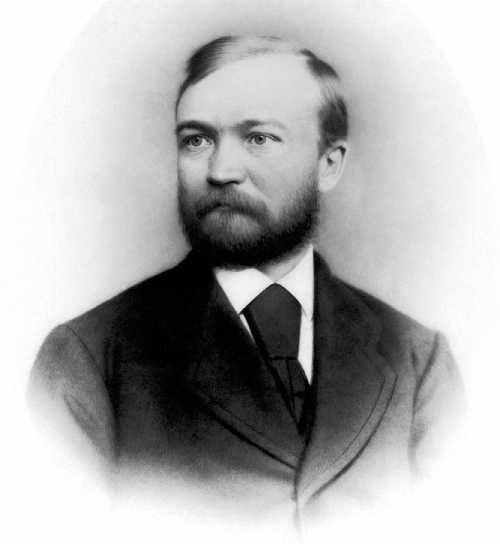
Andrew Carnegie.
Industrialist and business
magnate, Carnegie
(1835–1919) was an
immigrant from Scotland
who created a vast
fortune in steel, often
using ruthless methods to
achieve his goals. A classic
rags-to-riches story,
Carnegie later disavowed
the pursuit of money for
its own sake, arguing in
his famous 1889 “Gospel
of Wealth” that the rich
should act as “trustees”
of their wealth for the
public good. One of
York
several “robber barons”
New
who later became
philanthropists, Carnegie
Collection,
was famous in his own
day for providing free
Granger
public library buildings
The©
around the nation.
A Dynamic Corporate Economy
649
fashioned the U.S. Steel Corporation from 200 separate iron and steel companies.
U.S. Steel, with its 112 blast furnaces and 170,000 steelworkers, controlled 60 percent of the country’s steelmaking capacity. Moreover, its 78 iron-ore boats and
1,000 miles of railroad gave it substantial control over procuring raw materials
and distributing finished steel products.
A weak federal government and a conservative Supreme Court set few limits on
corporations in this period, despite significant antitrust agitation in the 1880s and 1890s. By then, many Americans feared the power wielded by tycoons who had
established monopolies or monopoly market shares not only in oil and steel, but
also in sugar, tobacco, and transportation, among other industries. The Sherman
Antitrust Act of 1890 was an attempt to declare any form of “restraint of trade”
illegal, but it was so vague as to be almost useless in the actual prosecution of corporations. Several states passed antitrust legislation, but other states virtually negated this legislation by passing laws favorable to trusts. In 1895, the Supreme Court dealt a crippling blow to the already weak Sherman Antitrust Act when it
ruled in U.S. v. E.C. Knight Company that the federal government did not have
authority over manufacturing because it was not commerce—a form of semantic
hair-splitting that revealed the conservative Court’s unwillingness to curtail the power of big business. Only in the 20th century would the Supreme Court begin
seriously to tackle the questions raised by the consolidation of giant businesses and the concentration of power in the hands of a wealthy few.
Mass
In 1900, Henry Ford was an eccentric 37-year-old mechanic
Production and
who built race cars in Michigan. In 1909, Ford unveiled his
Distribution
Model T: an unadorned, even homely car, but reliable enough
to travel hundreds of miles without servicing and cheap enough
to be affordable to most working Americans.
Ford had dreamed of creating an automobile civilization with his Model T, and
by the 1920s Americans were buying his car by the millions. The stimulus this insatiable demand gave to the economy can scarcely be exaggerated. Millions of cars
required millions of pounds of steel alloys, glass, rubber, petroleum, and other
material. Millions of jobs in coal and iron-ore mining, oil refining and rubber
manufacturing, steelmaking and machine tooling, road construction, and service
stations came to depend on automobile manufacturing.
Ford innovated with mass-production techniques that increased production
speed and lowered unit costs. Mass production often meant replacing skilled work-
ers with machines that were coordinated to permit high-speed, uninterrupted pro-
duction at every stage of the manufacturing process. Mass-production techniques
had become widespread in basic steel manufacturing and sugar refining by the
1890s, and they spread to the machine-tool industry and automobile manufacturing
in the first two decades of the 20th century.
Such production techniques were profitable only if large quantities of output
could be sold. Although a burgeoning domestic market offered a vast potential for sales, manufacturers often found distribution systems inadequate. This was the case with North Carolina smoking tobacco manufacturer James Buchanan Duke, who
almost single-handedly transformed the cigarette into one of the best-selling
650
Chapter 19 The Rise of Corporate America, 1865–1914
commodities in American history. In 1885, at a time when relatively few Americans smoked, Duke invested in several Bonsack cigarette machines, each of which
manufactured 120,000 cigarettes per day. To create a market for the millions of
cigarettes he was producing, Duke advertised his product aggressively throughout
the country. He also established regional sales offices so that his sales representatives could keep in touch with local jobbers and retailers. As cigarette sales skyrocketed, more corporations sought to emulate Duke’s techniques. Over the course
of the next 20 years, those corporations that integrated mass production and mass distribution, as Duke did in the 1880s and 1890s, came to define American “big
business.”
Revolution
The growth in the number and size of corporations revolu-
in Management
tionized corporate management. The ranks of managers
mushroomed, as elaborate corporate hierarchies defined both
the status and the duties of individual managers. Increasingly, senior managers
took over from owners the responsibility for long-term planning. Day-to-day
operations fell to middle managers who oversaw particular departments (e.g., pur-
chasing, research, production, labor) in corporate headquarters or who supervised regional sales offices or directed particular factories. Middle managers also managed the people—accountants, clerks, foremen, engineers, salesmen—in these departments, offices, or factories. The rapid expansion within corporate managerial ranks created a new middle class, whose members were intensely loyal to their employers but at
odds both with blue-collar workers and with the older middle class of shopkeepers, small businessmen, and independent craftsmen.
As management techniques grew in importance, companies tried to make them
more scientific. Firms introduced cost-accounting methods into purchasing and
other departments charged with controlling the inflow of materials and the outflow of goods. Many corporations began requiring college or university training in
science, engineering, or accounting for entry into middle management. Corpora-
tions that had built their success on a profitable invention or discovery sought to maintain their competitive edge by creating research departments and hiring professional scientists—those with doctorates from American or European universities—
to come up with new technological and scientific breakthroughs. Such departments
were modeled on Thomas Edison’s industrial research laboratory.
CORPORATIONS AND AMERICAN CULTURE
New technological innovations reshaped almost all Americans’ lives. Electricity,
streetcars, and elevators were just a few of the industrial innovations that changed urban dwellers’ everyday relationship to physical space. Even people’s relationship to time changed. The world of mass-produced consumer goods also provided a new
standardization of experience, and created a new national consumer culture.
Standardized
Before the post–Civil War boom in railroads, there was no
Time
such thing as “standard” time: instead, many localities and
cities kept their own time, derived from the sun’s meridian in
Corporations and American Culture
651
each locality. If the clock read noon in Chicago, for instance, it read 11:50
in St. Louis, 11:38 in St. Paul, and 11:27 in Omaha, with many other local times in between. This situation played havoc with railroad timetables.
In a sign of corporations’ power over American life, in 1883 a consortium of
railroad companies agreed to standardize North American time with the creation
of four different time zones—much as they exist today—in which all clocks would
be set to exactly the same time. This was a corporate act, not an official government act, and some grumbling followed about the arrogance of railroad presidents
changing “God’s time.” But people everywhere quickly adopted “railroad time,”
although Congress did not officially sanction standard time zones until 1918.
A National
Consumer goods also standardized American experience as
Consumer
manufacturers produced national brands such as Ivory soap,
Culture
Quaker oats, and Jell-O. Advertising firms such as J. Walter
Thompson and N. W. Ayer & Son began working hand in
hand with manufacturers to create national marketing campaigns. Expenditures
on advertising increased enormously: from some $50 million in 1867 to $500 million by 1900.
Technological improvements in lithography and the half-tone process in the
1880s and 1890s allowed advertisers to create bright, colorful images that were distributed nationally. Advertising had featured little visual imagery before the 1880s, but multicolor advertising trade cards (including baseball cards from cigarette companies) became a national fad in the 1880s, followed by increased visual imagery in ads in the 1890s and early 1900s. Advertisements became part of a shared national visual culture.
A series of technological breakthroughs in printing allowed new popular maga-
zines and mass-circulation newspapers to reach hundreds of thousands of readers
nationally, as well. The conservative Ladies’ Home Journal, for instance, founded in 1893, achieved enormous success with its profusion of illustrations and photographs, soon reaching over 500,000 readers. Newspapers expanded greatly as
well, responding to the demands of a growing population with the first color
comics, women’s pages, Sunday sections, society pages, and sports pages—where
readers could follow the standings of the first national teams in baseball.
Advertising revenues from department stores fueled the growth of newspapers in
large cities around the country. These new department stores were glittering “palaces of consumption” that dramatically changed the urban experience of buying consumer goods. In a major retailing innovation, stores such as Marshall Field & Co. in Chicago (1865) and R. H. Macy’s in New York (1866) sold a wide variety of items—from per-fume to shoes to hats to clothing to household goods—all under one roof in different departments, instead of in different stores. Customers strolled down carpeted aisles—
arranged to mimic city streets—and gazed at a dazzling array of goods arrayed in glass cases. Ornate interiors with mirrors and lights added to a sensory experience of profusion, color, and excitement.
Outside of cities, men and women could participate in the new national culture
of consumption through mail order. Mail-order catalogues were the brilliant idea of A. Montgomery Ward, who had worked at Marshall Field’s firm in Chicago. Starting with a single price sheet of items in 1872, Ward expanded to an 8-page-booklet 652
Chapter 19 The Rise of Corporate America, 1865–1914
within two years, then a 72-page catalogue, and by 1884 was producing a thick,
240-page catalogue that listed close to 1,000 items for sale—everything from
women’s underclothing to entire houses.
Ideas of Wealth
A profusion of consumer goods reached a wide national
and Society
audience in this period. But among the wealthy, some also
practiced what the economist Thorstein Veblen described in
The Theory of the Leisure Class (1899) as “conspicuous consumption.” They sent
agents to Europe to buy paintings and tapestries from impoverished aristocrats.
In their mansions on Fifth Avenue and their summer homes at Newport, Rhode
Island, they entertained lavishly. At one famous costume ball in New York in
1897, guests in satin gowns sewn with jewels impersonated aristocrats. Such aris-
tocratic pretensions extended to marriage: between 1874 and 1911, 72 American
heiresses married British peers. The extravagant habits of a wealthy elite gave substance to Mark Twain’s labeling of this era as the Gilded Age. The estimated
number of millionaires (a word that came into use during this era) in 1860 was
300; by 1892, the number was 4,000. While this was not a large proportion of the
population, it was nevertheless a highly visible group.
Many among the wealthy, and eventually among a broader middle class as
well, justified their right to wealth with an emerging post–Civil War vocabulary of Social Darwinism. “The growth of a large business,” wrote John D. Rockefeller,
“is merely a survival of the fittest, the working out of a law of nature and a law of God.” In assuming that market forces were in fact laws of nature, Rockefeller and other industrial titans such as Andrew Carnegie drew upon the influential work of the English author Herbert Spencer, who had coined the phrase “survival of the fittest” in applying the evolutionary theories of Charles Darwin to human society.
Social Darwinism was popular among both white intellectuals and a wider middle-
class reading public to explain existing racial and class hierarchies in society: according to its tenets, human history could be understood in terms of an ongoing struggle among races, with the strongest and the fittest invariably triumphing. The wealth and power of the Anglo-Saxon race were ample testimony, in this view, to
its superior fitness.
Social Darwinism reflected a widely shared belief that human society operated
according to principles that were every bit as scientific as those governing the natural world. The ability of 19th-century biologists, chemists, and physicists to penetrate the mysteries of the natural world generated confidence in science, in people’s ability to know and control their physical environment. That confidence, in turn, prompted
intellectuals to apply the scientific method to the human world. The social sciences—
economics, political science, anthropology, sociology, psychology—took shape in the late 19th century, each trying to discover the scientific laws governing individual and group behavior. Awed by the accomplishments of natural scientists, social scientists were prone to exaggerate the degree to which social life mimicked natural life; hence the appeal of Social Darwinism, a philosophy that allegedly showed how closely the history of human beings resembled the history of animal evolution.
At first popular mostly among intellectuals, Social Darwinism was quickly
adopted as a way of explaining social and racial hierarchy by a broader public,
Corporations and American Culture
653
with “survival of the fittest” becoming a popular catchphrase. Social Darwinism
provided a comfortable way of understanding the glaring social inequality of the
post–Civil War era: workers were doomed to be permanent wage laborers not
because of some fault in the emerging corporate system, but because they were
not “fit.” The rich, meanwhile, were entitled to every dollar that came their way.
Sharpened
The well-publicized activities of the wealthy sharpened a
Class
growing sense of class distinction in this era. “No observing
Distinctions
person can help being aware of an increasing tendency toward
a strong demarcation of classes in this country,” the antebel-
lum abolitionist Lydia Maria Child wrote to a friend in 1877. Different classes “are as much strangers to each other, as if they live in different countries.” Throughout the late 19th century, many Americans worried over the class distinctions they saw emerging around them as part of the corporate reordering of American life. Was this sharpened sense of class distinctions acceptable in a republican society that promised equality for all? A source of uneasiness at first, class distinctions became a source of alarm among numerous observers in the 1880s and especially the 1890s, when
widespread labor activism challenged the existing social order.
The rise of corporations helped to produce a new, “white-collar” middle class.
Corporations needed salaried managers, engineers, office workers, and retail clerks.
The expansion of this “white-collar” work—a term that entered common usage
during the late 19th century and referred to detachable, starched white collars for shirts—marked a significant change from the antebellum period. Agricultural labor dropped from 53 percent of the gainfully employed in 1870, to 35 percent in 1900, and to 21 percent in 1930; clerical work in the same period rose from less than
1 percent to over 8 percent. The profession of engineer, directly related to the
expansion of manufacturing, leapt by an astonishing 586 percent, between 1870
and 1900.
Many members of this new corporate middle class sought to distinguish them-
selves from the “lower classes.” The post–Civil War suburbanization movement
was one important spatial realization of this drive for distinction. As early as 1873, Scribner’s magazine noted that “the middle class, who cannot live among the rich, and will not live among the poor ... go out of the city to find their houses.” By the end of the 19th century, suburban communities of detached houses, surrounded by
lawns, were markers of the middle-class status of businessmen and professionals
who worked by day in cities and traveled back and forth by train or streetcar to their homes.
Theater, literature, and art were also arenas of class distinction. Before the Civil War, performances of Shakespeare had often been rowdy, participatory, cross-class events. By the end of the century, however, the middle class not only claimed
Shakespeare as an icon of “high” culture, but also succeeded in imposing a new
set of standards for audience behavior at the theater. Noisy and enthusiastic audience participation gave way to an expectation of total silence during performances as a marker of gentility.
Within literary magazines and books, middle-class critics sought to create per-
manent “genteel” standards and decried the vulgarity of an extensive popular
654
Chapter 19 The Rise of Corporate America, 1865–1914
“low” literature of dime novels and westerns. Century and Harper’s New Monthly
published serial novels by great authors and a variety of articles and “tasteful” fiction, including an emerging literature of nostalgia for slavery with virulently racist portrayals of blacks. This white nostalgia for black subordination paralleled growing middle-class alarm over the “insubordination” of the working class in late 19th-century labor strife.
A new art movement, American Impressionism, also expressed a middle-class
desire for gentility. Influenced by French Impressionism, artists such as William Merrit Chase and Childe Hassam painted light-flecked landscapes or flower-filled
urban parks, recording middle-class pleasures in cities strikingly devoid of workers.
Yet increasingly over the late 19th century, mere gentility began to seem arid to some middle-class artists and writers. Painters such as Thomas Eakins and Thomas
Anshutz pioneered a style that would develop into the “realism” of the early 20th century, with its grittier view of city life and less idealized vision of the human form. The dean of American letters, William Dean Howells, called for a new “realism” based on close observation of and engagement with life. His novels explored
issues that had rarely been touched by American authors, including divorce, the
moral bankruptcy of capitalism, and interracial marriage. Discouraged by the wid-
ening gulf between the classes, in 1886 Howells even broke with most of his class in his plea for clemency for the defendants in the Haymarket affair (see later section).
The gulf between the classes also alarmed Edward Bellamy, whose 1888
utopian novel, Looking Backward, imagined a world in the year 2000 in which
“labor troubles” and social inequities had been eradicated through a form of socialism called Nationalism. Bellamy’s powerful fictional indictment of Gilded Age society resonated with half a million readers, making his novel one of the most popular of the 19th century. More than 160 Nationalist clubs sprang up in which members
of the middle class mulled over the possibilities of government ownership of industry. For some authors and artists in the 1880s and 1890s, the desire to pull away from genteel standards was inspired by a sense of the considerable social costs of the new corporate order.
Obsession with
The fractious events of the 1890s induced many middle-class
Physical and
and wealthy Americans to engage in what Theodore Roosevelt
Racial Fitness
dubbed “the strenuous life.” In an 1899 essay with that title,
Roosevelt exhorted Americans to live vigorously, to test their
physical strength and endurance in competitive athletics, and to experience nature through hiking, hunting, and mountain climbing. Other writers, too, argued that
through sport and vigorous activity, men could find and express their virility.
The 1890s were a time of heightened enthusiasm for competitive sports, physi-
cal fitness, and outdoor recreation. Millions of Americans, both women and men,
began riding bicycles and eating healthier foods. Young women began to engage
in organized sports and other athletic activities. A passion for athletic competition also gripped American universities. The power and violence of football helped make it the sport of choice at the nation’s elite campuses, and, for 20 years, Ivy League schools were the nation’s football powerhouses.
Changes in Middle-class Women’s Lives
655
In the country at large, the new enthusiasm for athletics and the outdoor life
reflected a widespread dissatisfaction with the growing regimentation of industrial society. Among middle-class and wealthy Americans, the quest for physical superiority reflected a deeper and more ambiguous anxiety: their racial fitness. Most of them were native-born Americans whose families had lived in the United States for several generations and whose ancestors had come from the British Isles, the Netherlands, or some other region of northwestern Europe. Having embraced the principles of Social Darwinism, they liked to attribute their success and good fortune to their “racial superiority.” They saw themselves as “natural” leaders, members of a noble Anglo-Saxon race endowed with uncommon intelligence, imagination, and discipline. But
events of the 1890s challenged the legitimacy of the elite’s wealth and authority, and the ensuing depression mocked their ability to exert economic leadership. The immigrant masses laboring in factories, despite their poverty and alleged racial inferiority, seemed to possess a vitality that the “superior” Anglo-Saxons lacked.
CHANGES IN MIDDLE-CLASS WOMEN’S LIVES
After the Civil War, many middle-class women continued to adhere to the ideology
of domesticity, assuming that their place was in the home. Yet an increasing num-
ber of women began to explore the world of work—whether out of necessity in the
turbulent economy of the late 19th century, or because they chose to enter a wider sphere of life. Significant changes in middle-class women’s lives included access to higher education and an embrace of a new, energetic athleticism.
Middle-class
Historians are not sure how many middle-class women went
Women and
to work: statistics of the period do not separate out working-
Work
class and middle-class women. By 1900, however, 21 percent
of all women were in the workforce, as opposed to 9.7 percent
of women in 1860. After the Civil War, women moved into nursing and office work,
while continuing to be a mainstay in teaching. By the end of the 19th century, middle-class women were also becoming editors, literary agents, and journalists in larger numbers, while also entering the professions of medicine and law in small numbers.
Many college women moved to cities to take up work, living in apartments on their own as “bachelor girls.”
The increased interest in work was reflected in literature of the period. Louisa
May Alcott’s 1873 novel Work, for instance, imagined an ideal cross-class, cross-
race world of supportive female workers, while Elizabeth Stuart Phelps spoke for
many discontented middle-class women in her 1877 novel The Story of Avis, in
which the despairing heroine ultimately gave up being an artist for her marriage.
But it was writer and economist Charlotte Perkins Gilman’s 1892 biting novella
The Yellow Wallpaper that spoke most powerfully of a new domestic claustropho-
bia. In that brief work, the unnamed heroine desires to write after the birth of a child but is told by her husband and doctor that she must rest instead. As a result she becomes virtually imprisoned in her home. Drawing upon Gilman’s own experiences, the novel is a bitter indictment of an unequal society.
656
Chapter 19 The Rise of Corporate America, 1865–1914
Few middle-class observers—men or women—were able to imagine women
combining work with family. And yet many women had to do so: the nationally
known journalist Jane Croly, for instance, who wrote columns under the name
“Jenny June,” supported her sick husband and four children as an editor and
author during the 1880s before becoming the first female professor of journalism
at Rutgers University.
The Women’s
Jane Croly began one of the most important movements
Club Movement
among middle-class women in the late 19th century: the
women’s club movement. In 1868, the New York Press Club
decided to bar women journalists from a celebratory dinner for the great novelist Charles Dickens, who was touring the United States. Croly was insulted and furi-ous, but turned that fury toward a positive purpose: forming the women’s club
Sorosis (the name was chosen to suggest sisterhood). Composed primarily of pro-
fessional women writers, Sorosis met regularly to discuss topics of the day and to exchange professional advice.
Sorosis inaugurated a movement of women’s clubs among working and non-
working middle-class women in communities across the nation. Distinct from ante-
bellum moral reform societies, the new women’s clubs were secular and had a
variety of different purposes, from intellectual discussion to civic reform. Providing sociability for women without male involvement or supervision, women’s clubs also offered leadership opportunities and provided a bridge to middle-class women’s
activism during the Progressive era. While many clubs in the 1860s and 1870s did
not support woman suffrage, by the turn of the 20th century, the women’s club
movement was an important source of support for the revived suffrage movement
(see Chapter 21). What’s more, by 1900, women had used the women’s club move-
ment to move into and even take over a variety of civic organizations—a way of
practicing politics by other means in an era before women had the vote.
This was especially important in the Jim Crow South, where black men were
disfranchised in the 1890s (see Chapter 21). Middle-class black women drew on
their extensive experiences in church organizations and Republican aid societies to create effective new networks of public civic organizations. African American
women also joined the largest women’s social organization of the late 19th century, the Woman’s Christian Temperance Union (WCTU). Under the leadership of
Frances Willard beginning in 1879, the WCTU engaged in a variety of social reform activities nationally and endorsed woman suffrage in 1884.
The “New
A clear indication that white middle-class women’s positions
Woman”
in society were changing by the turn of the 20th century was
the ubiquitous discussion of the “New Woman” in the
1890s. A cultural icon of cartoons, illustrations, paintings, short stories, and essays, the New Woman was depicted as a public figure who was athletic, self-confident,
young, and independent: she wore the new, less confining fashion of shirtwaists
and skirts; rode a bicycle; and even smoked in some images. The painter John
Singer Sargent captured this dawning moment of confidence for women in several
compelling portraits of strong women.
Workers’ Resistance to Corporations
657
But to some observers, the New Woman was a fearsome thing, threatening the
sanctity of the home and traditional gender roles. A backlash against middle-class women’s new roles took different shapes but was often rooted in new “scientific”
expertise. Arguing against women’s higher education, for instance, the Harvard
Medical School professor Edward H. Clarke asserted in 1873 that intellectual
work damaged women’s reproductive organs. “A girl could study and learn,” he
warned, “but she could not do all this and retain uninjured health, and a future
secure from neuralgia, uterine disease, hysteria, and other derangements of the nervous system.”
The Comstock Law (1872) made it illegal to send reproductive literature or
devices through the mails on the grounds that they were “obscene,” eroding women’s already-limited control of reproduction. As women took to bicycles during the bicycle craze of the 1890s, experts warned that it would be unhealthy for women to expend so much strength in physical activity. Women actively resisted these attacks in articles, lectures, and through their own actions, both large and small. Frances Willard of the WCTU, for instance, took up bicycling at age 53 in part, she said, because she knew her example would “help women to a wider world.”
Higher
Women moved into higher education in large numbers in
Education and
the late 19th century. In the Midwest and the West, public
Professional
universities as well as land-grant universities (a result of the
Organizations
1862 Morrill Act) expanded and began to admit women in
the 1860s. In the East there were fewer coeducational
institutions, but the founding of women’s colleges—with Vassar leading the way in 1865—meant that by 1890, women were approximately 40 percent of all college
graduates nationally.
Oddly enough, this move into higher education did not translate into greater ease of access to professional education. Women had broken into medical training in
1849 with the admission of Elizabeth Blackwell to Geneva Medical College in upstate New York. But as separate medical colleges gave way to medical schools within universities in the late 19th century, women began to lose ground in medical education.
Professional organizations often excluded women as well; at the turn of the 20th
century, the American Medical Association, a gatekeeper to the profession, was an all-white, all-male organization. As other national professional organizations were founded in the 1870s and 1880s—including the American Bar Association, the
American Historical Association, and the American Economic Association—they too
erected barriers to the entry of women and blacks. Professionalization was thus a double-edged sword: while new professional organizations established much-needed
uniform standards and training in a variety of professions and disciplines, they also closed ranks against women and minorities.
WORKERS’ RESISTANCE TO CORPORATIONS
A national culture of consumption had grown up in the last decades of the 19th
century, but not everyone had equal access to it. Wages that did not keep pace
with the booming economy meant less money to spend, not to mention a struggle
to put food on the table.
658
Chapter 19 The Rise of Corporate America, 1865–1914
Although the average per capita income of all Americans increased by 35 per-
cent from 1878 to 1893, real wages advanced only 20 percent. That advance
masked sharp inequalities of wages by skill, region, race, and gender. Many
unskilled and semiskilled workers made barely enough to support themselves,
much less a family; many families, especially recent immigrants (who formed a large part of the blue-collar workforce), needed two or three wage earners to survive.
“Eight hours for work, eight hours for rest, eight hours for what we will” was
a famous slogan of the labor movement in the post–Civil War era. In the demand
for “eight hours for what we will,” workers voiced their belief that they had a right to leisure time under their own control. As one worker told a Senate committee in 1883, “a workingman wants something besides food and clothes in this country....
He wants recreation. Why should not a workingman have it as well as other
people?”
Why not indeed? While some alarmed middle-class observers believed that all
workers were revolutionaries who wanted to overturn the American government,
only a small percentage were political radicals, much less revolutionaries. The truth was more prosaic: workers wanted fair wages and fair conditions in the workplace. They wanted equality in a system in which power had been systematically
stripped from them, and liberty seemed to accrue more to corporations than to
individuals. Broad-based workers’ movements throughout the late 19th century
attempted to rectify a situation in which equal opportunities no longer seemed to be available to all.
Industrial
Conditions in the industrial workplace were often dangerous.
Conditions
The drive for even greater speed and productivity on rail-
roads and in factories gave the United States the unhappy
distinction of having the world’s highest rate of industrial accidents. The railroads were particularly hazardous, with over 72,000 deaths of employees on the tracks
between 1890 and 1917. What one historian has called “mechanized violence”
characterized other industries as well: coal mines threatened underground collapses, explosions, and the release of toxic gases; iron mills and steel mills required
work with molten metals at open hearths; textile mills threatened mutilation and
dismemberment.
Yet there was little government regulation of industrial safety, and workmen’s
compensation did not appear until the 1930s. As a result, many families were
impoverished by workplace accidents that killed or maimed their chief breadwin-
ner. This was one source of a rising tide of labor discontent. Another was the erosion of worker autonomy in factories, where new machinery took over tasks once
performed by skilled workers and where managers made decisions about the proce-
dures and pace of operations once made by workers. Many crafts that had once
been a source of pride to those who practiced them became just a job that could
be performed by anyone. Labor increasingly became a commodity bartered for
wages rather than a craft whereby the worker sold the product of his labor rather than the labor itself. For the first time in American history, the census of 1870
reported that a majority of employed persons worked for wages paid by others
rather than working for themselves.
Workers’ Resistance to Corporations
659
Skilled artisans considered this an alarming trend. Their efforts to preserve or
recapture independence from bosses and robber barons fueled much of the labor
unrest in the 1870s and 1880s. In 1866, the leaders of several craft unions had
formed the National Labor Union, which advocated for an eight-hour day at a
time when many industries required workers to work for 10 or even 12 hours daily.
Labor parties sprang up in several states; the Labor Reform candidate for governor of Massachusetts in 1870 won 13 percent of the vote. While the advocacy of an
eight-hour day would remain a central demand of the postwar labor movement,
the National Labor Union would fade in the 1870s. During the depression that fol-
lowed the Panic of 1873, workers were virtually powerless to push their agenda.
The National Labor Union withered away in the depression of the 1870s, but
industrial violence escalated. In the anthracite-coal fields of eastern Pennsylvania, the Molly Maguires (an amalgam of a labor union and a secret order of Irish
Americans) carried out guerrilla warfare against mine owners. In the later 1870s, the Greenbackers (a group that urged currency expansion to end deflation) and
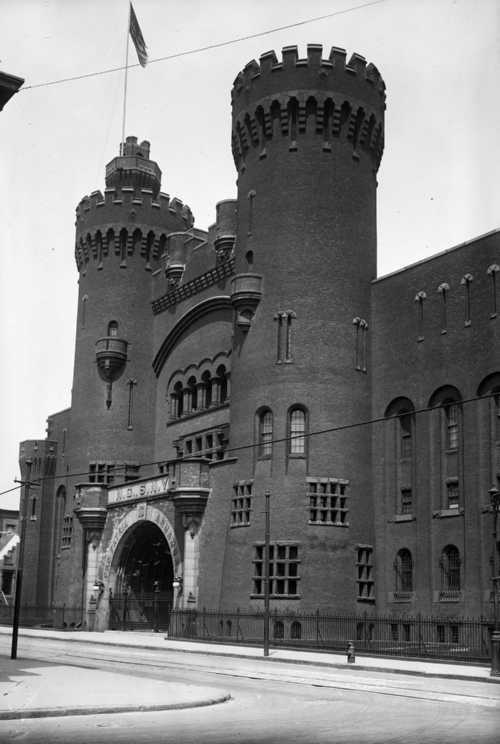
Urban Fortresses. In
the 1880s and 1890s,
numerous armories were
built in cities across the
country to protect against
a perceived threat from
the “dangerous classes”—
workers and the poor.
This immense, castle-like
1894 armory in Brooklyn,
New York, was meant to
inspire awe.
Bettmann/CORBIS©
660
Chapter 19 The Rise of Corporate America, 1865–1914
labor reformers formed a coalition that elected several local and state officials plus 14
congressmen in 1878. In 1880, the Greenback-Labor candidate for president won
3 percent of the popular vote.
The Great
The worst labor violence in U.S. history up to that time, the
Railroad Strike
Great Railroad Strike of 1877 underscored the deep discon-
of 1877
tent of workers nationwide. In July, the Baltimore and Ohio
Railroad cut wages by 10 percent—its third recent wage
reduction. B & O workers had seen their wages drop steadily ever since 1873, a depression year. When workers in Martinsburg, West Virginia, walked out in protest, workers up and down the B & O line joined them.
The strike touched a nerve nationally and spread rapidly; within a few days,
what had begun as a local protest had traveled to Baltimore, Philadelphia, Pittsburgh, New York, Louisville, Chicago, St. Louis, Kansas City, and San Francisco. Women
as well as men joined angry crowds in the streets; workers from a variety of
industries walked out in sympathy; and in some places the strike crossed both gender and racial lines. Strikers and militia in a number of cities fired on each other, and workers set fire to railroad cars and depots. Alarmed at the possibility of a “national insurrection,” President Hayes called in the army. The strike finally ended in early August—“The strikers have been put down by force,” Hayes noted in his diary.
But this spontaneous, unorganized labor upheaval did not produce solutions to
workers’ dilemmas. On the contrary, fears of a workers’ “insurrection” led to a
new cohesion in the middle class, which began to talk of a “war” between capital
and labor. Not only did the middle class strongly support military intervention in the wake of 1877, but it also supported the construction of armories in the nation’s largest cities.
The Knights
Many workers in the wake of 1877 looked to a new labor
of Labor
organization for inspiration. The Knights of Labor had been
founded in 1869 in Philadelphia as a secret fraternal organi-
zation, one of many such artisan societies in eastern cities. Under the leadership of Terence Powderly, a machinist by trade, it became public in 1879 and then
expanded rapidly in the wake of the Great Railroad Strike, finally achieving hun-
dreds of thousands of members nationally in the 1880s.
The Knights of Labor offered workers an inspiring vision of an alternative to
competitive corporate society. Rooted in the artisan republicanism of the antebellum era (see Chapter 7), with even its name suggesting a nostalgic look backward, the Knights opposed the wage labor system, declaring “an inevitable and irresistible conflict between the wage-system of labor and republican system of government.”
Instead it offered an inclusive vision of a “cooperative commonwealth” that would include both men and women and would not discriminate by race. In its platform it called for an eight-hour day, equal pay for women, public ownership of railroads, abolition of child labor, and a graduated income tax.
By the late 1870s, the Knights were a potent national federation of unions—or
“assemblies,” as they were officially known—and departed in several respects from the norm of labor organization at that time. Most of its assemblies were organized Workers’ Resistance to Corporations
661
by industry rather than by craft, giving many unskilled and semiskilled workers
union representation for the first time. It was also a more inclusive labor organization than most, although in local practice the Knights did not live up to its lofty ideals. Only some assemblies admitted women or blacks. Tendencies toward exclusivity of craft, gender, and race divided and weakened many assemblies.
A paradox of purpose also plagued the Knights. Most members wanted to
improve their lot within the existing system through higher wages, shorter hours, better working conditions—the bread-and-butter goals of working people. This meant
collective bargaining with employers; it also meant strikes. The assemblies won
some strikes and lost some. Powderly and the Knights’ national leadership discouraged strikes, however, partly out of practicality: a losing strike often destroyed an assembly, as employers replaced strikes with strikebreakers, or “scabs.”
Another reason for Powderly’s antistrike stance was philosophical. Strikes con-
stituted a tacit recognition of the legitimacy of the wage system. In Powderly’s view, wages siphoned off to capital a part of the wealth created by labor. The Knights, he said, intended “to secure to the workers the full enjoyment of the wealth they
create.” This was a goal grounded both in the past independence of skilled workers and in a radical vision of the future, in which workers’ cooperatives would own the means of production. “There is no reason,” said Powderly, “why labor cannot,
through cooperation, own and operate mines, factories, and railroads.”
The Knights did sponsor several modest workers’ cooperatives. Their success
was limited, though, partly from lack of capital and of management experience
and partly because even the most skilled craftsmen found it difficult to compete
with machines in a mass-production economy. Ironically, the Knights gained their
greatest triumphs through strikes. In 1884 and 1885, successful strikes against the Union Pacific and Missouri Pacific railroads won prestige and a rush of new members, which by 1886 totaled 700,000. Expectations ran high, but defeat in a second strike against the Missouri Pacific in spring 1886 was a serious blow. Then came
the Haymarket bombing in Chicago.
Haymarket
Chicago was a center of labor activism and radicalism. In
1878, the newly formed Socialist Labor Party won 14 per-
cent of the vote in the city, electing five aldermen and four members of the Illinois legislature. With recovery from the depression after 1878, the Socialist Labor Party fell onto lean times. Four-fifths of its members were foreign-born, mostly Germans.
Internal squabbles generated several offshoots of the party in the 1880s. One of
these embraced anarchism and called for the violent destruction of the capitalist system so that a new socialist order could be built on its ashes. Anarchists infiltrated some trade unions in Chicago and leaped aboard the bandwagon of a
national movement centered in that city for a general strike on May 1, 1886, to
achieve the eight-hour workday. Chicago police were notoriously hostile to labor
organizers and strikers, so the scene was set for a violent confrontation.
The May 1 showdown coincided with a strike at the McCormick farm machin-
ery plant in Chicago. A fight outside the gates on May 3 brought a police attack on the strikers in which four people were killed. Anarchists then organized a protest meeting at Haymarket Square on May 4. Toward the end of the meeting, when the
662
Chapter 19 The Rise of Corporate America, 1865–1914
rain-soaked crowd was already dispersing, the police suddenly arrived in force.
When someone threw a bomb into their midst, the police opened fire. When the
wild melee was over, 50 people lay wounded and 10 dead, 6 of them policemen.
Haymarket set off a wave of hysteria against labor radicals. Police in Chicago
rounded up hundreds of labor leaders. Eight anarchists (seven of them German-
born) went on trial for conspiracy to commit murder, although no evidence turned
up to prove that any of them had thrown the bomb. All eight were convicted; seven were sentenced to hang. One of the men committed suicide; the governor commuted
the sentences of two others to life imprisonment; the remaining four were hanged
on November 11, 1887. The case became a cause célèbre that bitterly divided the
country. Many workers, civil libertarians, and middle-class citizens who were troubled by the events branded the verdicts judicial murder, but most Americans
applauded the summary repression of radicalism they regarded as un-American.
The Knights of Labor were caught in this anti-labor backlash. Although the
Knights had nothing to do with the Haymarket affair and Powderly had repeatedly
denounced anarchism, his opposition to the wage system sounded to many Ameri-
cans suspiciously like socialism, perhaps even anarchism. Membership in the
Knights plummeted from 700,000 in spring 1886 to fewer than 100,000 by 1890.
The American
As the Knights of Labor waned, a new national labor orga-
Federation of
nization waxed. Founded in 1886, the American Federation
Labor (AFL)
of Labor (AFL) was a loosely affiliated association of unions
organized by trade or craft: cigar-makers, machinists, car-
penters, typographers, plumbers, painters, and so on. Most AFL members were
skilled workers. The leader of the AFL, Samuel F. Gompers, was a onetime
Marxist and cigar maker who was reelected to the AFL presidency every year from
1896 until his death in 1924.
Many workers understood that the only hope for economic improvement lay in
organizing unions powerful enough to wrest wage concessions from reluctant
employers. But this was no easy task. Federal and state governments had shown
themselves ready to use military force to break strikes. The courts, following
the lead of the U.S. Supreme Court, repeatedly found unions in violation of the
Sherman Antitrust Act, even though that act had been intended to control corpora-
tions, not unions. Judges in most states usually granted employer requests for
injunctions—court orders that barred striking workers from picketing their place
of employment (and thus from obstructing employer efforts to hire replacement
workers). Before 1916, no federal laws protected workers’ right to organize or
required employers to bargain with the unions to which their workers belonged.
This hostile legal environment retarded the growth of unions from the 1890s
through the 1920s. It also made the AFL, the major labor organization of those years, more timid and conservative than it had been before the depression of the 1890s. Few AFL members were women and blacks. The AFL accepted capitalism and the wage
system. Instead of agitating for governmental regulation of the economy and the
workplace, it concentrated on the bread-and-butter issues of better conditions, higher wages, shorter hours, and occupational safety within the system—“pure and simple
unionism,” as Gompers called it.
Workers’ Resistance to Corporations
663
The AFL had concluded that labor’s powerful opponents in the legislatures and
the courts would find ways to undermine whatever governmental gains organized
labor managed to achieve. That conclusion was reinforced by a 1905 ruling, Lochner v.
New York, in which the U.S. Supreme Court declared unconstitutional a seemingly
innocent New York state law that limited bakery employees to a 10-hour day.
Yet in its early years the AFL showed considerable vitality under the leadership
of Gompers, with its membership quadrupling from less than a half million in 1897
to more than 2 million in 1904. Craft unions negotiated contracts, or trade agreements, with employers that stipulated the wages workers were to be paid, the hours they were to work, and the rules under which new workers would be accepted into
the trade. These agreements were accorded the same legal protection that American law bestowed on other commercial contracts.
Still, the AFL had limited success. Its 2 million members represented only a small portion of the industrial workforce. Its concentration among craft workers, moreover, distanced it from most workers, who were not skilled. Unskilled and semiskilled workers could only be organized into an industrial union that offered membership to
all workers in a particular industry. Gompers understood the importance of such
unions and allowed several of them, including the United Mine Workers (UMW) and
the International Ladies Garment Workers Union (ILGWU), to participate in the AFL.
But AFL ranks remained dominated by skilled workers who looked down upon the
unskilled, especially immigrants. AFL members demonstrated even worse prejudice
toward black workers, with more than 10 AFL unions excluding African Americans
from membership in the early 20th century.
The Homestead
During the 1890s, strikes occurred with a frequency and a
Strike
fierceness that made 1877 and 1886 look like mere preludes
to the main event. The most dramatic confrontation took
place in 1892 at the Homestead plant (near Pittsburgh) of the Carnegie Steel
Company. Carnegie and his plant manager, Henry Clay Frick, were determined to
break the power of the country’s strongest union, the Amalgamated Association of
Iron, Steel, and Tin Workers. Frick used a dispute over wages and work rules as an opportunity to close the plant (a “lockout”), preparatory to reopening it with
nonunion workers. When the union called a strike and refused to leave the plant,
Frick called in 300 Pinkerton guards to oust them. (The Pinkerton detective agency had evolved since the Civil War era into a private security force that specialized in antiunion activities.) A full-scale gun battle between strikers and Pinkertons erupted on July 6, leaving nine strikers and seven Pinkertons dead and scores wounded.
Frick persuaded the governor to send in 8,000 militia to protect the strikebreakers, and the plant reopened. Public sympathy, much of it pro-union at first, shifted
when an anarchist tried to murder Frick on July 23. The failed Homestead strike
crippled the Amalgamated Association; another strike against U.S. Steel (successor of Carnegie Steel) in 1901 destroyed it.
The Depression
By the 1890s, the use of state militias to protect strike-
of 1893–1897
breakers had become common. Events after 1893 brought an
escalation of conflict. The most serious economic crisis since
664
Chapter 19 The Rise of Corporate America, 1865–1914
the 1873–78 depression was triggered by the Panic of 1893, a collapse of the stock market that plunged the economy into a severe four-year depression. The bankruptcy of the Reading Railroad and the National Cordage Company in early 1893
set off a process that by the end of the year had caused 491 banks and 15,000
other businesses to fail. By mid-1894, the unemployment rate had risen to more
than 15 percent.
An Ohio reformer named Jacob Coxey conceived the idea of sending Con-
gress a “living petition” of unemployed workers to press for appropriations to
put them to work on road building and other public works. “Coxey’s army,” as
the press dubbed it, inspired other groups to hit the road and ride the rails to
Washington during 1894. This descent of the unemployed on the capital pro-
voked arrests by federal marshals and troops, and ended in anticlimax when
Coxey and others were arrested for trespassing on the Capitol grounds. Coxey’s
idea for using public works to relieve unemployment turned out to be 40 years
ahead of its time.
The Pullman
The explosive tensions between capital and labor fueled the
Strike
Pullman strike of 1894. George M. Pullman had made a
fortune in the manufacture of sleeping cars and other rolling
stock for railroads. Workers in his large factory complex lived in the company
town of Pullman just south of Chicago, with paved streets, clean parks, and decent houses rented from the company. But Pullman controlled many aspects of their
lives, including banning liquor from the town and punishing workers whose
behavior did not suit his ideas of decorum. When the Panic of 1893 caused a sharp drop in orders for Pullman cars, the company laid off one-third of its workforce
and cut wages for the rest by 30 percent, but did not reduce company house rents
or company store prices. Pullman refused to negotiate with a workers’ committee,
which called a strike and appealed to the American Railway Union (ARU) for help.
The ARU had been founded the year before by Eugene V. Debs. A native
of Indiana, Debs had been elected secretary of the Brotherhood of Locomotive
Firemen in 1875 at the age of 20. By 1893, he had become convinced that
the conservative stance of the various craft unions in railroading (firemen, engineers, brakemen, and so forth) was divisive and contrary to the best interests of labor. He formed the ARU to include all railroad workers in one union. With
150,000 members, the union won a strike against the Great Northern Railroad
in spring 1894. When George Pullman refused the ARU’s offer to arbitrate the
strike of Pullman workers, Debs launched a boycott by which ARU members
would refuse to run any trains that included Pullman cars. When the railroads
attempted to fire the ARU sympathizers, whole train crews went on strike and
quickly paralyzed rail traffic.
Over the protests of Illinois Governor John P. Altgeld, who sympathized with
the strikers, President Grover Cleveland sent in federal troops. That action
inflamed violence instead of containing it. The U.S. attorney general (a former
railroad lawyer) obtained a federal injunction against Debs under the Sherman
Antitrust Act on grounds that the boycott and the strike were a conspiracy in
restraint of trade. This creative use of the Sherman Act was upheld by the
Farmers’ Movements
665
Supreme Court in 1895 and became a powerful weapon against labor unions in
the hands of conservative judges.
For a week in July 1894, the Chicago railroad yards resembled a war zone.
Millions of dollars of equipment went up in smoke. Thirty-four people, mostly
workers, were killed. Finally, 14,000 state militia and federal troops restored order and broke the strike. Debs went to jail (for violation of the federal injunction) for six months. He emerged from prison a socialist.
To many Americans, 1894 was the worst year of crisis since the Civil War. The
Pullman strike was only the most dramatic event of a year in which 750,000 work-
ers went on strike and another 3 million were unemployed. But it was a surge of
discontent from farmers that wrenched American politics off its foundations in
the 1890s.
FARMERS’ MOVEMENTS
Between 1870 and 1890, America’s soaring grain production increased three times
as fast as the American population. Only rising exports could sustain such expan-
sion in farm production. But by the 1880s, the improved efficiency of large farms in Eastern Europe brought intensifying competition and consequent price declines,
especially for wheat, just as competition from Egypt and India had eroded prices
Kansas
Topeka,
Society
Historical
State
Kansas
The
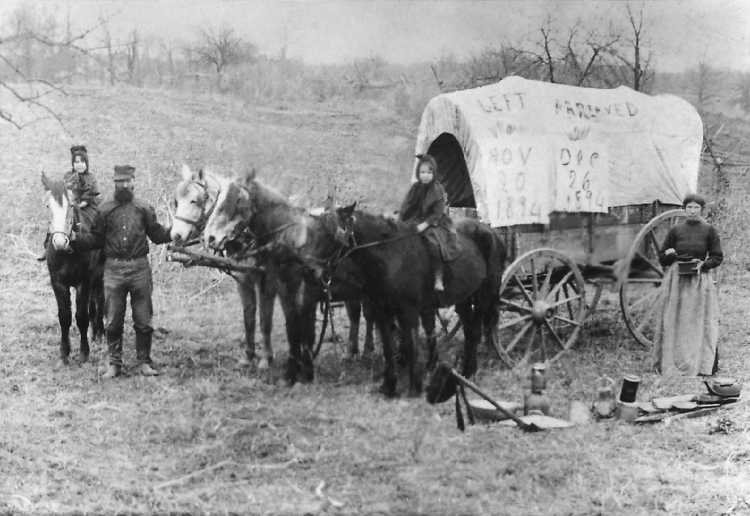
Returning to Illinois, 1894. This photograph shows one of the thousands of farm
families who had moved into Kansas, Nebraska, and other plains states in the wet years of the 1870s and 1880s, only to give up during the dry years of the 1890s. Their plight added fuel to the fire of rural unrest and protest during those years.
666
Chapter 19 The Rise of Corporate America, 1865–1914
for American cotton. Prices on the world market for these two staples of American agriculture—wheat and cotton—fell about 60 percent from 1870 to 1895, while the
wholesale price index for all commodities (including other farm products) declined by 45 percent during the same period. Not surprisingly, distress was greatest and protest loudest in the wheat-producing West and the cotton-producing South.
Victims of a world market largely beyond their control, farmers lashed out at
targets nearer home: railroads, banks, commission merchants, and the monetary
system. In truth, these institutions did victimize farmers, although not always
intentionally.
Resistance
The power wielded by the railroad companies inevitably
to Railroads
aroused hostility. Companies often charged less for long
hauls than for short hauls in areas with little or no competi-
tion. The rapid proliferation of tracks produced overcapacity in some areas, which led to rate-cutting wars that benefited some shippers at the expense of others—
usually large shippers at the expense of small ones. To avoid “ruinous competi-
tion” (as the railroads viewed it), companies formed “pools” by which they divided traffic and fixed their rates. Some of these practices made sound economic sense, but others appeared discriminatory and exploitative. Railroads gave credence to
farmers’ charges of monopoly exploitation by keeping rates higher in areas with no competition (most farmers lived in areas served by only one line) than in regions with competition. Grain elevators, many of which were owned by railroad companies, came under attack for cheating farmers by rigging the classification of their grain.
Farmers responded by organizing cooperatives to sell crops and buy supplies.
The umbrella organization for many of these cooperatives was the Patrons of
Husbandry, known as the Grange, founded in 1867. But because farmers could
not build their own railroads, they organized “antimonopoly” parties and
elected state legislators who enacted “Granger laws” in several states. These
laws established railroad commissions that fixed maximum freight rates and
warehouse charges. Railroads challenged the laws in court. Eight challenges
made their way to the U.S. Supreme Court, which in Munn v. Illinois (1877)
ruled that states could regulate businesses clothed with a “public interest”—
railroads and other common carriers, millers, innkeepers, and the like. It was a
landmark decision.
The welter of different and sometimes conflicting state laws, plus rulings by the U.S. Supreme Court in the 1880s that states could not regulate interstate railroad traffic, brought a drive for federal regulation. After years of discussion, Congress passed the Interstate Commerce Act in 1887. This law, like most such laws,
reflected compromise between the varying viewpoints of shippers, railroads, and
other pressure groups. It outlawed pools, discriminatory rates, long-haul versus
short-haul differentials, and rebates to favored shippers. It required that freight and passenger rates must be “reasonable and just.” What that meant was not entirely
clear, but the law created the Interstate Commerce Commission (ICC) to define the requirement on a case-by-case basis. Because the ICC had minimal enforcement
powers, however, federal courts frequently refused to issue the orders the ICC
Farmers’ Movements
667
requested. Staffed by men who were knowledgeable about railroading, the ICC
often sympathized with the viewpoint of the industry it was supposed to regulate.
Nevertheless, its powers of publicity had some effect on railroad practices, and
freight rates continued to decline during this period as railroad operating effi-
ciency improved.
The Greenback
The long period of price deflation from 1865 to 1897,
and Silver
unique in American history, made credit even more costly for
Movements
farmers. When the price of wheat or cotton declined, farmers
earned even less money with which to pay back loans from
country store merchants. Thus it was not surprising that angry farmers who
denounced banks or country store merchants for gouging them also attacked a
monetary system that brought deflation.
The federal government’s monetary policies worsened deflation problems. The
1862 emergency wartime issuance of treasury “greenback” notes (see Chapter 15)
had created a dual currency—gold and greenbacks—with the greenback dollar’s
value relative to gold rising and falling according to Union military fortunes. After the war, the Treasury moved to bring the greenback dollar to par with gold by reducing the amount of greenbacks in circulation. This limitation of the money supply produced deflationary pressures, with the South and West suffering from downward
pressures on prices they received for their crops. Western farmers were particularly vociferous in their protests against this situation, which introduced a new sectional conflict into politics—not North against South, but East against West.
Many farmers in 1876 and 1880 supported the Greenback Party, whose plat-
form called for the issuance of more U.S. Treasury notes (greenbacks). Even more
popular was the movement for “free silver.” Until 1873, government mints had
coined both silver and gold dollars at a ratio of 16 to 1—that is, 16 ounces of silver were equal in value to one ounce of gold. However, when new discoveries of gold
in the West after 1848 placed more gold in circulation relative to silver, that ratio undervalued silver, so that little was being sold for coinage.
Silver miners joined with farmers to demand a return to silver dollars. In 1878,
Congress responded by passing, over President Hayes’s veto, the Bland-Allison Act requiring the Treasury to purchase and coin no less than $2 million and no more
than $4 million of silver monthly. Once again, silver dollars flowed from the mint.
But with increased production of new silver mines, the market price of silver actually dropped to a ratio of 20 to 1.
Pressure for “free silver”—that is, for government purchase of all silver offered for sale at a price of 16 to 1 and its coinage into silver dollars—continued during the 1880s. The admission of five new western states in 1889 and 1890 contributed
to the passage of the Sherman Silver Purchase Act in 1890. That act increased the amount of silver coinage, but not at the 16-to-1 ratio. Even so, it went too far to suit “gold bugs,” who wanted to keep the United States on the international gold
standard.
President Cleveland blamed the Panic of 1893 on the Sherman Silver Purchase
Act, which caused a run on the Treasury’s gold reserves triggered by uncertainty
over the future of the gold standard. Cleveland called a special session of Congress 668
Chapter 19 The Rise of Corporate America, 1865–1914
in 1893 and persuaded it to repeal the Sherman Silver Purchase Act, setting the
stage for the most bitter political contest in a generation.
Grangers and
Agrarian reformers supported the free silver movement, but
the Farmers’
many had additional grievances concerning problems of
Alliance
credit, railroad rates, and the exploitation of workers and
farmers by the “money power.” Both the Grange and the
Farmers’ Alliance, a new farmers’ organization that expanded rapidly in the 1880s, addressed these political concerns. Both also addressed farm families’ social and cultural needs, providing them with a sense of community that helped reduce rural isolation. The Grange sponsored picnics and cultural events, actively encouraging the participation of women. Local chapters were required to have female members,
and women took up positions of leadership at the local level and also attended
national meetings. The Grangers were not anti-consumption, but they desired to
avoid middlemen: this made them a good audience for the new mail-order catalo-
gues. Indeed, the innovative retailer Montgomery Ward first gained a foothold in
the mail-order business by styling himself the official supply house for the Grange.
Like the Grange, the Farmers’ Alliance also provided a sense of community for
farmers. Starting in Texas as the Southern Farmers’ Alliance, it expanded into other southern states and the North. By 1890, the movement had evolved into the National Farmers’ Alliance and Industrial Union, which was affiliated with the Knights of
Labor. It was also affiliated with a separate Colored Farmers’ Alliance, formed by African Americans who recognized the utility of the Farmers’ Alliance but were not welcome in the larger whites-only organization. Reaching out to 2 million farm families, the Farmers’ Alliance set up marketing cooperatives to eliminate the middlemen who profited as “parasites” on the backs of farmers. Like the Grange, the Alliance served the social needs of farm families as well as their economic needs, organizing picnics and educational institutes in addition to camp meetings. Appealing to women as well as men, the Alliance helped farmers to overcome their isolation, especially in the sparsely settled regions of the West. The Alliance also gave farmers a sense of pride and solidarity to counter the image of “hick” and “hayseed” being purveyed
by an increasingly urban American culture.
The Farmers’ Alliance developed a comprehensive political agenda. At a
national convention in Ocala, Florida, in December 1890, it set forth these objectives: (1) a graduated income tax; (2) direct election of U.S. senators (instead of election by state legislatures); (3) free and unlimited coinage of silver at a ratio of 16 to 1; (4) effective government control and, if necessary, ownership of railroad, telegraph, and telephone companies; and (5) the establishment of “subtreasuries”
(federal warehouses) for the storage of crops, with government loans at 2 percent interest on those crops. The most important of these goals, especially for southern farmers, was the subtreasuries. Government storage would allow farmers to hold
their crops until market prices were more favorable. Low-interest government loans on the value of these crops would enable farmers to pay their annual debts and thus escape the ruinous interest rates of the crop lien system in the South and bank mortgages in the West.
These were radical demands for the time. Nevertheless, most of them eventually
became law: the income tax and the direct election of senators by constitutional
The Rise and Fall of the People’s Party
669
amendments in 1913; government control of transportation and communications
by various laws in the 20th century; and the subtreasuries in the form of the Commodity Credit Corporation in the 1930s.
Anticipating that the Republicans and the Democrats would resist these
demands, many Alliancemen were eager to form a third party. In Kansas they had
already done so, launching the People’s Party, whose members were known as
Populists, in summer 1890. White Southerners, mostly Democrats, opposed the
idea of a third party for fear that it might open the way for the return of the Republican Party, and African Americans, to power.
In 1890, farmers helped elect numerous state legislators and congressmen who
pledged to support their cause, but the legislative results were thin. By 1892, many Alliance members were ready to take the third-party plunge. The two-party system
seemed fossilized and unable to respond to the explosive problems of the 1890s.
THE RISE AND FALL OF THE PEOPLE’S PARTY
Enthusiasm for a third party was particularly strong in the plains and mountain
states, five of which had been admitted since the last presidential election: North and South Dakota, Montana, Wyoming, and Idaho. The most prominent leader of
the Farmers’ Alliance was Leonidas L. Polk of North Carolina. A Confederate vet-
eran, Polk commanded support in the West as well as in the South. He undoubtedly
would have been nominated for president by the newly organized People’s Party
had not death cut short his career at the age of 55 in June 1892.
The first nominating convention of the People’s Party met at Omaha a month
later. The preamble of their platform expressed the grim mood of delegates. “We
meet in the midst of a nation brought to the verge of moral, political, and material ruin,” it declared. “The fruits of the toil of millions are boldly stolen to build up colossal fortunes for a few.... From the same prolific womb of governmental injustice we breed the two great classes—tramps and millionaires.” The platform called for unlimited coinage of silver at 16 to 1; creation of the subtreasury program for crop storage and farm loans; government ownership of railroad, telegraph, and telephone companies; a graduated income tax; direct election of senators; and laws to protect labor unions against prosecution for strikes and boycotts. To ease the lingering tension between southern and western farmers, the party nominated Union
veteran James B. Weaver of Iowa for president and Confederate veteran James G.
Field of Virginia for vice president.
Despite winning 9 percent of the popular vote and 22 electoral votes, Populist
leaders were shaken by the outcome. In the South, most of the black farmers who
were allowed to vote stayed with the Republicans. Democratic bosses in several
southern states dusted off the racial demagoguery and intimidation machinery of
Reconstruction days to keep white farmers in line for the party of white supremacy.
Only in Alabama and Texas, among southern states, did the Populists get more
than 20 percent of the vote. They did even worse in the older agricultural states of the Midwest, where their share of the vote ranged from 11 percent in Minnesota
down to 2 percent in Ohio. Only in distressed wheat states such as Kansas,
Nebraska, and the Dakotas and in the silver states of the West did the Populists
do well, carrying Kansas, Colorado, Idaho, and Nevada.
670
Chapter 19 The Rise of Corporate America, 1865–1914
The party remained alive, however, and the anguish caused by the Panic of
1893 seemed to boost its prospects. In several western states, Populists or a
Populist-Democratic coalition controlled state governments for a time, and a
Populist-Republican coalition won the state elections of 1894 in North Carolina.
Women as well as men campaigned for the Populists: Mary Lease, one of the few
women practicing law in Kansas, became famous for her impassioned speeches
against corporate power.
In 1893, President Cleveland’s success in getting the Sherman Silver Purchase
Act repealed drove a wedge into the Democratic Party. Southern and western
Democrats turned against Cleveland. In what was surely the most abusive attack
on a president ever delivered by a member of his own party, Senator Benjamin
Tillman of South Carolina told his constituents in 1894: “When Judas betrayed
Christ, his heart was not blacker than this scoundrel, Cleveland, in deceiving the Democracy. He is an old bag of beef and I am going to Washington with a pitch-fork and prod him in his fat ribs.”
The Silver Issue
Clearly the silver issue stirred deep emotions. For many peo-
ple silver meant far more than a mere change in monetary
policy: it also represented a widespread yearning for a more equitable society in which corporations and banks held less power. Thus when Democratic dissidents
stood poised to take over the party in 1896, they adopted free silver as the centerpiece of their program. This stand raised possibilities for a fusion with the Populists, who hoped the Democrats would adopt other features of their platform as
well. Meanwhile, out of the West came a new and charismatic figure, a silver-
tongued orator named William Jennings Bryan, whose shadow would loom large
across the political landscape for the next generation. A one-term congressman
from Nebraska, Bryan had taken up the cause of free silver. He came to the
Democratic convention in 1896 as a young delegate—only 36 years old. Given
the opportunity to make the closing speech in the debate on the silver plank in the party’s platform, Bryan brought the house to its feet in a frenzy of cheering with his peroration: “You shall not press down upon the brow of labor this crown of
thorns, you shall not crucify mankind upon a cross of gold.”
This speech catapulted Bryan into the presidential nomination. He ran on a
platform that not only endorsed free silver but also embraced the idea of an income tax, condemned trusts, and opposed the use of injunctions against labor. Bryan’s
nomination created turmoil in the People’s Party. Although some Populists wanted
to continue as a third party, most of them saw fusion with silver Democrats as the road to victory. At the Populist convention, the fusionists got their way and
endorsed Bryan’s nomination. In effect, the Democratic whale swallowed the Popu-
list fish in 1896.
The Election
The Republicans nominated William McKinley, who would
of 1896
have preferred to campaign on his specialty, the tariff.
Bryan made that impossible. Crisscrossing the country in an
unprecedented whistle-stop campaign covering 18,000 miles, Bryan gave as many as
30 speeches a day, focusing almost exclusively on the free silver issue. Republicans
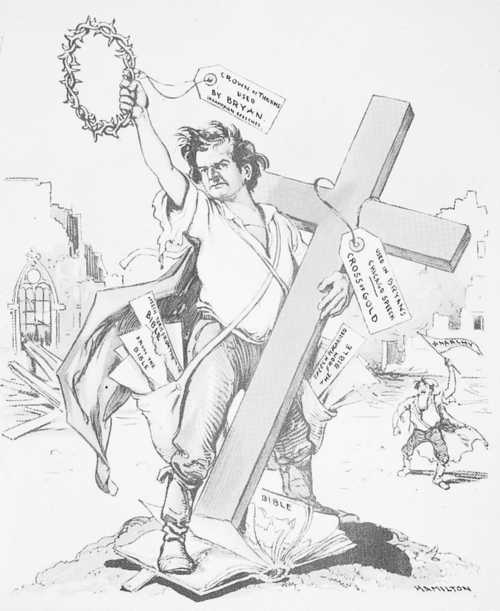
The Rise and Fall of the People’s Party
671
An Anti-Bryan Car-
toon, 1896. This
cartoon in Judge
magazine, entitled “The
Sacrilegious Candidate,”
charged William Jennings
Bryan with blasphemy in
his “Cross of Gold”
speech at the Democratic
national convention.
Bryan grinds his Bible
into the dust with his boot
while waving a crown of
thorns and holding a
cross of gold. In the
background, a bearded
caricature of an anarchist
dances amid the ruins of
a church and other
buildings.
York
New
Collection,
Granger
The©
responded by denouncing the Democrats as irresponsible inflationists. Free silver, they said, would mean a 57-cent dollar and would demolish the workingman’s gains
in real wages achieved over the preceding 30 years.
Under the skillful leadership of Ohio businessman Mark Hanna, chairman of
the Republican National Committee, McKinley waged a “front-porch campaign”
in which various delegations visited his home in Canton, Ohio, to hear carefully
crafted speeches that were widely publicized in the mostly Republican press. Hanna sent out an army of speakers and printed pamphlets in more than a dozen languages to reach immigrant voters. His propaganda portrayed Bryan as a wild man
from the prairie whose monetary schemes would further wreck an economy that
had been plunged into depression during a Democratic administration. McKinley’s
election, by contrast, would maintain the gold standard, revive business confidence, and end the depression.
The 1896 election was the most impassioned and exciting in a generation. Many
Americans believed that the fate of the nation hinged on the outcome. The number of voters jumped by 15 percent over the 1892 election. The sectional pattern of South and West versus Northeast and North Central was almost as pronounced as the
North–South split of 1860. Republicans won a substantial share of the urban, immigrant, and labor vote by arousing fear about the Democratic 57-cent dollar and by inspiring hope with the slogan of McKinley as “the advance agent of prosperity.”
McKinley rode to a convincing victory by carrying every state in the northeast
672
Chapter 19 The Rise of Corporate America, 1865–1914
quadrant of the country. Bryan carried most of the rest. Republicans won decisive control of Congress as well as the presidency. They would maintain control for the next 14 years. The election of 1896 marked a crucial turning point in American political history away from the stalemate of the preceding two decades.
Whether by luck or by design, McKinley did prove to be the advance agent of
prosperity. The economy pulled out of the depression during his first year in office and entered into a long period of growth—not because of anything the new
administration did (except perhaps to encourage a revival of confidence) but
because of the mysterious workings of the business cycle. With the discovery of
rich new goldfields in the Yukon, in Alaska, and in South Africa, the silver issue lost potency, and a cascade of gold poured into the world economy. The long
deflationary trend since 1865 reversed itself in 1897. Farmers entered a new—
and unfamiliar—era of prosperity. Bryan ran against McKinley again in 1900
but lost even more emphatically. The nation seemed embarked on a placid sea of
plenty. But below the surface, the currents of protest and reform that had boiled up in the 1890s still ran strong.
“ROBBER BARONS” NO MORE
The depression of the 1890s—along with the Populist movement and labor protests
such as the Homestead and Pullman strikes—shook the confidence of members of
the industrial elite. Industrialists were terrified when in 1892 anarchist Alexander Berkman marched into the office of Henry Clay Frick, Andrew Carnegie’s right-hand man, and shot him at point-blank range (Frick survived). Although such phys-
ical assaults were rare, anger over ill-gotten and ill-spent wealth was widespread. In the 1890s, popular rage forced Mrs. Bradley Martin and her husband to flee to
England after she spent $370,000 (roughly $3.5 million in 2007 dollars) on one
evening of entertainment for her friends in New York’s high society.
Industrial titans were often called “robber barons.” Seeking a more favorable
image, some industrialists began to restrain their displays of wealth and use their private fortunes to advance the public welfare. As early as 1889, Andrew Carnegie had advocated a “gospel of wealth.” The wealthy, he believed, should consider all income in excess of their needs as a “trust fund” for their communities. In 1901, the year in which he formed U.S. Steel, Carnegie withdrew from industry and
devoted himself to philanthropic pursuits, especially in art and education. By the time he died in 1919, he had given away or entrusted to several Carnegie foundations 90 percent of his fortune. Among the projects he funded were New York’s
Carnegie Hall, Pittsburgh’s Carnegie Institute (now Carnegie-Mellon University),
and 2,500 public libraries throughout the country.
Other industrialists, including John D. Rockefeller, soon followed Carnegie’s
lead. A devout Baptist with an ascetic bent, Rockefeller had never flaunted his
wealth, but his ruthless business methods in assembling the Standard Oil Com-
pany and in crushing his competition made him one of the most reviled of the
robber barons. In the wake of journalist Ida Tarbell’s stinging 1904 exposé of
Standard Oil’s business practices, and of the federal government’s subsequent
prosecution of Standard Oil for monopolistic practices in 1906, Rockefeller transformed himself into a public-spirited philanthropist. Between 1913 and 1919, his
Conclusion
673
WASH.
4
ME.
NORTH
6
MONTANA
DAKOTA
3
3
MINN.
VT.
4
N.H.
OREGON
9
4
4
SOUTH
WIS.
N.Y.
MASS.
IDAHO
DAKOTA
12
36
15
3
4
MICH.
R.I. 4
1
WYOMING
14
3
CONN. 6
IOWA
PENN.
32
NEBRASKA
13
N.J.
OHIO
10
NEVADA
8
ILL.
IND.
23
MD.
DEL. 3
3
8
UTAH
24
15
W. VA.
VA.
CALIF.
3
COLORADO
6
12
8
4
KANSAS
MO.
10
17
KY.
1
12
N.C.
TENN.
11
12
ARK.
S.C.
8
9
GA.
MISS.
ALA.
13
9
11
TEXAS
LA.
15
8
Electoral
Popular
McKinley
FLA.
(Republican)
271
7,102,000
4
Learning
Bryan
(Democrat)
176
6,493,000
Cengage©
MAP 19.1 Presidential Election of 1896
Note the continuity of voting patterns over the two generations from the 1850s to the 1890s by comparing this map with the election maps in chapters 14, 15, and 17.
Rockefeller Foundation dispersed an estimated $500 million. His most significant
gifts included money to establish the University of Chicago and the Rockefeller
Institute for Medical Research (later renamed Rockefeller University). His chari-
table efforts did not escape criticism, however; many Americans interpreted them
as an attempt to establish control over American universities, scientific research, and public policy. Still, Rockefeller’s largesse helped build for the Rockefeller family a reputation for public-spiritedness and good works, one that grew even
stronger in the 1920s and 1930s. Many other business leaders, such as Julius
Rosenwald of Sears Roebuck and Daniel and Simon Guggenheim of the Ameri-
can Smelting and Refining Company, also dedicated themselves to philanthropy
during this time.
CONCLUSION
For many Americans, the strikes and violence and third-party protests of the 1890s were a wake-up call. They realized that wrenching economic change threatened the
liberty and equality they had long taken for granted as part of the American dream.
Many middle-class Americans began to support greater government power to carry
out progressive reforms that might cure the ills of an industrializing society.
The rise of corporate America created a fundamental paradox: on the one hand,
the new industrial landscape denied workers independence and subjected them to
harsh conditions, which they resisted as best they could in a series of strikes in 674
Chapter 19 The Rise of Corporate America, 1865–1914
the late 19th and early 20th centuries. Yet that same corporate world provided
significant opportunities for a better life—opportunities that were especially
embraced by the millions of immigrants who settled in American cities at the turn of the century. There, immigrants often found greater liberties than they had known before. But opportunity did not necessarily translate into equality: the search for a more equal society was far from finished.
20
CITIES, PEOPLES, CULTURES,
1890–1920