
• An Industrializing West • Conquest and Resistance: American Indians
in the Trans-Mississippi West • Industrialization and the New South
• The Politics of Stalemate
“HOW I DO WISH YOU could all come out here,” the new Kansas homesteader
Mary Abell wrote to her family back east in 1871. “It is such a beautiful
country—I did not know there was any thing so beautiful in the whole
world as the country we passed over in coming here.” Just arrived from New
York with her husband, Abell was clearly excited about the prospect of a new life in the West: “Robert has got a piece of land that suits him,” she told her sister. “It seems so fortunate.” She knew there was much to do in the days ahead—“There is
a house to be built fences to make—a well to be dug and a cow to be got.” But
Abell didn’t seem to mind: “I should never be content to live East now,” she said.
“Things there would look very little.”
Abell was part of a great wave of settlement in the post–Civil War era that
would transform the West. From 1865 to 1890, the white population in the trans-
Mississippi west increased some 400 percent to 8,628,000—a figure that includes
both native-born and white immigrants. The dream of western lands also inspired
many African Americans, whose cherished hopes for liberty led hundreds of thou-
sands to leave the South for points west from 1880 to 1910. At the same time,
immigrants from China, Mexico, and other countries were drawn to the economic
opportunities of the West as part of a global movement of peoples in this period.
All of these men and women were driven by desires for a better life, but this
motivation often conflicted with the rights and desires of the diverse peoples who already inhabited the West, including, among others, a variety of Indian cultures 609
610
Chapter 18 A Transformed Nation: The West and the New South, 1865–1900
CHRONOLOGY
1862
Sioux uprising in Minnesota; 38 Sioux executed
1864
Colorado militia massacres Cheyenne in village at Sand Creek,
Colorado
1866
Cowboys conduct first cattle drive north from Texas
1869
President Grant announces his “peace policy” toward Indians
1876
Sioux and Cheyenne defeat Custer at Little Big Horn
1880
James A. Garfield elected president
1881
Garfield assassinated; Chester A. Arthur becomes president
1883
Pendleton Act begins reform of civil service
1884
Grover Cleveland elected president
1887
Dawes Severalty Act dissolves Indian tribal units and implements
individual ownership of tribal lands
1888
Benjamin Harrison elected president
1889
Government opens Indian Territory (Oklahoma) to white settlement
1890
Wounded Knee massacre ◆ New Mississippi constitution pioneers
black disenfranchisement in South ◆ Republicans try but fail to
enact federal elections bill to protect black voting rights ◆ Congress
enacts McKinley Tariff
1892
Grover Cleveland again elected president
1895
Booker T. Washington makes his Atlanta Compromise address
1896
Plessy v. Ferguson legalizes “separate but equal” state racial
segregation laws
1898
Williams v. Mississippi condones use of literacy tests and similar
measures to restrict voting rights
and societies; borderlands villages of Spanish-speaking peoples; settlements of
Chinese miners and laborers; and Mexicans in California. Settlement set in motion conflict and resistance in numerous locations. Who would gain power over Western
lands? Whose liberty would be respected? What efforts would be made to achieve
equality—or deny equality—to all of these peoples? This chapter explores the transformation of the West and the South during the late 19th century, part of a larger process of industrialization in this period.
AN INDUSTRIALIZING WEST
Traditionally, historians have associated industrialization with the East in the
post–Civil War era, but in fact the West also industrialized in this period. That industrialization had many linked components: the settlement of the West, including the creation of farms, communities, and western cities; the production of commodities such as cattle and timber that could be shipped east; the creation of western An Industrializing West
611
consumers and thus the demand for manufactured goods; the extraction of resources through mining and logging; and the shipment of commodities using a national
transportation network. These western processes of resource extraction may have
looked different from the factory-centered industrialization that developed in the East and Midwest at this time (see Chapter 19), but they still involved the transformation of an agrarian economy to an industrial society. Like eastern industrialization, western industrialization also had global reach, pulling immigrants from
China, Peru, Chile, Hawaii, Europe, and Mexico to the already diverse West.
The Homestead
Settlement of the West was part of the larger process of
Act
industrialization. Mary Abell and her husband, for instance,
were able to become homesteaders because of legislation that
took effect on January 1, 1863—the same day that the Emancipation Proclamation
became law. Meant to provide free land for western settlers, the Homestead Act
was the result of a dream that stretched back decades. “Go West, young man!”
had been a famous saying during the 1850s, associated with an extended campaign
for a homestead law by newspaper editor Horace Greeley. The saying embodied a
cherished American ideal: the belief that individual ownership of land by farmers was at the heart of a virtuous citizenry and a sound democratic republic. That ideal had fueled Jeffersonian agrarianism, too.
In the 1850s, many people believed that a western “safety valve” was necessary
to ward off the potential evils of industrialization, urbanization, and capitalist expansion. Free land in the West would help prevent a system of perpetual wage
labor, or “wage slavery,” by allowing individual farmers to support themselves.
Thus free land would ultimately help preserve American values of democratic indi-
vidualism. Yet settlement of the West was not so much an escape from industriali-
zation as an important factor in the ongoing industrialization of the West.
The provisions of the Homestead Act were remarkably egalitarian for their
day—at least up to a point. Both men and unmarried women were eligible to file
for up to 160 acres of surveyed land in the public domain, as long as they were
over the age of 21. (Married women were assumed to be dependents of their
homesteading husbands.) Immigrants who affirmed their intention to become citi-
zens were also eligible. As long as homesteaders lived on the land for five years, not only cultivating it but also “improving” it by building a house or barn, they could receive full title for a fee of only $10. Utilizing these provisions, white homesteaders ultimately claimed some 285 million acres of land, a remarkable
redistribution of public acreage by the government.
However, despite a surface egalitarianism, the Homestead Act privileged white
farmers over African Americans and Hispanics, who rarely had the resources neces-
sary to homestead. Even free land required tools, seed, plus often-costly transportation to a far-away place. Experts in the Agriculture Department estimated such
needs at $1,000, a huge sum for most Americans at the time. The act also denied
access to Chinese laborers, who could not become U.S. citizens and had few prop-
erty rights. It made no provisions for the truly poor.
Furthermore, the Act severely affected such groups as New Mexico sheep-
herders and Native Americans for whom such settlement did not open up land but
612
Chapter 18 A Transformed Nation: The West and the New South, 1865–1900
instead took it away. The Homestead Act was in fact part of a larger process of
conquest, driven by the twin pressures of industrialization and white settlement, through which Indians were irrevocably stripped of their lands.
A final problem with the Act was corruption in its implementation. Those who
agitated for a Homestead Act in the antebellum period had been fueled by a sense
of idealism. Ironically, however, through chicanery, outright fraud, and government giveaways, more public land actually fell into the hands of railroads, other corporations, and speculators, than into the hands of individual farmers during this period.
Was the Homestead Act a success or failure in American life? To younger sons
in Norwegian or German farm families who could expect to inherit no land at
home, the opportunity to obtain 160 acres in Minnesota or Nebraska seemed
miraculous. But clearly, that perspective was not shared by Native Americans.
Railroads
Nothing was more important to the industrialization of the
West than the railroad. Just as free land for homesteaders
was a long-held dream for many Americans, so, too, was the creation of a trans-
continental railroad that would link East and West. The two dreams were con-
nected: the settlement of the West would be greatly facilitated by the extension of the railroad into far-flung territory. Thus it was no accident that in 1862, the year the government passed the Homestead Act, it also passed the Pacific Railroad Bill, which provided large loans and extremely generous subsidies of land to two railroad companies, the Union Pacific (working west) and the Central Pacific (working east), in order to enable them to build a transcontinental line stretching from
Omaha, Nebraska, to Sacramento, California. (Railroad lines already existed from
Omaha to the East.) Two years later, the government also provided a substantial
monetary subsidy for each mile of track laid in the West. Ultimately, the govern-
ment would give away 131 million acres of land to support transcontinental rail-
roads, including huge land subsidies to three additional railroads: the Atchison, Topeka, and Santa Fe (following the Santa Fe Trail between Missouri and the
Southwest); the Southern Pacific (from Southern California to New Orleans); and
the Northern Pacific (from the Great Lakes to the Columbia River).
These lavish subsidies set off a frenzy of railroad building; they also made a
few individuals very rich, including the “Big Four” of the Central Pacific: Leland Stanford, Collis P. Huntington, Mark Hopkins, and Charles Crocker. Big in every
way (they collectively weighed 860 pounds), the four men had come to California
during the Gold Rush and had shrewdly sized up its entrepreneurial opportunities.
They now avidly seized the historic opportunity at hand and formed a partnership
that effectively split up the work necessary in such a giant task, including the
work of influencing lawmakers. Like so many others involved in the notoriously
corrupt postwar railway boom, they were not shy about using bribery or graft to
achieve their aims. The leader of the Union Pacific, Thomas C. Durant, was not
shy either, having been the chief architect of the scandalous Credit Mobilier
scheme (see Chapter 17).
Having provided generous subsidies, the government expected the railroads to
obtain their own financing, and so various railroads sold millions of dollars of
stocks or bonds, many selling as much stock as the market would bear without
An Industrializing West
613
much relationship to the actual value of the railroads. This “watered” stock
was part of the runaway corruption that surrounded financing railroads. The Big
Four participated wholeheartedly in this corruption, creating construction con-
tracts, for instance, that paid them $90 million for work that only cost them
$32.2 million.
Once financing had been arranged for this complex venture, the Union Pacific
and Central Pacific embarked on a daunting task that would engage some 20,000
workers at a time. From 1865 on, the two railroads raced against one another, as
whoever laid the most track stood to gain in government subsidies as well as later commerce. The Union Pacific employed primarily Irish laborers, while the Central
Pacific employed a workforce that was by 1867 almost 90 percent Chinese. All
worked almost constantly.
Chinese
A global economy had drawn thousands of Chinese laborers
Laborers and
to California during the Gold Rush, beginning in 1849.
the Railroads
Mostly peasants emigrating from the Pearl River delta of
Guangdong Province in southeast China, they were pushed
from home by poverty and unstable political conditions related to China’s defeat in the British Opium Wars; they were pulled to America by their hope to make a
better living in “Gold Mountain.” While only a few hundred men emigrated in
1849 and 1850, by the mid-1850s, thousands of Chinese immigrants arrived
annually. By 1870, there were some 63,000 Chinese in the United States, with over three-quarters settled in California.
Almost entirely men, Chinese immigrants intended to be sojourners, not perma-
nent settlers: they planned to take their hard-earned savings home to the wives and families they had left behind. At first they worked as independent prospectors
panning for gold, but as gold profits dwindled, they moved into other areas of
work. In the 1860s, labor contractors in China actively recruited young men to
come to America to build the transcontinental railroad, as well as to work as agricultural laborers, to develop fisheries and vineyards, and to help reclaim California swamplands. Some 12,000 Chinese laborers ultimately built the Central Pacific
Railroad, often under exceptionally harsh conditions, and with substantially less pay than white laborers.
Even before they began working on the railroads, Chinese miners and laborers
faced extremes of prejudice from white nativists. In 1850, the California State legislature responded to anti-foreigner agitation with a Foreign Miners’ Tax aimed at all foreigners; two years later, the legislature specifically targeted Chinese immigrants.
Western labor leaders, particularly Dennis Kearney of the Workingman’s Party of
California, inflamed nativist crowds of white workers with anti-Chinese rhetoric: in 1877, during the national Great Railway Strike (see Chapter 19), mobs of white workers rioted against Chinese workers in San Francisco’s Chinatown. Violence
against Chinese workers occurred in numerous places in the West during the
1870s and 1880s, including a massacre in Rock Springs, Colorado, after the Union
Pacific Railroad decided to hire Chinese workers. Twenty-eight Chinese died in an attack that included burning down Chinese homes; similar attacks soon occurred
throughout the West.
614
Chapter 18 A Transformed Nation: The West and the New South, 1865–1900
At the local level, Chinese immigrants faced a host of discriminatory ordi-
nances specifically targeting them, from queue ordinances regulating the length of men’s hair (forbidding the distinctive braid worn by Chinese men); to sidewalk
ordinances preventing the carrying of baskets on shoulders. At the state level,
California laws denied Chinese the right to own land, to testify in court, to inter-marry with whites, and to immigrate. Under these conditions, Chinese workers cre-
ated communities of their own against stiff odds. Yet by 1850, a thriving
Chinatown had emerged in San Francisco, and Chinese sections emerged in numer-
ous communities throughout the West.
In 1882 the federal government weighed in with its first discriminatory law tar-
geting a specific immigrant group. The Chinese Exclusion Act suspended Chinese
immigration for 10 years with the exception of a few job categories. Wealthy
Chinese businessmen and merchants were allowed entry because of the U.S. govern-
ment’s interest in trade with China. But the law forbade Chinese laborers, who
were said to endanger “the good order of certain localities.” Renewed in 1892, the Chinese Exclusion Act achieved its aim: The population of Chinese declined from
105,465 in 1880 to 89,863 in 1900, during a period in which immigration swelled
for other groups (for more on Chinese immigrants, see Chapter 20).
The Golden
By the early spring of 1869, what one commentator called
Spike
the “irrepressible railroad” was almost an accomplished fact.
The only question was where East and West would meet. In
the final stages of track-laying, the two railroads—which would receive money,
after all, based on miles of track built—actually built some track parallel to one another before finally being instructed by no less than President Grant to determine a meeting point.
The result, on May 10, 1869, was the historic driving of a “golden spike” in
Promontory, Utah, to mark the merging of the two lines. Present that day, we
know from the historical record, were “men of every color, creed, and nationality,”
including the Chinese laborers who had built the railroad and laid the very last
track. But official photographs of the event leave them out—a silence that speaks volumes about racial prejudice at the time.
Soon, others followed this first trans-continental railroad, although there were
numerous difficulties and abortive attempts. The Northern Pacific ran out of capital in 1873 and went into receivership; the Santa Fe fell short of its goal. Still, by 1893, a total of five trans-continental railroads would be in service, and track mileage west of the Mississippi would increase from 3,272 miles at the end of the Civil
War to 72,473 miles. No single factor was as important to the industrialization of the West as the building of railroads, which provided an infrastructure for the western economy as well as connection to eastern markets.
Railroads and
Railroads changed ordinary people’s lives across the West.
Borderlands
The arrival of the railroads, as well as the Anglo settlers who
Communities
followed swiftly in their wake, dramatically changed estab-
lished patterns of life in the borderlands communities of
northern New Mexico and southern Colorado. In the 1870s Hispanic villagers
An Industrializing West
615
lived communally in this area, grazing sheep and cattle on the open range. That
way of life had not changed much even after the conquest of New Mexico in 1848.
But the coming of the railroads in the 1880s put new pressure on Hispanic
village life. In places like Rio Arriba County, New Mexico, Hispanic villagers who had done a thriving trade freighting—hauling goods by wagons—found themselves
replaced by the railroads. As a result, communities that had combined trade with
grazing and farming were now forced to go back only to farming and grazing,
even though this combination had never produced quite enough for their needs.
Even worse, in a pattern repeated throughout the West, Hispanic villagers found
that Anglo settlement and fencing of once-open lands reduced the available range
for grazing.
As Anglo-owned livestock companies moved in, bringing in better breeds and
buying up grazing land, they began to squeeze out the Hispanic farmers. By the
1890s villagers began to depend on credit for the first time; in the turbulent economy of that decade, many of them were unable to pay their debts. The end result
was the loss of their sheep—and livelihood—to Anglo businessmen who had
extended credit to them. Many ended up working for livestock companies, some-
times caring for herds they had once owned themselves. Eventually others ended
up as miners, forced to become wage laborers.
Resentment became active resistance in the 1880s, when a secret organization,
las Gorras Blancas (White caps), rode mostly at night to cut fences, tear up railroad track, and burn bridges. “Our purpose is to protect the rights of the people in general and especially those of the helpless classes,” the group declared in its platform.
But the group had only limited success in achieving these goals.
Mining
A similar process held true in mining. The California Gold
Rush of 1849 and the early 1850s had drawn miners from
across the United States—and from Mexico, Europe, China, Chile, and other
countries, as well—to pan for gold. After the Civil War, mining continued but the image of the individual prospector striking it rich on his own claim became
increasingly quaint. By the 1870s the majority of miners were wage laborers who
worked for corporations, not for themselves. Mining was big business, with groups of investors consolidating holdings in some of the richest mines. George Hearst, for instance, began by investing in 1859 in the legendary Comstock Lode in Nevada—
the richest vein of silver in America. “If you’re ever inclined to think that there’s no such thing as luck,” Hearst remarked, “just think of me.” In 1877, Hearst and
business partners bought the Homestake Mine in the Black Hills, and then enriched their holdings still further by buying up the claims of surrounding miners. Other financiers invested in the industries related to mining, including railroads, lumber companies, and smelters.
Gold Rush prospectors had worked the surface of the earth with picks, shovels,
and tin pans. But soon miners and mining companies developed new technologies
to extract ore, whether on the surface of the earth or underground. Hydraulic mining, used as early as the 1850s, employed high-pressure jets of water to wash away banks of earth and even mountains in order to extract gold. By the 1880s, hydraulic mining produced 90 percent of California’s gold, but it also ravaged the
616
Chapter 18 A Transformed Nation: The West and the New South, 1865–1900
environment, tearing away indiscriminately at earth, boulders, and trees, and leaving desolate landscapes in its wake. The debris (tailings) from hydraulic mining
clogged rivers and caused floods, ruining farms with muddy waste. Other types of
mining destroyed landscapes as well: copper mining in particular created strip-
mining moonscapes.
Railroads played a central role in the development of industrial mining, not
only providing access to mines but also enabling a new kind of mining late in the century. Gold discoveries had propelled the first waves of western settlement, but by the 1870s, silver eclipsed gold in volume and some years even in value. Copper mining became profitable after the arrival of the railroads, which allowed transportation of huge quantities of ore. In Butte, Montana, mining had centered on diminishing supplies of silver until 1881. But the arrival of railroads that year made it possible to extract Butte’s rich lode of copper, known as the “richest hill on
earth.” The same held true for large-scale copper mining in southern Arizona,
which was also catalyzed by the arrival of the railroads in the 1880s. Such large-scale resource extraction was at the heart of western industrialization.
Miners’ working conditions in heavily mechanized hardrock mines grew
steadily worse. Mining on the Comstock Lode involved work in mines with tem-
peratures of well over 100 degrees—sometimes as much as 150 degrees deep under-
ground. Miners died of the heat, of poor ventilation, of the release of toxic gases, and of accidents with mining equipment. Accidents disabled one out of every 30
miners in the 1870s. By the end of the 19th century, mining was the most danger-
ous industry in the country.
Unions gained a limited foothold in the 1870s and 1880s, but wage cuts in the
early 1890s initiated a new burst of labor radicalism and resistance. After a violent confrontation between miners and the National Guard at Coeur d’Alene, Idaho,
in 1892, mining unions met at Butte, Montana, in 1893 to form the Western
Federation of Miners (WFM), whose radical politics included a call to radically
transform the American economic system. That year, a violent strike at Cripple
Creek, Colorado, broke out over mine owners’ attempts to move from an eight-
hour to a ten-hour day. These strikes were part of nationwide labor activism and
resistance in the 1890s (see Chapter 19). Ultimately the WFM would help to found
the 20th-century Industrial Workers of the World (IWW) (see Chapter 20). The
IWW’s leader, William “Big Bill” Haywood, later remembered being approached
by a WFM organizer as a young man in Idaho. “I had never heard of the need of
workingmen organizing for mutual protection,” Haywood said, but he soon
became a leader of the WFM himself. The industrialization of the West became a
radicalizing political experience for many.
Ranching
It wasn’t just miners who went on strike: by the 1880s, even
cowboys attempted strikes for better pay and better working
conditions. The idea of a striking cowboy might seem incongruous, but cowboys
were employees, too, and increasingly in the late 19th century they were employees of large industrial corporations. Contrary to most Hollywood images, they were
also a diverse group: approximately one-third of the trail cowboys were African
American, Mexican, or Indian.
An Industrializing West
617
Cattle Drives
A postwar boom in the range cattle industry had its beginnings
and the Open
in southern Texas. The Spaniards had introduced longhorn
Range
cattle there in the 18th century. This hardy breed multiplied
rapidly: by the 1850s, millions of them roamed freely on the
Texas plains. The market for them was limited in this sparsely settled region—the nearest railhead was usually too far distant to make shipping them north and east economically feasible.
The Civil War changed all that. Beef supplies in the older states dropped dras-
tically, and prices rose to the unheard-of sum of $40 per head. The postwar explosion of population and railroads westward brought markets and railheads ever
closer to western cattle that were free to anyone who rounded them up and
branded them.
Astute Texans quickly saw that the longhorns represented a fortune on the
hoof—if they could be driven northward the 800 miles to the railhead at Sedalia,
Missouri. In spring 1866, cowboys hit the trail with 260,000 cattle in the first of the great drives. Disease, stampedes, bad weather, Indians, and irate farmers in
Missouri (who were afraid that the Texas fever carried by some of the longhorns
would infect their own stock) killed or ran off most of the cattle.
Only a few thousand head made it to Sedalia, but the prices they fetched con-
vinced ranchers that the system would work, if only they could find a better route.
By 1867, the rails of the Kansas Pacific had reached Abilene, Kansas, 150 miles
closer to Texas, making it possible to drive the herds through a sparsely occupied portion of Indian Territory. About 35,000 longhorns reached Abilene that summer,
where they were loaded onto cattle cars for the trip to Kansas City or Chicago. This success resulted in the interlocking institutions of the cattle drive and the Chicago stockyards. The development of refrigerated rail cars in the 1870s enabled Chicago to ship dressed beef all over the country. Abilene mushroomed overnight from a
sleepy village where one bartender spent his spare time catching prairie dogs, into a boomtown where 25 saloons stayed open all night. The railroad made almost as
much money shipping liquor into town as it did shipping cattle out.
More than a million longhorns bellowed their way north on the Chisholm
Trail to Abilene over the next four years, while the railhead crept westward to
other Kansas towns, chiefly Dodge City, which became the most wide-open and
famous of the cow towns. As buffalo and Indians disappeared from the grasslands
north of Texas, ranches moved northward to take their place. Cattle drives grew
shorter as railroads inched forward. Ranchers grazed their cattle for free on millions of acres of open, unfenced government land. But clashes with “grangers”
(the ranchers’ contemptuous term for farmers), on the one hand, and with a grow-
ing army of sheep ranchers on the other—not to mention rustlers—led to several
“range wars.” Most notable was the Johnson County War in Wyoming in 1892.
Grangers and small ranchers there (who had sometimes gotten their start by rus-
tling) defeated the hired guns of the Stock Growers’ Association, which represented larger ranchers.
By that time, open-range grazing was already in decline. The boom years of the
early 1880s had overstocked the range and driven down prices. Then came record
cold and blizzards on the southern range in the winter of 1884–85, followed by
even worse weather on the northern plains two years later. Hundreds of thousands






















































































































































































































618
Chapter 18 A Transformed Nation: The West and the New South, 1865–1900
t. ol
AS
R
TERR
rc
n
fin
K
lk
R
N
ty
(Virginia City)
rv
r
k
ty
HO
s
oise TERR
Ch
Sutter
er
V
(Sacramen
amen
men
am
amen
OLO
LOR
O OR
S
as
a
sa
n
tyy
ty
SSed
s Pe
ke'
y
N
NE
N
E
NSA
T
PACIFIC
OCEAN
Forest
Arid lands
tonio
Grassland
Mining
Gulf of Mexico
Cow country
Learning
Cengage©
MAP 18.1 Mining and Cattle Frontiers, 1870s
Most of the mines shown on this map produced gold and silver. The next generation would begin to exploit the copper to be found in Montana and Arizona, and later generations would extract oil from Texas and Oklahoma and coal and oil from Wyoming.
of cattle froze or starved to death. These catastrophes spurred reforms that ended open-range grazing. The ranchers who survived turned to growing hay and supplemental feed for the winter. They reduced the size of their herds, started buying or leasing land and fencing in their cattle, and invested in scientific breeding that crossed longhorns with higher-quality stock to produce a better grade of beef.
The
As open-range grazing declined, industrialized ranching ex-
Industrialization
panded. We don’t usually think of ranching as an industrial
of Ranching
process—industrialization tends to conjure up images of
eastern factories belching smoke—but in fact major ranching
companies operated as big businesses by the end of the century. As historian David Igler has shown, by 1900 the California corporation Miller & Lux was one of the An Industrializing West
619
Number of Beef Cattle
50
40
30
Millions 20
10
0 1867 1872 1877 1882 1887 1892 1897
Year
Beef Cattle in the United States, 1867–1897
largest industrial enterprises in the country, having integrated raising cattle
on vast landholdings together with meatpacking in San Francisco. Its two
founding partners were German immigrants who had started out working as
butchers in San Francisco but soon owned their own shops. Despite their
remarkably similar backgrounds—or perhaps because of them—they never liked
each other much. Still, they were enormously successful business partners,
building a corporation that shared many similarities with other large companies
in the late 19th century. Mobilizing large amounts of capital, they employed
over a thousand laborers in extensive operations that tightly connected ranch-
lands with the city.
Industrial
Cowboys did not just ride the open range in the Texan cattle
Cowboys
drives that have became the stuff of legend; they also rode
the extensive Miller & Lux landholdings. Before the 1870s,
the most valuable of the firm’s cowboys were vaqueros, Mexican cowboys who
rounded up cattle, branded them, and drove them to San Francisco. The tradition
of the vaqueros had arrived in the New World with the Spanish, who introduced
herding by men on horseback. By the late 19th century, the raising of cattle herds by vaqueros had been practiced for centuries in California.
Not surprisingly, the head vaquero at Miller & Lux was a Mexican American,
Rafael Cuen. His was a position of skill and respect, yet his salary was not as high as that of his white coworkers, which reflected prevalent discrimination against
Mexicans. It’s possible this carried an especially sharp sting since his father had once owned (and lost) a piece of the Miller & Lux land. The arrival of railroads took a toll on the positions of vaqueros like Cuen: after the 1870s cattle were
shipped to market by rail.
620
Chapter 18 A Transformed Nation: The West and the New South, 1865–1900
Mexican
Throughout the late 19th century, Mexican Americans,
Americans
many of whom had owned their land for generations, lost
both property and political influence to incoming Anglo-
American settlers. Many elite Californios, who were ranchers in southern
California, for instance, had to sell their lands to pay outstanding debts after devastating droughts in the 1860s virtually destroyed the ranching industry. But even as early as 1849 in the northern California goldfields, resentment of “foreigners”
provoked violence against Mexican American miners—and the Foreign Miners’
Tax of 1850 effectively forced Mexican Americans out of the goldfields (even
though they were not “foreigners”). As the 19th century progressed, hordes of
Anglo-American “squatters” invaded the expansive holdings of Californios, who
were forced to seek relief in the courts. Although their claims were generally
upheld, legal proceedings often stretched on for years. After exorbitant legal fees and other expenses were taken into account, a legal triumph was often a Pyrrhic
victory. In the end, most Mexican American landholders in northern California,
like those in southern California, had to sell the very lands they had fought to keep in order to pay their mounting debts.
The migration of Anglos into eastern Texas had played a role in fomenting the
war for Texas independence and in bringing about the war with Mexico
(see Chapter 13). By the latter half of the 19th century, eastern Texas was over-
whelmingly Anglo; most Tejanos (people of Mexican origin or descent) were con-
centrated in the Rio Grande Valley of southern Texas. As in California, Anglos in Texas used force and intimidation, coupled with exploitative legal maneuvering, to disenfranchise the Tejanos. The Texas Rangers often acted as an Anglo vigilante
force that exacted retribution for the real or imagined crimes of Mexican Ameri-
cans. Eventually, Mexican Americans in Texas were reduced to a virtual state of
peonage, dependent on Anglo protectors for political and economic security.
Similar patterns prevailed in New Mexico, but the effects were mitigated some-
what because New Mexicans continued to outnumber Anglo-American settlers.
Earlier in the 19th century, international trade along the Santa Fe Trail had
strengthened the political and economic status of the New Mexican elites. Now
these same elites consolidated their position by acting as power brokers between
poorer New Mexicans and wealthy Anglos. Throughout the Southwest, Spanish-
speaking peoples maintained their cultural traditions in the face of Anglo
settlement, with the Roman Catholic Church serving as an important center of
community life. An influx of immigrants from Mexico toward the end of the
century created a new basis for community as well.
Itinerant
The vaquero Rafael Cuen was a highly skilled worker of
Laborers
great value to his employer; he was one of the lucky
employees who had long-term employment. But for many
workers in the West, itinerancy was the norm; a virtual army of workers and
wanderers traveled the western countryside. Most low-level jobs in ranching were
seasonal, meaning that workers were forced to move from place to place periodi-
cally in search of work. And as western industrialization uprooted many workers
from their traditional lives, more and more people took to the road. As Henry
An Industrializing West
621
Kansas
Topeka,
Society,
Historical
State
Kansas
Destruction of the Buffalo. Historians estimate that as many as 30 million bison
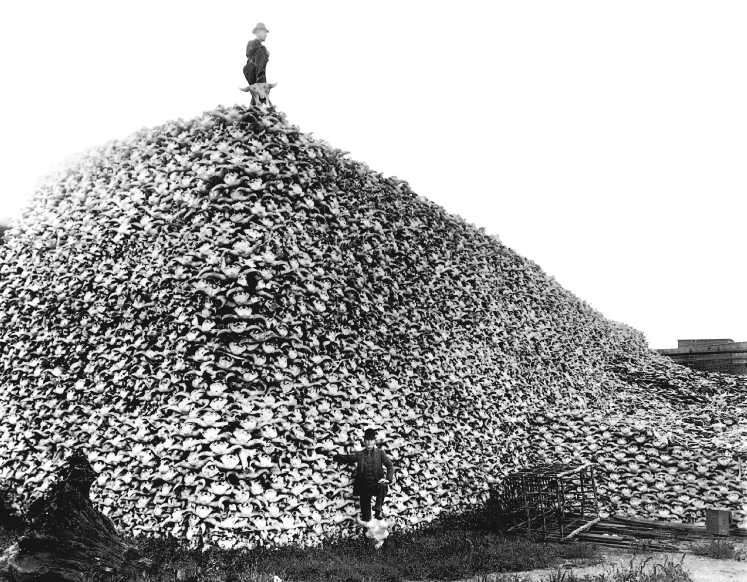
(popularly called buffalo) once roamed the grasslands of North America. By the mid-19th century, however, expansion of the European American settlement, the demand for buffalo robes in the European and eastern U.S. markets, and competition from Indian horses for grazing lands had reduced the herds by many millions. Such pressures intensified after the Civil War—as railroads penetrated the West and new technology enabled tanners to process buffalo hides for leather. Professional hunters flocked to the range and systematically killed the bison. By the 1880s, the buffalo were almost extinct, leaving behind millions of bones, which were gathered in piles, as in this photograph of buffalo skulls, and shipped to plants that ground them into fertilizer.
George said in his bestselling 1879 book, Progress and Poverty, a scathing indictment of the current economic system, “the ‘tramp’ comes with the locomotive.”
For George, who had been a prospector before becoming a newspaper editor in
California, the fault lay in a system of “land monopoly” that allowed control of
land and resources by the few at the expense of the many.
At Miller & Lux, itinerant laborers were Chinese, Portuguese, Italian, Mexican, and Mexican American, in addition to white, native-born Americans. One itinerant
laborer on an irrigation crew, Joseph Warren Matthews, was a farmer who had
heavy debts. To pay his debts he had taken on a series of grueling temporary
jobs, including wage labor for a lumber company in the Pacific Northwest, work
in the Alaskan goldfields, pipe laying for a water company, ore smelting, and
622
Chapter 18 A Transformed Nation: The West and the New South, 1865–1900
digging ditches. His situation underlined the precariousness of many lives in the industrializing West.
Homesteading
Homesteaders and farmers shared that precariousness: not
and Farming
only were 49 percent of all homesteaders unable to “prove
up” their claims, but many were ultimately forced off their
homesteads by the unforgiving climate of the Great Plains.
For much of the antebellum period, the Great Plains region was known as the
Great American Desert and assumed to be uninhabitable. By the 1850s, however,
many boosters of western expansion promoted the idea that the Great Plains was
a potentially lush American garden perfect for settlement. In this view, aridity was not a problem; the folk belief that “rainfall follows the plow”—that settlement
would somehow prevent droughts—even gained credence among some geologists
and other experts.
A great wave of settlement of the Great Plains occurred during the late 1870s
to the mid-1880s, when rainfall was in fact relatively abundant. But the truth was that the average normal rainfall on the Great Plains was scarcely enough to support farming except in certain river valleys. Years of drought inevitably followed, beginning in 1886 and lasting through the mid-1890s—and fueling farmers’ discontent and protests (see Chapter 19). Homesteaders and farmers in Minnesota,
Iowa, and parts of Kansas and Nebraska were relatively lucky—those areas had
rich soil and adequate rainfall. In Iowa, for instance, farmers had great success with a “corn and hog” farm economy. But other land was arid and unproductive,
producing heartbreak for homesteaders and farmers. Between 1888 and 1892, half
the population of Kansas and Nebraska was forced to give up and move back east
to Illinois or Iowa.
The Experience
Homesteading families on the Great Plains literally built
of
their houses from the ground up: in an environment with-
Homesteading
out trees, they cut the dense prairie sod into blocks and
stacked them up to form walls, providing a small window
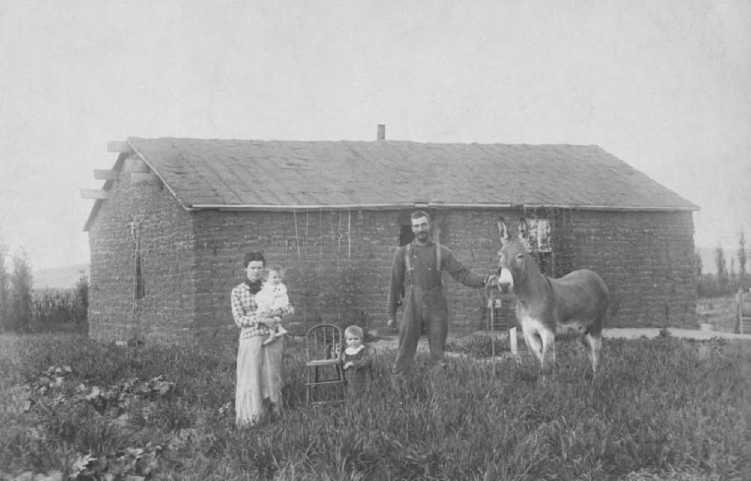
and a door in a “soddy” of around 18 by 24 feet. Soddies were a practical
solution to a difficult problem on the plains, but they were also dark, dank, and claustrophobic.
As Kansas homesteader Mary Abell explained to her sister: “Imagine living
in a place dug out of the side of a hill (one side to the weather with door and
window—top covered with dirt and you have our place of abode). No one east
would think of putting pigs in such a place.” Abell’s letters from 1871 to 1875
make clear the hard labor involved in homesteading: in addition to caring
for five children, in the fall of 1873, she had been her husband’s “sole help in getting up and stacking at least 25 tons of hay and oats.” Less than a week later,
“one of those dreadful prairie fires” swept through the Abells’ land, and they
lost not only their hay and oats but also chickens and farm equipment. In 1874,
she faced both drought and grasshoppers, and wrote to her family that “none of
you have the least conception” of “actual want, destitution.” In 1875, Abell died at the age of 29.
An Industrializing West
623
Not all homesteaders faced dire straits. Of the 4 million immigrants who
came from Germany, the Czech region of the Austro-Hungarian Empire, and the
Scandinavian countries from 1865 to 1890, many settled in the upper Midwest
and northern plains and became successful farmers. The northern plains region
had the highest proportion of foreign-born residents in the nation during the last quarter of the century. These European immigrants formed homogenous ethnic
enclaves that maintained the distinctive culture and traditions of their homelands.
Swedish immigrants in Minnesota, for instance, spoke Swedish with one another
and centered their lives around the Swedish Lutheran church; their children
attended Swedish schools and learned to read the Swedish bible, sing Swedish
songs, and recite Swedish history; and both men and women wore traditional
Swedish dress on holidays. By the end of the century, there were also homogenous
ethnic communities of Germans, Czechs, Poles, Hungarians, and Norwegians dot-
ting the northern landscape.
Gender and
The Homestead Act was unusual in allowing unmarried
Western
women to make claims; between 5 and 15 percent of home-
Settlement
stead entries in different locales went to women in the late
19th century. Many of these women probably “proved up”
only to immediately sell their land, rather than farm it themselves: but still, the Division
Photographs
and
Prints
Congress,of
Library
A Nebraska Soddy. This appealing young family stands proudly in front of their
Nebraska soddy in 1884 or 1885, during a time when rainfall was abundant on the Great Plains. A long-term drought began in 1886, however, making us wonder whether this family was able to hang on to its homestead through the coming difficult times.
624
Chapter 18 A Transformed Nation: The West and the New South, 1865–1900
existence of women homesteaders reminds us that in some ways, gender arrange-
ments were different in the West than in other regions of the country.
The most pronounced difference was in mining camps and towns, which were
overwhelmingly masculine. During the Gold Rush, California was up to 93 percent
male, and many ranches, including Miller & Lux holdings, were exclusively male as well. Mining towns were known as violent places, and many observers were anxious to establish a more respectable family life there.
Prostitutes from all over the world were drawn to mining towns throughout the
late 19th century, but nowhere except in San Francisco were women systematically
forced into sexual slavery. There, the situation of Chinese laborers encouraged an exploitative world trade in women. Although by the last decades of the century
Chinese merchants were allowed to bring their wives and daughters to America,
laborers had no such rights. Furthermore, respectable single women were expected
to stay home. The number of Chinese women in America never rose above 5,000
during the 19th century.
The absence of Chinese women encouraged a brutal international trade in pros-
titution. Chinese women who were kidnapped or purchased from poor parents
were sold into indentured servitude or slavery and unknowingly shipped to America to become prostitutes. In San Francisco, an estimated 85 to 97 percent of Chinese women were prostitutes in 1860; around 72 percent in 1870; and between 21 and
50 percent in 1880. They faced a harsh existence. However, some women managed
to escape prostitution. Some women married men who had saved up enough money
to purchase the contracts that bound them; Protestant missionaries worked to res-
cue prostitutes, as well.
As these few examples show, settlement patterns of the West produced—
at least for a short period of time—societies with unequal numbers of men
and women, with different results in different places. The impact of these dis-
parities continues to intrigue historians, who still puzzle, for instance, over the reasons why several western states were the first to grant woman suffrage
(see Chapter 21).
CONQUEST AND RESISTANCE: AMERICAN INDIANS IN THE
TRANS-MISSISSIPPI WEST
The westward expansion of ranching and farming after 1865 doomed the free
range of the Plains Indians and the buffalo. In the 1830s, eastern tribes had been forcibly moved to preserves west of the Mississippi so as permanently to separate whites and Indians. Yet in scarcely a decade, white settlers had penetrated these lands via the overland trails to the Pacific Coast. In the 1850s, when the Kansas and Nebraska territories opened to white settlement, the government forced a dozen tribes living there to cede 15 million acres, leaving them on reservations totaling less than 1.5 million acres. Thus began what historian Philip Weeks has called the
“policy of concentration”: No longer were Indians to be pushed ever westward.
Instead, they were to be concentrated onto reservations a fraction of the size of where they had formerly hunted freely.
Conquest and Resistance: American Indians in the Trans-Mississippi West
625
Even before the Civil War, the nomadic Plains Indians, whose culture and econ-
omy were based on the buffalo, faced pressure not only from the advancing tide of white settlement but also from the forced migration of eastern tribes into their domain. In the aftermath of the Civil War, the process of concentrating Indian tribes on reservations accelerated. Chiefs of the five “civilized tribes”—Cherokees, Creeks, Choctaws, Chickasaws, and Seminoles—had signed treaties of alliance with the
Confederacy. At that time, they were living in Indian Territory (most of present-
day Oklahoma), where their economy was linked to the South. Many of them,
especially members of the mixed-blood upper class, were slaveholders. Bitter toward the United States, the tribal leaders cast their lot with the Confederacy on the principle that “the enemy of my enemy is my friend.” The Cherokee leader Stand Watie
rose to brigadier general in the Confederate army and was the last Confederate
commander to surrender, on June 23, 1865.
But siding with the Confederacy proved to be a costly mistake for these tribes.
The U.S. government “reconstructed” Indian Territory more quickly and with less
contention than it reconstructed the former Confederate states. Treaties with the five tribes in 1866 required them to grant tribal citizenship to their freed slaves and reduced tribal lands by half. The government then settled Indians who had
been dispossessed from other areas on the land it had taken from these tribes.
Conflict with
The Civil War set in motion a generation of Indian warfare
the Sioux
that was more violent and widespread than anything since the
17th century. Herded onto reservations along the Minnesota
River by the Treaty of Traverse des Sioux in 1851, the Santee Sioux were angry in the summer of 1862 that annuity payments did not arrive, threatening starvation.
Warriors began to speak openly of reclaiming ancestral hunting grounds. Then on
August 17, a robbery in which five white settlers were murdered seemed to open the floodgates. The warriors persuaded Chief Little Crow to take them on the warpath, and over the next few weeks, at least 500 white Minnesotans were massacred.
Hastily mobilized militia and army units finally suppressed the uprising.
A military court convicted 319 Indians of murder and atrocities and sentenced
303 of them to death. Appalled by this ferocious retaliation, Lincoln personally
reviewed the trial transcripts and reduced the number of executions to 38—the largest act of executive clemency in American history. Even so, the hanging of 38 Sioux on December 26, 1862, was the largest mass execution the country has ever witnessed.
The government evicted the remaining Sioux from Minnesota to Dakota Territory.
In the meantime, the army’s pursuit of fleeing Santee Sioux provoked other
Sioux tribes farther west. By 1864, and for a decade afterward, fighting flared
between the army and the Sioux across the northern plains. It reached a climax in 1874 and 1875 after gold-seekers poured into the Black Hills of western Dakota,
a sacred place to the Sioux. At the Battle of Little Bighorn in Montana Territory on June 25, 1876, Sioux warriors led by Sitting Bull and Crazy Horse, along with
their Cheyenne allies, wiped out George A. Custer and the 225 men with him in the Seventh Cavalry. In retaliation, General Philip Sheridan carried out a winter campaign in which the Sioux and Cheyenne were crushed.
626
Chapter 18 A Transformed Nation: The West and the New South, 1865–1900
Blackfeet
Chippewa
Nez Percé
Crow
Teton-Dakota
Chief Joseph's
Rebellion
Bannock Arapaho
1877
Cheyenne Sioux
Fetterman
Massacre
1866
Snake
Sioux
"Battle" of
Crow
Wounded Knee
1890
Paiute
Ute
Chivington
Ute
Massacre
1864
Kiowa
Navajo
Pueblo
Mohave
Hopi
Zuni
Red River War
1869–1874
Apache
Reservations in 1875
Comanche
Reservations in 1900
Present state boundaries
Learning
Battle site
Cengage©
MAP 18.2 Indian Reservations, 1875 and 1900
Before the Civil War, Indians had hunted and trapped over most of this vast region. The shrinking areas on which they were confined by the reservation policy vividly illustrate that for the first Americans, the story was not “the expansion of America” but “the contraction of America.”
The largest and most warlike of the Plains tribes, the Sioux were confined to a
reservation in Dakota Territory where poverty, disease, apathy, and alcoholism reduced them to a desperate condition.
Suppression
Just as the Sioux uprising in Minnesota had triggered war on
of Other Plains
the northern plains in 1862, a massacre of Cheyenne in
Indians
Colorado in 1864 sparked a decade of conflict on the
southern plains. The discovery of gold near Pike’s Peak set
off a rush to Colorado in 1858–59. The government responded by calling several
Cheyenne and Arapaho chiefs to a council, and with a combination of threats and
promises, persuaded the chiefs to sign a treaty giving up all claims to land in this region (guaranteed by an earlier treaty of 1851) in exchange for a reservation at Sand Creek in southeast Colorado.
Conquest and Resistance: American Indians in the Trans-Mississippi West
627
In 1864, hunger and resentment on the reservation prompted many warriors to
return to their old hunting grounds and to raid white settlements. Skirmishes soon erupted into open warfare. In the fall, Cheyenne Chief Black Kettle, believing that he had concluded peace with the Colorado settlers, returned to the reservation.
There, at dawn on November 29, militia commanded by Colonel John Chivington
surrounded and attacked Black Kettle’s unsuspecting camp, killing 200 Indians, half of them women and children.
The notorious Sand Creek massacre set a pattern for several similar attacks
on Indian villages in subsequent years. Ever since the earliest battles between
colonists and Indians in the 17th century, whites had followed the strategy of burning Indian crops and villages as a means of destroying or driving off the Indians.
Sherman and Sheridan had adopted a similar strategy against the Confederates
and followed it again as military commanders responsible for subduing the Plains
Indians. Their purpose was to corral all of the Indians onto the reservations that were being created throughout the West. In addition to trying to defeat the Indians in battle, which proved to be difficult against the mounted Plains Indians, the army encouraged the extermination of the buffalo herds. Professional hunters slaughtered the large, clumsy animals by the millions for their hides, thus depriving Plains
Indians of both physical and spiritual sustenance. When the buffalo became nearly extinct in 1883, the Plains Indians understood that their old way of life was gone forever. “Nothing happened after that,” recalled one Crow warrior. “We just lived.
There were no more war parties, no capturing horses from the Piegan and the
Sioux, no buffalo to hunt. There is nothing more to tell.”
The Indians were left with no alternative but to come into the reservations, and
by the 1880s, nearly all of them had done so. Chief Joseph of the Nez Percé pro-
nounced the epitaph for their way of life when federal troops blocked the escape
of his band from Montana to Canada in 1877:
I am tired of fighting. Our chiefs are killed. The old men are all dead. It is cold and we have no blankets ... no food.… The little children are freezing to death.… Hear me, my chiefs; I am tired; my heart is sick and sad. From where the sun now stands, I will fight no more forever.
The “Peace
Many Eastern reformers condemned America’s suppression
Policy”
of the Indians. The most prominent was Helen Hunt
Jackson, whose A Century of Dishonor (1881) was an out-
raged indictment of anti-Indian violence, exploitation, and broken treaties. Yet as sympathetic as Jackson was to the Indians’ plight, she was not sympathetic to
Indian culture; like other white Protestant reformers of her day, she believed that Indians must be stripped of their culture in order to assimilate to American society.
In this she was in alignment with the government. In 1869 President Grant had
announced a new “peace policy” toward Indians, urging “their civilization and
ultimate citizenship.” “Civilization” meant acceptance of white culture, including the English language, Christianity, and individual ownership of property. It also meant allegiance to the United States rather than to a tribe. In 1869, Grant established a Board of Indian Commissioners and staffed it with humanitarian reformers.
628
Chapter 18 A Transformed Nation: The West and the New South, 1865–1900
In 1871, the century-long policy of negotiating treaties with Indian “nations” came to an end. From then on, Indians became “wards of the nation,” to be “civilized”
and prepared for citizenship, first on reservations and eventually on individually owned parcels of land that were carved out of the reservations. Most Indians acquiesced in the “reconstruction” that offered them citizenship by the 1880s—they had little choice.
The Dawes
In order to further the goal of Indian ownership of private
Severalty Act
property, Protestant reformers in the 1880s found themselves
and Indian
in a strange alliance with land-hungry westerners, who greed-
Boarding
ily eyed the 155 million acres of land tied up in reservations.
Schools
If part of that land could be allotted directly for individual
ownership by Indian families, the remainder would become
available for purchase by whites. The 1887 Dawes Severalty Act combined these
impulses toward greed and reform. This landmark legislation called for the dissolution of Indian tribes as legal entities, offered Indians the opportunity to become citizens, and allotted each head of family 160 acres of farmland or 320 acres of
grazing land, as long as they were “severed” from their tribe.
For whites who were eager to seize reservation land, the Dawes Act brought a
bonanza. At noon on April 22, 1889, the government threw open specified parts of
the Indian Territory to “Boomers,” who descended on the region like locusts and
by nightfall had staked claim to nearly 2 million acres. Indians did not just lose the lands legally opened for white settlement: many Indians who received individual land titles through the Dawes Act also lost these lands to unscrupulous whites
through fraud and misrepresentation. Eventually, whites gained title to 108 million acres of former reservation land.
For Indians, the Dawes Severalty Act was a disaster. Private ownership of land
was an alien concept to most tribes, yet Indians received little training for a transition to farming, much less the appropriate tools and supplies. Moreover, the poor quality of their land allotments made farming difficult, if not impossible. In an attempt to strip Indians of their culture, the Dawes Act forbade Indian religions and the telling of Indian myths and legends, as well as the practices of medicine men.
Indian boarding schools, established beginning in the late 1870s, were another
attempt to strip Indians of their culture. Children were taken from their families to the Hampton Institute in Virginia and the Carlisle Institute in Pennsylvania, among other schools. There they were forbidden to speak Indian languages or wear Indian clothing. As one 1890 set of instructions from the U.S. Bureau of Indian Affairs put it: “Pupils must be compelled to converse with each other in English, and should be properly rebuked or punished for persistent violation of this rule.” The writer
Zitkala-Sa, a Yankton Sioux, later remembered her life in an Indian school: “the
melancholy of those black days has left so long a shadow that it darkens the path of years that have since gone by.”
Indian schools may have had assimilation to white culture as a goal, but they
also had a very narrow vision of the place Indians would hold in a white world.
Girls were educated for menial jobs as servants; many spent long hours working
in school laundries as virtual servants of the schools that were supposed to teach Conquest and Resistance: American Indians in the Trans-Mississippi West
629
them. Students resisted as best they could by running away, often only to be caught and returned to school again; many adults later resisted the training they had
received by returning to Indian traditions. This was the case with Zitkala-Sa. After graduation from an Indian boarding school, Zitkala-Sa taught at the Carlisle
School and became a much-praised writer in New York. But later she would
undergo a spiritual crisis: she compared herself to a “slender tree” that had been
“uprooted from my mother, nature, and God,” and lamented that she had “forgot-
ten the healing in trees and brooks.” Eventually she left New York, married a
Sioux, and became an activist for Native American rights.
The Ghost
At a time of despair for many Indians, a new visionary reli-
Dance
gious movement swept through Indian peoples in 1890,
offering a different kind of resistance to white domination. The
Ghost Dance began with the visions of the Paiute shaman Wovoka, who counseled
Indians that if they gave up alcohol, lived a simple life, and devoted themselves to prayer, white men would disappear from the earth, Indian lands would be restored, and dead Indians would rejoin the living. This message of hope was embodied in the Ghost Dance ritual, involving days of worship expressed in part through dance.
When the Ghost Dance religion spread to those Sioux led by Sitting Bull, and
they began days of ecstatic dancing, Indian agents grew alarmed: as one agent telegraphed authorities, “Indians are dancing in the snow and are wild and crazy. We
need protection and we need it now.” The results of the ensuing confrontations
between Indians and authorities were tragic: first Sitting Bull and his grandson
were killed in a skirmish with reservation authorities; then a few days later, a
trigger-happy military—members of the Seventh Cavalry, Custer’s old regiment—
opened fire on Sioux men, women, and children at Wounded Knee in the Pine
Ridge Reservation, killing 146 Indians, including 44 women and 18 children, as
well as 25 soldiers. For many, the massacre at Wounded Knee symbolized the death
of 19th-century Plains Indian culture. While Indians throughout the West would
adapt to a new world with great resilience, working to preserve their cultural practices, there was no question that their old world had been demolished.
Sitting Bull and
Only a few years before he was killed, Sitting Bull had been one
Buffalo Bill:
of the prime attractions in the entertainment extravaganza
Popular Myths
known as Buffalo Bill Cody’s Wild West Show. Sitting Bull had
of the West
been a canny negotiator of fees for his appearances in 1885; he
required an interpreter, several attendants, and a salary that
came to half the annual salary of the typical Indian agent. He also used press interviews while on the Wild West tour to ask the U.S. government to live up to its promises to Indians. If Cody was using Sitting Bull, Sitting Bull was certainly using Cody right back.
Having “real” Indians in his show was of vital importance to Cody, who capi-
talized on the public’s hunger for “authentic” spectacular entertainments in his popular Wild West shows. Cody was an extraordinary mix of the new industrializing
West, the frontier West, and an emerging culture of mass entertainment. Having
begun his career as a soldier in the Civil War, Cody then worked for one of the
transcontinental railroad lines (where he gained the nickname “Buffalo Bill” for
630
Chapter 18 A Transformed Nation: The West and the New South, 1865–1900
Sitting Bull and
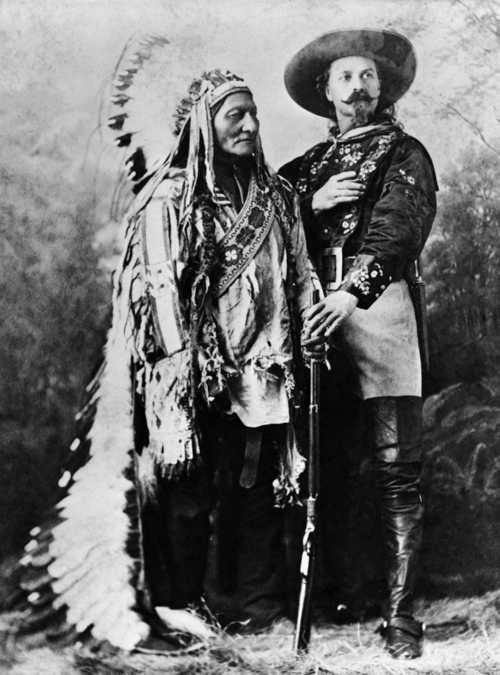
Buffalo Bill. Before he
was killed in 1890 during
the Ghost Dance
movement, the renowned
Sioux leader Sitting Bull
became an important part
of Buffalo Bill’s Wild West
Show, negotiating
shrewdly for his salary. In
this remarkable 1885
staged image, the
elaborately costumed
Buffalo Bill and Sitting
Bull appear as virtual
equals, both resting a
hand on the same rifle.
Bettmann/CORBIS©
slaughtering buffalo) before becoming a scout for the Fifth Cavalry. When Cody
became the subject of a popular dime Western novel, the most improbable turn in
Cody’s career occurred: he decided to dramatize his own life in a series of theatrical entertainments. By the year Sitting Bull joined Buffalo Bill’s Wild West Show with its band of trick riders and sharpshooters, it required 18 railroad cars to transport performers (including a number of Indians), work crews, animals, and equipment.
The Wild West Show celebrated the white conquest of the West in a series of
acts called “The Drama of Civilization,” which showed scenes of an emigrant train crossing the prairie, Buffalo Bill rescuing a pioneer family from Indians, and a mining camp. Billed as “America’s National Entertainment,” these shows revealed just how tightly linked industrialization and conquest were in Americans’ thinking—and even in their entertainment.
INDUSTRIALIZATION AND THE NEW SOUTH
Like the West, the South underwent a surge of industrialization in the last decades of the 19th century. Boosters like the energetic and influential Henry Grady, editor of the Atlanta Constitution, proclaimed that a New South had emerged, one hospitable to industry and to Northern investment.
Industrialization and the New South
631
Some people scoffed at such promotional talk in a world that was still decid-
edly rural, but in fact the pace of industrialization quickened in the last decades of the century, with textiles leading the way. In 1880, the South had only 5 percent of the country’s textile-producing capacity; by 1900, it had 23 percent and was
well on its way to surpassing New England a generation later. Tobacco also
industrialized, with James B. Duke of North Carolina transforming the industry
(see Chapter 19).
Railroads and iron also saw a surge in growth. Between 1877 and 1900 the
South built railroads faster than any other region in the country. In 1880 the
former slave states produced only 9 percent of the nation’s pig iron; by 1890, after a decade of extraordinary expansion for the industry nationwide, that proportion
had doubled. Most of the growth was concentrated in northern Alabama, where
the proximity of coal, limestone, and ore made the new city of Birmingham the
“Pittsburgh of the South.”
But there were limits to Southern industrialization. It was difficult to catch up with well-established Northern industries. Thus Southerners competed in the few
areas in which they could find markets for local crops and resources: textiles produced from their own cotton; cigarettes manufactured from Southern tobacco; as
well as lumber, sugar, and iron.
Not all of the wealth from the new industries went into the pockets of South-
erners, though. Over the late 19th century, Southern industry attracted more and
more Northern capital in a pattern that held true across industries. At first, for instance, Southerners supplied most of the capital in the expansion of the textile industry. But after 1893, an increasing amount came from the North, as New
England mill owners began to recognize the benefits of relocating to the low-
wage, nonunion South. In the tobacco industry, too, initial Southern capital gave way to Northern financing, especially after James Duke moved to New York in
the 1880s. But most dependent on Northern capital were the railroads and iron
industries. When in 1886 Southern railroads switched their tracks from the
regional gauge to the national standard, the symbolic domination of the North
seemed complete.
Heavy Northern investment in Southern industry meant that the South had less
control over economic decisions that affected its welfare. Some historians have
referred to the South’s “colonial” relationship to the North in the late 19th century.
One result was that the low wages prevailing in the South made for inequitable distribution of the economic benefits of industrial growth. Average Southern per
capita income remained only two-fifths of the average in the rest of the country
well into the 20th century.
Race and
Even those low wages were unequally distributed, as the
Industrialization
politics of race influenced the structuring of industrial jobs.
Along the piedmont from Virginia to Alabama, new cotton
mills sprang up for a white labor force drawn from farm families on the worn-out
red clay soil of this region. About 40 percent of the workers were women, and 25
percent were children aged 16 and younger. Living in company towns, workers
labored long hours for wages about half the level prevailing in New England’s
mills, with their cheap labor giving mill owners a competitive advantage.
632
Chapter 18 A Transformed Nation: The West and the New South, 1865–1900
At first, African Americans assumed that there would be jobs for them in this
new textile industry. And why not? Blacks had worked in mills before the Civil
War, and they continued to work in tobacco factories in the postwar era, albeit in the lowest-paid jobs and performing the dirtiest work. There seemed no reason why such a large and inexpensive workforce might not become a mainstay of the mills.
But industrialization did not mean progress for blacks. Instead, it went hand in
hand with segregation in the increasingly white supremacist world of the 1880s and 1890s. To attract white workers, mill owners promised them segregated environments. The bargain offered was this: mill workers might not earn very much, but
they would gain what one historian has called the “wages of whiteness,” a sense
of racial superiority that could serve as compensation for their low economic status.
Thus the emerging industrial economy of the New South was built around the poli-
tics of race. For most African Americans agricultural work was thus the only
option.
Southern
A major success story, however, was increasing black own-
Agriculture
ership of land in the post-Reconstruction period, with almost
200,000 farmers achieving that cherished goal. Most black
landowners in the South were in the Upper South or coastal areas; others were in
the trans-Mississippi West.
Still, most blacks were tenants rather than landowners, and many blacks and
whites faced lives of grinding rural poverty. Those who owned land risked sliding into tenantry; those who did not own land found it impossible to make the leap to land ownership. One-crop specialization, overproduction, declining prices, and an exploitative credit system all contributed to the problem. The basic institution of the Southern rural economy was the crop lien system, which came into being
because of the shortage of money and credit in the war-ravaged South. Few banks
had survived the war, and land values had plummeted, which left farmers unable to secure a bank loan with their land as collateral. Instead, merchants in the crossroads country stores that sprang up across the South provided farmers with sup-
plies and groceries in return for a lien on their next crop.
This system might have worked well if the merchants had charged reasonable
interest rates and if cotton and tobacco prices had remained high enough for
the farmer to pay off his debts after harvest with a little left over. But the country storekeeper charged a credit price 50 or 60 percent above the cash price, and crop prices, especially for cotton, were dropping steadily. Cotton prices declined from an average of 12 cents per pound in the 1870s to 6 cents in the 1890s. As prices fell, many farmers went deeper and deeper into debt to the merchants. Sharecroppers
and tenants incurred a double indebtedness: (1) to the landowner whose land they
sharecropped or rented, and (2) to the merchant who furnished them supplies on
credit. Because many landowners became merchants, and vice versa, that indebted-
ness was often to the same man.
One reason cotton prices fell was overproduction. Britain had encouraged the
expansion of cotton growing in Egypt and India during the Civil War to make up
for the loss of American cotton. After the war, Southern growers had to face international competition. By 1878, the Southern crop had reached the output of the
Industrialization and the New South
633
best antebellum year, and during the next 20 years, output doubled. This overpro-
duction drove prices ever lower. To obtain credit, farmers had to plant every acre with the most marketable cash crop—cotton. This practice exhausted the soil and
required ever-increasing amounts of expensive fertilizer, which fed the cycle of overproduction and declining prices.
It also reduced the amount of land that could be used to grow food crops.
Farmers who might otherwise have produced their own cornmeal and raised their
own hogs for bacon became dependent on merchants for these supplies. Before the
Civil War, the cotton states had been nearly self-sufficient in food; by the 1890s, they had to import nearly half their food at a price 50 percent higher than it would have cost to grow their own. Many Southerners recognized that only diversification could break this dependency, but the crop lien system locked them into dependency.
Exodusters and
Given the difficulties rural African Americans faced—from
Emigrationists
persistent poverty to dependence on white owners to racial
discrimination and violence—it is not surprising that many
dreamed of leaving the South entirely. In the late 1870s, a movement called Exodus gained momentum among African Americans who believed that they might have to
“repeat the history of the Israelites” and “seek new homes beyond the reign and
rule of Pharaoh.” Most pinned their hopes on internal emigration to the West,
although some explored the possibility of emigration to Liberia as well. In 1875, Benjamin Singleton, a former Tennessee slave, helped a group of African Americans establish new lives in an agrarian colony in western Kansas; three years later, he circulated an advertisement picturing prairie abundance in the hopes of enticing a few hundred more settlers. Instead, in the spring of 1879, some 20,000 African
Americans began an exodus to Kansas from all over the Southwest—drawn not
just by the advertisement but also by rumors that there was free land available for settlers as well as free supplies from the government. The rumors were false, but many of these Exodusters stayed on in Kansas anyway, although not as homesteaders amidst the prairie abundance but as domestics and laborers in Kansan
towns, including some they founded, such as Nicodemus.
Race Relations
The desire to emigrate for better jobs, autonomy, and a place
in the New
where African Americans could be truly free did not end with
South
the Exodusters. “The disposition among the colored people to
migrate now is strong, and is increasing,” commented a white
Southerner in 1889. There was a net loss of 537,000 African Americans in the South between 1880 and 1910. Economic reasons were important, but so too was the
worsening world of white supremacy that arose in that period.
Adherence to the industrial ideology behind the New South, with its emphasis
on racial cooperation, was shallow at best among broad classes of whites. Many
refused to let go of the legacy of the defeated plantation South. They celebrated the Lost Cause by organizing fraternal and sororal organizations such as the
United Daughters of the Confederacy (UDC). The UDC, like the Daughters of
the American Revolution (DAR) on which it was modeled, was open only to white
women who could prove their relation to the “first families” of the South. Its
634
Chapter 18 A Transformed Nation: The West and the New South, 1865–1900
members decorated the graves of Confederate soldiers, funded public statues of
Confederate heroes, and sought to preserve a romanticized history of the slavery
era. Several white Southern authors became famous writing stories about this
fabled South. Thomas Nelson Page’s racist sentimental story “Marse Chan” cre-
ated a national craze for Southern literature in the 1880s. Published in a Northern magazine, the story was written in what Page claimed to be authentic black dialect, with an aging freedman telling of the glorious days before the war when
slaves supposedly had little work to do. Such stories romanticized the Southern
plantation, cleansing it of the horrors of slavery.
The national appeal of such stories made it clear that anti-black racism was not
just a Southern phenomenon. Certainly, there was shockingly little Northern reac-
tion to the wave of lynchings of black men in the South in the 1890s. Lynchings
rose to an all-time high, averaging 188 per year, while the viciousness of racist propaganda reached an all-time low. At a time when many middle-class blacks were
steadily gaining economically even as a downward spiral in the rural economy frustrated whites, lynchings of black men were not just extraordinarily violent acts. They were also clear symbolic messages to entire black communities to keep their “place”
in a white-dominated society. Ritualized expressions of white power, lynchings were not secret or furtive events, but often well-orchestrated community affairs advertised in advance and sometimes even including men, women, and children as spectators.
In 1892, three respected African American businessmen who owned a grocery
store in Memphis, Tennessee, were taken from the jail where they awaited trial and lynched by a white mob. Their ostensible crime was attempted murder—firing on
three white intruders who had burst into their store—but their real offense was successfully challenging the dominance of a white grocery store in their area.
In response to the lynching, the African American journalist Ida B. Wells
embarked on an extensive anti-lynching campaign involving an economic boycott
as well as a series of fiery editorials in her newspaper, Free Speech, that called into question the usual white rationale for lynching: the supposed rape or molestation of a white woman. Exposing this common trumped-up charge as “the old racket,”
Wells ignited the wrath of white Memphis residents and was forced to flee for her life to the North. But there her anti-lynching campaign met with indifference from Northerners until Wells traveled to England on a speaking tour. She received widespread publicity as she called into question how civilized America could be if it tolerated a barbaric practice like lynching; she also touched a nerve back home.
Upperclass white Northerners indifferent to the murder of blacks but sensitive to English opinion finally sat up and began to notice her campaign. Her English
travels were a brilliant strategy to shake up Northern complacency and challenge
Northern complicity in lynching.
The Emergence
Wells was part of an extensive African American middle
of an African
class that came of age in the 1880s and 1890s. These men
American
and women, educated in the emerging black colleges, became
Middle Class
teachers, doctors, lawyers, ministers, and business owners.
They formed numerous civic organizations, such as the 1896
National Association of Colored Women, which was part of the women’s club
movement of the late 19th century (see Chapter 19). Echoing the moral reform
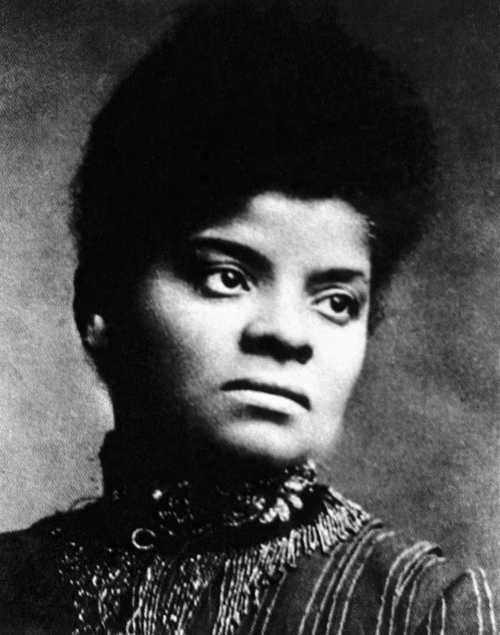
Industrialization and the New South
635
Ida B. Wells. A
passionate crusader for
justice, the renowned
journalist Ida B. Wells
received death threats
after she began a
campaign against
lynching in her Memphis,
Tennessee, newspaper,
Free Speech, in 1892.
Forced to leave Memphis,
Wells moved to Chicago
and continued her anti-
lynching crusade in
pamphlets, newspaper
columns, and public
lectures delivered both in
the United States and in
England. Together with
Booker T. Washington,
Wells was one of the
most prominent African
York
American leaders of the
New
1890s.
Collection,
Granger
The©
activities of white middle-class women, its president, Mary Church Terrell, called on middle-class black women to work with “the masses of our women” and to
“uplift and claim them.”
Such institution building, combined with increasing prosperity, gave middle-
class blacks great optimism that “racial uplift” might reduce or even eliminate racism in American society. “We as a race are enjoying the brightest rays of Christian civilization,” wrote one bishop in the African Methodist Episcopal (AME) Church.
Middle-class blacks believed that through education and self-improvement, they
could become “best men” and “best women,” seen as equals by middle-class
whites. These were not naïve hopes as black entry into the middle class surged in the 1880s and early 1890s.
The Rise
But these visible successes of middle-class African Americans
of Jim Crow
enraged white supremacists, who denied any possibility of
class solidarity across racial lines. Serious anti-black riots
broke out in Wilmington, North Carolina, in 1898 and in Atlanta in 1906. Several
states adopted new constitutions that disenfranchised most black voters by means
of literacy or property qualifications (or both), poll taxes, and other clauses
implicitly aimed at black voters. The new constitutions contained “understanding
636
Chapter 18 A Transformed Nation: The West and the New South, 1865–1900
clauses” or “grandfather clauses” that enabled registrars to register white voters who were unable to meet the new requirements. In Williams v. Mississippi
(1898), the U.S. Supreme Court upheld these disenfranchisement clauses on the
grounds that they did not discriminate “on their face” against blacks. State
Democratic parties then established primary elections in which only whites could
vote.
During these same years, most southern states passed Jim Crow laws (the name
came from black-face minstrelsy; see Chapter 10) mandating racial segregation in
public facilities of all kinds. Many African Americans resisted: in 1884, Ida B.
Wells, at the time a young schoolteacher, refused to give up her seat in a railway
“ladies’ car.” The conductor “tried to drag me out of the seat,” she remembered,
“but the moment he caught hold of my arm I fastened my teeth in the back of his
hand. I had braced my feet against the seat in front and was holding to the back, and as he had already been badly bitten he didn’t try it again by himself. He went forward and got the baggageman and another man to help him and of course they
succeeded in dragging me out.” Wells sued the railroad, winning her case in a lower court before losing it on appeal.
In 1896 came a tremendous setback for American equality. In the landmark
case of Plessy v. Ferguson (1896), the Supreme Court sanctioned Jim Crow laws
so long as the separate facilities for blacks were equal to those for whites—which, in practice, they never were. At this “nadir” of the black experience in freedom, as one historian has called the 1890s, a new black leader emerged as successor of the abolitionists and Reconstruction politicians who were fading from the
scene. Booker T. Washington, a 39-year-old educator who had founded Tuskegee
Institute in Alabama, gave a speech at the 1895 Atlanta Exposition that made him
famous—and has been controversial ever since.
Speaking to a white audience at this celebration of Southern industry and
progress, Washington was introduced as “a representative of Negro enterprise
and civilization.” Assuring his audience that he wanted to “cement the friendship of the races,” Washington talked of the “new era of industrial progress” and told the industrialists before him that they should hire African Americans rather than immigrants. “Cast down your bucket where you are,” he told them, “among the
eight million of Negroes whose habits you know.” If they did so, Washington
said, they would not only find people to “run your factories,” but could also
be assured that they would be surrounded by a “faithful, law-abiding, and unre-
sentful” people. In the most famous sentence of the speech, Washington then
promised that “in all things that are purely social we can be as separate as the
fingers, yet one as the hand in all things essential to mutual progress.” In effect, Washington accepted segregation as a temporary accommodation between the
races in return for white support of black efforts for education, social uplift,
and economic progress.
It was a complex, canny speech, much like the man himself, and Washington’s
listeners came away with very different impressions. Many African Americans
applauded his appeal for black inclusion in the new industrial order; many white
audience members simply took away the idea that Washington approved of segre-
gation, vocational training for blacks, and a permanent, second-class status. An
eloquent response to Washington came from the emerging African American leader
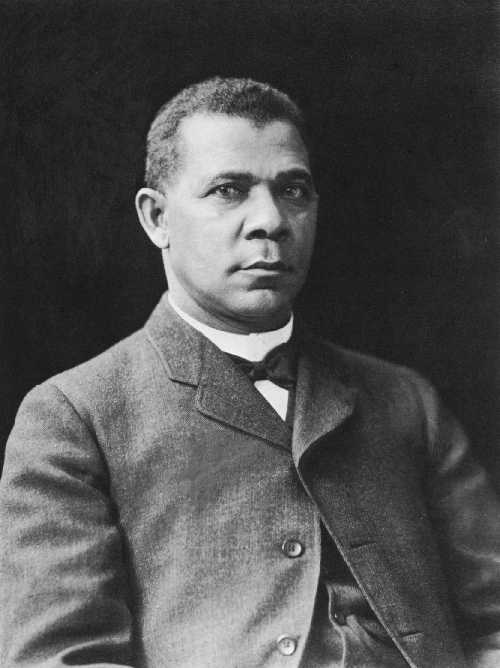
The Politics of Stalemate
637
Booker T.
Washington. The
most powerful African
American leader of his
time, Washington built an
excellent secondary
school and industrial
training institute at
Tuskegee, Alabama, and
gained great influence
with philanthropists and
political leaders. But
several prominent African
American writers and
activists, including
W. E. B. Du Bois,
accused Washington
of acquiescing
in segregation and
second-class citizenship
for African Americans
in exchange for the
crumbs of philanthropy.
Images
Archive/Getty
Hulton
W. E. B. Du Bois in his 1903 masterpiece The Souls of Black Folk, a set of essays written between 1897 and 1903. Criticizing Washington for a policy of conciliation and submission, Du Bois reminded his audience that “only a firm adherence to their higher ideals and aspirations will ever keep those ideals within the realm of possibility.”
THE POLITICS OF STALEMATE
During the 20 years between the Panic of 1873 and the Panic of 1893, serious
economic and social issues beset the American polity. The strains of rapid indus-
trialization, an inadequate monetary system, agricultural distress, and labor
protest built up to a potentially explosive force. The two mainstream political parties, however, seemed indifferent to these problems. Partisan memories of the Civil War mired Americans in the politics of the past. Paralysis gripped the national
government.
The Republican Party did not disappear from the South after 1877. Nor
was the black vote immediately and totally suppressed. Republican presidential candidates won about 40 percent of the votes in former slave states throughout the
1880s, and some blacks continued to win elections to state legislatures until the 638
Chapter 18 A Transformed Nation: The West and the New South, 1865–1900
1890s. Until 1901, every U.S. Congress but one had at least one black representa-
tive from the South. Independent parties occasionally formed coalitions with
Republicans to win local or state elections, especially in Virginia.
Even so, “bulldozing” of black voters (Chapter 17) continued to keep the
southern states solid for the Democrats. In 1880, the Democratic Party hoped to
build on this foundation to win the presidency for the first time in a generation.
Taking their cue from the Republicans, the Democrats nominated a Civil War
hero, General Winfield Scott Hancock, for president. His opponent was another
Civil War general, James A. Garfield. The popular vote was extremely close:
Hancock carried every southern state, while Garfield won all but three northern states—
and the election.
Knife-Edge
The five presidential elections from 1876 through 1892,
Electoral
taken together, were the most closely contested elections in
Balance
American history. No more than 1 percent separated the
popular vote of the two major candidates in any of these con-
tests except 1892, when the margin was 3 percent. The Democratic candidate won
twice (Grover Cleveland in 1884 and 1892), and in two other elections carried a tiny plurality of popular votes (Tilden in 1876 and Cleveland in 1888) but lost narrowly in the Electoral College. During the 20 years covered by these five administrations, the Democrats controlled the House of Representatives in seven Congresses to the
Republicans’ three, while the Republicans controlled the Senate in eight Congresses to the Democrats’ two. During only six of those 20 years did the same party control the presidency and both houses, and then by only razor-thin margins.
The few pieces of major legislation during these years—the Pendleton Civil
Service Act of 1883, the Interstate Commerce Act of 1887, and the Sherman Anti-
trust Act of 1890—were enacted by bipartisan majorities only after they had been
watered down by numerous compromises. Politicians often debated the tariff, but
the tariff laws they passed had little real impact.
Divided government and the even balance between the two major parties made
for political stalemate. Neither party had the power to enact a bold legislative program; both parties avoided taking firm stands on controversial issues. At election time, Republican candidates “waved the bloody shirt” to keep alive the memory
of the Civil War. They castigated Democrats as former rebels or Copperheads
who could not be trusted with the nation’s destiny. Democrats, in turn, especially in the South, denounced racial equality and branded Republicans as the party of
“Negro rule”—a charge that took on added intensity in 1890 when Republicans
tried (and failed by one vote in the Senate) to enact a federal elections law to
protect the voting rights of African Americans. From 1876 almost into the 20th
century, scarcely anyone but a Confederate veteran could be elected governor or
senator in the South.
Availability rather than ability or a strong stand on issues became the prime
requisite for presidential and vice presidential nominees. Geographical availability was particularly important. The solid Democratic South and the rather less solid
Republican North gave each party a firm bloc of electoral votes in every election.
But in three large northern states—New York, Ohio, and Indiana—the two parties
The Politics of Stalemate
639
were so closely balanced that the shift of a few thousand votes would determine the margin of victory for one or the other party in the state’s electoral votes. These three states alone represented 74 electoral votes, fully one-third of the total necessary for victory. The party that carried New York (36 electoral votes) and either of the other two won the presidency.
Of 20 nominees for president and vice president by the two parties in five elec-
tions, 16 were from these three states. Only once did each party nominate a presidential candidate from outside these three states: Democrat Winfield Scott Hancock of Pennsylvania in 1880 and Republican James G. Blaine of Maine in 1884—both
lost.
Civil Service
The most salient issue of national politics in the early 1880s
Reform
was civil service reform. Old-guard factions in both parties
opposed it. Republicans split into three factions known in
the colorful parlance of the time as Mugwumps (the reformers), Stalwarts (who
opposed reform), and Half-Breeds (who supported halfway reforms). Mugwumps
and Half-Breeds combined to nominate James A. Garfield for president in 1880.
Stalwarts received a consolation prize with the nomination of Chester A. Arthur
for vice president. Four months after Garfield took office, a man named Charles
Guiteau approached the president at the railroad station in Washington and shot
him. Garfield lingered for two months before dying on September 19, 1881.
Described by psychiatrists as a paranoid schizophrenic, Guiteau was viewed
by the public as a symbol of the spoils system at its worst. He had been a government clerk and a supporter of the Stalwart faction of the Republican Party but had lost his job under the new administration. As he shot Garfield, he shouted, “I am a Stalwart and Arthur is president now!” This tragedy gave a final impetus to civil service reform. If the spoils system could cause the assassination of a president, it was time to get rid of it.
In 1883, Congress passed the Pendleton Act, which established a category of
civil service jobs that were to be filled by competitive examinations. At first, only one-tenth of government positions fell within that category, but a succession of
presidential orders gradually expanded the list to about half by 1897. State and
local governments began to emulate federal civil service reform in the 1880s and
1890s.
Like the other vice presidents who had succeeded presidents who had died in
office (John Tyler, Millard Fillmore, and Andrew Johnson), Arthur failed to achieve nomination for president in his own right. The Republicans turned in 1884 instead to their most charismatic figure, James G. Blaine of Maine. His 18 years in the
House and Senate had included six years (1869–75) as Speaker of the House. He
had made enemies over the years, however, especially among Mugwumps, who
believed that his cozy relationship with railroad lobbyists while Speaker and rumors of other shady dealings disqualified him for the presidency.
The Mugwumps, heirs of the old Conscience Whig element of the Republican
Party, had a tendency toward self-righteousness in their self-appointed role as
spokesmen for political probity. They were small in number but large in influence.
Many were editors, authors, lawyers, college professors, or clergymen. Concentrated 640
Chapter 18 A Transformed Nation: The West and the New South, 1865–1900
in the Northeast, particularly in New York, they admired the Democratic governor
of that state, Grover Cleveland, who had gained a reputation as an advocate of reform and “good government.” When Blaine won the Republican nomination, the
Mugwumps defected to Cleveland.
In such a closely balanced state as New York, that shift could make a decisive
difference, but Blaine hoped to neutralize it by shaving a few percentage points
from the normal Democratic majority of the Irish vote. He made the most of his
Irish ancestry on the maternal side, but that effort was rendered futile late in the campaign when a Protestant clergyman characterized the Democrats as the party
of “Rum, Romanism, and Rebellion.” Although Blaine was present when the
Reverend Samuel Burchard made this remark, he failed to repudiate it. When the
incident hit the newspapers, Blaine’s hope for Irish support faded. Cleveland carried New York State by 1,149 votes (a margin of one-tenth of 1 percent) and thus
became the first Democrat to be elected president in 28 years.
The Tariff Issue
Ignoring a rising tide of farmer and labor discontent, Cle-
veland decided to make or break his presidency on the tariff
issue. He devoted his annual State of the Union message in December 1887 en-
tirely to the tariff, maintaining that lower duties would help all Americans by reducing the cost of consumer goods and by expanding American exports through
reciprocal agreements with other nations. Republicans responded that low tariffs
would flood the country with products from low-wage industries abroad, forcing
American factories to close and throwing American workers out on the streets.
The following year, the Republican nominee for president, Benjamin Harrison,
pledged to retain the protective tariff. To reduce the budget surplus that had built up during the 1880s, the Republicans also promised more generous pensions for
Union veterans.
The voters’ response was ambiguous. Cleveland’s popular-vote plurality actually
increased from 29,000 in 1884 to 90,000 in 1888 (out of more than 10 million votes cast). Even so, a shift of six-tenths of 1 percent put New York in the Republican column and Harrison in the White House. Republicans also gained control of both
houses of Congress. They promptly made good on their campaign pledges by passing
legislation that almost doubled Union pensions and by enacting the McKinley Tariff of 1890. Named for Congressman William McKinley of Ohio, this law raised duties
on a large range of products to an average of almost 50 percent.
The voters reacted convincingly—and negatively. They handed the Republicans
a decisive defeat in midterm congressional elections, converting a House Republican majority of 6 to a Democratic majority of 147, and a Senate Republican majority of eight to a Democratic majority of six. Nominated for a third time in 1892,
Cleveland built on this momentum to win the presidency by the largest margin in
20 years, but this outcome was deceptive. On March 4, 1893, when Cleveland
took the oath of office for the second time, he stood atop a social and economic
volcano that would soon erupt. When the ashes settled and the lava cooled, the
political landscape would be forever altered.
Conclusion
641
CONCLUSION
In 1890, the superintendent of the U.S. Census made a sober announcement of dra-
matic import: “Up to and including 1880 the country had a frontier of settlement, but at present the unsettled area has been so broken into by isolated bodies of settlement that there can hardly be said to be a frontier line ... any longer.”
This statement prompted a young historian at the University of Wisconsin,
Frederick Jackson Turner, to deliver a paper in 1893 that became the single most
influential essay ever published by an American historian. For nearly 300 years,
said Turner, the existence of a frontier of European-American settlement advancing relentlessly westward had shaped American character. To the frontier Americans
owed their upward mobility, their high standard of living, and the rough equality of opportunity that made liberty and democracy possible. “American social development has been continually beginning over again on the frontier,” declared
Turner. He continued:
This perennial rebirth, this fluidity of American life, this expansion westward with its new opportunities … furnish the forces dominating American character.… Frontier
individualism has from the beginning promoted democracy [and] that restless, nervous energy, that dominant individualism … and withal that buoyancy and exuberance
which comes with freedom—these are traits of the frontier, or traits called out elsewhere because of the existence of the frontier.
For many decades, Turner’s insight dominated Americans’ perceptions of them-
selves and their history. Today, however, the Turner thesis is largely discredited as failing to explain the experiences of the great majority of people throughout most of American history who lived and worked in older cities and towns or on farms
or plantations hundreds of miles from any frontier, and whose culture and institutions were molded more by their place of origin than by a frontier. The whole concept of a frontier as a line of beyond which lay empty, uninhabited land has also been discredited.
The Turner thesis also ignored the environmental consequences of the westward
movement. The virtual destruction of the bison, the hunting almost to extinction of other forms of wildlife, the ravaging of virgin forests by indiscriminate logging, and the plowing of semi-arid grasslands on the plains drastically changed the ecological balance in the West. These ecological changes stored up trouble for the future in the form of soil erosion, dust bowls, and diminished biodiversity. Thoughtful Americans began to express concern about these problems in the 1890s, foreshadowing
the launching of a conservation movement in the following decade.
For most Americans, however, the exploitation of the West was a matter of
pride, not concern. The positive claims of the Turner thesis reflected beliefs shared widely among whites. They believed that liberty and equality were both at least
partly the product of the frontier, of the chance to go west and start a new life.
And now that opportunity seemed to be ending. In fact, to many Americans it
seemed that a new and worrisome power had overtaken American life, threatening
American liberty: the power of the corporation.
19
THE RISE OF CORPORATE AMERICA,
1865–1914