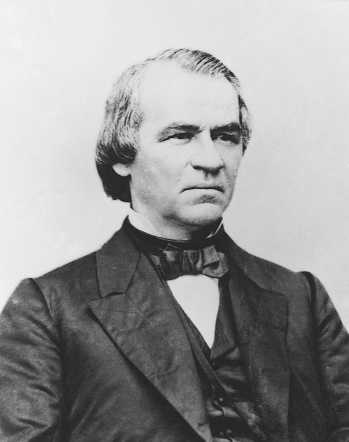
• Wartime Reconstruction • Andrew Johnson and Reconstruction • The
Advent of Congressional Reconstruction • The Impeachment of Andrew
Johnson • The Grant Administration • The Retreat from Reconstruction
FROM THE BEGINNING of the Civil War, the North fought to “reconstruct” the
Union. Lincoln at first attempted to restore the Union as it had existed before
1861, but once the abolition of slavery became a Northern war aim, the Union
could never be reconstructed on its old foundations. Instead, it must experience a
“new birth of freedom,” as Lincoln had said at the dedication of the military cemetery at Gettysburg.
But precisely what did “a new birth of freedom” mean? At the very least, it
meant the end of slavery. The slave states would be reconstructed on a free-labor basis. But what would liberty look like for the 4 million freed slaves? Would they become citizens equal to their former masters in the eyes of the law? Would
they have the right to vote? Should Confederate leaders and soldiers be punished
for treason? On what terms should the Confederate states return to the Union?
What would be the powers of the states and of the national government in a
reconstructed Union?
WARTIME RECONSTRUCTION
Lincoln pondered these problems long and hard. At first he feared that whites in
the South would never extend equal rights to the freed slaves. After all, even
most Northern states were denying full civil equality to the few black people
within their borders. In 1862, Lincoln encouraged freedpeople to emigrate to
all-black countries such as Haiti, where they would have a chance to get
ahead without having to face the racism of whites. Black leaders, abolitionists,
and many Republicans objected to that policy. Black people were Americans.
577
578
Chapter 17 Reconstruction, 1863–1877
CHRONOLOGY
1863
Lincoln issues Proclamation of Amnesty and Reconstruction
1864
Congress passes Wade-Davis bill; Lincoln kills it by pocket veto
1865
Congress establishes Freedmen’s Bureau ◆ Andrew Johnson
becomes president, announces his reconstruction plan ◆ Southern
states enact Black Codes ◆ Congress refuses to seat Southern
congressmen elected under Johnson’s plan
1866
Congress passes civil rights bill and expands Freedmen’s Bureau
over Johnson’s vetoes ◆ Race riots in Memphis and New Orleans
◆ Congress approves 14th Amendment ◆ Republicans increase
congressional majority in fall elections
1867
Congress passes Reconstruction acts over Johnson’s vetoes
◆ Congress passes Tenure of Office Act over Johnson’s veto
1868
Most Southern senators and representatives readmitted to Congress
under congressional plan of Reconstruction ◆ Andrew Johnson
impeached but not convicted ◆ Ulysses S. Grant elected president
◆ 14th Amendment is ratified
1870
15th Amendment is ratified
1871
Congress passes Ku Klux Klan Act
1872
Liberal Republicans defect from party ◆ Grant wins reelection
1873
Economic depression begins with the Panic
1874
Democrats win control of House of Representatives
1875
Democrats implement Mississippi Plan ◆ Congress passes civil
rights act
1876
Centennial celebration in Philadelphia ◆ Disputed presidential
election causes constitutional crisis
1877
Compromise of 1877 installs Rutherford B. Hayes as president
◆ Hayes withdraws troops from South
1883
Supreme Court declares civil rights act of 1875
unconstitutional
Wartime Reconstruction
579
Why should they not have the rights of American citizens instead of being urged to leave the country?
Lincoln eventually embraced the logic and justice of that view. But in beginning
the process of reconstruction, he first reached out to Southern whites whose allegiance to the Confederacy was lukewarm. On December 8, 1863, Lincoln issued
his Proclamation of Amnesty and Reconstruction, which offered presidential par-
don to Southern whites who took an oath of allegiance to the United States and
accepted the abolition of slavery. In any state where the number of white males
aged 21 or older who took this oath equaled 10 percent of the number of voters
in 1860, that nucleus could reestablish a state government to which Lincoln prom-
ised presidential recognition.
Because the war was still raging, this policy could be carried out only where
Union troops controlled substantial portions of a Confederate state: Louisiana,
Arkansas, and Tennessee in early 1864. Nevertheless, Lincoln hoped that once the
process had begun in those areas, it might snowball as Union military victories
convinced more and more Confederates that their cause was hopeless. But those
military victories were long delayed, and in most parts of the South, reconstruction did not begin until 1865.
Another problem that slowed the process was growing opposition within
Lincoln’s own party. Many Republicans believed that white men who had fought
against the Union should not be rewarded with restoration of their political rights while black men who had fought for the Union were denied those rights. The Proclamation of Reconstruction stated:
… any provision which may be adopted by [a reconstructed] State government in
relation to the freed people of such State, which shall recognize and declare their permanent freedom, provide for their education, and which may yet be consistent,
as a temporary arrangement, with their present condition as a laboring, landless, and homeless class, will not be objected to by the national Executive.
This seemed to mean that white landowners and former slaveholders
could adopt labor regulations and other measures to control former slaves, so
long as they recognized their freedom and made minimal provision for their
education.
Radical
These changes were radical advances over slavery, but for
Republicans and
many Republicans they were not radical enough. Led by
Reconstruction
Thaddeus Stevens in the House and Charles Sumner in the
Senate, the radical Republicans wanted to go much further.
If the freedpeople were landless, they said, provide them with land by confiscating the plantations of leading Confederates as punishment for treason. Radical
Republicans also distrusted oaths of allegiance sworn by ex-Confederates. Rather
than simply restoring the old ruling class to power, asked Charles Sumner, why not give freed slaves the vote, to provide a genuinely loyal nucleus of supporters in the South?
580
Chapter 17 Reconstruction, 1863–1877
These radical positions did not command a majority of Congress in 1864. Yet
the experience of Louisiana, the first state to reorganize under Lincoln’s more
moderate policy, convinced even nonradical Republicans to block Lincoln’s pro-
gram. In the occupied portion of Louisiana (New Orleans and several parishes in
the southern half of the state), enough white men took the oath of allegiance to
satisfy Lincoln’s conditions. They adopted a new state constitution and formed a
government that abolished slavery and provided a school system for blacks. But
despite Lincoln’s private appeal to the new government to grant literate blacks
and black Union soldiers the right to vote, the reconstructed Louisiana legislature chose not to do so. It also authorized planters to enforce restrictive labor policies on black plantation workers. Louisiana’s actions alienated a majority of congressional Republicans, who refused to admit representatives and senators from the
“reconstructed” state.
At the same time, though, Congress failed to enact a reconstruction policy
of its own. This was not for lack of trying. In fact, both houses passed the
Wade-Davis reconstruction bill (named for Senator Benjamin Wade of Ohio and
Representative Henry Winter Davis of Maryland) in July 1864. That bill did not
enfranchise blacks, but it did impose such stringent loyalty requirements on
Southern whites that few of them could take the required oath. Lincoln therefore
vetoed it.
Lincoln’s action infuriated many Republicans. Wade and Davis published a
blistering “manifesto” denouncing the president. This bitter squabble threatened
for a time to destroy Lincoln’s chances of being reelected. Union military success in fall 1864, however, combined with sober second thoughts about the consequences of a Democratic electoral victory, reunited the Republicans behind Lincoln.
The collapse of Confederate military resistance the following spring set the stage for compromise between the president and Congress on a policy for the postwar South.
Two days after Appomattox, Lincoln promised that he would soon announce such
a policy, which probably would have included voting rights for some blacks and
stronger measures to protect their civil rights. But three days later, Lincoln was assassinated.
ANDREW JOHNSON AND RECONSTRUCTION
In 1864, Republicans had adopted the name Union Party to attract the votes of
War Democrats and border-state Unionists who could not bring themselves to
vote Republican. For the same reason, they also nominated Andrew Johnson of
Tennessee as Lincoln’s running mate.
Of “poor white” heritage, Johnson had clawed his way up in the rough-
and-tumble politics of east Tennessee. This region of small farms and few slaves
held little love for the planters who controlled the state. Andrew Johnson
denounced the planters as “stuck-up aristocrats” who had no empathy with the
Southern yeomen for whom Johnson became a self-appointed spokesman. Johnson,
although a Democrat, was the only senator from a seceding state who refused to
Andrew Johnson and Reconstruction
581
support the Confederacy. For this stance, the Republicans rewarded him with the
vice presidential nomination, hoping to attract the votes of pro-war Democrats and upper-South Unionists.
Booth’s bullet therefore elevated to the presidency a man who still thought of
himself as primarily a Democrat and a Southerner. The trouble this might cause in a party that was mostly Republican and Northern was not immediately apparent,
however. In fact, Johnson’s enmity toward the “stuck-up aristocrats” whom he
blamed for leading the South into secession prompted him to utter dire threats
against “traitors.” “Treason is a crime and must be made odious,” he said, soon
after becoming president. “Traitors must be impoverished…. They must not only
be punished, but their social power must be destroyed.”
Radical Republicans liked the sound of this pronouncement. It seemed to prom-
ise the type of reconstruction they favored—one that would deny political power to ex-Confederates and would enfranchise blacks. They envisioned a coalition between these new black voters and the small minority of Southern whites who had never
supported the Confederacy. These men could be expected to vote Republican.
Republican governments in Southern states would guarantee freedom and would
pass laws to provide civil rights and economic opportunity for freed slaves. They would also strengthen the Republican Party nationally.
Johnson’s
From a combination of pragmatic, partisan, and idealistic
Policy
motives, therefore, Radical Republicans prepared to imple-
ment a progressive reconstruction policy. But Johnson un-
expectedly refused to cooperate. Instead of calling Congress into special session, he moved ahead on his own. On May 29, 1865, Johnson issued two proclamations. The first provided a blanket amnesty for all but the highest-ranking Con-
federate officials and military officers, and those ex-Confederates with taxable
property worth $20,000 or more—the “stuck-up aristocrats.” The second named
a provisional governor for North Carolina and directed him to call an election of delegates to frame a new state constitution. Only white men who had received
amnesty and taken an oath of allegiance could vote. Similar proclamations soon
followed for other former Confederate states. Johnson’s policy was clear: He
would exclude both blacks and upper-class whites from the reconstruction
process.
Although at first many Republicans supported Johnson’s policy, the radicals
were dismayed. They feared that restricting the vote to whites would lead to
oppression of the newly freed slaves and restoration of the old power structure
in the South. They began to sense that Johnson (who had owned slaves) was as
dedicated to white supremacy as any Confederate. “White men alone must govern
the South,” he told a Democratic senator. After a tense confrontation with a
group of black men led by Frederick Douglass, who had visited the White House
to urge black suffrage, Johnson told his private secretary: “I know that damned
Douglass; he’s just like any nigger, and he would sooner cut a white man’s throat than not.”
582
Chapter 17 Reconstruction, 1863–1877
Moderate Republicans believed that black men should participate to some de-
gree in the reconstruction process, but in 1865 they were not yet prepared to break with the president. They regarded his policy as an “experiment” that would be
modified as time went on. “Loyal negroes must not be put down, while disloyal
white men are put up,” wrote a moderate Republican. “But I am quite willing to
see what will come of Mr. Johnson’s experiment.”
Southern
As it happened, none of the state conventions enfranchised
Defiance
a single black. Some of them even balked at ratifying the
13th Amendment (which abolished slavery). The rhetoric of
some white Southerners began to take on a renewed anti-Yankee tone of defiance
that sounded like 1861 all over again. Reports from Unionists and army officers
in the South told of neo-Confederate violence against blacks and their white
sympathizers. Johnson seemed to encourage such activities by allowing the organi-
zation of white militia units in the South. “What can be hatched from such an
egg,” asked a Republican newspaper, “but another rebellion?”
Then there was the matter of presidential pardons. After talking fiercely about
punishing traitors, and after excluding several classes of them from his amnesty
Division
Division
Photographs
Photographs
and
and
Prints
Prints
Congress,
Congress,
of
of
Library
Library
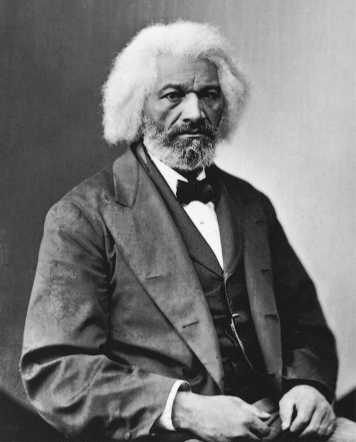
Andrew Johnson and Frederick Douglass. By 1866, the president and the leading
black spokesman for equal rights represented opposite poles in the debate about
Reconstruction. Johnson wanted to bring the South back into the Union on the basis of white suffrage; Douglass wanted black men to be granted the right to vote. Johnson’s resistance to this policy as Republicans tried to enact it was a factor in his impeachment two years later.
Andrew Johnson and Reconstruction
583
proclamation, Johnson began to issue special pardons to many ex-Confederates,
restoring to them all property and political rights. Moreover, under the new state constitutions, Southern voters were electing hundreds of ex-Confederates to state offices. Even more alarming to Northerners, who thought they had won the war,
was the election to Congress of no fewer than nine ex-Confederate congressmen,
seven ex-Confederate state officials, four generals, four colonels, and even the former Confederate vice president, Alexander H. Stephens. To apprehensive Republi-
cans, it appeared that the rebels, unable to capture Washington in war, were about to do so in peace.
Somehow the aristocrats and traitors Johnson had denounced in April had
taken over the reconstruction process. Instead of weapons, they had resorted to flattering the presidential ego. Thousands of prominent ex-Confederates or their tearful female relatives applied for pardons, confessing the error of their ways and appealing for presidential mercy. Reveling in his power over these once-haughty aristo-
crats who had disdained him as a humble tailor, Johnson waxed eloquent on his
“love, respect, and confidence” toward Southern whites, for whom he now felt
“forbearing and forgiving.” More effective, perhaps, was the praise and support
Johnson received from leading Northern Democrats. Although the Republicans
had placed him on their presidential ticket in 1864, Johnson was after all a Democrat. That party’s leaders enticed Johnson with visions of reelection as a Democrat in 1868 if he could manage to reconstruct the South in a manner that would preserve a Democratic majority there.
The Black
That was just what the Republicans feared. In the fall of
Codes
1865, their concern that state governments devoted to white
supremacy would reduce the freedpeople to a condition
close to slavery was confirmed when some of those governments enacted “Black
Codes.”
One of the first tasks of the legislatures of the reconstructed states was to de-
fine the rights of 4 million former slaves. The option of treating them exactly like white citizens was scarcely considered. Instead, the states excluded black people from juries and the ballot box, did not permit them to testify against whites in
court, banned interracial marriage, and punished blacks more severely than whites for certain crimes. Some states defined any unemployed black person as a vagrant
and hired him out to a planter, forbade blacks to lease land, and provided for the apprenticing to whites of black youths who did not have adequate parental
support.
These Black Codes aroused anger among Northern Republicans, who saw
them as a brazen attempt to reinstate a quasi-slavery. “We tell the white men of
Mississippi,” declared the Chicago Tribune, “that the men of the North will con-
vert the State of Mississippi into a frog pond before they will allow such laws to disgrace one foot of the soil in which the bones of our soldiers sleep and over
which the flag of freedom waves.” And in fact, the Union army’s occupation
forces did suspend the implementation of Black Codes that discriminated on racial grounds.
584
Chapter 17 Reconstruction, 1863–1877
Land and Labor
The Black Codes, although discriminatory, were designed to
in the Postwar
address a genuine problem. The end of the war had left
South
black–white relations in the South in a state of limbo. The
South’s economy was in a shambles. Burned-out plantations,
fields growing up in weeds, and railroads without tracks, bridges, or rolling stock marked the trail of war. Nearly half of the livestock in the former Confederacy and most other tangible assets except the land had been destroyed. Law and order
broke down in many areas. The war had ended early enough in the spring to allow
the planting of at least some food crops. But who would plant and cultivate them?
One-quarter of the South’s white farmers had been killed in the war; the slaves
were slaves no more. “We have nothing left to begin anew with,” lamented a South
Carolina planter. “I never did a day’s work in my life, and I don’t know how to
begin.”
Despite all of this trouble, life went on. Soldiers’ widows and their children
plowed and planted. Slaveless planters and their wives calloused their hands for
the first time. Confederate veterans drifted home and went to work. Former slave
owners asked their former slaves to work the land for wages or shares of the crop, and many did so. Others refused, because for them to leave the old place was an
essential part of freedom. In slavery times, the only way to become free was to run away, and the impulse to leave the scene of bondage persisted. “You ain’t, none o’
you, gwinter feel rale free,” said a black preacher to his congregation, “till you shakes de dus’ ob de Ole Plantashun offen yore feet” (dialect in original source).
Thus the roads were alive with freedpeople who were on the move in summer
1865. Many of them signed on to work at farms just a few miles from their old
homes. Others moved into town. Some looked for relatives who had been sold
away during slavery or from whom they had been separated during the war. Some
wandered aimlessly. Crime increased as people, both blacks and whites, stole food to survive, and as whites organized vigilante groups to discipline blacks and force them to work.
The Freedmen’s
Into this vacuum stepped the U.S. Army and the Freedmen’s
Bureau
Bureau. Tens of thousands of troops remained in the South
as an occupation force until civil government could be
restored. The Freedmen’s Bureau (its official title was Bureau of Refugees, Freedmen, and Abandoned Lands), created by Congress in March 1865, became the principal
agency for overseeing relations between former slaves and owners. Headed by anti-
slavery General Oliver O. Howard and staffed by army officers, the bureau estab-
lished posts throughout the South to supervise free-labor wage contracts between
landowners and freedpeople. The Freedmen’s Bureau also issued food rations to
150,000 people daily during 1865, one-third of them to whites. Southern whites
viewed the Freedmen’s Bureau with hostility. Without it, however, the postwar
chaos and devastation in the South would have been much greater—as some whites
privately admitted. Bureau agents used their influence with black people to
encourage them to sign free-labor contracts and return to work.
Andrew Johnson and Reconstruction
585
In negotiating labor contracts, the bureau tried to establish minimum wages.
Lack of money in the South, however, caused many contracts to call for share
wages—that is, paying workers with shares of the crop. At first, landowners
worked their laborers in large groups (called gangs). But many black workers
resented this arrangement as reminiscent of slavery. Thus, a new system evolved,
called sharecropping, whereby a black family worked a specific piece of land in
return for a share of the crop produced on it.
Land for the
Freedpeople, of course, would have preferred to own the
Landless
land they farmed. “What’s de use of being free if you don’t
own land enough to be buried in?” asked one black share-
cropper (dialect in original). Some black farmers did manage to save up enough
money to buy small plots of land. Demobilized black soldiers purchased land with
their bounty payments, sometimes pooling their money to buy an entire plantation
on which several black families settled. Northern philanthropists helped some
freedmen buy land. But most ex-slaves found the purchase of land impossible. Few
of them had money, and even if they did, whites often refused to sell their land
because it would mean losing a source of cheap labor and encouraging notions of
black independence.
Several Northern radicals proposed legislation to confiscate ex-Confederate
land and redistribute it to freedpeople, but those proposals went nowhere. The
most promising effort to put thousands of slaves on land of their own also failed.
In January 1865, after his march through Georgia, General William T. Sherman
had issued a military order setting aside thousands of acres of abandoned planta-
tion land in the Georgia and South Carolina low country for settlement by freed
slaves. The army even turned over some of its surplus mules to black farmers. The expectation of “40 acres and a mule” excited freedpeople in 1865, but President
Johnson’s Amnesty Proclamation and his wholesale issuance of pardons restored
most of this property to pardoned ex-Confederates. The same thing happened to
white-owned land elsewhere in the South. Placed under the temporary care of the
Freedmen’s Bureau for subsequent possible distribution to freedpeople, by 1866
nearly all of this land had been restored to its former owners by order of President Johnson.
Education
Abolitionists were more successful in helping freedpeople
obtain an education. During the war, freedmen’s aid societies
and missionary societies founded by abolitionists had sent teachers to Union-
occupied areas of the South to set up schools for freed slaves. After the war, this effort was expanded with the aid of the Freedmen’s Bureau. Two thousand
Northern teachers, three-quarters of them women, fanned out into every part of the South. There they trained black teachers to staff first the mission schools and later the public schools established by Reconstruction state governments. After 1870, the missionary societies concentrated more heavily on making higher education available to African Americans. Many of the traditionally black colleges in the South
586
Chapter 17 Reconstruction, 1863–1877
Division
Photographs
and
Prints
Congress,of
Library
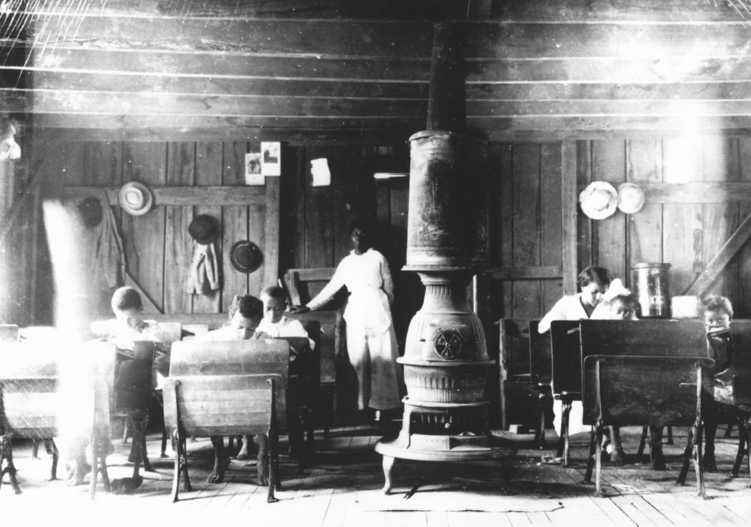
A Black School During Reconstruction. In the antebellum South, teaching slaves
to read and write was forbidden. Thus about 90 percent of the freedpeople were illiterate in 1865. One of their top priorities was education. At first, most of the teachers in the freedmen’s schools established by Northern missionary societies were Northern white women, but as black teachers were trained, they took over the elementary schools, such as this one photographed in the 1870s.
today were founded and supported by their efforts. This education crusade, which
the black leader W. E. B. Du Bois described as “the most wonderful peace-battle of the nineteenth century,” reduced the Southern black illiteracy rate to 70 percent by 1880 and to 48 percent by 1900.
THE ADVENT OF CONGRESSIONAL RECONSTRUCTION
Political reconstruction shaped the civil and political rights of freedpeople. By the time Congress met in December 1865, the Republican majority was determined to control the process by which former Confederate states would regain
full representation. Congress refused to admit the representatives and senators
elected by the former Confederate states under Johnson’s reconstruction policy
and set up a special committee to formulate new terms. The committee held
hearings at which Southern Unionists, freedpeople, and U.S. Army officers testi-
fied to abuse and terrorism in the South. Their testimony convinced Republicans
of the need for stronger federal intervention to define and protect the civil rights The Advent of Congressional Reconstruction
587
of freedpeople. Many radicals wanted to go further and grant the ballot to
black men.
Most Republicans realized that Northern voters would not support such a
radical policy, however. Racism was still strong in the North, where most states
denied the right to vote to the few blacks living within their borders. Moderate
Republicans feared that Democrats would exploit Northern racism in the congres-
sional elections of 1866 if Congress made black suffrage a cornerstone of Recon-
struction. Instead, the special committee decided to draft a constitutional
amendment that would encourage Southern states to enfranchise blacks but would
not require them to do so.
Schism between
Meanwhile, Congress passed two laws to protect the eco-
President and
nomic and civil rights of freedpeople. The first extended the
Congress
life of the Freedmen’s Bureau and expanded its powers. The
second defined freedpeople as citizens with equal legal
rights and gave federal courts appellate jurisdiction to enforce those rights. To the dismay of moderates who were trying to heal the widening breach between the
president and Congress, Johnson vetoed both measures. He followed this action
with a speech to Democratic supporters in which he denounced Republican
leaders as traitors who did not want to restore the Union except on terms that
would degrade white Southerners. Democratic newspapers applauded the presi-
dent for vetoing bills that would “compound our race with niggers, gypsies, and
baboons.”
The 14th
Johnson had thrown down the gauntlet to congressional
Amendment
Republicans, and they did not hesitate to take it up. With
more than a two-thirds majority in both houses, they passed
the Freedmen’s Bureau and Civil Rights bills over the president’s vetoes. Then on April 30, 1866, the special committee submitted to Congress its proposed 14th
Amendment to the Constitution. After lengthy debate, the amendment received the
required two-thirds majority in Congress on June 13 and went to the states for
ratification. Section 1 defined all native-born or naturalized persons, including blacks, as American citizens and prohibited the states from abridging the “privileges and immunities” of citizens, from depriving “any person of life, liberty, or property without due process of law,” and from denying to any person “the equal
protection of the laws.” Section 2 gave states the option of either enfranchising black males or losing a proportionate number of congressional seats and electoral votes. Section 3 disqualified a significant number of ex-Confederates from holding federal or state office. Section 4 guaranteed the national debt and repudiated the Confederate debt. Section 5 empowered Congress to enforce the 14th Amendment
by “appropriate legislation.” The 14th Amendment had far-reaching consequences.
Section 1 has become the most important provision in the Constitution for defining and enforcing civil rights.
588
Chapter 17 Reconstruction, 1863–1877
The 1866
Republicans entered the 1866 congressional elections cam-
Elections
paign with the 14th Amendment as their platform. They
made clear that any ex-Confederate state that ratified the
amendment would be declared “reconstructed” and that its representatives and
senators would be seated in Congress. Tennessee ratified the amendment, but
Johnson counseled other Southern legislatures to reject the amendment, which
they did. Johnson then prepared for an all-out campaign to gain a friendly
Northern majority in the congressional elections.
Johnson began his campaign by creating a National Union Party made up of a
few conservative Republicans who disagreed with their party, some border-state
Unionists who supported the president, and Democrats. The inclusion of Demo-
crats doomed the effort from the start. Many Northern Democrats still carried
the taint of having opposed the war effort, and most Northern voters did not trust them. The National Union Party was further damaged by race riots in Memphis
and New Orleans, where white mobs, including former Confederate soldiers,
killed 80 blacks, among them several former Union soldiers. The riots bolstered
Republican arguments that national power was necessary to protect “the fruits
of victory” in the South. Perhaps the biggest liability of the National Union Party was Johnson. In a whistle-stop tour through the North, he traded insults with
hecklers and embarrassed his supporters by comparing himself to Christ and his
Republican adversaries to Judas.
Republicans swept the election: They gained a three-to-one majority in the next
Congress. Having rejected the Reconstruction terms embodied in the 14th Amend-
ment, Southern Democrats now faced far more stringent terms. “They would not
cooperate in rebuilding what they destroyed,” wrote an exasperated moderate
Republican, so “we must remove the rubbish and rebuild from the bottom.
Whether they are willing or not, we must compel obedience to the Union and
demand protection for its humblest citizen.”
The
In March 1867, the new Congress enacted over Johnson’s
Reconstruction
vetoes two laws prescribing new procedures for the full res-
Acts of 1867
toration of the former Confederate states to the Union. These
laws represented a complex compromise between radicals
and moderates that had been hammered out in a confusing sequence of committee
drafts, caucus decisions, all-night debates on the floor, and frayed tempers. The Reconstruction acts of 1867 divided the 10 Southern states into five military districts, directed army officers to register voters for the election of delegates to new constitutional conventions, and enfranchised males aged 21 and older (including
blacks) to vote in those elections. The acts also disenfranchised (for these elections only) those ex-Confederates who were disqualified from holding office under the
not-yet-ratified 14th Amendment—fewer than 10 percent of all white voters. When
a state had adopted a new constitution that granted equal civil and political rights regardless of race and had ratified the 14th Amendment, it would be declared
reconstructed, and its newly elected congressmen would be seated.
These measures embodied a true revolution. Just a few years earlier, Southern
whites had been masters of 4 million slaves and part of an independent Confederate The Impeachment of Andrew Johnson
589
nation. Now they were shorn of political power, with their former slaves not only free but also politically empowered. In 1867 the emancipation and enfranchisement of black Americans seemed, as a sympathetic French journalist described it, “one of the most radical revolutions known in history.”
Like most revolutions, the reconstruction process did not go smoothly. Many
Southern Democrats breathed defiance and refused to cooperate. The presence of
the army minimized anti-black violence, but thousands of white Southerners who
were eligible to vote refused to do so, hoping that their nonparticipation would delay the process long enough for Northern voters to come to their senses and elect Democrats to Congress.
Blacks and their white allies organized Union leagues to inform and mobilize
the new black voters into the Republican Party. Democrats branded Southern white
Republicans as “scalawags” and Northern settlers as “carpetbaggers.” By Septem-
ber 1867, the 10 states had 735,000 black voters and only 635,000 white voters
registered. At least one-third of the registered white voters were Republicans.
President Johnson did everything he could to block Reconstruction. He
replaced several Republican generals in command of Southern military districts
with Democrats. He had his attorney general issue a ruling that interpreted the
Reconstruction acts narrowly, thereby forcing a special session of Congress to pass a supplementary act in July 1867. He encouraged Southern whites to obstruct the
registration of voters and the election of convention delegates.
Johnson’s purpose was to slow the process until 1868 in the hope that North-
ern voters would repudiate Reconstruction in the presidential election of that year, when Johnson planned to run as the Democratic candidate. Off-year state elections in fall 1867 encouraged that hope. Republicans suffered setbacks in several Northern states, especially where they endorsed referendum measures to enfranchise black men. “I almost pity the radicals,” chortled one of President Johnson’s aides after the 1867 elections. “After giving ten states to the negroes, to keep the Democrats from getting them, they will have lost the rest.”
THE IMPEACHMENT OF ANDREW JOHNSON
Johnson struck even more boldly against Reconstruction after the 1867
elections. “What does Johnson mean to do?” an exasperated Republican asked
another. “I am afraid his doings will make us all favor impeachment.” In
February 1868, Johnson removed from office Secretary of War Edwin M.
Stanton, who had administered the War Department in support of the congres-
sional Reconstruction policy. This appeared to violate the Tenure of Office
Act, passed the year before over Johnson’s veto, which required Senate consent
for such removals. By a vote of 126 to 47 along party lines, the House im-
peached Johnson on February 24. The official reason for impeachment was
that he had violated the Tenure of Office Act (which Johnson considered un-
constitutional). The real reason was Johnson’s stubborn defiance of Congress
on Reconstruction.
Under the U.S. Constitution, impeachment by the House does not remove an
official from office. It is more like a grand jury indictment that must be tried by a petit jury—in this case, the Senate, which sat as a court to try Johnson on the
590
Chapter 17 Reconstruction, 1863–1877
impeachment charges brought by the House. If convicted by a two-thirds majority
of the Senate, he would be removed from office.
The impeachment trial proved long and complicated, which worked in John-
son’s favor by allowing passions to cool. The Constitution specifies the grounds
on which a president can be impeached and removed: “Treason, Bribery, or other
high Crimes and Misdemeanors.” The issue was whether Johnson was guilty of
any of these acts. His able defense counsel exposed technical ambiguities in the
Tenure of Office Act that raised doubts about whether Johnson had actually vio-
lated it. Several moderate Republicans feared that the precedent of impeachment
might upset the delicate balance of powers between the executive branch, Con-
gress, and the judiciary that was an essential element of the Constitution. Behind the scenes, Johnson strengthened his case by promising to appoint the respected
General John M. Schofield as secretary of war and to stop obstructing the Recon-
struction acts. In the end, seven Republican senators plus all Democrats voted for acquittal on May 16, and the final tally fell one vote short of the necessary two-thirds majority.
The Completion
The impeachment trial’s end cleared the poisonous air in
of Formal
Washington, and Johnson quietly served out his term. Con-
Reconstruction
stitutional conventions met in the South during winter and
spring 1867–68. Hostile whites described them as “Bones
and Banjoes Conventions” and the Republican delegates as “ragamuffins and
jailbirds.” In sober fact, however, the delegates were earnest advocates of a new order, and the constitutions they wrote were among the most progressive in the
nation. Three-quarters of the delegates to the 10 conventions were Republicans.
About 25 percent of those Republicans were Northern whites who had relocated to
the South after the war; 45 percent were native Southern whites who braved the
social ostracism of the white majority to cast their lot with the despised Repub-
licans; and 30 percent were blacks. Only in the South Carolina convention were
blacks in the majority.
The new state constitutions enacted universal male suffrage, putting them
ahead of most Northern states on that score. Some of the constitutions disenfran-
chised certain classes of ex-Confederates for several years, but by 1872, all such disqualifications had been removed. The constitutions mandated statewide public
schools for both races for the first time in the South. Most states permitted segregated schools, but schools of any kind for blacks represented a great step forward.
Most of the constitutions increased the state’s responsibility for social welfare beyond anything previously known in the South.
Violence in some parts of the South marred the voting on ratification of these
state constitutions. The Ku Klux Klan, a night-riding white terrorist organization, made its first appearance during the elections. Nevertheless, voters in seven states ratified their constitutions and elected new legislatures that ratified the 14th Amendment in spring 1868. That amendment became part of the U.S. Constitution the following summer, and the newly elected representatives and senators from those seven states, nearly all Republicans, took their seats in the House and Senate.
The Impeachment of Andrew Johnson
591
The 15th
The remaining three Southern states completed the recon-
Amendment
struction process in 1869 and 1870. Congress required them
to ratify the 15th as well as the 14th Amendments. The 15th
Amendment prohibited states from denying the right to vote on grounds of race,
color, or previous condition of servitude. Its purpose was not only to prevent the reconstructed states from any future revocation of black suffrage, but also to
extend equal suffrage to the border states and to the North. With final ratification of the 15th Amendment in 1870, the Constitution became truly color blind for the
first time in U.S. history.
But the 15th Amendment still left half of the population disfranchised. Many
supporters of woman suffrage were embittered by its failure to ban discrimination on the grounds of gender as well as race. The radical wing of the suffragists, led by Elizabeth Cady Stanton and Susan B. Anthony, therefore opposed the 15th Amendment, causing a split in the woman suffrage movement.
This movement had shared the ideological egalitarianism of abolitionism since
the Seneca Falls Convention of 1848. In 1866, male and female abolitionists
formed the American Equal Rights Association (AERA) to work for both black
and woman suffrage. Although some Republicans sympathized with the suffra-
gists, they knew that no strong constituency among male voters favored granting
the vote to women. Most members of the AERA recognized that although Recon-
struction politics made black enfranchisement possible, woman suffrage would
have to wait until public opinion could be educated up to the standard of gender
equality.
Stanton and Anthony refused to accept this reasoning. Why should illiterate
Southern blacks have the right to vote, they asked, when educated Northern
women remained shut out from the polls? The 15th Amendment would establish
“the most odious form of aristocracy the world has ever seen: an aristocracy of
sex.” When a majority of delegates at the 1869 convention of the AERA voted
to endorse the 15th Amendment, several women led by Stanton and Anthony
walked out and founded the National Woman Suffrage Association. The remain-
ing delegates reorganized as the American Woman Suffrage Association. For the
next two decades, these rival organizations, working for the same cause, remained at odds with each other.
The Election
Just as the presidential election of 1864 was a referendum
of 1868
on Lincoln’s war policies, so the election of 1868 was a
referendum on the Reconstruction policy of the Repub-
licans. The Republican nominee was General Ulysses S. Grant. Although he had
no political experience, Grant commanded greater authority and prestige than
anyone else in the country. As general-in-chief of the army, he had opposed
Johnson’s Reconstruction policy in 1866 and had broken openly with the presi-
dent in January 1868. That spring, Grant agreed to run for the presidency in
order to preserve in peace the victory he had won for Union, and liberty he had
won in war.
592
Chapter 17 Reconstruction, 1863–1877
The Democrats turned away from Andrew Johnson, who carried too many
political liabilities. They nominated Horatio Seymour, the wartime governor of
New York, bestowing on him the dubious privilege of running against Grant.
Hoping to put together a majority consisting of the South plus New York and
two or three other Northern states, the Democrats adopted a militant platform
denouncing the Reconstruction acts as “a flagrant usurpation of power … uncon-
stitutional, revolutionary, and void.” The platform also demanded “the abolition
of the Freedmen’s Bureau, and all political instrumentalities designed to secure
negro supremacy.”
The vice presidential candidate, Frank Blair of Missouri, became the point
man for the Democrats. In a public letter, he proclaimed: “There is but one way
to restore the Government and the Constitution, and that is for the President-elect to declare these [Reconstruction] acts null and void, compel the army to undo its usurpations at the South, disperse the carpetbag State Governments, [and] allow
the white people to reorganize their own governments.”
The only way to achieve this bold counterrevolutionary goal was to suppress
Republican voters in the South. This, the Ku Klux Klan tried its best to do.
Federal troops failed to prevent much of the violence because martial law had
been lifted in the states where civilian governments had been restored. In
Louisiana, Georgia, Arkansas, and Tennessee, the Klan or Klan-like groups
committed dozens of murders and intimidated thousands of black voters. The
violence helped the Democratic cause in the South, but probably hurt it in
the North, where many voters perceived the Klan as an organization of neo-
Confederate paramilitary guerrillas. In fact, many Klansmen were former sol-
diers, and such famous Confederate generals as Nathan Bedford Forrest and
John B. Gordon held high positions in the Klan.
Seymour did well in the South, carrying five former slave states and coming
close in others, despite the solid Republican vote of the newly enfranchised blacks.
Grant, however, swept the electoral vote 214 to 80. Seymour actually won a slight majority of the white voters nationally; without black enfranchisement, Grant
would have had a minority of the popular vote.
THE GRANT ADMINISTRATION
Grant is usually considered a failure as president. That indictment is only partly correct. Grant’s inexperience and poor judgment betrayed him into several unwise
appointments of officials, who were later convicted of corruption, and scandals
that plagued his back-to-back administrations (1869–77). His secretary of war
was impeached for selling appointments to army posts and Indian reservations,
and his attorney general and secretary of the interior resigned under suspicion of malfeasance in 1875.
Although he was an honest man, Grant was too trusting of subordinates. He
appointed many former members of his military family, as well as several of his
wife’s relatives, to offices for which they were scarcely qualified. In an era notorious for corruption at all levels of government, many of the scandals were not
The Grant Administration
593
Grant’s fault. The Tammany Hall “Ring” of “Boss” William Marcy Tweed in
New York City may have stolen more money from taxpayers than all of the fed-
eral agencies combined. It was said that the only thing the Standard Oil Company
could not do with the Ohio legislature was to refine it. In Washington, one of the most widely publicized scandals, the Credit Mobilier affair, concerned Congress
rather than the Grant administration. Several congressmen had accepted stock in
the Credit Mobilier, a construction company for the Union Pacific Railroad,
which received loans and land grants from the government. In return, the com-
pany expected lax congressional supervision, thereby permitting financial manip-
ulations by the company.
What accounted for this explosion of corruption in the postwar decade, which
one historian has called “The Era of Good Stealings”? During the war, expansion
of government contracts and the bureaucracy had created new opportunities for the unscrupulous. Following the intense sacrifices of the war years came a relaxation of tensions and standards. Rapid postwar economic growth, led by an extraordinary
rush of railroad construction, further encouraged greed and get-rich-quick schemes of the kind satirized by Mark Twain and Charles Dudley Warner in their 1873
novel The Gilded Age, which gave its name to the era.
Civil Service
Some of the apparent increase in corruption during the
Reform
Gilded Age was more a matter of perception. Reformers
focused a harsh light into the dark corners of corruption,
hitherto unilluminated because of the nation’s preoccupation with war and recon-
struction. Thus reformers’ publicity may have exaggerated the actual extent of
corruption. In reality, during the Grant administration, several government agen-
cies made real progress in eliminating abuses that had flourished in earlier
administrations.
The chief target of civil service reform was the “spoils system.” With the slo-
gan “To the victor belongs the spoils,” the victorious party in an election rewarded party workers with appointments as postmasters, customs collectors, and the like.
The hope of getting appointed to a government post was the glue that kept the
faithful together when a party was out of power. An assessment of 2 or 3 percent
on the beneficiaries’ government salaries kept party coffers filled when the party was in power. The spoils system politicized the bureaucracy and staffed it with
unqualified personnel who spent more time working for their party than for the
government. It also plagued every incoming president (and other elected officials) with the “swarm of office seekers” that loom so large in contemporary accounts
(including those of the humorist Orpheus C. Kerr, whose nom de plume was
pronounced “Office Seeker”).
Civil service reformers wanted to separate the bureaucracy from politics by
requiring competitive examinations for the appointment of civil servants. This
movement gathered steam during the 1870s and finally achieved success in 1883
with the passage of the Pendleton Act, which established the modern structure of
the civil service. When Grant took office, he seemed to share the sentiments of civil service reformers; several of his cabinet officers inaugurated examinations for
594
Chapter 17 Reconstruction, 1863–1877
certain appointments and promotions in their departments. Grant also named a
civil service commission headed by George William Curtis, a leading reformer and
editor of Harper’s Weekly. But many congressmen, senators, and other politicians
resisted civil service reform because patronage greased the political machines that kept them in office. They managed to subvert reform, sometimes using Grant as
an unwitting ally and thus turning many reformers against the president.
Foreign Policy
A foreign policy controversy added to Grant’s woes. The
Issues
irregular procedures by which his private secretary had nego-
tiated a treaty to annex Santo Domingo (now the Dominican
Republic) alienated leading Republican senators, who defeated ratification of the treaty. Politically inexperienced, Grant acted like a general who needed only to give orders, rather than as a president who must cultivate supporters. The fallout from the Santo Domingo affair widened the fissure in the Republican Party between
“spoilsmen” and “reformers.”
But the Grant administration had some solid foreign policy achievements to
its credit. Hamilton Fish, the able secretary of state, negotiated the Treaty of
Washington in 1871 to settle the vexing Alabama Claims. These were damage
claims against Britain for the destruction of American shipping by the C.S.S.
Alabama and other Confederate commerce raiders built in British shipyards. The
treaty established an international tribunal to arbitrate the U.S. claims, resulting in the award of $15.5 million in damages to U.S. ship owners and a British
expression of regret.
The events leading to the Treaty of Washington also resolved another long-
festering issue between Britain and the United States: the status of Canada. The
seven separate British North American colonies were especially vulnerable to
U.S. desires for annexation. In fact, many bitter Northerners demanded British
cession of Canadian colonies to the United States as fair payment for the war-
time depredations of the Alabama and other commerce raiders. Such demands
tended to strengthen the loyalty of many Canadians to Britain as a counter-
weight to the aggressive Americans. In 1867, Parliament passed the British North
America Act, which united most of the Canadian colonies into a new and largely
self-governing Dominion of Canada. The Treaty of Washington reduced
Canadian-American as well as Anglo-American tensions. It resolved disputes
over American commercial fishing in Canadian waters. American demands for
annexation of Canada faded away. These events gave birth to the modern nation
of Canada.
Reconstruction
During Grant’s two administrations, the “Southern Question”
in the South
was the most intractable issue. A phrase in Grant’s accep-
tance of the presidential nomination in 1868 had struck a
responsive chord in the North: “Let us have peace.” With the ratification of the
15th Amendment, many people breathed a sigh of relief at this apparent resolu-
tion of “the last great point that remained to be settled of the issues of the war.”
It was time to deal with other matters that had been long neglected. Ever since the The Grant Administration
595
N.J.
IOWA
PA.
NEBRASKA
OHIO
MD.
IND.
DE.
ILL.
VA.
W.VA.
1
COL.
1870
KANSAS
MO.
KY.
1870
N.C.
1866
1868
1869
2
1870
TENN.
INDIAN
ARK.
S.C.
NEW
TERRITORY
1868
1868
MEXICO
1874 4
ALA.
GA.
1877
TERR.
MISS.
1868
1870
1870
1874
1871
3
TEXAS
5
1876
1870
LA.
1873
1868
1877
FLORIDA
1868
1877
1866 Date of readmission to the Union
1869 Date of reestablishment of conservative
or Democratic control
Commanding generals of military districts:
1 Gen. Schofield
2 Gen. Sickles
3 Gen. Pope
Learning
4 Gen. Ord
5 Gen. Sheridan
Cengage©
MAP 17.1 Reconstruction in the South
The dates for each state listed on this map show how short-lived “Radical Reconstruction”
was in most Southern states.
annexation of Texas a quarter-century earlier, the nation had known scarcely a
moment’s respite from sectional strife. “Let us have done with Reconstruction,”
pleaded the New York Tribune in 1870. “LET US HAVE PEACE.” But there was
no peace. Reconstruction was not over; it had hardly begun. State governments
elected by black and white voters were in place in the South, but Democratic
violence against Reconstruction and the instability of the Republican coalition
that sustained it portended trouble.
Blacks in Office
Because the Republican Party had no antebellum roots in the
South, most Southern whites perceived it as a symbol of
conquest and humiliation. In the North, the Republican Party represented the most 596
Chapter 17 Reconstruction, 1863–1877
prosperous, educated, and influential elements of the population, but in the South, most of its adherents were poor, illiterate, and landless.
About 80 percent of Southern Republican voters were black. Although most
black leaders were educated and many had been free before the war, most black
voters were illiterate ex-slaves. Neither the leaders nor their constituents, however, were as ignorant or as venal as stereotypes have portrayed them. Of 14 black
representatives and two black senators elected in the South between 1868 and
1876, all but three had attended secondary school and four had attended college.
Several of the blacks elected to state offices were among the best-educated men of their day. Jonathan Gibbs, secretary of state in Florida from 1868 to 1872 and
state superintendent of education from 1872 to 1874, was a graduate of Dart-
mouth College and Princeton Theological Seminary. Francis L. Cardozo, secretary
of state in South Carolina for four years and treasurer for another four, was educated at the University of Glasgow and at theological schools in Edinburgh and
London.
It is true that some lower-level black officeholders, as well as their constitu-
ents, could not read or write, but the fault for that situation lay not with them but with the slave regime that had denied them an education. Illiteracy did not
preclude an understanding of political issues for them any more than it did for
Irish American voters in the North, some of whom were also illiterate. Southern
blacks thirsted for education. Participation in the Union League and the experi-
ence of voting were forms of education. Black churches and fraternal organiza-
tions proliferated during Reconstruction and tutored African Americans in their
rights and responsibilities.
Linked to the myth of black incompetence was the legend of the “African-
ization” of Southern governments during Reconstruction. The theme of
“Negro rule” was a staple of Democratic propaganda. It was enshrined in
folk memory and in generations of textbooks. In fact, blacks held only 15 to
20 percent of public offices, even at the height of Reconstruction in the early
1870s. No states had black governors (although the black lieutenant governor
of Louisiana acted as governor for a month), and only one black man became
a state supreme court justice. Nowhere except in South Carolina did blacks
hold office in numbers anywhere near their proportion of the population; in
that state, they constituted 52 percent of all state and federal elected officials from 1868 to 1876.
“Carpetbaggers”
Next to “Negro rule,” carpetbagger corruption and scalawag
rascality have been the prevailing myths of Reconstruction.
Carpetbaggers did hold a disproportionate number of high political offices in
Southern state governments during Reconstruction. More than half of the Repub-
lican governors and nearly half of the congressmen and senators were Northerners.
A few did resemble the proverbial adventurer who came south with nothing but a
carpetbag in which to stow the loot plundered from a helpless people. Most of the Northerners were Union army officers who stayed on after the war as Freedmen’s
Bureau agents, teachers in black schools, business investors, pioneers of a new
political order—or simply because they liked the climate.
The Grant Administration
597
Like others who migrated to the West as a frontier of opportunity, those who
settled in the postwar South hoped to rebuild its society in the image of the free-labor North. Many were college graduates at a time when fewer than 2 percent of
Americans had attended college. Most brought not empty carpetbags but consider-
able capital, which they invested in what they hoped would become a new South.
They also invested human capital—themselves—in a drive to modernize the region’s
social structure and democratize its politics. But they underestimated the hostility of Southern whites, most of whom regarded them as agents of an alien culture and
leaders of an enemy army—as indeed they had been—in a war that for many
Southerners was not yet over.
“Scalawags”
Most of the native-born whites who joined the Southern
Republican Party came from the upcountry Unionist areas of
western North Carolina and Virginia, eastern Tennessee, and elsewhere. Others
were former Whigs who saw an opportunity to rebuild the South’s economy in
partnership with equally Whiggish Northern Republicans. Republicans, said a
North Carolina scalawag, were the “party of progress, of education, of develop-
ment.... Yankees and Yankee notions are just what we want in this country.
We want their capital to build factories and work shops, and railroads.”
But Yankees and Yankee notions were just what most Southern whites did
not want. Democrats saw that the Southern Republican Party they abhorred was
a fragile coalition of blacks and whites, Yankees and Southerners, hill-country
yeomen and low-country entrepreneurs, illiterates and college graduates. The
party was weakest along the seams where these disparate elements joined, espe-
cially the racial seam. Democrats attacked that weakness with every weapon at
their command, from social ostracism of white Republicans to economic intimida-
tion of black employees and sharecroppers. The most potent Democratic weapon
was violence.
The Ku Klux
The generic name for the secret groups that terrorized the
Klan
Southern countryside was the Ku Klux Klan, but some went
by other names (the Knights of the White Camelia in
Louisiana, for example). Part of the Klan’s purpose was social control of the black population. Sharecroppers who tried to extract better terms from landowners, or
black people who were considered too “uppity,” were likely to receive a midnight
whipping—or worse—from white-sheeted Klansmen. Scores of black schools,
perceived as a particular threat to white supremacy, went up in flames.
The Klan’s main purpose was political: to destroy the Republican Party by
terrorizing its voters and, if necessary, by murdering its leaders. No one knows
how many politically motivated killings took place—certainly hundreds, probably
thousands. Nearly all of the victims were Republicans; most of them were black.
In one notorious incident, the Colfax Massacre in Louisiana (April 18, 1873), a
clash between black militia and armed whites left three whites and nearly 100
blacks dead. Half of the blacks were killed in cold blood after they had surren-
dered. In some places, notably Tennessee and Arkansas, Republican militias formed 598
Chapter 17 Reconstruction, 1863–1877
HISTORY THROUGH FILM
The Birth of a Nation (1915)
Directed by D. W. Griffith. Starring
Carolina, Ben Cameron and Elsie Stone-
Lillian Gish (Elsie Stoneman), Henry B.
man, and Phil Stoneman and Flora Ca-
Walthall (Ben Cameron), Ralph Lewis
meron fall in love. If the story had
(Austin Stoneman), George Siegmann
stopped there, Birth of a Nation would
(Silas Lynch).
have been just another Hollywood ro-
mance. But Austin Stoneman brings south
with him Silas Lynch, an ambitious, leering
Few if any films have had such a perni-
mulatto demagogue who stirs up the ani-
cious impact on historical understanding
mal passions of the ignorant black majority
and race relations as Birth of a Nation.
to demand “Equal Rights, Equal Politics,
This movie popularized a version of Re-
Equal Marriage.” A “renegade Negro,”
construction that portrayed predatory
Gus, stalks the youngest Cameron daugh-
carpetbaggers and stupid, brutish blacks
ter, who saves herself from rape by jump-
plundering a prostrate South and lusting
ing from a cliff to her death. Silas Lynch
after white women. It perpetuated vicious
tries to force Elsie to marry him. “I will
stereotypes of rapacious black males.
build a Black Empire,” he tells the beauti-
It glorified the Ku Klux Klan of the Re-
ful, virginal Elsie (Lillian Gish was the Hol-
construction era, inspiring the founding
lywood beauty queen of silent films), “and
of the “second Klan” in 1915, which
you as my queen shall rule by my side.”
became a powerful force in the 1920s
Finally, provoked beyond endurance,
(see Chapter 24).
white South Carolinians led by Ben
The first half of the film offers a conven-
Cameron organize the Ku Klux Klan to
tional Victorian romance of the Civil War.
save “the Aryan race.” Riding to the res-
The two sons and daughter of Austin
cue of embattled whites in stirring scenes
Stoneman (a malevolent radical Republican
that anticipated the heroic actions of the
who is a thinly disguised Thaddeus Ste-
cavalry against Indians in later Holly-
vens) become friends with the three sons
wood Westerns, the Klan executes Gus,
and two daughters of the Cameron family
saves Elsie, disperses black soldiers and
of “Piedmont,” South Carolina, through
mobs, and carries the next election for
the friendship of Ben Cameron and Phil
white rule by intimidating black voters.
Stoneman at college. The Civil War tragi-
The film ends with a double marriage
cally separates the families. The Stoneman
that unites the Camerons and Stonemans
and Cameron boys enlist in the Union and
in a symbolic rebirth of a nation that joins
Confederate armies and—predictably—
whites of the North and South in a new
face each other on the battlefield. Two
union rightfully based on the supremacy
Camerons and one Stoneman are killed in
of “the Aryan race.”
the war, and Ben Cameron is badly
The son of a Confederate lieutenant
wounded and captured, to be nursed back
colonel, David Wark (D. W.) Griffith
to health by—you guessed it—Elsie Stone-
was the foremost director of the silent
man. After the war, the younger Camerons
movie era. He pioneered many precedent-
and Stonemans renew their friendship.
setting cinematic techniques and pro-
During the Stonemans’ visit to South
foundly influenced filmmaking throughout
The Grant Administration
599
Bettmann/CORBIS©
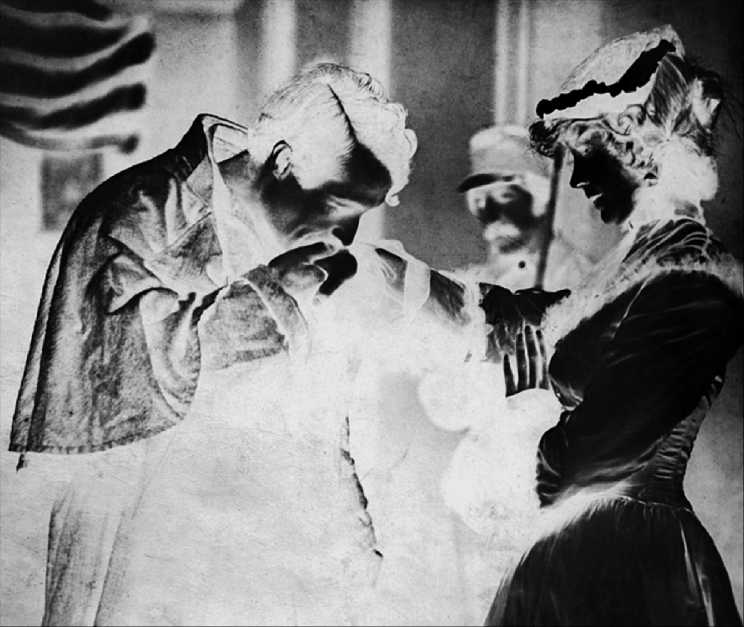
Ben Cameron (Henry B. Walthall) kissing the hand of Elsie Stoneman (Lillian Gish) in Birth of a Nation.
the world. Birth of a Nation was the first
behavior (as in its inspiration for the
real full-length feature film, technically
Klan of the 1920s). Although Birth of
and artistically superior to anything
a Nation aroused controversy in parts
before it. Apart from its place in the
of the North and was picketed by the
history of cinema, though, why should
NAACP, some 200 million people saw
anyone today watch a movie that perpe-
the film in the United States and abroad
tuates such wrongheaded history and
from 1915 to 1946. The story, and di-
noxious racist stereotypes? Precisely
rector Griffith, demonstrated in dra-
because it reflects and amplifies an
matic fashion how the South, having
interpretation of Reconstruction that
lost the Civil War, won the battle for
prevailed from the 1890s to the 1950s,
how the war and especially Reconstruc-
and thereby shaped not only historical
tion would be remembered for more
understanding but also contemporary
than half a century.
600
Chapter 17 Reconstruction, 1863–1877
to suppress and disarm the Klan, but in most areas the militias were outgunned and outmaneuvered by ex-Confederate veteran Klansmen. Some Republican governors
were reluctant to use black militia against white guerrillas for fear of sparking a racial bloodbath—as happened at Colfax.
The answer seemed to be federal troops. In 1870 and 1871, Congress enacted
three laws intended to enforce the 14th and 15th Amendments. Interference with
voting rights became a federal offense, and any attempt to deprive another person of civil or political rights became a felony. The third law, passed on April 20, 1871, and popularly called the Ku Klux Klan Act, gave the president power to suspend
the writ of habeas corpus and send in federal troops to suppress armed resistance to federal law.
Armed with these laws, the Grant administration moved against the Klan.
Because Grant was sensitive to charges of “military despotism,” he used his
powers with restraint. He suspended the writ of habeas corpus in only nine South
Carolina counties. Nevertheless, there and elsewhere federal marshals backed by
troops arrested thousands of suspected Klansmen. Federal grand juries indicted
more than 3,000, and several hundred defendants pleaded guilty in return for
suspended sentences. To clear clogged court dockets so that the worst offenders
could be tried quickly, the Justice Department dropped charges against nearly
2,000 others. About 600 Klansmen were convicted; most of them received
fines or light jail sentences, but 65 went to a federal penitentiary for terms of up to five years.
The Election
These measures broke the back of the Klan in time for the
of 1872
1872 presidential election. A group of dissident Republicans
had emerged to challenge Grant’s reelection. They believed
that conciliation of Southern whites rather than continued military intervention
was the only way to achieve peace in the South. Calling themselves Liberal
Republicans, these dissidents nominated Horace Greeley, the famous editor of the
New York Tribune. Under the slogan “Anything to beat Grant,” the Democratic
Party also endorsed Greeley’s nomination, although he had long been their an-
tagonist. On a platform denouncing “bayonet rule” in the South, Greeley urged
his fellow Northerners to put the issues of the Civil War behind them and to
“clasp hands across the bloody chasm which has too long divided” North and
South.
This phrase would come back to haunt Greeley. Most voters in the North were
still not prepared to trust Democrats or Southern whites. Powerful anti-Greeley cartoons by political cartoonist Thomas Nast showed Greeley shaking the hand of a
Klansman dripping with the blood of a murdered black Republican. Nast’s most
famous cartoon portrayed Greeley as a pirate captain bringing his craft alongside the ship of state, while Confederate leaders, armed to the teeth, hid below waiting to board it.
Grant swamped Greeley on election day. Republicans carried every Northern
state and 10 of the 16 Southern and border states. Blacks in the South enjoyed
more freedom in voting than they would again for a century. But this apparent triumph of Republicanism and Reconstruction would soon unravel.
The Retreat from Reconstruction
601
The Panic
The U.S. economy had grown at an unprecedented pace since
of 1873
recovering from a mild postwar recession. In eight years,
35,000 miles of new railroad track had been laid down—
equal to all the track laid in the preceding 35 years. The first transcontinental railroad had been completed on May 10, 1869, when a golden spike was driven at
Promontory Summit, Utah Territory, linking the Union Pacific and the Central
Pacific. But the building of a second transcontinental line, the Northern Pacific, precipitated a Wall Street panic in 1873 and plunged the economy into a five-year depression.
Jay Cooke’s banking firm, fresh from its triumphant marketing of Union war
bonds, took over the Northern Pacific in 1869. Cooke pyramided every conceiv-
able kind of equity and loan financing to raise the money to begin laying rails
west from Duluth, Minnesota. Other investment firms did the same as a fever of
speculative financing gripped the country. In September 1873, the pyramid of
paper collapsed. Cooke’s firm was the first to go bankrupt. Like dominoes, thou-
sands of banks and businesses also collapsed. Unemployment rose to 14 percent,
and hard times set in.
THE RETREAT FROM RECONSTRUCTION
It is an axiom of American politics that the voters will punish the party in power in times of economic depression. That axiom held true in the 1870s. Democrats made
large gains in the congressional elections of 1874, winning a majority in the House for the first time in 18 years.
Public opinion also began to turn against Republican policies in the South.
The campaign by Liberal Republicans and Democrats against “bayonet rule”
and “carpetbag corruption” that left most Northern voters unmoved in 1872
found a growing audience in subsequent years. Intraparty battles among Republi-
cans in Southern states enabled Democrats to regain control of several state gov-
ernments. Well-publicized corruption scandals also discredited Republican
leaders. Although corruption was probably no worse in Southern states than in
many parts of the North, Southern postwar poverty made waste and extravagance
seem worse. White Democrats scored propaganda points by claiming that corrup-
tion proved the incompetence of “Negro-carpetbag” regimes.
Northerners grew increasingly weary of what seemed to be the endless turmoil
of Southern politics. Most of them had never had a strong commitment to racial
equality, and they were growing more and more willing to let white supremacy
regain sway in the South. “The truth is,” confessed a Northern Republican, “our
people are tired out with this worn out cry of ‘Southern outrages’!!! Hard times & heavy taxes make them wish the ‘nigger,’ ‘everlasting nigger,’ were in hell or
Africa.”
By 1875, only four Southern states remained under Republican control: South
Carolina, Florida, Mississippi, and Louisiana. In those states, white Democrats
had revived paramilitary organizations under various names: White Leagues
(Louisiana), Rifle Clubs (Mississippi), and Red Shirts (South Carolina). Unlike
the Klan, these groups operated openly. In Louisiana, they fought pitched battles with Republican militias in which scores were killed. When the Grant
602
Chapter 17 Reconstruction, 1863–1877
administration sent large numbers of federal troops to Louisiana, people in both
North and South cried out against military rule. The protests grew even louder
when soldiers marched onto the floor of the Louisiana legislature in January
1875 and expelled several Democratic legislators after a contested election. Was
this America? Republican Senator Carl Schurz asked in a widely publicized
speech: “If this can be done in Louisiana, how long will it be before it can be
done in Massachusetts and Ohio? How long before a soldier may stalk into the
national House of Representatives, and, pointing to the Speaker’s mace, say
‘Take away that bauble!’”
The Mississippi
The backlash against the Grant administration affected the
Election of 1875
Mississippi state election of 1875. Democrats there de-
vised a strategy called the Mississippi Plan. The first step
was to “persuade” the 10 to 15 percent of white voters still calling themselves
Republicans to switch to the Democrats. Only a handful of carpetbaggers could
resist the economic pressures, social ostracism, and threats that made it “too
damned hot for [us] to stay out,” wrote one white Republican who changed
parties.
The second step in the Mississippi Plan was to intimidate black voters because,
even with all whites voting Democratic, the party could still be defeated by the 55
percent black majority. Economic coercion against black sharecroppers and work-
ers kept some of them away from the polls, but violence was the most effective
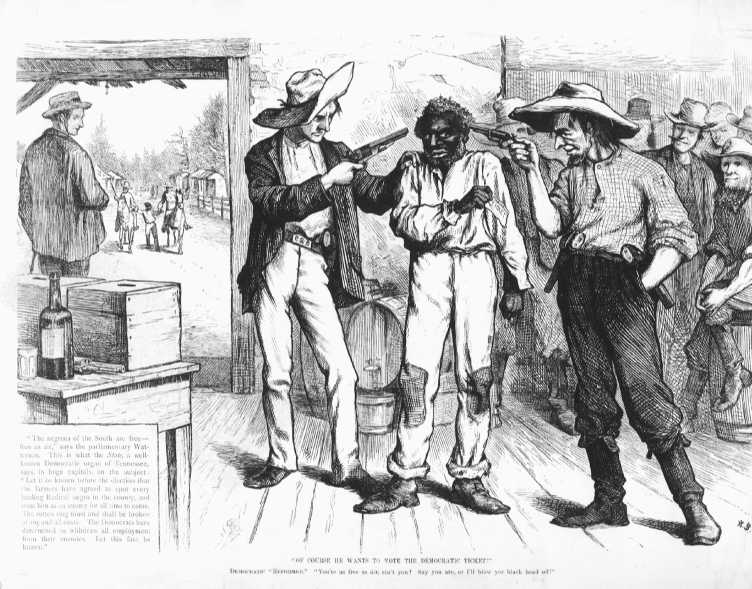
method. Democratic “rifle clubs” showed up at Republican rallies, provoked riots, and shot down dozens of blacks in the ensuing melees. Governor Adelbert Ames—a
native of Maine, a Union general who had won a medal of honor in the war, and
one of the ablest of Southern Republicans— called for federal troops to control the violence. Grant intended to comply, but Ohio Republicans warned him that if he
sent troops to Mississippi, the Democrats would exploit the issue of “bayonet
rule” to carry Ohio in that year’s state elections. Grant yielded—in effect giving up Mississippi for Ohio. The U.S. attorney general replied to Ames’s request for
troops:
The whole public are tired out with these annual autumnal outbreaks in the South, and the great majority are now ready to condemn any interference on the part of the government.... Preserve the peace by the forces in your own state, and let the country see that the citizens of Mississippi, who are … largely Republican, have the courage to fight for their rights.
Governor Ames did try to organize a loyal state militia, but that proved
difficult—and in any case, he was reluctant to use a black militia for fear of
provoking a race war. “No matter if they are going to carry the State,” said
Ames with weary resignation, “let them carry it, and let us be at peace and have
no more killing.” The Mississippi Plan worked like a charm. In five of the state’s counties with large black majorities, the Republicans polled 12, 7, 4, 2, and 0
votes, respectively. What had been a Republican majority of 30,000 in 1874
became a Democratic majority of 30,000 in 1875.
The Retreat from Reconstruction
603
Bettmann/CORBIS©
How the Mississippi Plan Worked. This cartoon shows how black counties could
report large Democratic majorities in the Mississippi state election of 1875. The black voter holds a Democratic ticket while one of the men, described in the caption as a “Democratic reformer,” holds a revolver to his head and says: “You’re as free as air, ain’t you? Say you are, or I’ll blow your black head off!”
The Supreme
Even if Grant had been willing to continue intervening in
Court and
Southern state elections, Congress and the courts would have
Reconstruction
constricted such efforts. The new Democratic majority in the
House threatened to cut any appropriations for the Justice
Department and the army intended for use in the South. In 1876, the Supreme
Court handed down two decisions that declared parts of the 1870 and 1871 laws
for enforcement of the 14th and 15th Amendments unconstitutional. In U.S. v.
Cruikshank and U.S. v. Reese, the Court ruled on cases from Louisiana and Ken-
tucky. Both cases grew out of provisions in these laws authorizing federal officials to prosecute individuals (not states) for violations of the civil and voting rights of blacks. But, the Court pointed out, the 14th and 15th Amendments apply to actions by states: “No State shall … deprive any person of life, liberty, or property ...
nor deny to any person ... equal protection of the laws” and the right to vote
“shall not be denied ... by any State.” Therefore, the portions of these laws that 604
Chapter 17 Reconstruction, 1863–1877
empowered the federal government to prosecute individuals were declared
unconstitutional.
The Court did not say what could be done when states were controlled by
white-supremacy Democrats who had no intention of enforcing equal rights. Mean-
while, in another ruling, Civil Rights Cases (1883), the Court declared unconstitutional a civil rights law passed by Congress in 1875. That law banned racial
discrimination in all forms of public transportation and public accommodations. If enforced, it would have effected a sweeping transformation of race relations—in the North as well as in the South. Even some of the congressmen who voted for the bill doubted its constitutionality, however, and the Justice Department had made little effort to enforce it. Several cases made their way to the Supreme Court, which in 1883 ruled the law unconstitutional—again on grounds that the 14th Amendment
applied only to states, not to individuals. Several states—all in the North—passed their own civil rights laws in the 1870s and 1880s, but less than 10 percent of the black population resided in those states. The mass of African Americans lived a segregated existence.
The Election
In 1876, the remaining Southern Republican state govern-
of 1876
ments fell victim to the passion for “reform.” The mounting
revelations of corruption at all levels of government ensured
that reform would be the leading issue in the presidential election. In this centennial year of the birth of the United States, marked by a great exposition in Philadelphia, Americans wanted to put their best foot forward. Both major parties gave their
presidential nominations to governors who had earned reform reputations in their
states: Democrat Samuel J. Tilden of New York and Republican Rutherford B.
Hayes of Ohio.
Democrats entered the campaign as favorites for the first time in two decades.
It seemed likely that they would be able to put together an electoral majority from a
“solid South” plus New York and two or three other Northern states. To ensure a
solid South, they looked to the lessons of the Mississippi Plan. In 1876, a new word came into use to describe Democratic techniques of intimidation: bulldozing. To
bulldoze black voters meant to trample them down or keep them away from the
polls. In South Carolina and Louisiana, the Red Shirts and the White Leagues mo-
bilized for an all-out bulldozing effort.
The most notorious incident, the Hamburg Massacre, occurred in the village of
Hamburg, South Carolina, where a battle between a black militia unit and 200 Red
Shirts resulted in the capture of several militiamen, five of whom were shot “while attempting to escape.” This time Grant did send in federal troops. He pronounced
the Hamburg Massacre “cruel, blood-thirsty, wanton, unprovoked ... a repetition
of the course that has been pursued in other Southern States.”
The federal government also put several thousand deputy marshals and election
supervisors on duty in the South. Although they kept an uneasy peace at the polls, they could do little to prevent assaults, threats, and economic coercion in backcountry districts, which reduced the potential Republican tally in the former Confederate states by at least 250,000 votes.
The Retreat from Reconstruction
605
WASH.
TERR.
ME.
7
MONTANA
TERRITORY
VT.
MINN.
5 N.H.
OREGON
DAKOTA
5
TERRITORY
5
2 1
N.Y.
MASS.
IDAHO
WIS.
35
13
TERR.
10
MICH.
R.I. 4
WYOMING
11
TERRITORY
PENN.
CONN. 6
IOWA
29
N.J.
NEBRASKA
11
9
OHIO
3
MD.
NEVADA
IND.
22
DEL. 3
ILL.
8
3
UTAH
15
21
W.VA.
CAL.
TERR.
COLORADO
5
VA.
6
3
KANSAS
11
MO.
KY.
5
15
12
N.C.
10
TENN.
INDIAN
12
ARIZONA
NEW MEXICO
S.C.
TERR.
ARK.
TERR.
TERR.
7
6
GA.
MISS.
ALA.
11
8
10
TEXAS
LA.
8
8
FLA.
4
Electoral
Popular
Hayes
(Republican)
185
4,036,298
Tilden
(Democrat)
184
4,288,590
Disputed
Learning
Cengage©
MAP 17.2 Hayes-Tilden Disputed Election of 1876
A comparison of this map with Map 17.1 shows the persistence of geographical voting patterns once Southern Democrats had overthrown most Republican state governments and effectively disfranchised many black voters.
Disputed
When the results were in, Tilden had carried four Northern
Results
states, including New York with its 35 electoral votes.
Tilden also carried all of the former slave states except—
apparently—Louisiana, South Carolina, and Florida, which produced disputed
returns. Because Tilden needed only one of them to win the presidency, while
Hayes needed all three, and because Tilden seemed to have carried Louisiana and
Florida, it appeared initially that he had won the presidency. But frauds and ir-
regularities reported from several bulldozed districts in the three states clouded the issue. For example, a Louisiana parish that had recorded 1,688 Republican
votes in 1874 reported only 1 in 1876. Many other similar discrepancies ap-
peared. The official returns ultimately sent to Washington gave all three states—
and therefore the presidency—to Hayes, but the Democrats refused to recognize
the results, and they controlled the House.
606
Chapter 17 Reconstruction, 1863–1877
The country now faced a serious constitutional crisis. Armed Democrats threat-
ened to march on Washington. Many people feared another civil war. The Consti-
tution offered no clear guidance on how to deal with the matter. A count of the
state electoral votes required the concurrence of both houses of Congress, but with a Democratic House and a Republican Senate, such concurrence was not forthcoming. To break the deadlock, Congress created a special electoral commission con-
sisting of five representatives, five senators, and five Supreme Court justices split evenly between the two parties, with one member, a Supreme Court justice, supposedly an independent—but in fact a Republican.
Tilden had won a national majority of 252,000 popular votes, and the raw
returns gave him a majority in the three disputed states. But an estimated
250,000 Southern Republicans had been bulldozed away from the polls. In a
genuinely fair and free election, the Republicans might have carried Mississippi
and North Carolina as well as the three disputed states. While the commission
agonized, Democrats and Republicans in Louisiana and South Carolina each
inaugurated their own separate governors and legislatures (Republicans in
Florida gave up the fight at the state level). Only federal troops in the capitals at New Orleans and Columbia protected the Republican governments in those
states.
The Compromise
In February 1877, three months after voters had gone to the
of 1877
polls, the electoral commission issued its ruling. By a parti-
san vote of 8 to 7—with the “independent” justice voting
with the Republicans—the commission awarded all of the disputed states to
Hayes. The Democrats cried foul and began a filibuster in the House to delay the
final electoral count beyond the inauguration date of March 4, to throw the
election to the House of Representatives, an eventuality that threatened to bring total anarchy. But, behind the scenes, a compromise began to take shape. Both
Northern Republicans and Southern Democrats of Whig heritage had similar in-
terests in liquidating the sectional rancor and in getting on with the business of economic recovery and development. To wean Southern Whiggish Democrats
away from a House filibuster, Hayes promised his support as president for federal appropriations to rebuild war-destroyed levees on the lower Mississippi and
federal aid for a southern transcontinental railroad. Hayes’s lieutenants also
hinted at the appointment of a Southerner as postmaster general, who would
have a considerable amount of patronage at his disposal—the appointment of
thousands of local postmasters.
Most important, Southerners wanted to know what Hayes would do about
Louisiana and South Carolina. Hayes signaled his intention to end “bayonet rule,”
which he had for some time considered a bankrupt policy. He believed that the
goodwill and influence of Southern moderates would offer better protection for
black rights than federal troops could provide. In return for his commitment to
withdraw the troops, Hayes asked for—and received—promises of fair treatment
of freedpeople and respect for their constitutional rights.
Conclusion
607
The End of
Such promises were easier to make than to keep, as future
Reconstruction
years would reveal. In any case, the Democratic filibuster
collapsed, and Hayes was inaugurated on March 4. He soon
fulfilled his part of the Compromise of 1877: ex-Confederate Democrat David Key
of Tennessee became postmaster general; in 1878, the South received more federal
money for internal improvements than ever before; and federal troops left the
capitals of Louisiana and South Carolina. The last two Republican state govern-
ments collapsed. The old abolitionist and radical Republican warhorses denounced
Hayes’s actions as a sellout of Southern blacks.
But voices of protest could scarcely be heard above the sighs of relief that the
crisis was over. Most Americans, including even most Republicans, wanted no more
military intervention in state affairs. “I have no sort of faith in a local government which can only be propped up by foreign bayonets,” wrote the editor of the New
York Tribune in April 1877. “If negro suffrage means that as a permanency then
negro suffrage is a failure.”
CONCLUSION
Before the Civil War, most Americans had viewed a powerful government as a
threat to individual liberties. That is why the first 10 amendments to the Constitution (the Bill of Rights) imposed strict limits on the powers of the federal government. During the Civil War and especially during Reconstruction, however, the
national government had to exert an unprecedented amount of power to free the
slaves and guarantee their equal rights as free citizens. That is why the 13th, 14th, and 15th Amendments to the Constitution contained clauses stating that “Congress
shall have power” to enforce these provisions for liberty and equal rights.
During the post–Civil War decade, Congress passed civil rights laws and
enforcement legislation to accomplish this purpose. Federal marshals and troops
patrolled the polls to protect black voters, arrested thousands of Klansmen and
other violators of black civil rights, and even occupied state capitals to prevent Democratic paramilitary groups from overthrowing legitimately elected Republican
state governments.
By 1875, many Northerners had grown tired of or alarmed by this continued
use of military power to intervene in the internal affairs of states. The Supreme Court stripped the federal government of much of its authority to enforce certain provisions of the 14th and 15th Amendments. Traditional fears of military power
as a threat to individual liberties came to the fore again.
The withdrawal of federal troops from the South in 1877 constituted both a
symbolic and a substantive end of the 12-year postwar era known as Reconstruc-
tion. Reconstruction had achieved the two great objectives inherited from the Civil War: (1) to reincorporate the former Confederate states into the Union, and (2) to accomplish a transition from slavery to freedom in the South. That transition was marred by the economic inequity of sharecropping and the social injustice of white supremacy. A third goal of Reconstruction, enforcement of the equal civil and political rights promised in the 14th and 15th Amendments, was betrayed by the
608
Chapter 17 Reconstruction, 1863–1877
Compromise of 1877. In subsequent decades, the freed slaves and their descendants suffered repression into segregated, second-class citizenship. Not until another war hero-turned-president sent troops into Little Rock (Chapter 28), 80 years after they had been withdrawn from New Orleans and Columbia, did the federal government
launch a second Reconstruction to fulfill the promises of the first.
18
A TRANSFORMED NATION:
THE WEST AND THE NEW SOUTH,
1865–1900