• Slavery and the War • A Winter of Discontent • Blueprint for Modern
America • The Confederate Tide Crests and Recedes • Black Men in
Blue • The Year of Decision • Lincoln’s Reelection and the End
of the Confederacy
ONEOFTHEGREATissuesawaitingresolutionasthearmiesmovedintoMaryland
in September 1862 was emancipation of the slaves. The war had moved
beyond the effort to restore the old Union. It now required the North to mobi-
lize every resource that might bring victory or to destroy any enemy resource that might inflict defeat. To abolish slavery would strike at a vital Confederate resource (slave labor) and mobilize that resource for the Union along with the moral power of fighting for freedom. Slaves had already made clear their choice by escaping to Union lines by the tens of thousands. Lincoln had made up his mind to issue an
emancipation proclamation and was waiting for a Union victory to give it credibility and potency.
This momentous decision would radically enlarge the scope and purpose
of the Union war effort. It would also polarize Northern public opinion and
political parties. So long as the North fought simply for restoration of the Union, Northern unity was impressive, but the events of 1862 and 1863 raised the
divisive question of what kind of Union was to be restored. Would it be a Union
without slavery, as abolitionists and radical Republicans hoped? Or “the Union
as it was, the Constitution as it is,” as Democrats desired? The answer to this
question would determine not only the course of the war but also the future of
the United States.
539
540
Chapter 16 A New Birth of Freedom, 1862–1865
CHRONOLOGY
1862
Confederacy enacts conscription (April 16) ◆ Lincoln informs the
cabinet of intention to issue Emancipation Proclamation (July 22)
◆ Battle of Antietam (September 17) ◆ Lincoln issues preliminary
Emancipation Proclamation (September 22) ◆ Battle of
Fredericksburg (December 13) ◆ Battle of Stones River (December
31–January 2)
1863
Lincoln issues final Emancipation Proclamation (January 1) ◆ Union
enacts conscription (March 3) ◆ Richmond bread riot (April 2) ◆
Battle of Chancellorsville (May 1–5) ◆ Battle of Gettysburg (July 1–3)
◆ Vicksburg surrenders (July 4) ◆ Port Hudson surrenders (July 9)
◆ New York draft riot (July 13–16) ◆ Assault on Fort Wagner
(July 18) ◆ Battle of Chickamauga (September 19–20) ◆ Battles of
Chattanooga (November 24–25)
1864
Battle of the Wilderness (May 5–6) ◆ Battle of Spotsylvania
(May 8–19) ◆ Fighting at Petersburg leads to nine-month siege
(June 15–18) ◆ Fall of Atlanta (September 1) ◆ Reelection of
Lincoln (November 8) ◆ Battle of Nashville (December 15–16)
1865
Capture of Fort Fisher (January 15) ◆ Confederates evacuate
Richmond (April 2) ◆ Lee surrenders at Appomattox (April 9) ◆
Booth assassinates Lincoln (April 14) ◆ Last Confederate army
surrenders (June 23) ◆ 13th Amendment abolishing slavery ratified
(December 6)
SLAVERY AND THE WAR
At first, the leaders of both the Union and the Confederacy tried to keep the issue of slavery out of the war. For Southern leaders to proclaim that the defense of slavery was the aim of the war might prompt nonslaveholders to ask why they were risking
their lives to protect their rich neighbors’ property. Even more important, it might jeopardize Confederate efforts to win recognition and support from Britain. So the Confederates proclaimed liberty rather than slavery as their war aim—the same liberty their ancestors had fought for in 1776. The unspoken corollary of that aim was the liberty of whites to own blacks.
In the North, the issue of emancipation was deeply divisive. Lincoln had been
elected on a platform pledged to contain the expansion of slavery, but that pledge had provoked most of the Southern states to quit the Union. For the administration to take action against slavery in 1861 would be to risk the breakup of the fragile coalition Lincoln had stitched together to fight the war: Republicans, Democrats, and border-state Unionists. Spokesmen for the latter two groups served notice
that, although they supported a war for the Union, they would not support a war
against slavery. In July 1861, with Lincoln’s endorsement, Congress passed a resolution affirming that Northern war aims included no intention “of overthrowing or interfering with the rights or established institutions of the States”—in plain words,
Slavery and the War
541
Division
Photographs
and
Prints
Congress,of
Library
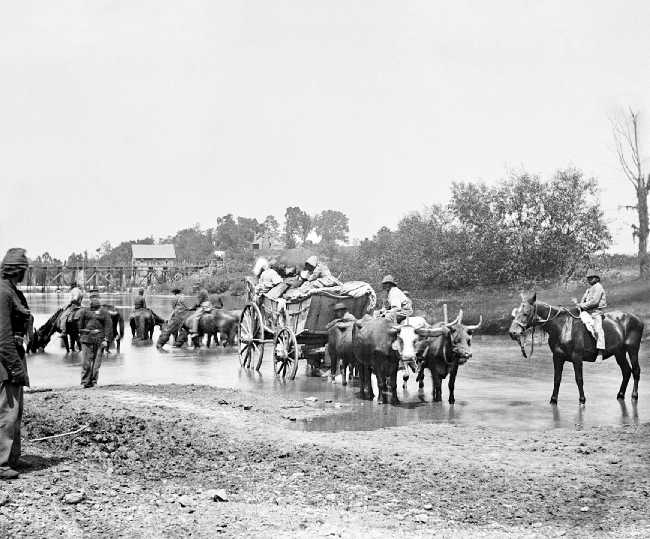
Contrabands Coming into Union Lines. This photograph taken in 1862 or 1863
shows “contrabands” fording the Rappahannock River in Virginia to reach freedom. They have “liberated” several draft animals as well as themselves.
slavery—but intended only “to defend and maintain the supremacy of the Constitu-
tion and to preserve the Union.”
Many Northerners saw matters differently. They insisted that a rebellion sus-
tained by slavery in defense of slavery could be suppressed only by striking against slavery. As the black leader Frederick Douglass stated, “War for the destruction of liberty must be met with war for the destruction of slavery.”
Wars tend to develop a logic and momentum that go beyond their original pur-
poses. When Northerners discovered at Bull Run in July 1861 that they were not
going to win an easy victory, many of them began to take a harder look at slavery.
Slaves constituted the principal labor force in the South. They raised most of the food and fiber, built most of the military fortifications, worked on the railroads and in mines and munitions factories. Southern newspapers boasted that slavery was “a
tower of strength to the Confederacy” because it enabled the South “to place in the field a force so much larger in proportion to her white population than the North.”
So why not convert this Confederate asset to a Union advantage by confiscating
slaves as enemy property and using them to help the Northern war effort?
The
The slaves entered this debate in a dramatic fashion. As
“Contrabands”
Union armies penetrated the South, a growing number of
slaves voted for freedom with their feet. By twos and threes,
542
Chapter 16 A New Birth of Freedom, 1862–1865
by families, and eventually by scores, they escaped from their masters and came
over to the Union lines. By obliging Union officers either to return them to slavery or accept them, these escaped slaves began to make the conflict a war for freedom.
Although some commanders returned escaped slaves to their masters or
prevented them from entering Union camps, increasingly, most did not. Their rationale was first expressed by General Benjamin Butler. In May 1861, three slaves who had been working for the Confederate army escaped to Butler’s lines near Fortress Monroe at the mouth of the James River in Virginia. Butler refused to return them on the grounds that they were “contraband of war.” The phrase caught on. For the
rest of the war, slaves who came within Union lines were known as contrabands. On August 6, 1861, Congress passed a confiscation act that authorized the seizure of all property that was being used for Confederate military purpose, including slaves. The following March, Congress forbade the return of slaves who entered Union lines.
The Border
The problem of slavery in the loyal border states preoccupied
States
Lincoln. On August 30, 1861, John C. Frémont, whose
political influence had won him a commission as major gen-
eral and command of Union forces in Missouri, issued an order freeing the slaves
of all Confederate sympathizers in Missouri. This caused such a backlash among
border-state Unionists, who feared it was a prelude to a general abolition edict, that Lincoln revoked the order, lest it “alarm our Southern Union friends, and turn them against us.”
In spring 1862, Lincoln tried persuasion instead of force in the border states. At his urging, Congress passed a resolution offering federal compensation to states that voluntarily abolished slavery. Three times, from March to July 1862, Lincoln urged border-state congressmen to accept the offer. He told them that the Confederate
hope that their states might join the rebellion was helping to keep the war alive.
Adopt the proposal for compensated emancipation, he pleaded, and that hope
would die. The pressure for a bold antislavery policy was growing stronger, he
warned them in May. Another Union general had issued an emancipation order;
Lincoln had suspended it, but “you cannot,” Lincoln told the border-state congressmen, “be blind to the signs of the times.”
They did seem to be blind. They complained of being coerced, bickered about
the amount of compensation, and wrung their hands over the prospects of eco-
nomic ruin and race war, even if emancipation were to take place gradually over a 30-year period, as Lincoln had suggested. At a final meeting, on July 12, Lincoln, in effect, gave them an ultimatum: Accept compensated emancipation or face the consequences. In fact, thousands of slaves had already run away to Union camps in the border states. “The incidents of the war cannot be avoided,” he said. “If the war continue long … the institution in your states will be extinguished by mere friction and abrasion.” Again they failed to see the light, and by a vote of 20 to 9, they rejected the proposal for compensated emancipation.
The Decision for
That very evening, Lincoln decided to issue an emancipation
Emancipation
proclamation in his capacity as commander-in-chief with
power to order the seizure of enemy property. Several
Slavery and the War
543
factors, in addition to the recalcitrance of the border states, impelled Lincoln to this fateful decision. One was a growing demand from his own party for bolder action:
Congress had just passed a second confiscation act calling for seizure of the property of active Confederates. Another was rising sentiment in the Army to “take off the kid gloves” when dealing with “traitors.” From General Henry W. Halleck,
who had been summoned to Washington as general-in-chief, went orders to Gen-
eral Grant in northern Mississippi instructing him on the treatment of rebel sym-
pathizers inside Union lines: “Handle that class without gloves, and take their
property for public use.” Grant himself had written several months earlier that if the Confederacy “cannot be whipped in any other way than through a war against
slavery, let it come to that.” Finally, Lincoln’s decision reflected his sentiments about the “unqualified evil” and “monstrous injustice” of slavery.
The military situation, however, rather than his moral convictions, determined
the timing and scope of Lincoln’s emancipation policy. Northern hopes that the war would soon end had risen after the victories of early 1862 but had then plummeted amid the reverses of that summer.
Three courses of action seemed possible. One, favored by the so-called Peace
Democrats, urged an armistice and peace negotiations to patch together some kind
of Union, but that would have been tantamount to conceding Confederate victory.
Republicans therefore reviled the Peace Democrats as traitorous Copperheads,
after the poisonous snake. A second alternative was to keep on fighting—in the
hope that with a few more Union victories, the rebels would lay down their arms
and the Union could be restored. Such a policy would leave slavery intact, a course of action that General McClellan strongly advocated. He wrote Lincoln an unsolicited letter of advice on July 7, 1862, warning him that “neither confiscation of
property … [n]or forcible abolition of slavery should be contemplated for a
moment.” Yet that was precisely what Lincoln was contemplating. This was the
third alternative: an effort to mobilize all the resources of the North and to destroy all the resources of the South, including slavery—a war not to restore the old Union but to build a new one.
After his meeting with the border-state representatives convinced him that
attempts at compromise were futile, Lincoln made his decision. On July 22, he formally notified the cabinet of his intention to issue an emancipation proclamation. It was “a military necessity, absolutely essential to the preservation of the Union,”
said Lincoln. “We must free the slaves or be ourselves subdued. The slaves [are]
undeniably an element of strength to those who [have] their service, and we must
decide whether that element should be with us or against us.”
The cabinet agreed, except for Postmaster General Montgomery Blair, a resi-
dent of Maryland and a former Democrat, who warned that the border states and
the Democrats would rebel against the proclamation and perhaps cost the adminis-
tration the fall congressional elections as well as vital support for the war. Lincoln might have agreed two months earlier. Now he believed that the strength gained
from an emancipation policy—from the slaves themselves, from the dynamic Re-
publican segment of Northern opinion, and in the eyes of foreign nations—would
more than compensate for the hostility of Democrats and border-state Unionists.
Lincoln did, however, accept the advice of Secretary of State Seward to delay the proclamation “until you can give it to the country supported by military success.”
544
Chapter 16 A New Birth of Freedom, 1862–1865
Otherwise, Seward argued, it might be viewed “as the last measure of an exhausted government, a cry for help ... our last shriek, on the retreat.” Lincoln slipped his proclamation into a desk drawer and waited for a military victory.
New Calls
Meanwhile, Lincoln issued a call for 300,000 new three-year
for Troops
volunteers for the army. In July, Congress passed a militia
act giving the president greater powers to mobilize the state
militias into federal service and to draft men into the militia if the states failed to do so. Although not a national draft law, this was a step in that direction. In
August, Lincoln called up 300,000 militia for nine months of service, in addition to the 300,000 three-year volunteers. (These calls eventually yielded 421,000 three-year volunteers and 88,000 nine-month militia.) The Peace Democrats railed
against these measures and provoked antidraft riots in some localities. The gov-
ernment responded by arresting rioters and antiwar activists under the president’s suspension of the writ of habeas corpus.1
Democrats denounced these “arbitrary arrests” as unconstitutional violations of
civil liberties and added this issue to others on which they hoped to gain control of the next House of Representatives in the fall elections. With the decline in Northern morale following the defeat at Second Bull Run and the early success of the Confederate invasion of Kentucky, prospects for a Democratic triumph seemed bright. One more military victory by Lee’s Army of Northern Virginia might crack the North’s
will to continue the fight. It would certainly bring diplomatic recognition of the Confederacy by Britain and France. Lee’s legions began crossing the Potomac into
Maryland on September 4, 1862.
The Battle
The Confederate invasion ran into difficulties from the start.
of Antietam
Western Marylanders responded impassively to Lee’s procla-
mation that he had come “to aid you in throwing off this
foreign yoke” of Yankee rule. Lee split his army into five parts. Three of them,
under the overall command of Stonewall Jackson, occupied the heights surrounding
the Union garrison at Harpers Ferry, which lay athwart the Confederate supply
route from the Shenandoah Valley. The other two remained on watch in the South
Mountain passes west of Frederick. Then on September 13, Union commander
George B. McClellan had an extraordinary stroke of luck. In a field near Frederick, two of his soldiers found a copy of Lee’s orders for these deployments. Wrapped
around three cigars, they had apparently been dropped by a careless Southern
1 A writ of habeas corpus is an order issued by a judge to law enforcement officers requiring them to bring an arrested person before the court to be charged with a crime so that the accused can have a fair trial. The U.S. Constitution permits the suspension of this writ “in cases of rebellion or invasion,” so that the government can arrest enemy agents, saboteurs, or any individual who might hinder the defense of the country, and hold such individuals without trial. Lincoln had suspended the writ, but political opponents charged him with usurping a power possessed only by Congress in order to curb freedom of speech of antiwar opponents and political critics guilty of nothing more than speaking out against the war.


Slavery and the War
545
Hagerstown
pk.T
IN
Poto
Dawn –
m
Hooke
reek
TA
a
r 9 A.M.
c
C
N
R
M
n
a
U
O
.
nsfield
M
am
Antietam
Boonsboro
te k
ntietam
i
Sept. 17
agerstow
t ee
A
Turner's Gap
n r
N
H
Sharpsburg
South Mountain
A C
To Boonesboro
Sept. 14
Stu
TH
art
F
U
9 A.M. – Noon
S
r
u
a
SO
Ho
m
n
od
k
Union forces
n
lin
Crampton's Gap
Frederick
er
Sept. 14
Lee
McClellan
West Cornfield
East
Harpers
Sept. 7
Sept. 13
Confederate forces
Woods
Ford
J
Woods
Ferry
a
McClellan's
Sept. 15
P
c
Dunker
o HQ.
S
iver
r
k Church
t
R
IN
e
s
Bloody Lane
r
TA
o
P
N
n
D
l
U
O
LEE
.
e
H.
Middle
a
H
P
Shenandoah
s
M
4–6
i
Bridge
o
l
n
o
E
t
r
t.
o
t
G
n
er 10 A.M. –
ID
4:30 P.M.
Sep
R
Sharpsburg
E
Lee
Lee's HQ.
M A R Y L A N D
Ford
B
BLU
urn
L
si
o
d
P
e
o
n
tom
g
ac
s
Riv
Burnside
e
t
r
re
Bridge
1 P.M. Ford
To Shepherdstown
A
e
.
t
V I R G I N I A
P.
Creek
H
Ford
McCLELLAN
il
Harpers Ferry
4:30 P.M.
From
Chantilly
P
Lee
otom
Sept. 2–3
a
ntietam
Boteler's
c R
A
WASHINGTON, D.C.
Ford
iv
Learning
Centreville
er
McClellan
0
5
10 Miles
0
/
1 2
1 Mile
Cengage©
MAP 16.1 Lee’s Invasion of Maryland, 1862 and the Battle of Antietam,
September 17, 1862
Both the advantages and disadvantages of Lee’s defensive position in this battle are illustrated by the right-hand map. The Confederate flanks were protected by water barriers (the Potomac River on the left and Antietam Creek on the right), but the Confederates fought with their back to the Potomac and only Boteler’s Ford as the single line of retreat across the river. If Burnside’s attack on the Confederate right had succeeded before A. P. Hill’s division arrived, Lee’s forces could have been trapped north of the river.
officer when the Confederate army passed through Frederick four days earlier.
With this new information, McClellan planned to pounce on the separated seg-
ments of Lee’s army before they could reunite. “Here is a paper,” he exulted, “with which if I cannot whip ‘Bobbie Lee,’ I will be willing to go home.”
But McClellan moved so cautiously that he lost much of his advantage.
Although Union troops overwhelmed the Confederate defenders of the South
Mountain passes on September 14, they advanced too slowly to save the garrison
at Harpers Ferry, which surrendered 12,000 men to Jackson on September 15. Lee
then managed to reunite most of his army near the village of Sharpsburg by
September 17, when McClellan finally crossed Antietam Creek to attack. Even so,
the Union forces outnumbered the Confederates by 2 to 1 (80,000 to 40,000 men),
but McClellan, as usual, believed that the enemy outnumbered him. Thus he missed
several opportunities to inflict a truly crippling defeat on the Confederacy. The 546
Chapter 16 A New Birth of Freedom, 1862–1865
battle of Antietam (called Sharpsburg by the Confederates) nevertheless proved to be the single bloodiest day in American history, with more than 23,000 casualties (killed, wounded, and captured) in the two armies.
Attacking from right to left on a four-mile front, McClellan’s Army of the
Potomac achieved potential breakthroughs at a sunken road northeast of Sharpsburg (known ever after as Bloody Lane) and in the rolling fields southeast of town. But fearing counterattacks from phantom reserves that he was sure Lee possessed, McClellan held back 20,000 of his troops and failed to follow through. Thus the battle ended in a draw. The battered Confederates still clung to their precarious line, with the Potomac at their back, at the end of a day in which more than 6,000 men on both sides were killed or mortally wounded—almost as many Americans as were killed or mortally
wounded in combat during the entire seven years of the Revolutionary War.
Even though he received reinforcements the next day, McClellan did not renew
the attack. Nor did he follow up vigorously when the Confederates finally retreated across the Potomac on the night of September 18.
The
Lincoln was not happy with this equivocal Union victory,
Emancipation
despite its important consequences. Britain and France
Proclamation
decided to withhold diplomatic recognition of the Confeder-
acy. Northern Democrats failed to gain control of the House
in the fall elections. And most significant of all, on September 22, Lincoln seized the occasion to issue his preliminary emancipation proclamation. It did not come as a total surprise. A month earlier, after Horace Greeley had written a strong editorial in the New York Tribune calling for action against slavery, Lincoln had
responded with a public letter to Greeley (much as a president today might use a
televised news conference). “My paramount object in this struggle,” wrote Lincoln,
“is to save the Union.... If I could save the Union without freeing any slave I would do it, and if I could save it by freeing all the slaves I would do it; and if I could save it by freeing some and leaving others alone I would also do that.” Lincoln had
crafted these phrases carefully to maximize public support for his anticipated
proclamation. He portrayed emancipation not as an end in itself— despite his per-
sonal convictions to that effect—but only as an instrument, a means toward saving the Union.
Lincoln’s proclamation of September 22 did not go into effect immediately.
Rather, it stipulated that if any state, or part of a state, was still in rebellion on January 1, 1863, the president would proclaim the slaves therein “forever free.”
Confederate leaders scorned this warning, and by January 1st no Southern state
had returned to the Union. After hosting a New Year’s Day reception at the White
House, Lincoln signed the final proclamation as an “act of justice” as well as “a fit and necessary war measure for suppressing said rebellion.”
The Emancipation Proclamation exempted the border states, plus Tennessee
and those portions of Louisiana and Virginia already under Union occupation
because these areas were deemed not to be in rebellion, and Lincoln’s constitutional authority for the proclamation derived from his power as commander-in-chief to
confiscate enemy property. Although the proclamation did not immediately liberate slaves in areas under Confederate control, it essentially made the Northern soldiers
A Winter of Discontent
547
Collection
Senate
U.S.
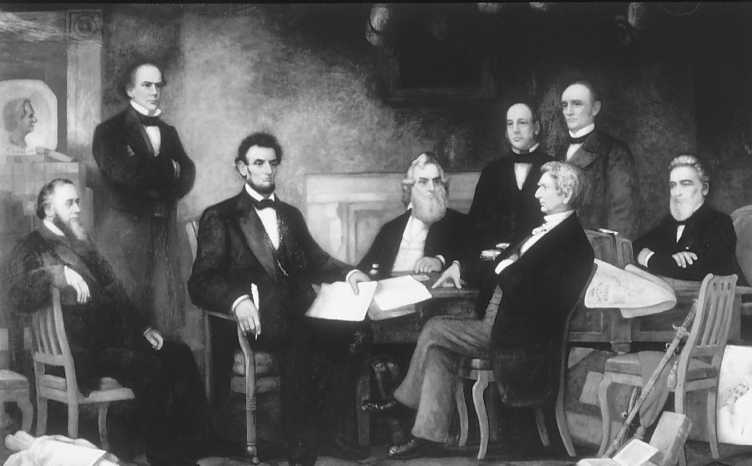
The Emancipation Proclamation. This famous contemporary painting by Francis
Carpenter portrays Lincoln and his cabinet discussing the Emancipation Proclamation, which lies on the desk before Lincoln. The other members of the cabinet, from left to right, are Secretary of War Edwin M. Stanton, Secretary of the Treasury Salmon P. Chase, Secretary of the Navy Gideon Welles, Secretary of the Interior Caleb B. Smith, Secretary of State William H. Seward (seated facing Lincoln), Postmaster General Montgomery Blair, and Attorney General Edward Bates.
an army of liberation, however reluctant many of them were to risk their lives for that purpose. If the North won the war, slavery would die. But in the winter and
spring of 1862–63, victory was far from assured.
A WINTER OF DISCONTENT
Although Lee’s retreat from Maryland and Braxton Bragg’s retreat from Kentucky suggested that the Confederate tide might be ebbing, the tide soon turned. The Union could never win the war simply by turning back Confederate invasions. Northern armies
would have to invade the South, defeat its armies, and destroy its ability to fight.
Displeased by McClellan’s “slows” after Antietam, Lincoln replaced him on
November 7 with General Ambrose E. Burnside. An imposing man whose mutton-
chop whiskers gave the anagram “sideburns” to the language, Burnside proposed to
cross the Rappahannock River at Fredericksburg for a move on Richmond before
bad weather forced both sides into winter quarters. Although Lee put his men into a strong defensive position on the heights behind Fredericksburg, Burnside nevertheless attacked on December 13. He was repulsed with heavy casualties that shook the morale of both the army and the public. When Lincoln heard the news, he said:
“If there is a worse place than hell, I am in it.”
548
Chapter 16 A New Birth of Freedom, 1862–1865
News from the western theater did little to dispel the gloom in Washington. The
Confederates had fortified Vicksburg on bluffs commanding the Mississippi River.
This bastion gave them control of an important stretch of the river and preserved transportation links between the states to the east and west. Grant proposed to sever those links, and in November 1862, he launched a two-pronged drive against Vicksburg. With 40,000 men, he marched 50 miles southward from Memphis by land,
while his principal subordinate William T. Sherman came down the river with
32,000 men accompanied by a gunboat fleet. Confederate cavalry raids destroyed
the railroads and supply depots in Grant’s rear, however, forcing him to retreat to Memphis. Meanwhile, Sherman attacked the Confederates at Chickasaw Bluffs on
December 29 with no more success than Burnside had enjoyed at Fredericksburg.
The only bit of cheer for the North came in central Tennessee at the turn of the
year. There, Lincoln had removed General Don Carlos Buell from command of the
Army of the Cumberland for the same reason he had removed McClellan—lack of
vigor and aggressiveness. Buell’s successor, William S. Rosecrans, had proved a
fighter in subordinate commands. On the Confederate side, Davis stuck with Braxton Bragg as commander of the Army of Tennessee, despite dissension from some subordinate officers within his ranks.
On the day after Christmas 1862, Rosecrans moved from his base at Nashville to
attack Bragg’s force 30 miles to the south at Murfreesboro. The ensuing three-day battle (called Stones River by the Union and Murfreesboro by the Confederacy) resulted in Confederate success on the first day (December 31) but defeat on the last. Both armies suffered devastating casualties. The Confederate retreat to a new base 40 miles farther south enabled the North to call Stones River a victory. Lincoln expressed his gratitude to Rosecrans: “I can never forget … that you gave us a hard-earned victory which, had there been a defeat instead, the nation could scarcely have lived over.”
As it was, the nation scarcely lived over the winter of 1862–63. Morale
declined, and desertions rose so sharply in the Army of the Potomac that Lincoln
replaced Burnside with Joseph Hooker, a controversial general whose nickname
“Fighting Joe” seemed to promise a vigorous offensive. Hooker did lift morale in
the Army of the Potomac, but elsewhere matters went from bad to worse.
Renewing the campaign against Vicksburg, Grant bogged down in the swamps
and rivers that protected that Confederate bastion on three sides. Only on the east, away from the river, did he find high ground suitable for an assault on Vicksburg’s defenses. Grant’s problem was to get his army across the Mississippi to that high ground, along with supplies and transportation to support an assault. For three
months, he floundered in the Mississippi-Yazoo bottomlands, while disease and
exposure depleted his troops. False rumors of excessive drinking that had dogged
Grant for years broke out anew, but Lincoln resisted pressures to remove him
from command. “What I want,” Lincoln said, “is generals who will fight battles
and win victories. Grant has done this, and I propose to stand by him.”
The Rise of the
During the winter of 1863, the Copperhead faction of the
Copperheads
Democratic Party found a ready audience for its message
that the war was a failure and should be abandoned. Having
won control of the Illinois and Indiana legislatures the preceding fall, Democrats A Winter of Discontent
549
there called for an armistice and a peace conference. They also demanded retrac-
tion of the “wicked, inhuman, and unholy” Emancipation Proclamation.
In Ohio, the foremost Peace Democrat, Congressman Clement L. Vallandigham,
was planning to run for governor. What had this wicked war accomplished?
Vallandigham asked Northern audiences: “Let the dead at Fredericksburg and
Vicksburg answer.” The Confederacy could never be conquered; the only tro-
phies of the war were “debt, defeat, sepulchres.” The solution was to “stop the
fighting. Make an armistice. Withdraw your army from the seceded states.”
Above all, give up the unconstitutional effort to abolish slavery.
Vallandigham and other Copperhead spokesmen had a powerful effect on
Northern morale. Alarmed by a wave of desertions, the army commander in Ohio
had Vallandigham arrested in May 1863. A military court convicted him of treason
for aiding and abetting the enemy. The court’s action raised serious questions of civil liberties. Was the conviction a violation of Vallandigham’s First Amendment right of free speech? Could a military court try a civilian under martial law in a state such as Ohio where civil courts were functioning?
Lincoln was embarrassed by the swift arrest and trial of Vallandigham, which
he learned about from the newspapers. To keep Vallandigham from becoming a
martyr, Lincoln commuted his sentence from imprisonment to banishment—to the
Confederacy! On May 15, Union cavalry escorted Vallandigham under a flag of
truce to Confederate lines in Tennessee, where the Southerners reluctantly accepted their uninvited guest. He soon escaped to Canada on a blockade runner. There,
from exile, Vallandigham conducted his campaign for governor of Ohio—an elec-
tion he lost in October 1863, after the military fortunes of the Union had improved.
Economic
Low morale in the North followed military defeat. By con-
Problems
trast, Southerners were buoyed by their military success but
in the South
were suffering from food shortages and hyperinflation. The
tightening Union blockade, the weaknesses and imbalances
of the Confederate economy, the escape of slaves to Union lines, and enemy
occupation of some of the South’s prime agricultural areas made it increasingly
difficult to produce both guns and butter. Despite the conversion of hundreds of
thousands of acres from cotton to food production, the deterioration of Southern
railroads and the priority given to army shipments made food scarce in some areas.
Prices rose much faster than wages. The price of salt, which was necessary to
preserve meat in those days before refrigeration, shot out of sight. Even the middle class suffered, especially in Richmond, whose population had more than doubled
since 1861. “The shadow of the gaunt form of famine is upon us,” wrote a war
department clerk in March 1863. The rats in his kitchen were so hungry that they
nibbled bread crumbs from his daughter’s hand “as tame as kittens. Perhaps we shall have to eat them!”
Poor people were worse off, especially the wives and children of nonslave-
holders away in the army. By spring 1863, food supplies were virtually gone. Wrote a North Carolina farm woman to the governor in April 1863:
A crowd of we Poor women went to Greenesborogh yesterday for something to eat as
we had not a mouthful of meet nor bread in my house. What did they do but put us in 550
Chapter 16 A New Birth of Freedom, 1862–1865
Consumer Price Index: 1860 = 100
10,000
9,000
8,000
7,000
6,000
Confederacy
5,000
4,000
3,000
2,000
1,000
Union
0
1860
1861
1862
1863
1864
1865
Wartime Inflation in the Confederacy and the Union
gail in plase of giveing us aney thing to eat.... I have 6 little children and my husband in the armey and what am I to do?
Some women took matters into their own hands. Denouncing “speculators”
who allegedly hoarded goods to drive up prices, they marched to stores, asked the price of bacon or cornmeal or salt, denounced such “extortion,” and took what
they wanted without paying. On April 2, 1863, a mob of more than 1,000 women
and boys looted several shops in Richmond before the militia forced them to dis-
perse. The Confederate government subsequently released some emergency food
stocks to civilians, and state and county governments aided the families of soldiers.
Better crops in 1863 helped alleviate the worst shortages, but serious problems
persisted.
The Wartime
In both South and North, the draft intensified social unrest
Draft and Class
and turned it in the direction of class conflict. The burst of
Tensions
patriotic enthusiasm that had prompted a million men to join
the colors in North and South during 1861 had waned by
spring 1862. That April, the Confederacy enacted a draft that made all white men
(with certain occupational exemptions), ages 18 to 35, liable to conscription.
A drafted man could hire a substitute, but the price of substitutes soon rose beyond the means of the average Southern farmer or worker, giving rise to the bitter cry that it was “a rich man’s war and a poor man’s fight.”
The cry grew louder in October 1862 when the Confederate Congress raised
the draft age to 45 and added a clause exempting one white man from the draft
on every plantation with 20 or more slaves. The purpose of this “overseer exemp-
tion” was to keep up production and prevent slave uprisings. It had been prompted by the complaints of planters’ wives, who had been left alone to manage the slaves after the departure of husbands, sons, and overseers for the army. The so-called
Twenty Negro Law was regarded as blatant discrimination by nonslaveholding
farm families whose men were also at the front. The law provoked widespread draft dodging and desertions.
A Winter of Discontent
551
Similar discontent greeted the enactment of a conscription law in the North. In
summer 1863, some 30,000 Union soldiers—who had enlisted in 1861 for two
years rather than the normal three—would be leaving military service, along with
80,000 of the nine-month militia called into service the preceding autumn. To
meet the looming shortfall of men, Congress decreed in March that all male citizens ages 20 to 45 must enroll for the draft. Not all of them would necessarily be called (administrative policy exempted married men over 35), but all would be liable.
The law was intended more to encourage volunteers to come forward than to
draft men directly into the army. In three of the president’s four calls for troops under this law, the War Department set a quota for every congressional district
and allowed 50 days for the quota to be met with volunteers before resorting to a draft lottery. Some districts avoided drafting anyone by offering large bounties
to volunteers. The bounty system produced glaring abuses, including “bounty
jumpers” who enlisted and then deserted as soon as they got their money—often
to enlist again under another name somewhere else.
The drafting process was also open to abuse. Like the Confederate law, the
Union law permitted hiring substitutes. To keep the price from skyrocketing as it had in the Confederacy, the law allowed a drafted man the alternative of paying a
“commutation fee” of $300 that exempted him from the current draft call (but not
necessarily from the next one)—that provision raised the cry of “rich man’s war,
poor man’s fight” in the North as well. The Democratic Party nurtured this sense of class resentment and racism intensified it. Democratic newspapers told white workers, especially the large Irish American population, that the draft would force them to fight a war to free the slaves, who would then come north to take their jobs. This volatile issue sparked widespread violence when the Northern draft got underway
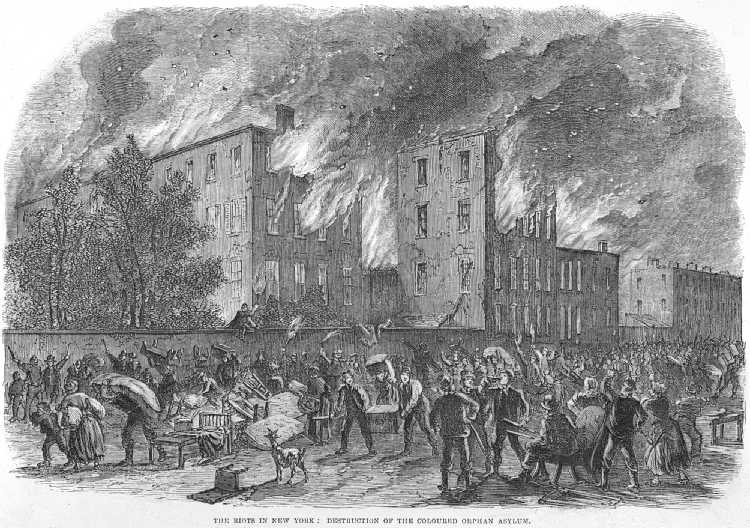
in summer 1863. The worst riot occurred in New York City July 13–16, where
huge mobs consisting mostly of Irish Americans demolished draft offices, lynched
several blacks, and destroyed huge areas of the city in four days of looting and
burning.
Draft riots in the North and bread riots in the South exposed alarming class
fissures that deepened with the strains of full-scale war. Although inflation was much less serious in the North than in the South, Northern wages lagged behind
price increases. Labor unions sprang up in several industries and struck for higher wages. In some areas (such as the anthracite coal fields of eastern Pennsylvania), labor organizations dominated by Irish Americans combined resistance to the draft and opposition to emancipation with violent strikes against industries owned by
Protestant Republicans. Troops sent in to enforce the draft sometimes suppressed
the strikes as well. These class, ethnic, and racial hostilities provided a volatile mix-ture in several Northern communities.
A Poor Man’s
The grievance that it was a rich man’s war and a poor man’s
Fight?
fight was more apparent than real. Property, excise, and
income taxes to sustain the war bore proportionately more
heavily on the wealthy than on the poor. In the South, wealthy property owners
suffered greater damage and confiscation losses than did nonslaveholders. The war liberated 4 million slaves, the poorest class in America. Both the Union and
552
Chapter 16 A New Birth of Freedom, 1862–1865
York
New
Collection,
Granger
The©
The anti-draft riots in New York City July 13–16, 1863, were the worst urban violence in American history. Thousands of rioters attacked draft offices, homes, businesses, and individuals. Black residents of the city were among the mob’s victims because they symbolized labor competition to Irish Americans, who constituted most of the rioters and who believed they would be drafted to fight a war to free the slaves. This illustration shows the burning of the Colored Orphan Asylum, a home for black orphans. More than 100
people were killed during those four days, most of them rioters shot down by police and soldiers.
Confederate armies fielded men from all strata of society in proportion to their
percentage of the population. If anything, among those who volunteered in 1861
and 1862, the planter class was overrepresented in the Confederate army and the
middle class in the Union forces because those privileged groups believed they had more at stake in the war and joined up in larger numbers during the early months
of enthusiasm. Those volunteers—especially the officers—suffered the highest per-
centage of combat casualties.
Nor did conscription fall much more heavily on the poor than on the rich.
Those who escaped the draft by decamping to the woods, the territories, or Canada were mostly poor. The Confederacy abolished substitution in December 1863 and
made men who had previously sent substitutes liable to the draft. In the North, several city councils, political machines, and businesses contributed funds to pay the commutation fees of drafted men who were too poor to pay out of their own pockets. In the end, it was neither a rich man’s war nor a poor man’s fight. It was an American war.
Blueprint for Modern America
553
BLUEPRINT FOR MODERN AMERICA
The 37th Congress (1861–63)—the Congress that enacted conscription, passed
measures for confiscation and emancipation, and created the greenbacks and the
national banking system (see Chapter 15)—also enacted three laws that, together
with the war legislation, provided what one historian has called “a blueprint for modern America”: the Homestead Act, the Morrill Land-Grant College Act, and
the Pacific Railroad Act. For several years before the war, Republicans and some
northern Democrats had tried to pass these laws to provide social benefits and to promote economic growth, only to see them defeated by Southern opposition or
by President Buchanan’s veto. The secession of Southern states, ironically, enabled Congress to pass all three laws in 1862.
The Homestead Act granted 160 acres of land to a farmer virtually free after he
had lived on the land for five years and had made improvements on it. The Morrill Land-Grant College Act gave each state thousands of acres to fund the establishment of colleges to teach “agricultural and mechanical arts.” The Pacific Railroad Act granted land and loans to railroad companies to spur building a transcontinental railroad from Omaha to Sacramento. Under these laws, the U.S. government
ultimately granted 80 million acres to homesteaders, 25 million acres to states for land-grant colleges, and 120 million acres to several transcontinental railroads.
Despite waste, corruption, and exploitation of the original Indian owners of this land, these laws helped farmers settle some of the most fertile land in the world, studded the land with state colleges, and spanned it with steel rails in a manner that altered the landscape of the western half of the country.
Women
The war advanced many other social changes, particularly
and the War
with respect to women. In factories and on farms, women
replaced men who had gone off to war. Explosions in ord-
nance plants and arsenals killed at least 100 women, who were as surely war
casualties as men killed in battle. The war accelerated the entry of women into the teaching profession, a trend that had already begun in the Northeast and now
spread to other parts of the country. It also brought significant numbers of women into the civil service. During the 1850s, a few women had worked briefly in the
U.S. Patent Office (including Clara Barton, who became a famous wartime nurse
and founded the American Red Cross). The huge expansion of government
bureaucracies after 1861 and the departure of male clerks to the army provided
openings that were filled partly by women. After the war, the private sector began hiring women as clerks, bookkeepers, “typewriters” (the machine was invented in
the 1870s), and telephone operators (the telephone was another postwar invention).
Women’s most visible impact was in the field of medicine. The outbreak of
war prompted the organization of soldiers’ aid societies, hospital societies, and other voluntary associations in which women played a leading role. Their most
important function was to help—and sometimes to prod—the medical branches
of the Union and Confederate armies to provide more efficient, humane care for
sick and wounded soldiers. Dr. Elizabeth Blackwell, the first American woman to
earn an M.D. (1849), organized a meeting of 3,000 women in New York City on
554
Chapter 16 A New Birth of Freedom, 1862–1865
April 29, 1861. They put together the Women’s Central Association for Relief,
which became the nucleus for the most powerful voluntary association of the
war, the U.S. Sanitary Commission.
Eventually embracing 7,000 local auxiliaries, the Sanitary Commission was an
essential adjunct of the Union army’s medical bureau. Most of its local volunteers were women, as were most of the nurses it provided to army hospitals. Nursing was not a new profession for women, but it had lacked respect as a wartime profession.
The fame won by Florence Nightingale of Britain during the Crimean War a half-
dozen years earlier had begun to change that perception. As thousands of middle
and even upper-class women volunteers flocked to army hospitals, nursing began
its transformation from a menial occupation to a respected profession.
The nurses had to overcome the deep-grained suspicions of army surgeons and
the opposition of husbands and fathers who shared the cultural sentiment that the shocking, embarrassingly physical atmosphere of an army hospital was no place
for a respectable woman. Many thousands of women went to work, winning
grudging and then enthusiastic admiration. One Confederate surgeon praised
women nurses as far superior to the convalescent soldiers who had formerly done
that job, “rough country crackers” who did not “know castor oil from a gun
rod nor laudanum from a hole in the ground.” In the North, the treasurer of the
Sanitary Commission, who at first had disliked the idea of his wife working as a
nurse, was converted by her performance as a volunteer for the Sanitary Commis-
sion during summer 1862. “The little woman has come out amazingly strong
during these past two months,” he wrote. “Have never given her credit for a tithe of the enterprise, pluck, discretion, and force of character that she has shown.”
The war also bolstered the fledgling women’s rights movement. It was no coin-
cidence that Elizabeth Cady Stanton and Susan B. Anthony founded the National
Woman Suffrage Association in 1869—only four years after the war. Although a
half-century passed before women won the vote, this movement could not have
achieved the momentum that made it a force in American life without the work of
women in the Civil War.
THE CONFEDERATE TIDE CRESTS AND RECEDES
The Army of Northern Virginia and the Army of the Potomac spent the winter of
1862–63 on opposite banks of the Rappahannock River. With the coming of
spring, Union commander Joe Hooker resumed the offensive with hopes of redeem-
ing the December disaster at Fredericksburg. On April 30, instead of charging
straight across the river, Hooker crossed his men several miles upriver and came
in on Lee’s rear. Lee quickly faced most of his troops about and confronted the
enemy in dense woods, known locally as the Wilderness, near the crossroads man-
sion of Chancellorsville. Nonplussed, Hooker lost the initiative.
The Battle of
Even though the Union forces outnumbered the Confederates
Chancellorsville
by almost two to one, Lee boldly went over to the offensive.
On May 2, Stonewall Jackson led 28,000 men on a stealthy
march through the woods to attack the Union right flank late in the afternoon. The surprise was complete. Jackson’s assault crumpled the Union flank as the sun

The Confederate Tide Crests and Recedes
555
dipped below the horizon. Jackson then rode out to scout the terrain for a moon-
light attack but was wounded on his return by jittery Confederates who mistook
him and his staff for Union cavalry. Nevertheless, Lee resumed the attack the next day. In three more days of fighting that caused 12,800 Confederate and 16,800
Union casualties (the largest number for a single battle in the war so far), Lee drove the Union troops back across the Rappahannock. It was a brilliant victory.
In the North, the gloom grew deeper. “My God!” exclaimed Lincoln when
he heard the news of Chancellorsville. “What will the country say?” Copperhead
opposition intensified. Southern sympathizers in Britain renewed efforts for diplomatic recognition of the Confederacy. Southern elation, however, was tempered by
grief at the death on May 10 of Jackson, who had contracted pneumonia after
amputation of his arm. Nevertheless, Lee decided to parlay his tactical victory at Chancellorsville into a strategic offensive by again invading the North. A victory on Union soil would convince Northerners and foreigners alike that the Confederacy was invincible. As his army moved north in June 1863, Lee was confident of
success. “There never were such men in an army before,” he wrote of his troops.
“They will go anywhere and do anything if properly led.”
Ely's Ford
HOOKER
iver
Rap
R
idan
United States
N
Ford
WILDERNESS
Rapp
Falmouth
a
S
h
n
a
e
nn
o
o
d
ck
s
g
R
k
S
w
t
i
c
M
u a r t
v
a
(
e
y
J
r
a
May 3
i
3
c
Ja
,
k s o n )
c
A.M
attack
.
k
attack
May 2,
Orange Turnpike Chancellorsville
Banks' Ford
5:30 P.M.
Hazel
M
Sedgwick
Grove
Lee holds off Sedgwick c
May 4
L
Early
at Salem Church, May 3 a
Orange Plank Road
w
Plank Road
Fredericksburg
and attacks, May 4
s
Ea
Salem
r
Br
Church
Anderson
l
ock
y
Early's withdrawal,
Ja
R
May 3
May 3
O
c
l
k
o
d
s
a
and Lee's attack,
attack
R
o
d
LEE
May 4
i
n
E
ch
's
a
m
R
r l y
oute
R
Mine
Road
Union positions, May 2
Confederate positions, May 2
Union positions, May 3
Confederate positions, May 3
Union positions, May 4
Confederate positions, May 4
0
1
2
3 Miles
Learning
Union advance
Confederate advance
RICHMOND,
FREDERICKSBURG
& POTOMAC R.R.
Union retreat, May 5–6
Confederate withdrawal
Cengage©
MAP 16.2 Battle of Chancellorsville, May 2–6, 1863
This map demonstrates the advantage of holding “interior lines,” which enabled General Lee to shift troops back and forth to and from the Chancellorsville and Fredericksburg fronts over the course of three days while the two parts of the Union army remained separated.
556
Chapter 16 A New Birth of Freedom, 1862–1865
The Gettysburg
At first, all went well. The Confederates brushed aside or
Campaign
captured Union forces in the northern Shenandoah Valley
and in Pennsylvania. Stuart’s cavalry threw a scare into
Washington by raiding behind Union lines into Maryland and Pennsylvania. That
very success led to trouble. With Stuart’s cavalry separated from the rest of the army, Lee lost the vital intelligence that the cavalry garnered as the army’s eyes. By June 28, several detachments of Lee’s forces were scattered about Pennsylvania, far from their base and vulnerable.
At this point, Lee learned that the Army of the Potomac was moving toward
him, now under the command of George Gordon Meade. Lee immediately ordered
his own army to reassemble in the vicinity of Gettysburg, an agricultural and college town at the hub of a dozen roads leading in from all directions. There, on the morning of July 1, the vanguard of the two armies met in a clash that grew into the greatest battle in American history.
As the fighting spread west and north of town, couriers pounded up the roads
on lathered horses to summon reinforcements to both sides. The Confederates
fielded more men and broke the Union lines late that afternoon, driving the survivors to a defensive position on Cemetery Hill south of town. General Richard
Ewell, Jackson’s successor as commander of the Confederate Second Corps, judging
this position too strong to take with his own troops, chose not to press the attack as the sun went down on what he presumed would be another Confederate victory.
When the sun rose the next morning, however, the reinforced Union army was
holding a superb defensive position from Culp’s Hill and Cemetery Hill south to
Little Round Top. Lee’s principal subordinate, First Corps commander James Long-
street, advised against attack, urging instead a maneuver to the south, toward
Washington, to force the Federals to attack Lee in a strong defensive position. But Lee believed his army invincible. After its victory on July 1, a move to the south might look like a retreat. Pointing to the Union lines, he said: “The enemy is there, and I am going to attack him there.” Longstreet reluctantly led the attack on the Union left. Once committed, his men fought with fury. The Union troops fought
back with equal fury. As the afternoon passed, peaceful areas with names like
Peach Orchard, Wheat Field, Devil’s Den, and Little Round Top were turned into
killing fields. By the end of the day, Confederate forces had made small gains at great cost, but the main Union line had held firm.
Lee was not yet ready to yield the offensive. Having attacked both Union
flanks, he thought the center might be weak. On July 3, he ordered a frontal attack on Cemetery Ridge, led by a fresh division under George Pickett. After a two-hour artillery barrage, Pickett’s 5,000 men and 8,000 additional troops moved forward
on that sultry afternoon in a picture-book assault that forms our most enduring
image of the Civil War. “Pickett’s Charge” was shot to pieces; scarcely half of the men returned unwounded to their own lines. It was the final act in an awesome
three-day drama that left some 50,000 men killed, wounded, or captured: 23,000
Federals and 25,000 to 28,000 Confederates.
Lee limped back to Virginia pursued by the Union troops. Lincoln was
unhappy with Meade for not cutting off the Confederate retreat. Nevertheless,
Gettysburg was a great Northern victory, and it came at the same time as other
important Union successes in Mississippi, Louisiana, and Tennessee.
The Confederate Tide Crests and Recedes
557
un
To Carlisle
R
g
E
27 miles
G
lilisle
reek
le
C
ID
RA
R ILRO
R AD
y
ile
R
b
R
h
To Harrisbur
To Ha
VE
V
g
36 miles
O
u
K
ock
A
E w e l l
R
AN
A
H
T
illou
O
o Ch
(
a
U
W
m
&
N
b
F
e
I
2
r
N
s
r
5
b
I
u
S
J u l y
m
r
H
i
g
r
E
le
D
1
RG
R
delp
l hia
se
ila
R
Ph
.R
To
.)
Oak
e
Hill
117 mil s
ETTSYBU
G
H o w a r d
GE
G
Pike
RID
R
RIDGE
J u l y
York
B u f o r d
1
College
Reynolds
R
d
N
killedd
O
D o u b l e d a y
HERR
H
H i l l
SRE Seminaryy
HPCM
Gettysburg
H
E
an
w
o
J u l y
Benner's
v
o
Ro
R ad
er
e
2
l
Hill
Road
l
Cemetery
Hagerstown
w
Hill
To Hano
1
ve
4
r
miles
To Hagerstown
To Hagerstow
36 miles
LEE
E
G
Culp’s
D
t
J u l y
Hill
I
e
3
R
e
Hancock
Wolf Hill
W
Wo
llll
r
P i c k e t t ' s
The Angle
t
Spangler’s’
s
C h a r g ead
High Water
Spring
g
Ro
R
E
Mark
n
G
o
D
Y L
itsburg
I
R
m
R
Power’s’
A
Em
s
Hill
N
el
I
1st Minnesota
M
kc
Y
M
i
R
E
S
E
S
TE
k
M
ee
Peach
ach
E
MEADE
N
r
To Baltimore
Orchard
Or
O
o
C
C
Ba
J u l y Wheatfi
t eld
53 miles
n
2
0
1
1
/
/
3
4
/
2
/
/4
/
1 Mile
u
R
Little Round
L
Ro
R nd
rsh
Devil
vil
Dee i
v
ev l’s
Top
Ma
M
Den
D
Deen
hby
Confederate positions
ug
20th
illo
.
Maine
.C
un
T
W
Big
1
Confederate attacks
D
R
o
Round Top
4
T
Learning
n
m
a
tot
iles
i
n
l
Union positions
ing
n
el
e
m
lum
se
y
sh
P
t
a
78
7
ow
W
n
Cengage
ToT
©
MAP 16.3 Battle of Gettysburg, July 1–3, 1863
On July 2 and 3, the Union army had the advantage of interior lines at Gettysburg, which enabled General Meade to shift reinforcements from his right on Culp’s Hill to his left near Little Round Top over a much shorter distance than Confederate reinforcements from one flank to the other would have to travel.
The Vicksburg
In mid-April, Grant had begun a move that would put
Campaign
Vicksburg in a vise. The Union ironclad fleet ran downriver
past the big guns at Vicksburg with little damage. Grant’s
troops marched down the Mississippi’s west bank and ferried across the river 40
miles south of Vicksburg.
There they kept the Confederate defenders off balance by striking east toward
Jackson instead of marching north to Vicksburg. Grant’s purpose was to scatter the Confederate forces in central Mississippi and to destroy the rail network so that his 558
Chapter 16 A New Birth of Freedom, 1862–1865
rear would be secure when he turned toward Vicksburg. It was a brilliant strategy, flawlessly executed. During the first three weeks of May, Grant’s troops marched
180 miles, won five battles, and trapped 32,000 Confederate troops and 3,000 ci-
vilians in Vicksburg between the Union army on land and the Union gunboats on
the river.
But the Confederate army was still full of fight. Confederate soldiers threw
back Union assaults against the Vicksburg trenches on May 19 and 22. Grant
then settled down for a siege. Running out of supplies, the Vicksburg garrison surrendered on July 4. On July 9, the Confederate garrison at Port Hudson, 200 river miles south of Vicksburg, surrendered to a besieging Union army. Northern forces
now controlled the entire length of the Mississippi River. “The Father of Waters
again goes unvexed to the sea,” said Lincoln. The Confederacy had been torn in
two, and Lincoln knew who deserved the credit. “Grant is my man,” he said,
“and I am his the rest of the war.”
Chickamauga
Northerners had scarcely finished celebrating the twin victo-
and
ries of Gettysburg and Vicksburg when they learned of an
Chattanooga
important—and almost bloodless—triumph in Tennessee. On
June 24, Union commander William S. Rosecrans assaulted
the Confederate defenses in the Cumberland foothills of east-central Tennessee.
He used his cavalry and a mounted infantry brigade armed with new repeating
rifles to get around the Confederate flanks while his infantry threatened the
Confederate front. In the first week of July, the Confederates retreated all the
way to Chattanooga.
After a pause to re-supply, Rosecrans’s army advanced again in August, this
time in tandem with a smaller Union army in eastern Tennessee commanded by
Burnside, who had come to this theater after being removed from command in
Virginia. Again the outnumbered Confederates fell back, evacuating Knoxville on
September 2 and Chattanooga on September 9. This action severed the South’s
only direct east-west rail link. Having sliced the Confederacy in half with the capture of Vicksburg and Port Hudson, Union forces now stood poised for a campaign
into Georgia that threatened to slice it into three parts. For the Confederacy, it was a stunning reversal of the situation only four months earlier, after Chancellorsville, when the Union cause had appeared hopeless.
Confederate General Braxton Bragg reached into his bag of tricks and sent fake
deserters into Union lines with tales of a Confederate retreat toward Atlanta. He then laid a trap for Rosecrans’s troops as they advanced through the mountain
passes south of Chattanooga. To help him spring it, Davis approved the detach-
ment of Longstreet with two divisions from Lee’s army to reinforce Bragg. On
September 19, the Confederates turned and counterattacked Rosecrans’s now out-
numbered army in the valley of Chickamauga Creek.
On that day and the next, in ferocious fighting that produced more casualties
(35,000) than any other single battle save Gettysburg, the Confederates finally
scored a victory. On September 20, after a confusion of orders left a division-size gap in the Union line, Longstreet’s men broke through, sending part of the Union
army reeling back to Chattanooga. Only a firm stand by corps commander George



The Confederate Tide Crests and Recedes
559
Haynes’ Bluff
k River
Mi M
.
l
i
R
N
Big Blac
li s
.
k
is
Snyder’s
e
s
.R
n’ ipp
an, Apr. 30
Bluff
R
s B i R.
N
en
R.
Yazoo
Sherman,
R
d
lat
Sherm
e Jun
E
e
JOHNSTON
n
Sher
Chickasaw
H
ma
Duckport
T
n
azoo
Bluffs
Johnston, late June
R
Canal
Y
to
Vicksburg
O
s
l l l l l
Sherman
N
surrenders
n
T
on July 4
S h erman
Bolton
Clinton
h
.G
Vicksburg
Edwards'
Station SOUTHERN
&
J o Pearl River
Station
MISSISSI
N
PP
l
I
McPherson
R
l
.R
l
.
M
P
c
JACKSO
McClernand
Sherm
Battle of
emberton
C
a
l
n
Jackson
e
Big Black River
r
May 14
L O U I S I A N A
n
issis ippi River
Williams’
Canal
B
a
S
May 17
a
Battle of
ker's C
n
Johnston
M
r. Champion’s Hill d
Warrenton
PEMBERTON
May 16
Raymond
LEAN
R
May 12
O
New Carthage
M I S S I S S I P P I
EW
N
GRANT
Sherman
0
5
10 Miles
CHAMPION’S HILL, May 16
McPherson
McClernand
To Jackson
17 miles
Union advance
Bake r’s Creek
Bolton
Black R.
PEMBERTON
SOUTHERN MISSISSIPPI R.R. Station
Big
Union entrenchments
To Vicksburg
17 miles
McPherso
Grand Gulf
Stevenson
n
Confederate positions
R.
Evacuated
May 2
Bay ou Pierre
Edwards’
Bowen
Champion’s
Confederate advance
Station
Hill
M
is is ippi
c
Learning
M
C
Loring
ler
Confederate retreat
n
Port Gibson
and
May 1
GRANT
Bruinsburg
Confederate entrenchments
To
0
1
2 Miles
Raymond
Cengage©
MAP 16.4 Vicksburg Campaign, April–July 1863
This map illustrates Grant’s brilliant orchestration of the campaign that involved Sherman’s feint at Haynes’ Bluff (top of map) on April 30 while the rest of the Union forces crossed at Bruinsburg (bottom of map) and then cleared Confederate resistance out of the way eastward to Jackson before turning west to invest Vicksburg.
H. Thomas—a Virginian who had remained loyal to the Union—prevented a Union
rout. For this feat, Thomas earned the nickname “Rock of Chickamauga.” Lincoln
subsequently appointed Thomas commander of the Army of the Cumberland to
replace Rosecrans, who was, in Lincoln’s words, “confused and stunned like a
duck hit on the head” after Chickamauga.
Lincoln also sent two army corps from Virginia under Hooker and two from
Vicksburg under Sherman to reinforce Thomas, whose troops in Chattanooga
were under virtual siege by Bragg’s forces, which held most of the surrounding
heights. More important, Lincoln put Grant in overall command of the beefed-up
Union forces there. When Grant arrived in late October, he welded the various
Northern units into a new army and opened a new supply line into Chattanooga.
On November 24, Hooker’s troops drove Confederate besiegers off massive Look-
out Mountain.
The next day, an assault on Bragg’s main line at Missionary Ridge east of
Chattanooga won a smashing success against seemingly greater odds than Pickett
had faced at Gettysburg. The Union troops that had been routed at Chickamauga
two months earlier redeemed themselves by driving the Confederates off Missionary Ridge and 20 miles south into Georgia.
These battles climaxed a string of Union victories in the second half of 1863,
which made that year one of “calamity ... defeat … utter ruin,” in the words of a Confederate official. The Southern diarist Mary Boykin Chesnut found “gloom and


560
Chapter 16 A New Birth of Freedom, 1862–1865
Murfreesboro
Sparta
Union movements, June 24–30
y
r
McMinnville
l
Union movements, Aug. 16–Sept. 9
a
N
Hoover's
N
v
A
Gap
Union positions, Sept. 10
a
S
S
Y
H
DC
V
T E N N E S S E E
u
I
IN
E
L
L
Confederate movements, June 24–Sept. 9
c
L
June
A
L
k
E
24–30
T
R
A
.
iver
R
N
V
Confederate movements, Sept. 10–13
Shelbyville
Manchester
ROSECRANS
U
&
O
E
M
iver Hia
E Knoxvil e
was
S
s
R.R.
ee
C
D
S From
H
E
IA
Union positions,
G
A.M.
SECOND DAY AT
Tullahoma
A
Sequatchie
N
T
A
N
R
T
O
Union positions, P.M.
CHICKAMAUGA
A
Tracy City
L
N
Tennes ee R
N
E
Elk R.
O
R
G
Union advance
SEPTEMBER 20
O
E
Fayetteville
G
E
R.
A
B
T Buckner .&
Union retreat
N
M
Chattanooga
Confederate advance
0
/
1 2
1Mile
U
occupied by
Union on
R
C
E. TEN
.
Sept. 9
N
R
ROSECRANS
.
Chattanooga
.R.
R
support
To
C
L
Bridgeport
Crittenden
Rossville
h
a
a
Lookout Sept. 13
F Bre
Ringgold
t
as's
ckenridge
t
a
Mt. Lee and
a
y
Polk
IC
n
ranger
et
k
Stevenson
.
Gordon's Mills
Sept.
T
o
G
t
N
o
e
Thom
.R
Steven's
M
13 A
g
l
A L A B A M A
R
S
Hindman
L
a
e c
Gap
To
N
p C
T
t
o
.
Sept. 10 Bu
A
o
BRAGG
Thomas
o
1
c
0 k
S
k
e
n
–
Thomas
p
er
t.
Dalton
1
11
Snodgrass
Ro
P
Huntsville
2
Sept. 10
LaFayette
&
Hill
ssv
D. H. Hill
N
i
BRAGG
MEMPHIS & CHARLESTO
l
Sept. 10
R
le
G E O R G I A
E TS
Tennes ee River
Longstreet
0
10
20 Miles
Resaca
E
Learning
W
R
W
W. Chickamauga Cr.
o
. Chickamauga Cr.
Union right
a
retreats after
d
Alpine
breakthrough
Cengage©
MAP 16.5 Road to Chickamauga, June–September 1863
From Murfreesboro to Chattanooga, Rosecrans’s campaign of maneuver on multiple fronts, as shown on this map, forced Bragg’s Army of Tennessee all the way south into Georgia in a campaign with minimal casualties before Bragg counterattacked at Chickamauga.
unspoken despondency hang[ing] like a pall everywhere.” Jefferson Davis removed
the discredited Bragg from command of the Army of Tennessee and reluctantly
replaced him with Joseph E. Johnston, in whom Davis had little confidence. Lincoln summoned Grant to Washington and appointed him general-in-chief of all Union
armies in March 1864, signifying a relentless fight to the finish.
BLACK MEN IN BLUE
The events of the second half of 1863 also confirmed emancipation as a Union war
aim. Northerners had not greeted the Emancipation Proclamation with great enthu-
siasm. Democrats and border-state Unionists continued to denounce it, and many
Union soldiers resented the idea that they would now be risking their lives for black freedom. The Democratic Party had hoped to capitalize on this opposition, and on
Union military failures, to win important off-year elections. Northern military victories knocked one prop out from under the Democratic platform, and the perfor-
mance of black soldiers fighting for the Union knocked out another.
The enlistment of black soldiers was a logical corollary of emancipation.
Proposals to recruit black soldiers, Democrats said, were part of a Republican plot to establish “the equality of the black and white races.” In a way, that charge was correct. One consequence of black men fighting for the Union would be to advance
the black race a long way toward equal rights. “Once let the black man get upon
his person the brass letters, U.S.,” said Frederick Douglass, “and a musket on his Black Men in Blue
561
shoulder and bullets in his pocket, and there is no power on earth which can deny that he has earned the right to citizenship.”
But it was pragmatism more than principle that pushed the North toward black
recruitment. One purpose of emancipation was to deprive the Confederacy of black
laborers and to use them for the Union. Putting some of those former laborers in
uniform was a compelling idea, especially as white enlistments lagged and the
North had to enact conscription in 1863. Some Union commanders in occupied
portions of Louisiana, South Carolina, and Missouri began to organize black regi-
ments in 1862. The Emancipation Proclamation legitimized this policy with its proposal to enroll able-bodied male contrabands in new black regiments, although
these units would serve as labor battalions, supply troops, and garrison forces
rather than as combat troops. They would be paid less than white soldiers, and
their officers would be white.
Black Soldiers
Continuing pressure from abolitionists, as well as military
in Combat
necessity, partly eroded this discrimination. Congress enacted
equal pay in 1864. Officers worked for better treatment of
their men. Above all, the regiments lobbied for the right to fight as combat soldiers.
Even some previously hostile white soldiers came around to the notion that black
men might just as well stop enemy bullets as white men. In May and June 1863,
black regiments in Louisiana fought well in an assault on Port Hudson and in
defense of a Union outpost at Milliken’s Bend, near Vicksburg. “The bravery of the blacks in the battle of Milliken’s Bend completely revolutionized the sentiment of the army with regard to the employment of negro troops,” wrote the assistant secretary of war, who had been on the spot with Grant’s army.
Even more significant was the action of the 54th Massachusetts Infantry, the
first black regiment raised mainly in the North. Its officers, headed by Colonel
Robert Gould Shaw, came from prominent New England antislavery families. Two
sons of Frederick Douglass were in the regiment—one of them as sergeant major.
Shaw worked hard to win the right for the regiment to fight. On July 18, 1863, he succeeded: The 54th was assigned to lead an assault on Fort Wagner, part of the
network of Confederate defenses protecting Charleston. Although the attack failed, the 54th fought courageously, suffering 50 percent casualties, including Colonel
Shaw, who was killed. This battle “made Fort Wagner such a name to the colored
race as Bunker Hill had been for ninety years to the white Yankees,” declared the New York Tribune.
The battle took place just after white mobs of draft rioters in New York had
lynched blacks. Abolitionist and Republican commentators drew the moral: Black
men who fought for the Union deserved more respect than white men who rioted
against it. Lincoln made this point eloquently in a widely published letter to a
political meeting in August 1863. When final victory was achieved, he wrote,
“there will be some black men who can remember that, with silent tongue, and
clenched teeth, and steady eye, and well-poised bayonet, they have helped man-
kind on to this great consummation; while, I fear, there will be some white
ones, unable to forget that, with malignant heart, and deceitful speech, they have strove to hinder it.”
562
Chapter 16 A New Birth of Freedom, 1862–1865
Division
Photographs
and
Prints
Congress,of
Library
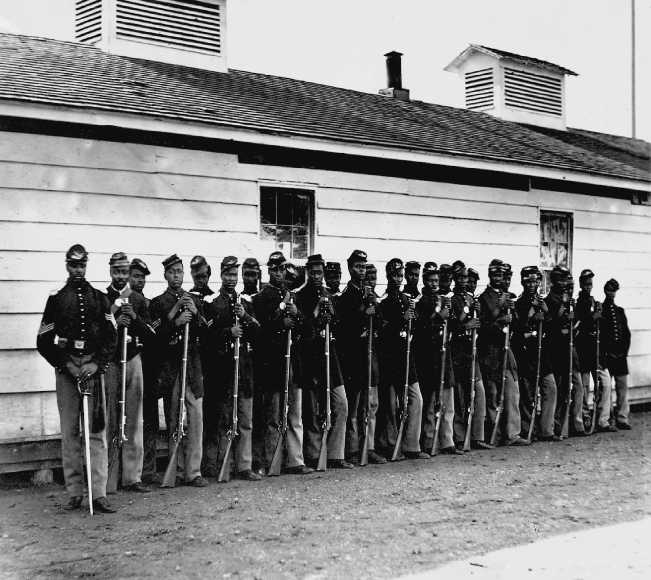
Part of Company E, 4th U.S. Colored Infantry. Organized in July 1863, most of
the men were former slaves from North Carolina. The 4th fought in several actions on the Petersburg and Richmond fronts in 1864, helping to capture part of the Petersburg defenses on June 15. Of the 166 black regiments in the Union Army, the 4th suffered the fourth-largest number of combat deaths.
Emancipation
Lincoln’s letter set the tone for Republican campaigns in
Confirmed
state elections that fall. The party swept them all, including
Ohio, where they buried Vallandigham under a 100,000-
vote margin swelled by the soldier vote, which went 94 percent for his opponent.
In effect, the elections were a powerful endorsement of the administration’s
emancipation policy. If the Emancipation Proclamation had been submitted to a
referendum a year earlier, observed a newspaper editor in November 1863, “the
voice of a majority would have been against it. And yet not a year has passed
before it is approved by an overwhelming majority.”
Emancipation would not be assured of survival until it had been christened by the Constitution. On April 8, 1864, the Senate passed the 13th Amendment to abolish
slavery, but Democrats in the House blocked the required two-thirds majority there.
Not until after Lincoln’s reelection in 1864 would the House pass the amendment,
which became part of the Constitution on December 6, 1865. In the end, though, the fate of slavery depended on the outcome of the war. And despite Confederate defeats in 1863, that outcome was by no means certain. Some of the heaviest fighting lay ahead.
The Year of Decision
563
THE YEAR OF DECISION
Many Southerners succumbed to defeatism in the winter of 1863–64. “I have never
actually despaired of the cause,” wrote a Confederate War Department official in
November, but “steadfastness is yielding to a sense of hopelessness.” Desertions
from Confederate armies increased. Inflation galloped out of control. According to a Richmond diarist, a merchant told a poor woman in October 1863 that the price
of a barrel of flour was $70: “‘My God!’ exclaimed she, ‘how can I pay such
prices? I have seven children; what shall I do?’ ‘I don’t know, madam,’ said he,
coolly, ‘unless you eat your children.’”
The Davis administration, like the Lincoln administration a year earlier, had to
face congressional elections during a time of public discontent, for the Confederate constitution mandated such elections in odd-numbered years. Political parties had ceased to exist in the Confederacy after Democrats and former Whigs had tacitly
declared a truce in 1861 to form a united front for the war effort. Many congressmen had been elected without opposition in 1861. By 1863, however, significant
hostility to Davis had emerged. Although it was not channeled through any orga-
nized party, it took on partisan trappings, as an inchoate anti-Davis faction
surfaced in the Confederate Congress and in the election campaign of 1863.
Some antiadministration candidates ran on a quasi-peace platform (analogous
to that of the Copperheads in the North) that called for an armistice and peace
negotiations. The movement left unresolved the terms of such negotiations—
reunion or independence—but any peace overture from a position of weakness
was tantamount to conceding defeat. The peace movement was especially strong
in North Carolina, where for a time it appeared that the next governor would be
elected on a peace platform (in the end, the “peace candidate” was defeated). Still, antiadministration candidates made significant gains in the 1863 Confederate elections, although they fell about 15 seats short of a majority in the House and two seats short in the Senate.
Out of the
Shortages, inflation, political discontent, military defeat, high
Wilderness
casualties, and the loss of thousands of slaves bent but did
not break the Southern spirit. As spring 1864 came on, a
renewed determination infused both home front and battlefront. The Confederate
armies no longer had the strength to invade the North or to win the war with a
knockout blow, but they could still fight a war of attrition. If they could hold out long enough and inflict enough casualties on the Union armies, they might weaken
the Northern will to continue fighting.
Northerners were vulnerable to this strategy. Military success in 1863 had cre-
ated a mood of confidence, and people expected a quick, decisive victory in 1864.
The mood grew with Grant’s appointment as general-in-chief. When Grant decided
to remain in Virginia with the Army of the Potomac and to leave Sherman in com-
mand of the Union forces in northern Georgia, Northerners expected these two
heavyweights to floor the Confederacy with a one-two punch. Lincoln was alarmed
by this euphoria. “The people are too sanguine,” he told a reporter. “They expect too much at once.” Disappointment might trigger despair.
564
Chapter 16 A New Birth of Freedom, 1862–1865
Lincoln was nearly proved right. Grant’s strategic plan was elegant in its
simplicity. While smaller Union armies in peripheral theaters carried out auxiliary campaigns, the two principal armies in Virginia and Georgia would attack the
main Confederate forces under Lee and Johnston. Convinced that in years past
Union armies in various theaters had “acted independently and without concert,
like a balky team, no two ever pulling together,” Grant ordered simultaneous offensives on all fronts, to prevent the Confederates from shifting reinforcements to one theater from another.
Grant’s offensives began the first week of May. The heaviest fighting occurred
in Virginia. When the Army of the Potomac crossed the Rapidan River, Lee
attacked its flank in the thick scrub forest of the Wilderness, where Union superiority in numbers and artillery would count for little (and where Lee had defeated
Hooker a year earlier at Chancellorsville). Lee’s action brought on two days
(May 5–6) of the most confused, frenzied fighting the war had yet seen. Hundreds
of wounded men burned to death in brush fires set off by exploding shells or
muzzle flashes. The battle surged back and forth, with the Confederates inflicting 18,000 casualties and suffering 12,000. Having apparently halted Grant’s offensive, they claimed a victory.
Spotsylvania
But Grant did not retreat, as other Union commanders in
and Cold Harbor
Virginia had done. Instead, he moved toward Spotsylvania
Courthouse, a key crossroads 10 miles closer to Richmond.
Skillfully, Lee pulled back to cover the road junction. Repeated Union assaults
during the next 12 days (May 8–19) left another 18,000 Northerners and 12,000
Southerners killed, wounded, or captured. The Confederates fought from an elab-
orate network of trenches and log breastworks they had constructed virtually
overnight. Civil War soldiers had learned the advantages of trenches, which gave
the defense an enormous advantage and made frontal assaults almost suicidal.
Having achieved no better than stalemate around Spotsylvania, Grant again
moved south around Lee’s right flank in an effort to force the outnumbered Confederates into an open fight. Lee, however, anticipated Grant’s moves and confronted him from behind formidable defenses at the North Anna River, Totopotomoy Creek,
and near the crossroads inn of Cold Harbor, only 10 miles northeast of Richmond.
Believing the Confederates must be exhausted and demoralized by their repeated
retreats, Grant decided to attack at Cold Harbor on June 3—a costly mistake. Lee’s troops were ragged and hungry but far from demoralized. Their withering fire
inflicted 7,000 casualties in less than an hour. “I regret this assault more than any other one I have ordered,” said Grant.
Stalemate
Now Grant moved all the way across the James River to
in Virginia
strike at Petersburg, an industrial city and rail center 20
miles south of Richmond. If Petersburg fell, the Confederates
could not hold Richmond. Once more Lee’s troops raced southward on the inside
track and blocked Grant’s troops. Four days of Union assaults (June 15–18) pro-
duced another 11,000 Northern casualties but no breakthrough. Such high Union
losses in just six weeks—some 65,000 killed, wounded, and captured, compared

The Year of Decision
565
MAY 12
Bloody
Angle
N
Hancock i
Rapidan Riv
R
er
Germanna
R
iver
Ford
ap
B
idan
Ely’s Ford
Wright
u
R
r
iv
n
er
Warren
s
Gordon
ide
W I L D E R N E S S
Spotsylvania
Sedgwick,
Court House
Anderson
May 5
N
Gordon
Early
R
Flank Attack,
a
P
May 6, Late P.M.
Wilderness
p
o
p
River 0 /12 1Mile
Tavern
ahannoc
Falmouth
May 6
k
W
R
a
i
May 5
r
Burnside,
May 6
ve
Ewell,
M re
Chancellorsville
r
a n
y ,
Fredericksburg
5
Orange Turnpike
Hancock
Orange Plank Road
May 6, P.M.
Salem
Br
Church
o
A. P. Hill, May 5
ck
GRANT
Orange Plank Road
Roa
MEADE
Longstreet, May 6
d
LEE
Advance,
May 7–8
Bloody Hancock,
Angle May 12
MAY 10
Union positions
N
Withdrawal,
B
i
right
u
Upton R
May 7–8
r
i
W
v
n
e
Union movements
r
sid
Warren
Wright
e
Hancock
Confederate positions
Warren
B
Gordon
ur
Confederate advance
n
Spotsylvania
Ewell
si
See inset maps
d
Court House
Spotsylvania
e
0
1
2 Miles
N
Confederate retreat
Learning
nderson
Court House
N
A
Early
Confederate trenches
Po River
0
/
1 2 1 Mile
Cengage©
MAP 16.6 Battle of the Wilderness and Spotsylvania, May 5–12, 1864
Four major battles with a total of more than 100,000 casualties to both sides were fought within a few miles of Fredericksburg between December 1862 and May 1864. Compare
this map with the Chancellorsville map. The first battle of Fredericksburg on December 13, 1862, was fought in the same vicinity as the Fredericksburg fighting on May 3, 1863, shown on the Chancellorsville map.
with 37,000 Confederate casualties—cost the Army of the Potomac its offensive
power. Grant reluctantly settled down for a siege along the Petersburg–Richmond
front that would last more than nine grueling months.
Meanwhile, other Union operations in Virginia had achieved little success.
Benjamin Butler bungled an attack up the James River against Richmond and was
stopped by a scraped-together army under Beauregard. Jubal Early, commanding
Stonewall Jackson’s old corps, blocked a Union thrust up the Shenandoah Valley at Lynchburg in June. Then Early led a raid all the way to the outskirts of Washington on July 11 and 12 before being driven back to Virginia. Union cavalry under Philip Sheridan inflicted considerable damage on Confederate resources in Virginia—
including the mortal wounding of Jeb Stuart in the battle of Yellow Tavern on
May 11—but again failed to strike a crippling blow. In the North, frustration set in over failure to win the quick, decisive victory the public had expected in April.
The Atlanta
In Georgia, Sherman’s army seemed to have accomplished
Campaign
more at less cost than Grant had in Virginia, but there too
Union efforts had bogged down in apparent stalemate by
566
Chapter 16 A New Birth of Freedom, 1862–1865
August. The strategy and tactics of both Sherman and Johnston in Georgia con-
trasted with those of Grant and Lee in Virginia. Sherman forced Johnston south
toward Atlanta by constantly flanking him to the Union right, generally without
bloody battles. Grant constantly forced Lee back by flanking moves to the Union
left, but only after bloody battles. By the end of June, Sherman had advanced 80
miles at the cost of 17,000 casualties to Johnston’s 14,000—only one-third of the combined losses of Grant and Lee.
Davis grew alarmed by Johnston’s apparent willingness to yield territory with-
out a fight. Sherman again flanked the Confederate defenses (after a failed attack) at Kennesaw Mountain in early July. He crossed the Chattahoochee River and
drove Johnston back to Peachtree Creek less than five miles from Atlanta. Fearing that Johnston would abandon the city, on July 17 Davis replaced him with John
Bell Hood.
A fighting general from Lee’s army who had lost a leg at Chickamauga, Hood
immediately prepared to counterattack against the Yankees. He did so three times, in late July. Each time, the Confederates reeled back in defeat, suffering a total of 15,000 casualties to Sherman’s 6,000. At last, Hood retreated into the formidable earthworks ringing Atlanta and launched no more attacks. But his army did manage to keep Sherman’s cavalry and infantry from taking the two railroads leading
into Atlanta from the south. Like Grant at Petersburg, Sherman seemed to settle
down for a siege.
Peace
By August, the Confederate strategy of attrition seemed to be
Overtures
working. Union casualties on all fronts during the preceding
three months totaled a staggering 110,000—double the
number for any comparable period of the war. “Who shall revive the withered
hopes that bloomed at the opening of Grant’s campaign?” asked the leading
Democratic newspaper, the New York World. “STOP THE WAR!” shouted
Democratic headlines. “All are tired of this damnable tragedy.”
Even Republicans joined the chorus of despair. “Our bleeding, bankrupt,
almost dying country longs for peace,” wrote Horace Greeley of the New York
Tribune. Greeley became involved in abortive “peace negotiations” spawned by
Confederate agents in Canada. Those agents convinced Greeley that they carried
peace overtures from Davis, but Lincoln was skeptical. Still, given the mood of the North in midsummer 1864, Lincoln could not reject any opportunity to stop the
bloodshed. He deputized Greeley to meet with the Confederate agents in Niagara
Falls on the Canadian side of the border. At almost the same time (mid-July), two other Northerners met under a flag of truce with Davis in Richmond. Lincoln had
carefully instructed them—and Greeley—that his conditions for peace were “resto-
ration of the Union and abandonment of slavery.”
Davis would no more accept those terms than Lincoln would accept his.
Although neither of the peace contacts came to anything, the Confederates gained
a propaganda victory by claiming that Lincoln’s terms had been the only obstacle
to peace. Northern Democrats ignored the Southern refusal to accept reunion and
focused on the slavery issue as the sole stumbling block. “Tens of thousands of
white men must yet bite the dust to allay the negro mania of the President,” ran a
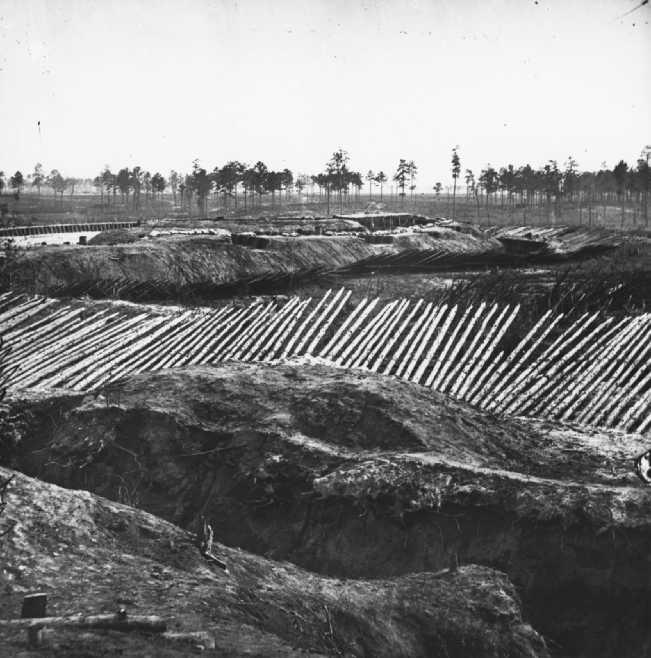
The Year of Decision
567
Archive
Art
The©
Trench Warfare, 1864–1865. During the grueling military campaigns of 1864 and
1865 the opposing armies constructed elaborate trench networks wherever they confronted each other. These Confederate trenches near Atlanta are fronted by sharpened stakes to impale attackers. Note also the scarcity of trees, which had been cut down for firewood, to make the stakes, and to create open fields of fire for rifles and cannons.
typical Democratic editorial. By August, even staunch Republicans were convinced
that “the desire for peace” and the impression that Lincoln “is fighting not for
the Union but for the abolition of slavery” made his reelection “an impossibility.”
Lincoln thought so, too. “I am going to be beaten,” he told a friend in August,
“and unless some great change takes place, badly beaten.”
Lincoln faced enormous pressure to drop emancipation as a condition of peace
so the onus could be shifted to Jefferson Davis’s insistence on Confederate independence. Lincoln refused to yield. He would rather lose the election than go back on the promise he had made in the Emancipation Proclamation. Some 130,000 black
soldiers and sailors were fighting for the Union. They would not do so if they
thought the North intended to forsake them:
If they stake their lives for us they must be prompted by the strongest motive … the promise of freedom. And the promise being made, must be kept.… There have been







568
Chapter 16 A New Birth of Freedom, 1862–1865
men who proposed to me to return to slavery the[se] black warriors…. I should be
damned in time & eternity for so doing. The world shall know that I will keep my faith to friends and enemies, come what will.
At the end of August, the Democrats nominated McClellan for president. The
platform on which he ran declared, “after four years of failure to restore the Union by the experiment of war … [we] demand that immediate efforts be made for a cessa-tion of hostilities.” Southerners were jubilant. Democratic victory on that platform, said the Charleston Mercury, “must lead to peace and our independence [if] for the next two months we hold our own and prevent military success by our foes.”
The Prisoner-
The Democratic platform also condemned the Lincoln ad-
Exchange
ministration’s “shameful disregard” of prisoners of war in
Controversy
Confederate prison camps. This raised another contentious
matter. By midsummer 1864, the plight of Union and Con-
federate captives had become one of the most bitter issues of the war. The
Tennessee
BATTLE OF PEACHTREE CREEK, JULY 20, 1864
BATTLE OF ATLANTA, JULY 22, 1864
River
Chattahoochee
W
Pea
River
SHERMAN
E
c
Thomas
ht
S
re
SHERMAN
Chattanooga
T
e C
T E N N E S S E E
E
re
P
e
e
R
k
ac
E
htree
orthFork
N
South Fork
.R
N
&
R
G
C
A
re
T
e
L
Schofield
k
South Fork
A
ID
N
Thomas
R
Schofield
TI
Decatur
Schofield
C R
GEORGIA
Y
Stewart
.
Cheatham
R. Stewar
R
A
Ringgold
Hardee
t
McPherson
McPherson
Decatur
ATLANTA
C
N
he
auga C reek
Th
HOOD
Ezra
a
LOOKOUT MT.
o
Rocky
t
m
a
Church
m
Face
ISSIO
a
M
s
Ridge
Ezra
N
ATLANTA
H
HOOD
N
N
est Chicam
Church
W
ar
Dug Gap
Dalton
de
May 7
0
1
2 Miles
e
0
1
2 Miles
Sch
La Fayette
ofie
BATTLE OF EZRA CHURCH, JULY 28, 1864
M
T
c
h
l
P
o
d
h
m
e
South Fork
rso
a
n
s
Howard (route of m SHERMAN
Thomas
arc
Snake Creek
Resaca
Schofield h)
Gap
Decatur
May 14–15
G E O R G I A
Hardee
Ezra
St
ATLANTA
e
Church
wart
S
S
c
.
h
D. L
iver
of
e
Union advance
e
R
M
ie
HOOD
c
ld
N
Ph
T
Union positions
e
ho
Adairsville
r
East Point
so
m
n
a
Confederate advance
0
1
2 Miles
ostanaula
s
O
Rome
Confederate positions
Cassville
River
BATTLE OF JONESBORO, AUG. 31–SEPT. 1, 1864
May 19
Kingston
C
Etowah
Confederate entrenchments
o
HOOD
osa River
Allatoona
Ezra
Decatur
Pass
Church
ATLANTA
Chattahoochee R.
iver
Sandtown
SHERMAN
Allatoona
R
H
T
JOHNSTON
a
h
S
rd
o
ch
WESTERN &
McP
field
East
e
m
o
hers
ATLANTIC R.R.
as
o
e
a
f
on
h
Point
s
ie
Tho
c
M
N
l
neCreek
m
hattahoochee
om
S
cP
d
as
KENNESAW MT.
C
ard
h
h
T
Rough &
e
June 27
ow
rs
H
Ready
on
Marietta
F
McPherson
l
Pumpkinvi
in
New Hope
t
Ha
Dallas
Church
Smyrna
R
Schofield
T
.
r
h
d
May25–28
July 9
omas
ee
Thomas
Fairburn
Learning
Schofield
July 8
Peachtree Creek
H
M
ow
c
a
P
SHERMAN
rd
herson
Decatur
0
10
20 Miles
ATLANTA
0
3
6 Miles
Jonesboro
Cengage©
MAP 16.7 Campaign for Atlanta, May–September 1864
The main map illustrates Sherman’s campaign of maneuver that forced Johnston back to Atlanta with relatively few battles. The first three inset maps show the Confederate counterattacks launched by Hood, and the fourth shows how the Union army got astride the last two railroads entering Atlanta from the south and forced Hood to evacuate the city.
The Year of Decision
569
upcoming presidential election and the generally worse conditions in Southern
prisons made it mainly a Northern political issue.
In 1862, the Union and Confederate armed forces had signed a cartel for the
exchange of prisoners captured in battle. The arrangement had worked reasonably
well for a year, making large prison camps unnecessary. When the Union army
began to organize regiments of former slaves, however, the Confederate govern-
ment announced that if they were captured, they and their white officers would be put to death for the crime of fomenting slave insurrections. In practice, the Confederate government did not enforce this policy because Lincoln threatened retaliation on Confederate prisoners of war if it did so. But Confederate troops sometimes
murdered black soldiers and their officers as they tried to surrender—most notably at Fort Pillow, a Union garrison on the Mississippi north of Memphis, where cavalry commanded by Nathan Bedford Forrest slaughtered scores of black (and some
white) prisoners on April 12, 1864.
In most cases, Confederate officers returned captured black soldiers to slavery
or put them to hard labor on Southern fortifications. Expressing outrage at this
treatment of soldiers wearing the United States uniform, the Lincoln administration in 1863 suspended the exchange of prisoners until the Confederacy agreed to treat white and black prisoners alike. The Confederacy refused. The South would “die in the last ditch,” said the Confederate exchange agent, before “giving up the right to send slaves back to slavery as property recaptured.”
There matters stood as the heavy fighting of 1864 poured many thousands of
captured soldiers into hastily contrived prison compounds that quickly became
death camps. Prisoners were subjected to overcrowding, poor sanitation, contami-
nated water, scanty rations, inadequate medical facilities, and exposure to deep-
South summer heat and northern winter cold. The suffering of Northern prisoners
was especially acute, because the deterioration of the Southern economy made it
hard to feed and clothe even Confederate soldiers and civilians, let alone Yankee prisoners. Nearly 16 percent of all Union soldiers held in Southern prison camps
died, compared with 12 percent of Confederate soldiers in Northern camps. Ander-
sonville was the most notorious hellhole. A stockade camp of 26 acres with neither huts nor tents, designed to accommodate 15,000 prisoners, it held 33,000 in August 1864. They died at the rate of more than 100 per day. Altogether, 13,000 Union
soldiers died at Andersonville.
The suffering of Union prisoners brought heavy pressure on the Lincoln
administration to renew exchanges, but the Confederates would not budge on the
question of exchanging black soldiers. After a series of battles on the Richmond–
Petersburg front in September 1864, Lee proposed an informal exchange of
prisoners. Grant agreed, on condition that black soldiers captured in the fighting be included “the same as white soldiers.” Lee replied, “negroes belonging to our citizens are not considered subjects of exchange and were not included in my proposition.”
No exchange, then, responded Grant. The Union government was “bound to secure
to all persons received into her armies the rights due to soldiers.” Lincoln backed this policy. He would not sacrifice the principle of equal treatment of black prisoners, even though local Republican leaders warned that many in the North “will work
and vote against the President, because they think sympathy with a few negroes,
also captured, is the cause of a refusal” to exchange prisoners.
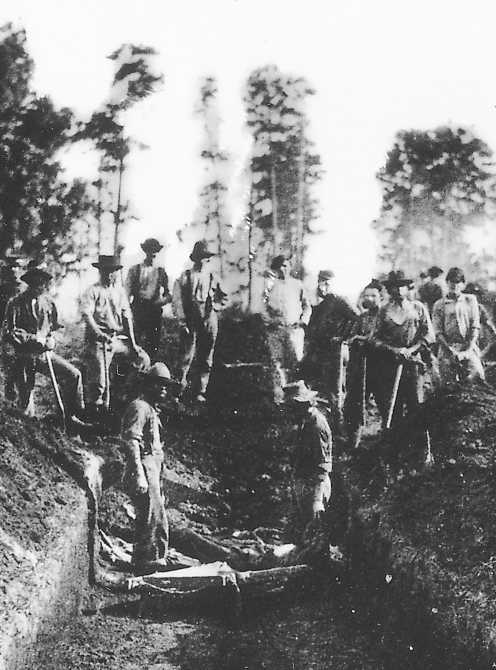
570
Chapter 16 A New Birth of Freedom, 1862–1865
Burial of Union
POWs at
Andersonville.
On many days during
summer 1864, at least 100
Union prisoners of war
died of disease,
malnutrition, or exposure
at Andersonville Prison in
Georgia. This scene of
burial in long trenches
became so commonplace
as to dull the sense of
horror.
Division
Photographs
and
Prints
Congress,of
Library
The Issue of
During the winter of 1864–65, the Confederate govern-
Black Soldiers
ment quietly abandoned its refusal to exchange black pris-
in the
oners, and exchanges resumed. One reason for this reversal
Confederate
was a Confederate decision to recruit slaves to fight for the
Army
South. Two years earlier, Davis had denounced the North’s
arming of freed slaves as “the most execrable measure
recorded in the history of guilty man.” Ironically, a few black laborers and body servants with Southern armies had taken up arms in the heat of battle and had
unofficially fought alongside their masters against the Yankees. By February
1865, Southern armies were desperate for manpower, and slaves constituted the
only remaining reserve. Supported by Lee’s powerful influence, Davis pressed
the Confederate Congress to enact a bill for recruitment of black soldiers. The
assumption that any slaves who fought for the South would have to be granted
freedom generated bitter opposition to the measure. “What did we go to war for,
if not to protect our property?” asked a Virginia senator. By three votes in the
House and one in the Senate, the Confederate Congress finally passed the bill on
March 13, 1865. Before any Southern black regiments could be organized,
however, the war ended.
Lincoln’s Reelection and the End of the Confederacy
571
LINCOLN’S REELECTION AND THE END OF THE CONFEDERACY
Despite Republican fears, battlefield events, rather than political controversies, had the strongest impact on U.S. voters in 1864. In effect, the election became a referendum on whether to continue fighting for unconditional victory. Within days after
the Democratic national convention had declared the war a failure, the military situation changed dramatically.
The Capture
After a month of apparent stalemate on the Atlanta front,
of Atlanta
Sherman’s army again made a large movement by the right
flank to attack the last rail link into Atlanta from the south.
At the battle of Jonesboro on August 31 and September 1, Sherman’s men captured
the railroad. Hood abandoned Atlanta to save his army. On September 3, Sherman
sent a jaunty telegram to Washington: “Atlanta is ours, and fairly won.”
This news had an enormous impact on the election. A New York Republican
wrote that the capture of Atlanta, “coming at this political crisis, is the greatest event of the war.” The Richmond Examiner glumly concurred. The fall of Atlanta,
it declared, “came in the very nick of time [to] save the party of Lincoln from irre-trievable ruin.”
The
If Atlanta was not enough to brighten the prospects for
Shenandoah
Lincoln’s reelection, events in Virginia’s Shenandoah Valley
Valley
were. After Early’s raid through the valley all the way to
Washington in July, Grant put Philip Sheridan in charge of a
reinforced Army of the Shenandoah and told him to “go after Early and follow
him to the death.” Sheridan infused the same spirit into the three infantry corps of the Army of the Shenandoah that he had previously imbued in his cavalry. On
September 19, they attacked Early’s force near Winchester, and after a day-long
battle sent the Confederates flying to the south. Sheridan pursued them, attacking again on September 22 at Fisher’s Hill 20 miles south of Winchester. Early’s line collapsed, and his routed army fled 60 more miles southward.
Early’s retreat enabled Sheridan to carry out the second part of his assignment
in the Shenandoah Valley, which had twice served as a Confederate route of inva-
sion and whose farms helped feed Confederate armies. Sheridan now set about de-
stroying the valley’s crops and mills so thoroughly that “crows flying over it for the balance of the season will have to carry their provender with them.” Sheridan
boasted that by the time he was through, “the Valley, from Winchester up to Staunton, ninety-two miles, will have little in it for man or beast.”
But Jubal Early was not yet willing to give up. Reinforced by a division from
Lee, on October 19 he launched a dawn attack across Cedar Creek, 15 miles south
of Winchester. He caught the Yankees by surprise and drove them back in disorder.
At the time of the attack, Sheridan was at Winchester, returning to his army from Washington, where he had gone to confer on future strategy. He jumped onto his
horse and sped to the battlefield in a ride that became celebrated in poetry and legend. By sundown, Sheridan’s charisma and tactical leadership had turned the battle from a Union defeat into another Confederate rout. The battle of Cedar Creek
ended Confederate power in the valley.
572
Chapter 16 A New Birth of Freedom, 1862–1865
Sherman’s and Sheridan’s victories ensured Lincoln’s reelection on November 8
by a majority of 212 to 21 in the electoral college. Soldiers played a notable role in the balloting. Every Northern state except three whose legislatures were controlled by Democrats had passed laws allowing absentee voting by soldiers. Seventy-eight
percent of the military vote went to Lincoln—compared with 54 percent of the
civilian vote. The men who were doing the fighting had sent a clear message that
they meant to finish the job.
From Atlanta
Many Southerners got the message, but not Davis. The
to the Sea
Confederacy remained “as erect and defiant as ever,” he told
his Congress in November 1864. It was this last-ditch resis-
tance that Sherman set out to break in his famous march from Atlanta to the sea.
Sherman had concluded, “We are not only fighting hostile armies, but a hostile
people.” Defeat of the Confederate armies was not enough to win the war; the railroads, factories, and farms that supported those armies must also be destroyed. The will of the civilians who sustained the war must be crushed. Sherman expressed
more bluntly than anyone else the meaning of this strategy. He was ahead of his
time in his understanding of psychological warfare. “We cannot change the hearts
of those people of the South,” he said, “but we can make war so terrible and make them so sick of war that generations would pass away before they would again
appeal to it.”
Sherman urged Grant to let him march through the heart of Georgia, living off
the land and destroying all resources not needed by his army—the same policy
Sheridan was carrying out in the Shenandoah Valley. Grant and Lincoln were reluc-
tant to authorize such a risky move, especially with Hood’s army of 40,000 men
still intact in northern Alabama. Sherman assured them that he would send George
Thomas to take command of a force of 60,000 men in Tennessee, who would be
more than a match for Hood. With another 60,000, Sherman could “move through
Georgia, smashing things to the sea. ... I can make the march, and make Georgia
howl!”
Lincoln and Grant finally consented. On November 16, Sherman’s avengers
marched out of Atlanta after burning a third of the city, including some nonmilitary property. Southward they marched 280 miles to Savannah, wrecking everything in
their path that could, by any stretch of the imagination, be considered of military value.
The Battles
They encountered little resistance. Instead of chasing
of Franklin
Sherman, Hood invaded Tennessee with the hope of recov-
and Nashville
ering that state for the Confederacy, a disastrous campaign
that virtually destroyed his army. On November 30, the
Confederates attacked part of the Union force at Franklin, 20 miles south of
Nashville. The slaughter claimed no fewer than 12 Confederate generals and 54
regimental commanders as casualties. Instead of retreating, Hood moved on to
Nashville, where on December 15 and 16, Thomas launched an attack that almost
wiped out the Army of Tennessee. Its remnants retreated to Mississippi, where
Hood resigned in January 1865.
Lincoln’s Reelection and the End of the Confederacy
573
Fort Fisher and
News of Hood’s defeat produced, in the words of a
Sherman’s
Southern diarist, “the darkest and most dismal day” of
March through
the Confederacy’s short history. But worse was yet to
the Carolinas
come. Lee’s army in Virginia drew its dwindling supplies
overland from the Carolinas and through the port of
Wilmington, North Carolina, the only city still accessible to blockade runners.
Massive Fort Fisher guarded the mouth of the Cape Fear River below
Wilmington, its big guns keeping blockade ships at bay and protecting the run-
ners. The Union navy had long wanted to attack Fort Fisher, but the diversion
of ships and troops to the long, futile campaign against Charleston had delayed
the effort. In January 1865, though, the largest armada of the war—58 ships
with 627 guns—pounded Fort Fisher for two days, disabling most of its big
guns. Army troops landed and stormed the fort, capturing it on January 15.
That ended the blockade running, and Sherman soon put an end to supplies
from the Carolinas as well.
At the end of January, Sherman’s soldiers headed north from Savannah,
eager to take revenge on South Carolina, which to their mind had started the
war. Here, they made even less distinction between civilian and military prop-
erty than they had in Georgia and left even less of Columbia standing than they
had of Atlanta. Seemingly invincible, Sherman’s army pushed into North
Carolina and brushed aside the force that Joseph E. Johnston had assembled
to stop them. The devastation left in their wake appalled Confederates. “All is
gloom, despondency, and inactivity,” wrote a South Carolinian. “Our army is
demoralized and the people panic stricken. To fight longer seems to be
madness.”
But the war would not end until the Confederate armies surrendered, as
Lincoln made clear in his second inaugural address on March 4, 1865. In the best-
known words from that address, he urged a binding up of the nation’s wounds
“with malice toward none [and] charity for all.” Even more significant, given that the conflict still raged, were these words:
American Slavery is one of those offences which, in the providence of God … He now wills to remove [through] this terrible war, as the woe due to those by whom the
offence came.... Fondly do we hope—fervently do we pray—that this mighty scourge of war may speedily pass away. Yet if God wills that it continue, until all the wealth piled by the bondman’s two hundred and fifty years of unrequited toil shall be sunk, and until every drop of blood drawn with the lash, shall be paid by another drawn with the sword, as was said three thousand years ago, so still it must be said “the judgments of the Lord, are true and righteous altogether.”
The Road to
The Army of Northern Virginia was now the only entity
Appomattox
that kept the Confederacy alive, but it was on the verge of
disintegration. Scores of its soldiers were deserting every
day. On April 1, Sheridan’s cavalry and an infantry corps smashed the right
flank of Lee’s line at Five Forks and cut off the last railroad into Petersburg.
The next day, Grant attacked all along the line and forced Lee to abandon both
Petersburg and Richmond. As the Confederate government fled its capital, its
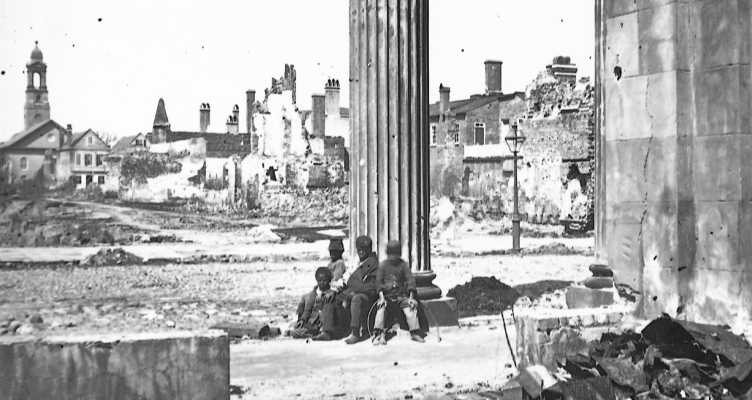
574
Chapter 16 A New Birth of Freedom, 1862–1865
army set fire to all the military stores it could not carry. The fires spread and destroyed more of Richmond than the Northern troops had destroyed of Atlanta
or Columbia.
Lee’s starving men limped westward, hoping to turn south and join the rem-
nants of Johnston’s army in North Carolina. Sheridan’s cavalry raced ahead and
cut them off at Appomattox, 90 miles from Petersburg, on April 8. When the weary
Confederates tried a breakout attack the next morning, their first probe revealed solid ranks of Union infantry arrayed behind the cavalry. It was the end. “There is nothing left for me to do,” said Lee, “but to go and see General Grant, and I would rather die a thousand deaths.” Lee met with Grant at the house of Wilmer McLean,
who in 1861 had lived near Manassas, where a shell had crashed through his
kitchen roof during the first battle of Bull Run. McLean had moved to the remote
village of Appomattox to escape the war, only to have its final drama played out in his parlor. There, the son of an Ohio tanner dictated surrender terms to a scion of one of Virginia’s First Families.
The terms were generous. Thirty thousand captured Confederates were allowed
to go home on condition that they promise never again to take up arms against the United States. After completing the surrender formalities on April 9, Grant introduced Lee to his staff, which included Colonel Ely Parker, a Seneca Indian. As Lee shook hands with Parker, he stared for a moment at Parker’s dark features and
said: “I am glad to see one real American here.” Parker replied solemnly: “We are all Americans.” And indeed they now were.
Division
Photographs
and
Prints
Congress,of
Library
The Fruits of War. Several Southern cities suffered enormous damage in the Civil War from Union shelling and from the fires caused by Confederate soldiers when they destroyed everything of military value before evacuating the cities. Such was true of Charleston, where a Northern photographer who entered the city after it fell in February 1865 posed four black children amid the ruins to portray the symbolism of destruction and renewal.
Conclusion
575
Casualties in Civil War Armies and Navies
Confederate records are incomplete; the Confederate data listed here are therefore estimates.
The actual Confederate totals were probably higher
Killed and
Mortally
Wounded,
Wounded Died of
Died in Miscellaneous
Total
Not
Total
in Combat Disease
Prison
Deaths*
Deaths
Mortally
Casualties
Union
111,904
197,388 30,192
24,881
364,345
277,401
641,766
Confederate (estimated)
94,000
140,000 26,000
No Estimates 260,000
195,000
455,000
Both Armies (estimated) 205,904
337,388 56,192
24,881
624,365
472,401
1,096,766
*Accidents, drownings, causes not stated, etc.
The
Wild celebrations broke out in the North at news of the fall
Assassination
of Richmond, followed soon by news of Appomattox.
of Lincoln
Almost overnight, the celebrations turned to mourning. On
the evening of April 14, the care-worn Abraham Lincoln
sought to relax by attending a comedy at Ford’s Theatre. In the middle of the play, John Wilkes Booth broke into Lincoln’s box and shot the president fatally in the
head. A prominent actor, Booth was a native of Maryland and a frustrated, un-
stable egotist who hated Lincoln for what he had done to Booth’s beloved South.
As he jumped from Lincoln’s box to the stage and escaped out a back door, he
shouted Virginia’s state motto at the stunned audience: “Sic semper tyrannis”
(“Thus always to tyrants”).
Lincoln’s death in the early morning of April 15 produced an outpouring of
grief throughout the North and among newly freed slaves in the South. The mar-
tyred president did not live to see the culmination of his great achievement in leading the nation to a victory that preserved its existence and abolished slavery. Within 11 days after Lincoln’s death, his assassin was trapped and killed in a burning barn in Virginia (April 26). The remaining Confederate armies surrendered one after another (April 26, May 4, May 26, June 23), and Union cavalry captured the fleeing
Jefferson Davis in Georgia (May 10). The trauma of civil war was over, but the
problems of peace and reconstruction had just begun.
CONCLUSION
Northern victory in the Civil War resolved two fundamental questions of liberty
and power left unresolved by the Revolution of 1776 and the Constitution of
1789: (1) whether this fragile republican experiment in federalism called the United States would survive as one nation; and (2) whether that nation, founded on a charter of liberty, would continue to exist as the largest slaveholding country in the world. Before 1861, the question of whether a state could secede from the Union
had remained open. Eleven states did secede, but their defeat in a war that cost
576
Chapter 16 A New Birth of Freedom, 1862–1865
625,000 lives resolved the issue: Since 1865, no state has seriously threatened secession. And in 1865, the adoption of the 13th Amendment to the Constitution con-
firmed the supreme power of the national government to abolish slavery and ensure the liberty of all Americans.
The Civil War also accomplished a regional transfer of power from South to
North. From 1800 to 1860, the slave states had used their leverage in the Jeffersonian Republican and Jacksonian Democratic parties to control national politics
most of the time. A Southern slaveholder was president of the United States during two-thirds of the years from 1789 to 1861. Most congressional leaders and Supreme Court justices during that period were Southerners.
In the 50 years after 1861, no native of a Southern state was elected president,
only one served as Speaker of the House and none as president pro tem of the Sen-
ate, and only 5 of the 26 Supreme Court justices appointed during that half-century were from the South. In 1860, the South’s share of the national wealth was 30 percent; in 1870, it was 12 percent.
The institutions and ideology of a plantation society and a caste system that
had dominated half the country before 1861 went down with a great crash in
1865—to be replaced by the institutions and ideology of free-labor capitalism.
Once feared as the gravest threat to liberty, the power of the national government sustained by a large army had achieved the greatest triumph of liberty in American history. With victory and peace in 1865, the reunited nation turned its attention to the issue of equality.
17
RECONSTRUCTION, 1863–1877