


516
Chapter 15 Secession and Civil War, 1860–1862
ND
r'
r's
Harper's FFer
tam
a
tam
EL.
EL
e
e 18
1
8
An
A
Annap
d
W hingto
hi g o
shington
6
ull un
n
un
hancello
an
o
edericksbur
cksbu
edericksbur
reder
Frederri
r
rederic
ederick
rg
T
W d
tsylvania
tsylvan
nia McClellan
McC
1862
186
WEST
d Har
d H bor
rbor
NI
R
Days
ven D
ven
Seven D y
ay
A
rg Norfolk
No
VIRGIN
e R
adddu
ad
th
g
alei h
e agg
1 3
SEE
NORTH t
AR
g
C
ra
B
L
1
hatt
g
out Mountain
ta
nt
m
mp
ction
Missi
dg
Wilmington
W
g
orinth
au
a ga
H CARO
o
lu
T erry 1865
ng
t 1
86
T
nt
P
om
Atla
b
ATLANTIC
g
Fort Sumter
M
M
gev
OCEAN
O
M
B
D
r
uPont 1861
e
g
Savannah
S
on
V
g
OU
Union forces
Confederate forces
cksonville
ck
Mobi
e
State capitals
Major battles
New Orleans
Ne O
New O
s
Learning
ut1862
Farragut
1864
Gulf of Mexico
Cengage
Farrag
©
MAP 15.2 Principal Military Campaigns of the Civil War
This map vividly illustrates the contrast between the vast distances over which the armies fought in the western theater of the war and the concentrated campaigns of the Army of the Potomac and the Army of Northern Virginia in the East.
more closely to nearby Ohio and Pennsylvania than to the South. Delegates who
had opposed Virginia’s secession from the Union returned home determined to
secede from Virginia. With the help of Union troops, who crossed the Ohio River
and won a few small battles against Confederate forces in the area during summer
1861, they accomplished their goal. Through a complicated process of conventions
and referendums—carried out in the midst of raids and skirmishes—they created
the new state of West Virginia, which entered the Union in 1863.
Indian Territory
To the south and west of Missouri, civil war raged along a
and the
different border—between Southern states and territories—for
Southwest
control of the resources of that vast region. In the Indian
Territory (present-day Oklahoma), the Native Americans, who
had been resettled there from Eastern states in the generation before the war, chose sides and carried on bloody guerrilla warfare against each other as ferocious as
The Balance Sheet of War
517
the bushwhacking in Missouri. The more prosperous Indians of the five “civilized
tribes” (Cherokees, Creeks, Seminoles, Chickasaws, and Choctaws), many of them of mixed blood and some of them slaveholders, tended to side with the Confederacy.
Some tribes signed treaties of alliance with the Confederate government. Aided by white and black Union regiments operating out of Kansas and Missouri, the pro-Union Indians gradually gained control of most of the Indian Territory.
In the meantime, Confederates had made their boldest bid to fulfill antebellum
Southern ambitions to win the Southwest. A small army composed mostly of
Texans pushed up the Rio Grande valley into New Mexico in 1861. The following
February, they launched a deeper strike to capture Santa Fe. They hoped to push
even farther westward and northward to gain the mineral wealth of California
and Colorado gold mines, whose millions were already helping to finance the
Union war effort and could do wonders for Confederate finances. A good many
Southerners lived in these Western territories and in California.
At first, the Confederate drive up the Rio Grande went well. The Texans won a
victory over the Unionist New Mexico militia and a handful of regulars at the battle of Valverde, 100 miles south of Albuquerque, on February 21, 1862. They continued up the valley, occupied Albuquerque and Santa Fe, and pushed on toward Fort
Union near Santa Fe. But Colorado miners who had organized themselves into
Union regiments and had carried out the greatest march of the war, over the rugged Rockies in winter, met the Texans in the battle of Glorieta Pass on March 26–28.
The battle was a tactical draw, but a unit of Coloradans destroyed the Confederate wagon train, forcing the Southerners into a disastrous retreat back to Texas. Of the 3,700 who had started out to win the West for the Confederacy, only 2,000 made it back. The Confederates had shot their bolt in this region; the West and Southwest remained safe for the Union.
THE BALANCE SHEET OF WAR
If one counts three-quarters of the border state population (including free blacks) as pro-Union, the total number of people in Union states in 1861 was 22.5 million,
compared with 9 million in the Confederate states. The North’s military manpower
advantage was even greater because the Confederate population total included 3.7
million slaves compared with 300,000 slaves in Union areas. At first, neither side expected to recruit blacks as soldiers. Eventually, the Union did enlist 180,000
black soldiers and 18,000 black sailors; the Confederacy did not take that step until the war was virtually over. Altogether, about 2.1 million men fought for the Union and 850,000 for the Confederacy. That was close to half of the North’s male population of military age (18 to 40) and three-quarters of the comparable Confederate white population. Because the labor force of the South consisted mainly of slaves, the Confederacy was able to enlist a larger proportion of its white population. The North’s economic superiority was even greater. The Union states possessed nine-tenths of the country’s industrial capacity and registered shipping, four-fifths of its bank capital, three-fourths of its railroad mileage and rolling stock, and three-fourths of its taxable wealth.
These statistics gave pause to some Southerners. In a long war that mobilized
the total resources of both sides, the North’s advantages might prove decisive. But 518
Chapter 15 Secession and Civil War, 1860–1862
HISTORY THROUGH FILM
The Red Badge of Courage (1951)
Directed by John Huston. Starring Audie
The film remains more faithful to the
Murphy (The Youth) and Bill Mauldin
book than most movies based on novels.
(The Loud Soldier).
Most of the dialogue is taken directly
from Crane. Henry Fleming’s self-doubts,
Stephen Crane’s short novel The Red
fears, and eventual heroism after he first
Badge of Courage became an instant clas-
runs away are brilliantly portrayed on
sic when it was published in 1895. Civil
the screen by action and dialogue against
War veterans praised its realistic descrip-
a background of a narrator’s words.
tions of the confusion, terror, chaos, cour-
Fleming is played by Audie Murphy,
age, despair, and adrenaline-driven rage of
America’s most decorated soldier in the
men in battle. A story of young Henry
Second World War, and Wilson by Bill
Fleming (The Youth) and his buddy
Mauldin, whose Willie and Joe cartoons
Wilson (The Loud Soldier) in their first
provided the most enduring images of
battle (Chancellorsville), the novel traces
the American infantryman in that war.
Henry’s transition from boyhood to man-
They make the characters come alive
hood, from raw recruit to veteran, over
with moving performances.
two days of violent combat. Intended by
Much of the credit for this success
Crane as a portrait of soldiers facing the
belongs to director John Huston, who
ultimate moment of truth in combat, the
brought out the best in his inexperienced
novel strives for universality rather than
actors. One of Hollywood’s most promi-
specificity as a Civil War story. Thus the
nent directors, Huston had lobbied Louis
battle is not actually named (although
Mayer of MGM to produce the film.
circumstances make clear that it is Chan-
Believing that “Nobody wants to see a
cellorsville, despite the film misleadingly
Civil War movie,” Mayer finally gave in
dating it in 1862). The 304th New York
but provided Huston with a skimpy bud-
regiment is fictional, and even the fact that
get. When Huston flew to Africa immedi-
it is a Civil War battle is scarcely men-
ately after the filming was completed to
tioned. Crane did achieve a sort of univer-
begin directing The African Queen, studio
sality; the novel is a story of men at war,
executives cut several of Huston’s scenes
not simply a story of the Civil War.
and reduced the movie’s length to 69
in 1861, few anticipated how long and intense the war would be. Both sides
expected a short and victorious conflict. Confederates seemed especially confident, partly because of their vaunted sense of martial superiority over the “bluebellied”
Yankee nation of shopkeepers. Many Southerners really did believe that one of
their own could lick three Yankees. “Let brave men advance with flintlocks and
old-fashioned bayonets, on the popinjays of Northern cities,” said ex-Governor
Henry Wise of Virginia, now a Confederate general, and “the Yankees would break
and run.”
Although this turned out to be a grievous miscalculation, the South did have
some reason to believe that its martial qualities were superior. A higher propor-
tion of Southerners than Northerners had attended West Point and other mili-
tary schools, had fought in the Mexican War, or had served as officers in the
The Balance Sheet of War
519
Collection
Everett
Theof
Courtesy
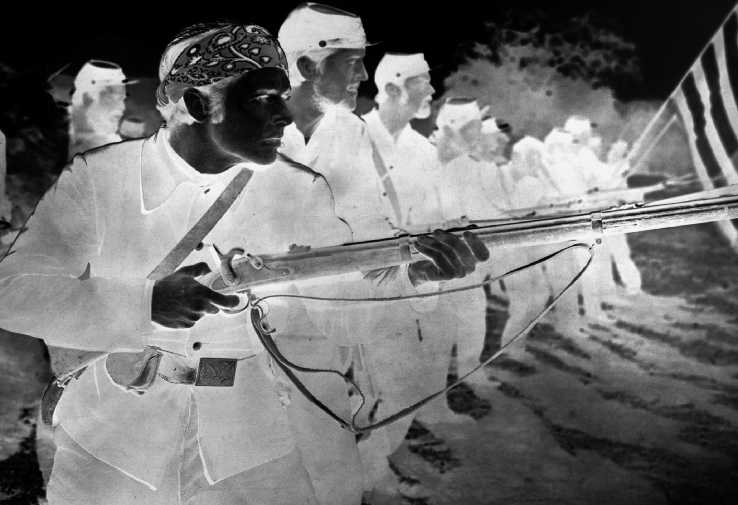
Audie Murphy (Henry Fleming) and Bill Mauldin (The Loud Soldier), in The Red Badge of Courage.
minutes. The studio also did little to pro-
the novel, however, it has become a classic
mote the film, and because audiences
that is still, more than a half-century after
failed to identify with its grim realism
it was filmed, one of the best cinematic
and mostly unknown cast, The Red Badge
portrayals of the psychology of men in
of Courage was a box-office failure. Like
combat.
regular army. Volunteer military companies were more prevalent in the antebel-
lum South than in the North. As a rural people, Southerners were proficient in
hunting, riding, and other outdoor skills useful in military operations. More-
over, the South had begun to prepare for war earlier than the North. As each
state seceded, it mobilized militia and volunteer military companies. Not until
summer 1861 would the North’s greater manpower manifest itself in the form
of a larger army.
Strategy
Even when fully mobilized, the North’s superior resources
and Morale
did not guarantee success. Its military task was much more
difficult than that of the South. The Confederacy had come
520
Chapter 15 Secession and Civil War, 1860–1862
into being in firm control of 750,000 square miles—a vast territory larger than all of Western Europe and twice as large as the 13 colonies in 1776. To win the war,
Union forces would have to invade, conquer, and occupy much of that territory,
cripple its people’s ability to sustain a war of independence, and destroy its armies.
Britain had been unable to accomplish a similar task in the war for independence, even though it enjoyed a far greater superiority of resources over the United States in 1776 than the Union enjoyed over the Confederacy in 1861. Victory does not
always ride with the heaviest battalions.
To “win” the war, the Confederacy did not need to invade or conquer the
Union or even to destroy its armies; it needed only to hold out long enough to convince Northerners that the cost of victory was too high. Most Confederates were
confident in 1861 that they were more than equal to the task. Most European mili-
tary experts agreed. The military analyst of the London Times wrote:
It is one thing to drive the rebels from the south bank of the Potomac, or even to occupy Richmond, but another to reduce and hold in permanent subjection a tract of country nearly as large as Russia in Europe.... No war of independence ever terminated unsuccessfully except where the disparity of force was far greater than it is in this case.... Just as England during the revolution had to give up conquering the colonies so the North will have to give up conquering the South.
The important factor of morale also seemed to favor the Confederacy. To be
sure, Union soldiers fought for powerful symbols: nation, flag, constitution. “We are fighting to maintain the best government on earth” was a common phrase in
their letters and diaries. It is a “grate [sic] struggle for Union, Constitution, and law,” wrote a New Jersey soldier. A Chicago newspaper declared that the South
had “outraged the Constitution, set at defiance all law, and trampled under foot
that flag which has been the glorious and consecrated symbol of American
Liberty.”
But Confederates, too, fought for nation, flag, constitution, and liberty—of
whites. In addition, they fought to defend their land, homes, and families against invading “Yankee vandals,” who many Southern whites quite literally believed
were coming to “free the negroes and force amalgamation between them and the
children of the poor men of the South.” An army fighting in defense of its homeland generally has the edge in morale. “We shall have the enormous advantage of fighting on our own territory and for our very existence,” wrote a Confederate leader.
Mobilizing
More than four-fifths of the soldiers on both sides were
for War
volunteers. The Confederacy passed a conscription law in
April 1862, and the Union followed suit in March 1863, but
even afterward, most recruits were volunteers. In both North and South, patriotic rallies with martial music and speeches motivated local men to enlist in a company (100 men) organized by the area’s leading citizens. The recruits elected their own company officers (a captain and two lieutenants), who received their commissions
from the state governor. A regiment consisted of 10 infantry companies, and each
regiment was commanded by a colonel, with a lieutenant colonel and a major as
second and third in command—all of them appointed by the governor. Cavalry
regiments were organized in a similar manner. Field artillery units were known as The Balance Sheet of War
521
batteries, a grouping of four or six cannon with their caissons and limber chests (two-wheeled, horse-drawn vehicles) to carry ammunition; the full complement of a six-gun battery was 155 men and 72 horses.
Volunteer units received a state designation and number in the order of their
completion—the 2nd Massachusetts Volunteer Infantry, the 5th Virginia Cavalry,
and so on. In most regiments, the men in each company generally came from the
same town or locality. Some Union regiments were composed of men of a particular
ethnic group. By the end of the war, the Union army had raised about 2,000 infan-
try and cavalry regiments and 700 batteries; the Confederates had organized just
under half as many. As the war went on, the original thousand-man complement
of a regiment was usually whittled down to half or less by disease, casualties, desertions, and detachments. The states generally preferred to organize new regiments
rather than keep the old ones up to full strength.
These were citizen-soldiers, not professionals. They carried their peacetime
notions of democracy and discipline into the army. That is why, in the tradition
of the citizen militia, the men elected their company officers and sometimes their field officers (colonel, lieutenant colonel, and major) as well. Professional military men deplored the egalitarianism and slack discipline that resulted. Political influence often counted for more than military training in the election and appoint-
ment of officers. These civilians in uniform were extremely awkward and
unmilitary at first, and some regiments suffered battlefield disasters because of inadequate training, discipline, and leadership. Yet this was the price that a democratic society with a tiny professional army had to pay to mobilize large armies almost overnight to meet a crisis. In time, these raw recruits became battle-hardened veterans commanded by experienced officers who had survived the
weeding-out process of combat or of examination boards or who had been pro-
moted from the ranks.
As the two sides organized their field armies, both grouped four or more regi-
ments into brigades and three or more brigades into divisions. By 1862, they began grouping two or more divisions into corps and two or more corps into armies. Each of these larger units was commanded by a general appointed by the president. Most of the higher-ranking generals on both sides were West Point graduates, but others were appointed because they represented an important political, regional, or (in the North) ethnic constituency whose support Lincoln or Davis wished to solidify.
Some of these “political” generals, like elected regimental officers, were incompetent, but as the war went on, they too either learned their trade or were weeded
out. Some outstanding generals emerged from civilian life and were promoted up
the ranks during the war. In both the Union and the Confederate armies, the best
officers (including generals) led their men by example as much as by precept; they commanded from the front, not the rear. Combat casualties were higher among
officers than among privates, and highest of all among generals, who died in action at a rate 50 percent higher than enlisted men.
Weapons
In Civil War battles, the infantry rifle was the most lethal
and Tactics
weapon. Muskets and rifles caused 80 to 90 percent of the
combat casualties. From 1862 on, most of these weapons
522
Chapter 15 Secession and Civil War, 1860–1862
were “rifled”—that is, they had spiral grooves cut in the barrel to impart a spin to the bullet. This innovation was only a decade old, dating to the perfection in the 1850s of the “minié ball” (named after French army Captain Claude Minié, its
principal inventor), a cone-shaped lead bullet with a base that expanded on firing to “take” the rifling of the barrel. This made it possible to load and fire a muzzle-loading rifle as rapidly (two or three times per minute) as the old smoothbore
musket. Moreover, the rifle had greater accuracy and at least four times the effective range (400 yards or more) of the smoothbore.
Civil War infantry tactics adjusted only gradually to the greater lethal range
and accuracy of the new rifle, however, for the prescribed massed formations had
emerged from experience with the smoothbore musket. Close-order assaults against
defenders equipped with rifles resulted in enormous casualties. The defensive power of the rifle became even greater when troops began digging into trenches. Massed
frontal assaults became almost suicidal. Soldiers and their officers learned the
hard way to adopt skirmishing tactics, taking advantage of cover and working
around the enemy flank.
Logistics
Wars are fought not only by men and weapons but also by
the logistical apparatus that supports and supplies them. The
Civil War is often called the world’s first modern war because of the role played by railroads, steam-powered ships, and the telegraph, which did not exist in earlier wars fought on a similar scale (those of the French Revolution and Napoleon).
Railroads and steamboats transported supplies and soldiers with unprecedented
speed and efficiency; the telegraph provided rapid communication between army
headquarters and field commanders.
Yet these modern forms of transport and communications were extremely vul-
nerable. Cavalry raiders and guerrillas could cut telegraph wires, burn railroad
bridges, and tear up the tracks. Confederate cavalry became particularly skillful at sundering the supply lines of invading Union armies and thereby neutralizing forces several times larger than their own. The more deeply the Union armies penetrated
into the South, the more men they had to detach to guard bridges, depots, and supply bases.
Once the campaigning armies had moved away from their railhead or wharf-
side supply base, they returned to dependence on animal-powered transport.
Depending on terrain, road conditions, length of supply line, and proportion of
artillery and cavalry, Union armies required one horse or mule for every two or
three men. Thus a large invading Union army of 100,000 men (the approximate
number in Virginia from 1862 to 1865 and in Georgia in 1864) would need about
40,000 draft animals. Confederate armies, operating mostly in friendly territory
closer to their bases, needed fewer. The poorly drained dirt roads typical of much of the South turned into a morass of mud in the frequently wet weather. These
logistical problems did much to offset the industrial supremacy of the North, particularly during the first year of the war when bottlenecks, shortages, and inefficiency marked the logistical effort on both sides. By 1862, though, the North’s
economy had fully geared up for war, making the Union army the best-supplied
army in history up to that time.
The Balance Sheet of War
523
Confederate officials accomplished impressive feats of improvisation in creating
war industries, especially munitions and gunpowder, but the Southern industrial
base was too slender to sustain adequate production. Particularly troublesome for the Confederacy was its inability to replace rails and rolling stock for its railroads.
Although the South produced plenty of food, the railroads deteriorated to the point that food could not reach soldiers or civilians. As the war went into its third and fourth years, the Northern economy grew stronger and the Southern economy grew
weaker.
Financing
One of the greatest defects of the Confederate economy was
the War
finance. Of the three methods of paying for a war—taxation,
loans, and (paper money)—treasury notes are the most
inflationary because they pump new money into the economy. By contrast, taxa-
tion and loans (war bonds) soak up money and thus counteract inflation. Although
Confederate treasury officials were quite aware of this difference, the Confederate Congress, wary of dampening patriotic ardor, was slow to raise taxes. And because most capital in the South was tied up in land and slaves, little was available for buying war bonds.
So, expecting a short war, the Confederate Congress authorized a limited issue
of treasury notes in 1861, to be redeemable in specie (gold or silver) within two years after the end of the war. The first modest issue was followed by many more
because the notes declined in value from the outset. The rate of decline increased during periods of Confederate military reverses, when people wondered whether
the government would survive. By early 1863 it took eight dollars to buy what
one dollar had bought two years earlier; just before the war’s end the Confederate dollar was worth one U.S. cent.
In 1863 the Confederate Congress tried to stem runaway inflation by passing a
comprehensive law that taxed income, consumer purchases, and business transac-
tions and included a “tax in kind” on agricultural products, allowing tax officials to seize 10 percent of a farmer’s crops. This tax was extremely unpopular among
farmers, many of whom hid their crops and livestock or refused to plant, thereby
worsening the Confederacy’s food shortages. The tax legislation was too little and too late to remedy the South’s fiscal chaos. The Confederate government raised less than 5 percent of its revenue by taxes and less than 40 percent by loans, leaving 60
percent to be created by the printing press. That turned out to be a recipe for
disaster.
In contrast, the Union government raised 66 percent of its revenue by selling
war bonds, 21 percent by taxes, and only 13 percent by printing treasury notes.
The Legal Tender Act authorizing these notes—the famous “greenbacks,” the
origin of modern paper money in the United States—passed in February 1862.
Congress had enacted new taxes in 1861, including the first income tax in Ameri-
can history, and had authorized the sale of war bonds. By early 1862, however,
these measures had not yet raised enough revenue to pay for the rapid military
buildup. To avert a crisis, Congress created the greenbacks. Instead of promising to redeem them in specie at some future date, as the South had done, Congress
made them legal tender—that is, it required everyone to accept them as real
524
Chapter 15 Secession and Civil War, 1860–1862
money at face value. The North’s economy suffered inflation during the war—
about 80 percent over four years—but that was mild compared with the 9,000 per-
cent inflation in the Confederacy. The greater strength and diversity of the North’s economy, together with wiser fiscal legislation, accounted for the contrast.
The Union Congress also passed the National Banking Act of 1863. Before the
war, the principal form of money had been notes issued by state-chartered banks.
After Andrew Jackson’s destruction of the Second Bank of the United States
(Chapter 12), the number and variety of banknotes had skyrocketed until 7,000
different kinds of state banknotes were circulating in 1860. Some were virtually
worthless; others circulated at a discount from face value. The National Banking
Act of 1863 resulted from the desire of Republicans to resurrect the centralized
banking system and create a more stable banknote currency, as well as to finance
the war. Under the act, chartered national banks could issue banknotes up to 90
percent of the value of the U.S. bonds they held. This provision created a market for the bonds and, in combination with the greenbacks, replaced the glut of state banknotes with a more uniform national currency.
National banknotes would be an important form of money for the next
half-century. They had two defects, however: First, because the number of
notes that could be issued was tied to each bank’s holdings of U.S. bonds, the
volume of currency available depended on the amount of federal debt rather
than on the economic needs of the country. Second, the banknotes tended to
concentrate in the Northeast, where most of the large national banks were
located, leaving the South and West short. The creation of the Federal Reserve
System in 1913 (Chapter 21) largely remedied these defects, but Civil War
legislation established the principle of a uniform national currency issued and
regulated by the federal government.
NAVIES, THE BLOCKADE, AND FOREIGN RELATIONS
To sustain its war effort, the Confederacy needed to import large quantities of
material from abroad. To shut off these imports and the exports of cotton that
paid for them, on April 19, 1861, Lincoln proclaimed a blockade of Confederate
ports. At first, the blockade was more a policy than a reality because the navy had only a few ships on hand to enforce it. The task was formidable; the Confederate
coastline stretched for 3,500 miles, with two dozen major ports and another 150
bays and coves where cargo could be landed. The U.S. Navy, which since the
1840s had been converting from sail to steam, recalled its ships from distant seas, took old sailing vessels out of mothballs, and bought or chartered merchant ships and armed them. Eventually, the navy placed several hundred warships on blockade
duty. But in 1861, the blockade was so thin that 9 of every 10 vessels slipped
through it on their way to or from Confederate ports.
King Cotton
The Confederacy, however, inadvertently contributed to the
Diplomacy
blockade’s success when it adopted King Cotton diplomacy.
Cotton was vital to the British economy because textiles
Navies, the Blockade, and Foreign Relations
525
were at the heart of British industry, and three-fourths of Britain’s supply of raw cotton came from the South. If that supply was cut off, Southerners reasoned,
British factories would shut down, unemployed workers would starve, and Britain
would face the prospect of revolution. Rather than risk such a consequence,
people in the South believed that Britain (and other powers) would recognize the
Confederacy’s independence and then use the powerful British navy to break
the blockade.
Southerners were so firmly convinced of cotton’s importance to the British
economy that they kept the 1861 cotton crop at home rather than try to export it
through the blockade, hoping thereby to compel the British to intervene. But the
strategy backfired. Bumper crops in 1859 and 1860 had piled up a surplus of cot-
ton in British warehouses and delayed the anticipated “cotton famine” until 1862.
In the end, the South’s voluntary embargo of cotton cost them dearly. The Confed-
eracy missed its chance to ship out its cotton and store it abroad, where it could be used as collateral for loans to purchase war matériel.
Moreover, the Confederacy’s King Cotton diplomacy contradicted its own
foreign policy objective: to persuade the British and French governments to refuse to recognize the legality of the blockade. Under international law, a blockade
must be “physically effective” to be respected by neutral nations. Confederate
diplomats claimed that the Union effort was a mere “paper blockade,” yet
the dearth of cotton reaching European ports as a result of the South’s embargo
suggested to British and French diplomats that the blockade was at least partly
effective. And by 1862 it was. Slow-sailing ships with large cargo capacity rarely tried to run the blockade, and the sleek, fast, steam-powered “blockade runners”
that became increasingly prominent had a smaller cargo capacity and charged
high rates because of the growing risk of capture or sinking by the Union navy.
Although most blockade runners got through, by 1862 the blockade had reduced
the Confederacy’s seaborne commerce enough to convince the British government
to recognize it as legitimate. The blockade was also squeezing the South’s econ-
omy. After lifting its cotton embargo in 1862, the Confederacy had increasing
difficulty exporting enough cotton through the blockade to pay for needed
imports.
Confederate foreign policy also failed to win diplomatic recognition by
other nations. That recognition would have conferred international legitimacy
on the Confederacy and might even have led to treaties of alliance or of for-
eign aid. The French Emperor Napoleon III expressed sympathy for the Con-
federacy, as did influential groups in the British Parliament. But Prime
Minister Lord Palmerston and Foreign Minister John Russell refused to recog-
nize the Confederacy while it was engaged in a war it might lose, especially if
recognition might jeopardize relations with the United States. The Union foreign
policy team of Secretary of State Seward and Minister to England Charles Fran-
cis Adams did a superb job. Seward issued blunt warnings against recognizing
the Confederacy; Adams softened them with the velvet glove of diplomacy.
Other nations followed Britain’s lead; by 1862, it had become clear that Britain
would withhold recognition until the Confederacy had virtually won its
526
Chapter 15 Secession and Civil War, 1860–1862
independence, but such recognition would have come too late to help the Con-
federacy win.
The Trent Affair
If anything illustrated the frustrations of Confederate diplo-
macy, it was the “Trent Affair.” In October 1861, Southern
envoys James Mason and John Slidell slipped through the blockade. Mason hoped
to represent the Confederacy in London and Slidell in Paris. On November 8,
Captain Charles Wilkes of the U.S.S. San Jacinto stopped the British mail steamer Trent with Mason and Slidell on board, near Cuba. Wilkes arrested the two
Southerners, took them to Boston, and became an instant hero in the North. When
the news reached England, the British government and public were outraged by
Wilkes’s “high-handed” action. Britain demanded an apology and the release of
Mason and Slidell. The popular press on both sides of the Atlantic stirred up war fever. Soon, however, good sense prevailed and Britain softened its demands. With a philosophy of “one war at a time,” the Lincoln administration released Mason
and Slidell the day after Christmas 1861, declaring that Captain Wilkes had acted
“without instructions.” The British accepted this statement in lieu of an apology, and the crisis ended.
The
Lacking the capacity to build a naval force at home, the
Confederate
Confederacy hoped to use British shipyards for the purpose.
Navy
Through a loophole in the British neutrality law, two fast
commerce raiders built in Liverpool made their way into
Confederate hands in 1862. Named the Florida and the Alabama, they roamed
the seas for the next two years, capturing or sinking Union merchant ships and
whalers. The Alabama was the most feared raider. She sank 62 merchant vessels
plus a Union warship, before another warship, the U.S.S. Kearsarge, sank the
Alabama off Cherbourg, France, on June 19, 1864. Altogether, Confederate pri-
vateers and commerce raiders destroyed or captured 257 Union merchant vessels
and drove at least 700 others to foreign registry. This Confederate achievement,
although spectacular, made only a tiny dent in the Union war effort, especially
when compared with the 1,500 blockade runners captured or destroyed by the
Union navy, not to mention the thousands of others that decided not to even try
to beat the blockade.
The Monitor and
Though plagued by shortages on every hand, the Confeder-
the Virginia
ate navy department demonstrated great skill at innovation.
Southern engineers developed “torpedoes” (mines) that sank
or damaged 43 Union warships in southern bays and rivers. The South also
constructed the world’s first combat submarine, the H. L. Hunley, which sank a
blockade ship off Charleston in 1864 but then went down before she could return
to shore. Another important innovation was the building of ironclad “rams” to
sink the blockade ships. The idea of iron armor for warships was not new—the
Division
Photographs
and
Prints
Congress,of
Library
Mayer/CORBISG.
Francis©
The Monitor and Merrimac. The above photograph shows the crew of the Union
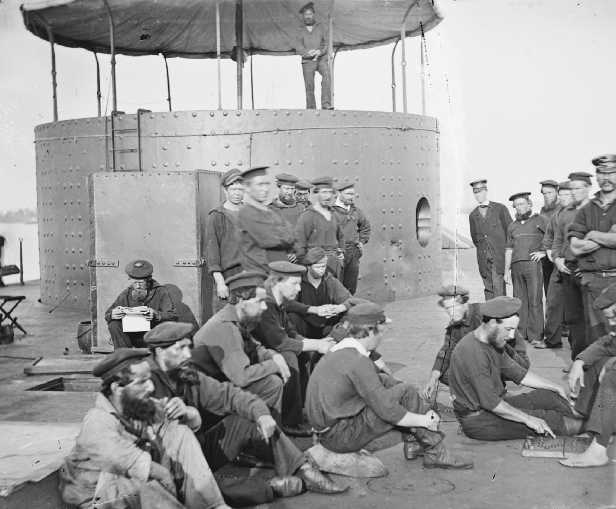
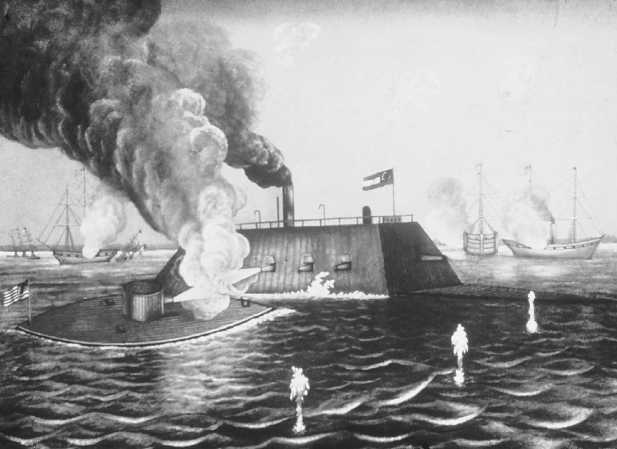
ironclad Monitor standing in front of its revolving two-gun turret. In action, the sun canopy above the turret would be taken down, and all sailors would be at their stations inside the turret or the hull, as shown in the painting of the famed battle, on March 9, 1862, between the Monitor and the Confederate Virginia (informally called the Merrimac because it had been converted from the captured U.S. frigate Merrimack). There is no photograph of the Virginia, which was blown up by its crew two months later when the Confederates retreated toward Richmond because its draft was too deep to go up the James River.
528
Chapter 15 Secession and Civil War, 1860–1862
British and French navies had prototype ironclads in 1861—but the Confederacy
built the first one to see action. It was the C.S.S. Virginia, commonly called (even in the South) the Merrimac because it was rebuilt from the steam frigate U.S.S.
Merrimack, which had been burned to the waterline by the Union navy at Norfolk
when the Confederates seized the naval base there in April 1861. Ready for its
trial-by-combat on March 8, 1862, the Virginia steamed out to attack the blockade squadron at Hampton Roads. She sank one warship with her iron ram and another
with her 10 guns. Other Union ships ran aground trying to escape, to be finished
off (Confederates expected) the next day. Union shot and shells bounced off
the Virginia’s armor plate. It was the worst day the U.S. Navy would have until
December 7, 1941.
Panic seized Washington and the whole northeastern seaboard. In almost
Hollywood fashion, however, the Union’s own ironclad sailed into Hampton
Roads in the nick of time and saved the rest of the fleet. This was the U.S.S.
Monitor, completed just days earlier at the Brooklyn navy yard. Much smaller
than the Virginia, with two 11-inch guns in a revolving turret (an innovation)
set on a deck almost flush with the water, the Monitor looked like a “tin can on a shingle.” It presented a small target and was capable of concentrating considerable firepower in a given direction with its revolving turret. The next day, the
Monitor fought the Virginia in history’s first battle between ironclads. It was a draw, but the Virginia limped home to Norfolk never again to menace the Union
fleet. Although the Confederacy built other ironclad rams, some never saw
action and none achieved the initial success of the Virginia. By the war’s end, the Union navy had built or started 58 ships of the Monitor class (some of them
double-turreted), launching a new age in naval history.
CAMPAIGNS AND BATTLES, 1861–1862
Wars can be won only by hard fighting. Some leaders on both sides overlooked
this truth. One of them was Winfield Scott, General-in-Chief of the U.S. Army.
Scott, a Virginian who had remained loyal to the Union, evolved a military strat-
egy based on his conviction that a great many Southerners were willing to be won
back to the Union. The main elements of his strategy were a naval blockade and a
combined army-navy expedition to take control of the Mississippi, thus sealing
off the Confederacy on all sides and enabling the Union to “bring them to terms
with less bloodshed than by any other plan.” The Northern press labeled Scott’s
strategy the Anaconda Plan, after the South American snake that squeezes its prey to death.
The Battle
Most Northerners believed that the South could be
of Bull Run
overcome only by victory in battle. Virginia emerged as
the most likely battleground, especially after the Confeder-
ate government moved its capital to Richmond in May 1861. “Forward to
Richmond,” clamored Northern newspapers. And forward toward Richmond
moved a Union army of 35,000 men in July, despite Scott’s misgivings and those
Campaigns and Battles, 1861–1862
529
of the army’s field commander, Irvin McDowell. McDowell believed his raw,
90-day Union militia were not ready to fight a real battle. They got no farther
than Bull Run, a sluggish stream 25 miles southwest of Washington, where a
Confederate army commanded by Beauregard had been deployed to defend a key
rail junction at Manassas.
Another small Confederate army in the Shenandoah Valley under General
Joseph E. Johnston had given a Union force the slip and had traveled to Manassas
by rail to reinforce Beauregard. On July 21, the attacking Federals forded Bull Run and hit the rebels on the left flank, driving them back. By early afternoon, the Federals seemed to be on the verge of victory, but a Virginia brigade commanded by
Thomas J. Jackson stood “like a stone wall,” earning Jackson the nickname he
carried ever after. By mid-afternoon, Confederate reinforcements, including one
brigade just off the train from the Shenandoah Valley, had grouped for a screaming counterattack (the famed “rebel yell” was first heard here). They drove the exhausted and disorganized Yankees back across Bull Run in a retreat that turned into a rout.
Although the Battle of Manassas (or Bull Run, as Northerners called it) was
small by later Civil War standards, it made a profound impression on both sides.
Of the 18,000 soldiers actually engaged on each side, Union casualties (killed,
wounded, and captured) were about 2,800 and Confederate casualties 2,000. The
victory exhilarated Confederates and confirmed their belief in their martial superiority. It also gave them a morale advantage in the Virginia theater that persisted for two years. And yet, Manassas also bred overconfidence. Some in the South
thought the war was won. Northerners, by contrast, were jolted out of their expectations of a short war. A new mood of reality and grim determination gripped the
North. Congress authorized the enlistment of up to 1 million three-year volunteers.
Hundreds of thousands flocked to recruiting offices in the next few months. Lin-
coln called General George B. McClellan to Washington to organize the new
troops into the Army of the Potomac.
An energetic, talented officer who was only 34 years old and small of stature
but great with an aura of destiny, McClellan soon won the nickname “The Young
Napoleon.” He had commanded the Union forces that gained control of West
Virginia, and he took firm control in Washington during summer and fall 1861.
He organized and trained the Army of the Potomac into a large, well-disciplined,
and well-equipped fighting force. He was just what the North needed after its
dispiriting defeat at Bull Run. When Scott stepped down as General-in-Chief on
November 1, McClellan took his place.
As winter approached, however, and McClellan did nothing to advance
against the smaller Confederate army whose outposts stood only a few miles from
Washington, his failings as a commander began to show. McClellan was afraid to
take risks; he never learned the military lesson that no victory can be won without risking defeat. He consistently overestimated the strength of enemy forces facing him and used these faulty estimates as a reason for inaction until he could increase his own force. When Republicans in Congress and in the press began to criticize
him (he was a Democrat), he accused his critics of political motives. Having built a fine fighting machine, he was afraid to start it up for fear it might break. The caution that McClellan instilled in the Army of the Potomac’s officer corps
530
Chapter 15 Secession and Civil War, 1860–1862
persisted for more than a year after Lincoln removed him from command in
November 1862.
Naval
Because of McClellan, no significant action occurred in the
Operations
Virginia theater after the Battle of Bull Run until spring
1862. Meanwhile, the Union navy won a series of victories
over Confederate coastal forts at Hatteras Inlet on the North Carolina coast, Port Royal Sound in South Carolina, and other points along the Atlantic and Gulf
coasts. These successes provided new bases from which to expand and tighten the
blockade. They also provided small Union armies with takeoff points for opera-
tions along the southern coast. In February and March 1862, an expeditionary
force under General Ambrose Burnside won a string of victories and occupied
several crucial ports on the North Carolina sounds. Another Union force captured
Fort Pulaski at the mouth of the Savannah River, cutting off that important
Confederate port from the sea.
One of the Union navy’s most impressive achievements was the capture in
April 1862 of New Orleans, the Confederacy’s largest city and principal port.
Most Confederate troops in the area had been called up the Mississippi to con-
front a Union invasion of Tennessee, leaving only some militia, an assortment of
steamboats converted into gunboats, and two strong forts flanking the river 70
miles below New Orleans. That was not enough to stop Union naval commander
David G. Farragut, a native of Tennessee who was still loyal to the U.S. Navy
in which he had served for a half century. In a daring action on April 24, 1862,
Farragut led his fleet upriver past the forts, losing one ship but scattering or
destroying the Confederate gunboats. The Union fleet compelled the surrender of
New Orleans with nine-inch naval guns trained on its streets.
Fort Henry and
These victories demonstrated the importance of sea power
Fort Donelson
even in a civil war. Even more important were Union victo-
ries won by the combined efforts of the army and fleets of
river gunboats on the Tennessee and Cumberland rivers, which flow through
Tennessee and Kentucky and empty into the Ohio River just before it joins the
Mississippi. The unlikely hero of these victories was Ulysses S. Grant, who had
failed in several civilian occupations after resigning from the peacetime military in 1854. Grant rejoined when war broke out. His quiet efficiency and determined
will won him promotion from Illinois colonel to brigadier general. When Confed-
erate units entered Kentucky in September, Grant moved quickly to occupy the
mouths of the Cumberland and Tennessee rivers.
Military strategists on both sides understood the importance of these naviga-
ble rivers as highways of invasion into the South’s heartland. The Confederacy
had built forts at strategic points along the rivers and had begun to convert a
few steamboats into gunboats and rams to back up the forts. The Union also con-
verted steamboats into “timberclad” gunboats—so called because they were
armored just enough to protect the engine and the paddle wheels but not enough

Campaigns and Battles, 1861–1862
531
Lebanon
I L L I N O I S
Th
0
20
40 Miles
om
N
a
Munfordville
s
ILLINOIS
Grant
.
G
RiverLogan Cross Roads
CENTRAL R.R.
R
r
.
een
R
Jan. 18
Puducah
K E N T U C K Y
Somerset
Cairo
C
Bowling Green
Crittenden
& NASHVILLE
M O .
ope
Foo
G
um t
P
F r
e
o a
Belmont
b
ILLE
Columbus
o n
Mill Springs
t t
e
e
r
ISV
la
iver
U
HALLECK
n
ell
O
Cumberland
R
d
u
L Tompkinsville
Ft. Henry
B
Cumberland
New Madrid Hickman
Surrendered Feb. 6
Clarksville
Gap
Union City
Riv
Gallatin
Paris
er
.
Ft. Donelson
Landings
OPERATIONS AGAINST
iver Island No. 10
r
R
e
Surrendered Feb. 16
R
v
Nashville
FORTS HENRY AND DONELSON
Captured by
i
Surrendered Feb. 25
F
Union Forces April 8
F
e
R
e
b
b
.
erlandb
A R K .
P
.
6
o
T E N N E S S E E 6
Foote's
D
Landing
m
l
Gunboats
u
k
uck
Franklin
C
Humboldt
Murfreesboro
Foote's
Ft. Pillow
River
Ft. Henry
Gunboats
Buckner
ississippiAbandoned June 4
M
Jackson
rant
G
Ft.
M
ennessee
O
T
Columbia
GRANT
.
Donelson
BI
R
LE
RUGGLES
Dover
Shelbyville
&
Memphis
Buell
O
nessee 0
1
2
3 Miles
n
Captured by
H
e
Pillow
FLOYD
I
T
Union River Navy
OR
Savannah
June 6
Grand Juction .R. Shiloh
Church
Chattanooga
Corinth
A
Stevenson
Iuka
. S. Johnsto
g
n
M
Union forces
EM
Huntsville
PH
rag
IS & CHARLE
Learning
A. S. JOHNSTON
B
STON
CUMBERLAND
Confederate forces
R
MOUNTAINS
.R
M I S S I S S I P P I
.
A L A B A M A
Confederate entrenchments
Cengage©
MAP 15.3 Kentucky–Tennessee Theater, Winter–Spring 1862
This map illustrates the importance of rivers and railroads as lines of military operations and supply. Grant and Foote advanced up (southward) the Tennessee and Cumberland
rivers, while Buell moved along the Louisville and Nashville Railroad. Confederate divisions under the overall command of General Albert Sidney Johnston used railroads to concentrate at the key junction of Corinth.
to impair speed and shallow draft for river operations. The Union also built a new class of ironclad gunboats designed for river warfare. Carrying 13 guns, these flat-bottomed, wide-beamed vessels drew only six feet of water. Their hulls and pad-
dle wheels were protected by a sloping casemate sheathed in iron armor up to
32½ inches thick.
When the first of these strange-looking but formidable craft were ready in
February 1862, Grant struck. His objectives were Forts Henry and Donelson on
the Tennessee and Cumberland rivers just south of the Kentucky–Tennessee bor-
der. The gunboats knocked out Fort Henry on February 6. Fort Donelson proved
a tougher nut to crack. Its guns repulsed a gunboat attack on February 14. The
next day, the 17,000-man Confederate army attacked Grant’s besieging army,
which had been reinforced to 27,000 men. With the calm decisiveness that became
his trademark, Grant directed a counterattack that penned the defenders back up
in their fort. Cut off from support by either land or river, the Confederate com-
mander asked for surrender terms on February 16. Grant’s reply made him
instantly famous when it was published in the North: “No terms except an
532
Chapter 15 Secession and Civil War, 1860–1862
immediate and unconditional surrender can be accepted. I propose to move imme-
diately upon your works.” With no choice, the 13,000 surviving Confederates
surrendered (some had escaped), giving Grant the most striking victory in the
war thus far.
These victories had far-reaching strategic consequences. Union gunboats now
ranged all the way up the Tennessee River to northern Alabama, enabling a Union
division to occupy the region, and up the Cumberland to Nashville, which became
the first Confederate state capital to surrender to Union forces on February 25.
Confederate military units pulled out of Kentucky and most of Tennessee and
reassembled at Corinth in northern Mississippi. Jubilation spread through the
North and despair through the South. By the end of March 1862, however, the
Confederate commander in the western theater, Albert Sidney Johnston (not to
be confused with Joseph E. Johnston in Virginia), had built up an army of
40,000 men at Corinth. His plan was to attack Grant’s force of 35,000, which
had established a base 20 miles away at Pittsburg Landing on the Tennessee River
just north of the Mississippi–Tennessee border.
The Battle
On April 6, the Confederates attacked at dawn near a
of Shiloh
church called Shiloh, which gave its name to the battle.
They caught Grant by surprise and drove his army toward
the river. After a day’s fighting of unprecedented intensity, with total casualties of 15,000, Grant’s men brought the Confederate onslaught to a halt at dusk. One of
the Confederate casualties was Johnston, who bled to death when a bullet severed
an artery in his leg—the highest-ranking general on either side to be killed in the war. Beauregard, who had been transferred from Virginia to the West, took
command after Johnston’s death.
Some of Grant’s subordinates advised retreat during the dismal night of April
6–7, but Grant would have none of it. Reinforced by fresh troops from a Union
army commanded by General Don Carlos Buell, the Union counterattacked the
next morning (April 7) and, after 9,000 more casualties to the two sides, drove
the Confederates back to Corinth. Although Grant had snatched victory from
the jaws of defeat, his reputation suffered a decline for a time because of the
heavy Union casualties (13,000) and the suspicion that he had been caught
napping the first day.
Union triumphs in the western theater continued. The combined armies of
Grant and Buell, under the overall command of the top-ranking Union general in
the West, Henry W. Halleck, drove the Confederates out of Corinth at the end of
May. Meanwhile, the Union gunboat fleet fought its way down the Mississippi to
Vicksburg, virtually wiping out the Confederate fleet in a spectacular battle at
Memphis on June 6. At Vicksburg, the Union gunboats from the north connected
with part of Farragut’s fleet that had come up from New Orleans, taking Baton
Rouge and Natchez along the way. The heavily fortified Confederate bastion at
Vicksburg, however, proved too strong for Union naval firepower to subdue. Nev-
ertheless, the dramatic succession of Union triumphs in the West from February
to June, including a decisive victory at the battle of Pea Ridge in northwest
Arkansas on March 7 and 8, convinced the North that the war was nearly won.
Campaigns and Battles, 1861–1862
533
“Every blow tells fearfully against the rebellion,” boasted the leading Northern
newspaper, the New York Tribune. “The rebels themselves are panic-stricken,
or despondent. It now requires no very far reaching prophet to predict the end
of this struggle.”
The Virginia
But affairs in Virginia were about to take a sharp turn in
Theater
favor of the Confederacy. In the western theater, the broad
rivers had facilitated the Union’s invasion of the South, but
in Virginia a half-dozen small rivers flowing west to east provided the Confederates with natural lines of defense. McClellan persuaded a reluctant Lincoln to approve a plan to transport his army down Chesapeake Bay to the tip of the Virginia peninsula, formed by the tidal portions of the York and James rivers. That would
shorten the route to Richmond and give the Union army a seaborne supply line
secure from harassment by Confederate cavalry and guerrillas.
This was a good plan—in theory. But once again, McClellan’s failings began
to surface. A small Confederate blocking force at Yorktown held him for the entire month of April, as he cautiously dragged up siege guns to blast through defenses
that his large army could have punched through in days on foot. McClellan slowly
followed the retreating Confederate force up the peninsula to a new defensive
line only a few miles east of Richmond, all the while bickering with Lincoln and
Secretary of War Edwin M. Stanton over the reinforcements they were withholding
to protect Washington against a possible strike by Stonewall Jackson’s small
Confederate army in the Shenandoah Valley.
Jackson’s month-long campaign in the Shenandoah (May 8–June 9), one of the
most brilliant of the war, demonstrated what could be accomplished through decep-
tion, daring, and mobility. With only 17,000 men, Jackson moved by forced
marches so swift that his infantry earned the nickname “Jackson’s foot cavalry.”
Darting here and there through the valley, they marched 350 miles in the course
of one month; won four battles against three separate Union armies, whose com-
bined numbers surpassed Jackson’s by more than 2 to 1 (but which Jackson’s force
always outnumbered at the point of contact); and compelled Lincoln to divert to
the valley some of the reinforcements McClellan demanded.
Even without those reinforcements, McClellan’s army substantially outnum-
bered the Confederate force defending Richmond, commanded by Joseph E.
Johnston. McClellan overestimated Johnston’s strength at double what it was
and acted accordingly. Even so, by the last week of May, McClellan’s army
was within six miles of Richmond. A botched Confederate counterattack on
May 31 and June 1 (the Battle of Seven Pines) produced no result except 6,000
Confederate and 5,000 Union casualties. One of those casualties was Johnston,
who was wounded in the shoulder. Jefferson Davis named Robert E. Lee to
replace him.
The Seven
That appointment marked a major turning point in the
Days’ Battles
campaign. Lee had done little so far to earn a wartime rep-
utation, having failed in his only field command to dislodge
534
Chapter 15 Secession and Civil War, 1860–1862
Union forces from control of West Virginia. His qualities as a commander began
to manifest when he took over what he renamed the Army of Northern Virginia.
Those qualities were boldness, a willingness to take great risks, an almost
uncanny ability to read the enemy commander’s mind, and a charisma that won
the devotion of his men. While McClellan continued to dawdle, Lee sent his
dashing cavalry commander, J. E. B. “Jeb” Stuart, to lead a reconnaissance
around the Union army to discover its weak points. Lee also brought Jackson’s
army in from the Shenandoah Valley and launched a June 26 attack on
McClellan’s right flank in what became known as the Seven Days’ battles.
Constantly attacking, Lee’s army of 90,000 drove McClellan’s 100,000 away
from Richmond to a new fortified base on the James River. The offensive cost
the Confederates 20,000 casualties (compared with 16,000 for the Union) and
turned Richmond into one vast hospital, but it reversed the momentum of
the war.
CONFEDERATE COUNTEROFFENSIVES
Northern sentiments plunged from the height of euphoria in May to the depths
of despair in July. “The feeling of despondency here is very great,” wrote a
New Yorker, while a Southerner exulted, “Lee has turned the tide, and I shall
not be surprised if we have a long career of successes.” The tide turned in the
western theater as well, where Union conquests in the spring had brought
50,000 square miles of Confederate territory under Union control. To occupy
and administer this vast area, however, drew many thousands of soldiers from
combat forces, which were left depleted and deep in enemy territory and vulner-
able to cavalry raids. During summer and fall 1862, the cavalry commands of
Tennesseean Nathan Bedford Forrest and Kentuckian John Hunt Morgan staged
repeated raids in which they burned bridges, blew up tunnels, tore up tracks,
and captured supply depots and the Union garrisons trying to defend them.
By August the once-formidable Union war machine in the West seemed to have
broken down.
These raids paved the way for infantry counteroffensives. After recapturing
some territory, Earl Van Dorn’s Army of West Tennessee got a bloody nose when
it failed to retake Corinth on October 3 and 4. At the end of August, Braxton
Bragg’s Army of Tennessee launched a drive northward from Chattanooga through
east Tennessee and Kentucky. It had almost reached the Ohio River in September
but was turned back at the Battle of Perryville on October 8. Even after these
defeats, the Confederate forces in the western theater were in better shape than
they had been four months earlier.
The Second
Most attention, though, focused on Virginia. Lincoln
Battle of Bull
reorganized the Union corps near Washington into the Army
Run
of Virginia under General John Pope, who had won minor
successes as commander of a small army in Missouri and
Tennessee. In August, Lincoln ordered the withdrawal of the Army of the Potomac

Confederate Counteroffensives
535
from the peninsula to reinforce Pope for a drive southward from Washington. Lee
quickly seized the opportunity provided by the separation of the two Union armies confronting him, by the ill will between McClellan and Pope, and by the bickering among various factions in Washington. To attack Pope before McClellan
could reinforce him, Lee shifted most of his army to northern Virginia, sent
Jackson’s foot cavalry on a deep raid to destroy its supply base at Manassas
Junction, and then brought his army back together to defeat Pope’s army near
Bull Run on August 29 and 30. The demoralized Union forces retreated into the
Washington defenses, where Lincoln reluctantly gave McClellan command of
the two armies and told him to reorganize them into one.
Lee decided to keep up the pressure by invading Maryland. On September 4,
his weary troops began splashing across the Potomac 40 miles upriver from
Washington. This move, which took place at the same time Braxton Bragg was
invading Kentucky, presented several momentous possibilities: Maryland might be
.
N
AL R. R
Rapidan R.
RT
C
Fredericksburg
N
McDowell
H
E
C
C
E
hi
R
ckah
IA
app
S
o
a
P
m
P
h
o
A
S
a
a
t
i
m
n
om
t
IN
n
Beaver
u
n
a
u
N
n
y
k
.
c
o
R
P
a
G
e
A
Dam
y
n
i
c
v
k
er
E
r
R
R
I
n
RICHMOND,
t
Mechanicsville
a
Creek
R
R
A
,
.
V
June 26
R
D
Old Church
FREDERICKSBURG
.
i
J
.
v
u
Meadow
.
& POTOMAC R.R.
er
K
n
H
Frederick's Hall
St
e
Bridge
Ja
.
E
u
c
ar
k
H
t
V
,
A
1
.
so i
J
C
u
E
2
n l
B
n
N
e
T
M
–
R
il
A
1
L
atta
A
1
R
2
S
Hanover
rter
A. P. H
–
.
pon
6
o
il
Gaines' Mill
o
R
1
u
.
6
t
Junction
y
Y
P
.P.H
il
June 27
h
P
R
.H
An
a
McCLELLAN
Longstreet
McCLELLAN
n a R.
m
i
Porter
u
ve
M
.H
Tunstall's
Ashland
nke
r
D
y
LEE
c
Savage
Station
R.
C
Magruder
Longstreet
A
Station
White RICHMOND & Urbanna
l
Huger
June 29 RICHMOND & YORK RIVER R.R.
Ja
e
m
Mechanicsville
House YORK RIVER
l
Richmond
es
R.R.
R
l
.
W
Richmond
a
.
h
Fair Oaks
West Point
n
R.
.
S
Oak S i
R
R
w te
t
a
C
G
s
u
Grove
e
m O
h
J. E. Jo
Y
a
i
hn
r
p a
ck
ANVILLE R.R.
s
R
ton
o
m
t
June 25
k
a
D Drewry's Bluff
r
U
C
,
h
h
k
a
i
Ju
o
ck
J
m
Action
Seven Pines
ah
SB
n
o
R
e
i
1
n
A
m
2
y
May 15
R
May 31–June 1
R. i
i
n
v
E
y
e
Chaffin's
–16
Glendale
p
R
p
r
T
.
om J. E. JOHNSTON
City Point
Severn R.
Bluff
June 30
at
Gloucester
PE
to
&
New Market
x R.
Petersburg
Williamsburg
Yorktown
Drewry's
S
D
tu
May 5
Bluff
Besieged
N
a
O
Malvern Hill
r
April 5–May 4
M
t,
Forge
SOUTHSIDE R.R.
NO
Magruder
A U
July 1
RF
H
Ju
Bridge
OL
C
r
n
n
K
I
m i
e
&
Ja
R
o
1
P
m
Ft. Monroe
y n
E
2
T
Warwick R. e
J
–
E
s
u
Charles City
R
l
1
S
R
y
6
B
iver
2
Court House
UR
Norfolk
G R
Captured May 10
Harrison's
.R
N
.
Landing
Portsmouth
James Ri
Elizabeth R.
ver
0
5
10
15 20 Miles
attoxR.
Suffolk
Appom
Confederate positions
Union positions
0 1 2 3 4 5 Miles
Learning
Confederate movements
Union movements
Confederate retreat
Union retreat
Cengage©
MAP 15.4 Peninsula Campaign, April–May 1862 [and] Seven Days’ Battles,
June 25–July 1, 1862
General McClellan used Union naval control of the York and James rivers to protect his flanks in his advance up the peninsula formed by these rivers (left map). When Robert E.
Lee’s Army of Northern Virginia counterattacked in the Seven Days’ Battles (right map), McClellan was forced back to the James River at Harrison’s Landing.

536
Chapter 15 Secession and Civil War, 1860–1862
P o t o ma
.
c
S TO SECOND MANASSAS
R i
T
v
.
(Bull Run)
e r
R
M
August 1862
WASHINGTON
E
G
N
I D
U
N
henandoah
R
R .
B
S
S
ul
Chantilly
E
R u
T
n
U
L
Alexandria
L
L
Fairfax Court
B
Rectortown
M
House
M
U
A
Centreville
NA
B
S
Manassas
SA
ORANGE & ALEXAND
S
RIA R.R.
Groveton
Gap
Salem
GAP
J
Aug. 25
Aug. 28
R.
a
R.
ckson
Thoroughfare
Gainesville
O
Manassas
c
Gap
coquan
e
C
Junction
r.
n
e
Bristoe Station
McCLELLAN
Aug. 27
o
L
sk
,t
e
c
p
e
o
a
Warrenton
e
P
J
r t
Warrenton
s g
Junction
P
POPE
O
n
T
0
5
10
15 Miles
o
O
L
MA
Pope
C
Sperryville
P o r t e r
RIVER
Brandy Station
Acquia Creek
Rappahannock
(Pope)
R.
ks
Culpepper
an
Court House
Falmouth
Confederate positions
B
Rapidan R.
C
Confederate movements
eda
Fredericksburg
r Run
Union positions
Cedar Mountain
Aug. 9
LEE
Sudley
Union movements
Sudley
Ford
Springs
Union retreat
N
Sudley
Church
n
Catharpin
Run
Bull Run
o
Orange
n
30
POPE
s
n
–31
Court Ho.
so
k
ug
k
so
k
Aug. 29
c
c
Retreats Aug. 30
c
C
a
o
Ja
P o p e
J
Ja
n
Warrenton Turnpike
f
Union Line,
ed
Evening,A
9
e
Stone
,
2
r
Gordonsville
a
e
.
Bridge
t
n
g
i
u
e
L
B
A
L
u
n
l
R.R.)
,
in
o i
R
e
e
n
Henry
un
n
ED
i
,
U
T
L
E
House
h
Groveton
o
ISH
v
r
e
e
o
t
n
u
FIN
i
g
a
n
h
N
g
f
er
,
a
A
G
r
(U
ug
e
. 30
ap
fed
Bull
Gainesville
L o n g s t r e e t
onC
Manassas Sudley
Road
R
t
u
e
New Market
n
M
P
AN
o
AS
r
S
T
AS
stre
t
o
GA
g
e
P
M
R.
n
r
R.
an
L o
A
a
u
s
g
sa
.
s
3
J
0
u
Learning
n
0
/
1 2
1 Mile
ction
P
Aug. 2
o r te
Cengage
9 r
©
MAP 15.5 Second Battle of Manassas (Bull Run), August 29–30, 1862
Note that some of the heaviest fighting in both battles took place around the house owned by Judith Henry, which was destroyed, and the elderly widow killed in her house, in the first battle.
Conclusion
537
won for the Confederacy. Another victory by Lee might influence the U.S. con-
gressional elections that fall and help Democrats gain control of Congress, and
might even force the Lincoln administration to negotiate peace with the Confed-
eracy. Successful invasion of Maryland, coming on top of other Confederate
successes, might even persuade Britain and France to recognize the Confederacy
and offer mediation to end the war, especially since the long-expected cotton
famine had finally materialized. In fact, in September 1862, the British and
French governments were considering recognition and awaiting the outcome of
Lee’s invasion to decide whether to proceed. Great issues rode with the armies
as Lee crossed the Potomac and McClellan cautiously moved north to meet him.
CONCLUSION
The election of 1860 had accomplished a national power shift of historic pro-
portions. Through their domination of the Jeffersonian Republican coalition
during the first quarter of the 19th century and of the Jacksonian Democrats
thereafter, Southern political leaders had maintained effective control of the
national government for most of the time before 1860. South Carolina’s seces-
sion governor, Francis Pickens, described this leverage of power in a private
letter to a fellow South Carolinian in 1857:
We have the Executive [Buchanan] with us, and the Senate & in all probability the H[ouse of] R[epresentatives] too. Besides we have repealed the Missouri line & the Supreme Court in a decision of great power, has declared it ... unconstitutional null and void. So, that before our enemies can reach us, they must first break down the Supreme Court—change the Senate & seize the Executive & ... restore the Missouri line, repeal the Fugitive slave law & change the whole govern [men]t. As long as the Govt. is on our side I am for sustaining it, & using its power for our benefit, & placing the screws upon the throats of our opponents.
In 1860, Pickens’s worst-case scenario started to come true. With Lincoln’s
election, the South lost control of the executive branch—and perhaps also the
House. They feared that the Senate and Supreme Court would soon follow. The
Republicans, Southerners feared, would launch a “revolution” to cripple slavery
and, as Lincoln had said in his “House Divided” speech two years earlier, place it
“in course of ultimate extinction.” The “revolutionary dogmas” of the Republicans, declared a South Carolina newspaper in 1860, were “active and bristling with terrible designs.” Worst of all, the Northern Black Republicans would force racial
equality on the South: “Abolition preachers will be on hand to consummate the
marriage of your daughters to black husbands.”
Thus the South launched a preemptive counterrevolution of secession to
forestall a revolution of liberty and equality they feared would be their fate if they remained in the Union. Seldom has a preemptive counterrevolution so
quickly brought on the very revolution it tried to prevent. If the Confederacy
had lost the war in spring 1862, as appeared likely after Union victories from
February to May of that year, the South might have returned to the Union with
538
Chapter 15 Secession and Civil War, 1860–1862
slavery intact. Instead, successful Confederate counteroffensives in summer 1862
convinced Lincoln that the North could not win the war without striking against
slavery. Another issue that rode with Lee’s troops as they crossed the Potomac
into Maryland in September 1862 was the fate of an emancipation proclamation
Lincoln had drafted two months earlier and then put aside to await a Union
victory.
16
A NEW BIRTH OF FREEDOM,
1862–1865