• The Election of 1860 • The Lower South Secedes • The Fort Sumter
Issue • Choosing Sides • The Balance Sheet of War • Navies, the
Blockade, and Foreign Relations • Campaigns and Battles, 1861–1862
• Confederate Counteroffensives
AS1860BEGAN,THEDEMOCRATICPARTYwasoneofthefewnationalinstitutions
left in the country. The Methodists and Baptists had split into Northern and
Southern churches in the 1840s over the issue of slavery; the Whig Party and
the nativist American Party had been shattered by sectional antagonism in the
mid-1850s. Finally, in April 1860, even the Democratic Party, at its national convention in Charleston, South Carolina, split into Northern and Southern camps.
This virtually ensured the election of a Republican president. Such a prospect
aroused deep fears among Southern whites that a Republican administration might
use its power to bring liberty and perhaps even equality to the slaves.
When Abraham Lincoln was elected president, the lower-South states seceded
from the Union. When Lincoln refused to remove U.S. troops from Fort Sumter,
South Carolina, the new Confederate States army opened fire on the fort. Lincoln
called out the militia to suppress the insurrection. Four more slave states seceded. In 1861, the country drifted into a civil war whose immense consequences no one
could foresee.
THE ELECTION OF 1860
A hotbed of Southern-rights radicalism, Charleston, South Carolina, turned out to be the worst possible place for the Democrats to hold their national convention.
Sectional confrontations took place inside the convention hall and on the streets.
Since 1836, the Democratic Party had required a two-thirds majority of delegates
502
The Election of 1860
503
CHRONOLOGY
1860
Lincoln elected president (November 6) ◆ South Carolina secedes
(December 20) ◆ Federal troops transfer from Fort Moultrie to Fort
Sumter (December 26)
1861
Rest of lower South secedes (January–February) ◆ Crittenden
Compromise rejected (February) ◆ Jefferson Davis inaugurated as
provisional president of new Confederate States of America
(February 18) ◆ Abraham Lincoln inaugurated as president of the
United States (March 4) ◆ Fort Sumter falls; Lincoln calls out
troops, proclaims blockade (April) ◆ Four more states secede to join
Confederacy (April–May) ◆ Battle of Bull Run (Manassas) (July 21)
Battle of Wilson’s Creek (August 10) ◆ The Trent affair
(November–December)
1862
Union captures Forts Henry and Donelson (February 6 and 16) ◆
Congress passes Legal Tender Act (February 25) ◆ Battle of Pea
Ridge (March 7–8) ◆ Battle of the Monitor and Merrimac (Virginia)
(March 9) ◆ Battle of Glorieta Pass (March 26–28) ◆ Battle of
Shiloh (April 6–7) ◆ Union Navy captures New Orleans (April 25)
◆ Stonewall Jackson’s Shenandoah Valley campaign (May–June) ◆
Seven Days’ battles (June 25–July 1) ◆ Second Battle of Manassas
(Bull Run) (August 29–30) ◆ Lee invades Maryland (September) ◆
Battle of Corinth (October 3–4) ◆ Battle of Perryville (October 8)
1863
Congress passes National Banking Act (February 25)
for a presidential nomination, a rule that in effect gave Southerners veto power.
Although Stephen A. Douglas had the backing of a simple majority of the delegates, southern Democrats were determined to deny him the nomination. His opposition
to the Lecompton constitution in Kansas had convinced pro-slavery Southerners
that they would be unable to control a Douglas administration.
The first test came in the debate on the platform. Southern delegates insisted on a plank favoring a federal slave code for the territories. Douglas could not run on a platform that contained such a plank, and if the party adopted it, Democrats were sure to lose every state in the North. By a slim majority, the convention rejected the plank and reaffirmed the 1856 platform endorsing popular sovereignty. Fifty
Southern delegates thereupon walked out of the convention. Even after they left,
Douglas could not muster a two-thirds majority, nor could any other candidate.
After 57 futile ballots, the convention adjourned to meet in Baltimore six weeks
later to try again.
By then the party was too badly shattered to be put back together. That
pleased some pro-slavery radicals. The election of a Black Republican president,
they believed, would provide the shock necessary to mobilize a Southern majority
for secession. Two of the most prominent secessionists were William L. Yancey
and Edmund Ruffin. In 1858, they founded the League of United Southerners to
“fire the Southern heart ... and at the proper moment, by one organized,
504
Chapter 15 Secession and Civil War, 1860–1862
concerted action, we can precipitate the Cotton States into a revolution.” After
walking out of the Democratic convention, the eloquent Yancey inspired a huge
crowd in Charleston’s moonlit courthouse square to give three cheers “for an
Independent Southern Republic.”
In Baltimore, an even larger number of delegates from Southern states walked
out. They formed their own Southern Rights Democratic Party and nominated John
C. Breckinridge of Kentucky (the incumbent vice president) for president on a slave-code platform. When regular Democrats nominated Douglas, the stage was set for
what would become a four-party election. A coalition of former southern Whigs,
who could not bring themselves to vote Democratic, and northern Whigs, who con-
sidered the Republican Party too radical, formed the Constitutional Union Party,
which nominated John Bell of Tennessee for president. Bell had no chance of win-
ning; the party’s purpose was to exercise a conservative influence on a campaign
that threatened to polarize the country.
The
From the moment the Democratic Party broke apart, it
Republicans
became clear that 1860 could be the year when the dynamic
Nominate
young Republican Party elected its first president. The
Lincoln
Republicans could expect no electoral votes from the 15
slave states. In 1856, however, they had won all but five
northern states, and with only two or three of those five they could win the presidency. The crucial states were Pennsylvania, Illinois, and Indiana. Douglas might still carry them and throw the presidential election into the House, where anything could happen. Thus the Republicans had to carry at least two of the swing states
to win.
As the Republican delegates poured into Chicago for their convention, their
leading presidential prospect was William H. Seward of New York. An experienced
politician who had served as governor and senator, Seward was by all odds the
most prominent Republican, but in his long career he had made many enemies.
His antinativist policies had alienated some former members of the American Party, whose support he would need to carry Pennsylvania. His “Higher Law” speech
against the Compromise of 1850 and his “Irrepressible Conflict” speech in 1858,
predicting the ultimate overthrow of slavery, had given him a reputation for radicalism that might drive away voters in the vital swing states of the lower North.
Several of the delegates, uneasy about that reputation, staged a stop-Seward
movement. The next candidate to the fore was Abraham Lincoln. Although he too
had opposed nativism, he had done so less prominently than Seward. His “House
Divided” speech had made essentially the same point as Seward’s “Irrepressible
Conflict” speech, but his reputation was still that of a more moderate man.
He was from one of the lower-North states where the election would be close, and
his rise from a poor farm boy and rail-splitter to successful lawyer and political leader perfectly reflected the free-labor theme of social mobility extolled by the Republican Party. By picking up second-choice votes from states that switched
from their favorite sons, Lincoln overtook Seward and won the nomination on the
third ballot. Seward accepted the outcome gracefully, and the Republicans headed
into the campaign as a united, confident party.
The Election of 1860
505
Division
Photographs
and
Prints
Congress,of
Library
The Political Quadrille. This cartoon depicts the four presidential candidates in 1860.
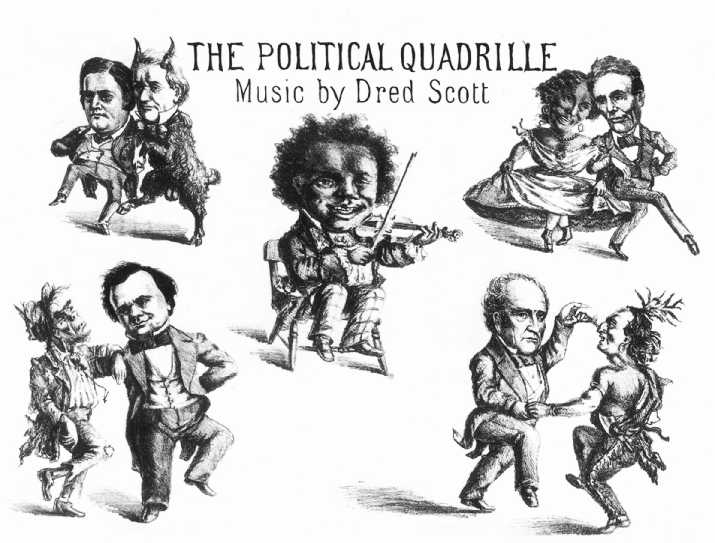
Clockwise from the upper left are John C. Breckinridge, Southern Rights Democrat; Abraham Lincoln, Republican; John Bell, Constitutional Union; and Stephen A. Douglas, Democrat. All are dancing to the tune played by Dred Scott, symbolizing the importance of the slavery issue in this campaign. Each candidate’s partner represents a political liability: for example, Breckinridge’s partner is the disunionist William L. Yancey wearing a devil’s horns, while Lincoln’s partner is a black woman who supposedly gives color to Democratic accusations that Republicans believed in miscegenation.
The Republican platform appealed to many groups in the North. Its main
plank pledged exclusion of slavery from the territories. Other planks called for a higher tariff (especially popular in Pennsylvania), a homestead act (popular in the Northwest), and federal aid for construction of a transcontinental railroad and for improvement of river navigation. This program was designed for a future in which
the “house divided” would become a free-labor society modeled on Northern capi-
talism. Its blend of idealism and materialism proved especially attractive to young people; a large majority of first-time voters in the North voted Republican in
1860. Thousands of them joined Wide-Awake clubs and marched in huge torch-
light parades through the cities of the North.
Southern Fears
Militant enthusiasm in the North was matched by fear and
rage in the South. Few people there could see any difference
between Lincoln and Seward—or for that matter between Lincoln and William
506
Chapter 15 Secession and Civil War, 1860–1862
Lloyd Garrison. They were all Black Republicans and abolitionists. Had not Lin-
coln branded slavery a moral, social, and political evil? Had he not said that the Declaration of Independence applied to blacks as well as whites? Had he not
expressed a hope that excluding slavery from the territories would put it on the
road to ultimate extinction? To Southerners, the Republican pledge not to interfere with slavery in the states was meaningless.
A Republican victory in the presidential election would put an end to the
South’s political control of its destiny. Two-thirds of the time from 1789 to
1860, Southerners (all slaveholders) had been president of the United States.
Two-thirds of the Speakers of the House and presidents pro tem of the Senate
had been Southerners. Southern justices had been a majority on the Supreme
Court since 1791. Lincoln’s election would mark an irreversible turning away
from this Southern ascendancy. Even Southern moderates warned that the South
could not remain in the Union if Lincoln won. “This Government and Black
Republicanism cannot live together,” said one of them. “At no period of the
world’s history have four thousand millions of property [that is, the slave owners]
debated whether it ought to submit to the rule of an enemy.” And what about the
three-quarters of Southern whites who did not belong to slaveholding families?
Lincoln’s election, warned an Alabama secessionist, would show that “the North
[means] to free the negroes and force amalgamation between them and the
children of the poor men of the South.”
Most whites in the South voted for Breckinridge, who carried 11 slave states.
Bell won the upper-South states of Virginia, Kentucky, and Tennessee. Missouri
went to Douglas—the only state he carried, although he came in second in the
popular vote. Although Lincoln received less than 40 percent of the popular
vote, he won every free state and swept the presidency by a substantial margin
in the Electoral College (three of New Jersey’s seven electoral votes went to
Douglas).
VOTING IN THE 1860 ELECTION
All States
Free States (18)
Slave States (15)
Candidate
Popular
Electoral
Popular
Electoral
Popular
Electoral
Lincoln
1,864,735
180
1,838,347
180
26,388
0
Opposition
2,821,157
123
1,572,637
3
1,248,520
120
to Lincoln
“Fusion”
595,846
—
580,426
—
15,420
—
Tickets*
Douglas
979,425
12
815,857
3
163,568
9
Breckinridge
669,472
72
99,381
0
570,091
72
Bell
576,414
39
76,973
0
499,441
39
*In several states, the two Democratic parties and the Constitutional Union Party arranged a single anti-Lincoln ballot. These “fusion” tickets carried several counties but failed to win any state.
The Lower South Secedes
507
THE LOWER SOUTH SECEDES
Lincoln’s victory provided the shock that Southern fire-eaters had craved. The
tension that had been building up for years suddenly exploded like a string of fire-crackers, as seven states seceded one after another. According to the theory of
secession, when each state ratified the Constitution and joined the Union, it
authorized the national government to act as its agent in the exercise of certain functions of sovereignty, but the states had never given away their fundamental
underlying sovereignty. Any state, then, by the act of its own convention, could
withdraw from its “compact” with the other states and reassert its individual sovereignty. Therefore, the South Carolina legislature called for such a convention
and ordered an election of delegates to consider withdrawing from the United
States. On December 20, 1860, the South Carolina convention did withdraw, by
a vote of 169 to 0.
The outcome was closer in other lower-South states. Unconditional unionism
was rare, but many conservatives and former Whigs shrank from the drastic step
of secession. At the conventions in each of the next six states to secede, some delegates tried to delay matters with vague proposals for “cooperation” among all
Southern states, or even with proposals to wait until after Lincoln’s inauguration on March 4, 1861, to see what course he would pursue. Nonetheless, proponents
of immediate secession overrode those minority factions. The conventions followed the example of South Carolina and voted to take their states out of the Union:
Mississippi on January 9, 1861, Florida on the 10th, Alabama on the 11th, Georgia on the 19th, Louisiana on the 26th, and Texas on February 1. In those six states as a whole, 20 percent of the delegates voted against secession, but most of these
“went with their states” after the final votes had been tallied. Delegates from the seven seceding states met in Montgomery, Alabama, in February to create a new
nation to be called the Confederate States of America.
Northerners
Most people in the North considered secession unconstitu-
Affirm the Union
tional and treasonable. In his final annual message to Con-
gress, on December 3, 1860, President Buchanan insisted
that the Union was not “a mere voluntary association of States, to be dissolved at pleasure by any one of the contracting parties.” If secession were consummated,
Buchanan warned, it would create a disastrous precedent that would make the
United States government “a rope of sand.” He continued:
Our thirty-three States may resolve themselves into as many petty, jarring, and hostile republics.... By such a dread catastrophe ... our example for more than eighty years would not only be lost, but it would be quoted as proof that man is unfit for self-government.
European monarchists and conservatives were already expressing smug satis-
faction at “the great smashup” of the republic in North America. They predicted
that other disaffected minorities would also secede and that the United States
would ultimately collapse into anarchy and revolution. That was precisely what
Northerners and even some upper-South Unionists feared. “The doctrine of seces-
sion is anarchy,” declared a Cincinnati newspaper. “If any minority have the right 508
Chapter 15 Secession and Civil War, 1860–1862
to break up the Government at pleasure, because they have not had their way,
there is an end of all government.” Lincoln denied that the states had ever pos-
sessed independent sovereignty before becoming part of the United States. Rather, they had been colonies or territories that never would have become part of the
United States had they not accepted unconditional sovereignty of the national government. “No State, upon its own mere motion, can lawfully get out of the
Union.... They can only do so against law, and by revolution.”
In that case, answered many Southerners, we invoke the right of revolution to
justify secession. After all, the United States was born of revolution. The secessionists maintained that they were merely following the example of their forefathers in declaring independence from a government that threatened their rights and liberties. An Alabaman asked rhetorically: “[Were not] the men of 1776, who withdrew
their allegiance from George III and set up for themselves … Secessionists?”
Northerners could scarcely deny the right of revolution: They too were heirs of
1776. But “the right of revolution, is never a legal right,” said Lincoln. “At most, it is but a moral right, when exercised for a morally justifiable cause. When exercised without such a cause revolution is no right, but simply a wicked exercise of physical power.” The South, in Lincoln’s view, had no morally justifiable cause. In fact, the event that had precipitated secession was his very election by a constitutional
majority. For Southerners to cast themselves in the mold of 1776 was “a libel
upon the whole character and conduct” of the Founding Fathers, said the antislav-
ery poet and journalist William Cullen Bryant. They rebelled “to establish the rights of man … and principles of universal liberty,” whereas Southerners in 1861 were
rebelling to protect “a domestic despotism.... Their motto is not liberty, but
slavery.”
Compromise
Bryant conveniently overlooked the fact that slavery had
Proposals
existed in most parts of the republic founded by the revolu-
tionaries of 1776. In any event, most people in the North
agreed with Lincoln that secession was a “wicked exercise of physical power.” The question was what to do about it. All kinds of compromise proposals came before
Congress when it met in December 1860. To sort them out, the Senate and
the House each set up a special committee. The Senate committee came up with a
package of compromises sponsored by Senator John J. Crittenden of Kentucky. The
Crittenden Compromise consisted of a series of proposed constitutional amend-
ments: to guarantee slavery in the states perpetually against federal interference; to prohibit Congress from abolishing slavery in the District of Columbia or on any
federal property (forts, arsenals, naval bases, and so on); to deny Congress the
power to interfere with the interstate slave trade; to compensate slaveholders who were prevented from recovering fugitive slaves who had escaped to the North; and, most important, to protect slavery south of latitude 36°30′ in all territories “now held or hereafter acquired.”
Given the appetite of the South for more slave territory in the Caribbean and
Central America, that italicized phrase, in the view of most Republicans, might
turn the United States into “a great slavebreeding and slavetrading empire.” But
even though endorsement of the territorial clause in the Crittenden Compromise
The Lower South Secedes
509
OREGON
CALIF.
Counties Carried by Candidates in
1860 Presidential Election
Lincoln
(Republican)
Douglas
(Democratic)
Breckinridge
(Democratic)
Bell
(Constitutional Union)
‘Fusion’ tickets
No returns,
unsettled, etc.
MAINE
V.T.
DAKOTA TERRITORY
MINN.
N.H.
NEW
YORK
MASS.
WISCONSIN
MICH.
R.I.
CONN.
PENNSYLVANIA
IOWA
NEBRASKA TERRITORY
N.J.
OHIO
MD.
ILLINOIS
IND.
DEL.
COLORADO
VIRGINIA
TERR.
8
KANSAS
MISSOURI
(1861)
KENTUCKY
NORTH
CAROLINA
TENNESSEE
10
11
INDIAN TERR.
SOUTH
NEW MEXICO
ARKANSAS
CAROLINA
The Progress of Secession
TERR.
9
1
(Circled numbers indicate order of secession)
GEORGIA
MISS. ALABAMA
4
5
Border slave states that
2
did not secede
States that seceded after
TEXAS
the fall of Fort Sumter
7
LOUISIANA
States that seceded before
6
the fall of Fort Sumter
FLA.
3
Union states
Learning
Cengage©
MAP 15.1 Election of 1860 and Southern Secession
Note the similarity of the geographical voting patterns in the upper map to Map 14.1.
Another striking pattern shows the correlation between the vote for Breckinridge (upper map) and the first seven states to secede (lower map).
510
Chapter 15 Secession and Civil War, 1860–1862
would require Republicans to repudiate the platform on which they had just won
the election, some conservatives in the party were willing to accept it in the interest of peace and conciliation. Their votes, together with those of Democrats and upper-South Unionists whose states had not seceded, might have gotten the compromise
through Congress. In any case, word came from Springfield, Illinois, where
President-elect Lincoln was preparing for his inaugural trip to Washington, telling key Republican senators and congressmen to stand firm against compromise on
the territorial issue. “Entertain no proposition for a compromise in regard to the extension of slavery,” wrote Lincoln.
Filibustering for all South of us, and making slave states would follow ... to put us again on the high-road to a slave empire.... We have just carried an election on principles fairly stated to the people. Now we are told in advance, the government shall be broken up, unless we surrender to those we have beaten.... If we surrender, it is the end of us. They will repeat the experiment upon us ad libitum. A year will not pass, till we shall have to take Cuba as a condition upon which they will stay in the Union.
Lincoln’s advice was decisive. The Republicans voted against the Crittenden
Compromise, which therefore failed in Congress. Most Republicans, though, went
along with a proposal by Virginia for a “peace convention” of all the states to be held in Washington in February 1861. In the end, however, the peace convention
produced nothing better than a modified version of the Crittenden Compromise,
which suffered the same fate as the original.
Nothing that happened in Washington would have made any difference to the
seven states that had seceded. No compromise could bring them back. “We spit
upon every plan to compromise,” said one secessionist. No power could “stem
the wild torrent of passion that is carrying everything before it,” wrote former
U.S. Senator Judah P. Benjamin of Louisiana. Secession “is a revolution [that]
can no more be checked by human effort ... than a prairie fire by a gardener’s
watering pot.”
Establishment
While the peace convention deliberated in Washington, the
of the
seceded states focused on a convention in Montgomery,
Confederacy
Alabama, that drew up a constitution and established a
government for the new Confederate States of America. The
Confederate constitution contained clauses that guaranteed slavery in both the
states and the territories, strengthened the principle of state sovereignty, and prohibited its Congress from enacting a protective (as distinguished from a revenue) tariff. It limited the president to a single six-year term. The convention delegates constituted themselves a provisional Congress for the new nation until regular
elections could be held in November 1861. For provisional president and vice
president, the convention turned away from radical secessionists, such as Yancey, and elected Jefferson Davis, a moderate secessionist, and Alexander Stephens, who had originally opposed Georgia’s secession but ultimately had supported it.
Davis and Stephens were two of the most able men in the South, with 25 years
of service in the U.S. Congress between them. A West Point graduate, Davis had
commanded a regiment in the Mexican War and had been secretary of war in the
Pierce administration—a useful fund of experience if civil war became a reality. But The Fort Sumter Issue
511
perhaps the main reason they were elected was to present an image of moderation
and respectability to the eight upper-South states that remained in the Union. The Confederacy needed those states—at least some of them—if it was to be a viable
nation, especially if war came. Without the upper South, the Confederate states
would have less than one-fifth of the population (and barely one-tenth of the free population) and only one-twentieth of the industrial capacity of the Union states.
Confederate leaders appealed to the upper South to join them because of the “com-
mon origin, pursuits, tastes, manners and customs [that] bind together in one brotherhood the … slaveholding states.” Residents of the upper South were indeed
concerned about preserving slavery, but the issue was less salient there. A strong heritage of Unionism competed with the commitment to slavery. Virginia had
contributed more men to the pantheon of Founding Fathers than any other state.
Tennessee took pride in being the state of Andrew Jackson, who was famous for
his stern warning to John C. Calhoun: “Our Federal Union—It must be
preserved.” Kentucky was the home of Henry Clay, the Great Pacificator, who
had put together compromises to save the Union on three occasions. These states
would not leave the Union without greater cause.
THE FORT SUMTER ISSUE
As each state seceded, it seized the forts, arsenals, customs houses, and other federal property within its borders. Still in federal hands, however, were two remote forts in the Florida Keys, another on an island off Pensacola, and Fort Moultrie in the Charleston harbor. Moultrie quickly became a bone of contention. In December
1860, the self-proclaimed republic of South Carolina demanded its evacuation by
the 84-man garrison of the U.S. Army. Moultrie was vulnerable to attack by the
South Carolina militia that swarmed into the area. On the day after Christmas
1860, Major Robert Anderson, commander at Moultrie, moved his men to Fort
Sumter, an uncompleted but immensely strong bastion on an artificial island in
the channel leading into Charleston Bay. A Kentuckian married to a Georgian,
Anderson sympathized with the South but remained loyal to the United States. He
deplored the possibility of war and hoped that moving the garrison to Sumter
would ease tensions by reducing the possibility of an attack. Instead, it lit a fuse that eventually set off the war.
South Carolina sent a delegation to President Buchanan to negotiate the with-
drawal of the federal troops. Buchanan surprised them by saying no. He even tried to reinforce the garrison. On January 9, the unarmed merchant ship Star of the
West, carrying 200 soldiers for Sumter, tried to enter the bay but was driven away by South Carolina artillery. Loath to start a war, Major Anderson refused to return fire with Sumter’s guns. Matters then settled into an uneasy truce. The Confederate government sent General Pierre G. T. Beauregard to take command of the troops
ringing Charleston Bay with their cannons pointed at Fort Sumter, and waited to
see what the incoming Lincoln administration would do.
When Abraham Lincoln took the oath of office as the 16th—and, some specu-
lated, the last—president of the United States, he knew that his inaugural address would be the most important in American history. On his words would hang the
issues of union or disunion, peace or war. His goal was to keep the upper South
512
Chapter 15 Secession and Civil War, 1860–1862
in the Union while cooling passions in the lower South, hoping that, in time,
Southern loyalty to the Union would reassert itself. In his address, he demonstrated firmness in purpose to preserve the Union and forbearance in the means of doing
so. He repeated his pledge not “to interfere with the institution of slavery where it exists.” He assured the Confederate states, “the government will not assail you.”
His first draft had also included the phrase “unless you first assail it,” but William H. Seward, whom Lincoln had appointed secretary of state, persuaded him to drop
those words as too provocative. Lincoln’s first draft had also stated his intention to use “all the powers at my disposal [to] reclaim the public property and places which have fallen.” He deleted that statement as too warlike and said only that he would
“hold, occupy, and possess the property, and places belonging to the government,”
without defining exactly what he meant or how he would do it. In his eloquent
peroration, Lincoln appealed to Southerners as Americans who shared with other
Americans four score and five years of national history. “We are not enemies, but friends,” he said.
Though passion may have strained, it must not break, our bonds of affection. The
mystic chords of memory, stretching from every battlefield and patriot grave to every living heart and hearthstone all over this broad land, will yet swell the chorus of the Union when again touched, as surely they will be, by the better angels of our nature.
Bettmann/CORBIS©
Bombardment of Fort Sumter, April 12, 1861. This illustration shows Confederate
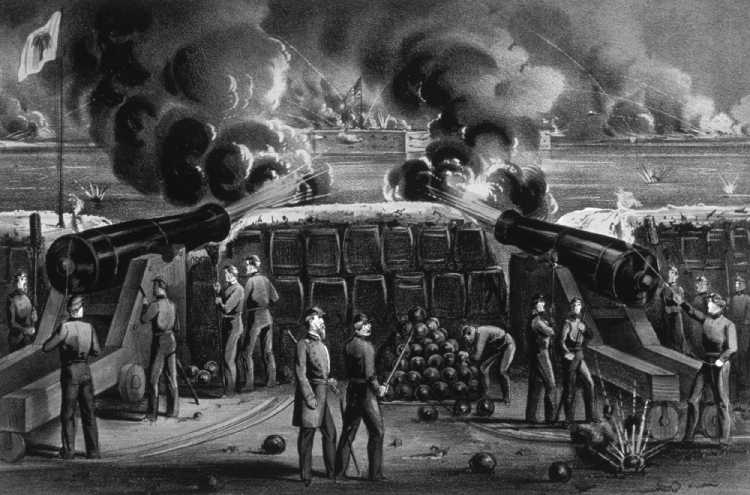
artillery in Fort Moultrie near Charleston, South Carolina, firing on Fort Sumter in the middle distance. Other Confederate guns are also firing on Fort Sumter from Fort Johnson, shown in the upper right portion of the picture. Confederate shells set the interior of Fort Sumter on fire, as portrayed here, forcing its surrender to forestall additional fires that might reach the powder magazine.
Choosing Sides
513
Lincoln hoped to buy time with his inaugural address—time to demonstrate his
peaceful intentions and to enable southern Unionists (whose numbers Republicans
overestimated) to regain the upper hand. But the day after his inauguration, Lincoln learned that time was running out. A dispatch from Major Anderson informed him
that provisions for the soldiers at Fort Sumter would soon be exhausted. The garrison must either be resupplied or evacuated. Any attempt to send in supplies by
force would undoubtedly provoke a response from Confederate guns at Charleston.
And by putting the onus of starting a war on Lincoln’s shoulders, such an action
would undoubtedly divide the North and unite the South, driving at least four
more states into the Confederacy. Thus, most members of Lincoln’s cabinet, along
with the army’s General-in-Chief Winfield Scott, advised Lincoln to withdraw the
troops from Sumter. That, however, would bestow a great moral victory on the
Confederacy. It would confer legitimacy on the Confederate government and would
probably lead to diplomatic recognition by foreign powers. Having pledged to
“hold, occupy, and possess” national property, could Lincoln afford to abandon
that policy during his first month in office?
The pressures from all sides caused Lincoln many sleepless nights. Finally, he hit upon a solution that evidenced the mastery that would mark his presidency. He
decided to send in unarmed ships with supplies but to hold troops and warships outside the harbor with authorization to go into action only if the Confederates used force to stop the supply ships. And he would give South Carolina officials advance notice of his intention. This stroke of genius shifted the decision for war or peace to Jefferson Davis. If Confederate troops fired on the supply ships, the South would stand convicted of starting a war by attacking “a mission of humanity” bringing
“food for hungry men.” If Davis allowed the supplies to go in peacefully, the U.S.
flag would continue to fly over Fort Sumter. The Confederacy would lose face at
home and abroad, and southern Unionists would take courage.
Davis did not hesitate. He ordered General Beauregard to compel Sumter’s
surrender before the supply ships got there. At 4:30 A.M. on April 12, 1861,
Confederate guns set off the Civil War by firing on Fort Sumter. After a 33-hour
bombardment the burning fort lowered the U.S. flag in surrender.
CHOOSING SIDES
News of the attack triggered an outburst of anger and war fever in the North. “The town is in a wild state of excitement,” wrote a Philadelphia diarist. “The American flag is to be seen everywhere.… Men are enlisting as fast as possible.” A New York woman wrote that the “time before Sumter” seemed like another century. “It seems
as if we were never alive till now; never had a country till now.”
Because the tiny U.S. Army—most of whose 16,000 soldiers were stationed at
remote frontier posts—was inadequate to quell the “insurrection,” Lincoln called
on the states for 75,000 militia. The free states filled their quotas immediately.
More than twice as many men volunteered as Lincoln had requested. Recognizing
that the 90 days’ service, to which the militia were limited by law, would be too short a time, on May 3 Lincoln issued a call for three-year volunteers. Before the war was over, more than 2 million men would serve in the Union army and navy.
514
Chapter 15 Secession and Civil War, 1860–1862
Slavery and Secession
The higher the proportion of slaves and slaveholders in the population of a southern state, the greater the intensity of secessionist sentiment.
Population
White Population
Who Were
in Slaveholding
Slaves
Families
Seven states that seceded December 1860–
47%
38%
February 1861 (South Carolina, Mississippi,
Florida, Alabama, Georgia, Louisiana, Texas)
Four states that seceded after the firing on Fort
32%
24%
Sumter (Virginia, Arkansas, Tennessee, North
Carolina)
Four border slave states remaining in Union
14%
15%
(Maryland, Delaware, Kentucky, Missouri)
The eight slave states still in the Union rejected Lincoln’s call for troops. Four of them—Virginia, Arkansas, Tennessee, and North Carolina—soon seceded and
joined the Confederacy. As a former Unionist in North Carolina remarked, “The
division must be made on the line of slavery. The South must go with the South….
Blood is thicker than Water.”
Few found the choice harder to make than Robert E. Lee of Virginia. One of
the most promising officers in the U.S. Army, Lee believed that Southern states had no legal right to secede. General-in-Chief Winfield Scott wanted Lee to become field commander of the Union army. Instead, Lee sadly resigned from the army after the
Virginia convention passed an ordinance of secession on April 17. “I must side
either with or against my section,” Lee told a Northern friend. “I cannot raise my hand against my birthplace, my home, my children.” Along with three sons and a
nephew, Lee joined the Confederate army.
Most Southern whites embraced war against the Yankees with more enthusi-
asm. When news of Sumter’s surrender reached Richmond, a huge crowd poured
into the state capitol square and ran up the Confederate flag. “Everyone is in favor of secession [and] perfectly frantic with delight,” wrote a participant. “I never in all my life witnessed such excitement.” The London Times correspondent described
crowds in North Carolina with “flushed faces, wild eyes, screaming mouths, hur-
rahing for ‘Jeff Davis’ and ‘the Southern Confederacy.’” No one in those cheering crowds could know that before the war ended, at least 260,000 Confederate soldiers would lose their lives (along with 365,000 Union soldiers) and that the slave South they fought to defend would be utterly destroyed.
The Border
Except for Delaware, which remained firmly in the Union,
States
the slave states that bordered free states were sharply divided
by the outbreak of war. Leaders in these states talked vaguely
of neutrality, but they were to be denied that luxury—Maryland and Missouri
Choosing Sides
515
immediately, and Kentucky in September 1861 when first Confederate and then
Union troops crossed their borders.
The first blood was shed in Maryland on April 19, 1861, when a mob
attacked Massachusetts troops traveling through Baltimore to Washington. The
soldiers fired back, leaving 12 Baltimoreans and 4 soldiers dead. Confederate partisans burned bridges and tore down telegraph wires, cutting Washington off from
the North for nearly a week until additional troops from Massachusetts and New
York reopened communications and seized key points in Maryland. The troops
also arrested many Confederate sympathizers. To prevent Washington from
becoming surrounded by enemy territory, federal forces turned Maryland into an
occupied state. Although thousands of Marylanders slipped into Virginia to join
the Confederate army, a substantial majority of Maryland residents remained
loyal to the Union.
The same was true of Missouri. Aggressive action by Union commander Na-
thaniel Lyon provoked a showdown between Unionist and pro-Confederate militia
that turned into a riot in St. Louis on May 10 and 11, 1861, in which 36 people
died. Lyon then led his troops in a summer campaign that drove the Confederate
militia, along with the governor and pro-Southern legislators, into Arkansas, where they formed a Missouri Confederate government in exile. Reinforced by Arkansas
regiments, these rebel Missourians invaded their home state, and on August 10
defeated Lyon (who was killed) in the bloody battle of Wilson’s Creek in the southwest corner of Missouri. The victorious Confederates marched northward all the
way to the Missouri River, capturing a Union garrison at Lexington 40 miles east
of Kansas City on September 20. Union forces then regrouped and drove the ragged
Missouri Confederates back into Arkansas.
From then until the war’s end, Unionists maintained political control of
Missouri through military power. Even so, continued guerrilla attacks by Confed-
erate “bushwhackers” and counterinsurgency tactics by Unionist “jay-hawkers”
turned large areas of the state into a no-man’s-land of hit-and-run raids, arson, ambush, and murder. During these years, the famous postwar outlaws Jesse and
Frank James and Cole and Jim Younger rode with the notorious rebel guerrilla
chieftains William Quantrill and “Bloody Bill” Anderson. More than any other
state, Missouri suffered from a civil war within the Civil War, and its bitter legacy persisted for generations.
In elections held during summer and fall 1861, Unionists gained firm control
of the Kentucky and Maryland legislatures. Kentucky Confederates, like those of
Missouri, formed a state government in exile. When the Confederate Congress
admitted both Kentucky and Missouri to full representation, the Confederate flag
acquired its 13 stars. Nevertheless, two-thirds of the white population in the four border slave states favored the Union, although some of that support was undoubtedly induced by the presence of Union troops.
The Creation of
The war produced a fifth Union border state: West Virginia.
West Virginia
Most of the delegates from the portion of Virginia west of
the Shenandoah Valley had voted against secession. A region
of mountains, small farms, and few slaves, western Virginia’s economy was linked