• Kansas and the Rise of the Republican Party • Immigration and
Nativism • Bleeding Kansas • The Election of 1856 • The Economy
in the 1850s • The Lincoln-Douglas Debates
THEWOUNDScausedbythe1850battleoverslaveryintheterritorieshadbarely
healed when they were reopened. This time the strife concerned the question of
slavery in the Louisiana Purchase territory, an issue presumably settled 34 years earlier by the Missouri Compromise of 1820.
The Compromise of 1820 had admitted Missouri as a slave state but had
banned slavery from the rest of the Purchase north of 36°300. To obtain southern
support for the organization of Kansas and Nebraska as territories, Senator Stephen Douglas consented to the repeal of this provision. Northern outrage at this repudiation of a “sacred contract” killed the Whig Party and gave birth to the antislavery Republican Party. In 1857, the Supreme Court added insult to injury with the Dred Scott decision, which denied Congress the power to restrict slavery from the territories. The ominous reorientation of national politics along sectional lines was
accompanied by a bloody civil war in Kansas and a raid on the federal arsenal at
Harpers Ferry, Virginia, by John Brown and his followers.
KANSAS AND THE RISE OF THE REPUBLICAN PARTY
By 1853, land-hungry settlers had pushed up the Missouri River to its confluence
with the Kansas and Platte rivers, and entrepreneurs were talking about a railroad across the continent to San Francisco. But settlement west of Missouri and land surveys for a railroad required the organization of this region as a territory. Accordingly, in 1853 the House passed a bill creating the Nebraska Territory, embracing the area north of Indian Territory (present-day Oklahoma) up to the Canadian
470
Kansas and the Rise of the Republican Party
471
CHRONOLOGY
1852
Plenary Council of Catholic Church seeks tax support for parochial
schools
1853
American Party (“Know-Nothings”) emerges
1854
Crimean War begins ◆ Congress passes Kansas-Nebraska Act
◆ Republican Party organized ◆ Antebellum immigration reaches peak
1855
Ethnic riots in several cities ◆ “Border Ruffian” legislature in
Kansas legalizes slavery
1856
Civil war in Kansas ◆ Preston Brooks canes Charles Sumner on
Senate floor ◆ Crimean War ends ◆ Buchanan wins three-way
presidential election
1857
Supreme Court issues Dred Scott decision ◆ Lecompton
constitution written in Kansas ◆ Congress enacts lower tariff
◆ Panic of 1857 ◆ Helper’s Impending Crisis published
1858
Kansas voters reject Lecompton constitution ◆ Lincoln-Douglas
debates
1859
Congress defeats federal slave code for territories ◆ John Brown’s
raid at Harpers Ferry
1860
Shoemakers’ strike in New England ◆ Buchanan vetoes
Homestead Act
border. But the House bill ran into trouble in the Senate. Under the Missouri Compromise, slavery would be excluded from the new territory. Having lost California, the pro-slavery forces were determined to salvage something from Nebraska.
Missourians were particularly adamant, because a free Nebraska would leave
them almost surrounded on three sides by free soil. Senator David R. Atchison of
Missouri vowed to see Nebraska “sink in hell” before having it become free soil.
As president pro tem of the Senate, Atchison wielded great influence. A pro-
fane, gregarious man, he had inherited Calhoun’s mantle as leader of the
southern-rights faction. In the 1853–54 session of Congress, he kept raising the asking price for southern support of a bill to organize the Nebraska Territory. The
sponsor of the Senate bill was Stephen A. Douglas, chairman of the Senate Commit-
tee on Territories. Only 5 feet 4 inches tall, Douglas had earned the nickname Little Giant for his parliamentary skill, which he had demonstrated most dramatically in helping pass the Compromise of 1850 through Congress. In Douglas’s opinion, the
application of popular sovereignty to the slavery question in New Mexico and Utah had been the centerpiece of the compromise. The initial draft of his Nebraska bill merely repeated the language used for those territories, specifying that when any portion of the Nebraska Territory came in as a state, it could do so “with or without slavery, as its constitution may provide.”
This was not good enough for Atchison and his southern colleagues. After talk-
ing with them, Douglas announced that because of a “clerical error,” a provision calling for the territorial legislature to decide on slavery had been omitted from the draft.
472
Chapter 14 The Gathering Tempest, 1853–1860
But Atchison raised the price once again, insisting on an explicit repeal of the Missouri Compromise. Sighing in response, Douglas stated that this action “will raise a hell of a storm,” but he nevertheless agreed. He further agreed to divide the area in question into two territories: Kansas west of Missouri and Nebraska west of Iowa and Minnesota. To many northerners this looked suspiciously like a scheme to mark Kansas out for slavery and Nebraska for freedom. Douglas then joined Jefferson Davis, Atchison, and other southern senators on a visit to the White House, where they twisted President Pierce’s arm to give the revised Kansas-Nebraska bill the administration’s support and to make its approval “a test of [Democratic] party orthodoxy.”
The Kansas-
The bill did “raise a hell of a storm.” Contemporaries and
Nebraska Act
historians have speculated endlessly on Douglas’s motives.
Some thought he wanted to win southern support for the
presidential nomination in 1856. Perhaps, but he risked losing northern support.
Others point out that Douglas’s real estate holdings in Illinois would have
increased in value if a transcontinental railroad were to traverse the Nebraska
Territory and that southern opposition could block this route. The most likely
reason, however, was Douglas’s passionate belief in Manifest Destiny, in filling up the continent with American settlers and institutions. “The tide of immigration and civilization must be permitted to roll onward,” he proclaimed. For this, he was
willing to pay the South’s price for support of his Kansas-Nebraska bill. He failed to recognize the depth of northern opposition to the “slave power” and to the
expansion of slavery. Douglas had no firm moral convictions about slavery. He
said that he cared not whether the settlers voted slavery up or down; the important thing was to give them a chance to vote.
But many Americans did care. They regarded the expansion of slavery as a
national question, and one that was too important to be left to territorial voters.
One of them was an old acquaintance of Douglas, Abraham Lincoln. An antislav-
ery Whig who had served four terms in the Illinois legislature and one term in
Congress, Lincoln was propelled back into politics by the shock of the Kansas-
Nebraska bill. He acknowledged the constitutional right to hold slave property in the states where it already existed, but he believed slavery was “an unqualified evil to the negro, the white man, and to the state.... There can be no moral right in connection with one man’s making a slave of another.” Lincoln admitted he did not
know how to bring this deeply entrenched institution to an end. He understood
that race prejudice was a powerful obstacle to emancipation. Still, he believed that the country must face up to the problem. It must stop any further expansion of
slavery as the first step on the long road to its “ultimate extinction.”
Lincoln excoriated Douglas’s “care not” attitude toward whether slavery was
voted up or down. He branded Douglas’s assertion that slavery would never be
imported into Kansas because of the region’s supposedly unsuitable climate a
“LULLABY argument.” The climate of eastern Kansas was similar to that of the
Missouri River Valley in Missouri, where slaves were busily raising hemp and
tobacco. Missouri slaveholders were already poised to take their slaves into the
Kansas River valley. “Climate will not … keep slavery out of these territories,”
said Lincoln. “Nothing in nature will.” Many of the founding fathers had looked
Kansas and the Rise of the Republican Party
473
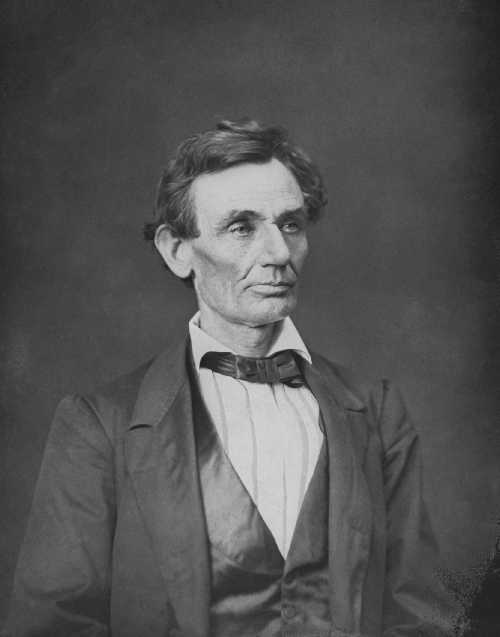
Abraham Lincoln.
Nominated to oppose
Stephen A. Douglas’s
reelection to the Senate
from Illinois in 1858,
Abraham Lincoln was not
yet a national figure. But
his status would change
dramatically with the
Lincoln-Douglas debates
of 1858, which focused
on the issue of slavery.
Lincoln’s eloquence in
this series of debates
propelled him into
national prominence.
NY
Resource,
Adoc-photos/Art©
forward to the day when slavery would no longer exist in republican America.
Instead, the United States had become the world’s largest slaveholding society, and Douglas’s bill would permit slavery to expand even further. In a political speech at Peoria, Illinois, in October 1854, Lincoln insisted:
The monstrous injustice of slavery deprives our republican example of its just influence in the world—enables the enemies of free institutions, with plausibility, to taunt us as hypocrites.… Let us re-adopt the Declaration of Independence, and with it, the practices, and policy, which harmonize with it.... If we do this, we shall not only have saved the Union; but we shall have so saved it, as to make, and to keep it, forever worthy of the saving.
With these eloquent words, Lincoln gave voice to the feelings rising up against
the Kansas-Nebraska bill. Abolitionists, Free-Soilers, northern Whigs, and even
many northern Democrats held impassioned meetings to form anti-Nebraska coali-
tions, but they could not stop passage of the bill. It cleared the Senate easily, supported by a solid South and 15 of the 20 northern Democrats. In the House, it
passed by a vote of 113 to 100.
Death of the
These proceedings completed the destruction of the Whigs as
Whig Party
a national party. Southern Whigs had been disappearing ever
since Zachary Taylor had “betrayed” them on the issue of a
474
Chapter 14 The Gathering Tempest, 1853–1860
free California. After the presidential election of 1852, few Whigs remained in the cotton South. In that year, the Whig Party nominated General Winfield Scott for
president. Although he was a Virginian, Scott, like Taylor, took a national rather than a southern view. He was the candidate of the northern Whigs in the national
convention, which nominated him on the 53rd ballot after a bitter contest between the northern and southern wings of the party. A mass exodus of southern Whigs
into the Democratic Party enabled Franklin Pierce to carry all but two slave states in the election. The unanimous vote of northern Whigs in Congress against the
Kansas-Nebraska bill was the final straw. The Whig Party never recovered its
influence in the South.
Whig strength seemed to be on its last legs in the North as well. Antislavery
Whig leaders, such as Seward and Lincoln, hoped to channel the flood of anti-
Nebraska sentiment through the Whig Party, an effort akin to containing Niagara
Falls. Free-Soilers and antislavery Democrats spurned the Whig label. Political coalitions arose spontaneously in the North under various names: anti-Nebraska, Fusion, People’s, Independent. The name that caught on evoked memories of America’s first fight for freedom in 1776: Republican. The first use of this name seems to have
occurred at an anti-Nebraska rally in a Congregational church at Ripon, Wisconsin, in May 1854. Soon, most of the congressional candidates fielded by anti-Nebraska
coalitions ran their campaigns under the Republican banner.
The 1854 elections were disastrous for northern Democrats. One-fourth of
Democratic voters deserted the party. The Democrats lost control of the House of
Representatives when 66 of 91 incumbent free-state Democratic congressmen went
down to defeat. Combined with the increase in the number of Democratic congress-
men from the South, where the party had picked up the pieces of the shattered
Whig organization, this rout brought the party under southern domination more
than ever.
But who would pick up the pieces of old parties in the North? The new
Republican Party hoped to do so, but it suffered a shock in urban areas of the
Northeast. Hostility toward immigrants created a tidal wave of nativism that
threatened to swamp the anti-Nebraska movement. “Nearly everybody appears
to have gone deranged on Nativism,” reported a Pennsylvania Democrat, while a
Whig in upstate New York warned that his district was “very badly infected with
Know-nothingism.” Described as a “tornado,” a “hurricane,” a “freak of political
insanity,” the Know-Nothings won landslide victories in Massachusetts and
Delaware, polled an estimated 40 percent of the vote in Pennsylvania, and did
well elsewhere in the Northeast and border states. Who were these mysterious
Know-Nothings? What did they stand for?
IMMIGRATION AND NATIVISM
During the early 19th century, immigration was less pronounced than in most other periods of U.S. history. The volume of immigration (the number of new immigrants
in proportion to the whole population) was little more than 1 percent in the 1820s, increasing to 4 percent in the 1830s. Three-quarters of the newcomers were Protestants, mainly from Britain. Most of them were skilled workers, farmers, or members of white-collar occupations.
Immigration and Nativism
475
In the 1840s, a combination of factors abruptly quadrupled the volume of immi-
gration and changed its ethnic and occupational makeup. The pressure of expanding population on limited land in Germany and successive failures of the potato crop in Ireland impelled millions of German and Irish peasants to emigrate. A majority came to the United States, where recovery from the depression of the early 1840s brought an economic boom and an insatiable demand for labor. During the decade after
1845, three million immigrants entered the United States—15 percent of the total
American population in 1845, the highest proportional volume of immigration in
American history. Many of them, especially the Irish, joined the unskilled and semiskilled labor force in the rapidly growing eastern cities.
450
400
350
Revolution
in
Germany
300
250
Thousands 200
Potato
Famine
in Ireland
150
100
Civil War
50
0 1830 1840
1850
1860
1870
Immigration to the United States
Source: From Division and the Stresses of Reunion 1845–1876, by David M. Potter. Copyright © 1973 Scott, Fores-man and Company. Reprinted by permission.
476
Chapter 14 The Gathering Tempest, 1853–1860
Most of the new arrivals were Roman Catholics. Anti-Catholicism had
centuries-deep roots in Anglo-American Protestantism. Fear of the pope and of the Roman Church as autocratic and antirepublican was never far below the surface of
American political culture, and scurrilous anti-Catholic literature circulated during the 1830s. Several ethnic riots between Protestant and Catholic workers over the
years culminated in pitched battles and numerous deaths in Philadelphia in 1844.
In several eastern cities nativist political parties sprang up in the early 1840s with the intent of curbing the political rights of immigrants.
Nativism appeared to subside with the revival of prosperity after 1844, but the
decline was temporary. Established Americans perceived more recent arrivals as
responsible for an increase of crime and poverty in the cities. They also viewed immigrant customs with suspicion. The social and political life of both the Irish and the Germans revolved around taverns and beer parlors at a time when the temperance
crusade had sharply curtailed drinking among native-born Protestants (see Chapter 11).
Immigrants
The growing political power of immigrants became a bone of
in Politics
contention. In Boston, for example, the number of foreign-
born voters (mostly Irish) increased by 200 percent from 1850
to 1855, whereas the number of native-born voters grew by only 14 percent. Most of the immigrants became Democrats, because that party welcomed or at least tolerated them and many Whigs did not. Foreign-born voters leaned toward the pro-slavery
wing of the Democratic Party, even though seven-eighths of them settled in free
states. Mostly working-class and poor, they rubbed shoulders against the small
northern black population; Irish American mobs sometimes attacked black neigh-
borhoods and rioted against black workers. They supported the Democratic Party as the best means of keeping blacks in slavery and out of the North. These attitudes sparked hostility toward immigrants among many antislavery people, some of whom
equated slavery with Catholicism as a backward, despotic, repressive institution.
The Roman Catholic hierarchy did little to allay that hostility. Pope Pius IX
(1846–78) led the Church into a period of reaction against secular liberalism. The Church sided with the counterrevolutionary forces that crushed the European uprisings of 1848, which sought greater political and social democracy. In the United
States, the leading Catholic prelate, Archbishop John Hughes of New York, taking
his cue from the pope, attacked abolitionists, Free-Soilers, and various Protestant reform movements as akin to the Red Republicanism of Europe. In 1850, in a
widely publicized address titled “The Decline of Protestantism and Its Causes,”
Hughes noted proudly that Catholic Church membership in the United States had
grown three times faster than Protestant membership over the previous decade,
and he predicted an eventual Catholic majority.
Attitudes toward immigrants had political repercussions. Two of the hottest
issues in state and local politics during the early 1850s were temperance and schools.
The temperance crusaders had grown confident and aggressive enough to go into
politics. The drunkenness and rowdiness they associated with Irish immigrants
became one of their particular targets. Beginning with Maine in 1851, 12 states had enacted prohibition laws by 1855. Although several of the laws were soon weakened by the courts or repealed by legislatures, they exacerbated ethnic tensions.
Immigration and Nativism
477
So too did battles over public schools versus parochial schools. Catholics resented the Protestant domination of public education and the reading of the King James Bible in schools. Archbishop Hughes flayed the public schools as purveyors of “Socialism, Red Republicanism, Universalism, Infidelity, Deism, Atheism, and Pantheism.” The
Church began to build parochial schools for the faithful, and in 1852, the first Plenary Council of American bishops decided to seek tax support for these schools or tax relief for Catholic parents who sent their children to them. This effort set off heated election contests in numerous northern cities and states. Anti-Catholic “free school”
tickets won most of these elections on a platform of defending public schools against the “bold effort” of this “despotic faith” to “uproot the tree of Liberty.”
The Rise of the
It was in this context that the Know-Nothings (their formal
Know-Nothings
name was the American Party) burst onto the political scene.
This party was the result of the merger in 1852 of two secret
fraternal societies that limited their membership to native-born Protestants: the Order of the Star-Spangled Banner and the Order of United Americans. Recruiting
mainly young men in skilled blue-collar and lower white-collar occupations, the
merged Order had a membership of 1 million or more by 1854. The Order sup-
ported temperance and opposed tax support for parochial schools. Members
wanted public office restricted to native-born men and sought to lengthen the naturalization period before immigrants could become citizens. Members were also
pledged to secrecy; if asked about the order, they were to reply, “I know nothing.”
This was the tornado that swept through the Northeast in the 1854 elections.
Although the American Party drew voters from both major parties, it cut more
heavily into the Whig constituency. Northern Whigs who had not already gone
over to the Republicans flocked to the Know-Nothings.
When the dust of the 1854 elections settled, it was clear that those who op-
posed the Democrats would control the next House of Representatives. But who
would control the opposition—antislavery Republicans or nativist Americans? In
truth, some northern voters and the congressmen they elected adhered to both po-
litical faiths. A Know-Nothing convention in Massachusetts resolved that “there
can exist no real hostility to Roman Catholicism which does not also abhor
slavery.” In New England, several Know-Nothing leaders were actually Republi-
cans in disguise who had jumped on the nativist bandwagon with the intention of
steering it in an antislavery direction.
But many Republicans warned against flirting with religious bigotry. In a letter
to a friend, Abraham Lincoln asked:
How can any one who abhors the oppression of negroes, be in favor of degrading
classes of white people? ... As a nation, we began by declaring that “all men are created equal.” We now practically read it “all men are created equal, except negroes.” When the Know Nothings get control, it will read “all men are created equal, except negroes, and foreigners, and catholics.” When it comes to this I should prefer emigrating to some country where they make no pretense of loving liberty—to Russia, for instance, where despotism can be taken pure, and without the base alloy of hypocrisy.
Other Republicans echoed Lincoln. Because “we are against Black Slavery,
because the slaves are deprived of human rights,” they declared, “we are also
478
Chapter 14 The Gathering Tempest, 1853–1860
against … [this] system of Northern Slavery to be created by disfranchising the Irish and Germans.”
The Decline
In 1855, Republican leaders maneuvered skillfully to divert
of Nativism
the energies of northern Know-Nothings from their crusade
against the pope to a crusade against the slave power. Two
developments helped them. The first was turmoil in Kansas, which convinced many
northerners that the slave power was a greater threat than the pope. The second
was an increase of nativist sentiment in the South. The American Party won elec-
tions in Maryland, Kentucky, and Tennessee and polled at least 45 percent of the
votes in five other southern states. Violence in several southern cities with large immigrant populations revealed a significant streak of nativism in the South.
These developments had important implications at the national level. Southern
Know-Nothings were pro-slavery, whereas many of their Yankee counterparts were
antislavery. Just as the national Whig party had foundered on the slavery issue, so did the American Party during 1855 and 1856. At the party’s first national council in June 1855, most of the northern delegates walked out when southerners and
northern conservatives joined forces to pass a resolution endorsing the Kansas-
Nebraska Act. A similar scene occurred at an American Party convention in 1856.
By that time, most northern members of the party had, in effect, become Republi-
cans. When the House of Representatives elected in 1854 convened in December
1855, a protracted fight for the speakership again took place. The Republican candidate was Nathaniel P. Banks of Massachusetts, a former Know-Nothing who now
considered himself a Republican. Banks finally won on the 133rd ballot with the support of about 30 Know-Nothings who thereby declared themselves Republicans.
By that time, nativism had faded. The volume of immigration suddenly
dropped by more than half in 1855 and stayed low for the next several years. Eth-
nic tensions eased, and cultural issues such as temperance and schools receded.
Although the Republican Party took on some of the cultural baggage of nativism
when it absorbed many northern Know-Nothings, party leaders shoved the baggage
into dark corners. The real conflict was not the struggle between native and immigrant, or between Protestant and Catholic, but between North and South over the
extension of slavery. That conflict led to civil war—and the war seemed already to have begun in the territory of Kansas.
BLEEDING KANSAS
When it became clear that southerners had the votes to pass the Kansas-Nebraska
Act, William H. Seward stood up in the Senate and told his southern colleagues:
“Since there is no escaping your challenge, I accept it in behalf of the cause of freedom. We will engage in competition for the virgin soil of Kansas, and God give victory to the side which is stronger in numbers as it is in right.” Senator David
Atchison of Missouri was ready for the expected influx of Free-Soil settlers to the new Kansas Territory. “We are playing for a mighty stake,” he wrote. “If we win
we carry slavery to the Pacific Ocean; if we fail we lose Missouri, Arkansas, Texas and all the territories; the game must be played boldly.”
Bleeding Kansas
479
Atchison did play boldly. At first, Missouri settlers in Kansas posted the stron-
ger numbers. As the year 1854 progressed, however, settlers from the North came
pouring in. Alarmed by this influx, bands of Missourians, labeled “border ruffians”
by the Republican press, rode into Kansas prepared to vote as many times as necessary to install a pro-slavery government. In fall 1854, they cast at least 1,700 illegal ballots and sent a pro-slavery territorial delegate to Congress.
When the time came for the election of a territorial legislature the following
spring, Atchison led a contingent of border ruffians to Kansas for the election.
“There are eleven hundred coming over from Platte County to vote,” he told his
followers, “and if that ain’t enough, we can send five thousand—enough to kill
every God-damned abolitionist in the Territory.”
His count was accurate. Nearly 5,000 came and voted illegally to elect a pro-
slavery territorial legislature. The territorial governor pleaded with President Pierce to nullify the election, but Pierce listened to Atchison and removed the governor.
Meanwhile, the new territorial legislature legalized slavery and adopted a slave
code that even authorized the death penalty for helping a slave to escape.
The so-called Free State party, outraged by these proceedings, had no intention
of obeying laws enacted by this “bogus legislature.” By fall 1855, they constituted a majority of bona fide settlers in Kansas. They called a convention, adopted a free-state constitution, and elected their own legislature and governor. By January 1856, two territorial governments in Kansas stood with their hands at each other’s throats.
#FK2.83*15
Society,
Historical
State
Kansas
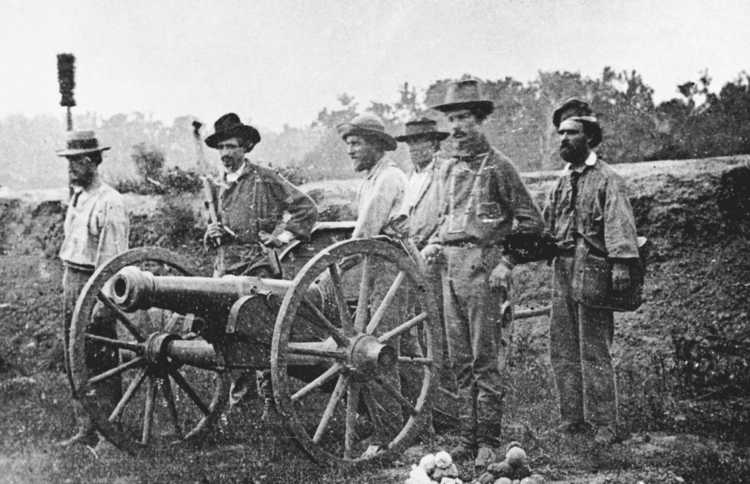
Free-State Men Ready to Defend Lawrence, Kansas, in 1856. After pro-
slavery forces sacked the free-state capital of Lawrence in 1856, Northern settlers decided they needed more firepower to defend themselves. Somehow they got hold of a six-pound howitzer. This cannon did not fire a shot in anger during the Kansas troubles, but its existence may have deterred the “border ruffians.”
480
Chapter 14 The Gathering Tempest, 1853–1860
Kansas now became the leading issue in national politics. The Democratic Sen-
ate and President Pierce recognized the pro-slavery legislature meeting in the town of Lecompton, while the Republican House of Representatives recognized the antislavery legislature in the town of Lawrence. Southerners saw the struggle as crucial to their future. “The admission of Kansas into the Union as a slave state is now a point of honor,” wrote Congressman Preston Brooks of South Carolina. “The fate
of the South is to be decided with the Kansas issue.” On the other side, Charles
Sumner of Massachusetts gave a well-publicized speech in the Senate on May 19
and 20 entitled “The Crime against Kansas.” “Murderous robbers from Missouri,”
charged Sumner, “from the drunken spew and vomit of an uneasy civilization” had
committed the “rape of a virgin territory, compelling it to the hateful embrace of slavery.” Among the southern senators Sumner singled out for special condemnation and ridicule was a cousin of Congressman Brooks, Andrew Butler of South
Carolina. Butler was a “Don Quixote,” said Sumner, “who had chosen a mistress
to whom he has made his vows ... the harlot, Slavery.”
The Caning
Sumner’s speech incensed southerners, none more than Preston
of Sumner
Brooks, who decided to avenge his cousin. Two days after the
speech, Brooks walked into the Senate chamber and began
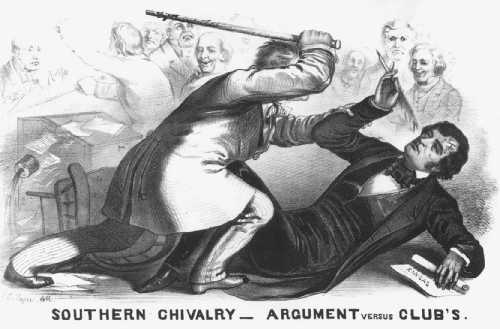
beating Sumner with a heavy cane. His legs trapped beneath the desk that was bolted to the floor, Sumner wrenched the desk loose as he stood up to try to defend himself, whereupon Brooks clubbed him so ferociously that Sumner slumped forward, bloody
and unconscious.
News of the incident sent a thrill of pride through the South and a rush of rage
through the North. Charleston newspapers praised Brooks for “standing forth so nobly in defense of ... the honor of South Carolinians.” Brooks resigned from Congress after censure by the House and was unanimously reelected. From all over the South came gifts of new canes, some inscribed with such mottoes as “Hit Him Again” and
“Use Knock-Down Arguments.” But in the North, the Republicans gained thousands
of voters as a result of the affair. It seemed to prove their contentions about “the barbarism of slavery.” “Has it come to this,” asked the poet William Cullen Bryant, editor of the New York Evening Post, “that we must speak with bated breath in the
presence of our Southern masters? ... Are we to be chastised as they chastise their slaves?” A veteran New York politician reported that he had “never before seen anything at all like the present state of deep, determined, & desperate feelings of hatred, & hostility to the further extension of slavery, & its political power.”
Republicans were soon able to add “Bleeding Kansas” to “Bleeding Sumner” in
their repertoire of winning issues. Even as Sumner was delivering his speech in
Washington, an “army” of pro-slavery Missourians, complete with artillery,
marched on the free-state capital of Lawrence, Kansas. On May 21, they shelled
and sacked the town, burning several buildings. A rival force of free-state men
arrived too late to intercept them. One of the free-state “captains” was John
Brown, an abolitionist zealot who considered himself anointed by the Lord to
avenge the sins of slaveholders. When he learned of the murder of several free-
state settlers and the sack of Lawrence, he “went crazy—crazy,” according to one
of his followers. We must “fight fire with fire,” Brown declared. “Something must
The Election of 1856
481
NY
Resource,
Library/Art
Public
York
New
The©
The Caning of Sumner. This drawing by an antislavery Northerner shows pro-slavery Congressman Preston Brooks of South Carolina beating Senator Charles Sumner of
Massachusetts with a heavy cane on the floor of the Senate on May 22, 1856. It portrays the inability of the South to respond to the power of Northern arguments, symbolized by the pen in Sumner’s right hand and a speech in his left hand, except with the unthinking power of the club. Note other southern senators in the background smiling on the scene or preventing northern senators from coming to Sumner’s aid. The caning of Sumner was the worst of several instances of North–South violence or threatened violence on the floor of Congress in the 1850s, presaging the violence on the battlefields of the 1860s.
be done to show these barbarians that we, too, have rights.” Leading four of his
sons and three other men to a pro-slavery settlement at Pottawatomie Creek on
the night of May 24–25, 1856, Brown dragged five men from their cabins and split
open their heads with broadswords.
Brown’s murderous act set off a veritable civil war in Kansas. One of Brown’s
sons was among the estimated 200 men killed in bushwhacker raids. Not until
President Pierce sent a tough new territorial governor and 1,300 federal troops
to Kansas in September 1856 did the violence subside—just in time to save the
Democrats from possible defeat in the presidential election.
THE ELECTION OF 1856
By 1856, the Republicans had become the largest party in the North. With the old
Free-Soilers as their radical core, they had recruited about three-fourths of the former Whigs and one-fifth of the Democrats. They were also the first truly sectional party in American history because they had little prospect of carrying a single
county in the slave states. At their first national convention, the Republicans wrote a platform that focused mainly on that “relic of barbarism,” slavery. The platform also incorporated the old Whig program of federal aid to internal improvements,
including a railroad to California. For its presidential nominee, the party steered away from its most prominent leaders, who were identified with the old parties,
and turned instead to John C. Frémont. This “Pathfinder of the West” had a dash-
ing image as an explorer and for his role in the acquisition of California. With little 482
Chapter 14 The Gathering Tempest, 1853–1860
Popular and Electoral Votes in the 1856 Presidential Election
Free States
Slave States
Total
Candidate
Popular
Electoral
Popular
Electoral
Popular
Electoral
Buchanan
1,227,000
62
607,000
112
1,833,000
174
(Democrat)
Frémont
1,338,000
114
0
0
1,338,000
114
(Republican)
Fillmore
396,000
0
476,000
8
872,000
8
(American)
political experience, he had few political enemies, and his antislavery credentials were satisfactory.
The Democrats chose as their candidate James Buchanan, a veteran of 30 years
in various public offices. The Democratic platform endorsed popular sovereignty
and condemned the Republicans as a “sectional party” that incited “treason and
armed resistance in the Territories.”
This would be a three-party election because the American Party was still in the
field. Having become mainly a way station for former southern Whigs, the party
nominated ex-Whig Millard Fillmore. The three-party campaign sifted out into a
pair of two-party contests: Democrats versus Americans in the South and Demo-
crats versus Republicans in the North. Fillmore, despite a good showing of 44 percent of the popular vote in the South, carried only Maryland. Considering
Buchanan colorless but safe, the rest of the South gave him three-fourths of the electoral votes he needed for victory.
The real excitement in this election showed itself in the North. For many Re-
publicans, the campaign was a moral cause, an evangelical crusade against the sin of slavery. Republican “Wide Awake” clubs marched in torchlight parades chanting “Free Soil, Free Speech, Free Men, Frémont!” A veteran politician in Indiana
marveled: “Men, Women & Children all seemed to be out, with a kind of fervor I have never witnessed before in six Pres. Elections in which I have taken an active part.” The turnout of eligible voters in the North was a remarkable 83 percent.
One awestruck journalist, anticipating a Republican victory, wrote, that “the process now going on in the United States is a Revolution.”
Not quite. Although the Republicans swept New England and the upper parts
of New York state and the Old Northwest—both settled by New Englanders, where
evangelical and antislavery reform movements had taken hold—the contest in the
lower North was close. Buchanan needed only to carry Pennsylvania and either In-
diana or Illinois to win the presidency, and the campaign focused on those states.
The immigrant and working-class voters of the eastern cities and the rural voters of the lower Midwest, descendants of upland southerners who had settled there,
were antiblack and anti-abolitionist in sentiment. They were ripe for Democratic
propaganda that accused Republicans of favoring racial equality. “Black
The Election of 1856
483
Republicans,” declared an Ohio Democratic newspaper, intended to “turn loose ...
millions of negroes, to elbow you in the workshops, and compete with you in fields of honest labor.” A Democrat in Pennsylvania told voters that “the one aim” of the Republicans was “to elevate the African race in this country to complete equality of political and economic condition with the white man.” Indiana Democrats organized parades with young girls in white dresses carrying banners inscribed:
“Fathers, save us from nigger husbands.”
The Republicans in these areas denied that they favored racial equality. They
insisted that the main reason for keeping slavery out of the territories was to enable white farmers and workers to make a living there without competition from black
labor. But their denials were in vain. Support for the Republican Party by promi-
nent black leaders, including Frederick Douglass, convinced hundreds of thousands of voters that the Black Republicans were racial egalitarians. For the next two
Frémont
(Republican)
Buchanan
(Democrat)
Fillmore
(American)
No returns,
unsettled, etc.
Learning
Cengage©
MAP 14.1 Counties Carried by Candidates in the 1856 Presidential Election
This map illustrates the sharp geographical division of the vote in 1856. The pattern of Republican counties coincided almost exactly with New England and the portions of other states settled by New England migrants during the two preceding generations.
484
Chapter 14 The Gathering Tempest, 1853–1860
decades, that sentiment would be one of the most potent weapons in the Demo-
cratic arsenal.
The charge that a Republican victory would destroy the Union was even more
effective. Buchanan set the tone in his instructions to Democratic Party leaders:
“The Black Republicans must be ... boldly assailed as disunionists, and the charge must be re-iterated again and again.” It was. And southerners helped the cause by threatening to secede if Frémont won. Fears of disruption caused many conservative ex-Whigs in the North to support Buchanan, who carried Pennsylvania, New
Jersey, Indiana, Illinois, and California and won the presidency.
But southerners did not intend to let Buchanan forget that he owed his elec-
tion mainly to the South. “Mr. Buchanan and the Northern Democracy are
dependent on the South,” wrote a Virginian after the election. “If we can succeed in Kansas ... and add a little more slave territory, we may yet live free men under the Stars and Stripes.”
The Dred
The South took the offensive at the outset of the Buchanan
Scott Case
administration. Its instrument was the Supreme Court, which
had a majority of five justices from slave states led by Chief
Justice Roger B. Taney of Maryland. Those justices saw the Dred Scott case as an
opportunity to settle once and for all the question of slavery in the territories.
Dred Scott was a slave whose owner, an army surgeon, had kept him at mili-
tary posts in Illinois and in Wisconsin Territory for several years before taking him back to Missouri. After the owner’s death, Scott sued for his freedom on the
grounds of his prolonged stay in the Wisconsin Territory, where slavery had been
outlawed by the Missouri Compromise. The case worked its way up from Missouri
courts through a federal circuit court to the U.S. Supreme Court. There it attracted attention as a test case of Congress’s power to prohibit slavery in the territories.
The southern Supreme Court justices decided to declare that the Missouri Com-
promise ban on slavery in the territories was unconstitutional. To avoid the appearance of a purely sectional decision, they sought the concurrence of a northern
Democratic justice, Robert Grier of Pennsylvania. President-elect Buchanan played an improper role by pressing his fellow Pennsylvanian to go along with the southern majority. Having obtained Justice Grier’s concurrence, Chief Justice Taney issued the Court’s ruling stating that Congress lacked the power to keep slavery
out of a territory, because slaves were property and the Constitution protects the right of property. For good measure, Taney also wrote that the circuit court should not have accepted the Scott case in the first place because black men were not
citizens of the United States and therefore had no standing in its courts. Five other justices wrote concurring opinions. The two non-Democratic northern justices
dissented vigorously. They stated that blacks were legal citizens in several northern states and were therefore citizens of the United States. To buttress their opinion that Congress could prohibit slavery in the territories, they cited Congress’s Constitutional power to make “all needful rules and regulations” for the territories.
Modern scholars agree with the dissenters. In 1857, however, Taney had a
majority, and his ruling became law. Modern scholars have also demonstrated
that Taney was motivated by his passionate commitment “to southern life and
The Election of 1856
485
values” and by his determination to stop “northern aggression” by cutting the ground out from under the hated Republicans. His ruling that their program to exclude
slavery from the territories was unconstitutional was designed to do just that.
Republicans denounced Taney’s “jesuitical decision” as based on “gross perver-
sion” of the Constitution. Several Republican state legislatures resolved that the ruling was “not binding in law and conscience.” They looked forward to the election
of a Republican president who could “reconstitute” the Court and secure a reversal of the decision. “The remedy,” said the Chicago Tribune, “is the ballot box.… Let the next President be Republican, and 1860 will mark an era kindred with that
of 1776.”
The Lecompton
Instead of settling the slavery controversy, the Dred Scott
Constitution
decision intensified it. Meanwhile, pro-slavery advocates,
having won legalization of slavery in the territories, moved
to ensure that it would remain legal when Kansas became a state. That required
deft maneuvering, because legitimate antislavery settlers outnumbered pro-slavery settlers by more than two to one. In 1857, the pro-slavery legislature (elected by the fraudulent votes of border ruffians two years earlier) called for a constitutional convention at Lecompton to prepare Kansas for statehood. Because the election for delegates was rigged, Free Soil voters refused to participate. One-fifth of the registered voters thereupon elected convention delegates, who met at Lecompton and
wrote a state constitution that made slavery legal.
Then a nagging problem arose. Buchanan had promised that the Lecompton
constitution would be presented to voters in a fair referendum. The problem was
how to pass the pro-slavery constitution, given the antislavery majority of voters.
The convention came up with an ingenious solution. Instead of a referendum on
the whole constitution, it would allow the voters to choose between a constitution
“with slavery” and one “with no slavery.” The catch was that the constitution
“with no slavery” guaranteed slave owners’ “inviolable” right of property in the
200 slaves already in Kansas and their progeny. It also did nothing to prevent
future smuggling of slaves across the 200-mile border with Missouri. Once in Kansas, they, too, would become “inviolable” property.
Free-state voters branded the referendum a farce and boycotted it. One-quarter
of the eligible voters went to the polls in December 1857 and approved the constitution “with slavery.” Meanwhile, in a fair election policed by federal troops, the antislavery party won control of the new territorial legislature and promptly submitted both constitutions to a referendum that was boycotted by pro-slavery voters.
This time, 70 percent of the eligible voters went to the polls and overwhelmingly rejected both constitutions.
Which referendum would the federal government recognize? That question
proved even more divisive than the Kansas-Nebraska debate four years earlier.
President Buchanan faced a dilemma. He had promised a fair referendum. But
southerners, who dominated both the Democratic Party and the administration
(the vice president and four of the seven cabinet members were from slave states), threatened secession if Kansas was not admitted to statehood under the Lecompton
constitution “with slavery.” “If Kansas is driven out of the Union for being a Slave 486
Chapter 14 The Gathering Tempest, 1853–1860
State,” thundered Senator James Hammond of South Carolina, “can any Slave
State remain in it with honor?” Buchanan caved in. He explained to a shocked
northern Democrat that if he did not accept the Lecompton constitution, southern
states would “secede from the Union or take up arms against us.” Buchanan sent
the Lecompton constitution to Congress with a message recommending statehood.
Kansas, said the president, “is at this moment as much a slave state as Georgia or South Carolina.”
What would Stephen Douglas do? If he endorsed the Lecompton constitution,
he would undoubtedly be defeated in his bid for reelection to the Senate in 1858.
And he regarded the Lecompton constitution as a travesty of popular sovereignty.
He broke with the administration on the issue. He could not vote to “force this
constitution down the throats of the people of Kansas,” he told the Senate, “in
opposition to their wishes and in violation of our pledges.”
The fight in Congress was long and bitter. The South and the administration had
the votes they needed in the Senate and won handily there, but the Democratic ma-
jority in the House was so small that the defection of even a few northern Democrats would defeat the Lecompton constitution. The House debate at one point got out of hand, and a wild fistfight erupted between Republicans and southern Democrats.
“There were some fifty middle-aged and elderly gentlemen pitching into each other like so many Tipperary savages,” wrote a bemused reporter, “most of them incapable, from want of wind and muscle, from doing each other any serious harm.”
When the vote was finally taken, two-dozen northern Democrats defected, provid-
ing enough votes to defeat Lecompton. Both sides then accepted a compromise pro-
posal to resubmit the constitution to Kansas voters, who decisively rejected it. This meant that while Kansas would not come in as a slave state, neither would it come in as a free state for some time yet. Nevertheless, the Lecompton debate had split the Democratic Party, leaving a legacy of undying enmity between southerners and
Douglas. The election of a Republican president in 1860 was now all but assured.
THE ECONOMY IN THE 1850S
Beginning in the mid-1840s, the American economy enjoyed a dozen years of
unprecedented growth and prosperity, particularly for the railroads. The number
of miles in operation quintupled. Railroad construction provided employment for
many immigrants and spurred growth in industries that produced rails, rolling
stock, and other railroad equipment. Most railroad construction took place in
the Old Northwest, linking the region more closely to the Northeast and continu-
ing the reorientation of transportation networks from a north-south river pattern to an east-west canal and rail pattern. By the mid-1850s, the east-west rail and
water routes carried more than twice as much freight tonnage as the north-south
river routes. This closer binding of the western and eastern states reinforced the effect of slavery in creating a self-conscious “North” and “South.”
Although the Old Northwest remained predominantly agricultural, rapid ex-
pansion of railroads there laid the basis for its industrialization. During the 1850s, industrial output in the free states west of Pennsylvania grew at twice the rate of Northeast industrial output and three times as great as the rate in the South. The Northwest urban growth rate tripled that of the Northeast and quadrupled that of
The Economy in the 1850s
487
the South. Chicago became the terminus for 15 rail lines in the 1850s, during which its population grew by 375 percent. In 1847, two companies that contributed to the rapid growth of agriculture during this era built their plants in Illinois: the McCormick reaper works at Chicago and the John Deere steel-plow works at Moline.
According to almost every statistical index available from that period, eco-
nomic expansion considerably outstripped even the prodigious pace of population
increase. While the number of Americans grew by 44 percent during these 12 years
(1844–56), the value of both exports and imports increased by 200 percent; mined
coal tonnage by 270 percent; banking capital, industrial capital, and industrial output by approximately 100 percent; farmland value by 100 percent; and cotton,
wheat, and corn harvests by about 70 percent. These advances meant a significant
increase of per capita production and income, although the distance between rich
and poor was widening—a phenomenon that has characterized all capitalist econo-
mies during stages of rapid industrial growth.
By the later 1850s, the United States had forged ahead of most other countries to become the second-leading industrial producer in the world, behind only Britain. But the country was still in the early stages of industrial development. Agricultural product processing and raw materials still played the dominant role. By 1860, the four leading industries, measured by value added in manufacturing, were cotton textiles, lumber products, boots and shoes, and flour milling. Iron and machinery, industries typical of a more mature manufacturing economy, ranked sixth and seventh.
“The American
The United States had pioneered in one crucial feature of
System of
modern industry: the mass production of interchangeable
Manufactures”
parts. This revolutionary concept had begun with the man-
ufacture of firearms earlier in the 19th century and had
spread to many products by the 1850s. High wages and a shortage of the skilled
craftsmen who had traditionally fashioned guns, furniture, locks, watches, and
other products had compelled American entrepreneurs to seek alternative methods.
“Yankee ingenuity,” already world-famous, came up with an answer: special-
purpose machine tools that would cut and shape an endless number of parts that
could be fitted together with other similarly produced parts to make whole guns,
locks, clocks, and sewing machines in mass quantities. These products were less
elegant and less durable than products made by skilled craftsmen, but they were
also less expensive and thus more widely available to the “middling classes” of a society that professed to be more democratic than Europe in its consumer economy
as well as in its politics.
Such American-made products were the hit of the first World’s Fair, the Crystal
Palace Exhibition at London in 1851. British manufacturers were so impressed by
Yankee techniques, which they dubbed “the American system of manufactures,”
that they sent two commissions to the United States to study them. The British
also invited Samuel Colt of Connecticut, inventor of the famous six-shooting
revolver, to set up a factory in England stocked with machinery from Connecticut.
In testimony before a parliamentary committee in 1854, Colt summed up the Amer-
ican system of manufactures in a single sentence: “There is nothing that cannot be produced by machinery.” Although the British had a half-century head start over
488
Chapter 14 The Gathering Tempest, 1853–1860
Americans in the Industrial Revolution, Colt’s testimony expressed a philosophy
that would enable the United States to surpass Britain as the leading industrial
nation by 1880.
The British industrial commissions cited the American educational system as an
important reason for the country’s technological proficiency. “Educated up to a far higher standard than those of a much superior grade in the Old World,” reported
the 1854 commission, “every [American] workman seems to be continually devising
some new thing to assist him in his work, and there is a strong desire ... to be
‘posted up’ in every new improvement.” By contrast, the British workman, trained
by long apprenticeship “in the trade,” rather than in school, lacked “the ductility of mind and the readiness of apprehension for a new thing” and was therefore “unwilling to change the methods he has been used to.”
Whether this British commission was right in its belief that American schooling
encouraged the “adaptative versatility” of Yankee workers, it was certainly true
that public education and literacy were more widespread in the United States than in Europe. Almost 95 percent of adults in the free states were literate in 1860, compared with 65 percent in England and 55 percent in France. The standardization
and expansion of public school systems that had begun earlier in New England
had spread to the mid-Atlantic states and into the Old Northwest by the 1850s.
Nearly all children received a few years of schooling, and most completed at least six or seven years.
This improvement in education coincided with the feminization of the teaching
profession, which opened up new career opportunities for young women. By the
1850s, nearly three-quarters of the public school teachers in New England were
women (who worked for lower salaries than male teachers), a trend that was
spreading to the mid-Atlantic states and the Old Northwest as well.
The Southern
In contrast to the North, where 94 percent of the entire
Economy
population could read and write, 80 percent of the free
population and only 10 percent of the slaves in the South
were literate. This was one of several differences between North and South that
antislavery people pointed to as evidence of the backward, repressive, and perni-
cious nature of a slave society.
Still, the South shared in the economy’s rapid growth following recovery from
the depression of 1837–43. Cotton prices and production both doubled between
1845 and 1855. Similar increases in price and output emerged in tobacco and
sugar. The price of slaves also doubled during this decade. Southern crops provided three-fifths of all U.S. exports, with cotton alone supplying more than half.
But a growing number of southerners deplored the fact that the colonial econ-
omy of the South was so dependent on the export of agricultural products and the
import of manufactured goods. Northern or British firms owned the ships that car-
ried southern cotton; Yankees or Englishmen provided most of the financial and
commercial services. In the years of rising sectional tensions around 1850, many
southerners began calling for economic independence from the North. How could
they obtain their rights, they asked, if they were “financially more enslaved than our negroes?” Yankees “abuse and denounce slavery and slaveholders,” declared a
The Economy in the 1850s
489
southern newspaper in 1851, yet “we purchase all our luxuries and necessaries
from the North…. Our slaves are clothed with Northern manufactured goods and
work with Northern hoes, ploughs, and other implements.... The slaveholder
dresses in Northern goods … and on Northern-made paper, with a Northern pen,
with Northern ink, he resolves and re-resolves in regard to his rights.”
Southerners must “throw off this humiliating dependence,” declared James D. B.
De Bow, the young champion of economic diversification in the South. In 1846,
De Bow had founded in New Orleans a periodical eventually known as De Bow’s
Review. Proclaiming on its cover that “Commerce is King,” the Review set out to
make this slogan a southern reality. De Bow took the lead in organizing annual
commercial conventions that met in various southern cities during the 1850s. In its early years, this movement encouraged southerners to invest in shipping lines, railroads, textile mills (“bring the spindles to the cotton”), and other enterprises. “Give us factories, machine shops, work shops,” declared southern proponents of King
Commerce, “and we shall be able ere long to assert our rights.”
Economic diversification in the South did make headway during the 1850s. The
slave states quadrupled their railroad mileage, increased the amount of capital invested in manufacturing by 77 percent, and boosted their output of cotton textiles by 44 percent. But northern industry was growing even faster. In 1860, the North
had five times more industrial output per capita than the South, and it had three times the railroad capital and mileage per capita and per thousand square miles.
Southerners had a larger percentage of their capital invested in land and slaves in 1860 than they had had 10 years earlier. Some 80 percent of the South’s labor force worked in agriculture—the same as 60 years earlier. By contrast, while farming remained, at 40 percent, the largest single occupation in the North, the northern
economy developed a strong manufacturing and commercial sector whose com-
bined labor force almost equaled that of agriculture by 1860.
The Sovereignty
A good many southerners preferred to keep it that way.
of King Cotton
“That the North does our trading and manufacturing mostly
is true,” wrote an Alabama planter in 1858. “We are willing
that they should. Ours is an agricultural people, and God grant that we may con-
tinue so. It is the freest, happiest, most independent, and with us, the most powerful condition on earth.” In the later 1850s, the drive for economic diversification in the South lost steam. King Cotton reasserted its primacy over King Commerce as
cotton output and prices continued to rise, suffusing the South in a glow of prosperity. “Our Cotton is the most wonderful talisman on earth,” declared a planter.
“By its power we are transmuting whatever we choose into whatever we want.” In
a speech that became famous, James Hammond of South Carolina told his fellow
senators in 1858 that “the slaveholding South is now the controlling power of the world…. No power on earth dares to make war on cotton. Cotton is king.”
Even the commercial conventions in the South seem to have embraced this
gospel. In 1854, they merged with a parallel series of planters’ conventions, and thereafter the delegates heard as much about cotton as they did about commerce.
By the later 1850s, one of the main goals of these conventions was to reopen the
African slave trade, prohibited by law since 1808. But many southerners rejected
490
Chapter 14 The Gathering Tempest, 1853–1860
that goal, partly on moral grounds and partly on economic grounds. Older slave
states such as Virginia, which profited from the sale of slaves to the booming cotton frontier of the Deep South, objected to any goal that would lower the price of their largest export. The conventions also lobbied for the annexation of Cuba,
which would bring a productive agricultural economy and 400,000 more slaves
into the United States.
Nowhere in the South, said defenders of slavery, did one see such “scenes of beg-
gary, squalid poverty, and wretchedness” as one could find in any northern city.
Black slaves, they insisted, enjoyed a higher standard of living than white “wage slaves” in northern factories. Black slaves never suffered from unemployment or
wage cuts, they received free medical care, and they were taken care of in old age.
This argument reached its fullest development in the writings of George
Fitzhugh, a Virginia farmer-lawyer whose newspaper articles were gathered into
two books published in 1854 and 1857, Sociology for the South and Cannibals All.
Free-labor capitalism, said Fitzhugh, was a competition in which the strong
exploited and starved the weak. Slavery, by contrast, was a paternal institution
that guaranteed protection of the workers. “Capital exercises a more perfect com-
pulsion over free laborers than human masters over slaves,” wrote Fitzhugh, “for
free laborers must at all times work or starve, and slaves are supported whether
they work or not.... What a glorious thing is slavery, when want, misfortune, old age, debility, and sickness overtake [the slave].”
Labor
How true was this portrait of poverty and starvation among
Conditions in
northern workers? Some northern labor leaders did complain
the North
that the “slavery” of the wage system gave “bosses” control
over the hours, conditions, and compensation of labor. But
there is no evidence that a northern workingman ever offered to change places with a southern slave. Average per capita income was about 40 percent higher in the
North than in the South. Although that average masked large disparities between
rich and poor—even between the middle class and the poor—those disparities were
no greater, and probably less, in the North than in the South.
To be sure, substantial numbers of recent immigrants, day laborers, and young
single women in large northern cities lived on the edge of poverty—or slipped over the edge. Many women seamstresses, shoe binders, milliners, and the like, who
worked 60 or 70 hours per week in the outwork system, earned less than a living
wage. Some of them resorted to prostitution in order to survive. The widespread
adoption of the newly invented sewing machine in the 1850s did nothing to make
life easier for seamstresses; it only lowered their per-unit piecework wages and
forced them to turn out more shirts and trousers than before. Many urban
working-class families could not survive on the wages of an unskilled or semi-
skilled man. Women had to take in laundry, boarders, or outwork, and one or
more children also had to work. Much employment was seasonal or intermittent,
leaving workers without wages for long periods, especially during the winter. The poverty, overcrowding, and disease in the tenement districts of a few large cities—
especially New York City—seemed to lend substance to pro-slavery claims that
slaves were better off.
The Economy in the 1850s
491
PERCENTAGE OF SLAVES IN
TOTAL POPULATION, 1860
NEBRASKA
TERRITORY
UTAH
TERRITORY
KANSAS
TERRITORY
INDIAN
NEW MEXICO
TERRITORY
TERRITORY
Areas without slaves,
or unsettled
Under 10 percent
10 to 30 percent
30 to 50 percent
50 percent and over
PENN.
N.J.
PRINCIPAL STAPLE CROP REGIONS
MD.
OF THE SOUTH, 1860
INDIANA
OHIO
DEL.
ILLINOIS
KANSAS
VIRGINIA
TERRITORY
MISSOURI
KENTUCKY
NORTH CAROLINA
INDIAN
TENNESSEE
TERRITORY
ARKANSAS
SOUTH
CAROLINA
ATLANTIC
GEORGIA
OCEAN
MISSISSIPPI
ALABAMA
Cotton
TEXAS
Sugar
LOUISIANA
Rice
FLORIDA
Tobacco
Learning
Hemp
Gulf of Mexico
Cengage©
MAP 14.2 Slavery and Staple Crops in the South, 1860
Note the close correlation between the concentration of the slave population and the leading cash crops of the South. Nothing better illustrates the economic importance of slavery.
492
Chapter 14 The Gathering Tempest, 1853–1860
But they were not—even apart from the psychological contrast between being
free and being a slave. New York City’s poverty, although highly concentrated
and visible, was exceptional. In the North, only one-fourth of the people lived in cities or towns of more than 2,500 people. Wages and opportunities for workers
were greater in the North than anywhere else in the world, including the South.
That was why 4 million immigrants came to the United States from 1845 to 1860
and why seven-eighths of them settled in free states. It was also why twice as many white residents of slave states migrated to free states than vice versa.
The Panic
In fall 1857, the relative prosperity of the North was inter-
of 1857
rupted by a financial panic that caused a short-lived but
intense depression. When the Crimean War in Europe
(1854–56) cut off Russian grain from the European market, U.S. exports had
mushroomed to meet the deficiency. After the Crimean War ended, U.S. grain
exports slumped. The sharp rise in interest rates in Britain and France, caused by the war, spread to U.S. financial markets in 1857 and dried up sources of credit.
Meanwhile, the economic boom of the preceding years had caused the American
economy to overheat: Land prices had soared, railroads had built beyond the capacity of earnings to service their debts, and banks had made too many risky loans.
This speculative house of cards came crashing down in September 1857. The
failure of one banking house sent a wave of panic through the financial community.
Banks suspended specie payments, businesses failed, railroads went bankrupt, con-
struction halted, and factories shut down. Hundreds of thousands of workers were
laid off, and others went on part-time schedules or took wage cuts, just as the cold winter months were arriving. The specter of class conflict such as had occurred
during the European revolutions of 1848 haunted the public. Unemployed workers
in several northern cities marched in parades carrying banners demanding work or
bread. A mob broke into the shops of flour merchants in New York City. On
November 10, a crowd gathered on Wall Street and threatened to break into the
U.S. customs house and sub-treasury vaults, where $20 million was stored. Soldiers and marines had to be called out to disperse the mob.
But the country got through the winter with little violence. No one was killed in the demonstrations—in contrast to the dozens who had been killed in ethnic riots a few years earlier and the hundreds killed in the guerrilla war in Kansas. Class conflict turned out to be the least threatening of the various discords that endangered society in the 1850s. Charity and public works helped tide the poor over the winter, and the panic inspired a vigorous religious revival. Spontaneous prayer meetings
arose in many northern cities, bringing together bankers and seamstresses, brokers and street sweepers. They asked God’s forgiveness for the greed and materialism
that, in a self-flagellating mood, they believed had caused the panic.
The depression was short-lived. By early 1858, banks had resumed specie pay-
ments; the stock market rebounded in the spring; factories reopened; railroad construction resumed; and by spring 1859, recovery was complete. The modest labor
union activities of the 1850s revived after the depression, as workers in some industries went on strike to bring wages back to pre-panic levels. In February 1860, the shoemakers of Lynn, Massachusetts, began the largest strike in U.S. history up to The Economy in the 1850s
493
that time, eventually involving 20,000 workers in the New England shoe industry.
Despite the organization of several national unions of skilled workers during the 1850s, however, less than 1 percent of the labor force was unionized in 1860.
Sectionalism
The Panic of 1857 intensified sectional animosities. The
and the Panic
South largely escaped the depression. Its export-driven econ-
omy seemed insulated from domestic downturns. After a brief
dip, cotton and tobacco prices returned to high levels and production continued to increase: The cotton crop set new records in 1858 and 1859. Southern boasts about the superiority of the region’s economic and labor systems took on added bravado.
“Who can doubt, that has looked at recent events, that cotton is supreme?” asked
Senator James Hammond in March 1858. “When thousands of the strongest com-
mercial houses in the world were coming down,” he told Yankees, “what brought
you up?... We have poured in upon you one million six hundred thousand bales of
cotton.... We have sold it for $65,000,000, and saved you.”
Northerners were not grateful. In fact, many of them blamed the South for
causing the depression or for blocking measures to ease its effects in the North.
Southern congressmen had provided most of the votes for a new tariff in 1857
that brought duties to their lowest levels in 40 years. Some northern Republicans blamed the tariff for causing the panic and wanted to revise certain duties upward to help hard-hit industries, especially Pennsylvania iron, which were being undercut by cheaper imports. They directed their arguments to workers as much as to manufacturers. “We demand that American laborers shall be protected against the pau-
per labor of Europe,” they declared. Tariff revision would “give employment to
thousands of mechanics, artisans, laborers, who have languished for months in un-
willing idleness.” In each session of Congress from 1858 through 1860, however, a combination of southerners and about half of the northern Democrats blocked
Republican efforts to raise tariffs. In the words of one bitter Pennsylvania Republican, this was proof that Congress remained “shamelessly prostituted, in a base subservi-ency to the Slave Power.” Republicans made important gains in the Pennsylvania
congressional elections of 1858, setting the stage for a strong bid in a state that they had to carry if they were to win the presidency in 1860.
Three other measures acquired additional significance after the Panic of 1857.
Republicans supported each of them as a means to promote economic health and to
aid farmers and workers, but southerners perceived all of them as aimed at helping northern farmers and workers and used their power to defeat them. One was a
homestead act to grant 160 acres of public land to each farmer who settled and
worked the land. Believing that this bill “would prove a most efficient ally for Abolition by encouraging and stimulating the settlement of free farms with Yankees,”
southern senators defeated it after the House had passed it in 1859. The following year both houses passed the Homestead Act, but Buchanan vetoed it and southern
senators blocked an effort to pass it over his veto. A similar fate befell bills for land grants to a transcontinental railroad and for building agricultural and mechanical colleges to educate farmers and workers. In the Old Northwest, where these measures were popular, Republican prospects for 1860 were enhanced by southern
and Democratic opposition to them.
494
Chapter 14 The Gathering Tempest, 1853–1860
The Free-Labor
By the later 1850s, the Republican antislavery argument had
Ideology
become a finely honed philosophy that historians have
labeled a free-labor ideology. It held that all work in a free
society was honorable, but that slavery degraded the calling of manual labor by
equating it with bondage. Slaves worked inefficiently, by compulsion; free men
were stimulated to work hard and efficiently by the desire to get ahead. Social
mobility was central to the free-labor ideology. Free workers who practiced the
virtues of industry, thrift, self-discipline, and sobriety could move up the ladder of success. “I am not ashamed to confess,” Abraham Lincoln told a working-class
audience in 1860, “that twenty-five years ago I was a hired laborer, mauling rails, at work on a flat-boat—just what might happen to any poor man’s son!” But in
the free states, said Lincoln, a man knows that “he can better his condition.... The free labor system opens the way for all—gives hope to all, and energy, and progress, and improvement of condition to all.”
Lincoln drew a rosy picture of northern reality, for large numbers of workers in
the North had little hope of advancing beyond the status of wage laborer. Still, he expressed a belief that was widely shared in the antebellum North. “There is not a working boy of average ability in the New England states, at least,” observed a visiting British industrialist in 1854, “who has not an idea of some mechanical invention or improvement in manufactures, by which, in good time, he hopes to better his condition, or rise to fortune and social distinction.” Americans could point to numerous examples of men who had achieved dramatic upward mobility. Belief in this “American dream” was most strongly held by Protestant farmers, skilled workers, and white-collar workers who had some real hope of getting ahead. These men tended to support the
Republican Party and its goal of excluding slavery from the territories.
For slavery was the antithesis of upward mobility. Bondsmen were “fatally
fixed in that condition for life,” as Lincoln noted. Slaves could not hope to move up the ladder of success, nor could free men who lived in a society where they had to compete with slave labor. “Slavery withers and blights all it touches,” declared an Iowa Republican. “It is a curse upon the poor, free, laboring white men.” In the United States, social mobility often depended on geographic mobility. The main
reason so many families moved into new territories was to make a new start, to
get ahead. But, declared a Republican editor, if slavery goes into the territories,
“the free labor of all the states will not. If the free labor of the states goes there, the slave labor of the southern states will not, and in a few years the country will teem with an active and energetic population.”
Southerners contended that free labor was prone to unrest and strikes. Of
course it was, said Lincoln in a speech to a New England audience during the shoemakers’ strike of 1860. “I am glad to see that a system prevails in New England
under which laborers can strike when they want to (Cheers).... I like the system
which lets a man quit when he wants to, and wish it might prevail everywhere
(Tremendous applause).” Strikes were one of the ways in which free workers could
try to improve their prospects. “I want every man,” said Lincoln, “to have the
chance—and I believe a black man is entitled to it—in which he can better his
condition.” That was why Republicans were determined to contain the expansion
of slavery, because if the South got its way in the territories, “free labor that can strike will give way to slave labor that cannot!”
The Economy in the 1850s
495
The Impending
From the South came a maverick voice that echoed the Re-
Crisis
publicans. Hinton Rowan Helper considered himself a
spokesman for the nonslaveholding whites of the South.
Living in upcountry North Carolina, a region of small farms and few slaves, he had brooded for years over slavery’s retarding influence on southern development. In
1857, he poured out his bitterness in a book entitled The Impending Crisis of the South. Using selective statistics from the 1850 census, he pictured a South mired in economic backwardness, widespread illiteracy, poverty for the masses, and great
wealth for the elite. He contrasted this dismal situation with the bustling, prosperous northern economy and its near-universal literacy, neat farms, and progressive institutions. What caused this startling contrast? “Slavery lies at the root of all the shame, poverty, ignorance, tyranny, and imbecility of the South,” he wrote. Slavery monopolized the best land, degraded all labor to the level of bond labor, denied
schools to the poor, and impoverished all but “the lords of the lash [who] are not only absolute masters of the blacks [but] of all nonslaveholding whites, whose
freedom is merely nominal, and whose unparalleled illiteracy and degradation is
purposely and fiendishly perpetrated.” The remedy? Nonslaveholding whites must
organize and use their votes to overthrow “this entire system of oligarchical
despotism.”
No southern publisher dared touch this book. Helper lugged his bulky manu-
script to New York City, where a printer brought it out in summer 1857. The
Impending Crisis was virtually banned in the South, and few southern whites
read it, but it made a huge impact in the North. Republicans welcomed it as con-
firmation of all they had been saying about the evils of slavery and the virtues of free labor. The Republican Party subsidized an abridged edition and distributed
thousands of copies as campaign documents. During the late 1850s, a war of
books (Helper’s Impending Crisis versus Fitzhugh’s Cannibals All) exacerbated
sectional tensions. Fitzhugh’s book circulated freely in the North, whereas the
sale or possession of Helper’s book was a criminal offense in many parts of the
South. The New England Antislavery Society even invited Fitzhugh to New Haven
to debate the abolitionist Wendell Phillips. Fitzhugh expressed surprise at his
courteous reception in the North, aware that Phillips and other abolitionists could not set foot in the South without peril to their lives. Northern spokesmen did not hesitate to point out the moral: A free society could tolerate free speech and a free press, but a slave society could not.
Southern
How accurate was Helper’s portrayal of southern poor
Nonslave-
whites degraded by slavery and ready to revolt against it?
holders
The touchy response of many southern leaders suggested that
the planters felt uneasy about that question. After all, slave-
holding families constituted less than one-third of the white population in slave states, and the proportion was declining as the price of slaves continued to rise.
Open hostility to the planters’ domination of society and politics was evident in the mountainous and upcountry regions of the South. These would become areas of
Unionist sentiment during the Civil War and of Republican strength after it.
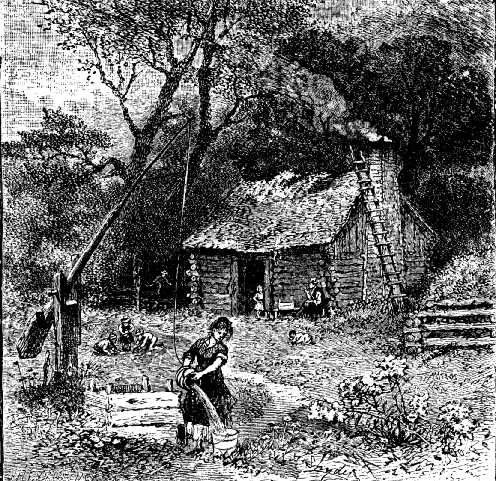
496
Chapter 14 The Gathering Tempest, 1853–1860
A Southern Yeoman
Farmer’s Home. This
modest log cabin on the
edge of a small clearing,
with the farmer’s wife
drawing water from a well
in the foreground, was
typical of nonslaveholders’
farms in the backcountry
of the South. Often
stigmatized as poor
whites, many of these
families were in fact
comfortable by the
standards of the day.
They did not feel the
sense of oppression by
the planter class that
Archives
Hinton Rowan Helper
Picture
believed they should feel.
Wind
North
But Helper surely exaggerated the disaffection of most nonslaveholders in the
South. Three bonds held them to the system: kinship, economic interest, and race.
In the Piedmont and the low-country regions of the South, nearly half of the whites lived in slaveholding families. Many of the rest were cousins or nephews or in-laws of slaveholders in the South’s extensive and tightly knit kinship network. Moreover, many young, ambitious nonslaveholders hoped to buy slaves eventually. Some of
them rented slaves. And because slaves could be made to do the menial, unskilled
labor in the South—the “mudsill” tasks, in Senator Hammond’s language—white
workers monopolized the more skilled, higher-paying jobs.
Even if they did not own slaves, white people owned the most important asset
of all—white skin. White supremacy was an article of faith in the South (and in
most of the North, for that matter). Race was a more important social distinction than class. Southern law, politics, and social ideology were based on the concept of domination by the “master race” of whites. Subordination was the Negro’s fate,
and slavery was the best means of subordination. Emancipation would loose a
flood of free blacks on society and would undermine the foundations of white
supremacy. Thus many of the poor whites in the South and immigrant workers or
poorer farmers in the North supported slavery.
Racist themes permeated pro-slavery rhetoric. “With us,” said John C. Calhoun
in 1848, “the two great divisions of society are not the rich and the poor, but white and black; and all the former, the poor as well as the rich, belong to the upper
class, and are respected and treated as equals.” True freedom, as Americans understood it, required equality of rights and status (although not of wealth or income).
Slavery ensured such freedom for all whites by putting a floor under them, a mud-
sill of black slaves that kept whites from falling into the mud of inequality. “Break The Lincoln-Douglas Debates
497
down slavery,” said a Virginia congressman, “and you would with the same blow
destroy the great Democratic principle of equality among men.”
THE LINCOLN-DOUGLAS DEBATES
Abraham Lincoln believed the opposite. For him, slavery and freedom were incom-
patible; the one must die that the other might live. This became the central theme of a memorable series of debates between Lincoln and Douglas in 1858, which came
to be known as the Lincoln-Douglas Debates and turned out to be a dress re-
hearsal for the presidential election of 1860.
The debates were arranged after Lincoln was nominated to oppose Douglas’s
reelection to the Senate. State legislatures elected U.S. senators at that time, so the campaign was technically for the election of the Illinois legislature. The real issue, however, was the senatorship, and Douglas’s prominence gave the contest national
significance. Lincoln launched his bid with one of his most notable speeches.
“‘A house divided against itself cannot stand,’” he said. “I believe this government cannot endure, permanently half slave and half free.... It will become all one thing, or all the other.” Under the Dred Scott decision, which Douglas had endorsed, slavery was legal in all of the territories. And what, asked Lincoln, would prevent the Supreme Court, using the same reasoning that had led it to interpret the Constitution as protecting property in slaves, from legalizing slavery in free states? (A case based on this question was then before the New York courts.) The advocates of
slavery, charged Lincoln, were trying to “push it forward, till it shall become lawful in all the States.” But Republicans intended to keep slavery out of the territories, thus stopping its growth and placing it “where the public mind shall rest in the
belief that it is in the course of ultimate extinction.”
The seven open-air debates between Douglas and Lincoln focused almost
entirely on the issue of slavery. Douglas asked: Why could the country not continue to exist half slave and half free as it had for 70 years? Lincoln’s talk about the
“ultimate extinction” of slavery would provoke the South to secession. Douglas
professed himself no friend of slavery, but if people in the southern states or in the territories wanted it, they had the right to have it. Douglas did not want black people—either slave or free—in Illinois. Lincoln’s policy would not only free the slaves but would also grant them equality. “Are you in favor of conferring upon the negro the rights and privileges of citizenship?” Douglas called out to supporters in the crowd. “No, no!” they shouted back. He continued:
Do you desire to strike out of our State Constitution that clause which keeps slaves and free negroes out of the State ... in order that when Missouri abolishes slavery she can send one hundred thousand emancipated slaves into Illinois, to become citizens and voters on an equality with yourselves? (“Never,” “no.”).... If you desire to allow them to come into the State and settle with the white man, if you desire them to vote … then support Mr. Lincoln and the Black Republican party, who are in favor of the
citizenship of the negro. (“Never, never.”)
Douglas’s demagoguery put Lincoln on the defensive. He responded with cau-
tious denials that he favored “social and political equality” of the races. The “ultimate extinction” of slavery might take a century. It would require the voluntary
498
Chapter 14 The Gathering Tempest, 1853–1860
cooperation of the South and would perhaps be contingent on the emigration of
some freed slaves from the country. But come what may, freedom must prevail.
Americans must reaffirm the principles of the founding fathers. In Lincoln’s words, a black person was
entitled to all the natural rights enumerated in the Declaration of Independence, the right to life, liberty and the pursuit of happiness. (Loud cheers.) I hold that he is as much entitled to these as the white man. I agree with Judge Douglas he is not my equal in many respects… . But in the right to eat the bread, without leave of anybody else, which his own hand earns, he is my equal and the equal of Judge Douglas, and the
equal of every living man. (Great applause.)
Lincoln deplored Douglas’s “care not” attitude about whether slavery was
voted up or down. He “looks to no end of the institution of slavery,” said Lincoln.
By endorsing the Dred Scott decision, Lincoln claimed, Douglas looks to its “perpetuity and nationalization.” Douglas was thus “eradicating the light of reason and liberty in this American people.” That was the real issue in the election, insisted Lincoln:
That is the issue that will continue in this country when these poor tongues of
Judge Douglas and myself shall be silent. It is the eternal struggle between these two principles—right and wrong—throughout the world…. The one is the common right
of humanity and the other the divine right of kings…. No matter in what shape it
comes, whether from a king who seeks to bestride the people of his own nation and live by the fruit of their labor, or from one race of men as an apology for enslaving another race, it is the same tyrannical principle.
The Freeport
The popular vote for Republican and Democratic state legis-
Doctrine
lators in Illinois was virtually even in 1858, but because ap-
portionment favored the Democrats, they won a majority of
seats and reelected Douglas. But Lincoln was the ultimate victor, for his perfor-
mance in the debates lifted him from political obscurity, while Douglas further
alienated southern Democrats. In the Freeport debate, Lincoln had asked Douglas
how he reconciled his support for the Dred Scott decision with his policy of popular sovereignty, which supposedly gave residents of a territory the power to vote slavery down. Douglas replied that even though the Court had legalized slavery in the territories, the enforcement of that right would depend on the people who lived there. This was a popular answer in the North, but it gave added impetus to
southern demands for congressional passage of a federal slave code in territories such as Kansas, where the Free-Soil majority had by 1859 made slavery virtually
null. In the next two sessions of Congress after the 1858 elections, southern
Democrats, led by Jefferson Davis, tried to pass a federal slave code for all territories. Douglas and northern Democrats joined with Republicans to defeat it.
Consequently, southern hostility toward Douglas mounted as the presidential elec-
tion of 1860 approached.
The 1859–60 session of Congress was particularly contentious. Once again a
fight over the speakership of the House set the tone. Republicans had won a plurality of House seats, but lacking a majority, they could not elect a Speaker without The Lincoln-Douglas Debates
499
the support of a few border-state representatives from the American (Know-
Nothing) Party. The problem was that the Republican candidate for Speaker was
John Sherman, who, along with 67 other congressmen, had signed an endorsement
of Hinton Rowan Helper’s The Impending Crisis of the South (without, Sherman
later admitted, having read it). This was a red flag to southerners, who refused to vote for Sherman. Through 43 ballots and two months, the House remained deadlocked. Tensions escalated, and members came armed to the floor. One observer
commented, “the only persons who do not have a revolver and knife are those
who have two revolvers.”
As usual, southerners threatened to secede if a Black Republican became
Speaker. Several of them wanted a shootout on the floor of Congress. We “are willing to fight the question out,” wrote one, “and to settle it right there.” The governor of South Carolina told one of his state’s congressmen: “If … you upon
consultation decide to make the issue of force in Washington, write or telegraph
me, and I will have a regiment in or near Washington in the shortest possible
time.” To avert a crisis, Sherman withdrew his candidacy and the House finally
elected a conservative ex-Whig as Speaker on the 44th ballot.
John Brown at
Southern tempers were frayed even at the start of this session
Harpers Ferry
of Congress because of what had happened at Harpers
Ferry, Virginia, in the previous October. After his exploits
in Kansas, John Brown had disappeared from public view. But he had not been
idle. Like the Old Testament warriors he admired, Brown intended to carry his war against slavery into Babylon—the South. His favorite New Testament passage was
Hebrews 9:22: “Without shedding of blood there is no remission of sin.” Brown
worked up a plan to capture the federal arsenal at Harpers Ferry, arm slaves with the muskets he seized there, and move southward along the Appalachian Mountains attracting more slaves to his army along the way until the “whole accursed
system of bondage” collapsed.
Brown recruited 5 black men and 17 whites, including three of his sons, for this
reckless scheme. He also had the secret support of a half-dozen Massachusetts and New York abolitionists, who had helped him to raise funds. On the night of October 16, 1859, Brown led his men across the Potomac River and occupied the sleeping town of Harpers Ferry without resistance. Few slaves flocked to his banner, but the next day, state militia units poured into town and drove Brown’s band into the fire-engine house. At dawn on October 18, a company of U.S. marines commanded by Colonel
Robert E. Lee and Lieutenant J. E. B. Stuart stormed the engine house and captured the surviving members of Brown’s party. Four townsmen, one marine, and ten of
Brown’s men (including two of his sons) were killed; not a single slave was liberated.
John Brown’s raid lasted 36 hours, but its repercussions resounded for years.
Brown and six of his followers were promptly tried by the state of Virginia, con-
victed, and hanged. This scarcely ended matters. The raid sent a wave of revulsion and alarm through the South. Although no slaves had risen in revolt, it revived
fears of slave insurrection that were never far beneath the surface of southern consciousness. Exaggerated reports of Brown’s network of abolitionist supporters confirmed southern suspicions that a widespread northern conspiracy was afoot,
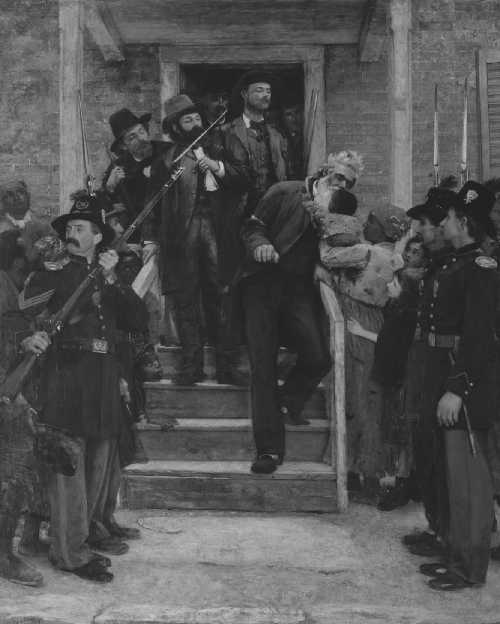
500
Chapter 14 The Gathering Tempest, 1853–1860
The Last Moments
of John Brown. This
famous 1882–1884
painting of John Brown
by Thomas Hovenden
reminds us that the
memory of Brown’s 1859
attack on Harpers Ferry
resonated deeply in
American culture. Here, a
sentimental portrait of
Brown portrays him about
to kiss a baby, while the
soldiers who will escort
NY
him to his death are
positioned as an honor
Resource,
guard. Depicting Brown
as a gentle hero and
Art/Artof
martyr to the cause of
antislavery, this genre
Museum
painting avoids grappling
with the ferocity and
violence of Brown’s
Metropolitan
actions, whether in
The©
Kansas or at Harpers
Ferry.
copyright
Image
determined to destroy their society. Although Republican leaders denied any con-
nection with Brown and disavowed his actions, few southerners believed them.
Had not Lincoln talked of the extinction of slavery? And had not William H.
Seward, who was expected to be the next Republican presidential nominee, given
a campaign speech in 1858 in which he predicted an irrepressible conflict between the free and slave societies?
Many northerners, impressed by Brown’s dignified bearing and eloquence dur-
ing his trial, considered him a martyr to freedom. In his final statement to the court, Brown said:
I see a book kissed, which I suppose to be the Bible, which teaches me that all things whatsoever I would that men should do to me, I should do even so to them. It teaches me, further, to remember them that are in bonds as bound with them. I endeavored to act up to that instruction…. Now, if it is deemed necessary that I should forfeit my life for the furtherance of the ends of justice, and mingle my blood further with the blood of my children and with the blood of millions in this slave country whose rights are disregarded by wicked, cruel, and unjust enactments, I say, let it be done.
On the day of Brown’s execution, bells tolled in hundreds of northern towns,
guns fired salutes, and ministers preached sermons of commemoration. “The death
of no man in America has ever produced so profound a sensation,” commented one
Conclusion
501
northerner. Ralph Waldo Emerson declared that Brown had made “the gallows as
glorious as the cross.”
This outpouring of northern sympathy for Brown shocked and enraged south-
erners and weakened the already frayed threads of the Union. “The Harper’s Ferry
invasion has advanced the cause of disunion more than any event that has hap-
pened since the formation of the government,” observed a Richmond, Virginia,
newspaper. “I have always been a fervid Union man,” wrote a North Carolinian,
but “the endorsement of the Harper’s Ferry outrage ... has shaken my fidelity....
I am willing to take the chances of every possible evil that may arise from disunion, sooner than submit any longer to Northern insolence.”
Something approaching a reign of terror now descended on the South. Every
Yankee seemed to be another John Brown; every slave who acted suspiciously
seemed to be an insurrectionist. Hundreds of northerners were run out of the South in 1860, some wearing a coat of tar and feathers. Several “incendiaries,” both white and black, were lynched. “Defend yourselves!” Senator Robert Toombs cried out to
the southern people. “The enemy is at your door ... meet him at the doorsill, and drive him from the temple of liberty, or pull down its pillars and involve him in a common ruin.”
CONCLUSION
Few decades in American history witnessed a greater disjunction between economic
well-being and political upheaval than the 1850s. Despite the recession following the Panic of 1857, the total output of the American economy grew by 62 percent
during the decade. Railroad mileage more than tripled, value added by manufactur-
ing nearly doubled, and gross farm product grew by 40 percent. Americans were
more prosperous than ever before.
Yet a profound malaise gripped the country. Riots between immigrants and
nativists in the mid-1850s left more than 50 people dead. Fighting in Kansas between pro-slavery and antislavery forces killed at least 200. Fistfights broke out on the floor of Congress. A South Carolina congressman bludgeoned a Massachusetts senator to
unconsciousness with a heavy cane. Representatives and senators came to congressional sessions armed with weapons as well as with violent words.
The nation proved capable of absorbing the large influx of immigrants despite
the tensions and turmoil of the mid-1850s. It might also have been able to absorb the huge territorial expansion of the late 1840s had not the slavery issue been reopened in an earlier territorial acquisition, the Louisiana Purchase, by the Kansas-Nebraska Act of 1854. This legislation, followed by the Dred Scott decision in
1857, seemed to authorize the unlimited expansion of slavery. Within two years of its founding in 1854, however, the Republican Party emerged as the largest party in the North on a platform of preventing all future expansion of slavery. By 1860, the United States had reached a fateful crossroads. As Lincoln had said, it could not endure permanently half-slave and half-free. The presidential election of 1860
would decide which road America would take into the future.
15
SECESSION AND CIVIL WAR,
1860–1862