• Growth as the American Way • The Mexican War • The Election
of 1848 • The Compromise of 1850 • Filibustering
THEUNITEDSTATESbecameatranscontinentalnationbetween1845and1848,
increasing in size by 50 percent. Through annexation, negotiation, and war,
the U.S. gained more than 1 million square miles, with Western migration
and settlement playing an important role in making this territorial acquisition
desirable. Historians often talk about the emergence of the U.S. as an imperial
power in the late 19th century, when it acquired colonies—but in fact expansion-
ism created earlier versions of U.S. empire, most notably in the 1840s.
Many Americans enthusiastically supported expansionism, whether through
migration or war. In one of the great sagas of American history, farm families
crossed a half-continent to Oregon and California starting in 1842 and 1843, fol-
lowed by the 1847 exodus of the Mormons to the basin of the Great Salt Lake and
the 1849 Gold Rush to California, which drew emigrants from many different
countries. These migrations took Americans into lands belonging to Mexico and
claimed by Britain—but increasingly settled by Americans.
Many Americans supported the territorial conquests of the Mexican War of
1846–48. A small, vocal number of Americans even advocated “filibustering”—
unsanctioned military excursions by private armies to Cuba, Mexico, Nicaragua,
and elsewhere in order to gain territory.
But not all Americans celebrated United States expansionism. And many
Americans worried over an increasingly fraught question: Was this new empire
for liberty—or for slavery? The acquisition of vast new stretches of land reopened the issue of slavery’s expansion and planted the bitter seeds of civil war.
440
Growth as the American Way
441
CHRONOLOGY
1844
Senate rejects Texas annexation ◆ James K. Polk elected president
1845
Congress annexes Texas ◆ Mexico spurns U.S. bid to buy
California and New Mexico
1846
U.S. declares war on Mexico ◆ U.S. and Britain settle Oregon
boundary dispute ◆ U.S. occupies California and New Mexico ◆
House passes Wilmot Proviso ◆ U.S. forces under Zachary Taylor
capture Monterrey, Mexico
1847
Americans win battle of Buena Vista ◆ U.S. Army under Winfield
Scott lands at Veracruz ◆ Mexico City falls
1848
Treaty of Guadalupe Hidalgo ends Mexican War, fixes Rio Grande
as border, cedes New Mexico and California to U.S. ◆ Gold
discovered in California ◆ Spain spurns Polk’s offer of $100 million
for Cuba ◆ Zachary Taylor elected president
1849
John C. Calhoun pens “Address of the Southern Delegates” ◆
California seeks admission as a free state
1850
Taylor dies, Millard Fillmore becomes president ◆ Bitter sectional
debate culminates in Compromise of 1850 ◆ Fugitive Slave Law
empowers federal commissioners to recover escaped slaves
1851
Fugitive Slave Law provokes rescues and violent conflict in North ◆
American filibusters executed in Cuba
1852
Uncle Tom’s Cabin becomes best seller ◆ Franklin Pierce elected
president
1854
Anthony Burns returned from Boston to slavery ◆ William Walker’s
filibusters invade Nicaragua ◆ Pierce tries to buy Cuba ◆ Ostend
Manifesto issued
1856
William Walker legalizes slavery in Nicaragua
1860
William Walker executed in Honduras
GROWTH AS THE AMERICAN WAY
By 1850, older Americans had seen the area of the United States quadruple in their lifetime. Since the Louisiana Purchase of 1803, the American population had also
quadrupled. Many Americans in 1850 took this prodigious growth for granted. They
considered it evidence of God’s beneficence to this virtuous republic. During the 1840s, a group of expansionists affiliated with the Democratic Party began to call themselves the Young America movement. They proclaimed that it was the Manifest
Destiny of the United States “to overspread and to possess the whole of the continent which Providence has given us for the development of the great experiment of liberty,”
as John L. O’Sullivan, editor of the Democratic Review, wrote in 1845.
Not all Americans considered this unbridled expansion good. For Native Amer-
icans, whose ancestors had arrived on the continent thousands of years before the Europeans, it was a story of defeat and contraction rather than of conquest and
442
Chapter 13 Manifest Destiny: An Empire for Liberty—or Slavery?
growth. By 1850 the diseases and guns first introduced by whites had reduced the
Indian population north of the Rio Grande to fewer than half a million, a fraction of the population of two or three centuries earlier. The relentless westward march of white settlements had pushed all but a few thousand Indians beyond the
Mississippi. In the 1840s, the U.S. government decided to create a “permanent
Indian frontier” at about the 95th meridian (roughly the western borders of Iowa, Missouri, and Arkansas). But white emigrants were already violating that frontier on the overland trails to the Pacific, and settlers were pressing against the borders of Indian territory. In little more than a decade, the idea of “one big reservation”
in the West would give way to the policy of forcing Indians onto small reservations.
The government “negotiated” with Indian chiefs for vast cessions of land in return for annuity payments that were often extracted by shrewd or corrupt traders. Many Indians perished of disease, malnutrition, and alcohol—first introduced by whites—
and in futile efforts to break out of the reservations and regain their land.
Manifest
By 1846, the Empire for Liberty that Thomas Jefferson had
Destiny and
envisioned for the Louisiana Purchase seemed more an
Slavery
empire for slavery. Territorial acquisitions since 1803 had
brought into the republic the slave states of Louisiana,
Missouri, Arkansas, Florida, Texas, and parts of Alabama and Mississippi. Only
Iowa, admitted in 1846, had joined the ranks of the free states.
The division between slavery and freedom in the rest of the Louisiana Purchase
had supposedly been settled by the Compromise of 1820. However, the expansion
of slavery into new territories was an explosive issue. The issue first arose with the annexation of Texas, which helped provoke war with Mexico in 1846—a war that
many antislavery northerners considered an ugly effort to expand slavery.
The
Many Americans of European descent saw their future in the
Expansionist
West. In the 1840s, newspaper editor Horace Greeley urged,
Impulse
“Go west, young man.” And to the West they went in
unprecedented numbers, driven in part by the depression of
1837–43 that prompted thousands to search for cheap land and better opportunity.
“The West is our object, there is no other hope left for us,” declared one farmer as he and his family set out on the Oregon Trail. “There is nothing like a new country for poor folks.”
An earlier wave of migration had populated the region between the Appala-
chians and the Missouri River, bringing a new state into the Union on an average
of every three years. During those years, reports from explorers, fur traders,
missionaries, and sailors filtered back from California and the Pacific Northwest, describing the bounteous resources and benign climates of those wondrous
regions. Richard Henry Dana’s Two Years Before the Mast (1840), the story of
his experience in the cowhide and tallow trade between California and Boston,
alerted thousands of Americans to this new Eden on the Pacific. Guidebooks rolled off the presses describing the boundless prospects that awaited settlers who would turn “those wild forests, trackless plains, untrodden valleys” into “one grand scene of continuous improvements, universal enterprise, and unparalleled commerce.”
Growth as the American Way
443
RED RIVER
MAINE
O R
BASIN
1820
E G O N
C O U
1818
N T
VT.
R Y
M
1
I
8
C
4
NH.
6
HI
WISCONSIN
G
MA.
AN
NEW YORK
CT.
RI.
L O U I S I A N A
P U R C H A S E
IOWA
PENNSYLVANIA N.J.
1 8 0 3
1846
OHIO
MD.
DEL.
M E X
ILLINOIS
I C A N
IND.
C E S S I O N
VIRGINIA
1 8 4 8
MISSOURI
1821
KENTUCKY
NORTH
CAROLINA
I N D I A N
TENNESSEE
T E R R I T O R Y
SOUTH
ARKANSAS
CAROLINA
1836
GEORGIA
GADSDEN
MISS.
PURCHASE
ALABAMA
1853
T E X A S
A N N E X A T I O N
1 8 4 5
LOUISIANA
1812
FLA.
1845
Area in thousands
of square miles
United States in 1783
847
Louisiana Purchase
822
Red River Basin
48
Free states
Florida
72
Texas annexation
Learning
389
Slave states
Oregon country
286
Mexican cession
529
Indian Territory,
Gadsden Purchase 30
where slavery existed
Cengage©
MAP 13.1 Free and Slave States and Territories, 1848
Two developments of critical importance to the controversy over the expansion of slavery in the 1840s and 1850s are illustrated by this map: the larger number of slave than free states entering the Union from the territories acquired from France (Louisiana Purchase) and Spain (Florida) and the huge amount of new territory added by the acquisition of Texas and the Southwest from Mexico and the settlement of the Oregon
boundary in the 1840s.
New Mexico
But in addition to Native Americans, another people already
and California
lived in portions of the region west of the 98th meridian. By
the time Mexico won its independence from Spain in 1821,
some 80,000 Mexicans lived in this region. Three-fourths of them had settled in the Rio Grande Valley of New Mexico and most of the rest in California. Centuries
earlier, the Spaniards had introduced horses, cattle, and sheep to the New World.
These animals became the economic mainstay of Hispanic society along New
Spain’s northern frontier. Later, Anglo-Americans would adopt Hispanic ranching
methods to invade and subdue the lands of the arid western plains. Spanish words
still describe the tools of the trade and the land: bronco, mustang, lasso, rodeo, stampede, canyon, arroyo, mesa.
Colonial society on New Spain’s northern frontier had centered on the missions
and the presidios. Intended to Christianize Indians, the missions also became an
instrument to exploit their labor, while the presidios (military posts) protected the settlers from hostile Indians. By the late 18th century, the mission system had fallen into decline, and 15 years after Mexican independence in 1821, it collapsed entirely.
The presidios, underfunded and understaffed, also declined, so that the defense of
444
Chapter 13 Manifest Destiny: An Empire for Liberty—or Slavery?
Mexico’s far northern provinces increasingly fell to the residents. But by the 1830s, many residents of New Mexico and California were more interested in bringing
American traders in than in keeping American settlers out. A flourishing trade over the Santa Fe Trail from Independence, Missouri, brought American manufactured
goods to Santa Fe, New Mexico (and points south), in exchange for Mexican
horses, mules, beaver pelts, and silver. New England ships carried American goods all the way around the horn of South America to San Francisco and other California ports in exchange for tallow and hides produced by californio ranchers. This trade linked the economies of New Mexico and California more closely to the United
States than to the Mexican heartland. The trickle of Americans into California and New Mexico in the 1820s foreshadowed the flood that would engulf these regions
two decades later.
The Oregon and
At the depth of the economic depression in 1842 and 1843,
California Trails
Oregon fever swept the Mississippi Valley. Thousands of
farm families sold their land, packed their worldly goods in
covered wagons along with supplies for five or six months on the trail, hitched up OREGON
COUNTRY
Portland Colum
M
bia R.
issour
O
i R
R
.
E
.
Willamette R. GO
R
NT Snake
R
R
WISCONSIN
A
O
M TERRITORY
I
i
L
C
IOWA
s is ip
S
K
G
TERRITORY
pi R
I
Y
R
.
E
E
R
South
A
Pass
R
T
M
A
CALIFORNIA
O
MO
N
TRAIL
U
RM
O
O
R
N
Sutter's
Salt Lake City
N
T
E
E
R
G
EK
O
Fort
N
V
T
TRA
Nauvoo
A
A
IL
San
I
ILLINOIS
Francisco
D
N
A
S
Independence
Monterey
MISSOURI
MEXICO
Colorado R.
SANTA FE T RAIL
PLA
PACIFIC
IN
Santa Fe
OCEAN
S
ARKANSAS
San Diego
MISS.
California Trail
Mormon Trek
Ri
TEXAS
o
Oregon Trail
Gra
Learning
0
100
200
300Miles
nd
LOUISIANA
e
Santa Fe Trail
0
100 200 300Kilometers
Cengage©
MAP 13.2 Overland Trails, 1846
The Santa Fe Trail was mainly a route for trade between the United States and the Mexican province (before 1848) of New Mexico. The other three trails carried hundreds of thousands of Americans to new homes in the West.
Growth as the American Way
445
their oxen, and headed out from Independence or St. Joseph, Missouri, for the trek of almost 2,000 miles to the river valleys of Oregon or California. Leaving in the spring, they hoped to cross the western mountains before winter—but instead they
often met with heartbreak along the way. From 1840 to 1869, an estimated 50,000
emigrants made the trek to Oregon.
On the Oregon Trail and on the California Trail before the gold rush, adult
men outnumbered women by more than 2 to 1. Many women were reluctant emi-
grants, unwilling to pull up stakes to march into the wilderness. Diaries kept by women on the trail often testified to their unhappiness: “What had possessed my
husband, anyway, that he should have thought of bringing us away out through
this God-forsaken country?” wrote one woman. She was sorry she had ever con-
sented “to take this wild goose chase.” For some families it did turn out to be a wild goose chase, but for many of those who stayed the course and settled in the
far West, it was a success story in which women were critical in transforming settlements into communities.
On the way west, migrants passed through regions claimed by three nations—
the United States, Mexico, and Britain—and they settled on land owned by Mexico
(California) or claimed jointly by the United States and Britain (Oregon, which then stretched north to the border of Russian Alaska). But no matter who claimed it, the land was inhabited mostly by Indians. Few of the emigrants thought about settling down along the way, for this vast reach of arid plains, forbidding mountains, and burning wastelands was then known as the Great American Desert. Whites considered it suitable only for Indians and a disappearing breed of fur trappers. But one group did find its new home at the edge of the Great Salt Lake.
The Mormon
Subjected to persecution that drove them from their original
Migration
home in western New York to Ohio, Missouri, and even-
tually to Illinois, the Mormons established Nauvoo, Illinois,
a thriving community of 15,000 souls, based on collective economic effort and
theocratic discipline imposed by their founder and prophet, Joseph Smith. But the people of Illinois proved no more hospitable to the Mormons than the sect’s
previous neighbors had been. Smith did not make matters any easier. His insis-
tence that God spoke through him, his autocratic suppression of dissent, and his
assertion that the Mormons were the only true Christians and would inherit the
earth provoked hostility. When a dissident faction of Mormons published Smith’s
latest revelation, which sanctioned polygamy, Smith ordered their printing press
destroyed. The county sheriff arrested him, and in June 1844, a mob broke into
the jail and killed him.
Smith’s martyrdom prompted yet another exodus. Under the leadership of
Smith’s successor, Brigham Young, the Mormons began the long trek westward
that would eventually lead them to the Great Salt Lake basin in a part of Mexican territory that soon was ceded to the United States in the wake of the Mexican War.
A man of iron will and administrative genius, Young organized the migration down
to the last detail. Arriving with the advance guard of Mormon pioneers at a pass
overlooking the Great Basin on July 24, 1847, Young, who was ill with tick fever, struggled from his wagon and stared at the barren desert and mountains
446
Chapter 13 Manifest Destiny: An Empire for Liberty—or Slavery?
Saints
Latter-dayof
Christ
Jesusof
Church
The
Archives,
Church
theof
Courtesy
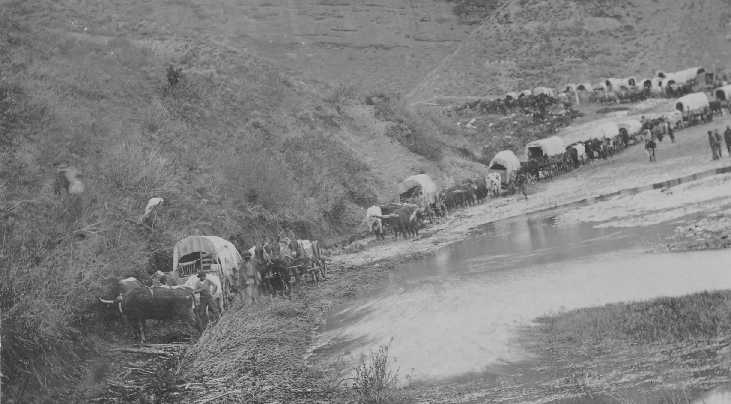
Mormon Emigrants on Their Way West. This rare photograph depicts a Mormon
wagon train snaking through a narrow mountain pass on its way to Salt Lake City.
Beleaguered by neighbors in Illinois, the Mormons decided after Joseph Smith’s murder in 1844 to emigrate to what was then Mexican territory—but would soon become part of the United States.
surrounding the lake. “This is the right place,” he declared. Here the Mormons
could create their Zion undisturbed.
They built a flourishing community, making the desert bloom with grain and
vegetables irrigated by water they ingeniously diverted from mountain streams.
Organizing the economy and the civil society as he had organized the exodus,
Young reigned as leader of the church, and from 1850 to 1857 as governor of
the newly created Utah Territory.
Zion, however, did not remain undisturbed. Relations with the government in
Washington, D.C., and with territorial officials, were never smooth, especially after Young’s proclamation in 1852 that authorized polygamy. (Although Young married a total of 55 women, most Mormon men could afford to support no more
than one wife and her children; only about one-sixth of Mormon marriages were
polygamous.) When conflict between the Mormons and the U.S. Army broke out
in 1857, Young surrendered his civil authority and made an uneasy peace with the
government.
The Republic
As the Mormons were starting west, a crisis between Mexico
of Texas
and the United States was coming to a boil. Although the
United States had renounced any claim to Texas in a treaty
with Spain negotiated in 1819, many Americans believed that Texas had been part
of the Louisiana Purchase. By the time the treaty was ratified in 1821, Mexico had won its independence from Spain. The new Republic of Mexico, seeking to develop
its northern borderlands in Texas, gave Stephen F. Austin, a Missouri businessman, Growth as the American Way
447
a large land grant to settle 300 American families there. Despite their pledge to become Roman Catholics and Mexican citizens, these immigrants and many who
followed remained Protestants and Americans at heart. They also brought in slaves, in defiance of a recent Mexican law abolishing slavery. Despite Mexican efforts to ban any further immigration, 30,000 Americans lived in Texas by 1835, outnumbering Mexicans 6 to 1.
American settlers, concentrated in east Texas, initially had little contact with
Mexican tejanos (Texans), whose settlements were farther south and west. But
political events in Mexico City in 1835 had repercussions on the northern frontier.
A new conservative national government seemed intent on consolidating its author-
ity over the northern territories. In response, Anglo-American settlers and tejanos forged a political alliance to protest any further loss of autonomy in their province.
When the Mexican government responded militarily, many Texans—both Anglo
and Mexican—fought back. Then, in March 1836, delegates from across Texas
met at a village appropriately called Washington. They declared Texas an indepen-
dent republic and adopted a constitution based on the U.S. model.
The American Revolution had lasted seven years; it took the Texans less than
seven months to win and consolidate their independence. Mexican General Antonio
López de Santa Anna led the Mexican army that captured the Alamo (a former mis-
sion converted to a fort) in San Antonio on March 6, 1836, killing all 187 of its defenders, including the legendary Americans Davy Crockett and Jim Bowie. Rallying to the cry “Remember the Alamo!” Texans swarmed to the revolutionary army
commanded by Sam Houston. When the Mexican army slaughtered another force
of more than 300 men after they had surrendered at Goliad on March 19, the Tex-
ans became further inflamed. A month later, Houston’s army, aided by volunteers
from southern U.S. states, routed a larger Mexican force on the San Jacinto River (near present-day Houston) and captured Santa Anna. Under duress, he signed a
treaty granting Texas its independence. The Mexican congress later repudiated the treaty but could not muster enough strength to reestablish its authority north of the Nueces River. The victorious Texans elected Sam Houston president of their new
republic and petitioned for annexation to the United States.
The Annexation
President Andrew Jackson, wary of provoking war with
Controversy
Mexico or quarrels with antislavery northerners, rebuffed the
annexationists. So did his successor, Martin Van Buren.
Although disappointed, the Texans turned their energies to building their republic.
The British government encouraged the Texans, in the hope that they would stand
as a buffer against further U.S. expansion. Abolitionists in England even cherished the notion that Britain might persuade the Texans to abolish slavery. Texas leaders made friendly responses to some of the British overtures, probably in the hope of provoking American annexationists to take action. They did.
Vice President John Tyler had unexpectedly become president after the death of
President William Henry Harrison from pneumonia in 1841, only weeks after his
inauguration as the first Whig president. Tyler was nominally a Whig—but he
soon broke with the Whig Party that had elected him. A states’-rights Virginian
who sought to create a new coalition to reelect him in 1844, Tyler seized on the
448
Chapter 13 Manifest Destiny: An Empire for Liberty—or Slavery?
annexation of Texas as “the only matter that will take sufficient hold of the feelings of the South to rally it on a southern candidate.”
Tyler named John C. Calhoun of South Carolina as secretary of state to negoti-
ate a treaty of annexation. The southern press ran scare stories about a British plot to use Texas as a beachhead for an assault on slavery, and annexation became a
popular issue in the South. Calhoun concluded a treaty with the eager Texans, but then he made a mistake: He released to the press a letter he had written to the
British minister to the United States, informing him that, together with other reasons, Americans wanted to annex Texas in order to protect slavery, an institution
“essential to the peace, safety, and prosperity” of the United States. This seemed to confirm abolitionist charges that annexation was a pro-slavery plot. Northern senators of both parties defeated the treaty in June 1844.
By then, Texas had become the main issue in the forthcoming presidential elec-
tion. Whig candidate Henry Clay had come out against annexation, as had the
leading contender for the Democratic nomination, former president Martin Van
Buren. Van Buren’s stand ran counter to the rising tide of Manifest Destiny sentiment within the Democratic Party. It also angered southern Democrats, who were
determined to have Texas. Through eight ballots at the Democratic national con-
vention, they blocked Van Buren’s nomination; on the ninth, the southerners broke the stalemate by nominating one of their own, James K. Polk of Tennessee. Polk, a staunch Jacksonian who had served as Speaker of the House of Representatives
during Jackson’s presidency, was the first “dark horse” candidate (not having
been a contender before the convention). Southerners exulted in their victory. “We have triumphed,” wrote one of Calhoun’s lieutenants. “Polk is nearer to us than
any public man who was named. He is a large Slave holder and [is for] Texas—
States rights out & out.” Polk’s nomination undercut President Tyler’s forlorn hope of being reelected on the Texas issue, so he bowed out of the race.
Polk ran on a platform that called for not only the annexation of Texas but
also the acquisition of all of Oregon up to 54°40′ (the Alaskan border). That de-
mand was aimed at voters in the western free states, who believed that bringing
Oregon into the Union would balance the expansion of slavery into Texas with
the expansion of free territory in the Northwest. Polk was more than comfortable
with this platform. In fact, he wanted not only Texas and Oregon, but California
and New Mexico as well.
Texas fever swept the South during the campaign. So powerful was the issue
that Clay began to waver, stating that he would support annexation if it could be done without starting a war with Mexico. This concession won him a few southern
votes but angered northern antislavery Whigs. Many of them voted for James G.
Birney, candidate of the Liberty Party, which opposed adding any more slave territory. Birney probably took enough Whig votes from Clay in New York to give Polk
victory there and in the Electoral College.
Acquisition
Although the election was extremely close (Polk won only a
of Texas
plurality of 49.5 percent of the popular vote), Democrats
and Oregon
regarded it as a mandate for annexation. Eager to leave office
in triumph, lame-duck President Tyler submitted to Congress
The Mexican War
449
a joint resolution of annexation, which required only a simple majority in both
houses instead of the two-thirds majority in the Senate that a treaty would have
required. Congress passed the resolution in March 1845. Texas thus bypassed the
territorial stage and came in as the 15th slave state in December 1845. Backed now by the United States, Texans claimed a southern and western border beyond the
Nueces River all the way to the Rio Grande, which nearly tripled the area that
Mexico had formerly defined as Texas. Mexico responded by breaking off diplo-
matic relations with the United States. The stage was set for five years of bitter controversy that included a shooting war with Mexico and political warfare in the United States over the issue of slavery expansion.
Meanwhile, Polk lost no time in addressing his promise to annex Oregon. “Our
title to the country of the Oregon is ‘clear and unquestionable,’” he said in his inaugural address. “Already our people are preparing to perfect that title by occupying it with their wives and children.” The problem was to persuade Britain to
recognize the title. Both countries had jointly “occupied” Oregon since 1818, overseeing the fur trade carried on by British and American companies. Chanting the
slogan “Fifty-four forty or fight!” many Americans in 1845 demanded all of
Oregon, as pledged in the Democratic platform. But Polk proved unwilling to fight for 54°40′. So far, Americans had settled only in the region south of the Columbia River, at roughly the 46th parallel. In June 1846, Polk accepted a compromise
treaty that split the Oregon country between the United States and Britain at the 49th parallel. Several Democratic senators from the Old Northwest (states north
of the Ohio River and west of Pennsylvania) accused Polk of betrayal and voted
against the treaty. They had supported Texas to the Rio Grande, and they had
expected Polk to support Oregon to 54°40′. A sectional breach had opened in the
Democratic Party that would soon grow wider.
THE MEXICAN WAR
Having avoided a war with Britain, Polk provoked one with Mexico in order to
gain California and New Mexico. In 1845, he sent a special envoy to Mexico City
with an offer to buy California and New Mexico for $30 million. To help Mexico
make the right response, he ordered federal troops to the disputed border area between Mexico and Texas, dispatched a naval squadron to patrol the Gulf Coast of
Mexico, and instructed the American consul at Monterey (the Mexican capital of
California) to stir up annexation sentiment among settlers there. These strong-arm tactics provoked a political revolt in Mexico City that brought a militant anti-American regime to power.
Polk responded in January 1846 by ordering 4,000 soldiers under General
Zachary Taylor to advance all the way to the Rio Grande. Recognizing that he
could achieve his goals only through armed conflict, Polk waited for news from
Texas that would justify a declaration of war, but none came. His patience having run out, on May 9, 1846, he began to draft a message to Congress asking for a
declaration of war on general grounds of Mexican defiance. That evening, word
finally arrived that two weeks earlier Mexican troops had crossed the Rio Grande
and attacked an American patrol, killing 11 soldiers. Polk had what he wanted. He quickly revised his message and sent it to Congress on May 11.
450
Chapter 13 Manifest Destiny: An Empire for Liberty—or Slavery?
Most Whigs opposed war with Mexico, but in the end, not wanting to be
branded unpatriotic, all but a handful of them voted for the final declaration of war, which passed the House by 174 to 14 and the Senate by 40 to 2. Despite their continuing opposition to what they called “Mr. Polk’s War,” most Whigs voted
supplies for the army. Having witnessed the demise of the Federalist Party after it had opposed the war in 1812, one Whig congressman said sarcastically that from
then on he had decided to vote for “war, pestilence, and famine.”
The United States went to war with a tiny regular army of fewer than 8,000
men, supplemented by 60,000 volunteers in state regiments, and an efficient navy
that quickly established domination of the sea lanes. Mexican soldiers outnumbered American in most of the battles, but the Americans had higher morale, better leadership, better weapons (especially artillery), and the backing of a more determined, stable government and a far richer, stronger economy. The U.S. forces won every
battle—and the war—in a fashion that humiliated Mexico and left a legacy of
national hostility and border violence. Especially remarkable was the prominent
role played by junior American officers trained at West Point, for whom the Mexican War was a rehearsal for a larger conflict that would take place 15 years later: Robert E.
Lee, Ulysses S. Grant, Pierre G. T. Beauregard, George B. McClellan, Braxton
Bragg, George H. Thomas, Thomas J. Jackson, George G. Meade, Jefferson Davis,
and others, whose names would become household words during the Civil War.
Military
The Mexican War’s first phase was carried out by Zachary
Campaigns
Taylor, whose 4,000 regulars routed numerically superior
of 1846
Mexican forces on the Rio Grande in early May, even before
Congress had declared war. Those victories made “Old Rough
and Ready” Taylor a hero, a reputation he rode to the presidency two years later.
Reinforced by several thousand volunteers, Taylor pursued the retreating Mexicans 100 miles south of the Rio Grande to the heavily fortified Mexican city of Monterrey, and took the city after four days of fighting in September 1846. Mexican resistance in the area crumbled, and Taylor’s force settled down as an army of occupation.
Meanwhile, the second phase of American strategy had gone forward in New
Mexico and California. In June 1846, General Stephen Watts Kearny led an army
of 1,500 tough frontiersmen and regulars west from Fort Leavenworth toward
Santa Fe. Kearny bluffed and intimidated the New Mexico governor, who fled
southward without ever ordering the local 3,000-man militia into action. Kearny’s army occupied Santa Fe on August 18 without firing a shot. With closer economic
ties to the United States than to their own country, which taxed them well but governed them poorly, many New Mexicans seemed willing to accept American rule.
After receiving reinforcements, Kearny left a small occupation force and divided
his remaining troops into two contingents, one of which he sent under Colonel
Alexander Doniphan into the Mexican province of Chihuahua. In the most extraor-
dinary campaign of the war, these 800 Missourians marched 1,500 miles, foraging
supplies along the way; fought and beat two much larger enemy forces; and finally linked up with Zachary Taylor’s army near Monterrey in spring 1847.
Kearny led the other contingent across deserts and mountains to California.
Events there had anticipated his arrival. In June 1846, a group of American
settlers backed by Captain John C. Frémont, a renowned western explorer with
The Mexican War
451
the army topographical corps, captured Sonoma and raised the flag of an indepen-
dent California, displaying the silhouette of a grizzly bear. Marked by exploits
both courageous and comic, this “bear-flag revolt” paved the way for the con-
quest of California by the americanos. The U.S. Pacific Fleet seized California’s ports and the capital at Monterey; sailors from the fleet and volunteer soldiers
under Frémont subdued Mexican resistance. Kearny’s weary and battered force
arrived in December 1846, barely in time to help with the mopping up.
Military
New Mexico and California had fallen into American hands,
Campaigns
and Mexican armies had experienced nothing but defeat, but
of 1847
the Mexican government refused to admit that the war was
lost. A political maneuver by President Polk to secure a more
tractable government in Mexico had backfired. In one of Mexico’s many palace
revolts, Santa Anna had been overthrown and forced into exile in Cuba in 1844. A
shadowy intermediary convinced Polk in July 1846 that if Santa Anna returned to
power, he would make peace on American terms in return for $30 million. Polk
instructed the navy to pass Santa Anna through its blockade of Mexican ports. The Mexican general then rode in triumph to Mexico City, where yet another new
government named him supreme commander of the army and president of the
republic. Breathing fire, Santa Anna spoke no more of peace. Instead, he raised new levies and marched north early in 1847 to attack Taylor’s army near Monterrey.
Taylor, 62 years old, was still rough but not as ready to withstand a counterof-
fensive as he had been a few weeks earlier. After capturing Monterrey in September 1846, he had let the defeated Mexican army go and had granted an eight-week
armistice in the hope that it would allow time for peace negotiations. Angry at
Taylor’s presumption in making such a decision and suspicious of the general’s
political ambitions, Polk canceled the armistice and named General-in-Chief
Winfield Scott to command the third phase of the war, a campaign against Mexico
City. A large, punctilious man, Scott acquired the nickname “Old Fuss and Feath-
ers” for a military professionalism that contrasted with the homespun manner of
“Rough and Ready” Zach Taylor. Scott decided to lead an invasion of Mexico’s
heartland from a beachhead at Veracruz, and in January 1847 ordered the transfer
of more than half of Taylor’s troops to his own expeditionary force.
Left with fewer than 5,000 men, most of them untried volunteers, Taylor com-
plained bitterly of political intrigue and military favoritism. Nevertheless, he
marched out to meet Santa Anna’s army of 18,000. In a two-day battle on February
22 and 23 at Buena Vista, Taylor’s little force bent but never broke. They inflicted twice as many casualties as they suffered in a fierce struggle highlighted by the brilliant counterattack of a Mississippi regiment commanded by Jefferson Davis. The
bloodied Mexican army retreated toward the capital. When news of the victory
reached the East, Taylor’s popularity soared to new heights. If Polk had wanted to quash a political rival by taking away most of his troops—as Taylor believed—he
had achieved just the opposite.
But it was General Scott who actually won the war. With a combined army-
navy force, he took the coastal fortress at Veracruz in March 1847. Over the next five months, his army, which never totaled more than 14,000 men, marched and
fought its way over more than 200 miles of mountains and plains to Mexico City.
452
Chapter 13 Manifest Destiny: An Empire for Liberty—or Slavery?
OREGON COUNTRY
U
Mi
N
s o
.
1846
O
u ri R.
R
R
ont
G
ento
m
A
é
U N I T E D
m
r
N
ar
F
1845–1846
I
c
Z
a
S Sutter's Fort
San
ont
E D
Francisco
Frém
S T A T E S
Ft. Leavenworth
MEXICAN
.
Monterey
Bent's
CESSION
Fort
St. Louis
Kearny 1845T
Colorado R
Final
E
Boundary
R
S
1850
R
A
to
Santa Barbara
IT
rka
ck
Santa Fe
O
nsa
t
s
o
Los Angeles
R
n
Las Vegas
R
.
18
Y
46
Socorno
.
DISPUTED
R
G
e
San Diego
ila
BY U.S.
d R.
R.
Sl
AND MEXICO
o
Kearny 1846
ississippiR
at
M
184
El Brazio
Sabi
6
ne R
El Paso
.
Pec
del Norte
os R
TEXAS
.
anh
Austin
ip
478
N
New Orleans
no 1
u
D
ece
San Antonio
Chihuahua
R
Chihuahua
i
s
o
R
G
.
rande
Corpus
Christi
M E X I C O
Taylor
Scott 1846
1846
Saltillo
Monterrey
Matamoros
PACIFIC
Buena Vista
OCEAN
Gulf of Mexico
Santa Anna
Mazatlán
1847
Ameri
San Blas
San Luis
c
Tampico
a
Potosi
n B
Pánuco R
l
.
ocka
Scott
de
Fort
La
1847
Manzanillo
Mexico City
Battle site
Veracruz
Chapultepec
Learning
Cerro
Blockade
Gordo
Cengage©
MAP 13.3 Principal Campaigns of the Mexican War, 1846–1847
This map provides a graphic illustration of the vast territory over which the Mexican War was fought; the distance from Veracruz to San Francisco is 2,500 miles.
It was a bold, high-risk action. When Scott’s forces reached the fortifications of Mexico City, held by three times their numbers, the Duke of Wellington, who was
following the campaign closely, predicted, “Scott is lost—he cannot capture the city, and he cannot fall back upon his base.” But capture it he did, on September 14,
after fierce hand-to-hand combat in the battles of Contreras, Churubusco, Molino
del Rey, and Chapultepec.
Antiwar
The war had enthusiastic support in the South and West and
Sentiment
among Democrats, but Whigs and many people in the
Northeast, especially in New England, considered it “a
wicked and disgraceful war.” Democrats and Whigs had different notions of
The Mexican War
453
progress. Democrats believed in expanding American institutions over space—in
particular, the space occupied by Mexicans and Indians. Whigs, on the other hand, believed in improving American institutions over time. “Opposed to the instinct of boundless acquisition stands that of Internal Improvement,” said Horace Greeley.
“A nation cannot simultaneously devote its energies to the absorption of others’
territories and the improvement of its own.”
Antislavery people raised their eyebrows when they heard Manifest Destiny
rhetoric about “extending the blessings of American liberty” to benighted regions.
They suspected that the real reason was the desire to extend slavery. Hosea Biglow, the rustic Yankee philosopher created by the abolitionist poet James Russell Lowell, observed:
They jest want this Californy
So’s to lug new slave-states in
To abuse ye an’ to scorn ye,
And to plunder ye like sin
The Wilmot
The slavery issue overshadowed all others in the debate over
Proviso
the Mexican War. President Polk could not understand the
reason for the fuss. “There is no probability,” he wrote in his
diary, “that any territory will ever be acquired from Mexico in which slavery
would ever exist.” But other Americans were less sure. Many southerners hoped
that slavery would spread into the fertile lowlands of Mexican territory. Many
northerners feared that it might. The issue came to a head early in the war. On
August 8, 1846, Pennsylvania Democratic Congressman David Wilmot offered an
amendment to an army appropriations bill: “... that, as an express and fundamen-
tal condition of the acquisition of any territory from the Republic of Mexico …
neither slavery nor involuntary servitude shall ever exist in any part of said
territory.”
This famous Wilmot Proviso framed the national debate over slavery for the
next 15 years. The House passed the amendment. Nearly all northern Democrats
joined all northern Whigs in the majority, while southern Democrats and southern
Whigs voted almost unanimously against it. In the Senate, greater southern strength defeated the proviso. This outcome marked an ominous wrenching of the party
division between Whigs and Democrats into a sectional division between free and
slave states. It was a sign that the two-party system might not successfully contain the convulsive question of slavery expansion.
Several factors underlay the split of northern Democrats from their own presi-
dent on this issue. Ever since southern Democrats had blocked Van Buren’s nomi-
nation in 1844, resentment had been growing in the party’s northern wing. Polk’s
acceptance of 49° latitude for Oregon’s northern boundary exacerbated this feeling.
“Our rights to Oregon have been shamefully compromised,” fumed an Ohio Dem-
ocrat. “The administration is Southern, Southern, Southern! ... Since the South have fixed boundaries for free territory, let the North fix boundaries for slave
territories.” The reduced rates of the Walker tariff in 1846 (sponsored by Robert J.
Walker of Mississippi, Polk’s secretary of the treasury) dismayed Democrats
from Pennsylvania’s industrial districts. Polk further angered Democrats from the
454
Chapter 13 Manifest Destiny: An Empire for Liberty—or Slavery?
1939.3.1
acc#
art
MHS
Society.
Historical
Missouri
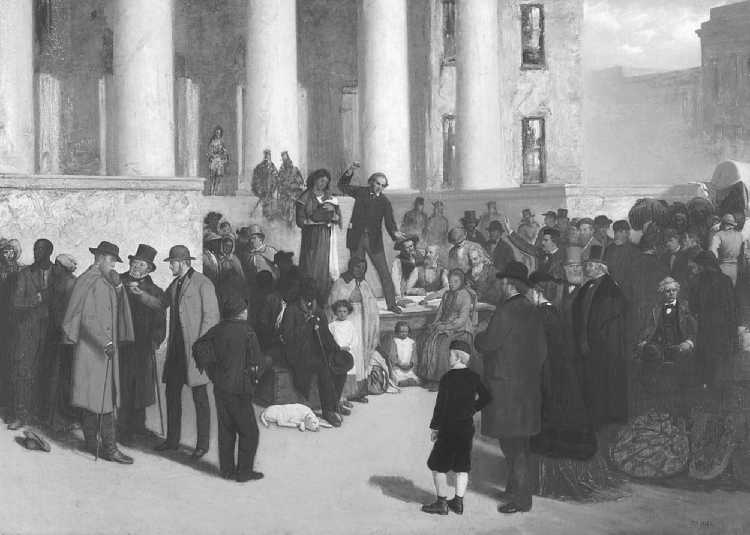
Slave Auction in St. Louis. The public buying and selling of human beings in cities such as St. Louis made a mockery of American boasts of liberty and gave a powerful impetus to the drive to prohibit the expansion of slavery into the territories acquired from Mexico. This painting hints at the ugliest dimension of the slave trade, the sale of mothers and children apart from fathers and sometimes apart from each other.
Old Northwest by vetoing a rivers and harbors bill that would have provided fed-
eral aid for transportation improvements in their districts. The Wilmot Proviso was in part the product of these pent-up frustrations over what northerners were
increasingly calling “the slave power.” “The time has come,” said a Democratic
congressman in 1846, “when the Northern Democracy should make a stand. Every
thing has taken a Southern shape and been controlled by Southern caprice for
years.... We must satisfy the Northern people ... that we are not to extend the institution of slavery as a result of this war.”
The slavery issue hung like the sword of Damocles over Polk’s efforts to nego-
tiate peace with Mexico. Polk also came under pressure from expansionist Demo-
crats who, excited by military victory, wanted more Mexican territory, perhaps
even “all Mexico.” Polk had sent diplomat Nicholas Trist with Scott’s army to
negotiate the terms of Mexican surrender. Authorized to pay Mexico $15 million
for California, New Mexico, and a Texas border on the Rio Grande, Trist worked
out such a treaty. In the meantime, though, Polk had succumbed to the “all Mexico”
clamor. He ordered Trist back to Washington, intending to replace him with some-
one who would exact greater concessions from Mexico. Trist ignored the recall,
signed the Treaty of Guadalupe Hidalgo on February 2, 1848, and sent it to
Washington. Although angered by Trist’s defiance, Polk nonetheless decided to end The Election of 1848
455
the controversy by submitting the treaty to the Senate, which approved it on
March 10 by a vote of 38 to 14. Half the opposition came from Democrats who
wanted more Mexican territory and half from Whigs who wanted none. As it was,
the treaty sheared off half of Mexico and increased the size of the United States by one-fourth.
THE ELECTION OF 1848
The treaty did nothing to settle the question of slavery in the new territory, however. Mexico had abolished the institution two decades earlier; would the United
States reintroduce it? Many Americans looked to the election of 1848 to decide
the matter. Four positions on the issue emerged, each identified with a candidate for the presidential nomination.
The Wilmot Proviso represented the position of those determined to bar slavery
from all territories. The Liberty Party endorsed the proviso and nominated Senator John P. Hale of New Hampshire for president. Southern Democrat John C. Calhoun
formulated the “southern-rights” position. Directly challenging the Wilmot Proviso, Calhoun introduced resolutions in the Senate in February 1847 affirming the right of slave owners to take their human property into any territory. The Constitution protected the right of property, Calhoun pointed out; Congress could no more
prevent a settler from taking his slaves to California than it could prevent him from taking his horses there.
Although most southerners agreed with Calhoun, the Democratic Party sought
a middle ground. The Polk administration endorsed the idea of extending the old
Missouri Compromise line of 36°30′ to the Pacific. This would have excluded slav-
ery from present-day Washington, Oregon, Idaho, Utah, Nevada, and the northern
half of California, but would have allowed it in present-day New Mexico, Arizona, and southern California. Secretary of State James Buchanan, also a candidate for
the Democratic presidential nomination (Polk did not seek renomination),
embraced this position.
Another compromise position became known as “popular sovereignty.” Identi-
fied with Senator Lewis Cass of Michigan, yet another contender for the Democratic nomination, this concept proposed to let the settlers of each territory decide for themselves whether to permit slavery. This solution contained a crucial ambiguity: It did not specify at what stage the settlers of a territory could decide on slavery. Most northern Democrats assumed that a territorial legislature would make that decision as soon as it was organized. Most southerners assumed that the decision would not be made until the settlers had drawn up a state constitution. That would normally happen only after several years as a territory, during which time slavery might well have taken deep enough root to be implanted in the state constitution. So long as neither assumption was tested, each faction could support popular sovereignty.
The Democratic convention nominated Cass for president, thereby seeming to
endorse popular sovereignty. In an attempt to maintain party unity, however, the
platform made no mention of the matter. The attempt was not entirely successful:
Two Alabama delegates walked out when the convention refused to endorse
Calhoun’s southern-rights position, and an antislavery faction from New York
walked out when it failed to win a credentials fight.
456
Chapter 13 Manifest Destiny: An Empire for Liberty—or Slavery?
The Whig convention tried to avoid a similar schism by adopting no platform
at all, but the slavery issue would not die. In the eyes of many antislavery delegates who styled themselves Conscience Whigs, the party made itself ridiculous by nominating Zachary Taylor for president. Desperate for victory, the Whigs chose a hero from a war that most of them had opposed. But the fact that Taylor was also a
large slaveholder who owned several plantations in Louisiana and Mississippi was
too much for the Conscience Whigs. They bolted from the party and formed a coa-
lition with the Liberty Party and antislavery Democrats.
The Free
The Free-Soilers met in convention in August 1848 and
Soil Party
nominated former president Martin Van Buren. The meeting
resembled a religious camp meeting more than a political
gathering. Speakers proclaimed slavery “a great moral, social, and political evil—
a relic of barbarism which must necessarily be swept away in the progress of Christian civilization.” The convention did not say how that would be done, but it did adopt a platform calling for “no more Slave States and no more Slave Territories.”
The campaign was marked by the futile efforts of both major parties to bury
the slavery issue. Free Soil pressure compelled both northern Democrats and Whigs to take a stand against slavery in the territories. Whigs pointed to their earlier support of the Wilmot Proviso, while Democrats said popular sovereignty would keep
the territories free. In the South, though, the two parties presented other faces.
There, the Democrats pointed with pride to their expansionist record that had
brought to the nation hundreds of thousands of square miles of territory—into
which slavery might expand. But Taylor proved the strongest candidate in the
South because he was a southerner and a slaveholder. “Will the people of [the
South] vote for a Southern President or a Northern one?” asked southern newspa-
pers. “We prefer Old Zack with his sugar and cotton plantations and four hundred
negroes to all their compromises.”
Taylor carried 8 of the 15 slave states and increased the Whig vote in the South
by 10 percent over 1844, while the Democratic vote declined by 4 percent.
Although he did less well in the North, he carried New York and enough other
states to win the election. The Free-Soilers won no electoral votes but polled 14 percent of the popular vote in the North. They also elected nine congressmen along
with two senators who would be heard from in the future: Salmon P. Chase of
Ohio, architect of the Free Soil coalition in 1848, and Charles Sumner of Massa-
chusetts, leader of the Conscience Whigs.
The Gold Rush
In 1848 workers building a sawmill on the American River
and California
near Sacramento discovered flecks of gold in the riverbed.
Statehood
The word gradually leaked out, reaching the East in August
1848, where a public that had been surfeited with tall tales
out of the West greeted this news with skepticism. But in December, Polk’s final
message to Congress confirmed the “extraordinary” discoveries of gold. Two days
later, a tea caddy containing 320 ounces of pure gold from California arrived in
Washington. Now all doubts disappeared. By spring 1849, 100,000 gold-seekers
were poised to take off by foot on the overland trail or by ship—either around
The Election of 1848
457
Cape Horn or to the isthmus of Central America, where, after a land crossing, they could board another ship to take them up the Pacific Coast. Eighty thousand
actually made it that first year (5,000 succumbed to a cholera epidemic).
San Francisco became a boomtown and a new center of Pacific trade, with
ships arriving filled with cargos of wheat, coffee, sugar, rice and other commodities from Chile, Australia, China, and Alaska. Men and women (outnumbered 10
to 1 by men) rushed to California from Chile, Mexico, Peru, France, Belgium, and
China. African Americans and Miwok Indians also worked as miners—although
they were quickly pushed aside by land-hungry Anglo Americans, who in 1850
instituted discriminatory laws that not only privileged whites but forced the expulsion of Mexicans—many of whom were American citizens under the Treaty of
Guadalupe Hidalgo. While a few miners struck it rich, most instead earned a bare
pittance—and soon raced off to new gold rushes in British Columbia, Colorado,
and Nevada.
The political organization of California could not be postponed: miners needed
law and order; settlers needed courts, land and water laws, mail service, and other amenities of established government. In New Mexico, the 60,000 former Mexican
citizens, now Americans, also needed a governmental structure for their new alle-
giance. Nor could the growing Mormon community at Salt Lake be ignored.
Still, the slavery question paralyzed Congress. In December 1848, lame-duck
president Polk recommended extension of the Missouri Compromise 36°30′ line to
the Pacific. The Whig-controlled House defied him, reaffirmed the Wilmot Proviso, drafted a bill to organize California as a free territory, and debated abolishing the slave trade and even slavery itself in the District of Columbia. Fistfights flared in Congress; southerners declared that they would secede if any of those measures
became law; the Democratic Senate quashed all the bills. A southern caucus asked
Calhoun to draft an address setting forth its position. He eagerly complied, producing in January 1849 a document that breathed fire against “unconstitutional”
northern efforts to keep slavery out of the territories. Calhoun reminded south-
erners that their “property, prosperity, equality, liberty, and safety” were at stake and prophesied secession if the South did not prevail.
But Calhoun’s firebomb fizzled. Only two-fifths of the southern congressmen
and senators signed it. Southern Whigs wanted nothing to do with it. They looked
forward to good times in the Taylor administration and opposed rocking the boat.
They were in for a rude shock. Taylor viewed matters as a nationalist, not as a
southerner. He proposed to admit California and New Mexico (the latter compris-
ing present-day New Mexico, Arizona, Nevada, Utah, and part of Colorado) imme-
diately as states, skipping the territorial stage.
From the South came cries of outrage. Immediate admission would bring in
two more free states because slavery had not existed under Mexican law, and
most of the 49ers were Free Soil in sentiment. With the administration’s support, Californians held a convention in October 1849, drew up a constitution excluding
slavery, and applied to Congress for admission as a state. Taylor’s end run would tip the existing balance of 15 slave and 15 free states in favor of the North, probably forever. The South would lose its de facto veto in the Senate. “For the first time,” said freshman Senator Jefferson Davis of Mississippi, “we are about permanently to destroy the balance of power between the sections.” Davis insisted that
458
Chapter 13 Manifest Destiny: An Empire for Liberty—or Slavery?
California
Sacramento,
Library,
State
California
Room,
History
California
theof
Courtesy
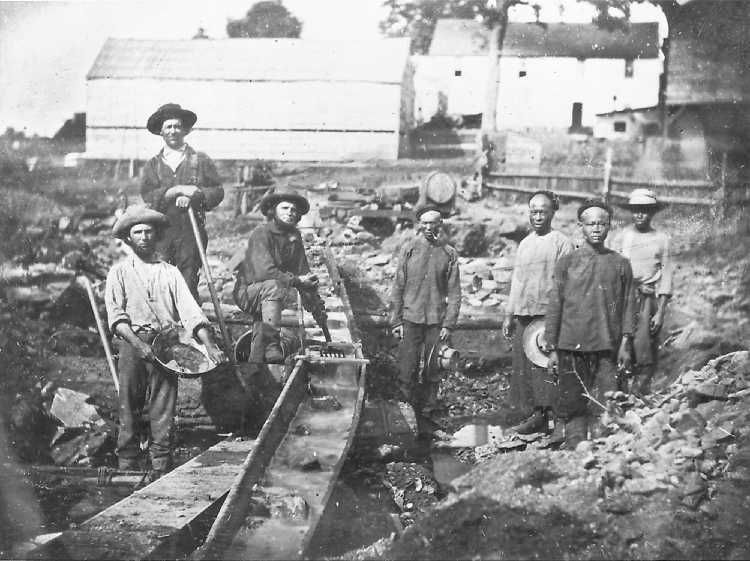
The California Gold Rush. Prospectors for gold in the foothills of California’s Sierra Nevada came from all over the world, including China. This photograph shows American-born and Chinese miners near Auburn, California, a year or two after the initial gold rush of 1849. It illustrates the original technology of separating gravel from gold by panning or by washing the gravel away in a sluice box, leaving the heavier gold flakes behind.
slave labor was suitable to mining and that slavery should be permitted in California.
Southerners vowed never to “consent to be thus degraded and enslaved” by such a
“monstrous trick and injustice” as admission of California as a free state.
THE COMPROMISE OF 1850
California and New Mexico became the focal points of a cluster of slavery issues
that faced the Congress of 1849–50. An earlier Supreme Court decision (Prigg v.
Pennsylvania, 1842) had relieved state officials of any obligation to enforce the return of fugitive slaves who had escaped into free states, declaring that this was a federal responsibility. Southerners therefore demanded a strong national fugitive slave law (in utter disregard of their oft-stated commitment to states’ rights);
antislavery northerners, on the other hand, were calling for an end to the disgraceful buying and selling of slaves in the national capital; and in the Southwest, a shooting war threatened to break out between Texas and New Mexico. Having
won the Rio Grande as their southern border with Mexico, Texans insisted that
the river must also mark their western border with New Mexico. (That would
The Compromise of 1850
459
have given Texas more than half of the present state of New Mexico.) This dispute also involved slavery because the terms of Texas’s annexation authorized the state to split into as many as five states, and the territory it carved out of New Mexico would create the potential for still another slave state.
These problems produced both a crisis and an opportunity. The crisis lay in the
threat to break up the Union. Southern states agreed to meet at Nashville in June 1850 “to devise and adopt some mode of resistance to northern aggression.” Few
doubted that the mode would be secession unless Congress met southern demands
at least halfway, but Congress got off to an unpromising start. Sectional disputes prevented either major party from commanding a majority in electing a Speaker of
the House. Through three weeks and 62 ballots, the contest went on while tempers
shortened. Northerners and southerners shouted insults at each other, fistfights
broke out, and a Mississippian drew a revolver during one heated debate. Southern warnings of secession became a litany: “If, by your legislation, you seek to drive us from the territories of California and New Mexico,” thundered Robert Toombs of
Georgia, “I am for disunion.” On the 63rd ballot, the exhausted legislators finally elected Howell Cobb of Georgia as Speaker by a plurality rather than a majority.
The Senate
As he had in 1820 and 1833, Henry Clay hoped to turn the
Debates
crisis into an opportunity. Seventy-two years old, a veteran of
30 years in Congress, three times an unsuccessful candidate
for president, Clay was the most respected and still the most magnetic figure in the Senate. A nationalist from the border state of Kentucky, he hoped to unite North
and South in a compromise. On January 29, 1850, he presented eight proposals to
the Senate and supported them with an eloquent speech, the first of many to be
heard in that body during what turned out to be the most famous congressional
debate in U.S. history. Clay grouped the first six of his proposals into three pairs, each pair offering one concession to the North and one to the South. The first pair would admit California as a free state but would organize the rest of the Mexican cession without restrictions against slavery. The second would settle the Texas
boundary dispute in favor of New Mexico but would compensate Texas to enable
the state to pay off bonds it had sold when it was an independent republic. (Many holders of the Texas bonds were southerners.) The third pair of proposals would
abolish the slave trade in the District of Columbia but would guarantee the continued existence of slavery there unless both Maryland and Virginia consented to abolition.
Of Clay’s final two proposals, one affirmed that Congress had no jurisdiction over the interstate slave trade; the other called for a strong national fugitive slave law.
At the end of a long, grueling bargaining process, the final shape of the Com-
promise of 1850 closely resembled Clay’s package. The public face of this process featured set speeches in the Senate, the most notable of which were those of John C.
Calhoun, Daniel Webster, and William H. Seward. Calhoun and Webster (along
with Clay) represented the grand Senate triumvirate of the previous generation;
Seward was the rising star of a new generation, whose speech catapulted him into
renown. Each senator spoke for one of the three principal viewpoints on the issues.
Calhoun went first, on March 4. Suffering from consumption (he would die
within a month), Calhoun sat shrouded in flannel as a colleague read his speech to 460
Chapter 13 Manifest Destiny: An Empire for Liberty—or Slavery?
a rapt audience. Unless northerners returned fugitive slaves in good faith, Calhoun warned, unless they consented to the expansion of slavery into the territories and accepted a constitutional amendment, “which will restore to the South, in substance, the power she possessed of protecting herself before the equilibrium between the two sections was destroyed,” southern states could not “remain in the Union
consistently with their honor and safety.” Calhoun wanted to give slave states a
veto power over any national legislation concerning slavery.
Webster’s speech three days later was both a reply to Calhoun and an appeal to
the North for compromise. In words that would be memorized by generations of
schoolchildren, Webster announced his theme: “I wish to speak today, not as a
Massachusetts man, nor as a Northern man, but as an American. I speak to-day
for the preservation of the Union. Hear me for my cause.” Although Webster had
voted for the Wilmot Proviso, he now urged Yankees not to insist upon it. Nature
would exclude slavery from New Mexico. “I would not take pains uselessly to reaf-
firm an ordinance of nature, nor to reenact the will of God.” Believing that God
helped those who helped themselves, many of Webster’s former antislavery admirers repudiated his leadership, especially because he also endorsed a fugitive slave law.
On March 11, Seward expressed the antislavery position in what came to be
known as his “higher law” speech. Both slavery and compromise were “radically
wrong and essentially vicious,” he said. In reply to Calhoun’s arguments for the
constitutional protection of slavery in the territories, Seward invoked “a higher law than the Constitution,” the law of God in whose sight all persons were equal.
Instead of legislating the expansion of slavery or the return of fugitive slaves, the country should be considering how to bring slavery peacefully to an end, for “you cannot roll back the tide of social progress.”
Passage of the
While these speeches were being delivered, committee mem-
Compromise
bers worked ceaselessly behind the scenes to fashion com-
promise legislation. But in reaching for a compromise, Clay
chose what turned out to be the wrong tactic. He lumped most of his proposals
together in a single bill, hoping that supporters of any given part of the compromise would vote for the whole in order to win the part they liked. Instead, most
senators and representatives voted against the package in order to defeat the parts they disliked. President Taylor continued to insist on the immediate admission of California (and New Mexico, when it was ready) with no quid pro quo for the
South. Exhausted and discouraged, Clay fled Washington’s summer heat, leaving a
young senator from Illinois, Stephen A. Douglas, to lead the forces of compromise.
Another rising star of the new generation, Douglas reversed Clay’s tactics.
Starting with a core of supporters made up of Democrats from the Old Northwest
and Whigs from the upper South, he built a majority for each part of the compro-
mise by submitting it separately and adding its supporters to his core: northerners for a free California, southerners for a fugitive slave law, and so on. This effort benefited from Taylor’s sudden death on July 9 (of gastroenteritis, after consuming large quantities of iced milk and cherries on a hot Fourth of July). The new president, Millard Fillmore, was a conservative Whig from New York who gave his
support to the compromise. One after another, in August and September, the separate The Compromise of 1850
461
measures became law: the admission of California as a free state; the organization of the rest of the Mexican cession into the two territories of New Mexico and Utah without restrictions against slavery; the settlement of the Texas–New Mexico border dispute in favor of New Mexico and the compensation of Texas with $10 million;
the abolition of the slave trade in the District of Columbia and the guarantee of slavery there; and the passage of a new fugitive slave law. When it was over, most Americans breathed a sigh of relief, and President Fillmore christened the Compromise of 1850 “a final settlement” of all sectional problems. Calhounites in the
South and antislavery activists in the North branded the compromise a betrayal of principle, but for the time being they seemed to be in a minority.
The compromise produced consequences different from what many antici-
pated. California came in as the 16th free state, but its senators during the
1850s were in fact conservative Democrats who voted with the South on most
issues. California law even allowed slave owners to keep their slaves while so-
journing in the state. The territorial legislatures of Utah and New Mexico legal-
ized slavery, but few slaves were brought there. And the fugitive slave law
generated more trouble and controversy than all the other parts of this final settlement combined.
The Fugitive
The Constitution required that a slave who escaped into a
Slave Law
free state must be returned to his or her owner, but failed to
specify how that should be done. Under a 1793 law, slave
owners could take their recaptured property before any state or federal court to
prove ownership. This procedure worked well enough so long as officials in free
states were willing to cooperate. But as the antislavery movement gained momen-
tum in the 1830s, some officials proved uncooperative. And professional slave-
catchers sometimes went too far—kidnapping free blacks, forging false affidavits to
“prove” they were slaves, and selling them south into bondage. Several northern
states responded by passing antikidnapping laws that gave alleged fugitives the
right of trial by jury. The laws also prescribed criminal penalties for kidnapping. In Prigg v. Pennsylvania (1842), the U.S. Supreme Court declared Pennsylvania’s antikidnapping law unconstitutional. But the Court also ruled that enforcing the
Constitution’s fugitive slave clause was entirely a federal responsibility, thereby absolving the states of any need to cooperate in enforcing it. Nine northern states thereupon passed personal liberty laws prohibiting the use of state facilities
(courts, jails, police or sheriffs, and so on) in the recapture of fugitives.
Fugitive slaves dramatized the poignancy and cruelties of bondage more viv-
idly than anything else. A man or woman risking all for freedom was not an ab-
stract issue but a real human being whose plight invited sympathy and help.
Consequently, many northerners who were not necessarily opposed to slavery in
the South nonetheless felt outrage at the idea of fugitives being seized in a land of freedom and returned to slavery. The “underground railroad” that helped spirit
slaves out of bondage took on legendary status. Stories of secret chambers where
fugitives were hidden, dramatic trips at night between stations on the under-
ground, and clever or heroic measures to foil pursuing bloodhounds exaggerated
the legend.
462
Chapter 13 Manifest Destiny: An Empire for Liberty—or Slavery?
Probably fewer than 1,000 of a total 3 million slaves actually escaped to free-
dom each year. But to southerners the return of those fugitives—like the question of the legality of slavery in California or New Mexico—was a matter of honor and
rights. “Although the loss of property is felt,” said Senator James Mason of Virginia, sponsor of the Fugitive Slave Act, “the loss of honor is felt still more.” The fugitive slave law, said another southern politician, was “the only measure of the Compromise [of 1850] calculated to secure the rights of the South.” Southerners therefore regarded obedience to the fugitive slave law as a test of the North’s good faith in carrying out the compromise.
The provisions of that law were extraordinary. It created federal commissioners
who could issue warrants for arrests of fugitives and before whom a slaveholder
would bring a captured fugitive to prove ownership. All the slaveholder needed
for proof was an affidavit from a slave-state court or the testimony of white
witnesses. The fugitive had no right to testify on his or her own behalf. The commissioner received a fee of $10 if he found the owner’s claim valid, but only $5 if he let the fugitive go. (The difference was supposedly justified by the larger amount of paperwork required to return the fugitive to slavery.) The federal treasury would pay all costs of enforcement. The commissioner could call on federal marshals to
apprehend fugitives, and the marshals in turn could deputize any citizen to help.
A citizen who refused could be fined up to $1,000, and anyone who harbored a fugitive or obstructed his or her capture would be subject to imprisonment. Northern
senators had tried in vain to weaken some of these provisions and to amend the law to give alleged fugitives the rights to testify, to habeas corpus, and to a jury trial.
The Slave-
Abolitionists denounced the law as draconian, immoral, and
Catchers
unconstitutional. They vowed to resist it. Opportunities soon
came, as slave owners sent agents north to recapture fugi-
tives, some of whom had escaped years earlier (the act set no statute of limitations).
In February 1851, slave-catchers arrested a black man living with his family in
Indiana and returned him to an owner who said he had run away 19 years before.
A Maryland man tried to claim ownership of a Philadelphia woman who he said
had escaped 22 years earlier; he also wanted her six children, all of whom were born in Philadelphia. In this case, the commissioner disallowed his claim to both mother and children, but statistics show that the law was rigged in favor of the claimants. In the first 15 months of its operation, 84 fugitives were returned to slavery and only 5
were released. (For the entire decade of the 1850s, the ratio was 332 to 11.)
Two of the most famous of these fugitive slaves were William and Ellen Craft,
whose successful struggle for liberty inspired other slaves and abolitionists on both sides of the Atlantic. Both born in slavery, William and Ellen were married in
Georgia in 1846. Unwilling to give birth to children who might be sold away from
her, Ellen plotted with her husband to escape to the North. Light enough to pass
for white (she was the daughter of her master and his light-skinned concubine),
Ellen sewed herself a pair of trousers and posed as a deaf-mute invalid young man traveling to Philadelphia for medical treatment attended by “his” slave William.
After some close calls, they made it to Philadelphia at the end of 1848 and moved on to Boston in 1849.
The Compromise of 1850
463
After passage of the Fugitive Slave Law in 1850, however, two agents from
Georgia appeared in Boston to recapture the Crafts. Local abolitionists spirited
them away to Canada and then to England, where the Crafts lived for the next 19
years and had five children. Active in British antislavery circles, the Crafts worked to counter pro-Confederate sentiment in England during the Civil War. In 1869, the
Crafts returned to the United States and bought a farm in Georgia in 1871, where
they established a school for local freedpeople, which they conducted for several years until white hostility and financial problems forced them to close it.
Unable to protect their freedom through legal means, many other blacks, with
the support of white allies, also resorted to flight and resistance. Thousands of northern blacks fled to Canada—3,000 in the last three months of 1850 alone. In
February 1851, slave-catchers arrested a fugitive who had taken the name Shadrach when he escaped from Virginia a year earlier. They rushed him to the federal courthouse, where a few deputy marshals held him, pending a hearing. But a group of
black men broke into the courtroom, overpowered the deputies, and spirited
Shadrach out of the country to Canada. This was too much for the Fillmore admin-
istration. In April 1851, another fugitive, Thomas Sims, was arrested in Boston, and the president sent 250 soldiers to help 300 armed deputies enforce the law and
return Sims to slavery.
Continued rescues and escapes kept matters at fever pitch for the rest of the
decade. In the fall of 1851, a Maryland slave owner and his son accompanied fed-
eral marshals to Christiana, Pennsylvania, a Quaker village, where two of the man’s slaves had taken refuge. The hunters ran into a fusillade of gunfire from a house where a dozen black men were protecting the fugitives. When the shooting stopped, the slave owner was dead and his son was seriously wounded. Three of the blacks
fled to Canada. This time Fillmore sent in the marines. They helped marshals arrest 30 black men and half a dozen whites who were indicted for treason. But the U.S.
attorney dropped charges after a jury acquitted the first defendant, a Quaker.
Another white man who aided slaves was not so lucky. Sherman Booth was
an abolitionist editor in Wisconsin who led a raid in 1854 to free a fugitive from custody. Convicted in a federal court, Booth appealed for a writ of habeas corpus from the Wisconsin Supreme Court. The court freed him and declared the Fugitive
Slave Law unconstitutional. That assertion of states’ rights prompted the southern majority on the U.S. Supreme Court to overrule the Wisconsin court, assert the
supremacy of federal law, and order Booth back to prison.
Two of the most famous fugitive slave cases of the 1850s ended in deeper
tragedy. In spring 1854, federal marshals in Boston arrested a Virginia fugitive, Anthony Burns. Angry abolitionists poured into Boston to save him. Some of them
tried to attack the federal courthouse, where a deputy was killed in an exchange of gunfire. But the new president, Franklin Pierce, was determined not to back down.
“Incur any expense,” he wired the district attorney in Boston, “to enforce the law.”
After every legal move to free Burns had failed, Pierce sent federal troops. While thousands of angry Yankees lined the streets under American flags hanging upside
down to signify the loss of liberty in the cradle of the Revolution, 200 marines and soldiers marched this lone black man back into bondage.
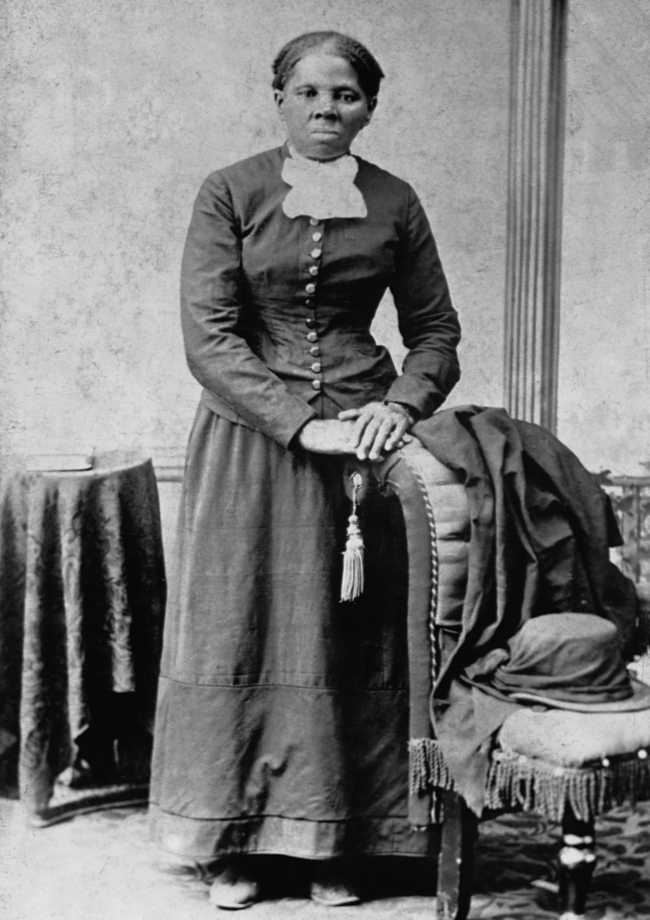
Two years later, Margaret Garner escaped from Kentucky to Ohio with her
husband and four children. When a posse of marshals and deputies caught up
464
Chapter 13 Manifest Destiny: An Empire for Liberty—or Slavery?
Bettmann/CORBIS©
Harriet Tubman. Born into slavery in Maryland around 1822, Harriet Tubman escaped to freedom in 1849, settling at first in Philadelphia. Despite the many dangers she faced, Tubman returned South over and over in the years before the Civil War, helping her own relatives as well as dozens of other slaves to escape north. Wanted posters throughout the upper South described this “Moses,” as Tubman was called, but she eluded capture. During the Civil War the intrepid Tubman worked for the Union Army as a nurse and cook, as well as scout and spy in Confederate territory. Tubman was also active in the woman suffrage movement late in the century. Working by necessity in secret before the Civil War, today Tubman is remembered, along with Frederick Douglass, as one of the most prominent abolitionists of the nineteenth century.
The Compromise of 1850
465
with them, Margaret seized a kitchen knife and tried to kill her children and herself rather than return to slavery. She managed to cut her three-year-old daughter’s
throat before she was overpowered. After complicated legal maneuvers, the federal commissioner remanded the fugitives to their Kentucky owner. He promptly sold
them down the river to Arkansas, and, in a steamboat accident along the way, one
of Margaret Garner’s sons drowned in the Mississippi.
Such events had a profound impact on public emotions. Most northerners were
not abolitionists, and few of them regarded black people as equals, but millions of them moved closer to an antislavery—or perhaps it would be more accurate to say
anti-Southern—position in response to the shock of seeing armed slave-catchers on their streets. “When it was all over,” agreed two previously conservative Whigs in Boston after the Anthony Burns affair, “I put my face in my hands and wept.
I could do nothing less.... We went to bed one night old-fashioned, conservative, compromise Union Whigs and waked up stark mad Abolitionists.”
Several northern states passed new personal liberty laws in defiance of the
South. Although those laws did not make it impossible to recover fugitives, they
made it so difficult, expensive, and time consuming that many slave owners gave
up trying. The failure of the North to honor the Fugitive Slave Law, part of the
Compromise of 1850, was one of the South’s bitter grievances in the 1850s. Several southern states cited it as one of their reasons for seceding in 1861.
Uncle Tom’s
A novel inspired by the plight of fugitive slaves further in-
Cabin
tensified public sentiment. Harriet Beecher Stowe was a
member of a prominent New England family of clergymen
and writers, and was herself a short story writer. In the 1840s, while living in
Cincinnati with her husband, a minister, she became acquainted with fugitive slaves who had escaped across the Ohio River. Outraged by the Fugitive Slave Act of
1850, in 1851 she began to write a new piece of fiction—managing to write a
chapter a week after she had put her children to bed.
Uncle Tom’s Cabin was first published in installments in an antislavery news-
paper. When it was published as a book in spring 1852, it became a runaway best
seller, and was eventually translated into 20 languages. The novel’s powerful
central theme was the tragedy of the breakup of families by slavery—dramatized
in scenes that would become an important part of American popular culture, such
as the slave Eliza’s escape across the ice-choked Ohio River to save her son from a slave trader. Throughout the novel Stowe spoke directly to white women readers,
asking them to imagine being torn from their own children. Yet it was not just
women who responded to her calls to end slavery: men, too, wrote of being deeply
affected by the tragic story she told. Still, at the end of her novel Stowe could imagine no better outcome for African Americans than emigration to Liberia—
an outcome that Frederick Douglass, among other abolitionists, vehemently
opposed. Hardly an advocate of equality for black Americans, Stowe nevertheless
generated enormous sympathy for the antislavery cause with her unforgettable
characters.
Although banned in some parts of the South, Uncle Tom’s Cabin found a wide
but hostile readership there. Pro-slavery authors rushed into print with more than a
466
Chapter 13 Manifest Destiny: An Empire for Liberty—or Slavery?
Bettmann/CORBIS©
Harriet Beecher Stowe and family. Harriet Beecher Stowe, the author of Uncle
Tom’s Cabin, was part of a large and influential family. In this formal 1850 photograph, Stowe is seated on the far right in the first row; her father, Lyman Beecher, one of the most prominent ministers in American history, is seated in the middle of the row. Left of Lyman Beecher is Harriet Beecher Stowe’s sister Catherine Beecher, influential both as an educator and for her books on household management that expounded the national importance of women in their domestic roles. In the back row, on the right, stands Stowe’s brother Henry Ward Beecher, widely regarded as the most inspiring and influential preacher of the post-Civil War era. While Harriet’s father Lyman had been a stern, Calvinist-inspired minister demanding individual repentance during numerous religious revivals before the Civil War, his son Henry instead emphasized the importance of the heart and individual responsibility in his own preaching. We can see that same emphasis on the central importance of emotion and
“right feeling” in Harriet Beecher Stowe’s abolitionist writings.
dozen novels challenging Stowe’s themes, but all of them together made nothing
like the impact of Uncle Tom’s Cabin. The book helped shape a whole generation’s
view of slavery.
FILIBUSTERING
If the prospects for slavery in New Mexico appeared unpromising, southerners
could contemplate a closer region where slavery already existed—Cuba. Enjoying
an economic boom based on slave-grown sugar, this Spanish colony only 90 miles
Filibustering
467
from American shores had nearly 400,000 slaves in 1850—more than any Ameri-
can state except Virginia. President Polk, his appetite for territory not yet sated by the acquisition of Texas, Oregon, and half of Mexico, offered Spain $100 million
for Cuba in 1848. The Spanish foreign minister spurned the offer, stating that he would rather see the island sunk in the sea than sold.
Cuba
If money did not work, revolution might. Cuban planters,
restive under Spanish rule, intrigued with American ex-
pansionists in the hope of fomenting an uprising on the island. Their leader was
Narciso López, a Venezuelan-born Cuban soldier of fortune. In 1849, López
recruited several hundred American adventurers for the first “filibustering”
expedition against Cuba (from the Spanish filibustero, a freebooter or pirate).
When President Taylor ordered the navy to prevent López’s ships from leaving
New York, López shifted his operations to the friendlier environs of New
Orleans, where he raised a new force of filibusters, many of them Mexican War
veterans. Port officials in New Orleans looked the other way when the expedition
sailed in May 1850, but Spanish troops drove the filibusters into the sea after
they had established a beachhead in Cuba.
Undaunted, López escaped and returned to a hero’s welcome in the South,
where he raised men and money for a third try in 1851. This time, William
Crittenden of Kentucky, nephew of the U.S. attorney general, commanded the
420 Americans in the expedition, but the invasion ended in fiasco and tragedy.
Spanish soldiers suppressed a local uprising timed to coincide with the invasion
and then defeated the filibusters, killing 200 and capturing the rest. López was
garroted in the public square of Havana. Then 50 American prisoners, including
Crittenden, were lined up and executed by firing squad.
These events dampened southerners’ enthusiasm for Cuba, but only for a time.
“Cuba must be ours,” declared Jefferson Davis, in order to “increase the number of slave-holding constituencies.” In 1852, the Democrats nominated Franklin Pierce of New Hampshire for president. Although a Yankee, Pierce had a reputation as a
“doughface”—a northern man with southern principles. Southern Democrats were
delighted with his nomination. Pierce was “as reliable as Calhoun himself,” wrote one, while another said that “a nomination so favorable to the South had not been anticipated.” Especially gratifying was Pierce’s support for annexing Cuba, which he made one of the top priorities of his new administration after winning a landslide victory over a demoralized Whig Party weakened by schism between its north-
ern and southern wings.
Pierce covertly encouraged a new filibustering expedition to Cuba. This one
was to be led by former Governor John Quitman of Mississippi. While Quitman
was recruiting hundreds of volunteers, southerners in Congress introduced a resolution to suspend the neutrality law that prohibited American interference in the
internal affairs of other countries. But at the last moment Pierce backed off, fearful of political damage in the North if his administration became openly identified with filibustering. The Quitman expedition never sailed.
Pierce again tried to buy Cuba, instructing the American minister in Madrid to
offer Spain $130 million. The minister was Pierre Soulé, a flamboyant Louisianian 468
Chapter 13 Manifest Destiny: An Empire for Liberty—or Slavery?
who managed to alienate most Spaniards by his clumsy intriguing. Soulé’s crowning act came in October 1854 at a meeting with the American ministers to Britain and
France in Ostend, Belgium. He persuaded them to sign what came to be known as
the Ostend Manifesto. “Cuba is as necessary to the North American republic as any of its present … family of states,” declared this document. If Spain persisted in refusing to sell, then “by every law, human and divine, we shall be justified in wrest-ing it from Spain.”
This “manifesto of the brigands,” as antislavery Americans called it, caused an
international uproar. The administration repudiated the Ostend Manifesto and
recalled Soulé. Nevertheless, acquisition of Cuba remained an objective of the Democratic Party. The issue played a role in both the 1860 presidential election and the secession controversy during 1860 and 1861. Meanwhile, American filibustering
shifted its focus 750 miles south of Havana to Nicaragua. There, the most remark-
able of the filibusteros, William Walker, had proclaimed himself president and
restored the institution of slavery.
The Gray-Eyed
A native of Tennessee and a brilliant, restless man, Walker
Man of Destiny
had earned a medical degree from the University of Pennsyl-
vania and studied and practiced law in New Orleans before
joining the 1849 rush to California. Weighing less than 120 pounds, Walker
seemed an unlikely fighter or leader of men, but he fought three duels, and his
luminous eyes, which seemed to transfix his fellows, won him the sobriquet “gray-
eyed man of destiny.”
Walker found his true calling in filibustering. At the time, numerous raids were
taking place back and forth across the border with Mexico, some of them staged to seize more of that country for the United States. In 1853, Walker led a ragged
“army” of footloose 49ers into Baja California and Sonora and declared the region an independent republic. Exhaustion and desertion depleted his troops, however,
and the Mexicans drove the survivors back to California.
Walker decided to try again, with another goal. Many southerners eyed
Nicaragua’s potential for growing cotton, sugar, coffee, and other crops. The
unstable Nicaraguan government offered a tempting target. In 1854, Walker
signed a contract with rebel leaders in the civil war of the moment. The following spring, he led an advance guard of filibusters to Nicaragua and proclaimed
himself commander-in-chief of the rebel forces. At the head of 2,000 American
volunteers, he gained control of the country and named himself president in
1856. The Pierce administration extended diplomatic recognition to Walker’s
regime.
But things soon turned sour. The other Central American republics formed an
alliance to invade Nicaragua and overthrow Walker. To win greater support from
the southern states, Walker issued a decree in September 1856 reinstituting slavery in Nicaragua. A convention of southern economic promoters meeting in Savannah
praised Walker’s efforts “to introduce civilization in the States of Central America, and to develop these rich and productive regions by slave labor.” Boatloads of new recruits arrived in Nicaragua from New Orleans, but in spring 1857, they succumbed to disease and to the Central American armies.
Conclusion
469
Walker escaped to New Orleans, where he was welcomed as a hero. He had no
trouble recruiting men for another attempt, but the navy stopped him in November
1857. Southern congressmen condemned the naval commander and encouraged
Walker to try again. He did, in December 1858, after a New Orleans jury refused
to convict him of violating the neutrality law. On this third expedition, Walker’s ship struck a reef and sank. Undaunted, he tried yet again. He wrote a book to raise funds for another invasion of Nicaragua, urging “the hearts of Southern youth to
answer the call of honor.... The true field for the expansion of slavery is in tropical America.” A few more southern youths answered the call, but they were stopped in
Honduras. There, on September 12, 1860, the gray-eyed man met his destiny before
a firing squad.
CONCLUSION
Within the three-year period from 1845 to 1848, the annexation of Texas, the
settlement of the Oregon boundary dispute with Britain, and the acquisition by
force of New Mexico and California from Mexico added 1,150,000 square miles
to the United States. This expansion was America’s “manifest destiny,” according
to Senator Stephen A. Douglas of Illinois. He further proclaimed:
Increase, and multiply, and expand, is the law of this nation’s existence. You cannot limit this great republic by mere boundary lines. Any one of you gentlemen might as well say to a son twelve years old that he is big enough, and must not grow any
larger, and in order to prevent his growth put a hoop around him and keep him to
his present size. Either the hoop must burst and be rent asunder, or the child must die. So it would be with this great nation.
But other Americans feared that the country could not absorb such rapid
growth without strains that might break it apart. At the outbreak of the war with Mexico, Ralph Waldo Emerson predicted that “the United States will conquer
Mexico, but it will be as the man swallows the arsenic, which brings him down in
turn. Mexico will poison us.” Emerson proved correct. The poison was the reopen-
ing of the question of slavery’s expansion, which had supposedly been settled by the Missouri Compromise in 1820. The admission of Texas as a huge new slave state
and the possibility that more slave states might be carved out of the territory
acquired from Mexico provoked northern congressmen to pass the Wilmot Proviso.
Southerners bristled at this attempt to prevent the further expansion of slavery.
Threats of secession and civil war poisoned the atmosphere in 1849 and 1850.
The Compromise of 1850 defused the crisis and appeared to settle the issue
once again, but events would soon prove that this compromise had merely post-
poned the crisis. The fugitive slave issue and filibustering expeditions to acquire more slave territory kept sectional controversies smoldering. In 1854, the Kansas-Nebraska Act would cause them to burst into a hotter flame than ever.
14
THE GATHERING TEMPEST,
1853–1860