for new lives as domestic servants in pious middle-class homes. This effort also
failed, largely because few prostitutes were interested in domestic service or evangelical religion. That fact became distressingly clear when in 1836 the society was
obliged to close its House of Industry after the residents had taken it over during the caretaker’s absence.
The Female Moral Reform Society was more successful with members of its
own class. Its newspaper, the Advocate of Moral Reform, circulated throughout
the evangelical North, eventually reaching 555 auxiliary societies with 20,000
readers. Now evangelical women fought prostitution by publishing the names of
customers. They campaigned against pornography, obscenity, lewdness, and se-
duction and taught their sons to be pure, even when it meant dragging them out
of brothels. Occasionally, they prosecuted men who took advantage of servant
girls. They also publicized the names of adulterers, and they had seducers brought into court. In the process, women reformers fought the sexual double standard
and assumed the power to define what was respectable and what was not.
Women’s Rights
From the late 1820s onward, middle-class women in the
North assumed roles that would have been unthinkable to
their mothers and grandmothers. Evangelical domesticity made loving mothers (and
not stern fathers) the principal rearers of children. Housewives saw themselves as missionaries to their families, influencing the moral choices their children and husbands made. In that role, women became arbiters of fashion, diet, and sexual be-
havior. Many joined the temperance movement and moral reform societies, where
they became public reformers while posing as mothers protecting their sons from
rum sellers and seducers. They gained a sense of spiritual empowerment that led
some to question their own subordinate status within a system of gendered social
roles. Lydia Maria Child, a writer of sentimental fiction and manuals on household economy as well as a leading abolitionist and moral reformer, proclaimed, “Those
who urged women to become missionaries and form tract societies ... have changed
the household utensil to a living, energetic being, and they have no spell to turn it into a broom again.”
Nearly all early feminists, like Child, were veterans of the antislavery crusade.
Abolitionists, following the perfectionist implications of Whig evangelicalism to their logical ends, called for absolute human equality and a near-anarchist rejection of impersonal institutions and prescribed social roles. It became clear to some female abolitionists that the critique of slavery (a root-and-branch denunciation of patriarchy and prescribed hierarchy) applied as well to inequality based on sex.
Radical female abolitionists reached the conclusion that they were human
beings first and women second. In 1837, Sarah Grimke announced, “The Lord
Jesus defines the duties of his followers in his Sermon on the Mount … without
any reference to sex or condition … never even referring to the distinction now so strenuously insisted upon between masculine and feminine virtues.... Men and
women are CREATED EQUAL! They are both moral and accountable beings, and
whatever is right for a man to do is right for woman.” A women’s rights conven-
tion put it just as bluntly in 1851: “We deny the right of any portion of the species to decide for another portion … what is and what is not their ‘proper sphere’; that
The Politics of Gender and Sex
437
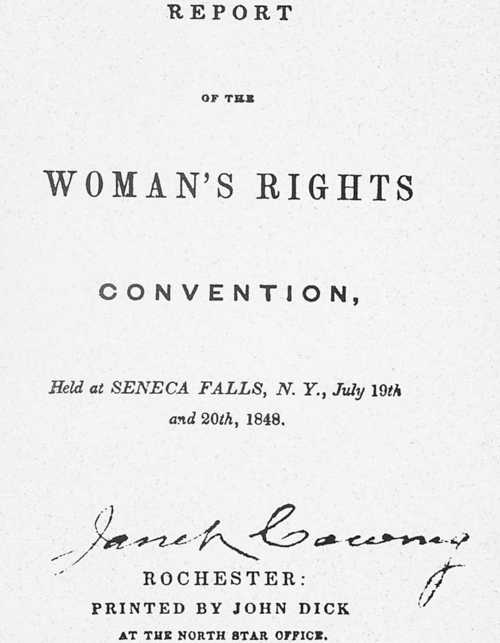
The Declaration of
Sentiments
Published by the
First Woman’s
Rights Convention
in 1848. This account of
the proceedings and list
of resolutions announced
that there was an
organized women’s rights
movement in the United
States. It also announced
that women’s rights
activists knew how to
organize a convention and
how to publicize their
activities in print. (Ties
between the women’s
and antislavery
movements led the
women to have their
report printed at the
offices of the North Star,
an antislavery paper
published by the black
abolitionist Frederick
Douglass—the only male
member of the convention
—in Rochester.)
the proper sphere for all human beings is the largest and highest to which they are able to attain.”
Such talk—and worse, the fact that women were delivering such speeches in
public—aroused opposition even among abolitionists. In 1840 the American Anti-
slavery Society sent a delegation to an international convention in London—with
women delegates and the woman abolitionist Abbey Kelley on the business commit-
tee. The convention voted to exclude women, and the Americans came home angry
and divided. Garrison and the radicals supported full rights for women, and pub-
lished their speeches and writings in the Liberator. Others wished to win public favor and elect anti-slavery congressmen and state legislators. They argued that the woman question was at best a distraction. The result was a split in the antislavery crusade, largely over the question of women’s rights.
Many women opposed gender inequality, and had been talking about it for a
long time. But it was the argument within the antislavery movement that spurred
the first organized movement for women’s rights. Beginning about 1840, women
lobbied state legislatures against the common law custom that women and children
were under the protection and authority of their husbands and fathers, and thus
had limited rights to property and over themselves. The reformers won significant changes in the laws governing women’s rights to own and inherit property, to the
438