persons have scarcely any chance to rise. But if colored persons are well treated, and have the same inducements to industry as others, they [will] work as well and behave as well.” The abolitionists backed up their equalitarian rhetoric with successful campaigns against segregation in Boston’s schools and public transportation, and against legal bans on miscegenation. Most of their fellow citizens disliked the abolitionists—not only because their attack upon slavery threatened the Union and the party system that held it together, but because their integrated movement and their anti-racist campaigns undermined the white republic.
The radicalized abolitionists were a combination of old and new reformers. Some
of them—Wendell Phillips, Thomas Wentworth Higginson, Theodore Parker—were
cultivated Bostonians who opposed slavery as an affront to reason and humanity.
Others were Quakers—the poet John Greenleaf Whittier, the lay minister Lucretia
Mott, and many more—who added their antislavery experience and convictions to
the cause. Abolitionists found their greatest support, however, in southern New
England, western New York, northern Ohio, and among the new middle classes
of the cities—ground that Yankee settlement, the Market Revolution, and Fin-
neyite revivals had turned into the heartland of the northern Whig Party.
It was also the center of the new evangelical domesticity, and of the question-
ing of traditional roles for women and men. Women from evangelical families
participated in church affairs and in the temperance movement, and the more rad-
ical of them moved into abolitionism. The American Colonization Society and
other early antislavery societies were largely elite and entirely male and they
made male arguments: slavery, they said, was economically, and socially irrational and dangerous. Abolitionists, on the other hand, enrolled blacks, women, and
white men who questioned the old rigidities of gender and race. They attacked
slavery on moral grounds, and their appeals were unabashedly emotional. Aboli-
tionist speeches, pamphlets, and escaped-slave narratives attacked slavery less for its supposed irrationality as a labor system than for what it did to slaves. The
crucial argument, repeated over and over, was that slavery crushed the family,
and particularly the sentimental relation between mothers and small children.
This argument reached its culmination in Harriett Beecher Stowe’s Uncle
Tom’s Cabin (1851). Stowe’s book was the most powerful antislavery tract, in
part because it successfully dramatized the moral and political imperatives of the northern middle class. At its core, Uncle Tom’s Cabin indicts slavery as a system of absolute power at odds with domesticity and Christian love. The novel reverses the power relations of this world: In it, the home, and particularly the kitchen, is the ultimate locus of good, whereas law, politics, and the marketplace—the whole
realm of white men—are moved to the periphery and defined as unfeeling destroy-
ers. Based solidly in revival Christianity, the novel lambasts the rational calculation, greed, and power-hunger of the “real world” that was made and governed
by white men and upholds domestic space filled with women, slaves, and children
who gain spiritual power through submission to Christ. The two most telling
scenes—the deaths of the Christian slave Uncle Tom and the perfect child Eva
St. Claire—reenact the crucifixion of Jesus. Uncle Tom prays for his tormentors
as he is beaten to death, and little Eva extracts promises of Christian behavior
from her deathbed. Both are powerless, submissive characters who die in order
to redeem a fallen humankind. Their deaths are thus Christian triumphs that
The Politics of Slavery and Race
433
convert the powerful and hasten the millennial day when the world will be gov-
erned by a feminized Christian love and not by male power.
Agitation
Antislavery, unlike other reforms, was a radical attack on
one of the nation’s central institutions, and the movement
attracted a minority even among middle-class evangelicals. Both Lyman Beecher
and Charles Finney opposed the abolitionists in the 1830s, arguing that emancipa-
tion would come about sooner or later through the religious conversion of slave
owners; antislavery agitation and the denunciation of slaveholders, they argued,
would divide Christians, slow the revival movement, and thus actually delay
emancipation. Finney warned his abolitionist friend Theodore Dwight Weld that
the logical end of antislavery was civil war. Other opponents, including some
within the antislavery ranks, were outraged that blacks and whites and men and
women met, organized, and socialized together, and that women and blacks deliv-
ered speeches to mixed audiences. When the American Antislavery Society held an
organizing convention in Philadelphia in 1833 the city’s hotels, churches, and
meeting halls refused to admit them, and the police announced that they could not protect “the amalgamationist conclave.” Most of the delegates boarded in black
households, and they met in a black-owned hall next door to Philadelphia’s oldest black church.
Radical abolitionists knew that they were a small, despised minority, and that
government and most citizens wanted to ignore the question of slavery. The aboli-
tionists staged a series of campaigns to force government and the public to face the South’s “peculiar institution.” In 1835, the society launched its Postal Campaign, flooding the mails with abolitionist tracts that southerners and most northerners regarded as “incendiary.” From 1836 onward, they deluged Congress with petitions
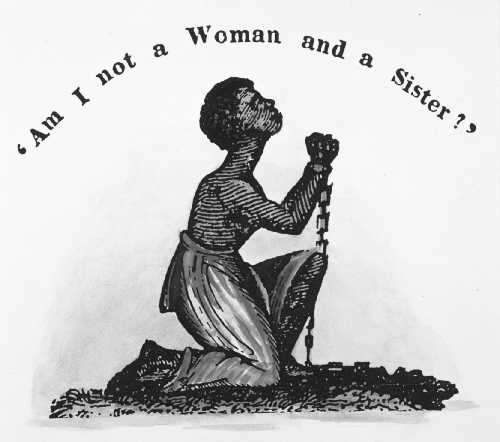
to abolish slavery and the slave trade in the District of Columbia (where Congress Woman and a
Sister. For many years,
the British antislavery
forces had used the
iconic image of a male
slave, kneeling and
holding up his chains,
with the words “Am I not
a man and a brother?”
American abolitionists
used that image as well,
but added a similar image
of a supplicant female
York
slave, underlining the
New
participation of women
and the emerging
centrality of women
Collection,
’s
issues in the American
Granger
antislavery movement.
The©
434