the King James Bible as heresies and as hated tools of British oppression. Some
of the textbooks were worse. Olney’s Practical System of Modern Geography,
a standard textbook, declared that “the Irish in general are quick of apprehension, active, brave and hospitable; but passionate, ignorant, vain, and superstitious.”
A nun in Connecticut complained that Irish children in the public schools “see
their parents looked upon as an inferior race.”
Many Catholic parents simply refused to send their children to school. Others
demanded changes in textbooks, the elimination of the King James Bible (perhaps
to be replaced by the Douay Bible), tax-supported Catholic schools, or at least
tax relief for parents who sent their children to parish schools. Whigs, joined by many native-born Democrats, saw Catholic complaints as popish assaults on the
Protestantism that they insisted was at the heart of American republicanism.
Some school districts, particularly in the rural areas to which many Scandina-
vian and German immigrants found their way, created foreign-language schools
and provided bilingual instruction. In other places, state support for church-run charity schools persisted. New York City supported both Catholic and Protestant
schools until 1825. So did Lowell, Massachusetts; Hartford and Middletown,
Connecticut; and Milwaukee, Wisconsin, at various times from the 1830s through
the 1860s. New Jersey provided state support to Catholic as well as other church
schools until 1866. In northeastern cities, however, where immigrant Catholics often formed militant local majorities, such demands led to violence and to organized nativist (anti-immigrant) politics. In 1844, the Native American Party, with the
endorsement of the Whigs, won the New York City elections. That same year in Phi-
ladelphia, riots that pitted avowedly Whig Protestants against Catholic immigrants, ostensibly over the issue of Bible reading in schools, killed 13 people. Such conflicts would severely damage the northern Democratic coalition in the 1850s.
Prisons
From the 1820s onward, state governments built institutions
to house orphans, the dependent poor, the insane, and crim-
inals. The Market Revolution increased the numbers of such persons and made
them more visible, more anonymous, and more separated from family and com-
munity resources. Americans in the 18th century (and many in the 19th century as
well) had assumed that poverty, crime, insanity, and other social ills were among God’s ways of punishing sin and testing the human capacity for both suffering and charity. By the 1820s, however, reformers were arguing that deviance was the result of childhood deprivation. “Normal” people, they argued, learned discipline
and respect for work, property, laws, and other people from their parents. Deviants were the products of brutal, often drunken households devoid of parental love and discipline. The cure was to place them in a controlled setting, teach them work
and discipline, and turn them into useful citizens.
In state legislatures, Whigs favored putting deviants into institutions for
rehabilitation. Democrats, although they agreed that the states should incarcerate criminals and deviants, regarded attempts at rehabilitation as wrong-headed and
expensive. They favored institutions that isolated the insane, warehoused the
dependent poor, and punished criminals. Most state systems were a compromise
between the two positions.
The Politics of Social Reform: Schools and Asylums
421
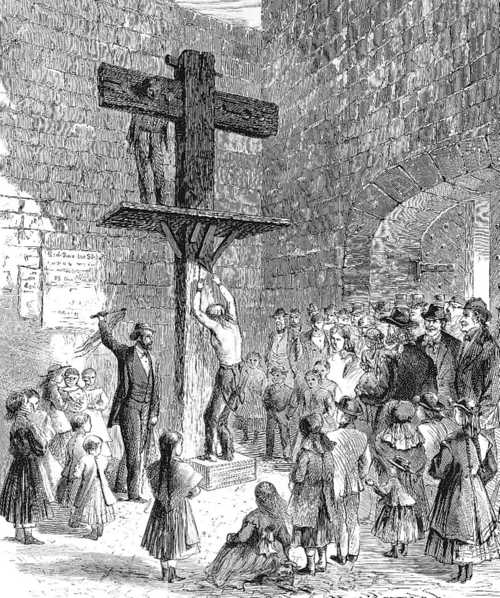
The Whipping Post
and Pillory at New
Castle, Delaware.
Delaware was a slave
state that continued to
inflict public, corporal
punishment on
lawbreakers. Many of the
witnesses to the
whipping depicted here
are small children, who
are supposedly learning a
lesson.
Archives
Picture
Wind
North
Pennsylvania built prisons at Pittsburgh (1826) and Philadelphia (1829) that
put solitary prisoners into cells to contemplate their misdeeds and to plot a new life. The results of such solitary confinement included few reformations and
numerous attempts at suicide. Only New Jersey imitated the Pennsylvania system.
Far more common were institutions based on the model developed in New York
at Auburn (1819) and Sing Sing (1825). In the Auburn system, prisoners slept in
solitary cells and marched in military formation to meals and workshops. They
were forbidden to speak to one another at any time. The rule of silence, it was
believed, encouraged both discipline and contemplation. The French writer Alexis
de Tocqueville, visiting a New York prison in 1830, remarked that “the silence
within these vast walls ... is that of death.... There were a thousand living beings, and yet it was a vast desert solitude.”
The Auburn system was designed both to reform criminals and to reduce ex-
penses, for the prisons sold workshop products to the outside. Between these two
goals, Whigs favored rehabilitation. Democrats favored profit-making workshops,
and thus lower operating costs and lower taxes. Robert Wiltse, named by the
Democrats to run Sing Sing prison in the 1830s, used harsh punishments (includ-
ing flogging and starving), sparse meals, and forced labor to punish criminals and make the prison pay for itself. In 1839, William Seward, as the newly elected
Whig governor of New York, fired Wiltse and appointed administrators who
422