During the second quarter of the 19th century, local and
state governments built systems of tax-supported public
schools, known as common schools. Before that time, most children learned
reading, writing, and arithmetic at home, in poorly staffed town schools, in private schools, or in charity schools run by churches or other benevolent organizations.
Despite the lack of any system of education, most children learned to read and
write. That was, however, more likely among boys than among girls, among whites
than among blacks, and among northeasterners than among westerners or
southerners.
By the 1830s, Whigs and Democrats agreed that providing common schools
was a proper function of government, and Democrats often agreed with Whigs
that schools could equalize opportunity. Massachusetts Democrat Robert Rantoul,
for example, believed that rich and poor children should “be brought equally and
together up to the starting point at the public expense; after that we must shift for ourselves.” More radical Democrats, however, wanted public schooling that would
erase snobbery. A newspaper declared in 1828 that “the children of the rich and the poor shall receive a national education, calculated to make republicans and banish aristocrats.” Marcus Morton, Democratic governor of Massachusetts, agreed that it was the job of the common schools to democratize children “before the pride of
family or wealth, or other adventitious distinction has taken a deep root in the
young heart.”
The reformers who created the most advanced, expensive, and centralized
state school systems were Whigs: Horace Mann of Massachusetts, Henry Barnard
of Connecticut, Calvin Stowe (husband of Harriet Beecher) of Ohio, and others.
These reformers talked more about character building and Whig Protestant cul-
ture than about the three R’s. They wanted schools that would downplay class
divisions, but they were interested less in democratizing wealthy children than in civilizing the poor. Calvin H. Wiley, the Whig superintendent of schools in North Carolina, promised that proper schools would make Americans “homogeneous …
intelligent, eminently republican, sober, calculating, moral and conservative.”
A Whig newspaper in Ohio declared in 1836 that character-building schools
were essential in a democracy: “Other nations have hereditary sovereigns, and
one of the most important duties of their governments is to take care of the edu-
cation of the heir to their throne; these children all about your streets … are your future sovereigns.” William Seward, the Whig governor of New York, insisted
that “education tends to produce equality, not by leveling all to the condition of the base, but by elevating all to the association of the wise and good.”
The schools taught a basic Whig axiom: that social questions could be reduced
to questions of individual character. A textbook entitled The Thinker, A Moral
Reader (1855) told children to “remember that all the ignorance, degradation, and misery in the world, is the result of indolence and vice.” To teach that lesson, the schools had children read from the King James Bible and recite prayers acceptable to all of the Protestant sects. Such texts reaffirmed a common Protestant morality while avoiding divisive doctrinal matters. Until the arrival of significant numbers of Catholic immigrants in the 1840s and 1850s, few parents complained about
Protestant religious instruction in the public schools.
The Politics of Social Reform: Schools and Asylums
419
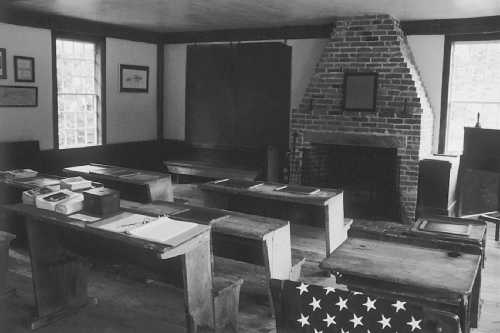
The Eureka
Schoolhouse in
Springfield,
Vermont. Mandated by
state law and supported
by local taxes, such one-
room schools taught
generations of American
children the three R’s.
Archives
Picture
Wind
North
Political arguments centered less on curriculum than on organization. Whigs
wanted state-level centralization and proposed state superintendents and state
boards of education, normal schools (state teachers’ colleges), texts chosen at the state level, and uniform school terms. They also (often with the help of economy-minded Democrats) recruited young women as teachers. In addition to fostering ci-
vility and Protestant morality in the schools, these women were a source of cheap labor. Salaries for female teachers in the northern states ranged from 40 percent to 60 percent lower than the salaries of their male coworkers. Largely as a result, the proportion of women among Massachusetts teachers rose from 56 percent in 1834
to 78 percent in 1860.
Democrats objected to the Whigs’ insistence on centralization as elitist, intru-
sive, and expensive. They gave power to individual school districts, thus enabling local school committees to shape the curriculum, the length of the school year,
and the choice of teachers and texts to local needs and preferences. Centralization, they argued, would create a metropolitan educational culture that served the purposes of the rich but ignored the preferences of farmers and working people. It
was standard Democratic social policy: inexpensive government and local control.
Henry Barnard, Connecticut’s superintendent of schools, called his Democratic op-
ponents “ignorant demagogues” and “a set of blockheads.” Horace Mann de-
nounced them as “political madmen.” As early as 1826, Thaddeus Stevens, who
would become a prominent Pennsylvania Whig, argued that voters must “learn to
dread ignorance more than taxation.”
Ethnicity,
The argument between Whig centralism and Democratic
Religion, and
parsimony dominated the debate over public education until
the Schools
the children of Irish and German immigrants entered schools
by the thousands in the mid-1840s. Most immigrant families
were poor and relied on their children to work and supplement the family income.
Consequently, their children’s attendance at school was irregular at best. More-
over, most immigrants were Catholics. The Irish regarded Protestant prayers and
420