15
15
AR
SC
TERR.
11
AL
GA
MS
Fu
7
11
t
4
ure Bound
LA
ary
5
FL
TERR.
Electoral Vote
Popular Vote
Number %
Number %
Jackson
(Democratic)
219
76
701,780
54
Clay
49
17
484,205
38
(National Republican)
Wirt
7
2.4
100,715
8
Learning
(Anti-Masonic)
Floyd
11
3.8
----------
----
(Independent Democrat)
Cengage©
MAP 11.3 Presidential Election, 1832
The election of 1832 was a landslide victory for Andrew Jackson. The National Republican Henry Clay carried only his native Kentucky, along with Delaware and southern New England. A defeated and resentful South Carolina ran its own candidate. Jackson, on the other hand, won in the regions in which he had been strong in 1828 and added support in New York and northern New England.
The Beginnings
Conflict over deposit removal and related questions of presi-
of the Whig
dential power united anti-Jacksonians—most of them com-
Party
mitted advocates of the American System—into the Whig
Party in 1834. The name of the party, as everyone who knew
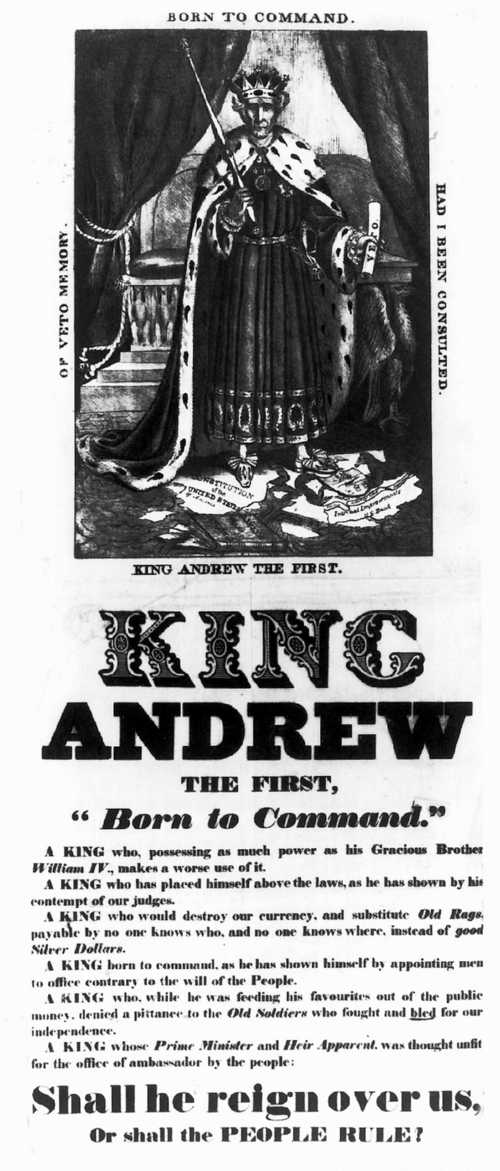
the language of the republic knew, stood for legislative opposition to a power-mad executive. Jackson, argued the Whigs, had transformed himself from the limited
executive described in the Constitution into King Andrew I. This had begun with
the spoils system. It had become worse when Jackson began to veto congressional
legislation. Earlier presidents had exercised the veto only nine times, usually on unimportant bills and always on the grounds that the proposed legislation was
unconstitutional. Jackson used the veto often—too often, said the Whigs, when a
key component of the American System was at stake. In May 1830, for instance,
Jackson vetoed an attempt by Congress to buy stock in a turnpike to run from the
terminus of the National Road at Louisville to Maysville, Kentucky. Jackson
argued that because the road would be entirely in Kentucky, it was “partial” leg-
islation that would take money from the whole people to benefit just one locality.
He also questioned whether such federal subsidies were constitutional. Most
important, however, Jackson announced that he was determined to reduce federal
expenditures in order to retire the national debt, hinting strongly that he would oppose all federal public works.
Jacksonian Democracy and the Market Revolution
405
The bank veto conveyed the same message even more strongly, and the with-
drawal of the government deposits brought the question of “executive usurpation”
to a head in 1834. Withdrawal of the deposits, together with Jackson’s high-handed treatment of his treasury secretaries, caused uneasiness even among the president’s supporters, and his enemies took extreme measures. Nicholas Biddle, announcing
that he must clean up the affairs of the Bank of the United States before closing its doors, demanded that all its loans be repaid—a demand that undermined the credit
system and produced a sharp financial panic. No doubt, one reason for Biddle’s
action was to punish Andrew Jackson. While Congress received a well-orchestrated
petition campaign to restore the deposits, Henry Clay led an effort in the Senate to censure the president, which it did in March 1834. Daniel Webster, the Bank’s best friend in government, and Clay, who had watched as Jackson denied one component
after another of his American System, led the old National Republican coalition (the name that anti-Jacksonians had assumed since 1824) into the new Whig Party. They
were joined by southerners (including Calhoun) who resented Jackson’s treatment of the South Carolina nullifiers and Biddle’s bank, and who distrusted his assurances on slavery. Jackson’s war on the Bank of the United States chased lukewarm supporters into the opposition, enabling Democrats to point to an increasingly sharp division between the Money Power and the Old Republic. Referring to Biddle’s panic of
1834, James K. Polk of Tennessee, who led the Democrats in the House of Represen-
tatives, declared, “the question is in fact whether we shall have the Republic without the Bank or the Bank without the Republic.”
A Balanced
In part, Jackson removed the deposits because he anticipated
Budget
a federal surplus revenue that, if handed over to Biddle’s
Bank of the United States, would make it stronger than ever.
The Tariffs of 1828 and 1832 produced substantial government revenue, and
Jackson’s frugal administration spent little of it. Even the Compromise Tariff of 1833 left rates temporarily high, and the brisk sale of public lands was adding to the surplus. In 1833, for the only time in its history, the United States paid off its national debt. Without Jackson’s removal of the deposits, a growing federal treasury would have gone into the bank and would have found its way into the hated
paper economy.
Early in his administration, Jackson had favored distributing surplus revenue to
the states to be used for internal improvements, but he came to distrust even that minimal federal intervention in the economy, fearing that redistribution would
encourage Congress to keep land prices and tariff rates high. Whigs, who by now
despaired of ever creating a federally subsidized, coordinated transportation system, picked up the idea of redistribution. With some help from the Democrats, they
passed the Deposit Act of 1836, which increased the number of banks receiving federal deposits (thus removing power from Jackson’s Pet Banks) and distributed the
federal surplus to the states to be spent on roads, canals, and schools. Jackson, who distrusted state-chartered banks as much as he distrusted the Bank of the
United States, feared that the new deposit banks would use their power to issue
mountains of new banknotes. He demanded a provision limiting their right to print banknotes. With that provision, he reluctantly signed the Deposit Act.
406