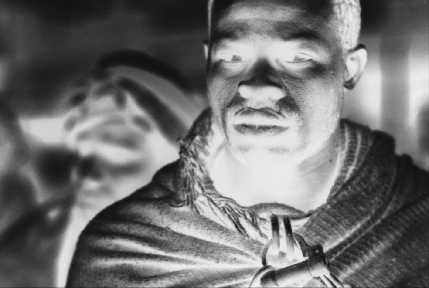
Amistad (1997)
Directed by Steven Spielberg. Starring
The Africans spend most of the movie
Matthew McConaughey (Roger Baldwin),
in a dark jail or in court, and the film cen-
Morgan Freeman (Theodore Joadson),
ters on them and their experiences with
Anthony Hopkins (John Quincy Adams),
two groups of Americans: the abolitionists
Djimon Hounsou (Cinque).
who are trying to free them, and the politi-
cal and legal officials who want to hang
In 1839, an American cruiser seized the
them—largely to keep their own political
Cuban slave ship Amistad off the shore
system intact. Spielberg’s abolitionists are
of Long Island. The ship carried 41 Afri-
Lewis Tappan, a black activist (Morgan
cans who had revolted, killed the captain
Freeman), an obscure young white lawyer
and crew, and commandeered the ship—
(Matthew McConaughey), and, in the
along with two Spanish slave dealers who
grand finale, Congressman and former
bargained for their lives by promising
President John Quincy Adams (played
to sail the ship east to Africa, then steer-
wonderfully by Anthony Hopkins). In the
ed for North America. The Africans were
historical case, the defense was handled by
imprisoned at New Haven and tried
veteran abolitionists or by persons who
for piracy and murder in federal court.
had been working with abolitionists for a
The government of Spain demanded
long time. Spielberg shaped this group to
their return, and southern leaders pres-
tell his own story, beginning with reluctant
sured President Van Buren for a
and confused reformers and politicians
“friendly” decision. The legal case cen-
who, along with the audience, gradually
tered on whether the Africans were
realize the moral imperatives of the case.
Cuban slaves or kidnapped Africans.
In one of the film’s more powerful
(The international slave trade was by
sequences, the Africans’ leader, Cinque
then illegal.) The New Haven court
(Djimon Hounsou), through a translator,
acquitted them, the federal government
tells his story to the lawyer: his village life
appealed the case, and the Supreme
in Sierra Leone (the one scene filmed in
Court freed them again. The Africans
bright sunlight), his capture by Africans,
were returned to Sierra Leone.
his transportation to the slave fort of
forms of state sovereignty, Jackson and the Democratic coalition insisted that the Union was inviolable and that any attempt to dissolve it would be met with force.
At the same time, a Democratic Party uniting northern and southern agrarians into a states’-rights, limited-government majority could guarantee southern rights within the Union. This answer to the southern question stayed in place until the breakup of the Democratic Party on the eve of the Civil War.
JACKSONIAN DEMOCRACY AND THE MARKET REVOLUTION
Jacksonian Democrats cherished the simplicity of Jefferson’s agrarian republic.
They assumed power at the height of the Market Revolution, and they spent much
of the 1830s and 1840s trying to reconcile the market and the republic. Like the
Jeffersonians before them, Democrats welcomed commerce as long as it served the
Jacksonian Democracy and the Market Revolution
401
Lomboko, the horrors of the passage on
lead the Revolution, speaks for his and
the Portuguese slaver Tecora, the slave
Cinque’s ancestors before the Supreme
market in Havana, and the bloody revolt
Court: to the prosecution’s argument
on the Amistad—all of it portrayed
that the Africans are pirates and mur-
wrenchingly on the screen. The Africans’
derers and to southern arguments that
story continues in jail, as they study pic-
slavery is a natural state, he answers that
tures in a Bible and try to figure out the
America is founded on the “self-evident
American legal, political, and moral sys-
truth” that the one natural state is free-
tem. In court, they finally cut through the
dom. It is a fine Hollywood courtroom
mumbo-jumbo by standing and chanting
speech: Adams has honored his ancestors,
“Give Us Free!”
the justices and the audience see the moral
In a fictive interview on the eve of the
rightness of his case, and the Africans are
Supreme Court case, Cinque tells Adams
returned to Sierra Leone. (In a subscript,
that he is optimistic because he has called
Spielberg tells us that Cinque returns to a
on the spirits of his ancestors to join him
village that had been destroyed in civil
in court. This moment, he says, is the
war, but the final ironic note is over-
whole reason for their having existed at
whelmed by the moral triumphalism of
all. Adams, whose own father had helped
the rest of the movie.)
Amistad (1997) tells the
story of 41 Africans who
stage a revolt on the slave
Andrew
ship carrying them to
Cuba and the trial that
follows.
COLLECTION/Cooper,
KOBAL
LLC/THE
Dreamworks
liberty and rough equality of white men, but paper currency and the dependence on credit that came with the Market Revolution posed problems. The so-called paper
economy separated wealth from “real work” and encouraged an unrepublican
spirit of luxury and greed. Worst of all, the new paper economy required
government-granted privileges that the Jacksonians, still speaking the language of revolutionary republicanism, branded “corruption.” For the same reasons, the protective tariffs and government-sponsored roads and canals of the American System
were unacceptable. The Jackson presidency aimed to curtail government involve-
ment in the economy, to end special privilege, and thus to rescue the republic from the Money Power.
The opposition to the Democrats (by 1834 they called themselves Whigs)
favored an activist central government that would encourage orderly economic
development through the American System of protective tariffs, a federally
402