15
11
AR
SC
TERR.
11
MS AL
GA
Fu
3
5
9
ture
LA
Boundary
5
FL
TERR.
Electoral Vote
Popular Vote
Number %
Number %
Jackson
Learning
(Jacksonian Democrat)
178
68
647,276
56
J. Q. Adams
83
32
508,064
44
(National Republican)
Cengage©
MAP 11.2 Presidential Election, 1828
The 1828 presidential contest was a clear result of the organizing efforts that were building a national Democratic party under the name of Andrew Jackson. Jackson picked up all of the states that had gone for Crawford or Clay in 1824, leaving only New England and small portions of the mid-Atlantic for John Quincy Adams.
Adams versus Jackson
391
New England. Just as clearly, it was a victory of popular melodrama over old forms of cultural gentility.
A People’s
Newspapers estimated that from 15,000 to 30,000 citizens
Inauguration
came to Washington to witness Jackson’s inauguration on
March 4, 1829. They were “like the inundation of the
northern barbarians into Rome,” remarked Senator Daniel Webster. Many had
traveled as much as 500 miles, and “they really seem to think that the country is rescued from some dreadful danger.” As members of the Washington establishment
watched uneasily, the crowd filled the open spaces and the streets near the east
portico of the Capitol Building, where Jackson was to deliver his inaugural address.
Jackson arrived at the Capitol in mourning. In December, his wife Rachel had
gone to Nashville to shop and had stopped to rest in a newspaper office. There, for the first time, she read the accusations that had been made against her. She fainted on the spot. Although she had been in poor health, no one would ever convince
Jackson that her death in January was not caused by his political enemies. He
assumed the presidency wearing a black suit and black tie, a black armband, and
a black hatband that trailed down his neck in what was called a weeper.
Jackson’s inaugural address was vague. He promised “proper respect” for
states’ rights and a “spirit of equity, caution, and compromise” on the question of the tariff, which was beginning to cause sectional controversy. He promised to
reform the civil service by replacing “unfaithful or incompetent” officers, and he vowed to retire the national debt through “a strict and faithful economy.” Beyond that, he said little, although he took every opportunity to flatter the popular majority. He had been elected “by the choice of a free people” (and not by King Caucus or Corrupt Bargains), and he pledged “the zealous dedication of my humble abilities to their service and their good.” He finished—as he often finished an important statement—by reminding Americans that a benign providence looked over them.
He then looked up to a roar of applause.
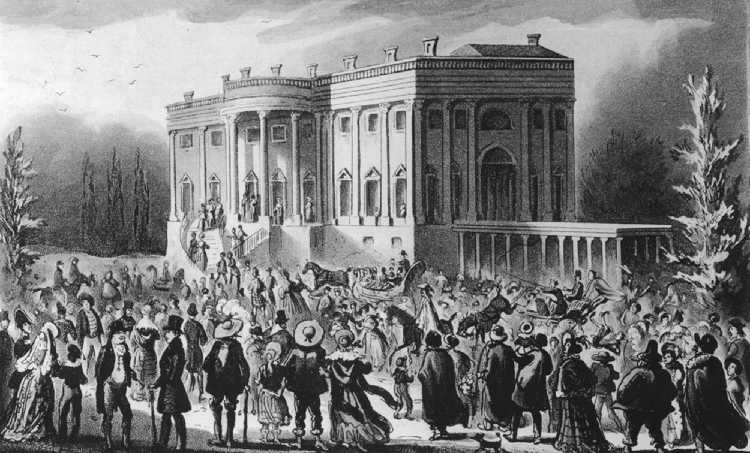
The crowd followed Jackson from the Capitol to the White House, invading
the mansion, muddying the carpets, tipping things over, breaking dishes, and standing in dirty boots on upholstered chairs. Jackson had to retreat to avoid being
crushed. The White House staff lured much of the crowd outside by moving the
punch bowls and liquor to the lawn. A wealthy Washington matron who had
admired the well-behaved crowd at the inaugural address exclaimed, “What a scene
did we witness! The Majesty of the People had disappeared, and a rabble, a mob, of boys, negros, women, children, scrambling, fighting, romping. What a pity, what a pity.” Another guest pronounced the occasion a “Saturnalia ... of mud and filth.”
A Democratic newspaper reported more favorably: “General Jackson is their own
President.... He was greeted by them with an enthusiasm which bespoke him the
Hero of a popular triumph.”
The Spoils
Jackson had begun to assemble his administration months
System
before he took office. Martin Van Buren, who had mobilized
much of the support Jackson gained between 1824 and
1828, was the new secretary of state—positioned to succeed Jackson as president.
392