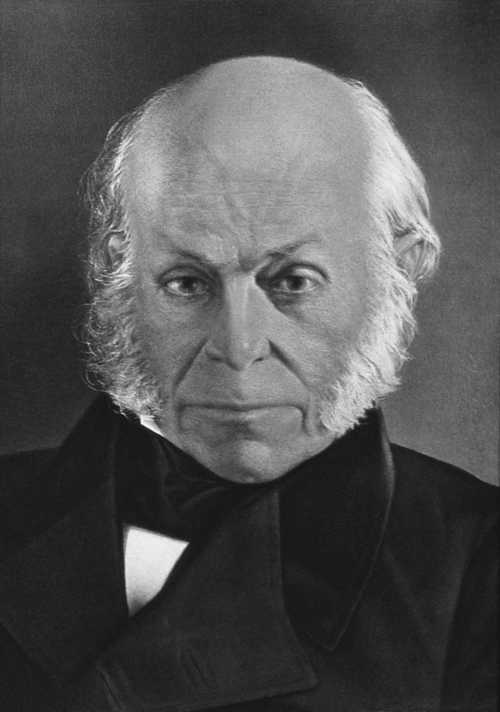
new irritation will mark it deeper and deeper.... This momentous question, like a fire-bell in the night, awakened and filled me with terror. I considered it at once the knell of the Union.” The Missouri question underlined a basic fact of American national politics: if politicians argued about slavery they would split along North-South lines and the Union would be endangered.
The Panic
Politicians debated the Missouri question against a darkening
of 1819
backdrop of economic depression. The origins of the Panic
of 1819 were international and numerous: European agri-
culture was recovering from the Napoleonic wars, thereby reducing the demand for
American foodstuffs; war and revolution in Latin America had cut off the supply of precious metals (the base of the international money supply); debt-ridden European governments hoarded the available specie; and American bankers and businessmen
met the situation by expanding credit and issuing banknotes that were mere dreams of real money.
Congress had in part chartered the Second Bank of the United States in 1816
to impose order on this situation, but the Bank under the presidency of the genial Republican politician William Jones became part of the problem. The western
branch offices in Cincinnati and Lexington became embroiled in the speculative
boom, and insiders at the Baltimore branch hatched criminal schemes to enrich
themselves. With matters spinning out of control, Jones resigned early in 1819.
The new president, Langdon Cheves of South Carolina, curtailed credit and
demanded that state banknotes received by the Bank of the United States be
redeemed in specie (precious metals). By doing so, Cheves rescued the Bank
from the paper economy created by state-chartered banks, but at huge expense:
When the state banks were forced to redeem their notes in specie, they demanded
payment from their own borrowers, and the national money and credit system
collapsed.
The depression that followed the Panic of 1819 was the first failure of the
market economy. Local ups and downs had occurred since the 1790s, but this col-
lapse was nationwide. Employers who could not meet their debts went out of
business, and hundreds of thousands of workers lost their jobs. In Philadelphia,
unemployment reached 75 percent. A tent city of the unemployed sprang up on
the outskirts of Baltimore. Other cities and towns were hit as hard, and the situation was no better in the countryside. Thomas Jefferson reported that farms in his neighborhood were selling for what had earlier been a year’s rent.
Faced with a collapse that none could control and that few understood, many
Americans directed their resentment onto the Bank of the United States. John Jacob Astor, a New York merchant and reputedly the richest man in America, admitted
that “there has been too much Speculation and too much assumption of Power on
the Part of the Bank Directors which has caused [sic] the institution to become
unpopular.” William Gouge, who would become the Jacksonian Democrats’ favor-
ite economist, put it more bluntly: When the Bank demanded that state banknotes
be redeemed in specie, he said, “the Bank was saved and the people were ruined.”
By the end of 1819, the Bank of the United States had won the name that it would
carry to its death in the 1830s: the Monster.
Republican Revival
383
REPUBLICAN REVIVAL
The crises during 1819 and 1820 prompted demands for a return to Jeffersonian
principles. President Monroe’s happily proclaimed Era of Good Feelings—a new
era of partyless politics created by the collapse of Federalism—was, according
to worried Republicans, a disaster. Without opposition, Jefferson’s dominant
Republican Party had lost its way. The nationalist Congress of 1816 had enacted
much of the Federalist program under the name of Republicanism. The result,
said the old Republicans, was an aggressive government that helped bring on
the Panic of 1819. At the same time, the collapse of Republican Party unity in
Congress had allowed the Missouri question to divide Congress along dangerous
sectional lines. By 1820, many Republicans were calling for a Jeffersonian revival that would limit government power and guarantee southern rights within the
Union.
Martin Van
The busiest and the most astute of those Republicans was
Buren Leads
Martin Van Buren of New York. An immensely talented
the Way
man without family connections (his father was a Hudson
valley tavern keeper) or formal education, Van Buren built
his political career out of a commitment to Jeffersonian principles, personal
charm, and party discipline. He and his colleagues in New York had begun to
invent the modern political party. The Founders had denounced parties, claiming
that republics rested on civic virtue, not competition. Van Buren’s New York
experience, however, along with his reading of national politics, told him that
disciplined political parties were necessary democratic tools. Van Buren insisted that competition and party divisions were inevitable and good, but that they must be made to serve the republic. He wrote: “We must always have party distinctions, and the old ones are the best.... If the old ones are suppressed, geographical differences founded on local instincts or what is worse, prejudices between free & slave holding states will inevitably take their place.” Van Buren claimed that the one-party politics of the Era of Good Feelings had allowed privileged insiders to create a big national state and to reorganize politics along sectional lines. Arriving in Washington in the aftermath of the Missouri debates and the Panic of
1819, he hoped to apply his new politics to what he perceived as a dangerous
turning point in national public life.
Working with like-minded politicians, Van Buren reconstructed the coalition of
northern and southern agriculturalists that had elected Thomas Jefferson. The result was the Democratic Party and, ultimately, a national two-party system that persisted until the eve of the Civil War.
The Election
With the approach of the 1824 presidential election, Van
of 1824
Buren and his friends supported William H. Crawford,
Monroe’s secretary of war and a staunch Georgia Republi-
can. The Van Burenites controlled the Republican congressional caucus, the body
that traditionally chose the party’s presidential candidates. The public distrusted the caucus as undemocratic because it represented the only party in government
384