of attachment with which their pride and political opinions are connected. They are more American.”
Even as they convinced themselves that they had won the war, Republicans
were painfully aware of the weaknesses that the war had displayed. Put simply,
the United States had been unable to coordinate a national fiscal and military
effort: bad roads, local jealousies, and a bankrupt treasury had nearly lost the
war. In addition, the war and the years leading up to it convinced many Republi-
cans, including Jefferson and Madison, that the export economy rendered the
United States dangerously dependent on Europe (and especially Great Britain).
Finally, many of the younger Republicans in Congress were interested less in ideological purity than in bringing commerce into new regions. The nation, they said, must abandon Jefferson’s export-oriented agrarianism and encourage prosperity
and national independence through subsidies to commerce, manufactures, and
internal improvements.
National
Henry Clay of Kentucky, retaining his power in the postwar
Republicans
Congress, headed the drive for protective tariffs, the bank,
and internal improvements. He called his program the
“American System,” arguing that it would foster national economic growth and
harmony between geographic sections, thus a happy and prosperous republic.
In 1816, Congress chartered a Second Bank of the United States, headquar-
tered in Philadelphia and empowered to establish branches wherever it saw fit.
The government agreed to deposit its funds in the Bank, to accept the Bank’s notes as payment for government land, taxes, and other transactions, and to buy one-fifth of the Bank’s stock. The Bank of the United States was more powerful than
the one that had been rejected (by one vote) by a Republican Congress in 1811.
The fiscal horrors of the War of 1812, however, had convinced most representa-
tives to support a national currency and centralized control of money and credit.
The alternative was to allow state banks—which had increased in number from
88 to 208 between 1813 and 1815—to issue the unregulated and grossly inflated
notes that had weakened the war effort and that promised to throw the anticipated postwar boom into chaos.
With no discussion of the constitutionality of what it was doing, Congress
chartered the Bank of the United States as the sole banking institution empow-
ered to do business throughout the country. Notes issued by the Bank would
be the first semblance of a national currency (they would soon constitute from
one-tenth to one-third of the value of notes in circulation). Moreover, the Bank
could regulate the currency by demanding that state bank notes used in transac-
tions with the federal government be redeemable in gold. In 1816, the Bank
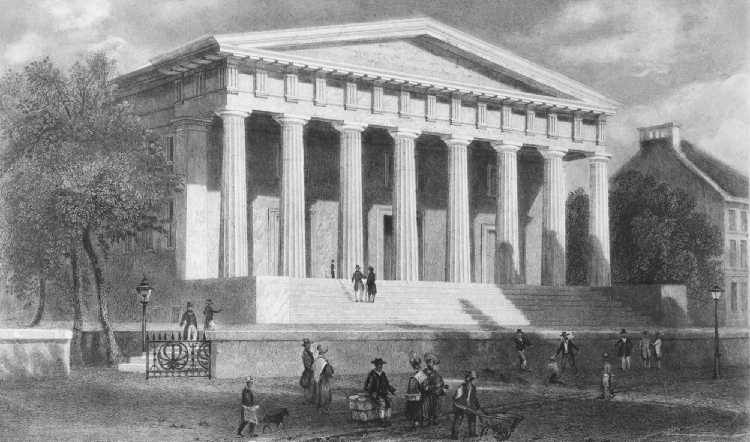
set up shop in Philadelphia’s Carpenter’s Hall, and in 1824, it moved around
the corner to a Greek Revival edifice modeled after the Parthenon—a marble
embodiment of the republican conservatism that directors of the Bank of the
United States promised as their fiscal stance. From that vantage point they
would fight (with a few huge lapses) a running battle with state banks and local
interests in an effort to impose fiscal discipline and centralized control over an exploding market economy.
The American System
377
The same Congress drew up the nation’s first overtly protective tariff in 1816.
Shut off from British imports during the war, the Americans had built their first factories, almost entirely in southern New England and the mid-Atlantic. The British planned to flood the postwar market with cheap goods and kill American manufactures, and Congress determined to stop them. Shepherded through the House by
Clay and his fellow nationalist John C. Calhoun of South Carolina, the Tariff of
1816 raised import duties an average of 25 percent, protecting American manufac-
tures at the expense of consumers and foreign trade. Again, wartime difficulties and wartime nationalism had paved the way: since Americans could not depend on imported manufactures, Congress saw domestic manufactures as a patriotic necessity
and a spur to commerce between the sections. The Northeast and the West sup-
ported the tariff, and it had enough southern support to ensure its passage. Tariffs would rise and fall between 1816 and the Civil War, but the principle of protectionism would persist.
Many of the Founders had seen a national transportation system as essential to
the prosperity and safety of the union. George Washington had urged roads and
canals linking the Atlantic states with the interior—providing western farmers with the civilizing benefits of commerce and securing their loyalty to the United States.
Thomas Jefferson shared Washington’s views and, like his fellow Virginian, he
favored improvements that would link the Potomac River with the Ohio. In 1802,
President Jefferson signed a bill that began construction of the Cumberland Road
(often called the National Road) from Cumberland, Maryland, to the Ohio River at
Wheeling.
These early dreams and projects served the postcolonial economy: they would
deliver farm produce to the coast and then to international markets; the coastal
towns would receive imported goods and ship them back into the countryside. As
early as 1770, George Washington had dreamed of making the Potomac River a
busy “Channel of Commerce between Great Britain” and the farmers of the inte-
rior. Others dreamed of other routes and rivers, but nearly all proponents of transportation into the west shared the great assumption of Washington’s early vision: the export economy would remain dominant; the United States would be an independent, unified, and prosperous economic colony of the Old World.
Henry Clay’s American System grew into a new vision: a national transporta-
tion network that would make the United States economically independent of
Europe and interdependent within itself. The Bank of the United States would sup-
ply fiscal stability and a uniform, trustworthy currency. The tariff would encourage Northeasterners to build factories and citizens in other parts of the country to buy what American manufacturers made, and farmers would enjoy expanded domestic
markets. The West would sell food to the cities and to the plantation South, and the South would supply the burgeoning textile industry with cotton. The system would
not deny international trade, but it would make the United States an economically integrated and independent nation.
Bills for transportation projects, however, did not get through Congress.
Internal improvements were subject to local ambitions: canals and roads that
helped one place hurt another. Some areas—southern New England and eastern
Pennsylvania are examples—had already built good roads and did not want to sub-
sidize the competition. There were also objections based in old Republican ideals.
378