attacked for “defiling the government.” The anti-abolitionist mob that sacked
Lewis Tappan’s house destroyed his furniture, but they rescued a portrait of George Washington and carried it as a banner during their later attacks on Finneyite evangelicals and English actors.
The more respectable and powerful whites had long been worried about
the mixed-race underclass of the cities and towns. Now, as the disorder that they expected of the lower orders took the form of race riots, the authorities responded. But rather than protect the jobs, churches, schools, businesses, friends, and political rights of African Americans from criminal attack, they determined
to stop the trouble by removing black people—from employment, from public
festivities, from their already-limited citizenship, and, ultimately, from the United States. Cities either excluded black children from public schools or set up segregated schools. In 1845, when Massachusetts passed a law declaring that all
children had the right to attend neighborhood schools, the Boston School Com-
mittee blithely ruled that the law did not apply to blacks. Blacks were also
excluded from white churches or sat in segregated pews. Even the Quakers seated
blacks and whites separately.
CITIZENSHIP
The transition from republic to democracy—and the relation of that transition to
the decline of patriarchy and efforts to shore up white manhood—took on legal,
institutional shape in a redefinition of republican citizenship. The revolutionary constitutions of most states retained colonial freehold (property) qualifications for voting. In the yeoman societies of the late 18th century, freehold qualifications granted the vote to between one-half and three-quarters of adult white men. Many
of the disfranchised were dependent sons who expected to inherit citizenship
along with land. Some states dropped the freehold clause and gave the vote to all adult men who paid taxes, but with little effect on the voting population. Both the freehold and taxpaying qualifications tended to give political rights to heads of households, granting active citizenship to independent fathers and not to their
dependents. Arthur St. Clair, the territorial governor of Ohio, argued for retention of the Northwest Ordinance’s 50-acre freehold qualification for voting in territorial elections in set-piece republican language: “I do not count independence and wealth always together,” he said, “but I pronounce poverty and dependence
inseparable.” When Nathaniel Macon, a respected old revolutionary from North
Carolina, saw that his state would abolish property qualifications in 1802, he
suggested that the suffrage be limited to married men. Like St. Clair’s proposition, it was an attempt to maintain the old distinction between citizen-householders
and disfranchised dependents.
Between 1790 and 1820, citizenship grounded in fatherhood and proprietor-
ship gave way to a democratic insistence on equal rights for all white men. There were several reasons for that development. First, the proportion of adult white
men who could not meet property qualifications multiplied at an alarming rate.
In the new towns and cities, artisans and laborers and even many merchants and
professionals did not own real estate. And in the west, new farms were often valued at below property qualifications. This became particularly troublesome after the
Citizenship
371
War of 1812, when a large proportion of veterans could not vote. In Shenandoah
County, Virginia, for instance, 700 of 1,000 men at a militia muster could not vote.
In 1829, the “Non-Freeholders of the City of Richmond” petitioned for the right to vote, arguing that the ownership of property did not make a man “wiser and
better.” “Virtue” and “intelligence,” they insisted, were “not among the products of the soil.” Even the aging Thomas Jefferson had come to believe, by 1824, that
property restrictions violated “the principal of equal political rights.”
In the early 19th century, state after state extended the vote to all adult white men. In 1790, only Vermont granted the vote to all free men. Kentucky entered the Union in 1792 without property or taxpaying qualifications. Tennessee followed
with a freehold qualification, but only for newcomers who had resided in their
counties for less than six months. The federal government dropped the 50-acre freehold qualification in the territories in 1812. Of the eight territories that became states between 1796 and 1821 none kept a property qualification, only three maintained a taxpaying qualification, and five explicitly granted the vote to all white
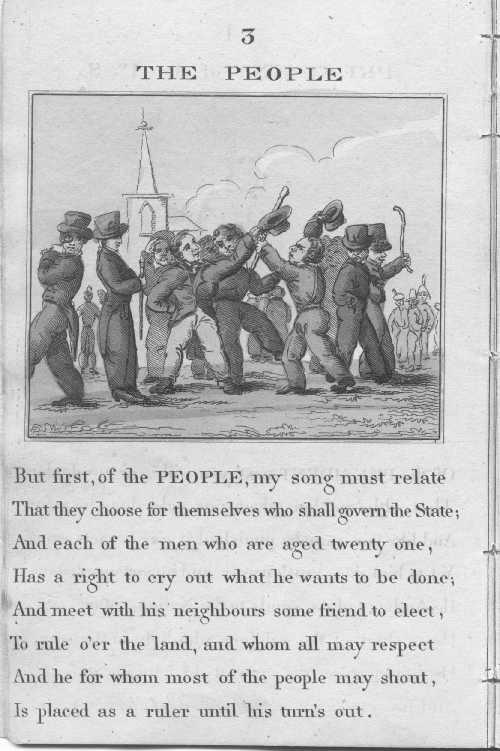
“The People” From
John Latrobe, The
Juvenile National
Calendar (1824).
Here is a page from a
children’s book published
in 1824. It depicts The
People engaged in
democratic politics.
Some are shouting,
shoving, and turning
politics into raucous play.
Others, in more genteel
postures, look on with
amusement and disdain.
All are white men. In
democratic America,
children learn that The
People include “each of
the men who are aged
twenty-one.” There are
no women or non-whites
in the picture. They are
not part of The People.
Division
Photographs
and
Prints
Congress,of
Library
372