that station, and to seek salvation outside of this world were precisely what the planters demanded of themselves and their own families. An important goal of
plantation missions was to create safe and profitable plantations. Yet that goal
was to be achieved by Christianizing both slaveholders and slaves—a lesson that
some slaveholders learned when they were expelled from their churches for mis-
treating their slaves. As for the slaves, we have seen that they listened selectively to what white missionaries preached, and turned evangelical Christianity into a
religion of their own (see Chapter 9).
RACE
Americans in the first half of the 19th century revised the racial order as well as the religious and domestic order of their society. White Americans had long
assumed that Africans belonged at the bottom of society, but they assumed that
others belonged there as well. In a colonial world in which many whites were
indentured servants, tenants, apprentices, and workers who lived in their employ-
ers’ homes, where increasing numbers of blacks were formally free and many
others were hired out as semi-free, few Americans made rigid distinctions concerning the “natural” independence of whites and the “natural” dependence of blacks.
(All Americans, after all, were colonial dependents of the British king.) The
language of colonial social division separated gentlemen from the “middling
sort,” and relegated the propertyless and dependent to the “lower orders” or the
“lower sort.” While the better-off whites were far from color blind, they wrote off poverty, disorder, drunkenness, and rioting as the work not of blacks but of an
undifferentiated substratum of “Negroes, sailors, servants, and boys.”
Modern racism—the notion that blacks were a separate and hopelessly infe-
rior order of humankind—emerged from developments in the early 19th century:
national independence and the crucial new distinction between Americans who
were citizens and those who were not, the recommitment to slavery in the South,
and the making of what would be called “free labor” in the North. Whites who
faced lifetimes of wage labor and dependence struggled to make dignity out
of that situation. At the same time, freed slaves entered the bottom of a newly
defined “free labor” society and tried to do the same. With plenty of help from
the wealthy and powerful, whites succeeded in making white democracy out of
the rubble of the old patriarchal republic. In the process, they defined nonwhites as constitutionally incapable of self-discipline, personal independence, and political participation.
Free Blacks
There had been sizable pockets of slavery in the northern
colonies, but revolutionary idealism, coupled with the
growing belief that slavery was inefficient, led one northern state after another to abolish it. Vermont, where there were almost no slaves, outlawed slavery in its
revolutionary constitution. By 1804, every northern state had taken some action,
usually by passing laws that mandated gradual emancipation. The first of such
laws, and the model for others, was passed in Pennsylvania in 1780. This law
freed slaves born after 1780 when they reached their 28th birthday. Slaves born
Race
367
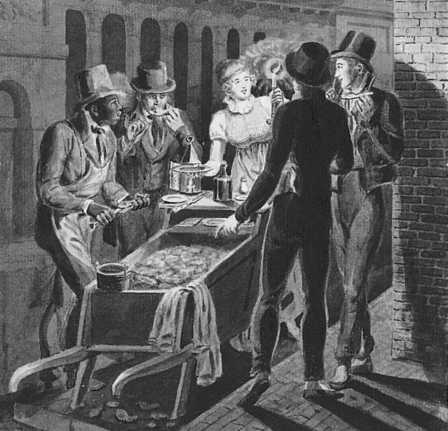
A Black Street
Vendor, Selling
Metro-
Oysters in
The
Metropolitan
Philadelphia, Circa
The
1814. In early 19th-
Krimmel.
©
century New York and
Lewis
Philadelphia, African
copyright
John
Americans monopolized
by
Image
the public sale of oysters
and clams.
Watercolor
(42.95.18)
1814,
1942.
Fund,
NY
Philadelphia,
Rogers
in
Art,
Resource,
Seller
of
Art/Art
Oyster
of
Museum
BlackA politan Museum
before 1780 would remain slaves, and slave children would remain slaves through
their prime working years. By 1830, only a handful of aging blacks remained
slaves in the North.
Gradual emancipation did not stop at the Mason-Dixon Line. We have seen
(Chapter 9) that thousands of Chesapeake slaveholders freed their slaves in the decades following the Revolution. Virginia seriously considered abolishing slavery
outright. In 1832, a Virginia constitutional convention argued the question of
immediate emancipation by state law. With the western counties supporting aboli-
tion (but insisting that freed blacks be transported from the state) and some of the eastern, slaveholding counties threatening to secede from the state if abolition won, the convention rejected emancipation by a vote of 73–58. In the Deep South, where slavery was a big and growing business, whites did not talk about emancipation.
They assumed that slavery was permanent, and that the only proper status for
blacks was bondage and submission to whites.
From Virginia on north, the rising population of free blacks gravitated to
the cities and towns. Despite the flood of white immigrants from Europe and the
American countryside, African Americans constituted a sizable minority in the rapidly expanding cities. New York City’s black population, 10.5 percent in 1800, was still 8.8 percent in 1820. Philadelphia, the haven of thousands of southern refugees, was 10.3 percent African American in 1800, 11.9 percent in 1820.
Blacks in the seaports tended to take stable, low-paying jobs. A few became
successful (occasionally wealthy) entrepreneurs, while some others practiced
skilled trades. Many took jobs as waiters or porters in hotels, as merchant
seamen, as barbers, and as servants in wealthy families. Others worked as dock-
workers and laborers. Still others became dealers in used clothing, or draymen
with their own carts and horses, or food vendors in the streets and in basement
shops. (In New York, oysters were a black monopoly.) As never before, free
black faces and voices became parts of the landscape and soundscape of cities
368