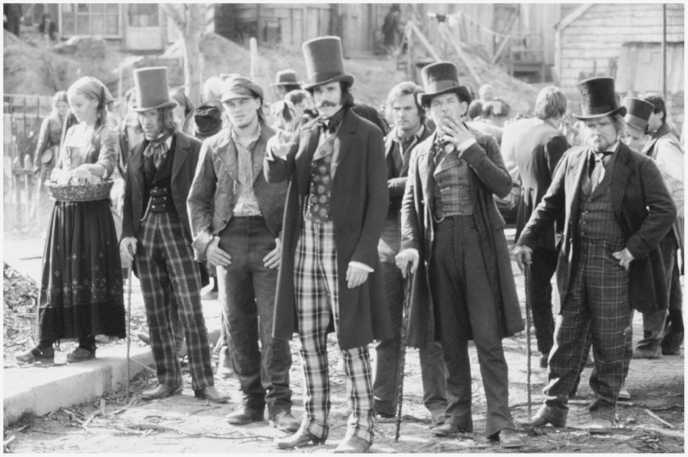
Gangs of New York (2002)
Directed by Martin Scorsese. Starring
pains to “reconstruct” Manhattan’s Five
Leonardo DiCaprio (Amsterdam Vallon),
Points, but our first view of the neighbor-
Daniel Day-Lewis (Bill “The Butcher”
hood is taken from a painting of a Brook-
Cutting), and Cameron Diaz (Jenny
lyn street made fifty years earlier. The
Everdeane).
oppressive noise and overcrowding that
contemporary visitors describe are obliter-
This is Martin Scorsese’s movie about the
ated by a large public space at the center of
Five Points of New York—a dangerous
the Points—historically nonexistent, but a
neighborhood that was home to the
fine field for the gang fights that begin and
working-class world that sustained the
end the movie. Scorsese does cast the
new forms of urban popular culture.
nativist leader as a butcher, a trade that
The film is an operatic tragedy: An Irish
was in fact dominated by non-immigrant
boy (Leonardo DiCaprio) whose father,
workers who were at the center of street
the leader of a gang called the Dead
gangs, prizefighting, and other low activi-
Rabbits, is killed by a nativist chieftain
ties. He also reconstructs a theatrical
(Daniel Day-Lewis) in a gang fight. He
performance—complete with actors in
grows up in an orphanage and returns to
blackface—that rings true. But he puts
the neighborhood to take revenge. He be-
his characters into too many fictional
comes part of the criminal entourage of
places. Historically, the gangs were head-
his father’s killer, falls in love with a beau-
quartered at saloons, firehouses, and
tiful and talented female thief (Cameron
stables. Scorsese’s operatic sensibilities,
Diaz), who had been raised (and used)
however, move the Dead Rabbits into cat-
by the same gang boss, and bides his
acombs beneath the Old Brewery—
time—tortured all the while by the pros-
complete with torchlight, a crude armory,
pect of killing a second father figure. In
and an untidy pyramid of skulls. The na-
the end, the Irish boy resurrects his
tivists, on the other hand, prefer an Asian
father’s gang and challenges the nativists
motif, holding their get-togethers in an or-
to a battle for control of the Five Points.
nate Chinese theater and social house that
The battle coincides with the Draft Riots
lends an air of orientalist extravaganza to
of 1863, and the film ends (as it had
a neighborhood that knew nothing of such
begun) in a horrendous bloodbath. The
things. The catalogue of crimes against
Irish thug kills the nativist thug, and the
history could go on and on: The Dead
film ends with U2 singing “We Who Built
Rabbits did not follow the cross into battle
America.”
(Irish street gangs were not particularly
For those who can stomach close-up
religious), Irish priests did not look like
fights with clubs and hatchets, it is a
Peter the Hermit, and Leonardo DiCaprio
good enough melodrama. Unhappily,
does not have a convincing Irish accent.
Scorsese casts his story against real history
The “reformers” who minister to the
and gets much of it wrong. The film takes
Five Points receive equally silly treatment.
identified as the march of progress, poorer and more conservative evangelicals
often condemned as a descent into worldliness that would almost certainly pro-
voke God’s wrath.
Members of the popular sects often held to the patriarchal family form in
which they had been raised, and with which both the Market Revolution and
The Plain People of the North
355
The chief of the reformers are the aristo-
their parlors to witness an execution, they
cratic Schermerhorns. In fact, most Five
would not have cheered. There is also an
Points missionaries were middle-class
appearance by P. T. Barnum. Barnum had
evangelicals who had little to do with the
made his museum the premier middle-class
Schermerhorns or the other old families of
entertainment spot in New York by es-
New York. The movie reformers hold a
chewing low theater, cockfights, and other
dance for the neighborhood; in fact, the
raucous and violent shows. Yet the movie
evangelicals hated dancing and parties.
has Barnum sponsoring a bare-knuckle
The reformers also attend a public hang-
prizefight—an act that would have cost
ing, cheering as four innocent men are
him his reputation and his livelihood. The
put to death. But New York had outlawed
climactic riot includes another Barnum
public executions a generation earlier; fel-
fabrication: Barnum’s museum is set on
ons were now hanged within prison walls
fire; his menagerie escapes, and a terrified
before small invited audiences. Even if pub-
elephant romps through the burning
lic hangings had persisted, reformers
streets. It almost certainly did not happen,
would not have attended them (they had
but even the most fact-bound historian
stopped going to such spectacles soon after
must bow to Scorsese’s artistic license on
1815), and had they been dragged out of
that one.
Desk
Tursi/Picture
Collection/Mario
Kobal
Films/The
Miramax/Dimension
Daniel Day-Lewis and his Five Points gang.
middle-class domesticity seemed at war. Hundreds of thousands of northern Prot-
estants considered the erosion of domestic patriarchy a profound cultural loss and not, as it seemed to the middle class, an avenue to personal liberation. Their
cultural conservatism was apparent in their efforts to sustain the father-centered family of the old rural North or to revive it in new forms.
356