“anxious bench” for the most likely converts), but toned them down for their own
more “respectable” audience. At the same time, middle-class evangelicals retained the Puritans’ Old Testament sense of cosmic history. They enlisted personal holiness in a fight to the finish between the forces of good and evil in this world. Building on these imperatives, the entrepreneurial families of the East and Northwest constructed an American middle-class culture after 1825. It was based, paradoxically, on an intensely private and emotionally loaded family life and an aggressively reformist stance toward the world at large.
Domesticity
The Yankee middle class made crucial distinctions between the
home and the world—distinctions that grew from the disinte-
gration of the old patriarchal household economy. Men in cities and towns now went off to work, leaving wives and children to spend the day at home. Even commercializing farmers made a distinction between (male) work that was oriented toward markets and (female) work that was tied to household maintenance (see Chapter 8). The new middle-class evangelicalism encouraged this division of domestic labor. The public world of politics and economic exchange, said the preachers, was the proper sphere of men; women, on the other hand, were to exercise new kinds of moral influence
within households. As one evangelical put it, “Each has a distinct sphere of duty—
the husband to go out into the world—the wife to superintend the household.…
Man profits from connection with the world, but women never; their constituents [sic]
of mind are different. The one is raised and exalted by mingled association. The purity of the other is maintained in silence and seclusion.”
The result was a feminization of domestic life. In the old yeoman-artisan repub-
lic, fathers were God’s delegated authorities on earth, assigned the task of governing women, children, and other underlings. Middle-class evangelicals raised new spiritual possibilities for women and children. Mothers replaced fathers as the principal rearers of children, and they enlisted the doctrines of free agency and individual moral responsibility in that task. Middle-class mothers raised their children with love and reason, not fear. They sought to develop the children’s conscience and their capacity to love, to teach them to make good moral choices, and to help them to
prepare for conversion and a lifetime of Christian service.
Middle-class mothers could take up these tasks because they could concentrate
their efforts on household duties and because they had fewer children than their
mothers or grandmothers had had. In Utica, New York, for example, women who
entered their childbearing years in the 1830s averaged only 3.6 births apiece; those who had started families only 10 years earlier averaged 5.1 births. Housewives also spaced their pregnancies differently. Unlike their forebears, who gave birth to a child about once every two years throughout their childbearing years, Utica’s
middle-class housewives had their children at five-year intervals, which meant that they could give each child close attention. As a result, households were quieter and less crowded; children learned from their mothers how to govern themselves and
seldom experienced the rigors of patriarchal family government. Thus mothers
assumed responsibility for nurturing the children who would be carriers of the new middle-class culture, and male authorities recognized the importance of that job.
Edward Kirk, a minister in Albany, insisted, “the hopes of human society are to
be found in the character, in the views, and in the conduct of mothers.”
The Northern Middle Class
347
Middle-class women and girls became a huge market for new forms of popu-
lar literature. There were cookbooks, etiquette books, manuals on housekeeping,
sermons, and sentimental novels, many of them written and most of them read by
women. The works of popular religious writers such as Lydia Sigourney, Lydia
Maria Child, and Timothy Shay Arthur found their way into thousands of
middle-class homes. Sarah Josepha Hale, whose Godey’s Lady’s Book was the
first mass-circulation magazine for women, acted as an arbiter of taste not only
in furniture, clothing, and food but also in sentiments and ideas. Upon reviewing the sentimental literature read in middle-class homes, Nathaniel Hawthorne was
not the only “serious” writer to deplore a literary marketplace dominated by “a
damned mob of scribbling women.”
Hawthorne certainly had economic reason for complaint. Sentimental novels
written by women outsold by wide margins his Scarlet Letter and House of Seven
Gables; Ralph Waldo Emerson’s essays; Henry David Thoreau’s Walden; Herman
Melville’s Moby Dick; Walt Whitman’s Leaves of Grass; and other works of the
American Renaissance of the 1850s. Susan Warner’s The Wide, Wide World broke
all sales records when it appeared in 1850. Harriet Beecher Stowe’s Uncle Tom’s
Cabin (1852) broke the records set by Warner. In 1854, Maria Cummin’s The
Lamplighter (the direct target of Hawthorne’s lament about scribbling women)
took its place as the third of the monster best sellers of the early 1850s.
These sentimental novels upheld the new middle-class domesticity. They sacralized the middle-class home and the trials and triumphs of Christian women. The action in each novel takes place indoors, usually in the kitchen or parlor, and the heroines are women who live under worldly patriarchy but who triumph through submission to
VA
Williamsburg,
Center,
Art
Folk
Rockefeller
Aldrich
Abby
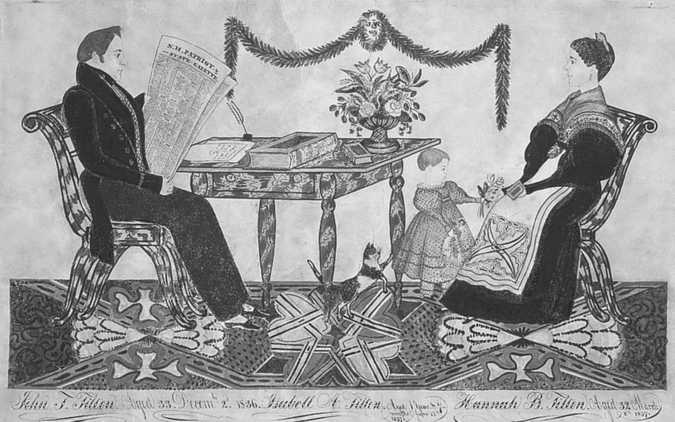
A Middle-Class New England Family at Home, 1837. The room is carpeted
and comfortably furnished. Father reads his newspaper; books rest on the table. Mother entertains their only child, and a kitten joins the family circle. This is the domestic foundation of sentimental culture on display.
348