


Web Site Review
Originally published in the Journal of American History (June 2008), p. 299.
Inside an American Factory: Films of the Westinghouse Works, 1904, http://memory.loc.gov/ammem/papr/west/westhome.html. Created and maintained by the Library of Congress National Digital Library Program, Washington, D.C. Reviewed Aug. 24, 2007.
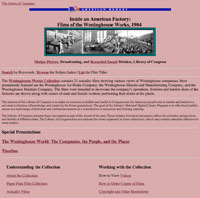
This collection of twenty-one films of the Westinghouse Works, shot in 1904, provides a fascinating glimpse into factory work and new technology at the turn of the century. Archivists believe that the films were created to celebrate the role of the Westinghouse Company in delivering electricity, and thereby progress and modern living, to America. The films were shown daily to packed houses at the Westinghouse Auditorium at the 1904 St. Louis World’s Fair (the Louisiana Purchase Exhibition), where American industrial progress was a major theme of many exhibits. Audiences would have marveled at the moving images (it would be several years before commercial movie theaters became commonplace) and also at the production of the generators, turbines, and motors that made electrical power possible.
The films should be of interest to scholars of industrialization as well as scholars of film technology. Although the films were part of an early attempt at public relations, they nonetheless provide visual evidence about the physical and social organization of work within the factory. The collection includes several impressive panoramic views of the Westinghouse Works. As the camera travels by crane down the aisle of the factory, the viewer sees men in overalls hammering and filing machinery while trains carrying parts roll in and out of the frame. Men in white collars oversee the work, consulting plans, each other, and the workers. The scene reveals some of the chaos, as well as the prevalence of craftwork, that Frederick W. Taylor would later claim to bring under control with scientific management. In other films, women in shirtwaists wind coils or grab their time cards as they file in to work. Other films focus on the final phases of production of impressive pieces of equipment such as generators and turbines.
High school and college teachers alike will find this Web site a useful addition to any unit on industrialization. Inside an American Factory includes excellent short secondary-source essays on the Westinghouse Works, working conditions, and George Westinghouse, helping viewers put the films into context. An excellent bibliography provides a starting point for students interested in exploring the topic more fully. The site also links to a Library of Congress “Collection Connections” page with useful questions that prompt students to look for specific clues about industrial safety, working conditions, company towns, and the role of women in factories, as they view the films. The “Collection Connections” page also provides links to related Library of Congress sites where students can further explore, for example, the early motion picture industry or the battle between direct current and alternating current systems for delivering electrical power.
Like the many other wonderful sites that make up the American Memory series, Inside an American Factory is easy to navigate, provides the information necessary to cite and document the sources, and offers helpful guidance on how to view the films.
Julie Kimmel
Germantown Academy
Fort Washington, Pennsylvania
 Full Text

