


Web Site Review
Originally published in the Journal of American History (March 2008), pp. 1331–1332.
Military Campaign Maps, http://memory.loc.gov/ammem/gmdhtml/milhome.html. Created and maintained by the Geography and Map Division, Library of Congress, Washington, D.C. Reviewed Aug. 1–8, 2007.
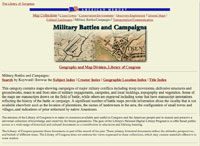
Maps and mapmaking have long been associated with a particular brand of military history. Devotees of battle and campaign history will find a valuable resource in the Library of Congress’s online archive Military Campaign Maps, which presents an impressive collection of several thousand digitized military maps. Comprehensiveness is not the goal here; historians searching for a map from a particular Mexican War battle or a specific campaign in World War I will be disappointed. Rather, the archive’s goal is to collect and present period maps of military sites: maps created by cartographers at the time of the conflict or shortly afterward. The Web site succeeds admirably in this goal, presenting a huge collection of documents as crisp, high-resolution images. The site divides its holdings into five collections.
While there are maps from as far back as the mid-eighteenth century (and even a few from the late twentieth), the bulk of the collection focuses on three conflicts: the War for Independence, the Civil War, and the European theater in World War II. The home page contains links to each of the five collections; within each collection, the site’s browser allows researchers to sort the maps geographically, by title, by date, or by creator, displayed twenty at a time.
Once located, the maps appear as high-resolution color images with impressive detail. Enlarging and viewing the images, however, is not completely intuitive. Selecting a given map from the directory opens two new windows; to look more closely at a specific area, the user first selects a resolution and window size and then clicks on a spot in the “navigator view.” The selected area then appears enlarged in the “zoom view” window. Steering through a large map in the “zoom view” window—tracing a river or road along its course, for example—takes some practice. But at the highest level of enlargement, the resolution is dazzling: a reader can detect individual pen strokes and boggle at the effort required to produce such detail. Many of the eighteenth- and nineteenth-century maps presented here are works of art in their own right.
Several supporting documents attached to the Civil War galleries—reprinted essays from reference works—offer guidance to scholars. None is particularly new. Clara LeGear’s essay on the famed Civil War mapmaker Jedediah Hotchkiss dates from 1948, while Richard Stephenson’s elaborate guide to mid-nineteenth century mapmaking appeared in 1989, but the information contained in them is hardly out of date. These supporting materials are not comprehensive, however, and a researcher confused by the conventions of eighteenth- and nineteenth-century cartography will require outside resources.
As its title suggests, the site will be of keen interest to military historians searching for firsthand depictions of military battles and campaigns. The site’s appeal should be more broad, however. Teachers looking for striking visuals that demonstrate the ways that mapmakers have attempted to translate the confusion of battle into static, two-dimensional representations, or who would like their students to consider the challenge of producing accurate representations of the earth’s topographical features before the advent of aerial observation and the global positioning system (gps), will find much of value here. Taken as a whole, the archive offers a fascinating study of the evolution of cartography over more than two centuries.
Christopher Hamner
George Mason University
Fairfax, Virginia
 Full Text

